
Keep it midmod
The State Historical Building Code in Plain Words
California lets a qualified historic building be repaired, altered and kept in use under alternative building rules. This page reads the law behind those rules, and the opening chapter of the code adopted under it, for people who own or care about a mid-century modern home or neighborhood: which buildings qualify, how the rules are applied, who runs the code and how an appeal works.
- Which buildings qualifyA register or official inventory: national, state or local.See the definition
- How it is appliedOwner election, repairs in kind, additions and continued use.Read the rules
- The BoardWhere it sits, who is on it and what it adopts.See the Board
- Opinions and appealsWho can ask, and which appeals the Board will take.Read the steps
How to use this page
California has a set of alternative building rules for historic buildings. Two texts stand behind it. The law is Part 2.7 of Division 13 of the Health and Safety Code, §§ 18950 to 18962, which the Legislature named the State Historical Building Code. The regulations adopted under that law are the California Historical Building Code, Part 8 of Title 24. This page reads the law section by section, and the opening chapter of the regulations, for people who own or care about a mid-century modern home or neighborhood.
It follows our reading of the California Register rules, because a place on a register is one of the things that makes a building qualify. We read the law on the Legislature’s site, and Chapter 8-1 of the 2025 edition of the regulations on screen, on November 14, 2026. Each point carries its section number so you can check it. The summaries are in our words. Laws and codes are amended, and a building department applies them to real plans, so treat this page as general information, not legal advice. For a decision about a particular house, read the current text and talk with your city’s building department, a design professional who works with older buildings, or an attorney.
One limit to keep in mind: we read the law in full and one chapter of the regulations. Chapters 8-2 to 8-10, which hold the technical rules, were not read for this page. The code’s chapters by title lists them, and What this page does not cover lists the rest.
The law at a glance
The section numbers below are the law’s. The notes beside them are ours.
- § 18950. The name: the State Historical Building Code.
- § 18951. The purpose: alternative regulations and standards for qualified historical buildings. What the code is for.
- § 18952. The reach: the part applies to all qualified historical buildings or structures.
- § 18953. The intent: keep historical value while giving reasonable protection and access.
- § 18954. The working rule: work that conforms to the part may be made, and building departments apply the alternative standards. How the rules are applied.
- § 18955. The definition of a qualified historical building or structure. Which buildings qualify.
- § 18956. How other statutes apply to a qualified building. Other laws.
- § 18957. Building and fire officials keep their duties.
- § 18958. The state agencies, besides the Board, that may adopt rules under the part.
- § 18959. Who administers and enforces the part, and how a city or county may modify the code.
- § 18959.5. The Board adopts the alternative building standards and submits them for approval.
- § 18960. The Board: where it sits, who is on it, reviews and appeals. The Board.
- § 18961. State agencies use the alternative provisions and consult the Board.
- § 18962. Parking when a designated historical resource is converted to a new use. The parking section.
Two names, two texts
The two names are close enough to mix up. The State Architect’s office draws the line between them on its page for the code.
- State Historical Building Code. The law: Health and Safety Code, Division 13, Part 2.7, enacted in 1975. The State Architect’s page gives its range as §§ 18950 to 18961. The Legislature’s site also shows § 18962 in the same part, in effect since January 1, 2019. Read the law.
- California Historical Building Code. The regulations: Part 8 of Title 24, the California Building Standards Code. They are adopted by the State Historical Building Safety Board, which this page calls the Board. The Board’s page says the Board adopted them in 1979 and that they are kept as Part 8 under Health and Safety Code § 18944.7.
- The edition we read. The 2025 California Historical Building Code, with an effective date of January 1, 2026. The Building Standards Commission’s page gives the same effective date for the whole 2025 Title 24 and lists Part 8 by name.
Our reading. On this page “the law” means Part 2.7 and “the code” means Part 8. The law is short and sets the frame. The code holds the working rules.
What the code is for
§ 18951 says what the part is for: alternative regulations and standards for rehabilitating, preserving, restoring (including related reconstruction) or relocating qualified historical buildings or structures. The same section adds two aims, energy conservation and a cost-effective approach to preservation.
§ 18953 states the intent as a balance. The alternatives are meant to keep a building’s historical value and, at the same time, give reasonable protection from fire, seismic forces and other hazards for the people in it, and reasonable availability and usability for people with disabilities.
Chapter 8-1 of the code repeats that purpose and adds a working rule: an enforcing agency must accept a solution that is reasonably equivalent to what the regular code calls for (8-101.2).
Our reading. A mid-century house has features a present-day code would not produce by itself: exposed post-and-beam framing, walls of glass, thin roof edges. The alternative rules are there so that a repair or alteration to a qualified building can keep features like those where a reasonably equivalent solution exists.
Which buildings qualify
Everything in the law turns on one term, the “qualified historical building or structure”. § 18955 defines it broadly: a structure or property, a group of structures, and their related sites, that an appropriate local or state government body has deemed important to the history, architecture or culture of an area.
The section then gives examples. A building counts if it is on a national, state or local historical register or official inventory, existing or future. It names the National Register of Historic Places, State Historical Landmarks, State Points of Historical Interest, and city or county registers or inventories of historical or architecturally significant sites, places, historic districts or landmarks.
The State Architect’s page lists places to look to find out whether a property is qualified. The state Office of Historic Preservation’s page quotes the same definition.
- State lists. The Office of Historic Preservation’s lists for the National Register and the California Register. Our guides read the rules behind each: the National Register and the California Register.
- The planning office. The page says a city or county planning department is usually where local lists are found.
- A heritage or history commission. A local commission can create and keep a list.
- Neighborhood and preservation groups. They may have access to official lists, but they cannot create one.
- Agencies with reviewed projects. Properties identified in a project that went through environmental review, and declared eligible, are qualified.
- If a property is on no list. The page names three routes: petition the local jurisdiction for an individual designation, prepare a National Register nomination and apply to the Office of Historic Preservation, or petition that office for a finding of eligibility.
Our reading. Two points matter for mid-century neighborhoods. Age and style alone are not in the definition: a government body has to have deemed the place important, so an Eichler or other mid-century house does not qualify just by being one. And the definition reaches groups of structures and historic districts, and local registers as well as state and national ones. Our list of mid-century modern historic districts links to the record for each neighborhood on a register. Whether a particular house qualifies is a question for the local building department.
How the alternative rules are applied
§ 18954 is the working sentence of the law. Repairs, alterations and additions needed for the preservation, restoration, rehabilitation, moving or continued use of a qualified building may be made if they conform to the part. The building department of every city or county applies the alternative standards when it permits that work, and state agencies apply them too.
Chapter 8-1 of the code fills in how.
- The owner elects. For private property, the enforcing agency applies the code when the owner elects it. The code may be used together with the regular code (8-102.1).
- Additions. A nonhistorical addition is allowed, and the addition follows the regular code (8-102.1.1).
- Moved buildings. A relocated qualified building may be sited under the regular code or under the code’s solutions. New nonhistorical construction tied to the move follows the regular code (8-102.1.2).
- Continued use. An existing use may continue if it met the standards in effect when the building went up and is not a distinct hazard to life, as the code defines that term (8-102.1.4).
- Corrective work. When a qualified building is found unsafe under the regular code, the work need only correct those conditions. The whole building does not have to be brought to the regular code (8-102.1.5).
- No added work. Nothing beyond what is needed to complete the work undertaken is required, with exceptions for accessibility and distinct hazards (8-102.1.6).
- Repairs in kind. Repairs may be made in kind, with historical materials and the existing historical construction methods, subject to the code (8-105.1).
- Other alternatives. An alternative the code does not list may be put to the enforcing agency, which may ask for evidence. It has to be reasonably equivalent in quality, strength, effectiveness, durability and protection (8-105.2).
- Access, item by item. Under § 18954, alternatives or exemptions to access rules are decided case by case and item by item, not for a whole building without a look at each item.
- A change of use. Chapter 8-1 sends changes of use or occupancy to Chapter 8-3, which we did not read (8-102.1.3).
Our reading. Read together, these lines mean that repairing a qualified mid-century house does not by itself pull every untouched part of it up to the present-day code, and that like-for-like repair has a footing in the code. They do not remove the permit or the building department’s review.
Other laws, officials and local changes
- Other statutes (§ 18956). Where other statutes or regulations apply to a qualified building, this part governs how they apply. The section names the access statutes in Part 5.5 of the same division and in Chapter 7 of the Government Code, and Division 15 of the Public Resources Code, which the Board’s page identifies as the Warren-Alquist energy act.
- Officials keep their duties (§ 18957). Nothing in the part stops authorized building or fire officials from doing their duties to protect public health and welfare.
- Who may adopt rules (§ 18958). Besides the Board: the Division of the State Architect, the State Fire Marshal, the State Building Standards Commission (only for approval of building standards), the Department of Housing and Community Development, the Department of Transportation and other affected state agencies.
- Who enforces (§ 18959). State agencies and local authorities administer and enforce the part within their own authority. Regular and alternative building standards are enforced the same way, by the same government bodies.
- Local changes (§ 18959(f)). A local agency may change or modify the code’s requirements where it finds that reasonably necessary because of local climatic, geological, seismic and topographical conditions. It has to make an express finding, the finding is a public record, and a copy goes to the Board. No change takes effect until the finding and the change have been filed with the Board.
Our reading. A city or county can have its own amendments to the code, but only on the record and only once filed. The building department can say whether it has any.
The Board
- Where it sits. The State Historical Building Safety Board is a unit within the Division of the State Architect (§ 18960(a)).
- What it does. It is a consultant to the State Architect and other state agencies and recommends rules to them (§ 18960(b)). It adopts the alternative building standards and submits them for approval (§ 18959.5). It distributes the adopted provisions to local building authorities and state agencies at cost (§ 18959(c)). And it is a review body for state and local agencies (§ 18960(c)).
- Who is on it. One member from each of 21 agencies and organizations named in the law. Among them are the Division of the State Architect, the State Fire Marshal, the State Historical Resources Commission, the California Council of the American Institute of Architects, the Structural Engineers Association of California, the California Council of Landscape Architects, the League of California Cities, the California Preservation Foundation and the California Building Officials. Those 21 choose a building contractor as one more member (§ 18960(d)).
- How members serve. Without pay. Each appointing body also names an alternate. A term is four years, and the Board chooses its chairperson each year (§ 18960(d), (e)).
The Board’s page on the State Architect’s site lists its meetings.
Opinions, reviews and appeals
- A request for an opinion. An agency chief, a building official or a local board of appeals may send the Board a written request for an opinion on a proposed design, material or method. The Board decides whether the proposal is reasonably equivalent and sends its findings to the enforcing agency (8-104.2). The law also lets the Board take a local agency’s request to interpret the part (§ 18960(c)(3)).
- An appeal. A local agency, or any person adversely affected by an enforcing agency’s regulation, rule, omission, interpretation, decision or practice, may appeal to the Board. The Board may accept the appeal only if it finds the issues have statewide significance (§ 18960(c)(1); 8-104.3).
- Other appeals. Every other appeal about building standards under the part goes the way § 18945(a) sets out (§ 18960(c)(6)).
- Decisions in print. The Board’s decisions are reported in print, and a copy of an appeal or interpretation decision goes to the State Building Standards Commission (§ 18960(c)). Rulings of statewide application may guide similar cases (8-106.1).
- Fees. The Board may charge a reasonable fee, no more than the cost of the service, for a review or for copies of its decisions. A local agency may also charge a reasonable fee, capped at cost, for making an appeal (§ 18960(c)(4), (5)).
- State agencies. State agencies use the alternative provisions and consult the Board for its review before they act or decide on variances or appeals (§ 18961).
- Emergencies. In a declared emergency, where a qualified building is declared an imminent threat, the state agency assessing the threat consults the Board before any demolition (8-104.2.2).
Our reading. The appeal rule is narrow: the Board takes issues of statewide significance. A disagreement about one house starts with the local building department, and a building official can ask the Board for an opinion.
Parking when a designated building changes use
§ 18962 was added in 2018 and took effect on January 1, 2019. It is about parking, not construction, and it applies when a development project converts or adapts a designated historical resource.
- To a residential use. Where the project is within one-half mile of a major transit stop, a local agency may not require more parking spaces than were on the site when the application was submitted.
- To a nonresidential use. The local agency gives a 25-percent reduction in the parking that would otherwise be required.
- Local ordinances. Both reductions apply unless a local historical preservation or adaptive reuse ordinance requires otherwise.
- The term. A “designated historical resource” is a structure or property officially designated on a local register of historical resources, the California Register or the National Register.
Our reading. This section uses a narrower word than the rest of the law: “designated”, not “qualified”. A house that qualifies under § 18955 through an official inventory is not, by that alone, designated on a register.
The code’s chapters by title
The 2025 edition lists ten chapters and two appendices. We read Chapter 8-1 only. The titles show where a question lands.
- Chapter 8-1. Administration. Read for this page: every number here that begins with 8-1 comes from it.
- Chapter 8-2. Definitions. Not read. Chapter 8-1 says the term “qualified historical building or property” is defined here.
- Chapter 8-3. Use and Occupancy. Not read. Chapter 8-1 sends changes of use here.
- Chapter 8-4. Fire Protection. Not read.
- Chapter 8-5. Means of Egress. Not read.
- Chapter 8-6. Accessibility. Not read.
- Chapter 8-7. Structural Regulations. Not read.
- Chapter 8-8. Archaic Materials and Methods of Construction. Not read. Chapter 8-1 points here for repairs in kind.
- Chapter 8-9. Mechanical, Plumbing and Electrical Requirements. Not read.
- Chapter 8-10. Qualified Historical Districts, Sites and Open Spaces. Not read.
- Appendices. Appendix A and a History Note Appendix. Not read.
The code can be read free on screen in the publisher’s reading view, which opens at Chapter 8-1.
What this page does not cover
- The technical chapters. Fire protection, exits, access, structure, older materials and building systems are in Chapters 8-2 to 8-10. We did not read them, and nothing here says what they require.
- Any city’s filed changes. A city or county may modify the code under § 18959(f). We did not look up any local changes.
- City and county preservation rules. Design guidelines, single-story overlays and local historic districts come from local law. Keep It Midmod covers those.
- The regular building code. The rest of Title 24 and local building ordinances are outside this page.
- Whether a house qualifies. That depends on the registers and inventories that cover it, and it is the building department’s call.
- The federal treatment standards. They are a separate text. Our reading of the ten rehabilitation standards covers them.
More on our site
- Preservation guides: every guide in this series on one page.
- The California Register of Historical Resources in plain words: the state register’s law and regulations.
- The National Register rules in plain words: 36 CFR Part 60, the federal rule.
- How to read a National Register nomination: the form, section by section, with four mid-century neighborhoods.
- The ten rehabilitation standards, read for a mid-century modern home.
- Sacramento’s Eichler historic district plan: a local district’s written standards, section by section.
- How to start a mid-century historic district: the path from a conversation with neighbors to a listing.
- Mid-century modern historic districts: the neighborhoods on a register, with a link to each record.
- Mid-century preservation glossary: the terms used across these guides, each with its source.
- Keep It Midmod: records, standards, repairs, local rules and easements in one guide.
Questions and answers
Does every Eichler or mid-century modern home qualify?
No. Under § 18955 a building qualifies when a local or state government body has deemed it important, for example by placing it on a register or an official inventory. Age and style alone are not in the definition. See which buildings qualify.
Is the State Historical Building Code the same thing as the California Historical Building Code?
They are two texts. One is the law, Health and Safety Code §§ 18950 to 18962. The other is the set of regulations in Part 8 of Title 24, adopted by the Board under that law. See two names, two texts.
Does an owner have to use it?
Chapter 8-1 of the code says the enforcing agency applies it to private property when the owner elects it, and that it may be used together with the regular code (8-102.1).
Does using the code mean no permit?
No. The alternative standards are enforced the same way, by the same bodies, as the regular ones (§ 18959(e)), and building and fire officials keep their duties (§ 18957).
If a room is added to a qualified house, which code applies to the new room?
Chapter 8-1 says a nonhistorical addition follows the regular code (8-102.1.1). The alternative rules stay with the historical building.
Can an owner appeal a building department’s decision to the Board?
An adversely affected person may appeal, but the Board may accept the appeal only if the issues have statewide significance (§ 18960(c)(1)). See opinions, reviews and appeals.
Where does a register listing come in?
A place on the National Register, the California Register or a local register is one of the ways a building qualifies. Our guides to the California Register, the National Register rules and starting a mid-century historic district cover how a listing happens.
We want mid-century neighborhoods to stay recognizably mid-century, and the rules for repairing a recognized house are part of that. If you own or are thinking of buying or selling an Eichler or other mid-century home in the Bay Area and want to talk through what recognition could mean for your home, call the Boyenga Team at (408) 373-1660 or (650) 383-8606, or write to MidMods@Boyenga.com.
About the sources
Everything this page says about the law comes from Health and Safety Code §§ 18950 to 18962, read on the Legislature’s site. The points numbered 8-1 come from Chapter 8-1 of the 2025 California Historical Building Code, read on screen in the publisher’s reading view; we kept notes in our own words and did not copy the text. The state explains the program on three pages: the State Architect’s page for the code, the Board’s page and the Office of Historic Preservation’s page. The edition and its effective date are on the Building Standards Commission’s page.
The summaries are in our words, and the lines headed “Our reading” are ours alone. We did not read Chapters 8-2 to 8-10. Laws and codes can be amended after we read them. Where the law or the code differs from this page, go by the law and the code.
From our listings
Beams, glass and brick at homes we’ve sold
A kitchen, a dining room, two living rooms, a garden seen through glass and a bathroom at mid-century homes we’ve sold in Fairbrae and Rancho Verde, in Sunnyvale; Fairgrove, in Cupertino; Fairhaven and Fairglen, in San Jose; and Palo Verde, in Palo Alto. Posts, beams, glass walls and brick fireplaces like these are what a repair in a mid-century home works around. None of these homes is shown here as a property on a register.
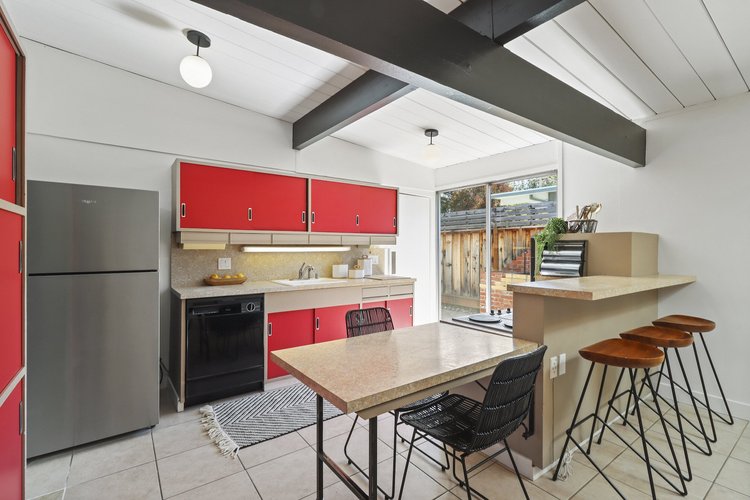
Fairbrae, SunnyvaleKitchen · Sold 2022 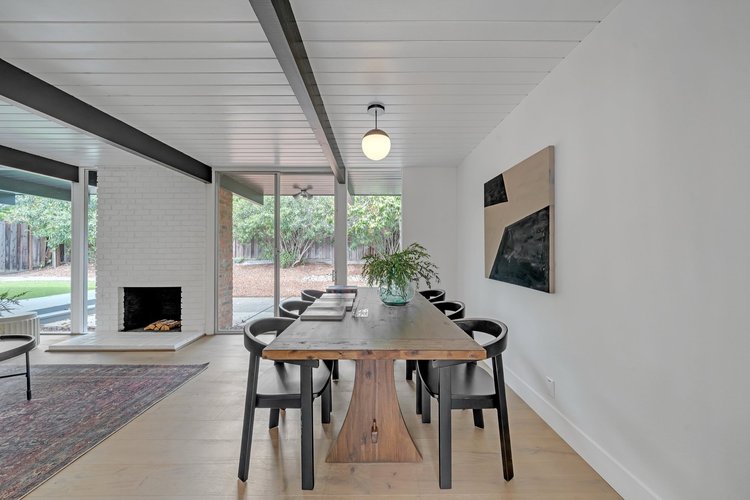
Fairgrove, CupertinoDining room · Sold 2023 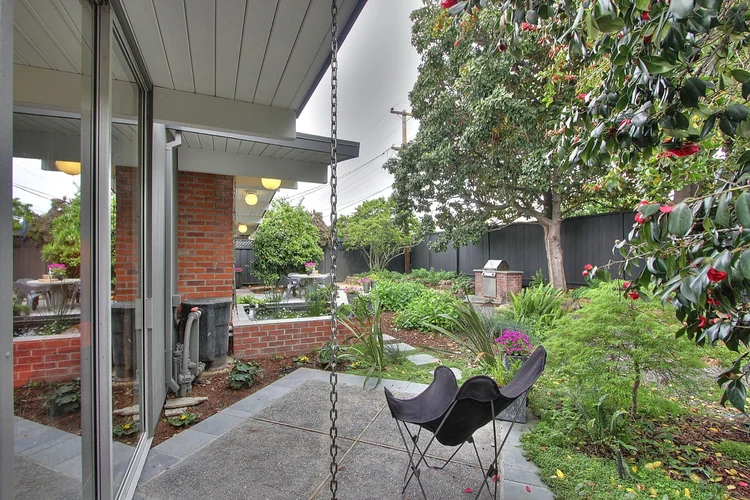
Fairhaven, San JoseGarden and glass walls · Sold 2015 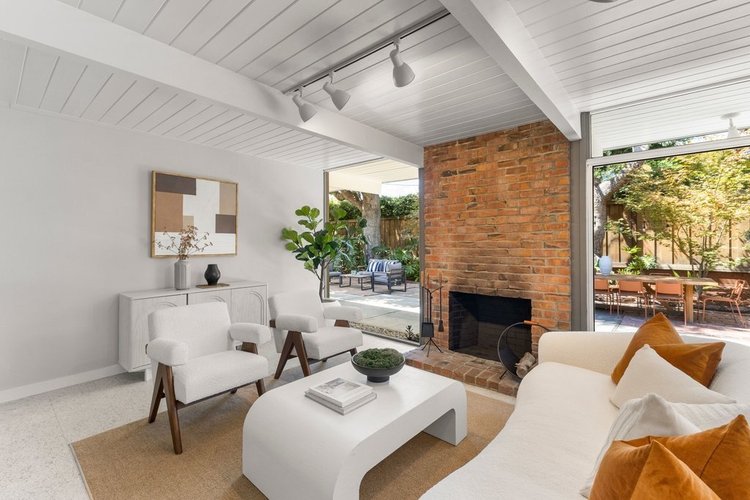
Fairglen, San JoseLiving room · Sold 2026 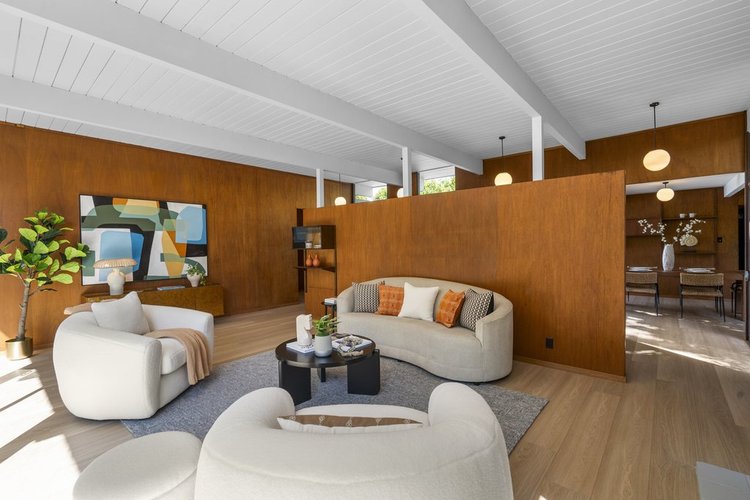
Palo Verde, Palo AltoLiving room · Sold 2024 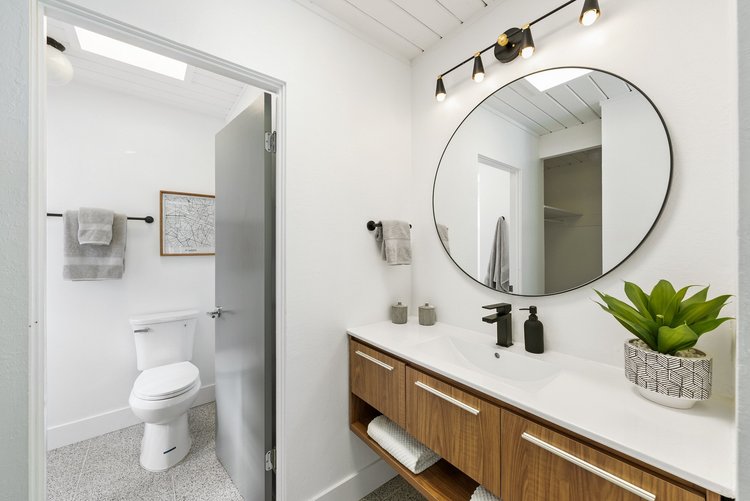
Rancho Verde, SunnyvaleBathroom with a skylight · Sold 2021
Listing photographs of homes sold by the Boyenga Team. More homes we’ve sold
See our portfolio