
Keep it midmod
California Mid-Century Modern Timeline: Offices, Buildings and Protections, Year by Year
California’s mid-century modern design in 209 dated entries, from 1905 to 2025: when the architects arrived and opened their offices, when the public buildings went up, when the Eichler tracts were built, and when cities and the National Register began to protect them.
The timeline is assembled from four guides on this site: our A to Z lists of Southern California and Bay Area modern architects, the landmarks page and the historic districts page. Every entry links back to the place it came from.
- Before 1930Arrivals, and offices in Los Angeles, Santa Barbara and San Francisco.21 entries
- The 1930sRichard Neutra’s office, new firms and Palm Springs.25 entries
- The 1940sNew practices and the Gregory Ain Mar Vista Tract.46 entries
- The 1950sPartnerships, Eichler tracts and public buildings.45 entries
- The 1960sCivic buildings, campuses and transit.36 entries
- 1970 to 1999Offices change hands, and SCI-Arc is founded.15 entries
- 2000 to 2025Design guidelines, districts and National Register listings.21 entries
How to read this timeline
Each year lists what our sources date to it. A marker shows the kind of entry, and the small line under each entry names its source and links to it.
- People and offices (164)
- Public buildings (17)
- Neighborhoods and protections (28)
- People and offices. These dates come from the archive finding aids and collection pages behind our two A to Z guides. Eighty-six of the 110 entries in those guides supply at least one line here. An archive describes its own collection, so each line follows the dates of the archive that holds the papers.
- Public buildings. These dates come from our landmarks page, which lists a source for each building. Only public buildings appear; houses do not.
- Neighborhoods and protections. These dates come from our historic districts page, which draws on city, state and National Register records. They cover when a tract was built and when it gained a listing, a district or a set of design rules.
- Spans of years. Where a source gives a span, the entry sits under the opening year and states the span.
- Gaps. A year with no entry is a year these sources do not date. It is not a year in which nothing happened.
- What we left out. Private houses and the names of the people they were built for. This page stays with offices, public buildings and whole neighborhoods.
Before 1930
The record opens with arrivals: Rudolph M. Schindler in the United States and Kem Weber in San Francisco in 1914, Richard Neutra and Raphael Soriano in the 1920s. By 1930 Schindler, Neutra, Lloyd Wright and J. R. Davidson are all at work in Los Angeles, and William Wurster has opened his firm.
- 1905
- Edward Bolles establishes his firm; John S. Bolles joins the San Francisco practice in 1936. Edward G. Bolles and John S. Bolles · Bay Area A to Z
- 1914
- Rudolph M. Schindler arrives in the United States. Rudolph M. Schindler · Southern California A to Z
- Kem Weber comes to San Francisco to work on the German section of the Panama-Pacific Exposition. Kem Weber · Southern California A to Z
- Lutah Maria Riggs comes to Santa Barbara. Lutah Maria Riggs · Southern California A to Z
- 1917
- Schindler works with Frank Lloyd Wright from 1917 to 1921. Rudolph M. Schindler · Southern California A to Z
- 1919
- Riggs graduates from UC Berkeley. Lutah Maria Riggs · Southern California A to Z
- Weber opens a practice in Santa Barbara, later moved to Los Angeles. Kem Weber · Southern California A to Z
- 1920
- Schindler moves to Los Angeles. Rudolph M. Schindler · Southern California A to Z
- 1921
- Riggs joins the office of George Washington Smith, where she works until 1930. Lutah Maria Riggs · Southern California A to Z
- 1923
- Richard Neutra arrives in the United States. Richard and Dion Neutra · Southern California A to Z
- 1924
- William Wurster opens his own firm. William Wurster and Catherine Bauer Wurster · Bay Area A to Z
- Raphael Soriano arrives in the United States. Raphael S. Soriano · Southern California A to Z
- 1925
- Neutra moves to Los Angeles. Richard and Dion Neutra · Southern California A to Z
- Lloyd Wright sets up his own practice as an architect and landscape architect in Los Angeles. Lloyd Wright · Southern California A to Z
- 1926
- In 1926 and 1927 Schindler and Neutra are partners in the Architecture Group for Industry and Commerce. Rudolph M. Schindler · Southern California A to Z
- Edla Muir starts work as a draftswoman and designer for John Byers. Edla Muir · Southern California A to Z
- 1927
- J. R. Davidson opens his own Los Angeles office. J. R. Davidson · Southern California A to Z
- Michael Goodman begins teaching at UC Berkeley, where he stays until 1971. Michael Goodman · Bay Area A to Z
- 1928
- Harwell Hamilton Harris starts as a draftsman for Neutra, where he stays until 1932. Harwell Hamilton Harris · Southern California A to Z
- 1929
- Soriano studies at USC from 1929 to 1934. Raphael S. Soriano · Southern California A to Z
- John Elgin Woolf receives his architecture degree from the Georgia Institute of Technology, then moves to Los Angeles. John Elgin Woolf · Southern California A to Z
The 1930s
Harwell Hamilton Harris and Gregory Ain, both of whom worked for Richard Neutra, open their own offices in 1933 and 1935, and Raphael Soriano opens his in 1935. Albert Frey is in Palm Springs by 1935, Julius Shulman photographs a Neutra house in 1936, and Telesis forms in 1939.
- 1930
- Gregory Ain works for Neutra from 1930 to 1935. Gregory Ain · Southern California A to Z
- Kenneth Wing opens his own firm in Long Beach. Kenneth Wing · Southern California A to Z
- Thornton M. Abell is designer and chief draftsman for Marsh, Smith and Powell from 1930 to 1942. Thornton M. Abell · Southern California A to Z
- H. Leland Vaughan is a UC Berkeley professor from 1930 to 1969. H. Leland and Adele Vaughan · Bay Area A to Z
- 1931
- Riggs becomes principal of her own firm. Lutah Maria Riggs · Southern California A to Z
- Vernon DeMars graduates from UC Berkeley. Vernon DeMars · Bay Area A to Z
- 1933
- Welton Becket and Walter Wurdeman move their practice to Los Angeles. Welton Becket · Southern California A to Z
- Harris opens his own Los Angeles firm. Harwell Hamilton Harris · Southern California A to Z
- 1934
- Theodore Bernardi works in William Wurster’s office from 1934 to 1942. Theodore Bernardi · Bay Area A to Z
- The Airline chair, by Kem Weber. Kem Weber · Southern California A to Z
- Muir earns her license, and the office becomes John Byers and Edla Muir, Associated Architects. Edla Muir · Southern California A to Z
- 1935
- Ain opens his own practice. Gregory Ain · Southern California A to Z
- Soriano opens his firm. Raphael S. Soriano · Southern California A to Z
- By 1935 Albert Frey is in Palm Springs, working with John Porter Clark. Albert Frey · Southern California A to Z
- Mario Ciampi is licensed as an architect. Mario Ciampi · Bay Area A to Z
- 1936
- Cliff May moves to Los Angeles. Cliff May · Southern California A to Z
- Julius Shulman photographs a house by Richard Neutra. Julius Shulman · Southern California A to Z
- Paul László arrives in Los Angeles. Paul László · Southern California A to Z
- 1937
- Caspar Ehmcke arrives in Los Angeles. Caspar Ehmcke · Southern California A to Z
- George Kelley comes to San Francisco to work on the Golden Gate International Exposition. George Kelley · Bay Area A to Z
- Walter S. White works for Harwell Hamilton Harris for six months, then for Schindler for eight. Walter S. White · Southern California A to Z
- Gordon Drake studies at USC from 1937 to 1941. Gordon Drake · Bay Area A to Z
- 1938
- John Lautner, after six years in the Taliesin Fellowship, is in Los Angeles by spring. John Lautner · Southern California A to Z
- Joseph Allen Stein works for Neutra in Los Angeles. Joseph Allen Stein · Bay Area A to Z
- 1939
- Telesis forms, with Francis Joseph McCarthy among its founding members. Francis Joseph McCarthy · Bay Area A to Z
The 1940s
The 1940s and the 1950s are the fullest decades on this page. The early 1940s are thinly recorded; the years from 1945 to 1949 are not. A. Quincy Jones, Caspar Ehmcke, Edward H. Fickett, Sim Bruce Richards, Paul Sterling Hoag and George Rockrise all open practices, the Palm Springs offices take shape, and in 1948 the Gregory Ain Mar Vista Tract is built in Los Angeles.
- 1940
- From 1940, by the finding aid’s account, Welton Becket runs Welton Becket and Associates. Welton Becket · Southern California A to Z
- Ernest Kump’s Fresno City Hall. Ernest Kump · Bay Area A to Z
- 1941
- Brian and Edith Heath arrive in San Francisco. Brian and Edith Heath · Bay Area A to Z
- 1942
- The Byers and Muir partnership dissolves, and Muir leads her own firm in West Los Angeles. Edla Muir · Southern California A to Z
- Maynard Lyndon starts an independent practice in Los Angeles. Maynard Lyndon · Southern California A to Z
- Lautner works with the Structon Company from 1942 to 1944. John Lautner · Southern California A to Z
- 1943
- J. Lloyd Conrich starts his own business. J. Lloyd Conrich · Bay Area A to Z
- 1944
- Wurster & Bernardi forms. Theodore Bernardi · Bay Area A to Z
- Heath Ceramics begins. Brian and Edith Heath · Bay Area A to Z
- Esther McCoy goes to work in Schindler’s Los Angeles office. Esther McCoy · Southern California A to Z
- Samuel Reisbord is a designer for Paul R. Williams from 1944 to 1946. Samuel Reisbord · Southern California A to Z
- 1945
- Donn Emmons joins, and the firm becomes Wurster, Bernardi & Emmons. Theodore Bernardi · Bay Area A to Z
- A. Quincy Jones opens his practice. A. Quincy Jones · Southern California A to Z
- The landscape firm Eckbo, Royston & Williams runs from 1945 to 1958. Eckbo, Royston & Williams · Southern California A to Z
- Jim Charlton arrives in Los Angeles and works with John Lautner. Jim Charlton · Southern California A to Z
- Lautner is a design associate of Douglas Honnold from 1945 to the summer of 1947. John Lautner · Southern California A to Z
- Paul Sterling Hoag works for Neutra in 1945 and 1946. Paul Sterling Hoag · Southern California A to Z
- Ehmcke opens his own practice. Caspar Ehmcke · Southern California A to Z
- 1946
- Robson C. Chambers joins John Porter Clark and Albert Frey in Palm Springs. Robson C. Chambers · Southern California A to Z
- William F. Cody is licensed in California; his Coachella Valley practice runs from 1946 to 1973. William F. Cody · Southern California A to Z
- I. Herman Kanner starts the office that becomes Kanner Architects. Kanner Architects · Southern California A to Z
- Riggs and Arvin Shaw are partners from 1946 to 1950. Lutah Maria Riggs · Southern California A to Z
- Edward A. Killingsworth is a draftsman in Kenneth S. Wing’s office from 1946 to 1953. Edward A. Killingsworth · Southern California A to Z
- 1947
- E. Stewart Williams begins a Palm Springs career that runs to 1996. E. Stewart Williams · Southern California A to Z
- White moves to Palm Springs and works for Clark & Frey. Walter S. White · Southern California A to Z
- Cody’s Del Marcos Hotel in Palm Springs. William F. Cody · Southern California A to Z
- George Rockrise comes to San Francisco as an associate of Thomas Church. George Rockrise · Bay Area A to Z
- Joseph Allen Stein, with John Funk, Garrett Eckbo and Robert Royston, develops designs for Ladera. Joseph Allen Stein · Bay Area A to Z
- Tallie Maule works at Skidmore, Owings & Merrill from 1947 to 1955. Tallie Maule · Bay Area A to Z
- Geraldine Knight Scott moves to Palo Alto; the following year she begins a Berkeley practice that runs until 1968. Geraldine Knight Scott · Bay Area A to Z
- Germano Milono is licensed in California. Germano Milono · Bay Area A to Z
- 1948
- The Gregory Ain Mar Vista Tract is built in Los Angeles: 52 parcels, with street plantings credited to landscape architect Garrett Eckbo. Historic districts page
- Olof Dahlstrand comes to the Bay Area; from 1950 he runs the practice of Fred and Lois Langhorst. Olof Dahlstrand · Bay Area A to Z
- Drake moves to Northern California. Gordon Drake · Bay Area A to Z
- Jack Hermann and Bolton White form a partnership. Jack Hermann · Bay Area A to Z
- 1949
- Whitney Smith and Wayne Williams found the firm Smith and Williams. Smith and Williams · Southern California A to Z
- Edward H. Fickett opens his own firm. Edward H. Fickett · Southern California A to Z
- John Lautner builds Googie’s Coffee House; the finding aid notes that it gave its name to a style of commercial architecture. John Lautner · Southern California A to Z
- Sim Bruce Richards opens his own firm in San Diego. Sim Bruce Richards · Southern California A to Z
- William Krisel graduates from USC. William Krisel · Southern California A to Z
- Hoag opens his own practice. Paul Sterling Hoag · Southern California A to Z
- Rockrise opens his own practice. George Rockrise · Bay Area A to Z
- Casey Kawamoto joins Thomas Church’s office. Casey Kawamoto · Bay Area A to Z
- Hans Gerson joins William Merchant’s office; he takes it over in 1962. William Merchant and Hans Gerson · Bay Area A to Z
- Bob’s Big Boy is built in Burbank; Wayne McAllister is the architect. Landmarks page
- Wayfarers Chapel in Rancho Palos Verdes, by Lloyd Wright, is built from 1949 to 1951. Landmarks page
The 1950s
Partnerships form: Palmer and Krisel in 1950, Jones and Emmons in 1951, Marquis and Stoller in 1956. Eichler Homes develops Green Gables and Greenmeadow in Palo Alto. The Capitol Records Building is completed in Hollywood in 1956, and a year later Foothill College is founded and Marin County hires Frank Lloyd Wright for its Civic Center.
- 1950
- Eichler Homes develops Green Gables in Palo Alto: 62 homes designed by Robert Anshen and Steve Allen. Historic districts page
- By 1950 Charlton is working with Whitney Smith, A. Quincy Jones, Wayne Williams and Edgardo Contini on a group of houses in Brentwood. Jim Charlton · Southern California A to Z
- Pierre Koenig is a draftsman for Raphael Soriano. Pierre Koenig · Southern California A to Z
- Krisel is licensed and forms a partnership with Dan Saxon Palmer. William Krisel · Southern California A to Z
- Jones begins teaching at USC. A. Quincy Jones · Southern California A to Z
- 1951
- A. Quincy Jones and Frederick E. Emmons become partners. A. Quincy Jones · Southern California A to Z
- Ray Kappe earns his degree at UC Berkeley and, later that year, joins Carl Maston in Los Angeles. Ray Kappe · Southern California A to Z
- Drake goes to work for Ernest J. Kump. Gordon Drake · Bay Area A to Z
- 1952
- Robson Chambers becomes a partner in the Palm Springs office of Clark and Frey. Albert Frey · Southern California A to Z
- Koenig earns his USC degree. Pierre Koenig · Southern California A to Z
- Stein leaves for India. Joseph Allen Stein · Bay Area A to Z
- 1953
- Palmer and Krisel’s large-scale work with the Alexander Construction Company begins with the Corbin Palms development. William Krisel · Southern California A to Z
- Killingsworth, Brady and Smith Associates forms; the office goes on to design houses for the Case Study House program. Edward A. Killingsworth · Southern California A to Z
- Robert B. Marquis Associates opens. Robert Marquis · Bay Area A to Z
- Howard A. Friedman and Henry Schubart form a partnership. Howard A. Friedman · Bay Area A to Z
- DeMars joins the UC Berkeley faculty. Vernon DeMars · Bay Area A to Z
- 1954
- Eichler Homes develops Greenmeadow in Palo Alto in 1954 and 1955: 243 homes designed by A. Quincy Jones and Frederick Emmons. Historic districts page
- Henrik Bull comes back to work in Mario Corbett’s San Francisco office. Henrik Bull · Bay Area A to Z
- Tito Patri works for Eckbo, Royston, and Williams from 1954 to 1957. Tito Patri · Bay Area A to Z
- Neutra’s book Survival Through Design is published. Richard and Dion Neutra · Southern California A to Z
- Bernardi lectures at UC Berkeley from 1954 to 1971. Theodore Bernardi · Bay Area A to Z
- 1955
- South Land Park Hills in Sacramento: 48 homes designed by Jones & Emmons, with 1955–1956 as the period of significance. Historic districts page
- The collection page dates the firm DeMars & Reay to 1955. Vernon DeMars · Bay Area A to Z
- Richard Vignolo joins Lawrence Halprin’s office. Richard Vignolo · Bay Area A to Z
- Frederic P. Lyman arrives in Los Angeles and works for Neutra and Alexander. Frederic P. Lyman · Southern California A to Z
- 1956
- The Capitol Records Building in Hollywood is completed; the architect is Louis Naidorf of Welton Becket Associates. Landmarks page
- Marquis and Stoller forms; it runs until 1974. Robert Marquis · Bay Area A to Z
- Bull opens his own office. Henrik Bull · Bay Area A to Z
- Charlton opens his own practice. Jim Charlton · Southern California A to Z
- John Outcault joins Clark, Frey & Chambers, then opens his own Palm Desert office the same year. John Outcault · Southern California A to Z
- Joseph H. Linesch becomes a partner in Evans, Linesch & Dutton. Joseph H. Linesch · Southern California A to Z
- Arthur H. Levin opens his own firm. Arthur H. Levin · Southern California A to Z
- 1957
- Foothill College is founded; Ernest Kump designs the Los Altos Hills campus with landscape architects Hideo Sasaki and Peter Walker. Landmarks page
- Marin County hires Frank Lloyd Wright for its Civic Center in San Rafael. Landmarks page
- The Ocotillo Lodge, by Palmer and Krisel, is finished. William Krisel · Southern California A to Z
- Rex Lotery opens his own Los Angeles firm. Rex Lotery · Southern California A to Z
- Claude Stoller joins the UC Berkeley faculty. Claude Stoller · Bay Area A to Z
- Carlos Diniz leaves Victor Gruen’s office to open his own studio. Carlos Diniz · Southern California A to Z
- 1958
- Work on the UC Berkeley Student Center, by Donald Hardison with Vernon DeMars, runs from 1958 to 1962. Donald Hardison · Bay Area A to Z
- Wayne Williams publishes Recreation Places. Wayne Williams · Southern California A to Z
- 1959
- Fairglen Additions goes up in San Jose’s Willow Glen between 1959 and 1961: 218 homes in thirteen plans. Historic districts page
- The Biological Sciences Building at UC Santa Barbara, by A. Quincy Jones. A. Quincy Jones · Southern California A to Z
- John Field begins his San Francisco practice. John Field · Bay Area A to Z
- Robert Tetlow’s master plan for Strybing Arboretum. Robert Tetlow · Bay Area A to Z
- Daniel Liebermann comes to California and works for Thomas Church, then for Aaron Green Associates. Daniel Liebermann · Bay Area A to Z
The 1960s
Public buildings carry the decade: Kaiser Center, the Theme Building at Los Angeles International Airport, the Cinerama Dome, the Century Plaza Hotel, the Cathedral of Saint Mary of the Assumption and the Transamerica Pyramid. Eichler tracts go up in Cupertino, Orange and Granada Hills, and several of the architects turn to teaching and to campus and transit work.
- 1960
- Kaiser Center is completed on Lake Merritt in Oakland, by Welton Becket & Associates, with a roof garden by Theodore Osmundson & Associates. Landmarks page
- The Marin County Civic Center is built from 1960 to 1976; the Administration Building is completed in 1962. Landmarks page
- Fairgrove in Cupertino: 220 Eichler houses built in 1960 and 1961. Historic districts page
- Fairhaven, an Eichler tract in Orange, dates from 1960; Fairmeadow follows in 1962 and Fairhills in 1964. Historic districts page
- Esther McCoy publishes Five California Architects. Esther McCoy · Southern California A to Z
- The collection page dates Hardison & Komatsu to 1960; the firm continues as HKIT Architects in Oakland. Donald Hardison · Bay Area A to Z
- 1961
- The Theme Building at Los Angeles International Airport is dedicated; the design team is Pereira & Luckman, with Paul Williams and Welton Becket. Landmarks page
- Pegfair Estates in Pasadena is built from 1961 to 1967. Historic districts page
- The collection page dates Kump’s Foothill College to 1961. Ernest Kump · Bay Area A to Z
- Koenig begins teaching at USC. Pierre Koenig · Southern California A to Z
- 1962
- Joseph Eichler builds Balboa Highlands in Granada Hills from 1962 to 1964, with the design credited to A. Quincy Jones, Frederick Emmons and Claude Oakland. Historic districts page
- Construction of the Dorothy Chandler Pavilion begins in March; Welton Becket’s building is dedicated in 1964. Landmarks page
- 1963
- The Cinerama Dome opens on Sunset Boulevard on November 7; Pierre Cabrol of Welton Becket and Associates is lead designer. Landmarks page
- Donald A. Wexler designs the Palm Springs Municipal Airport in 1963 and 1964. Donald A. Wexler · Southern California A to Z
- Mario Ciampi is the consultant in charge of San Francisco’s downtown plan. Mario Ciampi · Bay Area A to Z
- James De Long is architecture editor of House Beautiful from 1963 to 1974. James De Long · Southern California A to Z
- 1964
- The Palmer and Krisel partnership ends. William Krisel · Southern California A to Z
- Sanford Hirshen comes to California; he is a partner in Hirshen Van der Ryn Architects from 1965 to 1971. Sanford Hirshen · Bay Area A to Z
- Dmitri Vedensky opens his own practice. Dmitri Vedensky · Bay Area A to Z
- 1965
- Wurster, Bernardi & Emmons receives the AIA Architectural Firm Award. Theodore Bernardi · Bay Area A to Z
- Bernard Judge starts The Environmental Systems Group. Bernard Judge · Southern California A to Z
- 1966
- The Century Plaza Hotel opens in Century City; Minoru Yamasaki is the architect. Landmarks page
- Tallie Maule is BART’s Chief Architect of Design Coordination from 1966 to 1973. Tallie Maule · Bay Area A to Z
- Chambers leaves Palm Springs for UC Santa Barbara, where he is campus architect into the early 1980s. Robson C. Chambers · Southern California A to Z
- Dahlstrand’s Carmel Valley Shopping Center. Olof Dahlstrand · Bay Area A to Z
- James Ream comes to San Francisco with John Carl Warnecke & Associates. James Ream · Bay Area A to Z
- The collection page dates the firm DeMars & Wells to 1966. Vernon DeMars · Bay Area A to Z
- 1967
- The cornerstone of the Cathedral of Saint Mary of the Assumption is laid in San Francisco in December. Landmarks page
- Crown College at UC Santa Cruz, by Ernest Kump. Ernest Kump · Bay Area A to Z
- Bull Field Volkmann Stockwell forms. Henrik Bull · Bay Area A to Z
- From 1967 Ray Kappe builds the architecture program at Cal Poly Pomona. Ray Kappe · Southern California A to Z
- 1968
- Gerson/Overstreet forms. William Merchant and Hans Gerson · Bay Area A to Z
- 1969
- 555 California Street is completed in San Francisco, by Wurster, Bernardi and Emmons and Skidmore, Owings and Merrill, with Pietro Belluschi consulting. Landmarks page
- The Transamerica Pyramid in San Francisco, by William Pereira, is built from 1969 to 1972. Landmarks page
- Shulman receives the Architectural Photography Medal of the American Institute of Architects. Julius Shulman · Southern California A to Z
- Lotery becomes a partner in Prin, Kahn, Kappe & Lotery. Rex Lotery · Southern California A to Z
1970 to 1999
The entries thin out as offices change hands or close. Ray Kappe and a group of faculty and students found what becomes SCI-Arc in 1972, the Smith and Williams partnership dissolves in 1973, and the last career date on this page is 1997.
- 1970
- The Cathedral of Saint Mary of the Assumption is completed; it is consecrated in May 1971. Landmarks page
- William Turnbull opens his own office. William Turnbull · Bay Area A to Z
- 1971
- The University Research Library at UCLA, by A. Quincy Jones. A. Quincy Jones · Southern California A to Z
- 1972
- Kappe leaves Cal Poly Pomona and, with a group of faculty and students, founds what becomes SCI-Arc. Ray Kappe · Southern California A to Z
- Vignolo opens his own practice. Richard Vignolo · Bay Area A to Z
- 1973
- The Smith and Williams partnership dissolves. Smith and Williams · Southern California A to Z
- 1974
- Dahlstrand’s faculty housing at UC Santa Cruz is begun. Olof Dahlstrand · Bay Area A to Z
- Charles Kanner takes over Kanner Architects. Kanner Architects · Southern California A to Z
- 1975
- Jones becomes dean at USC. A. Quincy Jones · Southern California A to Z
- 1976
- Donlyn Lyndon begins teaching at UC Berkeley. Donlyn Lyndon · Bay Area A to Z
- 1978
- Stoller/Partners forms. Claude Stoller · Bay Area A to Z
- By the finding aid’s account, the office takes the name Kappe, Lotery, Boccato. Rex Lotery · Southern California A to Z
- 1986
- John Field’s next firm, Field Paoli Architects, follows. John Field · Bay Area A to Z
- 1988
- Vedensky chairs The Sea Ranch design committee from 1988 to 1997. Dmitri Vedensky · Bay Area A to Z
- 1997
- Koenig becomes a full professor at USC. Pierre Koenig · Southern California A to Z
2000 to 2025
From here the timeline is about keeping what was built. Cities adopt design guidelines and historic districts for mid-century neighborhoods, and tracts from the sections above are listed on the National Register of Historic Places.
- 2001
- Cupertino’s design handbook for its R1e Eichler zoning is dated January 16. Historic districts page
- 2003
- The Los Angeles City Council adopts a Historic Preservation Overlay Zone for the Gregory Ain Mar Vista Tract. Historic districts page
- 2005
- Green Gables and Greenmeadow in Palo Alto are listed on the National Register of Historic Places on July 28. Historic districts page
- Wayfarers Chapel is listed on the National Register of Historic Places. Landmarks page
- 2009
- Sunnyvale’s City Council adopts the Sunnyvale Eichler Design Guidelines in July. Historic districts page
- Poppy Peak in Pasadena: the city’s list gives December 23 for this National Register district. Historic districts page
- 2010
- Pegfair Estates in Pasadena: the city’s list gives January 18 for this National Register district. Historic districts page
- The Los Angeles City Council adopts a Historic Preservation Overlay Zone for Balboa Highlands. Historic districts page
- Royal Hawaiian Estates becomes a Palm Springs city historic district. Historic districts page
- 2013
- Racquet Club Cottages West becomes a Palm Springs city historic district. Historic districts page
- 2016
- Sandcliff Garden Homes and Park Imperial South become Palm Springs city historic districts. Historic districts page
- 2018
- Palo Alto adopts its Eichler Neighborhood Design Guidelines on April 2; the document describes them as voluntary. Historic districts page
- Fairhaven, Fairhills and Fairmeadow in Orange become local historic districts; the city’s page gives 2018 as the year. Historic districts page
- 2019
- Fairglen Additions in San Jose is listed on the National Register on June 6. Historic districts page
- 2020
- Desert Holly and Merito Manor become Palm Springs city historic districts. Historic districts page
- 2021
- Pomeroy Green in Santa Clara is listed on the National Register on March 24. Historic districts page
- 2023
- Wayfarers Chapel is named a National Historic Landmark. Landmarks page
- 2024
- Sacramento adopts the district plan for the South Land Park Hills (Eichler) Historic District on May 21. Historic districts page
- San Jose releases a draft of its Eichler Neighborhood Objective Design Standards in October. The city page we read lists hearing dates and does not report a result. Historic districts page
- Country Club Estates and Ocotillo Lodge become Palm Springs city historic districts. Historic districts page
- 2025
- Sandcliff in Palm Springs is listed on the National Register on April 1. Historic districts page
More on our site
The guides this timeline is drawn from, and the pages that go further.
- Southern California modern architects A to Z: 54 entries from finding aids at UC Santa Barbara, the Getty, UCLA and other archives.
- Bay Area modern architects A to Z: 56 entries from UC Berkeley’s Environmental Design Archives.
- Mid-century modern landmarks: buildings of the period, with photographs.
- Mid-century modern historic districts: neighborhoods with adopted protections, in California and beyond.
- Eichler plans and Bay Area design archives: tract site plans, the architects’ collections and how to ask for a file.
- Profiles of Richard Neutra, Rudolph Schindler, John Lautner, Pierre Koenig, Charles and Ray Eames, Jones & Emmons and Anshen & Allen.
- Mid-century modern homes in Southern California: the places and the houses.
- Architects and builders: the profiles and histories on our site, in one place.
- Keep It Midmod and the preservation glossary: how owners and neighborhoods keep mid-century houses mid-century.
Questions and answers
Is this a complete history of California modernism?
No. It is 209 dated statements drawn from four guides on this site, set in order. It is as complete as those guides and no more. Use it to see what was happening at the same time, and follow the source line when you want the fuller account.
Why is an architect I know missing?
People appear here only if they have an entry in one of our two A to Z guides and the archive’s description gives a year for something. Craig Ellwood, for one, has a profile on our site and no line on this page.
Where do the Eichler neighborhoods fit?
Joseph Eichler was a developer, and the timeline shows his company’s tracts where our historic districts page dates them: Green Gables (1950) and Greenmeadow (1954 and 1955) in Palo Alto, South Land Park Hills in Sacramento, Fairglen Additions in San Jose (1959 to 1961), Fairgrove in Cupertino (1960 and 1961), three tracts in Orange (1960 to 1964) and Balboa Highlands in Granada Hills (1962 to 1964). These are the tracts with a listing, a district or adopted design rules, not every tract he built.
What do the entries after 2000 mean for an owner?
A National Register listing, a city historic district and a set of design guidelines are three different things, and what each asks of an owner differs from city to city. The historic districts page sets out what each neighborhood has, and the preservation glossary explains the terms.
Can I date my own house from this page?
Not directly. The timeline dates offices, public buildings and whole neighborhoods. For one house, start with the house itself, in our archives guide, and then look for the architect or builder in the A to Z guides.
We want California’s mid-century houses to stay mid-century, and knowing when a neighborhood was built, and by whom, is where that starts. Our own work is in the Bay Area. If you are getting ready to repair, remodel or sell a mid-century home there and want a second pair of eyes on what you have found, call the Boyenga Team at (408) 373-1660 or (650) 383-8606, or write to MidMods@Boyenga.com.
About the sources
Every line restates a dated fact from one of four guides on this site, and each was checked against the saved text of that guide’s source before this page was built. The people and office dates come from finding aids on the Online Archive of California and from collection pages of UC Berkeley’s Environmental Design Archives, read in November 2026. The building dates come from the sources listed on the landmarks page, and the neighborhood and protection dates from the city, state and National Register records listed on the historic districts page.
Archives and cities revise their pages from time to time. Where a source differs from this page, go by the source. We reproduce no archive images here.
From our listings
Atriums and kitchens in homes we’ve sold
Atriums, kitchens and a patio at mid-century homes we’ve sold in Fairbrae and Rancho Verde, in Sunnyvale, and Palo Verde, in Palo Alto. Each photo shows the home as it was when listed. We haven’t checked these houses against any tract, district or date on this page.
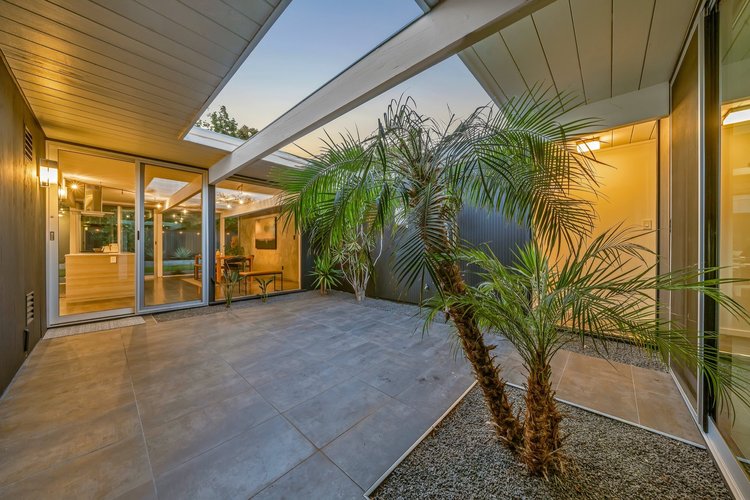
Fairbrae, SunnyvaleAtrium at dusk · Sold 2023 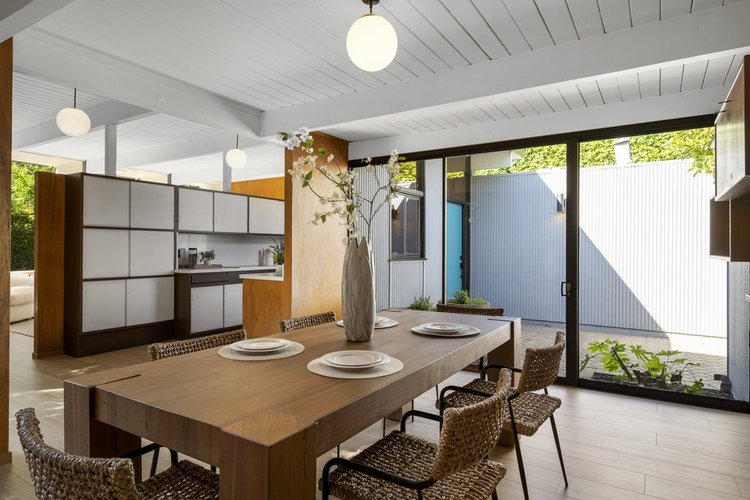
Palo Verde, Palo AltoDining area and atrium · Sold 2024 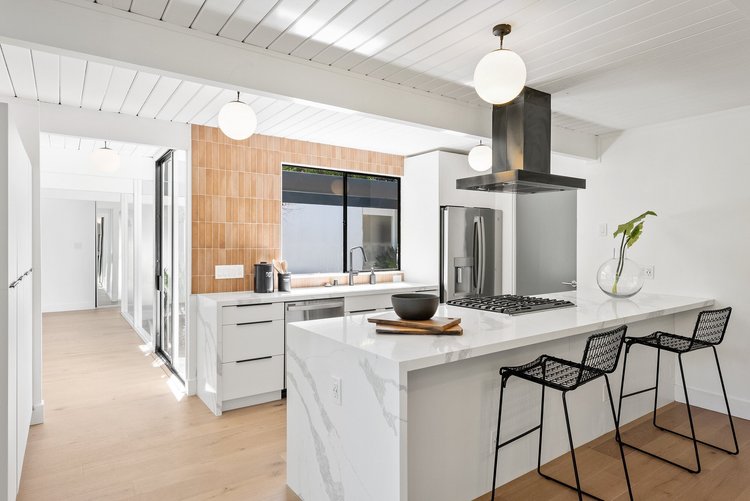
Rancho Verde, SunnyvaleKitchen · Sold 2021 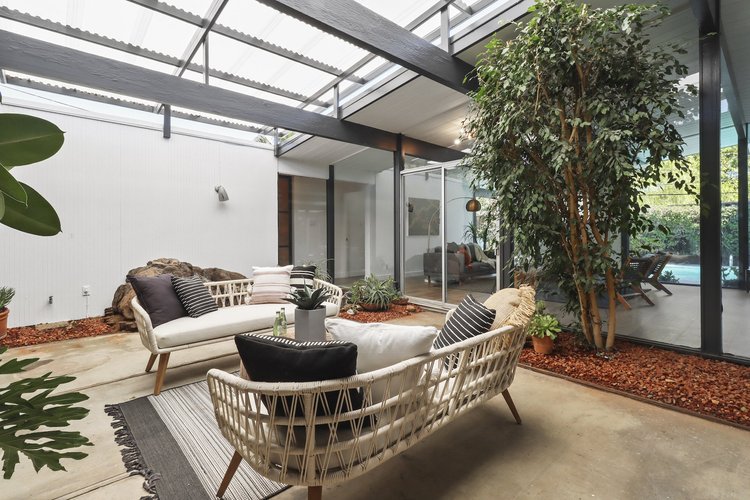
Fairbrae, SunnyvaleAtrium · Sold 2022 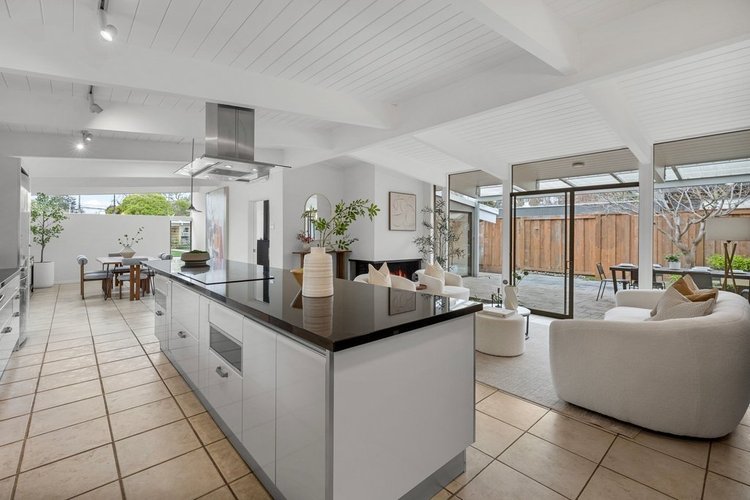
Palo Verde, Palo AltoKitchen · Sold 2026 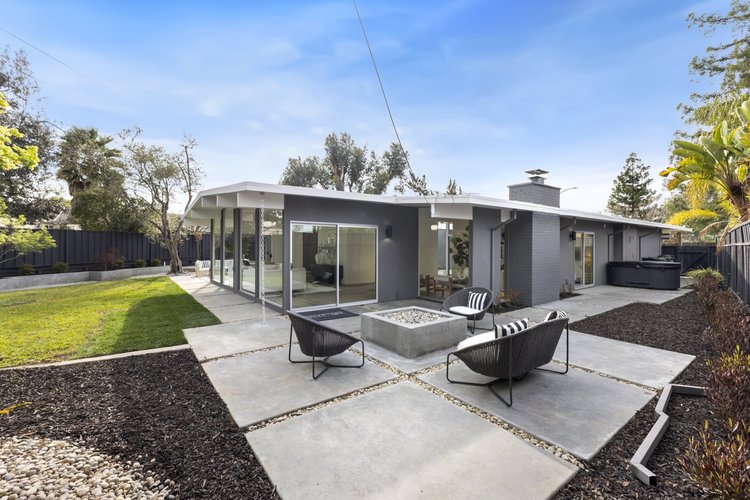
Fairbrae, SunnyvalePatio · Sold 2024
Listing photographs of homes sold by the Boyenga Team at Compass. More homes we’ve sold
See our portfolio