
Keep it midmod
How to Read a National Register Nomination, Section by Section
A National Register nomination is a long document built on a short form. This page walks through the form’s eleven sections with four nominations for mid-century modern neighborhoods in California, Indiana and Colorado, so that you can read the one for a neighborhood you care about, or picture what yours would need to say.
- The form, section by sectionWhat each of the eleven sections asks, and what four nominations entered.Read the form
- Four nominationsPoppy Peak, Pegfair Estates, Thornhurst Addition and Arapahoe Acres at a glance.See the four
- Contributing or notHow the houses inside the line are counted, and one count that was corrected.See the counts
- BoundariesThree ways a nomination explains where a district stops.See the lines
How to use this page
Every listing in the National Register of Historic Places starts as the same document: the National Register of Historic Places Registration Form, NPS Form 10-900. The form’s own heading says it is used to nominate, or to request determinations for, individual properties and districts, and it points the writer to National Register Bulletin 16A for instructions. Items that do not apply are marked “N/A”, and the long answers go on continuation sheets (Form 10-900a).
That makes a nomination easy to read once you know the order: eleven numbered sections, then maps and photographs. The short boxes at the front hold the facts. The continuation sheets for Sections 7 and 8 hold the description and the argument, and they are where most of the pages go.
We read four nominations for mid-century modern neighborhoods to build this page, the same four that stand behind entries on our historic districts page. Below, each section of the form gets a card: what the form asks, then what the four nominations entered. Everything stays at neighborhood level. We do not repeat house addresses or names of owners, although a nomination may contain both.
Four nominations at a glance
Each card gives the facts from the front boxes of the form, in the form’s own terms.
Poppy Peak Historic District, Pasadena, California
- Counted. 34 contributing and 17 noncontributing buildings.
- Period of significance. 1935–1968.
- Criterion and area. Criterion C, architecture, argued at the local level of significance.
- Size. 12.29 acres.
- Related listing. Cultural Resources of the Recent Past, City of Pasadena.
- Dates. The form is dated April 2, 2008. The City of Pasadena’s list of designated properties shows it as a National Register district dated December 23, 2009.
Read it. Poppy Peak nomination, as posted by the California Office of Historic Preservation.
Pegfair Estates Historic District, Pasadena, California
- Counted. 22 contributing and 3 noncontributing buildings.
- Period of significance. 1961–1967.
- Criterion and area. Criterion C, architecture. The narrative describes the houses as Contemporary Ranch.
- Size. 7.63 acres.
- Architect/builder. Neptune & Thomas.
- Related listing. Cultural Resources of the Recent Past, City of Pasadena.
- Dates. The posted copy is stamped as a draft. The city’s list shows the district as a National Register district dated January 18, 2010.
Read it. Pegfair Estates nomination, as posted by the California Office of Historic Preservation.
Thornhurst Addition, Carmel, Indiana
- Counted. 21 buildings and one site as contributing; seven buildings and two objects as noncontributing.
- Period of significance. 1956–1971.
- Criterion and area. Criterion C, architecture.
- Size. The boundary description gives approximately 11 acres.
- Architect/builder. Avriel Shull.
- Related listing. Historic Residential Suburbs in the U.S., 1830-1970.
- Dates. The form is dated December 4, 2008.
Read it. Thornhurst Addition record on the National Park Service’s NPGallery, with the nomination text.
Arapahoe Acres, Englewood, Colorado
- Counted. The form’s own line reads 123 buildings and one site as contributing and one building as noncontributing. The listing record corrects it; see counting what contributes.
- Period of significance. 1949–1957.
- Criteria and areas. Criteria A and C. Architecture, Community Planning and Development, Landscape Architecture and Social History.
- Size. The description places it on a thirty-acre parcel.
- Architect/builder. Edward Hawkins and Eugene Sternberg are among the names entered.
- Related listing. None; the line reads “N/A”.
- Dates. The form is dated February 28, 1998. The listing record gives the date listed as November 3, 1998.
Read it. Arapahoe Acres record on NPGallery, with the nomination text.
The form, section by section
The section names below are the form’s. The summaries of what each one asks are in our words.
Sections 1 and 2: Name of Property and Location
What the form asks. Section 1 takes the historic name and any other names or site number. Section 2 takes the street and number, city or town, state, county and zip code, with boxes for “not for publication” and “vicinity”.
In the four nominations. All four are neighborhoods, so the name is the neighborhood’s: Poppy Peak Historic District and Pegfair Estates Historic District in Pasadena, Los Angeles County, California; Thornhurst Addition in Carmel, Hamilton County, Indiana; Arapahoe Acres in Englewood, Arapahoe County, Colorado.
Sections 3 and 4: the two certifications
What the form asks. Section 3 is signed by the certifying official, who marks whether the property should be considered significant nationally, statewide or locally. Section 4 belongs to the National Park Service: boxes for entered in the National Register, determined eligible, determined not eligible, removed, or other, with the signature of the Keeper and the date of action.
In the four nominations. On the Arapahoe Acres form the “locally” box is marked and the certifying official is the State Historic Preservation Officer. The Poppy Peak statement also argues for the local level of significance. These two sections are where a nomination becomes a listing. The glossary explains the Keeper and the State Historic Preservation Officer.
Section 5: Classification
What the form asks. Ownership (private, public-local, public-State or public-Federal); category (building, district, site, structure or object); and the number of resources, counted as contributing or noncontributing in four rows: buildings, sites, structures and objects. Resources already listed are left out of the count. The last line names any related multiple property listing.
In the four nominations. This is the box most readers want. Poppy Peak: 34 contributing, 17 noncontributing. Pegfair Estates: 22 and 3. Thornhurst Addition: 22 and 9, counting a site and two objects along with the houses. Arapahoe Acres: 124 and 1 on the form, later corrected. Three of the four name a multiple property listing; more on that below.
Section 6: Function or Use
What the form asks. The historic function and the current function, each chosen from the categories in the instructions.
In the four nominations. All four enter the same thing on both lines, a single dwelling under the Domestic category. They were built as houses and they are houses now.
Section 7: Description
What the form asks. An architectural classification and a materials list (foundation, walls, roof, other), both from set categories, then a narrative on continuation sheets that describes the historic and current condition of the property.
In the four nominations. All four classify the houses under Modern Movement. Arapahoe Acres adds International Style and, as an “other” entry, Usonian Style. The materials lines read like a mid-century specification: Poppy Peak lists poured concrete and concrete block foundations, glass and wood walls that include plywood and board and batten, and asphalt and wood shake roofs. Pegfair Estates adds flagstone, and Thornhurst lists brick, wood, asphalt and, as an “other” entry, Celotex. The narratives then set the scene. Pegfair’s houses stand around one drive that ends in a cul-de-sac; Arapahoe Acres went up on a thirty-acre parcel between 1949 and 1957; at Thornhurst the designer sold 21 custom-built homes in the addition.
Section 8: Statement of Significance
What the form asks. Boxes for the four criteria: A, events and the broad patterns of history; B, the lives of significant persons; C, design and construction, which includes the work of a master; D, information about prehistory or history. Then boxes for seven criteria considerations, A through G, covering special cases such as religious properties, moved or reconstructed buildings, commemorative properties and places less than 50 years old. Then the areas of significance, the period of significance, significant dates, significant person, cultural affiliation and architect/builder, followed by the narrative statement.
In the four nominations. Criterion C is marked on all four, and Arapahoe Acres also marks Criterion A. The periods of significance are 1935–1968 for Poppy Peak, 1961–1967 for Pegfair Estates, 1956–1971 for Thornhurst and 1949–1957 for Arapahoe Acres. All four also mark Consideration G, which gets its own section below. Glossary entries: criteria and period of significance.
Section 9: Major Bibliographical References
What the form asks. The books, articles and other sources used; any earlier documentation on file with the Park Service, such as a Historic American Buildings Survey record; and the primary location of additional data, with the name of the repository.
In the four nominations. The repositories named are local. Poppy Peak gives the City of Pasadena Planning Department; Pegfair Estates gives the Pasadena Public Library and the city’s Planning and Development Department. The Poppy Peak description adds that its completion dates and its architect and builder names came from research in building records and permits. Those are the same kinds of records our plans and archives guide points to.
Section 10: Geographical Data
What the form asks. The acreage, map coordinates (UTM references), a verbal boundary description, and a boundary justification that explains why the line was drawn where it was.
In the four nominations. Poppy Peak covers 12.29 acres and Pegfair Estates 7.63, and Thornhurst’s boundary description gives approximately 11 acres. The justification is the part to read closely, because it says what the district is in one or two sentences. We compare the four under boundaries below.
Section 11 and the additional documentation
What the form asks. Who prepared the form and when, then a list of what travels with it: continuation sheets, a USGS map showing the location, a sketch map for districts and for large properties, and representative black and white photographs. A property owner block is completed only at the request of the state or federal preservation officer.
In the four nominations. The Poppy Peak description sends the reader to a district map in the additional documentation, and that map is the quickest way to see which houses were counted as contributing. We leave the preparers’ names and contact details on the forms.
Consideration G and the fifty-year guideline
A mid-century neighborhood can reach the National Register while some of its houses are still short of fifty years old. The form handles that with Criteria Consideration G, the box for a property that is less than 50 years of age or that achieved significance within the past 50 years. All four of these nominations mark it. The glossary has more under the fifty-year guideline.
- Pegfair Estates. The statement takes the point head on. It says the district appears to meet the consideration for properties under 50 years old, as an exceptional district of Contemporary Ranch architecture.
- Thornhurst Addition. A footnote cites the Park Service’s bulletin on historic residential suburbs for a general rule: when a neighborhood as a whole was laid out more than 50 years ago and most of its homes and other resources are older than that, a case for exceptional importance is not needed.
- Poppy Peak. The box is marked on the form, while the description says that a significant majority of the houses were built within the period of significance and that the district is exempt from the consideration. The two do not say quite the same thing, which is a reminder to read the boxes and the narrative together.
The multiple property listing
A multiple property listing rests on a shared cover document. That document sets out the themes and patterns of history shared by a group of related properties, so a nomination filed under it can lean on that background and spend its pages on the place itself.
Both Pasadena nominations name the same one, Cultural Resources of the Recent Past, City of Pasadena, and the Poppy Peak statement says the district meets that document’s requirements and is eligible under Criterion C at the local level. The Thornhurst form names Historic Residential Suburbs in the U.S., 1830-1970 and says the district meets its registration requirements. Arapahoe Acres names none and makes its whole case on its own pages.
Our reading: when a nomination names a multiple property listing, half of the argument lives in that other document. If you are thinking about a nomination of your own, ask the state office early whether a cover document already exists for your area. Our guide to starting a district covers that early call.
Counting what contributes
A district nomination sorts everything inside the line into two groups, contributing and noncontributing. The four nominations give their own reasons for putting a house in the second group, and one of them had its count corrected at listing.
- Thornhurst Addition. The description says the homes its designer built there between 1956 and 1971 are all contributing. Seven later homes are noncontributing. They stay inside the district because, as the form puts it, the layout of the addition is historic and all of the developed land along its streets is within the boundary. The form also counts two noncontributing objects, and the boundary description mentions two non-contributing walls.
- Poppy Peak. 34 of 51 houses contribute. The description says the others do not represent the Modern Movement, are in styles the multiple property document does not address, or were not built during the period of significance. It adds that a significant number of them are still compatible with the district in siting, massing, scale and roof lines.
- Pegfair Estates. 22 of 25 houses contribute. The description goes house by house, and where alterations have left a house with poor integrity it says the house is not a contributing resource.
- Arapahoe Acres. The copy opens with a Supplementary Listing Record. It says Sections 5 and 7 of the form gave different numbers of noncontributing resources, and it sets out the correct count: 122 contributing buildings, 2 noncontributing buildings and 1 contributing site, 125 resources in all. The record gives the date listed as November 3, 1998.
Our reading: a noncontributing house is still inside the district and still counted. And when the numbers in a nomination do not agree with each other, look for a correction sheet at the front before deciding which one is right. Our districts page has more on contributing and not contributing.
Boundaries and why they are drawn
The boundary justification is short, and it tells you how the writers thought about the place. The four nominations use three different arguments.
- By what survives. The two Pasadena nominations draw the line around the parcels tied to the significant houses from the period of significance that keep a high level of architectural integrity.
- By the plat. Thornhurst follows the addition as it was platted in 1955 and expanded in 1957, and it leaves out parcels that were never developed as part of the addition.
- By the builder’s parcel. Arapahoe Acres takes in the entire parcel historically associated with the neighborhood as its builder developed it. The boundary description leaves out one property.
Our reading: for a tract of mid-century houses, the recorded tract map is usually the natural starting line, and the question is whether anything inside it should be left out. The plans and archives guide explains where tract maps are kept.
Draft, nomination, listing
A nomination is not the same thing as a listing, and the copy you find may be from before, during or after the decision.
- Drafts. The two Pasadena copies open with a cover note from the California Office of Historic Preservation. It says nominations are drafts until the Keeper lists them, and that they can change at the State Historical Resources Commission meeting in response to comments.
- Listing dates come from elsewhere. For those two, we took the dates from the City of Pasadena’s list of designated properties: December 23, 2009 for Poppy Peak and January 18, 2010 for Pegfair Estates.
- Corrections at listing. The Arapahoe Acres listing record says the property is listed in accordance with the attached nomination, subject to the amendments it sets out. Section 4 of any form is where the Keeper’s action is recorded.
How a nomination moves from the state office to the Keeper, and how owners are counted along the way, is covered step by step in our guide to the National Register path and how owners are counted.
Finding and reading one yourself
The four nominations read for this page are linked in the cards above: two on the California Office of Historic Preservation’s site and two on NPGallery, the National Park Service’s site for National Register records. Our historic districts page links a source record for each neighborhood it lists, so that is the place to look for a mid-century district near you.
When you open one, try reading it in this order: Section 5 for the counts, Section 8 for the criteria and the period of significance, Section 10 for the boundary justification, then the narrative for Section 7. That is ten minutes of reading, and it will tell you what the district is, why it matters and where it stops.
More on our site
- Mid-century modern historic districts: the neighborhoods on a register, with a link to each record.
- How to start a mid-century historic district: the path from a conversation with neighbors to a listing.
- The National Register rules in plain words: 36 CFR Part 60, the federal rule behind the form, read section by section.
- The California Register in plain words: the state register’s rules, read section by section.
- Mid-century preservation glossary: the terms used on this page, each with its source.
- The ten rehabilitation standards, read for a mid-century modern home.
- Sacramento’s Eichler historic district plan: a local district’s written standards, section by section.
- Keep It Midmod: records, standards, repairs, local rules and easements in one guide.
- Eichler plans and archives: where plans, tract maps and permits are kept.
- Southern California modern architects A to Z and the California mid-century modern timeline.
Questions and answers
Is a nomination the same as a listing?
No. A nomination is the document that asks for a listing. The California copies say on their cover that nominations are drafts until the Keeper lists them. Section 4 of the form is where the Park Service records what it decided.
Does the form say what an owner can or cannot do with a house?
The form has no section for rules. It names the place, describes it and argues why it is significant. What listing does and does not do is a separate subject, covered in our guide under what listing does and does not do. This page is general information, not legal advice.
Why is a house inside a district counted as noncontributing?
In these four nominations, because it was built later, has been altered, or does not fit the style the district is listed for. In Thornhurst Addition the seven noncontributing homes are later ones. They are still inside the boundary and still part of the count.
Who decides the period of significance?
The writers propose it in Section 8 and tie it to the evidence. In these four it follows the years of building: 1949–1957 at Arapahoe Acres, 1956–1971 at Thornhurst, 1961–1967 at Pegfair Estates and 1935–1968 at Poppy Peak.
Where does the research in a nomination come from?
Section 9 lists the sources and names a repository. The Pasadena nominations point to the city’s planning department and the public library. For a house or a tract of your own, our plans and archives guide lists the public collections and city records to try.
Which standards apply to changes after a district is listed?
A nomination does not set any. Local commissions, easement holders and grant programs use the ten Standards for Rehabilitation to judge changes to historic buildings, and we read them one by one in our guide to the rehabilitation standards.
We want mid-century neighborhoods to stay recognizably mid-century, and a nomination is one of the clearest records of what makes a neighborhood worth keeping that way. If you own or are thinking of buying or selling an Eichler or other mid-century home in the Bay Area and want to talk through what the records say about it, call the Boyenga Team at (408) 373-1660 or (650) 383-8606, or write to MidMods@Boyenga.com.
About the sources
Everything this page says about the four nominations comes from the documents themselves: the Poppy Peak and Pegfair Estates nominations as posted by the California Office of Historic Preservation, the Thornhurst Addition and Arapahoe Acres nominations from the National Park Service’s NPGallery, and the City of Pasadena’s list of designated historic properties. The section names and instructions are taken from the forms. All were read in November 2026, and every statement was checked against a saved copy before this page was built.
The summaries are in our words, and the lines headed “Our reading” are ours alone. A nomination can be amended after it is written. Where a source differs from this page, go by the source.
From our listings
Brick, glass and low roofs at homes we’ve sold
Brick chimneys, walls of glass, exposed beams and low roofs at mid-century homes we’ve sold in Fairgrove, in Cupertino; Fairglen and Fairhaven, in San Jose; Fairbrae and Rancho Verde, in Sunnyvale; and Palo Verde, in Palo Alto. A nomination’s description section records materials and features like these. None of these homes is shown here as a National Register property.
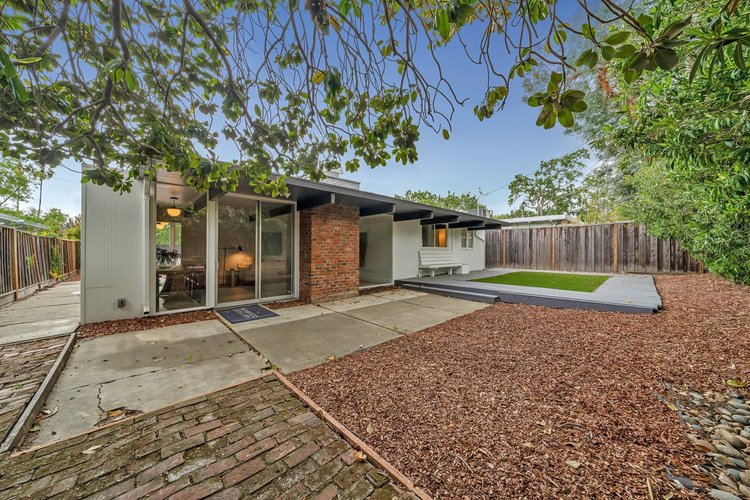
Fairgrove, CupertinoBack of the home · Sold 2023 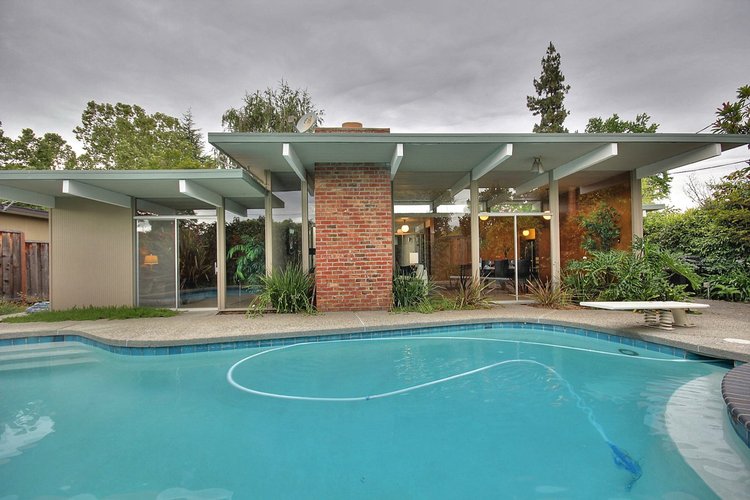
Fairglen, San JosePool and brick chimney · Sold 2013 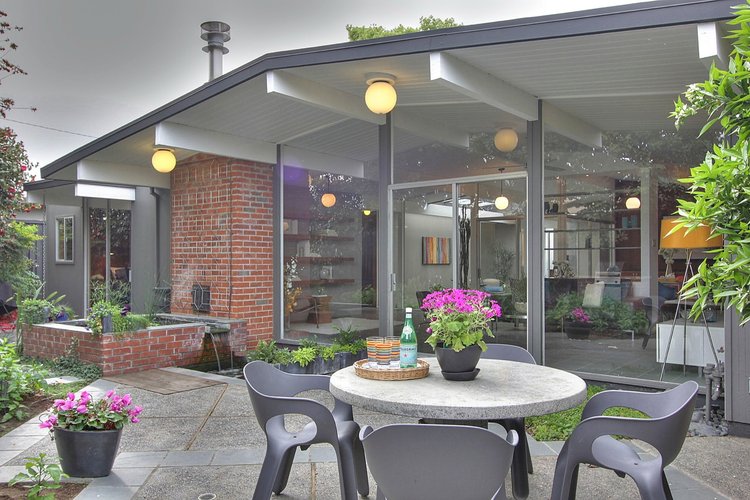
Fairhaven, San JoseBack patio · Sold 2015 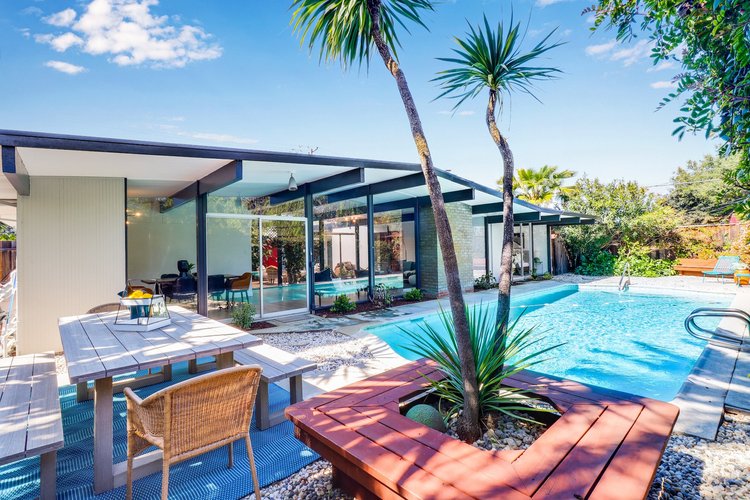
Fairbrae, SunnyvalePool · Sold 2022 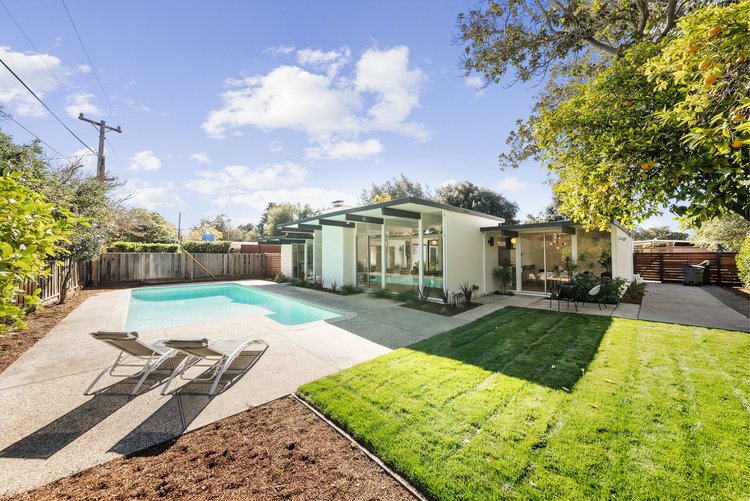
Rancho Verde, SunnyvalePool and lawn · Sold 2021 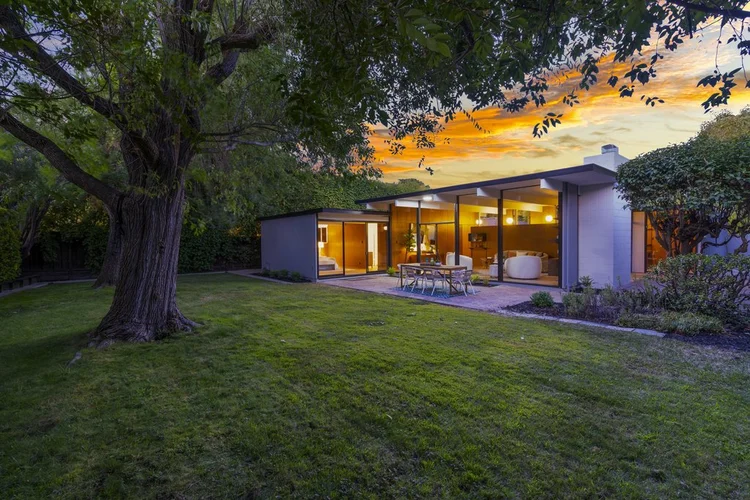
Palo Verde, Palo AltoLawn at dusk · Sold 2024
Listing photographs of homes sold by the Boyenga Team. More homes we’ve sold
See our portfolio