
Preservation guide
Mid-Century Modern Historic Districts: Where Midmod Neighborhoods Have Formal Standing
Most mid-century neighborhoods stay mid-century only because their owners keep them that way. A few have more behind them. They are on the National Register of Historic Places, on a city register, or under zoning written for the tract. This page gathers the ones whose public records we could read: four Eichler developments in the Bay Area, rules in four Bay Area cities, four more places elsewhere in California, and 18 neighborhoods in 12 other states.
It is a companion to Keep It Midmod, our guide to repairing one house so it stays mid-century. This page is about whole neighborhoods: what a designation does, what it leaves alone, and how to check whether your own house is covered.
- Bay Area EichlersFour Eichler developments on the National Register, from Palo Alto to San Jose.See the four
- City rulesGuidelines, overlays and zoning written for Eichler tracts in four Bay Area cities.Check the rules
- Elsewhere in CaliforniaSacramento, Pasadena and Palm Springs.See the records
- Beyond California18 neighborhoods in 12 states, from Arizona to Massachusetts.Tour the list
What a designation does, and what it leaves alone
A historic district is a group of buildings recognized together. For mid-century neighborhoods the recognition comes in two main forms, and they do different jobs.
- The National Register of Historic Places. The federal list, kept by the National Park Service. The Park Service’s own answer is that listing places no restrictions on what a private owner does with a property, up to and including tearing it down, unless the project involves federal funding, licenses or permits. It adds that state or local preservation laws may still apply. So the Register is a record and an honor.
- City and county tools. A local register, a historic overlay, design guidelines, a single-story overlay or zoning written for one tract. These are where review of a remodel comes from, and each city writes its own. Some are binding and some are voluntary.
So the useful question for an owner is rarely “Is my neighborhood historic?” It is “Which rules apply to my lot?”
Contributing and not contributing
A district nomination counts its buildings one by one. Three records on this page show how that works. The Thornhurst Addition nomination in Indiana counts 21 contributing buildings, and seven houses added later that do not contribute. The Six Moon Hill release in Massachusetts counts 29 mid-century houses, and one house built in 2006 that does not. The Arapahoe Acres nomination in Colorado counts 122 contributing buildings and 2 that are not. In the first two, the houses that do not contribute are later additions.
The Park Service’s advice is to look in the district’s file to see whether a building is counted as contributing, or to ask the State Historic Preservation Office.
Bay Area Eichlers on the National Register
Three tracts built by Joseph Eichler’s company are historic districts on the National Register: Greenmeadow and Green Gables in Palo Alto, and the Fairglen Additions in San Jose. A fourth Eichler development, the Pomeroy Green townhouse complex in Santa Clara, was listed in 2021. The first three descriptions come from California’s Office of Historic Preservation; each name opens the record.
| Development | City | What the record shows | Listed | On our site |
|---|---|---|---|---|
| Greenmeadow | Palo Alto | 243 homes, plus a community center of two buildings and a swimming pool. Developed by Eichler Homes, Inc. in 1954–1955 and designed by A. Quincy Jones and Frederick Emmons. | July 28, 2005 | Greenmeadow history |
| Green Gables | Palo Alto | 62 single-story homes developed by Eichler Homes, Inc. in 1950 and designed by Robert Anshen and Steve Allen. | July 28, 2005 | Green Gables history |
| Fairglen Additions | San Jose | 218 homes in Willow Glen, built between 1959 and 1961 in thirteen home plans. Designed by Anshen & Allen, Jones & Emmons and Claude Oakland. | June 6, 2019 | Fairglen Additions history |
| Pomeroy Green | Santa Clara | The National Park Service’s weekly list of March 26, 2021 shows Pomeroy Green as listed. Our history covers the Eichler townhouse complex and how the listing came about. | March 24, 2021 | Pomeroy Green history |
A tract name is not a boundary. A house in one of these neighborhoods may sit outside the listed area, or inside it without being counted as contributing. The state’s listed resources for Santa Clara County are the place to start checking.
Bay Area city rules for Eichler tracts
Review of a remodel comes from city rules, and four Bay Area cities have written rules or guidelines for their Eichler tracts. None of these depends on historic status. They differ in how binding they are.
| Place | Tool | What it does | Read more |
|---|---|---|---|
| Palo Alto | Eichler Neighborhood Design Guidelines, adopted April 2, 2018 | Voluntary, by the document’s own account. They cover additions, second stories, rooflines, glass, siding and roofing. | Palo Alto Eichler design guidelines |
| Palo Alto | Single-story overlay, shown as “(S)” in the zone name | Keeps the lots it covers to one story. The city’s parcel data lists a 17-foot maximum building height on these lots. Owners apply for an overlay, and the 2018 guidelines describe a threshold of support from 70 percent of owners. | Single-story overlay districts |
| Sunnyvale | Eichler Design Guidelines, adopted by the City Council in July 2009 | In design review in a designated Eichler neighborhood, the decision must be compatible with the guidelines. They do not ban second stories. | Sunnyvale Eichler design guidelines |
| Cupertino | R1e Eichler zoning, with a design handbook dated January 16, 2001 | Covers Fairgrove, a tract of 220 Eichler houses built in 1960 and 1961. | Fairgrove and R1e zoning |
| San Rafael | –EA combining district | Our Terra Linda histories describe –EA as the city’s Eichler and Alliance Homes overlay. A city zoning handout gives its limits: a maximum height of 17 feet to the peak and one habitable floor, with separate design criteria for upper-story additions. | Terra Linda Eichler history; Alliance homes history |
Lucas Valley in Marin County has community standards of its own in the county’s development code; our Lucas Valley history covers them. For any Bay Area address, the Eichler Remodel Rules Finder covers 34 places and shows five layers of rules to check before remodeling.
Elsewhere in California
Sacramento has a city Register district of Eichler homes with a written plan. Pasadena has two National Register districts of modern houses. A Palm Springs listing joined the Register in 2025.
| Neighborhood | Place | What the record shows | Status |
|---|---|---|---|
| South Land Park Hills (Eichler) Historic District | Sacramento | 48 homes designed by Jones & Emmons, with 1955–1956 as the period of significance. The district plan lists interior work, re-painting, re-roofing and solar panels among the work typically exempt from design review. It bars two-story additions unless they sit at the rear, behind the front half of the house’s footprint. | A district on the city’s Register. The plan was adopted May 21, 2024. |
| Pegfair Estates Historic District | Pasadena | 25 houses, 22 of them contributing, built from 1961 to 1967. The nomination form names Neptune & Thomas in its architect and builder field. | National Register district. The city’s list gives January 18, 2010. |
| Poppy Peak Historic District | Pasadena | 51 houses. The period of significance runs from 1935 to 1968, so it begins before World War II. Architects named in the form include Harwell Hamilton Harris, Richard Neutra, and Buff, Straub & Hensman. | National Register district. The city’s list gives December 23, 2009. |
| Sandcliff | Palm Springs | The National Park Service’s weekly list of April 4, 2025 shows Sandcliff as listed. We have not read the nomination, so we add no description. | National Register. Listed April 1, 2025. |
The copies of both Pasadena nomination forms on the state’s site carry a note that nominations are drafts until the Keeper of the National Register lists them. So the listing dates here come from the city’s own list of designations. For more on the region, see our guide to the mid-century modern homes of Southern California.
Beyond California: 18 neighborhoods in 12 states
Mid-century neighborhoods have earned formal standing across the country. Sixteen of the 18 below have a National Park Service record. Villa Monterey is on Scottsdale’s city register, and Paradise Palms is under a Clark County overlay. Each name opens the record we read. Where a Park Service record shows only the date it was published, we say “is dated” instead of “listed”.
Southwest and Mountain West
| Neighborhood | Place | What the record shows | Status |
|---|---|---|---|
| Town and Country Scottsdale | Scottsdale, Arizona | 62 homes on about 12 acres, built from 1958 to 1960. Builder Fred E. Woodworth; architect Ralph Haver. | Scottsdale Historic Register, June 7, 2005. The city register gives a National Register listing of September 2009. Park Service record 09000694. |
| Village Grove 1-6 | Scottsdale, Arizona | 255 homes on about 72 acres, built from 1957 to 1959 by Allied Construction Company. | Scottsdale Historic Register, June 7, 2005. The city register gives a National Register listing of May 2010. |
| Villa Monterey Units 1-7 | Scottsdale, Arizona | 758 homes and 13 common tracts on about 115 acres, built from 1961 to 1969. Architect Ralph Haver and Associates; builder Butler Homes. | Scottsdale Historic Register, June 7, 2011. |
| Paradise Palms | Clark County, Nevada | A county news release credits the houses to Las Vegas architect Hugh Taylor and to Southern California architects William M. Bray, Dan Palmer and William Krisel. | Clark County Historic Neighborhood Overlay. The release reports a unanimous County Commission vote that grew the overlay from a first phase of 216 homes to nearly a thousand. |
| Arapahoe Acres | Englewood, Colorado | Built from 1949 to 1957 on a thirty-acre parcel bought by designer and builder Edward Hawkins, who brought in architect Eugene Sternberg in 1949 to plan the site and design a first group of houses. The nomination counts 122 contributing buildings, 2 that do not contribute and 1 contributing site. | National Register district, listed November 3, 1998. |
Midwest
| Neighborhood | Place | What the record shows | Status |
|---|---|---|---|
| The Acres | Charleston Township, Kalamazoo County, Michigan | The Park Service record names Frank Lloyd Wright and others, with 1947 and 1954 as significant years. | National Register. The Park Service record is dated May 19, 2004. |
| Thornhurst Addition | Carmel, Indiana | The nomination names Avriel Shull in its architect and builder field and gives 1956–1971 as the period of significance. It counts 21 contributing buildings. Seven houses added later do not contribute. | National Register. The Park Service record is dated June 24, 2010. |
| Rush Creek Village Historic District | Worthington, Ohio | The Park Service record names Theodore van Fossen, Richard Wakefield and others, with 1954 and 1956 as significant years. | National Register district. The Park Service record is dated August 14, 2003. |
South and Mid-Atlantic
| Neighborhood | Place | What the record shows | Status |
|---|---|---|---|
| Northcrest Historic District | Doraville, DeKalb County, Georgia | The Park Service record names Ernest P. Mastin and others, and gives 1959–1975 as the period of significance. | National Register district, Park Service record 100000883. |
| Hollin Hills Historic District | Fairfax County, Virginia | A 326-acre neighborhood that took shape between 1949 and 1971 under developer and builder Robert Davenport and architect and planner Charles Goodman. At listing it counted 475 contributing houses, buildings, sites and structures. | Virginia Landmarks Register, June 19, 2013. National Register, September 30, 2013. Fairfax County adopted a Historic Overlay District on March 8, 2022, covering 492 parcels. |
| Holmes Run Acres Historic District | Fairfax County, Virginia | Built between 1951 and 1958. Developers Gerald and Eli Luria hired architects Nicholas Satterlee and Donald Lethbridge. | Virginia Landmarks Register, December 6, 2006. National Register, March 22, 2007. |
| Carderock Springs Historic District | Near Bethesda, Montgomery County, Maryland | 275 modernist houses built from 1962 to 1967 by builder Edmund J. Bennett, with a clubhouse and pool complex. The state record counts 351 resources, 329 of them contributing. | National Register district, listed November 21, 2008. |
| Hammond Wood Historic District | Silver Spring, Maryland | 58 Contemporary houses on 15 acres, built from 1949 to 1951. Architect Charles M. Goodman; builders Paul Hammond and Paul I. Burman. The state record counts 55 of 58 resources as contributing. | National Register district, listed December 15, 2004. |
| Rock Creek Woods Historic District | Silver Spring, Maryland | 74 Contemporary houses built from 1958 to 1961. Architect Charles M. Goodman; builders Herschel and Marvin Blumberg of Bancroft Construction Company. The state record counts 73 of 77 resources as contributing. | National Register district, listed December 15, 2004. |
Northeast
| Neighborhood | Place | What the record shows | Status |
|---|---|---|---|
| Six Moon Hill Historic District | Lexington, Massachusetts | 29 houses of mid-century modern design, and one house built in 2006 that does not contribute, with a commonly owned swimming pool, picnic area and open land. Largely the work of architects associated with The Architects’ Collaborative. | A state release of October 27, 2015 reports that the Massachusetts Historical Commission approved the nomination. Park Service record 15000981. |
| Peacock Farm Historic District | Lexington, Massachusetts | The Park Service record names Compton & Pierce, Henry Hoover and Carl Koch, with White & Green as builders. It is part of a multiple-property filing on the mid-century modern houses of Lexington. | National Register district. The state’s Six Moon Hill release gives 2012 as the year it was listed. |
| Usonia Historic District | Pleasantville, Westchester County, New York | The Park Service record names Frank Lloyd Wright and others. | National Register district. The Park Service record is dated September 5, 2012. |
Pacific Northwest
| Neighborhood | Place | What the record shows | Status |
|---|---|---|---|
| Oak Hills Historic District | Beaverton, Washington County, Oregon | The Park Service record names Robert Rummer and others. | National Register district. The Park Service record is dated July 10, 2013. |
This is not a complete list. Neighborhoods whose records we could not read are left out, and being left out says nothing about a neighborhood’s status.
Three routes neighborhoods have taken
The records above show three ways a mid-century neighborhood ends up with formal standing. Several use more than one.
- National Register listing. A nomination documents why the place matters and counts which buildings contribute. It brings recognition and a detailed public record. By itself it brings no review of private work.
- A city or county register or overlay. This is where review comes from. Scottsdale placed Town and Country and Village Grove on its own register in 2005, and the same register gives National Register listings in 2009 and 2010. Fairfax County adopted its overlay for Hollin Hills in 2022, more than eight years after the National Register listing. Clark County’s overlay for Paradise Palms began with 216 homes and grew to nearly a thousand. Sacramento’s plan for its Eichler district lists the work that is typically exempt from design review.
- Zoning written for the tract. No historic status is involved. Palo Alto’s single-story overlays, Cupertino’s R1e zoning and San Rafael’s –EA district limit stories, height or design through ordinary zoning. Design guidelines, such as Palo Alto’s and Sunnyvale’s, sit beside them.
How to check your own house
- Name the tract. The Eichler Tract Finder lists tracts in 26 Bay Area places, and the Bay Area Eichler Tract Map shows 87 tracts on one map.
- Check the local rules. Start with the Eichler Remodel Rules Finder, then read the city’s current code or ask the planning counter. The design guidelines hub gathers our city-by-city guides.
- Look in the record. For a Register district, the nomination shows the boundary and which buildings contribute. Our guide Is my house historic? explains California’s registers and local lists.
- Find the house’s own papers. The Mid-Century House Records Finder shows where permits and maps are kept in 34 Bay Area cities and county areas. The Eichler Archives Directory lists 39 tract site-plan records you can open online.
- Ask before you design. Rules change, and a guideline in one city is a standard in the next. Take the question to the planning counter before you pay for drawings.
Questions and answers
Does a National Register listing stop an owner from remodeling?
Not by itself. The National Park Service says listing places no restrictions on what a private owner does with a property, unless the project involves federal funding, licenses or permits. State and local preservation laws can still apply, so the answer for a given lot comes from the city or county.
What does “contributing” mean?
A district nomination counts the buildings that add to the district’s historic character and the ones that do not. The Thornhurst Addition record counts seven later houses as not contributing, and Six Moon Hill’s counts one house built in 2006. A house can sit inside a district’s boundary and still be counted either way.
Is every Eichler neighborhood a historic district?
No. This page lists four Bay Area Eichler developments on the National Register and one city Register district in Sacramento. Other tracts rely on ordinary zoning, plus tools such as single-story overlays and design guidelines where a city has adopted them.
Is a single-story overlay a historic district?
No. It is a zoning tool. In Palo Alto it keeps the lots it covers to one story. It does not regulate materials or style, and it involves no historic status. Our overlay guide explains how the Bay Area versions work.
Which mid-century neighborhoods outside California have formal standing?
This page lists 18 in 12 states, including Arapahoe Acres in Colorado, Hollin Hills in Virginia, Six Moon Hill in Massachusetts and three neighborhoods in Scottsdale, Arizona. It is not a complete list. We include only neighborhoods whose public records we could read.
How does a neighborhood get started?
With its owners. In Palo Alto, owners apply for a single-story overlay, and the city’s 2018 guidelines describe a threshold of support from 70 percent of them. For the National Register, the National Park Service says the forms and documentation go to the State Historic Preservation Office. For a city register or overlay, the planning department is the first call. Our guide How a Mid-Century Neighborhood Becomes a Historic District follows the nomination steps, how owners are counted and the timeline in California.
Keep reading
- How a neighborhood becomes a historic district: the nomination steps, how owners are counted and the timeline.
- Preservation glossary: 52 terms in plain English, from contributing building to period of significance.
- Keep It Midmod: a preservation guide: repairing one house so it stays mid-century.
- Eichler Archives Directory: where the plans, photographs and records are held.
- Design guidelines hub: our city-by-city guides.
- Is my house historic?: how California’s registers and local lists work.
- Mid-century modern landmarks: 13 public buildings of the period.
- Mid-century modern homes of Southern California: our guide to the region.
- Streng Brothers homes in Sacramento: more Sacramento modern.
If you own a mid-century home in the Bay Area and want to know what applies to it before you remodel or sell, call the Boyenga Team at (408) 373-1660 or (650) 383-8606, or write to MidMods@Boyenga.com.
About the sources
Every count, date and name on this page comes from a public record we read on November 11 and 12, 2026: state and National Park Service register pages, nomination forms, and city and county documents, plus our own histories where we link them. We put each record in our own words and leave out street addresses. Rules and designations change, so confirm with the agency before you rely on anything here. This page is general information, not legal advice. We reproduce no images from these sources.
- National Park Service: National Register frequently asked questions
- California Office of Historic Preservation: Greenmeadow
- California Office of Historic Preservation: Green Gables
- California Office of Historic Preservation: Fairglen Additions
- California Office of Historic Preservation: listed resources in Santa Clara County
- National Park Service: weekly list of March 26, 2021
- National Park Service: weekly list of April 4, 2025
- City of San Rafael: zoning district development standards handout
- City of Sacramento: South Land Park Hills (Eichler) Historic District Plan
- Pegfair Estates Historic District nomination form, on the state’s site
- Poppy Peak Historic District nomination form, on the state’s site
- City of Pasadena: designated properties and districts
- City of Scottsdale: Scottsdale Historic Register
- Clark County, Nevada: news release on Paradise Palms
- National Park Service record: Town and Country Scottsdale
- National Park Service record: Arapahoe Acres
- Arapahoe Acres nomination form
- National Park Service record: The Acres
- National Park Service record: Thornhurst Addition
- Thornhurst Addition nomination form
- National Park Service record: Rush Creek Village
- National Park Service record: Northcrest
- Virginia Department of Historic Resources: Hollin Hills
- Fairfax County: Hollin Hills Historic Overlay District
- Virginia Department of Historic Resources: Holmes Run Acres
- Maryland Historical Trust: Carderock Springs
- Maryland Historical Trust: Hammond Wood
- Maryland Historical Trust: Rock Creek Woods
- Massachusetts Historical Commission: Six Moon Hill release
- National Park Service record: Six Moon Hill
- National Park Service record: Peacock Farm
- National Park Service record: Usonia
- National Park Service record: Oak Hills
From our listings
Mid-century homes we’ve sold
Low roofs, walls of glass and atriums in mid-century homes we’ve sold in Fairbrae and Rancho Verde, in Sunnyvale, Palo Verde, in Palo Alto, and Fairhaven, in San Jose. Each photo shows the home as it was when listed. We haven’t checked these houses against any district or overlay named above.
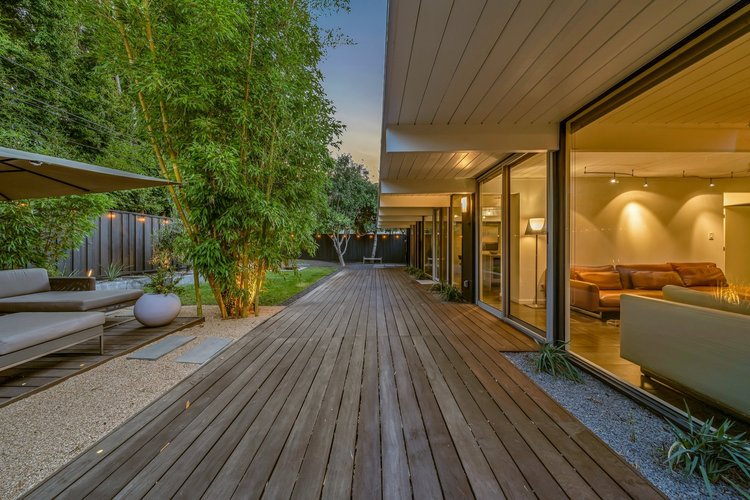
Fairbrae, SunnyvaleDeck at dusk · Sold 2023 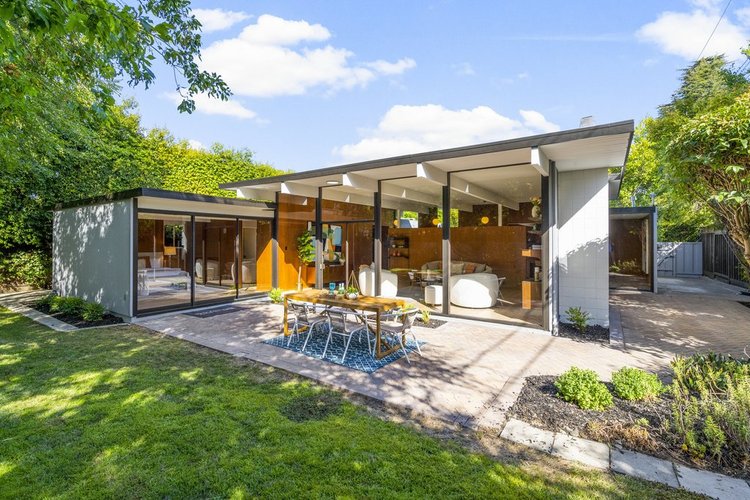
Palo Verde, Palo AltoBack lawn · Sold 2024 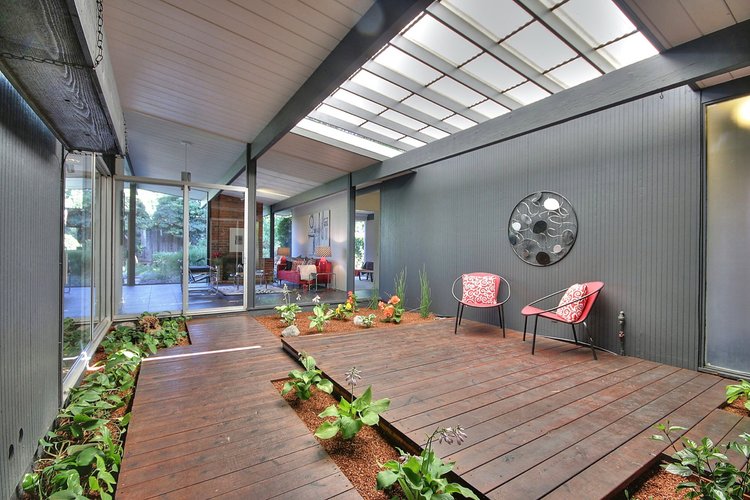
Fairhaven, San JoseAtrium deck · Sold 2014 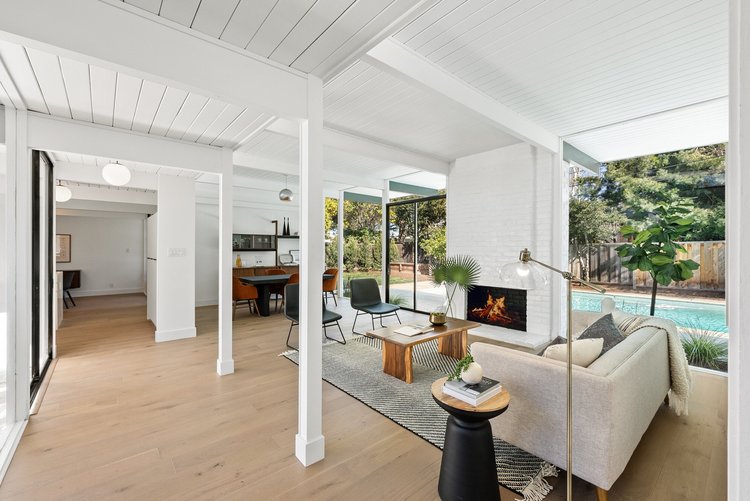
Rancho Verde, SunnyvaleLiving room · Sold 2021 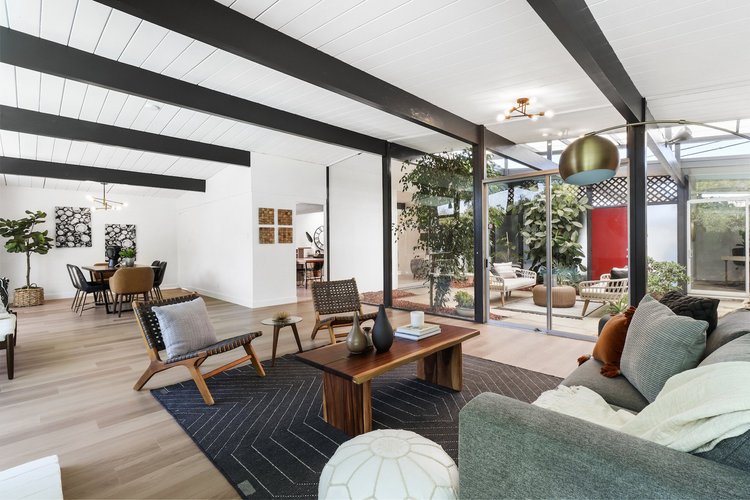
Fairbrae, SunnyvaleLiving room · Sold 2022 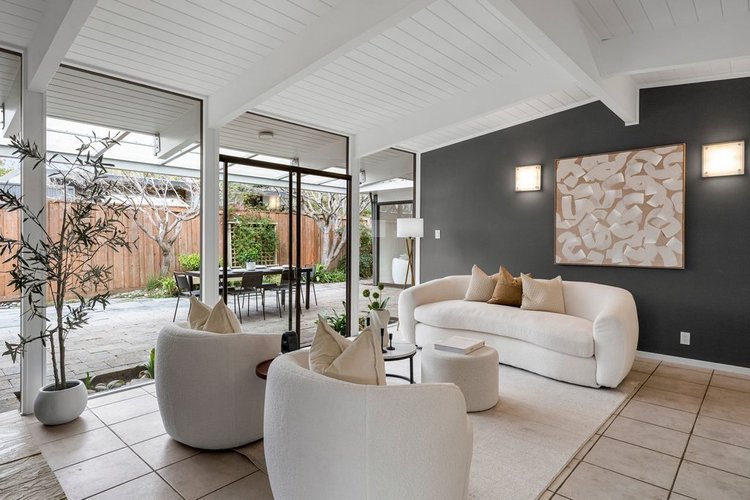
Palo Verde, Palo AltoLiving room and atrium · Sold 2026
Listing photographs of homes sold by the Boyenga Team. More homes we’ve sold
See our portfolio