
Keep it midmod
The California Register of Historical Resources in Plain Words
California has a historic register of its own, with its own law, its own regulations and its own way of counting owner objections. This page reads those rules section by section for people who own or care about a mid-century modern neighborhood: how a place gets on the register, what it has to show, where an owner’s say comes in, and what a listing changes.
- Three ways onAutomatic listing, listing under Commission procedures, and nomination with a public hearing.See the three ways
- Four criteriaWhat a house, a garden or a whole tract has to show.Read the criteria
- Owner objectionsHow an objection is made and counted, for one house and for a district.See the count
- What listing changesEnvironmental review, and what these rules leave to cities.Read the effects
How to use this page
California keeps a historic register of its own, the California Register of Historical Resources. Three texts stand behind it. Public Resources Code § 5024.1 creates the register and sets its criteria. Sections 4850 to 4858 of Title 14 of the California Code of Regulations set the procedure. Section 15064.5 of the state’s environmental review guidelines says how a listed resource is treated when a project is under review. This page reads the three together, for people who own or care about a mid-century modern neighborhood.
It is the state companion to our reading of the federal rule. We read the statute on the Legislature’s site and the regulations in the state’s online code on November 14, 2026, when the regulations’ database was current through Register 2026, No. 44. Each point carries its section number so you can check it. The summaries are in our words. Laws and regulations are amended, and the state office has working practices of its own, so treat this page as general information, not legal advice. For a decision about a particular property, read the current text and talk with the state Office of Historic Preservation, your city’s planning office or an attorney.
One limit to keep in mind: these rules cover the state register only. City design guidelines, single-story overlays and local historic districts come from city and county law. What these rules do not cover lists the rest.
The rules at a glance
The section names below are the law’s. The notes beside them are ours.
- Public Resources Code § 5024.1. Creates the register, sets the four criteria, says what is listed automatically and what may be nominated, and outlines the procedure. Read the section. Our summary starts at what the register is.
- Public Resources Code § 5020.1. The definitions used across the state’s preservation law: the Commission, the Office, the Officer, historic district, local register, substantial adverse change. Read the section.
- Public Resources Code § 21084.1. The environmental review statute’s line on historical resources. Read the section. Our summary: what listing changes.
- 14 CCR § 4850, Authority, and § 4850.1, Purpose. Where the regulations come from and what they are for. Read § 4850 and § 4850.1.
- 14 CCR § 4851, Historical Resources Eligible for Listing. The three groups of resources and how each gets onto the register. Read the section. Our summary: three ways onto the register.
- 14 CCR § 4852, Types of Historical Resources and Criteria for Listing. Resource types, the four criteria, integrity, the special considerations, surveys and local designations. Read the section. Our summaries: types and criteria, integrity, districts and surveys and local designations.
- 14 CCR § 4853, Application Format. What goes in the packet. Read the section. Our summary: the nomination packet.
- 14 CCR § 4854, Application Procedures. Who may nominate, the local government’s 90 days and the copy sent to the owner. Read the section. Our summary: the nomination packet.
- 14 CCR § 4855, the Commission’s Public Hearing of a Nomination. Notice, comment, owner objections, the vote count and the decision. Read the section. Our summaries: notice and hearing and owner objections.
- 14 CCR § 4856, Removal from the Register. The two grounds for removal and the papers a request needs. Read the section. Our summary: removal and second looks.
- 14 CCR § 4857, Requests for Redetermination. How to ask the Commission to look again at a decision. Read the section. Our summary: removal and second looks.
- 14 CCR § 4858, Saving Clause. A standard clause that keeps the rest of the chapter standing if one part is held invalid. We did not summarize it further. Read the section.
- 14 CCR § 15064.5. Part of the state’s environmental review guidelines. We summarize subdivisions (a) and (b), the parts on historical resources. Read the section. Our summary: what listing changes.
What the register is, and who runs it
Public Resources Code § 5024.1 sets up the register as the state’s authoritative guide to its historical resources, for use by state and local agencies, private groups and citizens. Its job is to identify those resources and to show which of them are to be protected, as far as is prudent and feasible, from substantial adverse change.
The law behind it was signed on September 27, 1992, and took effect on January 1, 1993 (§ 4850). The regulations read on this page were filed in December 1997 and became operative on January 1 of the year after.
Five parties appear again and again in the rules:
- The State Historical Resources Commission. Oversees the register, holds the public hearing on a nomination and decides it (§ 5024.1, § 4855). Glossary: State Historical Resources Commission.
- The State Office of Historic Preservation. Called “the Office” in the rules. It receives applications, reviews them and sends the notices (§ 4854, § 4855).
- The State Historic Preservation Officer. Called “the Officer”. Sends written notice of the Commission’s decision within 45 days, and is one of the parties who may ask for a removal (§ 4855, § 4856). Glossary: State Historic Preservation Officer.
- The local government. Gets a copy of a nomination and 90 days to join it or comment before it is filed. Its support or objection must be given full and careful consideration (§ 4854, § 4855).
- The owner. Is notified, may comment, and may object in a notarized letter (§ 4855). See owner objections and the count.
How it sits beside the National Register
The two registers are built to fit together. Section 4852 says the state criteria are consistent with the ones the National Park Service developed for the National Register, modified for state use so that the state register can take in a range of resources that better reflects California’s history.
The link also runs the other way. A California property that is listed in the National Register, or has been formally determined eligible for it, is on the California Register automatically (§ 5024.1(d), § 4851(a)). Section 4851 explains “formally determined eligible”: the property was found eligible through one of the federal programs the state office administers, namely the National Register itself, the tax certification review under 36 CFR Part 67, or a Section 106 review of a federal undertaking.
The state register can also reach further than the federal one. Section 4852(c) says a resource that has lost too much integrity to meet the National Register criteria may still be eligible for the California Register.
Our reading. A mid-century neighborhood that is already a National Register district needs no second application to be on the state register. Our list of mid-century historic districts links to each district’s record, and our reading of the federal rule covers the federal side, including how the federal rule handles owner objections.
Three ways onto the register
Section 4851 sorts historical resources into three groups, and each group reaches the register by a different road.
- Listed automatically, § 4851(a). California properties listed in the National Register or formally determined eligible for it, and State Historical Landmarks numbered 770 and higher. The Office tells the owners by mail that the resource has been placed on the register. Removal may be requested at any time, but the request has to meet one of the grounds for removal.
- Listed under procedures the Commission adopts, § 4851(b). Two kinds of older designations. Landmarks numbered below 770 are named here, and the regulation says that no procedure for adding them had been adopted when the chapter began. Points of Historical Interest go on the register when the nomination meets the listed conditions, among them a clear boundary and a list of contributing and noncontributing features. The steps are 60 days’ notice, a Commission hearing, a recommendation, and the signature of the Director of the Department of Parks and Recreation. Glossary: Landmarks and Points of Historical Interest.
- Nominated by application and heard in public, § 4851(c). Individuals, organizations and government agencies may all nominate. The section lists what may be nominated: a single resource or a historic district; a resource that contributes to a nominated district; a group of resources identified in a historic resource survey that meets the documentation standards; and resources designated under a city or county ordinance, whether or not the Office has already approved that ordinance’s criteria.
Our reading. A mid-century tract that is not on the National Register would usually come by the third road, as a district nomination. The rest of this page follows that road. Our guide to starting a district has the practical steps.
Resource types and the four criteria
Section 4852(a) names five types of resource: buildings, sites, structures, objects and historic districts. A house is a building. A designed landscape is a site. Bridges and tunnels are structures, and fountains and monuments are objects. A historic district is a unified geographic area holding a concentration of historic buildings, structures, objects or sites that belong together historically, culturally or architecturally.
To be listed, a resource has to be significant at the local, state or national level under at least one of four criteria (§ 4852(b), § 5024.1(c)). The state office’s page numbers them Criterion 1 to 4:
- Criterion 1, events. It is associated with events that made a significant contribution to the broad patterns of local or regional history, or to the cultural heritage of California or the United States.
- Criterion 2, people. It is associated with the lives of people important to local, California or national history.
- Criterion 3, design. It shows the distinctive features of a type, period, region or method of construction, or it represents the work of an important creative individual, or it has high artistic values.
- Criterion 4, information. It has yielded, or could yield, information important to the prehistory or history of the local area, California or the nation.
Our reading. For a tract of mid-century modern houses, Criterion 3 is the usual starting point: a type, a period and a method of construction. A nomination may claim more than one criterion. Glossary: criteria. To see how a finished nomination argues its case, read our guide to the significance section of a nomination.
Integrity, the fifty-year question and moved buildings
Meeting a criterion is half the test. The other half is integrity. Section 4852(c) describes it as the authenticity of a resource’s physical identity, shown by the survival of features that were there during its period of significance. A resource has to keep enough of its historic appearance to be recognizable and to convey why it matters.
- Seven aspects. Integrity is weighed by location, design, setting, materials, workmanship, feeling and association, and it is judged against the criterion the nomination relies on.
- Repaired houses can qualify. The section says resources that have been rehabilitated or restored may be evaluated for listing.
- Changes can matter too. Alterations made over time, or historic changes in use, may have historical, cultural or architectural significance of their own.
- A wider door than the federal one. A resource that has lost too much integrity for the National Register may still be eligible for the California Register.
- The fifty-year question, § 4852(d)(2). A resource less than fifty years old may be considered if it can be shown that enough time has passed to understand its historical importance. Glossary: fifty-year guideline.
- Moved buildings, § 4852(d)(1). A moved building may be considered if it was moved to prevent its demolition and the new location is compatible with it. The Commission encourages keeping resources where they stand.
The same subsection has a paragraph on reconstructed buildings, which we did not summarize.
Districts and contributing resources
The statute defines a historic district as a definable, unified geographic area with a significant concentration, linkage or continuity of sites, buildings, structures or objects, united historically or aesthetically by plan or physical development (§ 5020.1). In our reading, a tract laid out and built to one plan fits that wording.
- A precise boundary. Section 4852(a) says districts are defined by precise geographic boundaries. A district with an unusual boundary needs a description of what lies just outside it.
- Every resource sorted. Each resource inside the boundary has to be designated as contributing or noncontributing. Glossary: contributing.
- Contributing resources are listed. The resources that contribute to the district’s significance are themselves listed on the register.
- All or nothing. If a district is listed, it is listed in its entirety, and every contributing resource is listed whether or not that resource’s owner objected (§ 4855). The objection count is taken across the whole district; see owner objections and the count.
For how boundaries and counts look in real nominations, see boundaries and counting resources in our nomination guide.
Surveys and local designations
Two kinds of local work can feed the state register: a historic resources survey and a city or county designation.
- Surveys, § 4852(e). The Office reviews a survey against the documentation standards in the chapter’s nominating instructions. If the survey meets them, the Office recommends that the Commission list every resource the survey rated in category 1 through 4 on DPR Form 523, and it reviews each category 5 rating against the register’s criteria. The review happens within 60 days of receiving the survey; at the end the Office sends the survey on to the Commission or asks for more information.
- What the categories mean. Category 1 is listed in the National Register. Category 2 is formally determined eligible for it. Category 3 appears eligible. Category 4 could become eligible. Category 5 is locally significant.
- Old surveys. If a survey’s results are five or more years old at the time of nomination, the documentation has to be updated before the nomination is made (§ 4852(e), § 5024.1(g)).
- Local designations, § 4852(f). A resource designated under a city or county ordinance that has the authority to restrict demolition or alteration may be nominated on that basis, when Office staff find that the local designation meets four tests: the ordinance gives owners notice and the public a chance to comment; its criteria weigh significance and integrity and call for a legal description; the designating body issues findings that explain the basis for its decision; and the designation gives some measure of protection. Glossary: local register.
Our reading. If your city has a survey or a historic context statement on file for its mid-century tracts, it can shorten the research a district nomination needs, but only if it is current.
The nomination packet
Sections 4853 and 4854 say what a nomination has to contain and where it goes. The forms are the state’s DPR 523 series. The state office’s page says a nomination generally needs one DPR 523A, one DPR 523B and, if needed, the 523L continuation sheet, and it lists the 523D District Record among the forms.
- Cover letter. Names the applicant, the owner and the local government with land-use control, and gives a concise statement of significance.
- Sketch map. Shows the boundaries of what is nominated, the footprint of every contributing and noncontributing resource, a north arrow and a scale.
- Photographs. Labeled with the date taken and the spot on the sketch map the picture was taken from. The state office’s page says 35mm slides are no longer required.
- For a district. One main form for the district as a whole and an abbreviated form for each contributing resource. The cover letter carries a list of the noncontributing resources and owner information for each resource. Photographs of each contributing resource and of a representative streetscape are required.
- Parcels and owners, § 4854. Assessor parcel numbers, maps and a legal description, with owners’ names and addresses on mailing labels. A district nomination adds a boundary map and a list of all owners inside the boundary that marks each property as contributing or noncontributing.
- Information Center. The applicant sends a copy of the application to the Information Center for the county at the same time it goes to the Office. The regulation has the regional Information Center assign the primary numbers, and the Office make sure they are assigned.
- Local designations. A nomination that rests on a city or county designation includes a copy of the ordinance or the local criteria.
Section 4854 then sets the order of events:
- Who may nominate. Any individual or group, including members of the general public, private organizations and local government.
- Tell the local government. Before filing, the applicant notifies the clerk of the local government by certified mail, sends a copy of the application, and asks the local government to join the nomination or comment on it. A local government that nominates a resource itself files directly with the Office.
- Ninety days. Ninety days after that notice, the applicant sends the completed application and any comments to the Office.
- Copy to the owner. If the applicant is not the owner, the Office sends the owner a copy of the application within 30 days of receiving it.
- Filing. The state office’s page says that as of September 1, 2026, nominations and supporting documents can be submitted electronically.
Where the plans, tract maps and permits for a mid-century tract are kept: Eichler plans and archives.
Notice, comment and the hearing
Section 4855 covers the public part. After the Office’s technical review, the nomination is scheduled for a hearing before the Commission. The Commission considers only comments that relate to the criteria for listing.
- Sixty days’ notice. At least 60 days before the hearing, the Office notifies every affected owner, the local government and interested local agencies, and the general public through the Commission’s hearing notices.
- In a district. The Office makes a reasonable effort to identify every owner, and sends notice and the chance to comment or object to all of them, whether or not their property was nominated as contributing.
- Local government. Its support or objection is to be given full and careful consideration. If the Commission lists a resource over the local government’s objection, its findings explain why.
- Findings and decision. The Commission adopts written findings. Within 45 days after it approves or disapproves a nomination, the Officer notifies the applicant, the owners and the affected local government in writing.
Our reading. Because only comments tied to the criteria count, a letter that speaks to significance, integrity or the boundary is the kind the Commission can use.
Owner objections and the count
This is the part owners ask about most, and the regulations are specific (§ 4855, with § 4854 and § 5024.1(f)). Glossary: owner objection.
- Consent is not required to nominate. The state office’s page puts it in one line: the owner’s consent is not required, but a resource cannot be listed over an owner’s objection.
- How to object. A private owner objects in a notarized letter that says the writer is the sole or a partial owner, that the writer objects to the listing, and why.
- Support and silence. Letters of support are welcome but not required. No reply is read as consent.
- One owner, one vote. Each owner has one vote, whatever share of the resource that owner holds. In a district, each owner has one vote no matter how many buildings, or how much of the district’s area, that owner holds.
- The majority rule. If a majority of the private owners object, for any reason, the resource or the district is not listed.
- What happens instead. The Commission designates it as formally determined eligible for listing. It may be listed later if and when the objection is withdrawn.
- Below a majority. If a district is listed, every contributing resource in it is listed, including one whose owner objected. See districts and contributing resources.
Our reading. Two things follow for a neighborhood. An owner who does not want the listing has to say so in the notarized form, because silence counts as consent. And an eligible finding is not nothing: the environmental review statute treats a resource determined eligible for the register the same way it treats a listed one (§ 21084.1; see what listing changes).
Removal and second looks
A listing can be undone, and a decision can be looked at again. The two are separate procedures.
- Removal, § 4856. The Commission may, at its discretion, consider a request to remove a resource after a public hearing. There are two grounds. One: through demolition, alteration or loss of integrity, the resource has lost its historical qualities or its potential to yield information. Two: new information or analysis shows the resource was not eligible when it was listed.
- Who may ask, and with what. The Officer, the owner, a member of the public or the local government may make the request in writing, with a detailed justification. The request includes photographs and other documentation of the resource’s current condition, photographic and archival documentation of the resource at the time of listing, and complete current ownership information.
- Timing. Notice goes out at least 60 calendar days before the hearing, and written notice of the decision follows within 60 days after the Commission reaches it. The Commission’s decision is binding.
- A second look, § 4857. A request for redetermination may be filed within 30 days after the Commission sends notice of its final determination. The grounds are a significant error in the facts, information or analysis, or a prior determination that, in light of current information, appears arbitrary, capricious or based on substantial error. The Commission decides within 60 days of receiving the request whether it will consider it. If the request is denied, the earlier determination becomes final.
What listing changes
What a listing changes is set out in two places: Public Resources Code § 21084.1 and § 15064.5 of the guidelines for the California Environmental Quality Act. Both are about environmental review of a project. The rules call the agency making that decision the lead agency.
- The basic rule, § 21084.1. A project that may cause a substantial adverse change in the significance of a historical resource is a project that may have a significant effect on the environment.
- Which resources count. A resource listed in the California Register, or determined eligible for it, is a historical resource for this purpose. A resource in a local register, or found significant in a survey that meets the statute’s conditions, is presumed significant unless the preponderance of the evidence shows it is not.
- Unlisted resources. Being on none of those lists does not stop the lead agency from deciding that a resource may be historical. The guidelines add that, generally, a resource is treated as historically significant if it meets the California Register criteria (§ 15064.5(a)(3) and (a)(4)).
- What “substantial adverse change” means, § 15064.5(b)(1). Physical demolition, destruction, relocation or alteration of the resource or of its immediate surroundings, such that the significance of the resource would be materially impaired.
- Following the federal treatment standards, § 15064.5(b)(3). Generally, a project that follows the Secretary of the Interior’s Standards for the Treatment of Historic Properties, with their guidelines, is considered mitigated to a level of less than a significant impact on the resource. Our page on the ten rehabilitation standards reads those standards for a mid-century house.
- Mitigation, § 15064.5(b)(4). The lead agency identifies potentially feasible measures to mitigate significant adverse changes, and makes sure the measures it adopts are enforceable through permit conditions, agreements or other measures.
The state office’s page puts some of the effects of designation in plainer terms. Among them:
- Limited protection. Environmental review may be required if the property is threatened by a project. The page sends owners to their local planning agency for more.
- Building code. The local building inspector must grant the code alternatives provided under the State Historical Building Code.
- A marker. The owner may place a plaque or marker at the site.
- Grants. The page says the register is used to determine eligibility for state historic preservation grant funding.
Our reading. None of the sections we read sets a design standard for a listed house, or a permit of its own. They say how a listed or eligible resource is treated once a project is under environmental review. They do not say which projects get that review, and we did not read those parts of the law for this page. Design rules for a neighborhood come from city and county ordinances: see what your city’s rules say, and Sacramento’s Eichler historic district plan for one example.
The day counts in one place
The rules count in days, and the same numbers come up more than once. None of the sections we read gives a total time from application to listing.
- 30 days. The Office’s copy of the application to an owner who is not the applicant (§ 4854). The window to ask for a redetermination (§ 4857).
- 45 days. The Officer’s written notice after the Commission approves or disapproves a nomination (§ 4855).
- 60 days. Notice to owners, the local government and the public before the hearing (§ 4855; the statute sets the comment period at not less than 60 calendar days). The Office’s review of a survey (§ 4852(e)). Notice to owners before a hearing on a Point of Historical Interest (§ 4851(b)). Notice before a removal hearing, and written notice after a removal decision (§ 4856). The Commission’s decision whether to take up a redetermination request (§ 4857).
- 90 days. The local government’s time to join a nomination or comment on it before the applicant files with the Office (§ 4854, § 5024.1(f)(1)).
What these rules do not cover
- City and county rules. Design guidelines, single-story overlays and local historic districts come from local law, not from these sections. See what your city’s rules say, and the glossary entries for Eichler design guidelines and the single-story overlay.
- The National Register. A separate federal program with a rule of its own. Our reading of it: 36 CFR Part 60, section by section.
- The Landmarks and Points programs. These sections say how a state Landmark or a Point of Historical Interest reaches the register. They do not restate the rules of those two programs. Glossary: Landmarks and Points of Historical Interest.
- Which projects get environmental review. The sections we read say how a historical resource is treated in that review, not when a project is subject to it.
- The chapter’s appendix. The nominating instructions the regulations cite as Appendix B are not summarized here.
- The State Historical Building Code. It is named on the state office’s page. We did not read the code for this page. Its law has a guide of its own: the State Historical Building Code in plain words.
- Archaeological sites. Section 15064.5 goes on to cover archaeological sites. We did not summarize those parts.
More on our site
- The National Register rules in plain words: 36 CFR Part 60, the federal companion to this page.
- How to read a National Register nomination: the form, section by section, with four mid-century neighborhoods.
- How to start a mid-century historic district: the path from a conversation with neighbors to a listing.
- Mid-century modern historic districts: the neighborhoods on a register, with a link to each record.
- Mid-century preservation glossary: the terms used on this page, each with its source.
- The ten rehabilitation standards, read for a mid-century modern home.
- Sacramento’s Eichler historic district plan: a local district’s written standards, section by section.
- Keep It Midmod: records, standards, repairs, local rules and easements in one guide.
- Eichler plans and archives: where plans, tract maps and permits are kept.
Questions and answers
If my neighborhood is on the National Register, is it on the California Register too?
Yes. A California property listed in the National Register, or formally determined eligible for it, is on the state register automatically (§ 5024.1(d), § 4851(a)). Our districts page links to the record for each mid-century district we have found.
Can a neighborhood be listed if some owners object?
Yes, unless a majority of the private owners object, each in a notarized letter. Each owner has one vote, and an owner who does not reply is counted as consenting (§ 4855). See owner objections and the count.
What happens if a majority objects?
The district is not listed. The Commission designates it as formally determined eligible, and it may be listed later if and when the objection is withdrawn. A resource determined eligible is still a historical resource under § 21084.1.
Does a listing stop an owner from remodeling?
The sections we read set no design standard and no permit of their own. What they change is how a project is treated in environmental review, and that depends on the project. A city or county can have rules of its own, so the planning office is the place to ask. See what listing changes.
Does a house have to be untouched to qualify?
No. Section 4852(c) asks for enough integrity to be recognizable as a historical resource and to convey why it is significant, and it says a resource that has been rehabilitated or restored may be evaluated for listing. See integrity.
Who can nominate a neighborhood?
Any individual or group, including members of the public, private organizations and local government (§ 4854). The owner’s consent is not required to nominate. Our guide to starting a district covers the practical side.
How long does it take?
The rules give waits, not a total: 90 days for the local government before filing, at least 60 days’ notice before the hearing, and 45 days for written notice of the decision. See the day counts.
Can a listing be removed?
On two grounds: the resource has lost its historical qualities, or new information shows it was not eligible when it was listed (§ 4856). See removal and second looks.
We want mid-century neighborhoods to stay recognizably mid-century, and knowing the state’s rules is part of that: they say what a listing takes, what it changes, and where an owner’s say comes in. If you own or are thinking of buying or selling an Eichler or other mid-century home in the Bay Area and want to talk through what recognition could mean for your street, call the Boyenga Team at (408) 373-1660 or (650) 383-8606, or write to MidMods@Boyenga.com.
About the sources
Everything this page says about the register comes from three kinds of text. The statutes, Public Resources Code §§ 5024.1, 5020.1 and 21084.1, were read on the Legislature’s site. The regulations, Title 14 of the California Code of Regulations, §§ 4850 to 4858 and § 15064.5, were read in the state’s online code, in a database current through Register 2026, No. 44. The state Office of Historic Preservation explains the program in its own words on its California Register page.
The summaries are in our words, and the lines headed “Our reading” are ours alone. Statutes and regulations can be amended after we read them. Where the law differs from this page, go by the law.
From our listings
Living rooms, kitchens and glass at homes we’ve sold
Living rooms, dining areas, a kitchen and an atrium at mid-century homes we’ve sold in Fairbrae, in Sunnyvale; Fairgrove, in Cupertino; Fairhaven and Fairglen, in San Jose; and Palo Verde, in Palo Alto. The rules on this page are about how a place is recognized, and rooms like these are what a nomination describes. None of these homes is shown here as a property on the California Register.

Fairbrae, SunnyvaleLiving room · Sold 2022 
Fairgrove, CupertinoLiving room · Sold 2023 
Fairhaven, San JoseDining area · Sold 2014 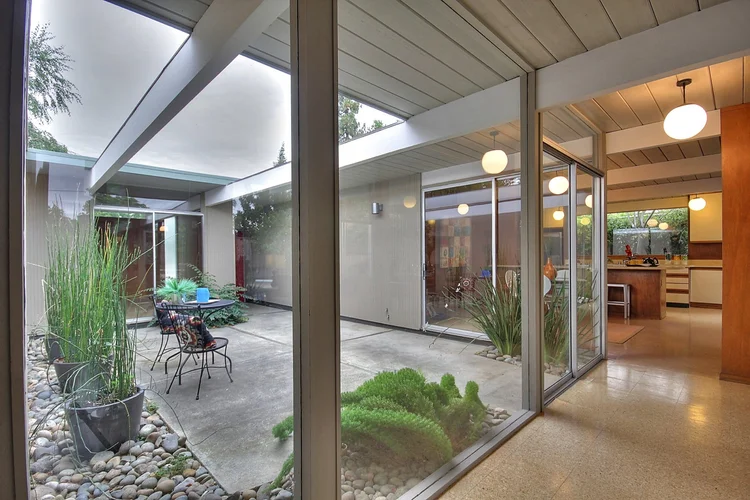
Fairglen, San JoseAtrium and kitchen · Sold 2013 
Palo Verde, Palo AltoLiving room · Sold 2024 
Fairgrove, CupertinoKitchen · Sold 2023
Listing photographs of homes sold by the Boyenga Team. More homes we’ve sold
See our portfolio