
Eichler tracts
Southern California Eichler Tracts: Orange, Granada Hills and Thousand Oaks
Joseph Eichler built most of his houses around San Francisco Bay. From 1960 to 1966 his company, Eichler Homes, also built in three places in Southern California: the City of Orange, Granada Hills in Los Angeles, and Thousand Oaks. This guide takes the five tracts one at a time: when each was built, how many homes it has, who designed it and whether it is now a historic district.
It is a companion to our records page, Eichler Homes in Southern California: Tracts and Records, which lists tract numbers, model codes and records offices. This page is the story: dates, counts, architects and districts. Every figure comes from a source listed at the end, and where two sources disagree we say which says which.
By the City of Orange’s account, Eichler had sold close to 2,000 homes by the mid-1950s and went on to build more than 11,000 across California. Wikipedia counts more than 11,000 houses in nine communities in Northern California between 1949 and 1966, plus the houses in three communities in the south. The Southern California tracts came late in that run: Eichler Homes filed for bankruptcy in 1967.
The five tracts at a glance
Three are in Orange, one is in Los Angeles and one is in Thousand Oaks. Counts and dates are given as the named source gives them.
Orange · 1960
Fairhaven
- Built
- Completed 1960
- Size
- 40 acres, 140 homes
- Plans
- Variations of eight basic models
- Status
- Local historic district
The first Eichler tract in Orange. The city’s history says the shed-style roof is unique to this tract.
On our site: Orange in our historic districts guide
Orange · 1962
Fairmeadow
- Built
- 1962 in the city’s history; 1960–1961 in an architect’s project index
- Size
- 34 acres, 119 homes (Wikipedia gives 123)
- Plans
- Five models and three one-off designs
- Designers
- Eichler’s three main firms; most by Anshen & Allen
- Status
- Local historic district
The second Orange tract, in the central part of the city.
On our site: Anshen & Allen profile
Orange · 1964
Fairhills
- Built
- 1964 in the city’s history; 1963–1964 and 1966 in the project index
- Size
- 23 acres, 80 houses
- Plans
- Eight designs
- Designers
- Claude Oakland and Jones & Emmons
- Status
- Local historic district
Planned for 183 homes in two phases. The second phase was canceled and the remaining graded lots were sold.
On our site: Claude Oakland profile
Granada Hills, Los Angeles · 1962–1964
Balboa Highlands
- Built
- 1962–64 per Los Angeles City Planning; 1961–1963 in the project index
- Size
- 109 homes, per Wikipedia
- Designers
- A. Quincy Jones, Frederick Emmons and Claude Oakland
- Status
- Historic Preservation Overlay Zone, adopted 2010
Los Angeles City Planning calls it the only Eichler development in Los Angeles County.
On our site: Jones & Emmons profile
Thousand Oaks · mid-1960s
Conejo
- Built
- 1964–1966 per Wikipedia; 1963 and 1965–1966 in the project index
- Size
- 103 homes, per Wikipedia
- Site plan
- Jones & Emmons, per the project index
- Status
- No district named in the sources we read
The project index calls the tract Conejo. Wikipedia gives the name “Eichler Homes In Conejo Village.”
On our site: Tract and model records
A note on the count. Los Angeles City Planning speaks of three Eichler tracts in Southern California, with Orange as one of the three. Counted tract by tract, Orange has three, which makes five.
Orange: Fairhaven, Fairmeadow and Fairhills
Orange has three Eichler tracts, built one after another. The city’s own history, a story map titled “The Eichler Tracts of Orange,” says Eichler broke ground there between 1960 and 1964. It gives a total of 305 homes for the three tracts; its own tract-by-tract figures (140, 119 and 80) add up to 339. We print the tract figures as the city gives them.
Fairhaven came first. The city describes a 40-acre tract, completed in 1960, with 140 homes based on variations of eight basic models. It names the LA-81, LJ-115 and LJ-124 plans among the most common. Most of the homes have flat or broad gable roofs, and some have a shed-style roof that the city calls unique to this tract. More than 8,000 people came to the grand opening on February 6, 1960. The city’s history says the success of Fairhaven paved the way for the two later Orange tracts and for the tracts in Thousand Oaks and Granada Hills.
Fairmeadow, in the central part of the city, was second. The city dates it 1962 and counts 119 homes on 34 acres, in five models and three one-off designs. It says the homes were designed by Eichler’s three main architectural firms, with most of them by Anshen & Allen. Two other sources differ on details: Wikipedia’s article on Joseph Eichler gives 123 homes, and an architect’s project index held at UC Berkeley dates its Fairmeadow records 1960–1961.
Fairhills was the last of the three. It covers 23 acres and has 80 houses in eight designs by Claude Oakland and Jones & Emmons. The city says the tract was planned to be much larger, 183 homes in two phases. Sales were slower than expected and the company’s money troubles were growing, so the second phase was canceled and the remaining graded lots were sold. The city dates Fairhills 1964; the project index dates its Fairhills records 1963–1964 and 1966.
The city’s history also lists what marks an Eichler in these tracts:
- Flat and gabled roofs, floor-to-ceiling glass and atriums.
- A street side that stays closed, with frosted glass and few windows, and a back that opens fully to the yard.
- Post-and-beam framing, which needed fewer parts and so was faster and cheaper to build.
- In Fairmeadow and Fairhills, curved and angled streets, a plan the city ties to Eichler Homes developments.
For a longer checklist, see how to tell an Eichler house.
Fairhills was close to the end for the company. The city’s history says that from 1963 to 1967 Eichler Homes built five high-density housing projects, among them the Eichler Summit building on Russian Hill. Cost overruns on those projects overwhelmed the company, and in 1967, three years after Fairhills was finished, Eichler Homes filed for bankruptcy.
Granada Hills: Balboa Highlands
Balboa Highlands is in Granada Hills, in the north San Fernando Valley. Los Angeles City Planning says it was built from 1962 to 1964 and calls it the only Eichler development in Los Angeles County. It credits the design to A. Quincy Jones, Frederick Emmons and Claude Oakland, and describes homes built around an atrium reached through sliding glass doors.
The city’s page gives no home count. Wikipedia’s article on Joseph Eichler gives 109. The project index for Claude Oakland’s firm lists the subdivision in five units and dates its records 1961–1963. The tract numbers for those five units are on our records page.
The City of Orange’s history adds one more point about this tract. In Southern California, it says, Eichler Homes is credited with the integration of tract housing, beginning with Balboa Highlands. There is more on that policy below.
Thousand Oaks: Conejo
The Thousand Oaks tract has the thinnest record of the five in the sources we could read. The City of Orange and Los Angeles City Planning both name Thousand Oaks as an Eichler location, and neither says more.
The project index lists the tract as Conejo, with Eichler Homes, Inc. as developer and Jones & Emmons for site planning, and dates its records 1963 and 1965–1966. Wikipedia’s article on Joseph Eichler calls the tract “Eichler Homes In Conejo Village,” counts 103 homes built between 1964 and 1966, and says the newer portion was marketed as Expo/West. Its article on A. Quincy Jones lists a Joseph Eichler housing development in Thousand Oaks among his projects.
We found no city page for this tract that we could read, so this guide names no historic district here. That is a gap in our reading, not a finding about the tract.
Who designed them
Three names run through these tracts.
Anshen & Allen designed the first Eichlers; Wikipedia dates the first prototypes to 1949. In Orange, the city says most of Fairmeadow is theirs.
Jones & Emmons was the Los Angeles partnership of A. Quincy Jones and Frederick Emmons. Wikipedia dates it from 1951 to Emmons’ retirement in 1969 and says that, by Emmons’ estimate, their designs are reflected in some 5,000 of Eichler’s homes. The finding aid for the Oakland & Imada Collection calls them “Eichler’s architects in southern California,” and the project index credits them with site planning on each of the four subdivisions it lists here.
Claude Oakland left Anshen & Allen in 1960 to form his own firm. Orange credits him, with Jones & Emmons, for Fairhills, and Los Angeles City Planning names him among the designers of Balboa Highlands.
A note on dates. The project index covers one firm’s files, Claude Oakland’s, and its dates are the dates on those project records. They do not always match the cities’ dates, as the cards above show. We print both and do not pick one. For the wider picture, see which architects designed which Eichlers.
Historic districts and design standards
Four of the five tracts carry a local historic designation.
Orange. The city’s history traces the steps. Homeowners formed Eichler associations and wrote booklets with tips on maintaining the homes. A city survey in 2005 identified the three tracts as potential historic districts. The 2010 general plan update set a goal of designating them. In 2016 the City Council received a petition with more than 80% of Eichler residents in support. By 2018 the city had moved forward with overlay zones and design standards. The city’s Historic Districts page gives 2018 as the year the three tracts were designated; one passage of the story map says 2019. Today, the city says, any project that affects the exterior of an Eichler home in these tracts must comply with the Orange Eichler Design Standards.
Granada Hills. Balboa Highlands is a Historic Preservation Overlay Zone, adopted by the Los Angeles City Council in 2010. City Planning calls it the first post-World War II neighborhood in the San Fernando Valley to achieve historic district status.
If you own a home in one of these districts, ask the city’s planning office what review applies before you plan exterior work. For how districts like these come about, see our guides to mid-century modern historic districts and starting a mid-century historic district, and is my house historic?
Eichler’s open housing policy
The City of Orange’s history says that from the company’s start, Eichler Homes operated an “open housing” policy, selling to buyers of every racial and ethnic group, at a time when other post-war developers often used restrictive covenants to keep minority buyers out.
Our two sources tell the 1958 story a little differently. The City of Orange says the National Association of Home Builders publicly opposed a court ruling that struck down specific racially discriminatory housing practices, and that Eichler publicly resigned from the association. Wikipedia says he resigned in 1958 when the association refused to support a non-discrimination policy. Both agree on the resignation and the year.
In 1963, the city’s history says, Eichler testified before Congress, using the record of his own company to answer the claim that integrated housing lowered home values. For the longer story, see our history of Eichler and open housing.
Not on this list: Palm Springs
Wikipedia’s list of Southern California Eichler developments also names Palm Springs, where it says building started in 2015 based on Eichler’s blueprints. Those are new houses, begun long after Eichler Homes filed for bankruptcy in 1967, so they are not counted among the five tracts here. For Palm Springs buildings of the mid-century years, see our Palm Springs mid-century modern landmarks.
About the sources
The three city pages were read by hand on November 12, 2026, the archive index and finding aid on November 9, 2026, and the two Wikipedia articles on November 16, 2026:
- City of Orange, “The Eichler Tracts of Orange” (story map), read November 12, 2026
- City of Orange, Historic Districts, read November 12, 2026
- Los Angeles City Planning, Balboa Highlands Historic Preservation Overlay Zone, read November 12, 2026
- UC Berkeley Environmental Design Archives, Oakland & Imada Collection (project index), read November 9, 2026
- Online Archive of California, finding aid for the Oakland & Imada Collection, read November 9, 2026
- Wikipedia, “Joseph Eichler”, read November 16, 2026
- Wikipedia, “A. Quincy Jones”, read November 16, 2026
Wikipedia can be edited by anyone, so where a figure comes only from Wikipedia this page says so. Where two sources give different dates or counts, both are printed with their source.
This page prints no prices and no street addresses. It is a history guide, not a market report.
Related guides: Southern California modern architects, A to Z · California mid-century modern timeline · Los Angeles mid-century modern landmarks · Preservation guides
From our listings
Bay Area Eichler homes we’ve sold
Two atriums, a living and dining room under exposed beams, and three backs of houses with walls of glass, at Eichler homes we’ve sold in Fairglen, in San Jose; Fairbrae and Rancho Verde, in Sunnyvale; Palo Verde and Greenmeadow, in Palo Alto; and Fairgrove, in Cupertino. These are Bay Area homes, and none is in the tracts on this page.
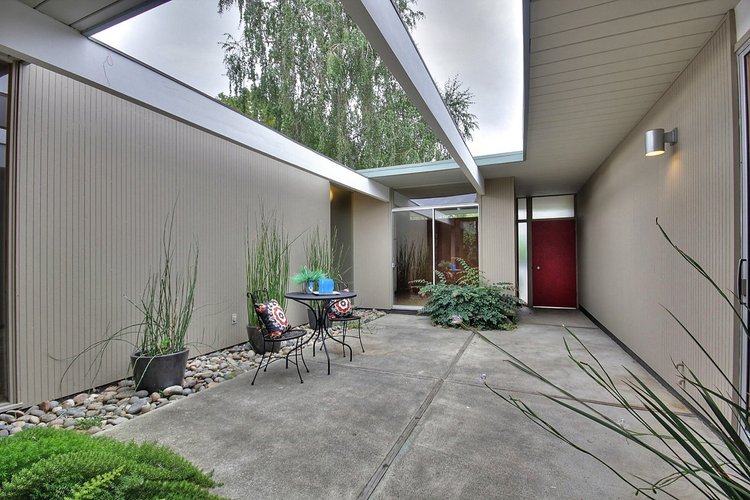
Fairglen, San JoseOpen atrium · Sold 2013 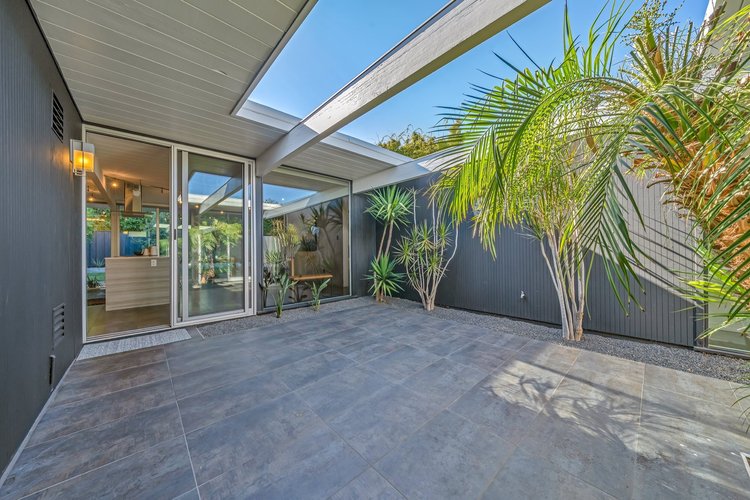
Fairbrae, SunnyvaleOpen-air atrium · Sold 2023 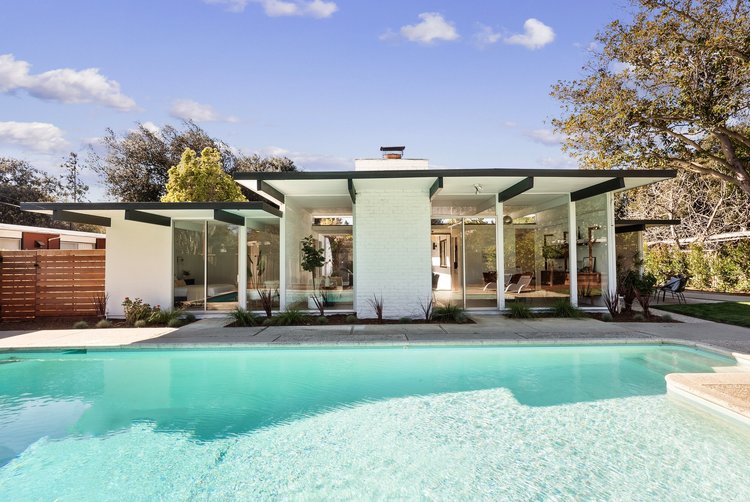
Rancho Verde, SunnyvalePool · Sold 2021 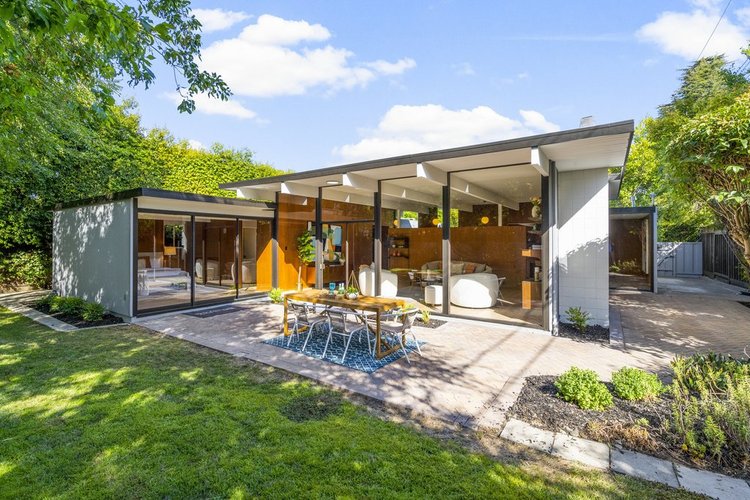
Palo Verde, Palo AltoBack lawn · Sold 2024 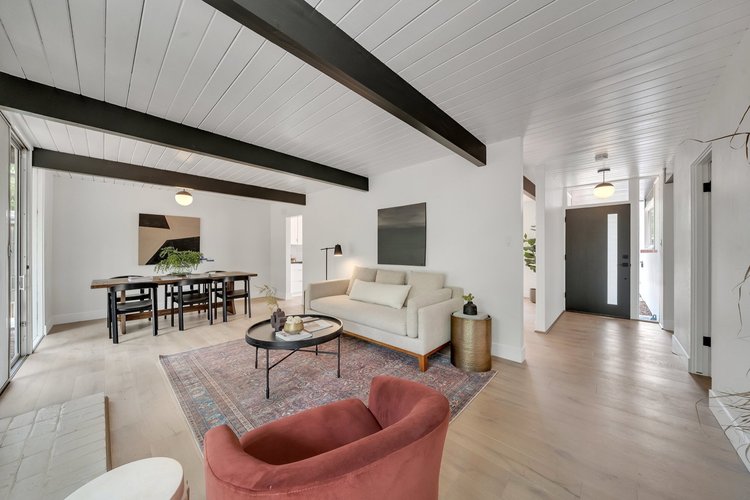
Fairgrove, CupertinoLiving and dining room · Sold 2023 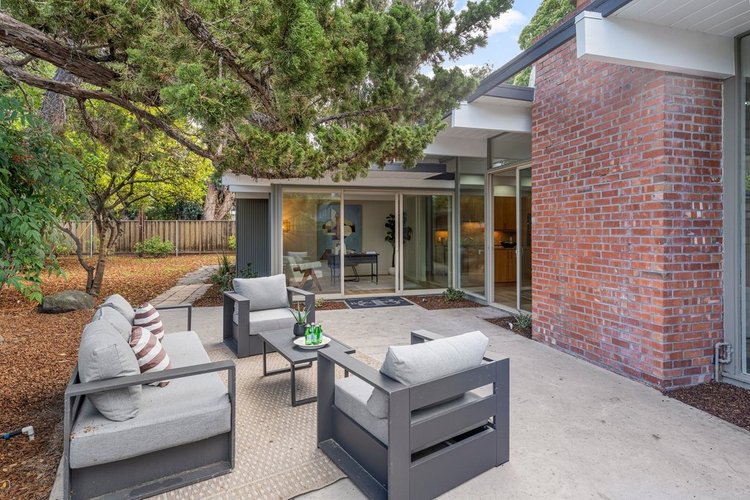
Greenmeadow, Palo AltoPatio and brick chimney · Sold 2026
Listing photographs of homes sold by the Boyenga Team. More homes we’ve sold
See our portfolio