
Eichler history
Joseph Eichler and Open Housing: A Short History
Joseph Eichler’s company sold its houses to any buyer who qualified, of any race or religion, in years when other post-war developers often used restrictive covenants to keep minority buyers out. In 1958 he resigned from the national home builders’ association over the issue.
This page sets out what two sources say about that policy and that resignation. It then lists the court rulings and laws on housing discrimination that came before and after, from 1948 to 1968.
Every date and figure comes from a source listed at the bottom. Where the sources tell the story differently, both versions are printed.
The policy: homes for any buyer who qualified
The City of Orange has three Eichler tracts and has written their history. That history says Eichler Homes ran an “open housing” policy from the company’s start, so that buyers from all racial and ethnic groups could purchase its homes. It adds that this set the company apart from other post-war developers, who often used restrictive housing covenants to stop minority buyers from purchasing.
Wikipedia’s article on Eichler puts it this way: he set a non-discrimination policy and offered homes for sale to anyone, of any religion or race. It also gives one of his stated aims, which was to build planned communities that were inclusive and diverse.
The city’s history says this was not advertised, and that for most of the company’s life Eichler did not look for attention for the policy. He thought a reputation as a champion of equal housing would get in the way of a longer plan: to prove that integrated housing was profitable.
The size of the company is part of the story. Wikipedia says that between 1949 and 1966 the company built more than 11,000 houses, in nine communities in Northern California and three in Southern California. The City of Orange also puts the total at over 11,000 homes.
1958: the break with the home builders’ association
The National Association of Home Builders is the builders’ trade group. Wikipedia says it was founded in 1942 and is today a federation of more than 700 state and local home builder associations. Our two sources tell the 1958 story a little differently:
- City of Orange: the association publicly opposed a court ruling that struck down specific racially discriminatory housing practices, and Eichler answered by resigning in public. The city’s history does not name the ruling.
- Wikipedia: he resigned in 1958 when the association refused to support a non-discrimination policy.
Both agree on the resignation and the year. The city’s history says the resignation made national news, and it shows a clipping from House and Home magazine, dated about 1958, that reported it.
According to the city, Eichler did not set out to shame other builders. He chose to show his own economic success as the way to persuade his peers to accept desegregation.
The argument: integration was good business
The city’s history gives Eichler’s view like this. Home builders and the real estate industry had real power to push back against racism in America. A successful business that proved integration was profitable could change the national conversation about fair housing.
In 1963, the city says, Eichler testified before Congress. He used the record of his own company to answer the belief that integrated housing lowered home values. Members of Congress and experts referred to his model in their deliberations, the history says, and it played a contributing part in the design of fair housing legislation.
The same history credits Eichler Homes with setting a precedent for equal housing, well ahead of much of the civil rights legislation of the late 1950s. In Southern California, it says, the company is credited with the integration of tract housing, beginning with the Balboa Highlands tract. Our Southern California Eichler tracts guide covers that tract, in Granada Hills, and the three in Orange.
The photograph from Lucas Valley
The city’s history describes a photograph taken in 1963 of two young residents of the Eichler neighborhood in Lucas Valley, in Marin County. It reports that Eichler called the picture “the most eloquent expression of the philosophy of my organization.”
Wikipedia’s article on Lucas Valley-Marinwood says Eichler also built the Lucas Valley community center and pool as a centerpiece of the neighborhood. For the tract itself, see the history of the Lucas Valley Eichlers.
The law before and after: eight dates
From the 1948 ruling on restrictive covenants to the federal Fair Housing Act of 1968. The dates of the laws and rulings come from Wikipedia.
1948
Shelley v. Kraemer
- Who
- U.S. Supreme Court
- What
- Courts may not enforce racially restrictive housing covenants
The court held that private parties could keep to such a covenant among themselves, but that a court enforcing one was state action, barred by the Equal Protection Clause. Source: Wikipedia.
1949
The first Eichler prototypes
- Who
- Joseph Eichler
- What
- First prototype houses built, according to Wikipedia
The City of Orange says the company ran an open housing policy from its inception.
On our site: Joseph Eichler profile
1958
Eichler resigns from the home builders’ association
- Who
- Joseph Eichler and the National Association of Home Builders
- What
- A public resignation
Both sources give the year. They differ on what the association had done; both versions are set out above.
1959
Unruh Civil Rights Act
- Who
- State of California; named for its author, Jesse M. Unruh
- What
- Bars unlawful discrimination by California businesses, housing accommodations included
The act is codified as Civil Code section 51. Source: Wikipedia.
1963
Rumford Fair Housing Act
- Who
- California Legislature; drafted by William Byron Rumford and signed by Governor Pat Brown
- What
- Landlords could not deny people housing because of ethnicity, religion or national origin
In the same year, the City of Orange says, Eichler testified before Congress on the record of his own company. Source for the act: Wikipedia.
1964
Proposition 14
- Who
- California voters; sponsored by the California Real Estate Association
- What
- Amended the state constitution to nullify the Rumford Act
The measure passed with 65% of the vote. The sponsoring association is now named the California Association of Realtors. Source: Wikipedia.
1966–1967
The courts strike down Proposition 14
- Who
- California Supreme Court, then the U.S. Supreme Court
- What
- Proposition 14 held unconstitutional under the Equal Protection Clause
The state court ruled 5–2 in 1966. The U.S. Supreme Court affirmed in 1967 in Reitman v. Mulkey. The proposition itself was repealed by Proposition 7 in November 1974. Source: Wikipedia.
1968
Fair Housing Act
- Who
- U.S. Congress; enacted April 11, 1968 and signed by President Lyndon B. Johnson
- What
- Titles VIII and IX of the Civil Rights Act of 1968
As first enacted it barred discrimination in the sale, rental and financing of housing on the basis of race, color, religion and national origin. Source: Wikipedia.
Read in order, the cards show where the 1958 resignation sat: ten years after the courts stopped enforcing restrictive covenants, and before the state and federal laws of 1959, 1963 and 1968.
After 1968
Eichler Homes filed for bankruptcy in 1967, the year before the federal law. Eichler, born June 25, 1900, died July 1, 1974.
The Fair Housing Act has been widened since it passed. Wikipedia says sex was added as a protected characteristic in 1974, and that disability was among the additions made in 1988. The law is administered and enforced by the Office of Fair Housing and Equal Opportunity, within the U.S. Department of Housing and Urban Development.
What the sources do not tell us
- The City of Orange does not name the court ruling that the association opposed in 1958.
- Neither source names the committee Eichler testified before in 1963.
- Wikipedia’s article on the National Association of Home Builders does not mention Eichler or the resignation.
We have left those points open and have not filled them in from memory.
Fair housing and our team
We sell Eichler and other mid-century modern homes in the Bay Area, and we follow fair housing law with every buyer and every seller. The team’s own statement is on our main site: Boyenga Team fair housing statement.
About the sources
The City of Orange story map was read by hand on November 12, 2026, and the Wikipedia articles on November 16, 2026:
- City of Orange, “The Eichler Tracts of Orange” (story map), read November 12, 2026
- Wikipedia, “Joseph Eichler”, read November 16, 2026
- Wikipedia, “National Association of Home Builders”, read November 16, 2026
- Wikipedia, “Shelley v. Kraemer”, read November 16, 2026
- Wikipedia, “Unruh Civil Rights Act”, read November 16, 2026
- Wikipedia, “1964 California Proposition 14”, read November 16, 2026
- Wikipedia, “Civil Rights Act of 1968”, read November 16, 2026
- Wikipedia, “Lucas Valley-Marinwood, California”, read November 16, 2026
Wikipedia can be edited by anyone, so where a date or figure comes only from Wikipedia this page says so. Where the two sources on Eichler tell the story differently, both versions are printed with their source.
This is a history page, not legal advice.
Related guides: Joseph Eichler profile · Southern California Eichler tracts · California mid-century modern timeline · Eichler architects: who designed which · Preservation guides
From our listings
Eichler homes we’ve sold in the Bay Area
Atriums, a courtyard and living rooms that open to them through walls of glass, at Eichler homes we’ve sold in Fairbrae, in Sunnyvale; Fairglen and Fairhaven, in San Jose; Fairgrove, in Cupertino; and Palo Verde, in Palo Alto. The photos show homes our team sold, not places named in the history on this page.
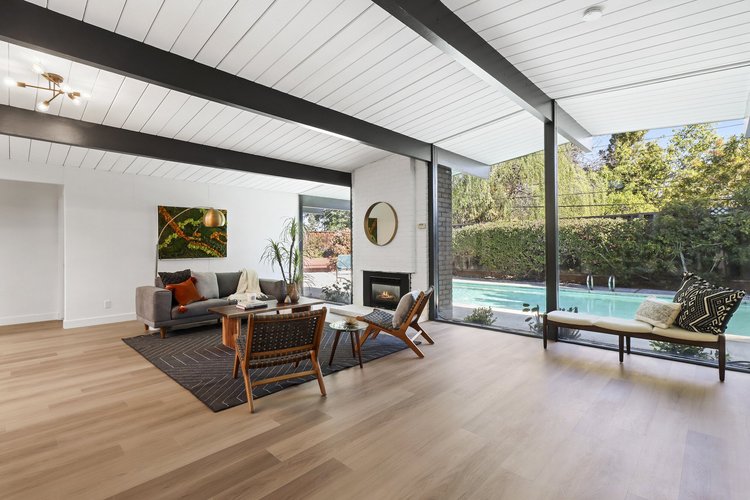
Fairbrae, SunnyvaleLiving room · Sold 2022 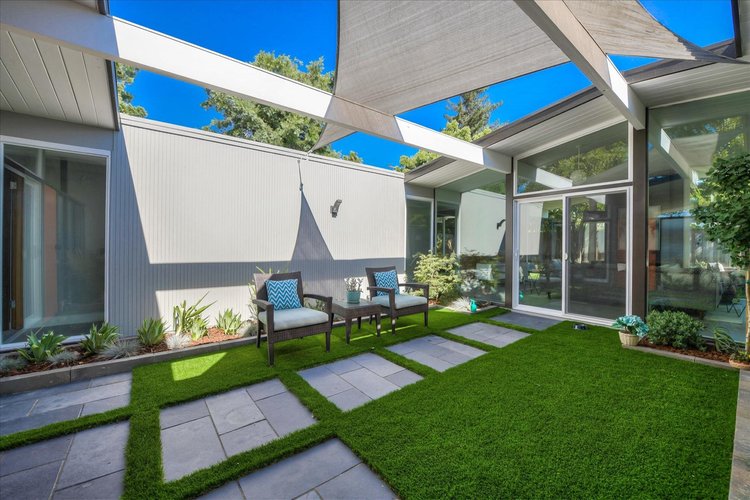
Fairglen, San JoseAtrium · Sold 2019 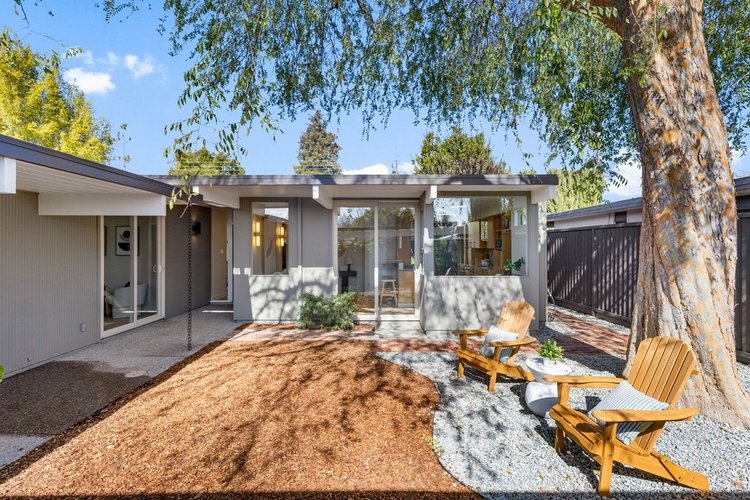
Fairgrove, CupertinoCourtyard · Sold 2026 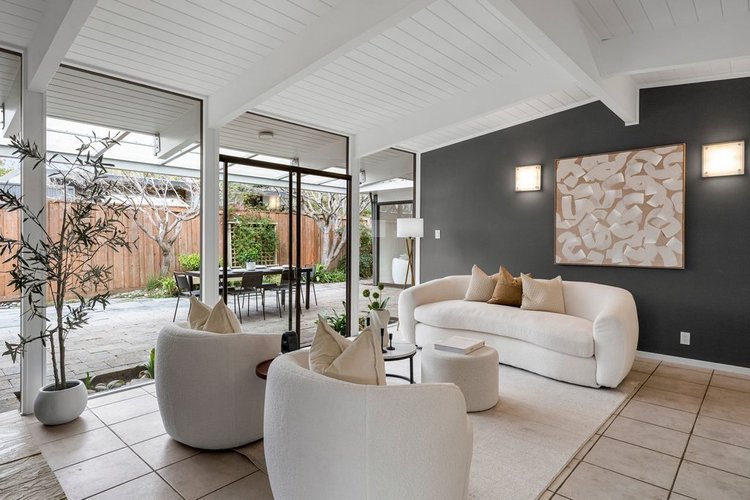
Palo Verde, Palo AltoLiving room and atrium · Sold 2026 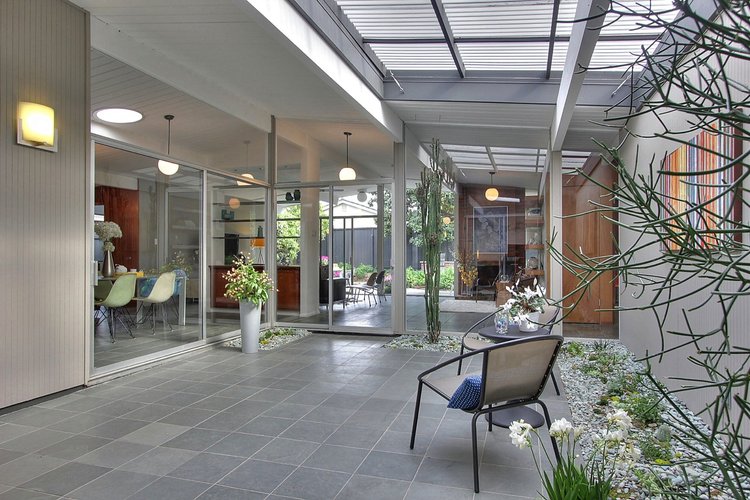
Fairhaven, San JoseAtrium and glass walls · Sold 2015 
Fairglen, San JoseAtrium · Sold 2026
Listing photographs of homes sold by the Boyenga Team. More homes we’ve sold
See our portfolio