
Cooling a flat roof house with no attic is a different job from cooling a house with a pitched roof and ducts overhead. Palo Alto's Eichler Neighborhood Design Guidelines, in the city's final draft dated February 2018, describe the original houses as lacking insulation and attic space, with single-pane windows and large expanses of glass, and say those conditions can leave the interior uncomfortable at times.
To cool an Eichler or a similar post-and-beam house, take the parts in order: the roof, the glass, shade outside, air movement, then equipment and its permit. The U.S. Department of Energy's home cooling page, last updated May 14, 2026, says a combination of proper insulation, energy-efficient windows and doors, daylighting, shading and ventilation will usually keep a home cool with low energy use in all but the hottest climates.
The roof: what a cool surface does and does not do
The Department of Energy's Energy Saver guide (July 2022) describes a cool roof as one that reflects sunlight and gives off heat efficiently. The same July 2022 guide says standard roofs can reach 150°F or more in summer sun, and that a cool roof can lower the roof's temperature by up to 50°F.
The Department's Guidelines for Selecting Cool Roofs (July 2010) add these points:
A cool roof is not a substitute for sufficient insulation.
Because it reduces heat gain all year, a cool roof can raise the energy needed for heating.
A bright roof can reflect light and heat into the higher windows of a taller building next door.
Spray polyurethane foam roofs rely on a protective coating, and those coatings are traditionally reflective.
California's Energy Code has its own rules for reroofing, and our guide to Title 24 reroof requirements for flat and low-slope roofs covers them.
The glass: coverings and film
The Energy Saver guide's summer advice for glass is plain: close the window coverings during the day to keep out the sun's heat. It also suggests sun-control or other reflective films on east- and west-facing windows to reduce solar heat gain.
Palo Alto's guidelines, which describe themselves as a voluntary planning tool, suggest reducing the need for air conditioning with window coverings, plantings that provide shade and window films. They note that exterior or interior roller shades were original window treatments in Eichler homes. On film, they advise studying product literature and samples first, because a reflective effect is discouraged. Our guide to window coverings for mid-century homes goes through shade types.
Shade outside the house
Shade that stops the sun before it reaches the roof and glass is the next layer. The Energy Saver guide says:
Deciduous trees with high, spreading crowns on the south side of a house shade the roof in summer and let the sun's warmth through in winter.
Trees, shrubs and groundcover shade the ground and pavement around a house, which cools the air before it reaches the walls and windows.
Shrubs and trellised vines can shade walls and windows.
The guide also says to use plants adapted to the local climate. Before planting close to the house or removing a tree to make room for equipment, ask your city whether any tree rules apply.
Moving air: open windows and fans
A Department of Energy building science page describes natural ventilation, also called night flushing: night air cools a home and its thermal mass, which will often keep the home cool through much of the next day. The page ties the method to climates with cool nights and regular breezes, and says it should not be used when outdoor air quality is poor.
On fans, the Energy Saver guide (July 2022) says:
Ceiling fans cool by creating a wind chill effect, and using one allows the thermostat to be set about 4°F higher with no loss of comfort. In summer the fan runs counterclockwise, and it is turned off when no one is in the room.
Whole-house fans pull cool air through the house and exhaust warm air through the attic. If your house has no attic, ask an installer whether any fan of this kind suits your roof.
Evaporative coolers work well where the air is hot and humidity is low.
Fans have a limit. The federal Ready.gov page on extreme heat (last updated July 16, 2026) advises against relying on a fan as the primary cooling device, because fans move air but do not lower body temperature.
Cooling equipment for a house without ducts
When shade and air movement are not enough, the Energy Saver guide lists the air conditioner options as room air conditioners, ductless mini-split or multi-split systems, and central air conditioning. Palo Alto's guidelines describe the original heating as a radiant system placed in the concrete slab, so ask a contractor whether your house has any ducts a cooling system could use.
The guide describes ductless mini-split heat pumps as air-source heat pumps that can be installed in homes or additions without ducts and that suit zoning or individual rooms. A ductless system has one or more indoor units on an interior wall or ceiling and an outdoor unit, with refrigerant carrying heat between them.
Sizing matters: the Energy Saver guide says an oversized air conditioner works less efficiently and less effectively than a smaller unit of the right size. Our guide to heat pumps for mid-century homes covers system types, the electrical panel and Bay Area air district rules.
What needs a permit and field verification
The California Energy Commission's 2025 single-family HVAC page states the starting point: installing a space-conditioning appliance, other than a plug-in room appliance, requires a building permit. The 2025 Energy Code applies to permit applications filed on or after January 1, 2026, and its HVAC rules cover alterations to existing houses as well as new ones. The same page, as of November 2026, says:
New HVAC systems require load calculations.
When an old system is removed, the refrigerant has to be recovered by a technician who holds an EPA 608 Type II or Universal certificate.
A split system sold for do-it-yourself installation still requires refrigerant charge verification, even though it is charged at the factory.
Plug-in room air conditioners and room heat pumps have no Energy Code efficiency requirements, though they must meet state and federal appliance efficiency rules.
Field verification is done under the Energy Code Compliance (ECC) Program, which the Commission says replaces the HERS Program for field verification and diagnostic testing under the 2025 code. The installing contractor and an ECC-Rater carry out the tests listed on the project's certificate of compliance, and a failed test has to be corrected until it passes. The Commission says this verification is part of the permit process enforced by the local building department, and that the completed documents are left in the home for the owner.
City and county building departments enforce the state codes, and local rules differ. One city's example: the City of Milpitas residential handout on air conditioning and heat pumps, dated August 10, 2026, calls for a mechanical permit, an electrical permit as well when the equipment is new or an electrical upgrade is required, and units kept at least 3 feet from any side or rear property line. Other cities set their own rules, so confirm them with your building department before work starts.
Where the equipment goes on an Eichler
What shows from the street is a design question as much as a mechanical one. Palo Alto's Eichler guidelines (the city's final draft dated February 2018) are voluntary, so the points below are guidance, not requirements:
Consider options that do not put air conditioning equipment in a visible roof location.
Where exterior equipment is needed, the preferred place is at ground level, to the rear or side of the house, with appropriate screening from the street.
Window-mounted air conditioners are discouraged on front facades.
Explore ductless systems such as mini-splits, and investigate low-profile ducts, which may be able to sit under new roofing materials. Rectangular ducts are preferred to round ones because their profile shows less from the street.
Other cities may have their own Eichler guidelines or standards, so ask your planning department which documents apply to your street. Our Eichler renovation guide indexes the other owner guides on this site.
This guide is general information as of November 2026, not engineering, legal or code advice. Rules change and cities amend the state codes, so confirm requirements with your building department and a licensed professional before you buy equipment or sign a contract.
From our listings
Overhangs and shaded patios at homes we’ve sold
Four photos from homes the Boyenga Team has sold in Sunnyvale and San Jose: deep roof overhangs over glass walls, a slatted pergola over a patio and a slatted roof over another. A photo shows the shade. It cannot show the insulation in a roof, the roofing on top of it or the equipment that cools the house.
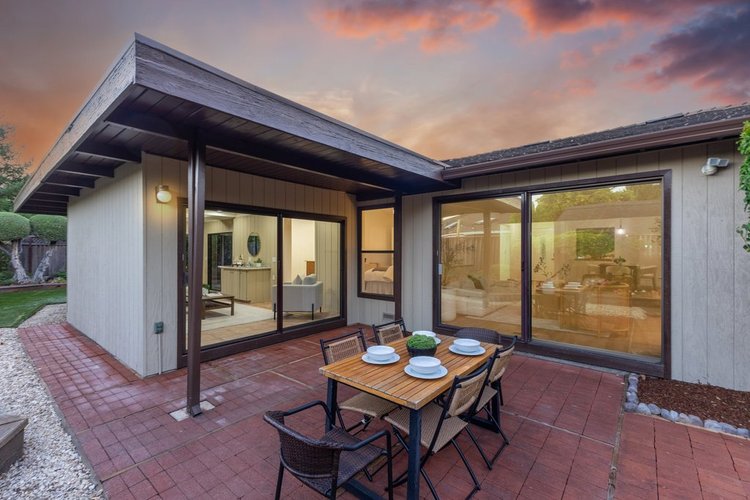
Ponderosa Park, SunnyvaleDeep roof overhang over a brick patio · Sold 2025 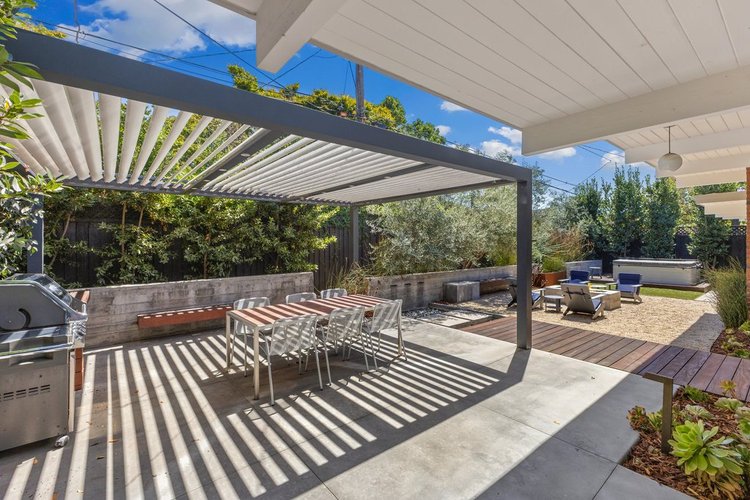
Fairglen, San JosePatio under a slatted pergola · Sold 2024 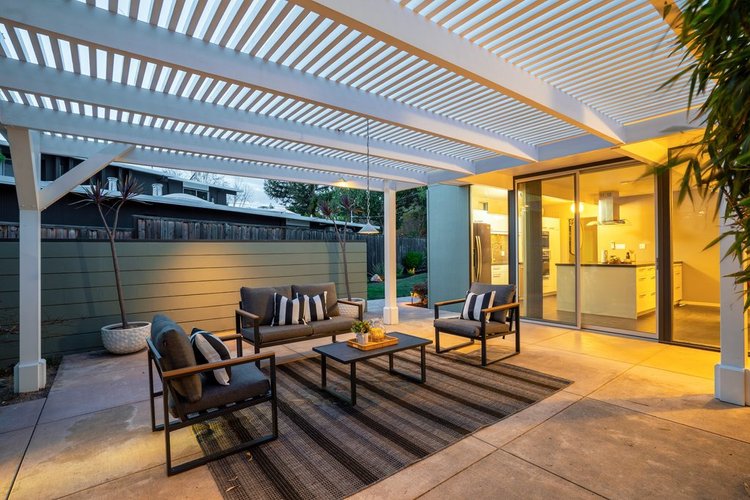
Fairglen, San JoseCovered patio with a slatted roof · Sold 2025 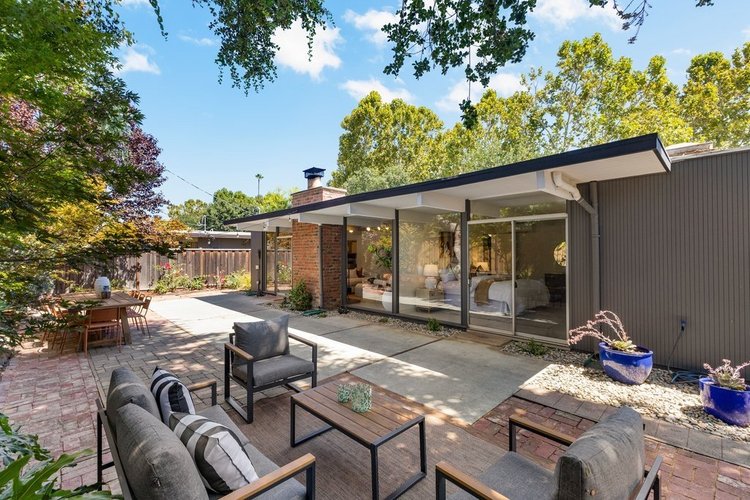
Fairglen, San JoseWall of glass under a deep overhang · Sold 2026
Listing photographs of homes sold by the Boyenga Team at Compass. More homes we’ve sold
See our portfolioFrequently asked questions
Can central air conditioning be added to a flat-roof house with no attic?
Palo Alto's voluntary Eichler guidelines (the city's final draft dated February 2018) describe the original houses as lacking attic space. They suggest exploring ductless systems such as mini-splits, or low-profile ducts that may be placed under new roofing materials. The California Energy Commission says installing a space-conditioning appliance, other than a plug-in room appliance, requires a building permit, so work out the layout with a licensed contractor before you apply.
Do I need a permit for a mini-split in California?
The California Energy Commission's 2025 single-family HVAC page says installing a space-conditioning appliance, other than a plug-in room appliance, requires a building permit. It also says new HVAC systems require load calculations, and that a split system sold for do-it-yourself installation still requires refrigerant charge verification. Your city issues the permit and may add its own rules.
Are fans enough in a heat wave?
The Department of Energy's Energy Saver guide (July 2022) says ceiling fans cool by creating a wind chill effect. A Department of Energy building science page ties night air cooling to climates with cool nights and regular breezes. Ready.gov advises against relying on a fan as the primary cooling device in extreme heat, because fans do not lower body temperature. The same page advises working out ahead of time where in your community you can go to get cool.
Related reading
Insulating an Exposed Beam Ceiling: Above the Deck, Edges and Walls
Mid-Century Modern Window Replacement: Retrofit, Film and Title 24
Energy Efficiency in Mid-Century Homes: Planning Eichler Upgrades
More guides on this topic: Owning & Renovating a Mid-Century Modern Home
Thinking about cooling a mid-century home you own or want to buy? Call or text the Boyenga Team at Compass at (408) 373-1660 or (650) 383-8606, or contact the Boyenga Team to talk it through.