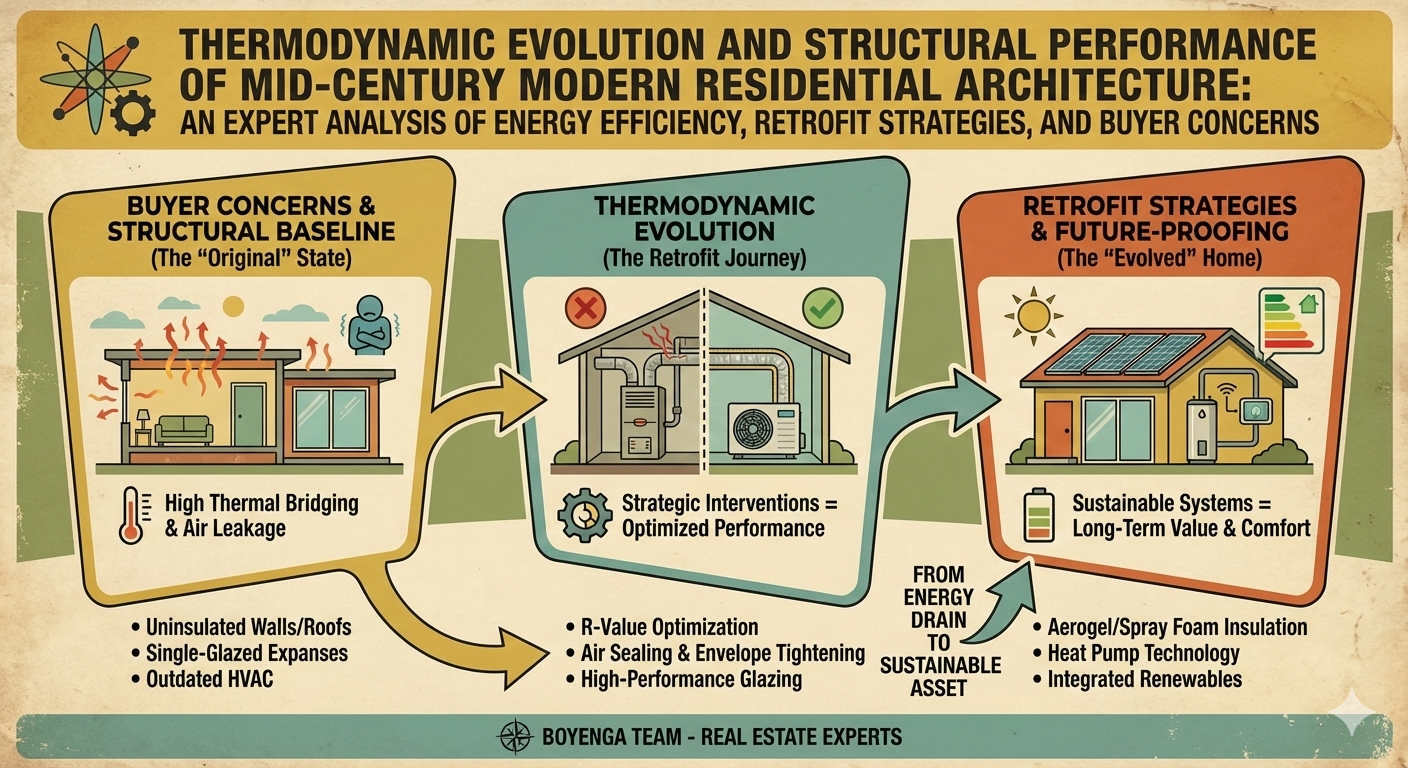
An Expert Analysis of Energy Efficiency, Retrofit Strategies, and Buyer Concerns from the Boyenga Team
Energy efficiency in mid-century homes starts with how they were built. A typical Eichler has no attic, a roof deck that doubles as the ceiling, walls of glass at the back and heat piped through the concrete slab. Each of those features limits where insulation and new equipment can go, and many upgrades bring in California's Energy Code and, in some tracts, local design rules.
This overview plans the whole house rather than one project at a time: which upgrades the code treats as repairs or alterations, what it requires for roofs, glass and heating, and what order makes sense. Each section links to our detailed guide. If you are still deciding how far to take a project, start with restore, remodel or rebuild.
How the house was built, and when the code applies
The National Register nomination for Palo Alto's Greenmeadow tract describes the standard Eichler: post-and-beam construction, floor-to-ceiling glass along the back wall, radiant heating as standard and no attic. The underside of the redwood roof decking is the ceiling, and the interior walls were mahogany veneer paneling. Palo Alto's Eichler guidelines list the maintenance issues residents raise, including flat roofs prone to leaks, single-pane glass, a lack of insulation and radiant heat they consider inefficient.
The 2025 Energy Code applies to permit applications filed on or after January 1, 2026. It covers additions and alterations but not repairs. A repair is maintenance that doesn't increase energy use; replacing a part the code regulates, such as a roof covering, a window or a heating system, is an alteration. When an alteration changes the envelope, mechanical systems or water heating, the state's compliance manual says a certificate of compliance (CF1R) goes in with the permit application.
Requirements depend on the climate zone. In the California Energy Commission's ZIP code list, the Palo Alto, Los Altos, Mountain View, Sunnyvale, Cupertino, Santa Clara, Campbell, Los Gatos, Saratoga and San Jose ZIP codes we checked are in Climate Zone 4, and the Menlo Park, Redwood City, San Carlos and San Mateo ones are in Climate Zone 3. Where a ZIP code spans more than one climate region, the city can assign one zone, so confirm yours.
The roof: insulation above the deck
With no attic, the practical place for roof insulation is above the deck, since insulating below it would cover the wood ceiling. The Greenmeadow nomination notes that tar-and-gravel roofs there have been replaced over the years with modified bitumen, single-ply sheeting and polyurethane foam, and Palo Alto's guidelines suggest exploring insulated roofing, which can often be combined with plain roofing such as single-ply or foam.
The code's roof rules apply when more than half of the roof surface is replaced, including a new layer laid over the old one. For low-sloped roofs, meaning a rise of less than 2:12:
Insulation. Climate Zone 4 requires R-14 continuous insulation or a roof assembly U-factor of 0.039. Climate Zone 3 has no requirement. Roofs that already have R-10 or more of continuous insulation are exempt, and in some cases the requirement drops to R-4 where added thickness would bring the base flashing below the manufacturer's minimum height.
Reflectance. In Climate Zone 4, new low-sloped roofing needs an aged solar reflectance of at least 0.63 and a thermal emittance of at least 0.75, or a solar reflectance index of 75. Insulation can be traded for reflectance, and with R-10 or more on the deck there's no reflectance requirement. Climate Zone 3 has no reflectance rule for these roofs.
Thickness is the design problem. Palo Alto's guidelines ask owners to keep the narrow profile of the roof edge, the overhangs and the exposed beam ends. San Jose's Eichler standards, in the version presented to the City Council, say minor changes to add insulation are generally acceptable if the roof keeps its original shape. Spray foam also needs a protective coating that is generally reapplied every 10 to 20 years. Our posts on foam roofs and above-deck insulation and Title 24 reroof requirements cover the details.
Glass: replacement windows and U-factor rules
Replacing a window or glass door with a new manufactured unit is an alteration, and the new unit has to meet the code's U-factor and solar heat gain coefficient (SHGC) limits. In Climate Zones 3 and 4 the maximum U-factor is 0.27, and Zone 4 also caps SHGC at 0.23. Two provisions matter for glass-heavy houses:
Small replacements. Replacing no more than 75 square feet of windows can use a U-factor up to 0.40, with an SHGC up to 0.35 in Zone 4.
New glass in old frames. Replacing only the glass in an existing sash and frame, or a sash in an existing frame, counts as a repair if the result performs at least as well as the original.
Palo Alto's guidelines prefer repairing original windows. When owners move to double-pane glass, they encourage reusing the existing sash and frames, and they discourage new vinyl windows and dividing the full-height rear glass into smaller units. Our window replacement guide covers frames, film, glazing rules and bedroom egress. For how the original glass walls and clerestories bring daylight into the house, see our guide to daylight in Eichler homes.
Heat: the radiant slab, heat pumps and gas rules
Radiant heat was standard in Greenmeadow and in Palo Alto's Green Gables tract. Palo Alto's guidelines recommend repairing a radiant system in place where feasible. They note that the copper pipes in some Eichlers may be repairable without removing concrete, while corroded steel pipes in others are much harder to fix. Our radiant heat guide walks through repair, replacement and retirement.
If you replace the system, three things shape the choice:
Heat pumps. The U.S. Department of Energy says heat pumps can deliver up to three times more heat than the energy they use, and that ductless mini-splits work in houses without ducts. Palo Alto's guidelines also suggest exploring ductless systems.
Ducts and the roofline. The Greenmeadow nomination counts readily visible ducts on the roof against a house's historic standing. Palo Alto suggests low-profile ducts that may fit under new roofing, and San Jose's standards ask that ductwork follow the roof form and stay low.
Electric resistance. Under the 2025 code, a replacement space heating system can't use electric resistance as its primary heat source, with exceptions when the existing system already does.
Gas equipment rules are changing too. The Bay Area Air District's zero-NOx rules apply only when equipment is replaced, not to a working unit. After amendments adopted November 4, 2026, the residential water heater compliance date is January 1, 2028, and the furnace rule's date is 2029. Before switching to electric equipment, Palo Alto Utilities advises having a licensed electrician evaluate the panel. See our posts on the Air District water heater rule and electrical panels and wiring.
Walls and air sealing
Palo Alto's guidelines note that heat escapes through exterior walls even when the windows are insulated, and suggest blown-in insulation that doesn't require removing the cladding. The DOE's Energy Saver guide suggests adding insulation whenever siding is replaced. It also recommends caulking and weatherstripping cracks and openings, sealing where pipes, ducts and wires pass through walls and ceilings, adding foam gaskets behind outlet and switch plates, and checking that fireplace dampers close.
Putting the upgrades in order, and rebates
Because so much of the code is triggered by replacement, the order of work matters as much as the list. One workable sequence:
Confirm your climate zone and pull the permit history.
Have the electrical panel evaluated before choosing electric equipment.
Add roof insulation when the roof is due for replacement, since that's when Zone 4's requirement applies anyway.
Choose a heating approach before the boiler or water heater fails.
Plan glass around the repair and small-replacement provisions and the city's design rules.
Incentives change often, so check official program pages before you sign a contract. As of November 8, 2026, the IRS page on the federal Energy Efficient Home Improvement Credit says it covers improvements made through December 31, 2025. The California Energy Commission's federal rebate page says HEEHRA appliance rebates for Phase I were fully reserved as of August 31, 2026, with Phase II availability to be announced, and it warns of scammers falsely claiming to represent the commission. This is general information, not legal or tax advice; confirm code requirements with your building department and tax questions with a tax professional.
Frequently asked questions
Do I have to insulate when I replace my flat roof?
In Climate Zone 4, yes, if more than half the roof is replaced: low-sloped roofs need R-14 continuous insulation or an equivalent U-factor unless an exception applies, such as existing R-10 insulation. Climate Zone 3 has no insulation requirement for roof alterations. Check your zone with the city first.
Can I keep my radiant heat?
Yes. Repairing a working system is a repair, and the Energy Code doesn't apply to repairs. If you replace the heating system, the new one can't rely on electric resistance as its main heat source unless the old one did.
Are double-pane windows required?
Only when you install new manufactured windows, which must meet the U-factor and SHGC limits or the small-replacement exception. New glass in existing sash and frames counts as a repair if it performs at least as well as the original. Nothing in the code requires replacing working windows.
The Boyenga Team at Compass, led by Eric and Janelle Boyenga, has been in Silicon Valley real estate since 1996, with 2,520+ homes sold and $2.6+ billion in sales. If you're planning upgrades to a mid-century house or weighing them before you buy, call or text (408) 373-1660 or (650) 383-8606, or contact the Boyenga Team.