
Tongue and groove ceiling repair in a mid-century modern house starts with a question that has little to do with carpentry: what is the surface made of, and what is on it? In a post-and-beam house the wood overhead can be the roof deck itself. In other rooms the ceiling may be acoustic tile, a sprayed or troweled texture, or wood that has been painted since the house was built.
This guide covers what to test before a ceiling is sanded, scraped, drilled or taken down, how repairs and finishes for wood decking are approached, and where acoustic ceiling tile and asbestos rules meet. Agency rules are described as of November 2026. They differ by city and by agency, so confirm the details for your address before work starts.
What the ceiling is made of
The National Register nomination for Greenmeadow, an Eichler tract in Palo Alto, describes those houses as they were built: the underside of the two-inch by eight-inch tongue-and-groove redwood roof decking is the ceiling, and the roofs have no attics. In the tract's community building it records ceilings that are exposed and stained on the underside of the decking, and it notes that the four-bedroom plans featured light-toned ceilings that made the rooms seem bigger.
Tongue and groove describes how the boards meet. The glossary in Palo Alto's Eichler Neighborhood Design Guidelines, the city's final draft dated February 2018, defines it as boards with a thin ridge on one edge and a slot on the other, fitting closely together. The glossary entry is written for wood siding. The guidelines are voluntary, and they encourage wood tongue-and-groove boards on the outside of a house without requiring them.
What to test before you disturb a ceiling
Asbestos. The US Environmental Protection Agency lists ceiling tiles among the building materials in which asbestos was used, and textured paint and patching compounds used on walls and ceilings among the places it may be found. EPA says you generally cannot tell whether a material contains asbestos by looking at it unless it is labeled.
The Bay Area Air District's asbestos rule, Regulation 11, Rule 2, names ceiling materials directly. Its definition of friable asbestos-containing material (section 11-2-222) gives acoustic ceiling material and ceiling tiles as examples. For residential buildings of four or fewer units the rule does not require a full survey, but it does require a sample and test when certain materials will be removed or disturbed, and acoustic ceiling material and acoustic plaster are on that list. The Air District's asbestos FAQ, updated June 4, 2025, adds that testing is still required when a job disturbs less than 100 square feet of suspect material. Outside the Bay Area Air District, ask your own air district which rules apply. Our guide to the asbestos survey before a remodel covers job numbers, notice periods and work practices.
Who takes the sample. The Air District FAQ says owners of residential buildings with four or fewer units may take their own samples if they take appropriate precautions. EPA does not recommend it and says a trained and accredited professional should do the sampling.
Bare wood. The same FAQ says construction materials made of uncoated wood, rubber, metal or glass are exempt from testing. If your wood ceiling has been painted, textured or covered, ask the Air District or a certified asbestos consultant whether it needs a test before you sand it.
Lead. EPA states that the federal government banned the sale of lead-based paint for use in homes in 1978, and that about three-quarters of US homes built before then still contain some. EPA recommends that a certified lead inspector or risk assessor test the surfaces to be renovated. EPA's answers on the federal renovation rule speak of paint or other surface coatings, so ask the tester whether a stained or varnished ceiling should be tested too.
Tongue and groove ceiling repair: stains and damaged boards
Where the ceiling is the underside of the roof deck, have the roof above a stained board checked before you treat the stain. The National Park Service's Preservation Brief 28, Painting Historic Interiors, says that before an interior is prepared for repainting, moisture coming in from failing roofs or gutters or from faulty plumbing should be identified and corrected. The Park Service's Preservation Briefs are guidance written for historic buildings, not rules for private houses. As general advice for a wood ceiling: fix the water first, let the wood dry, have the finish tested before sanding or cutting, then repair the board and match the finish.
Where a ceiling board is also the roof deck, ask a carpenter and a roofer how a damaged board would be replaced. The Contractors State License Board (CSLB) describes two classifications that bear on the job: the C-5 framing and rough carpentry classification includes installing roof decking and sheathing, and a C-39 roofing contractor installs products and repairs surfaces that seal, waterproof and weatherproof structures. Ask the city building department whether the repair needs a permit. Our post on Eichler roof replacement covers the layers above the deck.
Finishes: clear, stained or painted
As noted above, the Greenmeadow nomination records both a stained wood ceiling and light-toned ceilings in that tract.
Preservation Brief 18, the Park Service's 1988 guide to rehabilitating interiors in historic buildings, advises against removing paint from traditionally finished surfaces to expose the wood, and equally against painting millwork that was not painted before. It also advises against destructive methods of removing paint or other coatings, naming propane and butane torches and sandblasting.
If the plan is to repaint, Brief 28 puts it in one line: "A paint job is only as good as the preparation that goes before it." It starts with removing loose paint, advises careful hand scraping on historic surfaces, and notes that mechanical sanders usually leave edge marks that show through the new paint film.
EPA's Renovation, Repair and Painting Rule requires anyone paid to do work that disturbs painted surfaces in a pre-1978 home to be certified and to use trained workers, and EPA counts surface preparation such as sanding and scraping as renovation. The rule's minor repair and maintenance category covers work that disturbs no more than six square feet of interior painted surface per room. EPA says the rule generally does not apply to owners working on their own home, but that it does apply if you rent out all or part of the home.
For do-it-yourself work, EPA describes containing the work area, covering floors with plastic, turning off forced-air systems and misting surfaces before sanding or scraping. Its supply list includes wet-dry sandpaper and power tools with HEPA vacuum attachments.
Acoustic tile and textured ceilings: leave, repair or remove
EPA lays out three paths for a material that contains asbestos:
Leave it. Material in good condition that will not be disturbed stays in place and is checked over time for tears, abrasions or water damage.
Repair it. Repair means sealing the material, with a product that binds the fibers together or coats the surface, or covering it. Either way the asbestos stays in place. EPA describes repair as work for trained and accredited asbestos professionals.
Remove it. Removal may be required when remodeling will disturb the material, and EPA says it must be done by a trained and accredited professional.
That bears on a common question about painting over old tile or texture. The Air District's rule (section 11-2-220) defines an encapsulant as a sealant material, such as latex paint, that coats or penetrates asbestos-containing material. EPA treats sealing as repair work for trained and accredited asbestos professionals. The CSLB's C-22 asbestos abatement classification includes encapsulation. So have the ceiling tested before you paint it, and if the result shows asbestos, ask a certified asbestos consultant or a C-22 contractor how the work should be done.
Brief 18 advises against dropped ceilings in rooms where high ceilings are part of the building's character, and notes that they change a room's proportions. Weigh that before lowering a ceiling to hide wiring or add insulation.
Lights, fans and other holes in the ceiling
A new light fixture, fan box or speaker means drilling. EPA's advice is not to saw, sand, scrape or drill holes in asbestos-containing materials, and to treat a material as if it contains asbestos when in doubt. Have acoustic tile or texture tested before a hole is made in it. Where there is no attic above the deck, ask your electrician how new wiring would be run. Brief 18 advises installing new ducts, pipes and wiring as inconspicuously as possible, and our guide to Eichler lighting at night covers fixture choices.
This guide is general information, not legal, engineering or code advice. Agency rules and pages change, so confirm requirements with the Air District, your city building department and licensed professionals before work begins. Other owner topics are indexed in our Eichler renovation guide.
From our listings
Plank ceilings in homes we’ve sold
Six rooms in homes the Boyenga Team has sold in Mountain View, Palo Alto, San Jose, Sunnyvale and Cupertino, with wood and white plank ceilings, exposed beams and skylights. A photo shows boards, beams and paint. It cannot show what a finish or a ceiling material contains; a lab test of a sample can, and this guide covers what to test before work starts.

Grandmeadow, Mountain ViewGabled wood ceiling with dark beams · Sold 2024 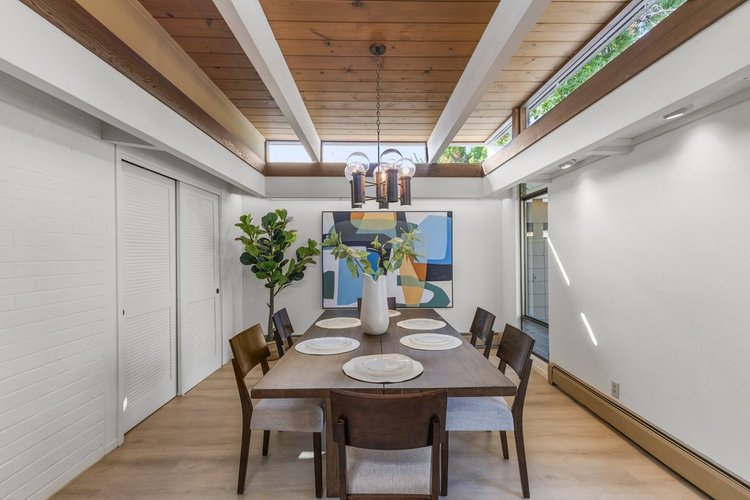
Duveneck / St. Francis, Palo AltoWood plank ceiling with white beams · Sold 2024 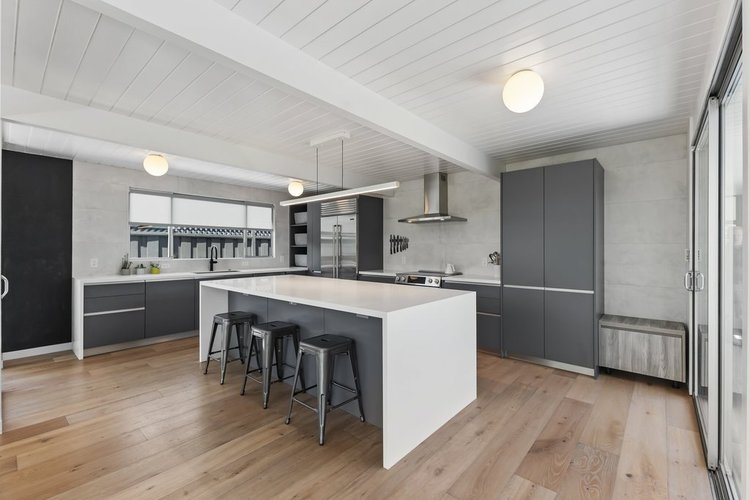
Fairglen, San JoseKitchen with a white plank ceiling · Sold 2024 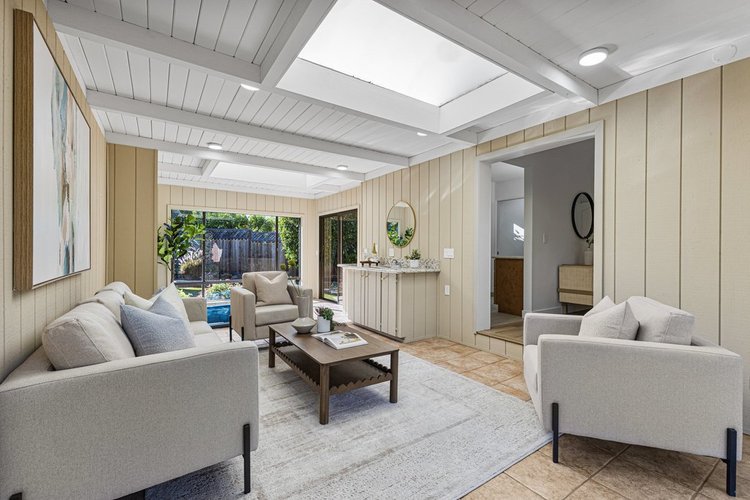
Ponderosa Park, SunnyvalePlank ceiling with white beams and skylights · Sold 2025 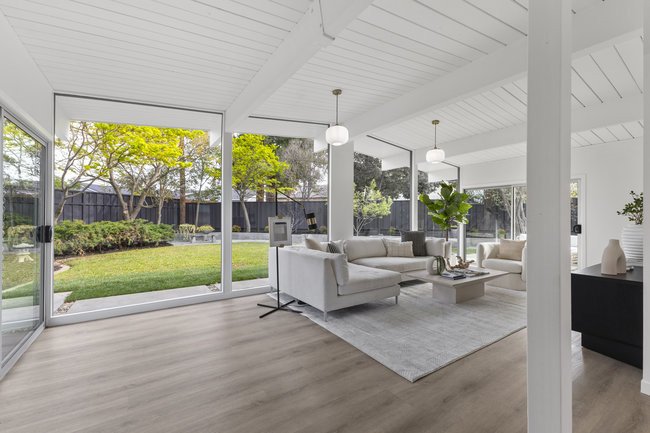
Fairbrae, SunnyvaleLiving room with a white plank ceiling · Sold 2024 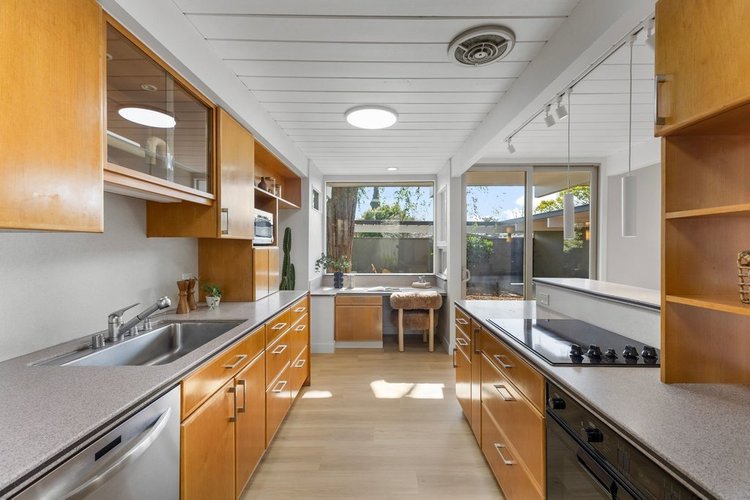
Fairgrove, CupertinoGalley kitchen with a white plank ceiling · Sold 2026
Listing photographs of homes sold by the Boyenga Team at Compass. More homes we’ve sold
See our portfolioFrequently asked questions
Do acoustic ceiling tiles contain asbestos?
They can. EPA lists ceiling tiles among the building materials in which asbestos was used and says you generally cannot tell by looking unless the material is labeled. The Bay Area Air District's rule names acoustic ceiling material and ceiling tiles as examples of friable material when they contain more than one percent asbestos. The Air District's FAQ says a sample must be tested by a laboratory to find out.
Can I sand a painted tongue-and-groove ceiling back to bare wood?
If the house was built before 1978, have the paint tested for lead first. EPA's rule requires anyone paid to do work that disturbs painted surfaces in those homes to be certified, and EPA describes misting, wet-dry sandpaper and HEPA-equipped tools for owners doing their own work. Park Service guidance for historic buildings advises careful hand scraping and advises against torches and sandblasting.
Can I paint over acoustic ceiling tile?
Have the tile tested first. The Air District's rule defines an encapsulant as a sealant material, such as latex paint, that coats or penetrates asbestos-containing material, and EPA describes sealing as repair work for trained and accredited asbestos professionals. If the test shows asbestos, ask a certified asbestos consultant before any paint goes on.
Related reading
Post and Beam Repair: Inspecting and Refinishing Exposed Beams
Insulating an Exposed Beam Ceiling: Above the Deck, Edges and Walls
Lead Paint Disclosure for Pre-1978 Homes, Plus Asbestos Testing
More guides on this topic: Owning & Renovating a Mid-Century Modern Home
Weighing ceiling work on a mid-century home you own or want to buy? Call or text the Boyenga Team at Compass at (408) 373-1660 or (650) 383-8606, or contact the Boyenga Team to talk it through.