
In an Eichler that still has its original radiant heat, the concrete slab is the floor and the heater at once: warm water runs through pipes set in the concrete. That makes choosing flooring over radiant heat slabs a heating decision as well as a design one.
This guide covers four checks to make before a new floor goes down: how the covering affects the heat, what the old floor and its adhesive contain, how much moisture the slab gives off, and who is licensed for each part of the job. Repairs to the heating system itself are covered in our guide to Eichler radiant heat repair and replacement.
The slab is the heating system
The final draft of Palo Alto's Eichler Neighborhood Design Guidelines, dated February 2018, notes that in these houses the radiant heating is embedded in the concrete slab floor. A US Department of Energy Building America guide, written for contractors to share with homeowners, explains how a hydronic radiant floor works: heated water is pumped through tubing laid in a pattern under the floor, and that tubing can be set in a concrete slab.
Two things follow for a flooring project. Whatever goes on top of the slab sits between the heat and the room. And because the tubing is inside the concrete, any step that cuts, drills or fastens into the slab calls for a question first: where do the lines run, and how will the installer stay clear of them?
The Palo Alto document, which describes the guidelines as voluntary, also speaks to repairs. Section 5.5, on mechanical systems and plumbing, says the original radiant heating and plumbing were placed within the slab and may be difficult to repair without highly invasive work, and it advises repair where feasible. A repair in the slab can mean opening the floor above it, so have the heating system checked before the slab is covered again.
How a floor covering changes the heat
The Department of Energy guide, dated August 2011, says some flooring types, thick carpet among them, can reduce a radiant floor's ability to transfer heat. It gives no thickness, and it doesn't rank tile, wood, vinyl or cork against one another.
The National Register of Historic Places registration form for Palo Alto's Greenmeadow tract says the original floor coverings respected the requirements of the radiant heat system: cork in the living areas and asphalt tile elsewhere.
What to do with that:
Ask the flooring maker, in writing, whether the product is approved for use over a heated concrete slab, and under what conditions.
Ask about the whole assembly, not only the top layer: the finish, any pad or underlayment, and the adhesive.
Test the old floor and adhesive before anyone sands or scrapes
Asphalt tile, the original finish named in the Greenmeadow record, appears by name in the Bay Area Air District's asbestos rule. Regulation 11, Rule 2 (Section 11-2-236) defines resilient floor covering as asbestos-containing floor tile, including asphalt or vinyl floor tile, and sheet vinyl floor covering. The US EPA's list of places where asbestos may be found includes vinyl floor tiles, the backing on vinyl sheet flooring, and adhesives. EPA says you generally can't tell by looking unless the material is labeled, and the Air District's asbestos FAQ, updated June 4, 2025, says a sample has to go to a laboratory for testing.
Our post on asbestos surveys before a remodel walks through the district's sampling rule. The short version, as of November 2026, for a residential building with four or fewer dwelling units: a full survey isn't required, but a sample and test is required when certain materials will be removed or disturbed, and resilient flooring is on that list (Section 11-2-303.8).
Floor preparation over a slab raises points the survey post doesn't cover:
The adhesive counts. The rule groups mastics with resilient floor coverings as Category I nonfriable material (Section 11-2-208), and the FAQ names both flooring and mastic among its examples of where asbestos can be found.
Sanding and grinding change how the material is treated. Under Section 11-2-233, Category I material that has been subjected to sanding, drilling, grinding, cutting or abrading counts as regulated asbestos-containing material.
Blasting old adhesive dry needs approval. The FAQ says dry removal, including shot blasting or bead blasting of floor tile mastic, is subject to approval by the district's Air Pollution Control Officer, even when the amount removed is under 100 square feet.
EPA's homeowner advice points the same way. EPA says, "Don't sand or try to level asbestos flooring or its backing," and advises installing new floor covering over asbestos flooring, if possible, when it needs replacing. It also says a trained and accredited asbestos professional should take the samples.
If new flooring goes over old tile on a radiant slab, ask the flooring installer and the heating contractor what the extra layer would mean for your heating. Outside the Bay Area Air District, ask your own air district which rules apply.
Test the slab for moisture
EPA's Moisture Control Guidance for Building Design, Construction and Maintenance (December 2013) was written for building professionals and describes itself as guidance, not a code or standard. On a damp slab, the guide says, flooring adhesive may not cure as it should, which leaves loose flooring and microbial growth in the adhesive. Flooring makers specify a maximum water vapor emission rate for the concrete under their products, and the guide warns that a covering laid over a slab above that rate may fail, mold may grow and the maker's warranty may be lost.
The guide recommends measuring a floor's vapor emission rate before coverings are installed, including when that happens long after the building went up. It recommends the same when lifting tiles, blistered sheet vinyl or other signs of floor failure appear.
EPA describes the two test methods it calls the most commonly used:
ASTM F1869, the calcium chloride test. A weighed canister of calcium chloride is placed on the slab under an air-tight plastic dome, typically for 60 to 72 hours, then weighed again. The result is given in pounds of water per 1,000 square feet over 24 hours. The 2013 guide says this method is accepted by most floor covering manufacturers.
ASTM F2170, the in-place probe test. This measures relative humidity in a hole drilled partway through the concrete slab.
The second method means drilling into a slab that holds the heating lines. The EPA guide doesn't discuss heated slabs, so ask the tester and the flooring maker how the lines will be located before any hole is drilled, which version of each standard applies, and whether the surface test meets the product's requirements.
A leaking line can also put moisture at the floor. Our guide to slab leaks in mid-century homes covers the signs and the tests.
Who does which part of the job
The Contractors State License Board (CSLB) splits this work among several license classifications, defined in Title 16 of the California Code of Regulations:
C-15, Flooring and Floor Covering. Prepares surfaces for flooring and installs carpet, resilient sheet goods, resilient tile and wood floors, including finishing and repair. The classification excludes ceramic tile.
C-54, Ceramic and Mosaic Tile. Prepares surfaces as needed and installs ceramic, mosaic, quarry, paver and stone tile, among other types.
C-4, Boiler, Hot Water Heating and Steam Fitting. Installs, services and repairs hot-water heating systems, including piping, valves and pumps.
C-22, Asbestos Abatement. A separate classification on CSLB's list.
Ask each contractor which classification they hold, and how the flooring or tile contractor will coordinate with whoever services the heating.
Permit rules depend on the scope of the work and differ by city. As of November 2026 the edition in effect is the 2025 California Building Standards Code (Title 24), effective January 1, 2026, and the Building Standards Commission notes that local ordinances also apply. Confirm with your building department before work starts, above all if the job touches the heating system, the plumbing or the slab.
A checklist before the new floor goes down
Have the radiant system checked before the slab is covered.
Have the existing flooring and adhesive sampled and tested before any removal, sanding, grinding or blasting.
Have the slab tested for moisture, and compare the result with the flooring maker's stated limit.
Ask how test holes and fasteners will be kept clear of the heating lines.
Get the flooring maker's written guidance for heated slabs.
Confirm each contractor's CSLB classification, and ask the building department whether your scope needs a permit.
For the wider picture of remodeling one of these houses, see our Eichler renovation guide.
This is general information as of November 2026, not legal, engineering or code advice. Rules and standards change, so confirm the requirements with your building department and your air district, and the details of your own house with a licensed professional.
From our listings
Floors at homes we’ve sold
Four photos from homes the Boyenga Team has sold in San Jose and Sunnyvale: a terrazzo floor seen through a glass wall, and atrium floors of concrete, large gray tiles and concrete pavers. A photo shows the surface. It cannot show what is in the slab under it or how a floor was put down, which is what this guide is about.
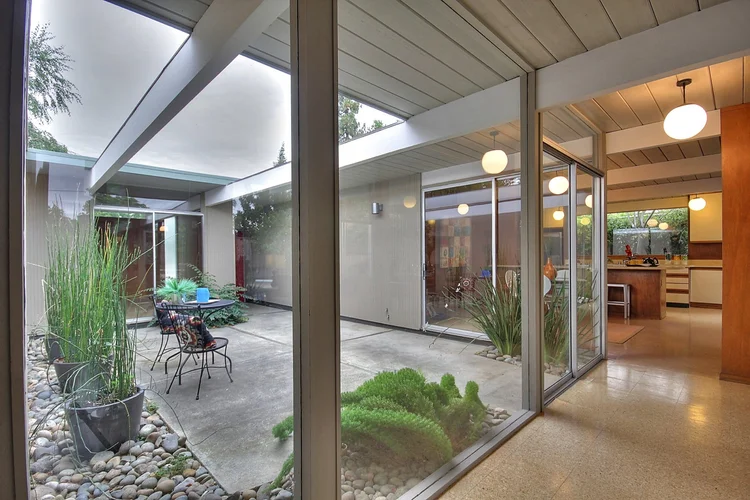
Fairglen, San JoseTerrazzo floor seen through a glass wall · Sold 2013 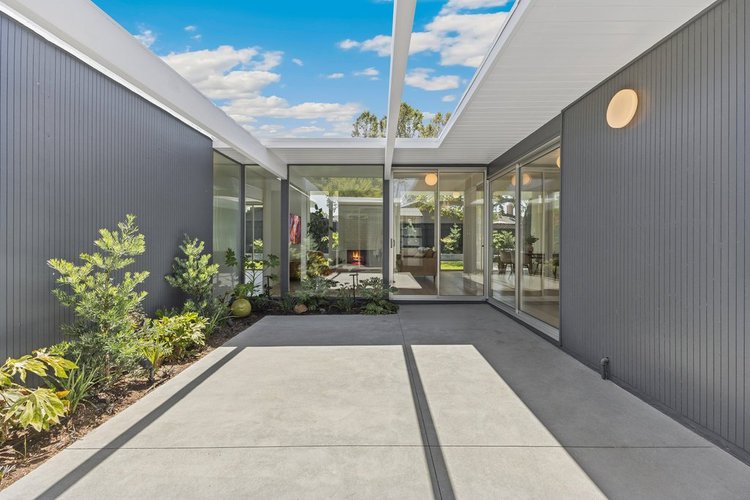
Fairglen, San JoseAtrium with a concrete floor · Sold 2024 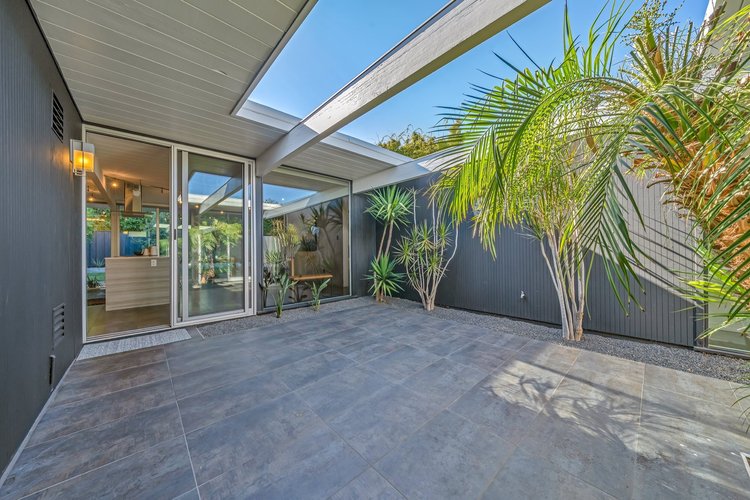
Fairbrae, SunnyvaleAtrium with large gray tiles · Sold 2023 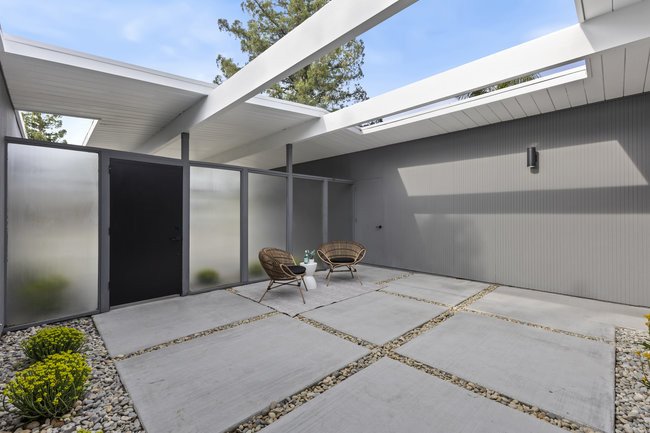
Fairbrae, SunnyvaleAtrium with a concrete paver floor · Sold 2024
Listing photographs of homes sold by the Boyenga Team. More homes we’ve sold
See our portfolioFrequently asked questions
Can carpet go over a radiant heat slab?
A US Department of Energy Building America guide from 2011 says thick carpet can reduce a radiant floor's ability to transfer heat. It doesn't set a thickness limit. Ask the carpet and pad makers for their guidance on heated slabs, and talk with your heating contractor before you buy.
Should old floor tile come up before new flooring goes down?
Not automatically. EPA advises installing new floor covering over asbestos flooring when possible and warns against sanding or leveling it. In the Bay Area Air District, a sample and test is required when resilient flooring in a residential building with four or fewer dwelling units will be removed or disturbed, so test first.
Does a decades-old slab still need a moisture test?
EPA's 2013 moisture guidance recommends measuring a floor's vapor emission rate before coverings are installed, even long after construction. Flooring makers set their own limits, and the guide warns that a covering laid over concrete above them may fail.
Do the Palo Alto Eichler guidelines limit interior flooring?
The city's final draft of the guidelines, dated February 2018, describes them as voluntary and has no guideline on interior floor finishes. Its chapter on National Register districts encourages owners who wish to preserve interior features to do so. For a specific property, confirm with the city's planning staff.
Related reading
Hire a Licensed Contractor in California: Mid-Century Remodel Guide
Accessible Eichler Remodel: Entries, Doors, Baths and Code Rules
Heat Pumps for Mid-Century Homes: Going All-Electric in the Bay Area
More guides on this topic: Owning & Renovating a Mid-Century Modern Home
Planning new floors in a mid-century home you own or want to buy? Call or text the Boyenga Team at Compass at (408) 373-1660 or (650) 383-8606, or contact the Boyenga Team to talk it through.