Mid-Century Modern Builders of Silicon Valley
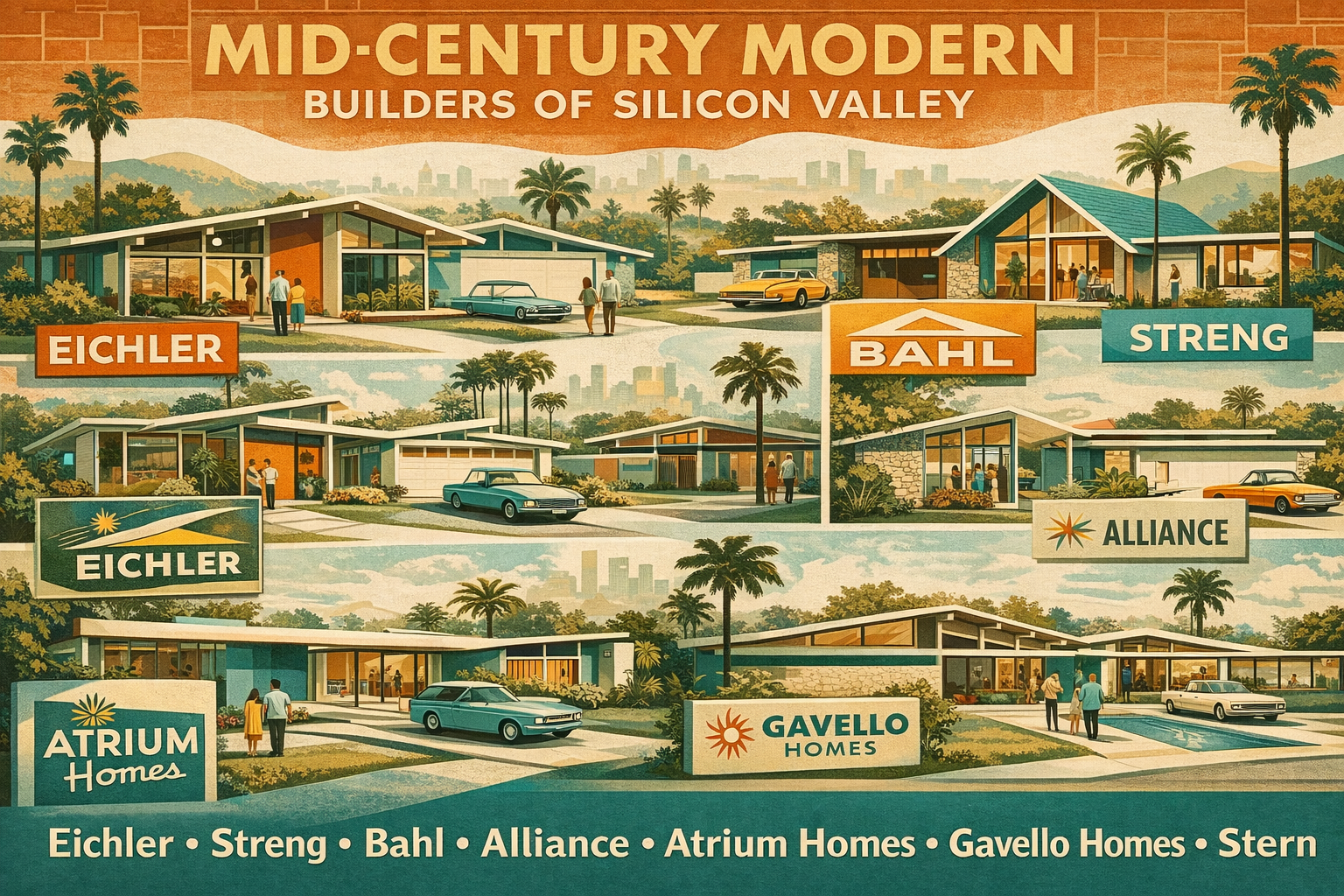
Silicon Valley’s mid-century modern housing stock wasn’t shaped by a single vision—it was built by a handful of influential developers who each interpreted modernism through a slightly different lens. Understanding which builder did what (and where) is essential when evaluating architectural pedigree, long-term value, and buyer demand today. Joseph Eichler’s tract homes set the gold standard for California Modern living in the postwar era, inspiring a wave of other builders who echoed his “indoor–outdoor” ethos. Below is a Property Nerd–level comparison of several builders that continue to define the region’s modernist DNA—plus how The Boyenga Team uses this knowledge to position homes correctly in today’s market.
Builder Comparison Snapshot
For quick reference, here’s how key mid-century modern builders in Silicon Valley stack up across architectural integrity, brand strength, buyer demand, and pricing potential:
Eichler
Architectural Purity: ⭐⭐⭐⭐⭐
Brand Recognition: ⭐⭐⭐⭐⭐
Buyer Demand: ⭐⭐⭐⭐⭐
Pricing Ceiling: Highest
Streng
Architectural Purity: ⭐⭐⭐⭐
Brand Recognition: ⭐⭐⭐
Buyer Demand: ⭐⭐⭐⭐
Pricing Ceiling: High
Bahl
Architectural Purity: ⭐⭐⭐⭐
Brand Recognition: ⭐⭐
Buyer Demand: ⭐⭐⭐⭐
Pricing Ceiling: Rising
Alliance
Architectural Purity: ⭐⭐⭐
Brand Recognition: ⭐⭐
Buyer Demand: ⭐⭐⭐
Pricing Ceiling: Moderate
Atrium-Style Homes
Architectural Purity: ⭐⭐⭐⭐
Brand Recognition: ⭐⭐
Buyer Demand: ⭐⭐⭐
Pricing Ceiling: Moderate–High
Note: Atrium-style refers to homes organized around a central interior courtyard—an idea pioneered by Eichler and later adapted by other builders with varying levels of execution and authenticity.
🟦 Joseph Eichler: The Blueprint for California Modern
Era: 1950–1974
Philosophy: “Modernism for the masses” — architecture as social progress
Signature Features:
Open-air interior atriums as organizing space (in many models)
Exposed post-and-beam construction with tongue-and-groove wood ceilings
Floor-to-ceiling glass walls and sliding doors that blur indoor–outdoor boundaries
Slab-on-grade foundations with radiant heating pipes in the floors
Minimalist street facades: low or flat rooflines with broad eaves, vertical wood siding, and few front windows for privacy
Neighborhood Context: Eichler built ~11,000 homes across California. In Silicon Valley, Eichler tracts are concentrated in Palo Alto (e.g. Greenmeadow, Fairmeadow), Sunnyvale (Fairbrae), Mountain View (Monta Loma’s Fairview tract), Cupertino (Fairgrove), Los Altos, San Jose (Willow Glen, Cambrian), and parts of Atherton and Los Altos Hills. Eichler also expanded to the Peninsula, East Bay, and Marin (Terra Linda) during his career.
Market Position: Eichler homes command the strongest brand recognition and authenticity premiums of all mid-century builders. They are not “just houses”—for many, they are architectural artifacts epitomizing California Modernism. Original features (unpainted wood ceilings, globe lights, etc.), intact atriums, and clean lines contribute significantly to value, and sensitive remodels tend to enhance rather than hurt pricing. Eichlers consistently fetch top-of-market prices in Silicon Valley, often in the high seven figures, with prime examples exceeding $2–4 million. Their combination of iconic design and name-brand cachet gives them exceptional pricing power.
Boyenga Team Insight: Selling an Eichler is about selling a lifestyle and legacy. The Boyenga Team tracks each home’s authenticity level, tract desirability, school district, and even “remodel saturation” in the neighborhood to price and market Eichlers precisely. By telling the architectural story of an Eichler—its design lineage, original details, and how it embodies indoor-outdoor living—we elevate it from a mere house to a coveted piece of California modern history. This narrative approach drives buyer excitement and premium results.
🟩 Streng Brothers: Sacramento Roots, Silicon Valley Impact
Era: 1959–1980s
Philosophy: Eichler-inspired modernism, delivered with production efficiency and climate adaptations
Signature Features:
Open-plan, post-and-beam homes inspired by Eichler designs (many Streng homes were designed by architect Carter Sparks, echoing Eichler aesthetics)
Atrium floor plans with a twist: Streng’s signature atrium is covered by a large tinted acrylic dome skylight rather than open to the sky. This created a greenhouse-like indoor garden at the entry, reducing heat loss and sun exposure.
No interior glass walls around the atrium (unlike Eichler’s open atriums) – this helped reduce heat gain in Sacramento’s hotter climate.
Vaulted ceilings and expansive sliders for indoor–outdoor flow, but with central HVAC instead of radiant floor heat. (Strengs were built on raised foundations with ducts, acknowledging the maintenance issues Eichlers had with radiant slabs.)
More conventional rooflines: often low-pitched gables or hip roofs (sometimes with a shallow A-frame profile) instead of flat roofs, to improve drainage and longevity.
Neighborhood Context: The Streng Brothers built nearly 4,000 homes, but exclusively in the Greater Sacramento region. They did not build in Silicon Valley – however, their homes are often discussed in Bay Area mid-century circles as a “close cousin” to Eichlers. Many Bay Area buyers have even ventured to Sacramento to find more affordable MCM homes in Streng communities.
Market Position: In Silicon Valley, you won’t encounter Streng-built homes for sale (since they’re all in Sacramento), so their direct market impact in SV is minimal. However, they serve as an important reference point. Streng homes are often seen as an “Eichler alternative” – they offer a very similar mid-century look and feel (thanks to Eichler-like layouts and features) but were historically cheaper, partly due to being outside the pricey Bay Area. Even in Sacramento, Strengs long traded below Eichlers; many sold in the $500k–$900k range a few years ago, though some have now exceeded $1M as design-savvy buyers recognize their value. There is growing interest from Bay Area MCM enthusiasts relocating or looking for more bang-for-buck, making well-preserved Strengs increasingly sought-after.
Boyenga Team Insight: Storytelling is key when dealing with “Eichler-adjacent” homes. If a Streng home were to be marketed to Silicon Valley buyers, framing it properly would be essential. We emphasize that buyers can get Eichler-like design (post-and-beam construction, indoor-outdoor flow, even an atrium of sorts) without the Eichler price tag – a compelling proposition. By clearly explaining the Streng pedigree and design philosophy, the Boyenga Team would aim to tap into the demand from modernism lovers who might not afford an Eichler in Palo Alto but crave that mid-century aesthetic. Even though Strengs aren’t local to Silicon Valley, we monitor how their value trends inform the broader mid-century market and buyer psychology.
🟨 Bahl Homes: Quietly Iconic Silicon Valley Modernism
Era: Late 1960s – early 1970s
Philosophy: Thoughtful modern design tailored to local Silicon Valley buyers, with an emphasis on privacy and efficient use of space
Signature Features:
Central enclosed patio at the core of the home – every Bahl “Patio Home” is built around an interior walled courtyard. This is essentially an atrium-like outdoor room, but unlike Eichler’s atriums it is usually accessed after entering the house (more hidden). Multiple rooms open onto this private patio via sliding glass doors, creating a secluded oasis at the center of the home.
Single-story post-and-beam construction, with exposed beams and tongue-and-groove wood ceilings reminiscent of Eichlers. The open-plan layouts and expanses of glass give Bahl homes true mid-century modern “bones.”
Flat or low-pitched roofs with wide eaves, giving a modern profile and ample shade. From the street, many Bahl homes present a flat-roof appearance with broad fascia.
Modest size, efficient layout: Typically 3–4 bedrooms in a compact ~1,200–1,600 sq ft. They were cleverly designed with minimal hallways and a great-room concept to maximize usable space. Owners often remark that the indoor-outdoor integration makes them feel larger than they are.
Privacy-focused facades: Bahl homes are almost fortress-like to the street. Expect a nearly blank front wall – often a tall privacy screen or the side of the garage, with perhaps a narrow clerestory window and a hidden front entry. Bahl deliberately oriented windows toward the interior patio and backyard, not the street, for maximum seclusion. In Bahl enclaves, you might see a continuous street wall with doors tucked out of sight, even more closed-off than Eichler’s designs.
Neighborhood Context: George Bahl built only a few small clusters of these homes (often cul-de-sacs) in Silicon Valley, making them quite rare. Notable concentrations include:
Sunnyvale – e.g. tiny courts off Remington Dr. and Wolfe Rd
Cupertino (Monta Vista) – e.g. North Portal Ave, Vicksburg Dr. (near today’s Apple campus)
Mountain View – pockets near San Antonio & Rengstorff
West San Jose – around the Cupertino border (e.g. near Lawrence Expy)
Each cluster might only have 10–20 homes, often with “Patio” or “Court” in the street name. Because they’re embedded in otherwise conventional neighborhoods, they’re easy to miss – a true hidden gem for mid-century fans.
Market Position: Bahl Homes have been under-the-radar for decades, but are now increasingly “rediscovered” and appreciated by design-savvy buyers. Their rarity and architectural merit have led some to achieve prices on par with Eichlers: for example, a Sunnyvale Bahl home sold for around $2.23M in 2023, rivaling mid-tier Eichler values. Typically, Bahl Patio Homes range from roughly $1.5M to $3M today, depending on location and condition. Buyers are drawn to their privacy, efficient layouts, and the fact that, unlike Eichlers, they often have no old radiant heat or leaky roofs to worry about (thanks to conventional heating and raised foundations). While Bahl lacked the “brand name” of Eichler, the pedigree effect is real: once buyers understand they’re looking at a Bahl (and not just an odd tract house), perceived value increases. In Silicon Valley’s market, we’re seeing Bahl Homes command premiums as their story gets out.
Boyenga Team Insight: Proper builder attribution can be a game-changer for Bahl Homes. Many owners and even agents might not realize they have a Bahl-designed home, potentially leaving money on the table. The Boyenga Team makes sure to identify and highlight the Bahl lineage in our marketing – we’ll often brand it as a “Bahl Patio Home” in listings. By educating buyers on Bahl’s design features (the enclosed patio concept, etc.) and comparing it to the better-known Eichlers, we create excitement around the home’s uniqueness. The result: buyers see it as a collectible mid-century modern (with all the privacy and livability bonuses), which drives up demand and pricing. In short, when a Bahl is presented as an architectural gem rather than just a 60s house, it moves from “interesting” to irreplaceable in the eyes of the market.
🟥 Alliance Homes: Modernism Meets Suburban Practicality
Era: 1954 (primarily built in a single year)
Philosophy: Bring Eichler-style contemporary design to a broader market, with slight tweaks for mainstream appeal and durability
Signature Features:
Eichler doppelgängers: Alliance Construction Company explicitly set out to build homes that looked like Eichler’s, even using similar post-and-beam construction, open layouts, globe lights, and walls of glass. Walking through an Alliance home, one sees many of the same mid-century elements as in a 1950s Eichler. This earned them the local nickname “Lik-Eichlers” (like Eichlers).
No atrium – L or U-shaped plans: Alliance homes did not include the open atrium that Eichler introduced a few years later. Instead, most models are L-shaped, with living and bedroom wings forming an L around a rear or side patio. Some even feature a covered patio off a bedroom – marketed in 1954 as a children’s play patio for kids to play or clean up before entering the house. (If you see a mid-century home with a central atrium, it’s not an Alliance.)
Moderate pitched roofs: Unlike Eichler’s almost-flat tar-and-gravel roofs, Alliance gave their homes a gently pitched gable roof, just enough to improve drainage in rainy Marin County. These low-slung gables still have wide eaves and a modern profile, but helped avoid some of the leak issues early Eichlers experienced.
Radiant heating 2.0: Impressively, Alliance embraced Eichler’s in-floor radiant heating – but used copper pipes instead of steel. Eichler’s steel radiant pipes often rusted and failed, whereas copper is far more durable. Many Alliance homes still have functioning original radiant heat, a selling point for purists who love that silent warm floor.
Slightly smaller models: Alliance houses were a bit more compact than contemporaneous Eichlers – roughly 1,200–1,500 sq ft for 3–4 bedrooms. They were efficient and simple, without the later larger models Eichler would produce in the 1960s.
Neighborhood Context: None in Silicon Valley. Alliance built all of its ~200 homes in Terra Linda, San Rafael (Marin County). In fact, the Alliance tract was constructed in 1954 in Terra Linda before Eichler built there – an interesting parallel development in mid-century modernism. Because of this, Silicon Valley house-hunters won’t encounter Alliance homes locally. However, historically speaking, Alliance represents an important contemporary of Eichler. (For reference, Terra Linda today has four MCM tracts: one by Alliance and three by Eichler; Alliance’s tract occupies the Las Pavadas/Golden Hinde area, predating Eichler’s sections).
Market Position: Within Marin, Alliance homes are a niche favorite among MCM enthusiasts – often respected by purists, but generally priced slightly below comparable Eichler homes in that area. Typical Alliance sales range around $1.4M–$1.7M as of recent years, a bit lower than Eichlers in Terra Linda (which tend to be larger on average). Their “secret sauce” features (the copper radiant heat, better roof pitch) are great talking points, but the lack of the Eichler name means they don’t quite get the full Eichler premium. Still, they offer a very Eichler-like living experience – sometimes at a relative bargain. In Silicon Valley discussions, Alliance homes mostly come up as a historical footnote (since they’re 50 miles away), but they underscore how mid-century modern demand was region-wide.
Boyenga Team Insight: When positioning homes with Eichler-esque design but less brand recognition (be it Alliance or others), we adjust our marketing focus. For Alliance-style homes, we’d emphasize “modern living first” – the lifestyle benefits (indoor-outdoor flow, walls of glass, stylish simplicity) that a design offers a buyer, rather than leaning on pedigree. Because there’s no local brand cachet to leverage, we highlight the quality of construction (for instance, those durable copper radiant floors) and the living experience (private patios, bright open interiors). Essentially, we sell the functional appeal of the architecture to a broad audience. That way, even buyers who’ve never heard of Alliance Homes can appreciate the home’s value as a cool mid-century modern environment for family life. The result: we capture lifestyle-oriented buyers, not just architecture buffs, ensuring strong demand.
🟪 “Atrium Homes”: Courtyard-Centered California Living
Definition: Atrium Homes are not a single builder, but a design category referring to mid-century modern homes that center around an interior courtyard (atrium). This concept was pioneered and popularized in California by developers like Eichler, and it epitomizes the indoor-outdoor living ethos of the era.
Origins: Joseph Eichler introduced open-air atriums in his designs in the late 1950s (first appearing around 1958). These were essentially open-sky courtyards in the middle of the house, usually at the entry foyer, surrounded by glass walls. The idea was revolutionary – it brought a private outdoor space inside the footprint of the home. Later, the Streng Brothers in Sacramento adapted the atrium concept by covering it with a skylight dome, creating a climate-controlled indoor garden (suitable for hotter summers). Many other custom architects also played with atrium concepts in mid-century designs.
Design Characteristics:
A true atrium is a fully enclosed courtyard open to the sky (or at least skylit) within the home’s walls. It’s distinct from a simple U-shaped patio or backyard – it’s an outdoor room in the center of the house.
Eichler’s atriums (late ’50s into the ’60s models): Typically at the very entrance, with the front door opening into the open-air atrium, and then the atrium providing access to the living areas via glass walls. This created a dramatic indoor-outdoor foyer.
Streng’s atriums: Typically set further inside and covered by an acrylic skylight (like a giant greenhouse roof) to avoid letting the weather directly in. No Eichler-style open sky, but still an interior garden space. Also, Streng atriums didn’t have interior glass walls around them as Eichler’s did, making them a bit more like an interior sunroom.
Other builders had atrium-like elements: For example, Bahl Patio Homes have a central courtyard, but it’s usually accessible only from inside (and not at the entry) – thus atrium-adjacent but not the classic Eichler atrium at the front. Some custom “atrium ranches” in the 60s also incorporated courtyard gardens for privacy and light.
Silicon Valley Presence: The atrium concept is most strongly associated with Eichler in Silicon Valley. Starting ~1958, many Eichler tracts feature atrium models. You’ll find open-air atriums in Eichler homes in neighborhoods like:
Sunnyvale: Fairorchard tract, Cherry Chase (later phase Eichlers)
Palo Alto: Greenmeadow (later Eichler phases) and Los Arboles
Cupertino: Fairgrove tract (Monta Vista Eichlers)
San Mateo Highlands and parts of Foster City (not SV, but notable Eichler atrium communities).
No Streng atriums in Silicon Valley, since Strengs are all in Sacramento. However, the atrium idea influenced many later designs and remodels in the Bay Area as people sought to emulate that light-filled courtyard vibe.
Market Impact: Homes with true atriums tend to enjoy the highest demand among mid-century modern buyers. There is an emotional draw to that private open-air space – it becomes the heart of the home. As a result, Eichlers with intact atriums often command top price-per-square-foot premiums in their neighborhoods. Of course, atriums come with maintenance considerations (e.g. roof detailing around the open space, drainage, etc.), but most buyers willingly accept those trade-offs for the lifestyle payoff. An atrium can transform the feel of a house – even a modest 1,500 sq ft Eichler feels like a mini-resort when you’re standing in a sun-drenched atrium with plants and artwork. Privacy combined with light is the key attraction: you get an outdoor experience that is shielded from neighbors.
Boyenga Team Insight: When marketing an atrium model Eichler or any courtyard-centric home, we make the atrium the star. Staging it with greenery and inviting furniture, timing open houses for daylight, and even referencing the atrium lifestyle in descriptions (e.g. “sip your morning coffee under open skies in the heart of your home”) helps buyers viscerally imagine living there. We’ve found that articulating the “atrium story” – how it was a mid-century innovation that remains coveted today – can significantly boost buyer perception of value. Many owners don’t realize they have something special; we ensure that what might be misclassified as just a “patio” is recognized as a bona fide architectural feature. In short, atriums are value multipliers, and we leverage them to elevate homes from simply cool to categorically unique in the market.
🟧 Mackay Homes: Eichler’s Friendly Rival in Modern Tract Development
Era: 1950s (mid-’50s peak for MCM homes)
Philosophy: Bring Eichler-style modernism to the mainstream homebuyer – often at slightly lower cost, with practical construction tweaks
Developer John Mackay was one of Eichler’s chief competitors and contemporaries in the Bay Area. In fact, Mackay hired the same architects (Anshen & Allen) who designed many early Eichlers, resulting in homes that closely emulated Eichler’s style. Mackay Homes were often marketed as “Patio Homes” in the 1950s to emphasize indoor-outdoor living. At first glance, a Mackay can be nearly indistinguishable from an Eichler – they feature open-beam post-and-beam construction, floor-to-ceiling glass, and clean modern lines just like Eichler homes. In some cases, even original Eichler architects were involved, lending authentic design pedigree.
Signature Features & Differences from Eichler: Mackay’s houses were so similar that many Silicon Valley owners have mistaken their Mackay for an Eichler over the years. However, a few key differences can help identify a Mackay home:
Foundation & Heating: Most Mackays were built on raised perimeter foundations (crawl spaces), not slabs. They used forced-air furnaces or wall heaters instead of Eichler’s radiant floor heating. Thus, a Mackay will typically have floor vents or a furnace closet (Eichlers lack those), and sometimes even original hardwood flooring (since a crawl space allowed wood subfloors). The raised foundation made Mackays easier to remodel (plumbing and ducts accessible).
Roof Profile: While Eichlers of the ’50s often have nearly flat roofs, Mackay homes more commonly sport a low gable or even occasional butterfly roof for a bit of flair. Some models introduced twin-peaked A-frame elements that Eichler didn’t use until later. These give Mackays a slightly taller facade silhouette.
Ceiling and Beams: Eichlers feature natural wood T&G plank ceilings between exposed beams. Mackays, by contrast, often used painted Celotex fiberboard panels between the beams. In many Mackays, the beams were originally painted or even enclosed, whereas Eichler beams were typically stained and left exposed. Interior walls in Mackays were usually drywall instead of Eichler’s lauan mahogany paneling, making the interior a tad more conventional in finish.
Layout Tweaks: Mackay layouts tend to be a bit more traditional in flow. For example, Mackays often have a defined entry foyer or a hallway separating the kitchen, whereas Eichler entries lead you straight into the living space or atrium with minimal transition. Kitchens in Mackay homes might be front-facing or more enclosed, and while some Mackays did have small front courtyards or covered entries, none had the expansive open atriums that Eichler introduced later.
Exterior Clues: From the curb, Mackays and Eichlers look very alike: single-story, carport/garage in front, vertical wood siding, big glass at the back. But one giveaway: garages. Many early Eichlers have open carports, whereas Mackays commonly came with an attached one- or two-car garage with a door. For instance, in Mountain View’s Monta Loma neighborhood, Eichler-built homes have carports, while adjacent Mackay-built homes have enclosed garages. Also, if you peek inside and see details like hardwood floors (original) or a furnace, you’re likely in a Mackay, not an Eichler.
Neighborhood Context: Mackay Homes left a significant footprint in the South Bay. Notable Mackay tracts include:
Mountain View – Monta Loma: Mackay co-developed part of Monta Loma in 1955–56 (adjacent to Eichler’s 1954 section). In this unique neighborhood, Eichler, Mackay, and another builder (Mardell) built homes side by side, creating a living case study in spotting the differences. A fun fact: Steve Jobs’ childhood home on Diablo Ave in Mountain View was a Mackay—often mistaken for an Eichler by onlookers.
Santa Clara – Maywood and Fairmede tracts: In the mid-1950s, Mackay built hundreds of modern homes in Santa Clara’s Maywood tract (1954–55) and nearby Fairmede (1957). These are classic Mackay neighborhoods where nearly every house on the street is a Mackay mid-century modern. They sit adjacent to Eichler’s own Santa Clara tracts, offering a compare-and-contrast for MCM fans.
Palo Alto & Cupertino: Mackay did smaller developments here – e.g., a tract in Palo Alto’s Greenmeadow area (Sunshine Glen, 1954) which even won a 1954 AIA National design award, and a handful in Cupertino. These are lesser-known pockets, sometimes intermingled with Eichlers or other ranchers.
In total, John Mackay’s firm built a few hundred mid-century modern tract homes around Silicon Valley (and many more traditional homes as well). He was prolific beyond the Bay Area too, with thousands of homes across California, but it’s his Eichler-like Bay Area tracts that garner attention today.
Market Position: Mackay homes today often fly under the radar – many owners don’t even know they own a “Mackay.” Consequently, they can sometimes sell for less than an equivalent Eichler, simply due to lack of brand recognition. However, savvy buyers recognize that Mackays offer the full mid-century package. In Mountain View and Santa Clara, Mackay houses in original condition have become hot commodities for MCM enthusiasts, especially when marketed as such. They tend to be a bit more affordable than Eichlers in the same area (perhaps a 5–10% discount, though this gap is closing), which makes them great value. For instance, a nicely updated Mackay in Monta Loma or Maywood might sell in the $1.3M–$1.8M range, slightly below a comparable Eichler – yet it delivers nearly identical architecture (and even a few practical advantages like that crawl space). As mid-century demand grows, Mackays have started to appreciate significantly; in some cases, remodeled Mackays now match Eichler prices because buyers see past the name and focus on design. The bottom line: Mackays are increasingly recognized as authentic mid-century modern homes in their own right.
Boyenga Team Insight: Education is key when marketing a Mackay. We often encounter situations where a buyer says, “I love Eichlers,” and we show them a Mackay and they don’t notice the difference until we point it out. Our strategy is to highlight the common DNA with Eichler – the fact that Anshen & Allen designed many Mackays, that these homes were literally Eichler’s rivals – so buyers immediately get the significance. We also point out the benefits: “This has the Eichler look with a furnace and crawl space, which many Eichler owners eventually wish for!” By framing a Mackay listing in terms of Eichler, we borrow the cachet and then build on it by noting the Mackay perks (like easier renovations, fewer maintenance headaches). We’ll use permit records, tract names, and even historical anecdotes (like the Steve Jobs factoid) to legitimize the home’s pedigree. When we handle a Mackay, it’s never marketed as just another ranch – it’s a mid-century modern by Mackay. That way, we capture all the Eichler enthusiasts and design buffs, ensuring strong demand and top-dollar sale prices that reflect the home’s true architectural value.
🟫 Gavello Homes: Mid-Century Modern Gems of Sunnyvale
Era: Mid-1950s – early 1960s
Philosophy: Deliver Eichler-caliber modernism on a smaller scale – “California modern for the average homebuyer,” spearheaded by a local developer with vision
Elmer Gavello was a South Bay developer who, like Eichler and Mackay, recognized the post-WWII appetite for stylish modern homes. Though not as famous or prolific, Gavello made his mark by building a small number of mid-century modern tracts that captured the era’s spirit with open-beam ceilings, walls of glass, and indoor-outdoor flow. He even collaborated with Anshen & Allen (Eichler’s architects) to ensure bona fide modernist design pedigree. Gavello’s flagship development was Gavello Glen in Sunnyvale, debuted in 1956.
Signature Features: Gavello Homes at first glance often mimic Eichlers, which is no surprise given the shared architects. Key traits include:
Low-pitched gable roofs with wide eaves – some with an A-frame look or broad-gabled ranch form. This gives a classic mid-century roofline and allows for clerestory windows.
Post-and-beam construction, open vaulted ceilings with exposed beams (usually painted), and floor-to-ceiling glass panels. In essence, Gavello hit all the major notes of California Modern design, thanks to influence from Anshen & Allen.
Layout: Typically single-story, often L- or U-shaped layouts. Instead of a central atrium, Gavello homes integrate an outdoor patio off the living/dining area, often covered by the main roof extension. It’s like a side courtyard that opens to the backyard – providing a private outdoor living space without being fully enclosed in the center. Many Gavello models wrap around a backyard or side patio, capitalizing on larger lot sizes.
Larger lots, suburban feel: One distinguishing aspect – Gavello tended to build on more expansive lots (~10,000 sq ft), especially in Sunnyvale. This meant his neighborhoods have a more spacious feel (think front lawns, wider side yards) compared to Eichler tracts which were a bit denser. Homes have driveways and full two-car garages, enhancing the classic suburban look.
Materials and details: Gavello exteriors blend modern and a touch of ranch: vertical wood siding combined with brick or stone accents (e.g. brick planters or partial brick facade) which Eichlers typically didn’t use. These touches added warmth and a hint of traditional curb appeal. Many Gavellos have a prominent brick chimney or a stone detail by the entry. Inside, they usually had forced-air heating (radiant heat was not a standard feature) and often hardwood or tile floors – practical and cost-effective choices at the time.
Neighborhood Context: Gavello’s developments were limited, making them rare finds today. The core is Sunnyvale’s Gavello Glen, a small tract near Ponderosa Park (streets like Quail Ave, Ponderosa Ave, Snapdragon Ct). Gavello Glen reportedly sold out quickly upon debut in 1956, testament to demand. Beyond Sunnyvale, a few Gavello homes popped up in adjacent areas: parts of Santa Clara and Mountain View in the late ’50s and early ’60s saw isolated Gavello-built homes or micro tracts. There was even one ambitious custom showpiece in Atherton (“the House with a Floating Roof” designed by Anshen & Allen for Gavello in 1957) that became locally famous – though that one was a unique case and later demolished. In essence, Sunnyvale is Gavello ground-zero, with perhaps a few dozen homes in total carrying his name. Notably, in the Ponderosa Park area of Sunnyvale, Gavello homes sit cheek by jowl with Eichlers, Stern & Price homes, and standard ranchers, creating a real mix of mid-century styles.
Market Position: For a long time, Gavello Homes were underappreciated, often misidentified as “just another rancher” or confused with Eichlers. Today, as mid-century interest has grown, Gavellos are recognized as “mid-century modern gems” (as we like to call them) with significant appeal. They tend to trade a bit below Eichlers in Sunnyvale simply due to lower name recognition – but that presents an opportunity. Buyers can sometimes get a Gavello for a slight discount per square foot compared to a nearby Eichler, even though both offer comparable design features. For example, if Eichlers in a given Sunnyvale neighborhood are fetching $1,200/sqft, a Gavello might be, say, $1,000–$1,100/sqft – a relative bargain for essentially Eichler-grade architecture with a bigger yard. We’ve seen well-preserved Gavellos become increasingly sought after; the gap is closing as word gets out. They particularly appeal to buyers who want mid-century character on a larger lot (something Eichlers often lack). Overall, Gavello Homes have strong upside when properly identified and marketed, given their scarcity and authentic design lineage.
Boyenga Team Insight: Identifying the builder is half the battle with Gavello Homes. The Boyenga Team makes sure that if we list a Gavello, the world knows it’s a Gavello. We tap into permits and tract maps (e.g. Sunnyvale records from 1956 listing “Gavello Construction” and architects Anshen & Allen) to verify the pedigree, then we broadcast it. Our marketing will compare the home directly to Eichlers (“designed by the same architects as Eichler homes”) and highlight those extra perks (bigger yard, less glass = easier to heat/cool, etc.). We also often have to educate other agents and appraisers that a Gavello is a legit mid-century modern – not just a random 1950s house. By doing so, we help buyers appreciate what they’re looking at. We’ve found that when buyers understand they’re getting a piece of architectural history (one that’s rarer than an Eichler), their willingness to pay increases. In short, shining a light on the Gavello story – the visionary local developer, the collaboration with Eichler’s architects, the “floating roof” legend – elevates the home’s cachet and can translate into a pricing advantage for our sellers.
⬛ Stern & Price Homes: Understated Modernism with Mainstream Appeal
Era: Late 1950s – 1970s
Philosophy: A “blend” of true mid-century modern principles with the practical comforts of a ranch-style home – design for the design-conscious and the average family
The partnership of Stern & Price produced some of Silicon Valley’s most quietly influential mid-century homes. They didn’t do large tracts; instead, they were “boutique infill” developers, building custom or small clusters of modern homes tucked into established neighborhoods. As a result, Stern & Price homes are rarer and less well-known by name, but they stand out for their thoughtful craftsmanship and subtle architectural touches. These homes often embody a hybrid of Eichler-like modernism and conventional ranch elements, aiming to attract families who appreciated style and comfort.
Signature Features:
Low-slung rooflines (low gable or hipped roofs) with deep overhangs – providing both sun shading and a visual accent. Stern & Price avoided flat roofs; their homes usually have a slight pitch, which has helped them age well (good drainage, sturdy framing). Many feature tongue-and-groove wood soffits and visible beams under the eaves for a modern look.
Blended construction: Most are post-and-beam structures at heart, but Stern & Price weren’t purists – they would incorporate some conventional framing to allow for attics or extra insulation. This means some Stern & Price interiors have finished ceilings (drywall) rather than exposed beams, and they tend to be better insulated than Eichlers. It was a conscious trade-off to improve comfort while still keeping the open, horizontal MCM aesthetic.
Walls of glass & courtyards: Nearly all Stern & Price homes embrace indoor-outdoor living: expect large sliding glass doors to rear patios, clerestory windows, and sometimes central courtyards or atrium-like patios. Not every home has a true atrium, but some have U-shaped layouts around a garden (often more landscaping-heavy, blending with the ranch influence). The key is that they maintain the ethos of bringing the outdoors in, even if executed in a more low-key way than Eichler’s dramatic atriums.
Natural materials with warmth: They frequently used redwood siding, often left natural or stained, as well as aggregate concrete or stone accents on facades and fireplaces. It’s common to see a Stern & Price with an aggregate stone entryway or a brick chimney breast – touches that add texture (and a bit of ranch flavor) that Eichlers generally didn’t have. Decorative elements like breeze block screens or distinctive front doors also appear, reflecting a tad more ornamentation than the minimalist Eichler style.
More interior segmentation: Floor plans were often a bridge between MCM open concept and traditional layouts. You might find a formal entry foyer, a separate family room, or a partial wall dividing spaces – features Eichler avoided in early years but many families appreciate. Bedrooms might be a touch larger, closets bigger, and there could be more storage (thanks to attic space) than a comparably sized Eichler. In essence, Stern & Price homes tried to keep the soaring ceilings and expansive living areas while mitigating some of Eichler’s “live with it” quirks.
Neighborhood Context: Stern & Price homes are scattered in Sunnyvale, Santa Clara, West San Jose, and Campbell, usually as individual custom builds or pocket developments. Some known clusters and spots:
Sunnyvale – Ponderosa Park area: Here Stern & Price homes sit alongside Gavello homes and others (e.g., Quail Ave, Daffodil Way). These are easy to miss as they blend into a neighborhood of traditional ranchers, but a trained eye spots the modern rooflines.
Santa Clara – Homestead Road corridor: Several custom Stern & Price builds from the late ’60s are found near Homestead & Lawrence (streets like Woodhams Rd, Mauricia Ave). They’re in otherwise typical subdivisions, adding mid-century flair in pockets.
West San Jose – Calabazas Creek vicinity: Just east of Calabazas Park (border of San Jose/Cupertino) lies a lesser-known enclave of Stern & Price homes. These were infill projects where a few lots were developed modern among existing homes.
Campbell – Hacienda Gardens area: In the late ’60s, Stern & Price built a handful of homes in Campbell (Hacienda Ave area) when infill opportunities arose. These tend to have larger lots and a slightly more upscale feel (deeper setbacks, etc.), showing the evolution of their style into the early ’70s.
Because these homes weren’t part of big tracts, identifying them can be tricky. They don’t advertise themselves as “Stern & Price” on the curb. Often, one has to check building permits or notice clusters of similarly styled homes. The developers often worked with local architects (one known architect for S&P homes was Stewart Willey) rather than branding the developments under their own name.
Market Position: For many years, Stern & Price homes were “sleepers” – easily mistaken for ordinary ranch houses by the uninitiated, and thus not fully valued as mid-century modern treasures. However, those in the know have long appreciated them as an accessible version of modernism. Compared to Eichlers, they didn’t have a cult following, but that is changing as awareness grows. Owners often love these homes for marrying the best of both worlds: they get the airy MCM vibe without some of the headaches (they have attics, better insulation, and usually attached garages). This makes them easier to adapt with modern upgrades – many have undergone beautiful renovations that would have been harder in an Eichler (e.g., vaulting a ceiling here or there, expanding a kitchen wall, etc.).
In the current market, a well-presented Stern & Price can fetch a strong price – perhaps not Eichler-level premiums, but if marketed as a mid-century jewel, it can approach them. They often sit in excellent locations (established neighborhoods with good schools), which bolsters their value. Buyers who discover Stern & Price homes tend to appreciate the extra space and features (like bigger yards) compared to typical Eichlers. We’ve seen prices in the “moderate-high” range for nicely kept examples – meaning they sell at a premium over standard ranch homes and can sometimes rival more famous mid-century homes if the buyer falls in love with the design. The challenge is usually recognition: these homes need to be actively presented as mid-century modern to achieve top dollar.
Boyenga Team Insight: Marketing a Stern & Price home is about unveiling a hidden story. We dub Stern & Price the “understated architects” of Silicon Valley’s mid-century scene – they didn’t seek the limelight, but their work has stood the test of time. When we list a Stern & Price, we aim to be the voice that property never had. We’ll often prepare a brief on the builders for potential buyers, point out the specific design elements (e.g., “notice the extra-wide eaves and clerestory windows – hallmarks of mid-century design”), and draw comparisons to Eichler to frame context. By placing the home in the narrative of Silicon Valley’s architectural history, we create that aura that drives mid-century homebuyers. And practically speaking, we highlight the comfort features: “This home was built with insulation and heating considerations Eichlers lack – so you get mid-century style with modern comfort.” That alleviates concerns and widens the appeal. We find that once buyers recognize the quality (straight rooflines, solid construction that’s lasted decades) and the design pedigree, they respond with the same enthusiasm as they would to an Eichler. In essence, we ensure Stern & Price homes don’t stay under the radar when we sell them – we shine a spotlight to get them the value they deserve.
Why Builder Knowledge = Market Power
Most agents simply list houses. The Boyenga Team sells architectural narratives. Knowing a home’s builder and design history is not just trivia – it’s market power. Here’s how deep builder knowledge gives our sellers an edge:
Identifying True Lineage: We dig into permits, tract maps, and archives to correctly identify who built a mid-century home. Eichler vs. Mackay vs. Gavello vs. others can mean a 10–20% swing in value. By pinning down the builder, we unlock the comparable sales and target buyer pool associated with that builder’s homes (no mislabeling, no missed opportunity).
Quantifying Authenticity: Not all “mid-century” homes are equal – an intact Eichler atrium or original mahogany paneling might add intangible value. We assess how much of the original design remains and how any remodels affect appeal. This helps in pricing precisely for the right audience. We’ve tracked, for example, how fully original Eichlers in prime tracts command premiums versus ones with altered facades or filled-in atriums. That insight guides whether to emphasize restoration potential or highlight modern upgrades in marketing.
Neighborhood-Level Premiums: Our team keeps tabs on micro-markets – for instance, which Sunnyvale Eichler tracts sell for more per sq ft (and why), or how a Cupertino Bahl court might outperform market averages due to school district and design rarity. We understand the modernist pockets in each city and what drives their demand (be it proximity to parks, commutes, or a particularly strong neighborhood MCM community).
Design-Driven Buyer Psychology: Mid-century homebuyers are often motivated by emotion and lifestyle imagery – the idea of “living in an Eichler” or enjoying a private atrium. We align pricing and marketing with these desires. That means using the correct architectural terminology in listings, staging homes to accentuate MCM features, and even timing our sales (e.g., holding an open house during a mid-century modern home tour event). By doing so, we tap into a fervent buyer base willing to pay top-of-market for the right story.
The result: modern homes move from merely interesting to irreplaceable in buyers’ eyes. And an irreplaceable home doesn’t sell for average prices – it garners top-of-market results. Our “Property Nerd” approach of blending data, history, and storytelling is how we consistently set record sales for mid-century properties in Silicon Valley. In a region built on innovation, we believe every Eichler, Mackay, Streng, Bahl, Alliance, Gavello, or Stern & Price home has an innovative story to tell – and we’re here to tell it, and sell it, to its fullest potential.
Eric & Janelle Boyenga of the Compass are nationally recognized for their expertise in Mid-Century Modern and architecturally significant homes, with a particular focus on Eichlers and design-driven properties throughout Silicon Valley.
As true Property Nerds, Eric Boyenga and Janelle Boyenga go beyond surface-level comps—analyzing builder pedigree, architectural integrity, floor-plan desirability, restoration quality, and buyer psychology to position each home precisely within its market niche. Their approach blends deep design literacy with modern marketing strategy, ensuring sellers capture maximum value and buyers secure homes that will hold long-term architectural and financial relevance.
Whether representing a landmark Eichler or a thoughtfully designed atrium home, the Boyenga Team brings clarity, strategy, and advocacy to every transaction—earning trust among discerning mid-century buyers, collectors, and design-focused homeowners.