Eichler Buyers Don’t Count Upgrades — They Audit Integrity
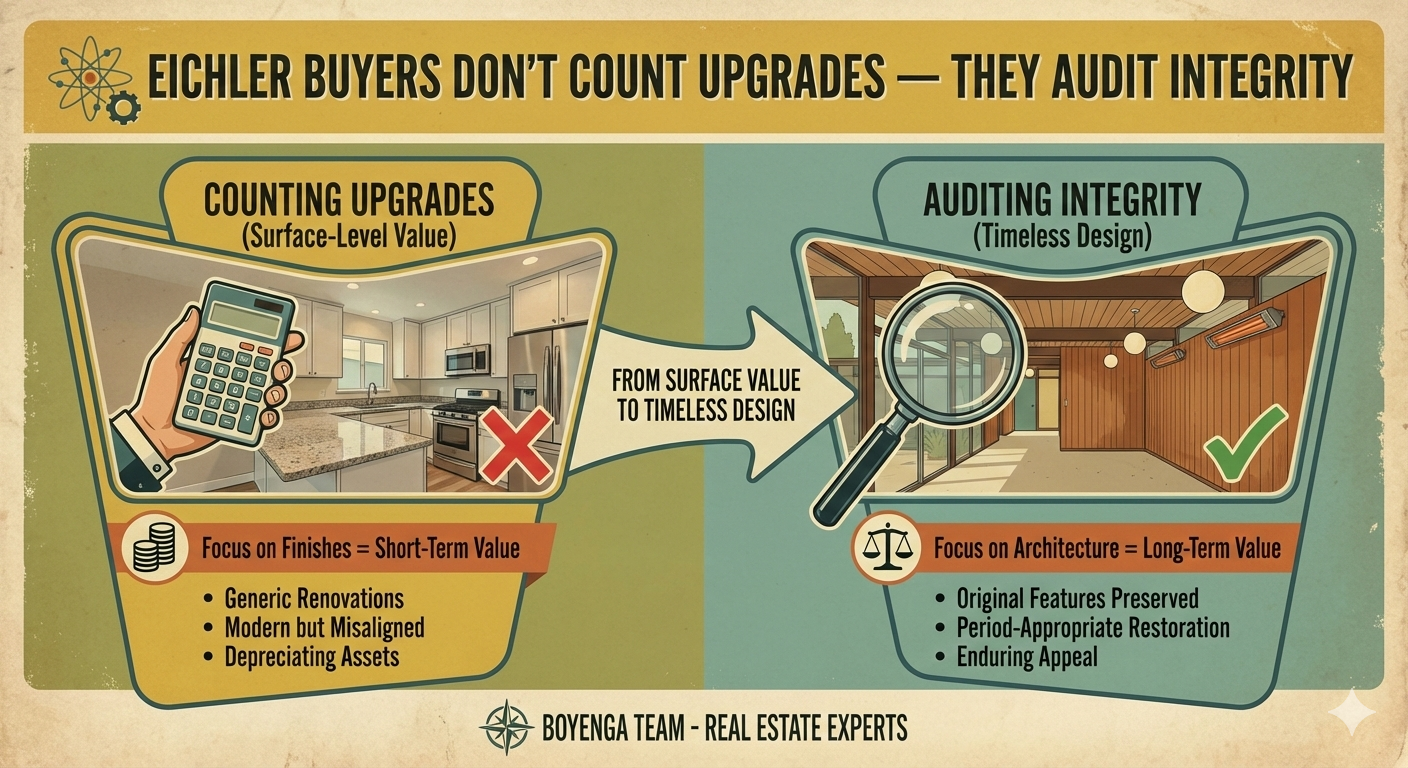
Eichler homes hold a special place in mid-century modern architecture, and the people who seek them out aren’t your typical homebuyers. While a mainstream buyer might swoon over a new granite countertop kitchen or a freshly remodeled bathroom, an Eichler enthusiast is more likely to inspect the exposed beams and clerestory windows with reverence. In other words, Eichler buyers aren’t tallying up modern upgrades – they’re conducting a subconscious “integrity audit” of the home’s original design. This article explores how the Eichler mindset differs from traditional homebuying, what architectural elements are non-negotiable to Eichler purists, and why these iconic mid-century homes defy the usual return-on-investment logic. We’ll also look at cautionary tales of over-modernization versus success stories of thoughtful preservation. Whether you’re a potential Eichler buyer or a proud owner tempted to renovate, read on for insights into the unique ethos of Eichler living.
A Different Mindset: Eichler Enthusiasts vs. Typical Homebuyers
In the world of conventional real estate, buyers (and appraisers) often fixate on tangible upgrades – “How new are the appliances? When was the kitchen last updated?” A standard 1950s ranch house might get a value boost from granite countertops or crown-molded cabinets. However, Eichler homes operate on a completely different value system. In established Eichler enclaves like Palo Alto, the usual formula of “newer = better” simply doesn’t apply eichlerhomesforsale.com. Instead of viewing a 1950s home as outdated, the Eichler aficionado sees it as a piece of art – a mid-century time capsule to be preserved and stewarded eichlerhomesforsale.com. These buyers care more about whether the home retains Joseph Eichler’s original vision (post-and-beam bones, indoor-outdoor harmony, honest materials) than whether it has a Sub-Zero fridge.
Traditional buyers tend to prioritize square footage, modern finishes, and “move-in ready” condition. They might equate value with the number of recent upgrades a home boasts eichlerhomesforsale.com. Eichler buyers, by contrast, prioritize authenticity and design integrity. They’re often self-educated (or even outright nerdy) about mid-century modern details, and they assess a home in terms of how faithfully it has been kept or restored to Eichler’s architectural principles. One Eichler specialist describes their Silicon Valley clientele: “In this market, buyers care about authenticity and condition”. To these enthusiasts, original mahogany wall paneling or an intact open-air atrium is far more exciting than a trendy cosmetic remodel.
Insight: A newly renovated traditional kitchen might add value in most homes, but in an Eichler, a generic “upgrade” can actually lower perceived value if it clashes with the mid-century aesthetic eichlerhomesforsale.com. Eichler aficionados view such changes as defects rather than selling points.
The “Integrity Audit”: What Eichler Buyers Look For
When an Eichler lover walks into a home, they aren’t pulling out a calculator to add up the cost of upgrades – consciously or not, they’re performing an integrity audit of the property’s design. This means evaluating how much of the original character remains and what past changes might need “undoing.” In fact, many purist Eichler buyers mentally deduct value for inappropriate upgrades, seeing them as “demolition projects they must fund” to restore the home eichlerhomesforsale.com. For example, if an owner has installed standard vinyl windows or textured drywall, an Eichler enthusiast knows they’ll likely need to remove them to restore the home’s intended look. It’s not uncommon for a purist buyer to actually budget for “un-renovating” in their offer price eichlerhomesforsale.com.
So, what does this integrity audit entail? It’s somewhat intuitive for those familiar with mid-century modern design. An Eichler buyer will walk through with a keen eye and ask questions like:
Are the post-and-beam bones still visible and honest? (Or did someone lower the ceiling or add false beams?)
Do the sightlines remain open from indoors to outdoors? (Or have walls, large cabinets, or heavy drapes chopped up the transparency?)
Is the atrium intact as a light-filled courtyard? (Or was it roofed over to create a foyer or extra room?)
What about the original materials? Are the tongue-and-groove wood ceilings unpainted and the mahogany panels intact, or were they drywalled and painted over?
Do any additions or alterations feel “off”? Eichler devotees can sense when a new element breaks the rhythm – an off-center front addition, a second-story pop-top, or a Victorian-style trim will stick out immediately as a blight on the purity. eichlerhomesforsale.com.
In essence, Eichler buyers are conducting a real-time preservation report card. Homes that score high on integrity (even if a bit worn around the edges) will light up their eyes; homes that have been “remuddled” with generic contemporary updates will raise red flags. In fact, Eichlers that have been subjected to too many incompatible changes often languish on the market, because the very buyers willing to pay top dollar for an Eichler see those changes as costly mistakes to fix eichlerhomesforsale.com. As one analysis noted, these “Remuddled” Eichlers tend to sit longer because enthusiasts view the so-called upgrades as defects eichlerhomesforsale.com. An Eichler with its atrium enclosed or its wood ceilings painted stark white might actually attract lower offers, not higher ones, because restoration-minded buyers factor in the cost of restoring the Eichler soul.
On the flip side, an Eichler in original or properly restored condition can command a premium. Think of it as the “time capsule effect.” Scarce features like unpainted redwood ceilings, original globe pendant lights, and authentically preserved layouts are assets in the eyes of the Eichler crowd eichlerhomesforsale.com. Rather than asking “how much will it cost to update this 60-year-old home?”, Eichler fans are more likely to think “what is the opportunity here to restore and make it mine without undoing someone else’s bad remodel?” They value the untouched “blank canvas” of a true Eichler, or a home updated only in architecturally sympathetic ways.
Mid-Century Must-Haves: The Eichler Authenticity Checklist
What exactly constitutes “architectural integrity” in an Eichler? Certain design elements are sacred to Eichler aficionados – they are the very features that define an Eichler’s soul and distinguish it from ordinary houses. Here are the key architectural elements Eichler buyers will check off in their mental audit:
Exposed Post-and-Beam Bones: Perhaps the hallmark of Eichler design is the post-and-beam construction that leaves the home’s structural skeleton visible by design. Instead of many interior load-bearing walls, Eichlers use stout posts and beams to hold up the roof, creating open spans and a free-flowing layout eichlerhomesforsale.com. Enthusiasts love seeing those real beams run through living spaces and even extend outside to the eaves – it’s a sign of authenticity. The beams aren’t just structural; they’re aesthetic, creating strong horizontal lines and giving the interior a modern, honest expression of structure eichlerhomesforsale.com. An Eichler purist will peer up at the ceiling: if they see continuous beams stretching across rooms (with no drop ceilings or attic added), that’s a big plus. If instead they see a mishmash of added walls or faux decorative trim hiding the beams, they know the home has lost some Eichler magic.
Floor-to-Ceiling Glass and Indoor-Outdoor Flow: “Bring the outside in” is an Eichler mantra. Original Eichlers feature expansive glass walls and sliding glass doors that blur the line between indoors and outdoors eichlerhomesforsale.com. A signature element is the use of floor-to-ceiling glass panels facing onto patios, backyards, or central courtyards, often with seamless transitions (even the same flooring material extending outside) to create one continuous living space under roof and sky eichlerhomesforsale.com. Eichler buyers will specifically note if the home has its walls of glass intact, providing those classic views of gardens and letting in abundant light. Sightlines are crucial – you should be able to stand in the living room or kitchen and see straight through to greenery outside. Many Eichlers were built so that upon entry, you first step into an open-air atrium before entering the indoor living space, immediately establishing that indoor-outdoor connection. If those sightlines have been chopped up (say a large glass wall was replaced with small windows, or an atrium was enclosed), that’s a strike against the home’s authenticity eichlerhomesforsale.com.
Open-Air Atrium or Courtyard: Speaking of atriums – the atrium is the heart of many Eichler homes. It’s a signature design feature: an open-sky courtyard, typically at the center or entry of the home, surrounded by glass walls. It brings light and nature to the interior, creating a private garden oasis. Eichler enthusiasts consider an intact atrium a huge asset, both for its beauty and its rarity in modern construction. A preserved atrium signals that the home’s core layout remains as intended. Conversely, covering an atrium with a solid roof or converting it into an indoor space is often seen as sacrilege in Eichler circles. Yes, you might gain a bit of square footage by enclosing it, but you lose the very “wow factor” that makes an Eichler an Eichler eichlerhomesforsale.com. Savvy Eichler buyers know this, which is why a house with a filled-in atrium will “feel darker and more closed-in, missing that light-filled transparency buyers expect” eichlerhomesforsale.com. Many will either pass on such a house or discount their offer price, knowing they’d want to open it back up. On the other hand, show a buyer a classic atrium model Eichler with sunlight spilling in and a Japanese maple or sculpture in the courtyard, and watch their face light up.
Tongue-and-Groove Wood Ceilings (Floating Roof Effect): Eichler homes were built with tongue-and-groove (T&G) wood plank ceilings that are actually the underside of the roof itself, eichlerhomesforsale.com. These planks (often beautiful redwood or Douglas fir) span between the beams and give the ceilings a warm, linear texture – an effect beloved by design enthusiasts. Importantly, the original Eichler ceiling has no attic and no drywall hanging down; what you see above is the structural roof decking. In some models, clerestory windows or gaps above the walls create a floating roof appearance – the ceiling plane seems to hover above the glass walls, letting light in at the edges. Eichler buyers prize these wood ceilings and the “floating” quality of the roofline. They will cringe if they see that a past owner covered the natural wood with sheetrock or even painted it solid white without reason. Those unpainted wood ceilings, often with exposed beams, are not only gorgeous but historically correct. Removing or obscuring them is seen as erasing a layer of the home’s character. As one Eichler expert warned, indiscriminately painting over original redwood or mahogany surfaces (the “White Blight” of renovations) is a value-destroying mistake that fights the home’s intended warmth eichlerhomesforsale.com. In short: Eichler fans want to see some knotty wood grain above – it tells them the house still has its mid-century soul.
Material Honesty and Minimalist Details: “Honesty of materials” is a core tenet of mid-century modern design that Eichler homes exemplify. In practical terms, this means what you see is what it is – wood looks like wood, concrete looks like concrete, and the structure isn’t buried under fussy ornamentation eichlerhomesforsale.com. Eichler buyers love walking into a house and finding, for instance, original Philippine mahogany wall panels or even simple block brick fireplace walls, because these authentic textures were meant to be seen. Likewise, an Eichler in original form won’t have crown molding, elaborate trim, or fake shutters – the aesthetics are clean and unadorned. Even features such as door hardware, globe light fixtures, and the iconic bright-orange front door (a playful pop of color on many Eichlers) contribute to the minimalist yet warm style. When evaluating a home, Eichler enthusiasts look for these subtle signs of authenticity: e.g., are the interior walls free of gaudy trim? Are the cabinets flat-panel and low-profile? Does the overall design feel “light” and unpretentious? Misguided remodels sometimes introduce Colonial or generic elements (such as ornate trim, paneled doors) that stand out like a sore thumb. Such additions break the Eichler spell. True Eichler integrity lies in restraint – preserving the simplicity and unity of materials so the home’s architecture can speak for itself. As fans often note, Joseph Eichler’s architects “rejected ornamentation in favor of honest materials and indoor-outdoor harmony” eichlerhomesforsale.com.
A classic Eichler facade showcases mid-century integrity – low-slung post-and-beam lines, floor-to-ceiling glass, and a modest, nature-inspired material palette. Instead of counting flashy upgrades, Eichler enthusiasts look for these core elements to ensure the home’s original spirit shines through.
(Image credit: Boyenga Team – Eichler Homes for Sale)
ROI vs. Reality: Why Eichlers Defy the Usual ROI Logic
From a conventional real estate perspective, homeowners often think in terms of Return on Investment (ROI) for upgrades: spend $50k on a kitchen, expect to get it back (and more) in the sale price. But Eichlers turn this calculus upside down. Many standard “value-add” improvements can actually subtract value from an Eichler if not done with respect for the architecture. The Eichler buyer market is not looking for a cookie-cutter modernized home; they’re looking for a well-preserved or properly modernized mid-century home. Thus, the standard ROI rules don’t apply neatly.
Consider this paradox: A 1958 Eichler in mostly original condition might sell for more than a neighboring Eichler of the same model that has a brand-new granite kitchen and all the trappings of a 2020s remodel. Why? Because the former has what Eichler lovers want (untouched wood cabinets, original layout, no prior botched changes), while the latter might have erased mid-century features in favor of generic “upgrades.” Data from niche markets backs this up: “Time capsule” Eichlers – largely untouched since the 60s – often command a premium due to their rarity eichlerhomesforsale.com. Features that would be considered dated in a normal house (old cabinetry, vintage lighting) are seen as essential assets in an Eichler, because they represent the home’s soul and offer the next owner a purist canvas to work with eichlerhomesforsale.com. Buyers will pay extra for the privilege of not having to undo someone else’s poor renovation choices eichlerhomesforsale.com.
On the flip side, Eichlers that have been “updated” in a generic contemporary style often suffer in the market. These are the aforementioned “remuddled” homes eichlerhomesforsale.com. Install Home Depot colonial-style doors, slap on thick white vinyl window frames, or swap out sleek Eichler siding for faux-stone veneer, and watch Eichler buyers recoil. Rather than adding value, those expenditures become a liability. One report noted that “homes updated with generic materials popular in other styles…sit on the market longer because buyers view the ‘upgrades’ as defects,” and that buyers effectively have to pay for both the seller’s renovation and the demolition to remove them (eichlerhomesforsale.com). From an ROI perspective, that’s a double loss for the misguided renovator.
Eichler ROI logic prioritizes what you can’t easily add later – architectural integrity, coherence of design – over surface cosmetics. You can always remodel a kitchen or bath to be more stylish, but you cannot easily restore an atrium once it’s been filled in, or replace a roof that was altered to add a second story. Eichler buyers know this, so they value homes with intact “bones” and will discount those with irreversible alterations eichlerhomesforsale.com. Indeed, the highest prices in Eichler sales often go to homes that hit the sweet spot of modern convenience and period-correct style: think “architecturally aligned renovations” where system upgrades and high-end finishes were completed in a way that looks original. These trophy homes – updated electrical, new foam roof, maybe a revamped kitchen with flat-front walnut cabinets and period-appropriate finishes – show that it’s possible to have the best of both worlds. Wealthy Eichler buyers will pay top dollar for such homes because they deliver modern functionality without compromising the mid-century aesthetic eichlerhomesforsale.com.
In summary, Eichler homes defy the typical ROI equations because their value derives from an intangible quality: integrity of design. As one analysis eloquently put it, “The ‘Eichler Premium’... is a payment for the successful preservation of a social contract between the architect and the inhabitant, prioritizing light and privacy over ornamentation.” eichlerhomesforsale.com In other words, Eichler buyers are investing in an experience and a piece of architectural history, not just a structure with X bedrooms and Y upgrades.
When “Upgrades” Undermine the Eichler Spirit
Too many well-meaning homeowners have learned the hard way that over-modernizing an Eichler can backfire. Let’s explore a few common mistakes that undermine an Eichler’s architectural spirit (and ultimately its value):
Enclosing the Atrium or Adding Walls: It might be tempting to gain a bit of interior square footage by putting a roof over that open-air atrium or subdividing an open living area into an extra room. But Eichler enthusiasts almost universally view this as a loss. Covering an atrium turns a unique indoor-outdoor sanctuary into just another foyer, often making the interior darker and robbing the house of its central focal point. Similarly, adding walls where Eichler architects intended openness goes against the grain. An example from Eichler lore: some owners in past decades enclosed atriums to create dining rooms or expanded foyers – only to find buyers later on asking how to remove those enclosures and restore the original plan. As noted earlier, a house that “walled off” its views and flow will likely sit on the market or attract low offers eichlerhomesforsale.com, because for Eichler purists, that’s a problem to be fixed, not a feature to pay extra for.
“Improving” Windows with Chunky Frames or Tinted Glass: Many Eichlers originally came with huge single-pane glass walls and very slim aluminum frames – a look that’s integral to their design. Upgrading single-pane windows to double-pane for energy efficiency is often prudent, but how it’s done matters immensely. Eichler specialists warn that inserting typical vinyl retrofit windows (with thick white frames and often smaller glass area) will “instantly ruin an Eichler” by chopping up its clean lines eichlerhomesforsale.com. Unfortunately, some owners or contractors not versed in mid-century style have replaced original glass expanses with modern windows that have thick grids, dark tints, or sliding units that don’t fit the original openings. The result can look clunky and out of character. One can almost hear an Eichler fan sighing at an open house, “Those new windows will have to go.” The City of Sunnyvale (home to many Eichlers) even notes in its Eichler design guidelines that maintaining minimal, narrow window frames in the original color is key, and that bulky frames or divided lites disrupt the Eichler look eichlerhomesforsale.com. The takeaway: a costly window replacement done wrong is worse than leaving the old windows – it’s an “upgrade” that actually subtracts appeal.
Painting or Covering Natural Wood Features: Eichler interiors often feature beautiful exposed wood – from the planked ceilings to wood-paneled walls or built-in cabinetry. These elements lend warmth and authenticity. However, during periods of remodeling, some owners painted mahogany walls in light colors or drywalled over them; others retained the natural wood ceilings and painted them white or installed a faux drop ceiling beneath. While this might have made the home feel more like a conventional suburban house, it effectively erased part of the Eichler character. Preservationists rue this trend, dubbing it the “White Blight” when tongue-and-groove ceilings are painted over needlessly eichlerhomesforsale.com. Beyond aesthetics, those wood surfaces were meant to balance the home’s glass and concrete elements and provide a humanizing texture eichlerhomesforsale.com. Covering them up removes that balance. So, an Eichler buyer walking into a house with all-white ceilings and no wood in sight might feel the space has lost a bit of soul. Yes, wood can often be stripped or restored, but that’s an added project (and original woods like Philippine mahogany are no longer readily available eichlerhomesforsale.com). The more original wood left, the better.
Out-of-Character Additions and Exterior Changes: Eichler exteriors are known for their simplicity – often a low-pitched roof, vertical grooved siding, and a modest street presence that shields the home’s openness inside. When additions are needed (such as enclosing a carport in a garage or expanding a bedroom wing), doing so in an Eichler-compatible way is challenging but feasible. Unfortunately, examples abound of clumsy second-story additions that tower awkwardly over a formerly low-slung profile, or decorative flourishes (like faux Mediterranean arches, or as one anecdote notes, adding “Classical touches like dentils and fluting” to an Eichler) that completely clash with the home’s DNA. In the early days, some Eichler owners who didn’t appreciate the style tried to make their homes look more traditional – those were the “bad old days” of misguided remodels. Today, with mid-century modern style en vogue, the pendulum swung the other way. Some owners over-stylize the homes with all-new 21st-century materials (slick metal cladding, floor-to-ceiling black glass doors, etc.) that look ultra-modern but no longer feel mid-century. This trend even has a name: “Dwellification,” a nod to Dwell magazine’s contemporary modern aesthetic, which can go so far that the house no longer reads as a true 1950s Eichler. For example, replacing all exterior siding with smooth gray cement panels might make a house look very 2020s-modern, but at the cost of losing Eichler’s original warmth and context. As architectural historian Hannah Simonson warned, if everyone “dwells” their Eichlers with identical modern finishes, we risk being unable to distinguish authentic mid-century design from new builds. The bottom line: too many flashy or stylistically inconsistent upgrades can dilute an Eichler’s character to the point where true aficionados no longer see it as an Eichler – and the home’s value (to that target market) will reflect that.
Preservation Pays Off: Enhancing Appeal the Eichler Way
For every tale of an over-modernized Eichler that struggled to find the right buyer, there’s an inspiring example of a home where subtle restoration or period-appropriate upgrades made all the difference. Eichler fans deeply appreciate when an owner has invested in preserving the home’s authenticity while gently updating for comfort. Here are some ways preservation-minded owners (and savvy renovators) enhance Eichler appeal – often with great results in market value and buyer love:
Restoring and Showcasing Original Features: The simplest way to honor an Eichler is to bring back its original glory. We’ve seen sellers who, before listing, chose to strip paint off the vaulted wood ceilings to reveal the redwood again, or carefully refinish the Philippine mahogany wall panels that had been dulled by age. These efforts can make an old Eichler sing. Likewise, keeping or reinstalling period-correct elements – say, replica globe pendant lights, or restoring the open breezeblock screen by the entry – can earn nods of approval from enthusiasts. One Palo Alto agent notes that “restoring wood ceilings, beams, and built-ins maintains the Eichler look”, and indeed many buyers often pay more for preserved materials. Think of it like a classic car: the more original parts and finishes, the more coveted it is. By highlighting these details rather than hiding them, sellers tap into the emotional premium Eichler lovers attach to authenticity.
Invisible or Sympathetic Upgrades: Not all upgrades are bad – in fact, some are very welcome. The key is that they improve the home’s performance without shouting for attention. For example, many Eichler owners have replaced old single-pane glass with dual-pane “frameless” units that look virtually identical to the originals, or opted for slim aluminum-framed windows that meet today’s codes while preserving the original sightline. These are smart upgrades that make the home more comfortable and efficient without compromising the design. Other examples include installing a new foam roof (for improved insulation and waterproofing) that is flat and hidden, like the original, or upgrading the slab's radiant heating system to ensure reliable operation. An Eichler market analysis highlighted “smart, invisible upgrades” such as thermally improved aluminum glazing, radiant heat restoration, and added insulation that enhance comfort while preserving the structure's “soul,” according to eichlerhomesforsale.com. In essence, systems and behind-the-scenes improvements get a thumbs-up – they make the home more livable for modern times, as long as the aesthetic and architectural experience remain mid-century.
Period-Appropriate Remodeling: Kitchens and bathrooms are areas where many Eichlers needed updates (original appliances wear out; original bath fixtures might feel cramped). The trick is to remodel these spaces in a way that feels true to the mid-century spirit. Successful Eichler renovations often stick to minimalist, low-profile cabinetry, simple tile or terrazzo floors, and faithful color palettes. For instance, instead of installing ornate granite islands, a thoughtful Eichler kitchen update might use flat-panel wood or glossy white cabinets, a streamlined island, and even incorporate some retro-inspired touches like period-style pendant lights or geometric backsplash tile. These choices enhance the home’s appeal because they fit right in – they could even be mistaken for original by the casual eye, just very well-kept. Buyers walk in and feel a sense of coherence: the kitchen looks modern and functional, but it also looks “at home” in the 1960s architecture eichlerhomesforsale.com. This is the “architecturally aligned” approach that tends to fetch top dollar and immediate offers. In contrast, a remodel that fights the architecture (say, a super-traditional farmhouse kitchen plunked into an Eichler) will be a jarring note. Real estate professionals often advise that Eichler kitchens and baths should keep sightlines open and scale appropriate, using “simple slab cabinetry, wood tones, and clean tile” so that the architecture remains the star. When done right, these updates make the home more enjoyable day-to-day and reassure buyers that they won’t have to sacrifice convenience – all without betraying the Eichler aesthetic.
Enhancing the Indoor-Outdoor Lifestyle: Another way preservation-minded owners amplify Eichler appeal is by celebrating the indoor-outdoor features rather than altering them. This could be as simple as sprucing up the atrium or backyard to make the transition from house to garden even more inviting. A little effort in the landscaping – say, keeping an atrium minimalist with a few plants and maybe period-appropriate outdoor furniture – can help buyers imagine themselves living the Eichler lifestyle: morning coffee under the sky, or kids playing in a safe enclosed atrium visible from the living room. Some owners even reverse past “upgrades” – for example, if a previous owner put carpet over the original concrete slab, the current owner might remove it and polish the concrete floor for a sleek indoor-outdoor-ready surface. Preserving the deep roof overhangs that provide shade and visual continuity, maintaining the signature Eichler breezeway or open carport, and avoiding tall fences that block views all enhance the property's character. Essentially, emphasize what makes the home unique (glass, patios, atrium, exposed structure) rather than trying to make it look like every other house. Sellers who do so often find that the home “speaks” to buyers on a visceral level, and it may even spark a bidding war among Eichler aficionados. After all, you’re not just selling a house – you’re selling the Eichler experience. And the more intact that experience, the more compelling the sale.
Advice for Sellers: Honor the Eichler Spirit (and Reap the Rewards)
If you’re a homeowner looking to sell an Eichler, you might be thinking of making some upgrades to maximize your sale price. The key advice from Eichler experts: when in doubt, don’t over-modernize. Resist the reflex to plaster over the very features that make your home special. Here are some seller-oriented tips to keep in mind:
Preserve (or uncover) Original Details: Before spending money on a trendy but generic makeover, consider investing in restoring the Eichler’s original elements. Refinish those wood panels or ceilings rather than hiding them. If you still have original globe lights, showcase them (they’re cool again!). Repair the original radiant heat if feasible – a working radiant system is a unique selling point that Eichler buffs value, compared to forcing them to use baseboards or ducts. Remember, mid-century modern is in vogue; what might seem “old” to you might be gold to the right buyer.
Modernize Systems, Not Style: It’s absolutely worthwhile to fix the “bones” – address any roofing issues, update electrical panels if they’re unsafe, ensure the radiant heating boiler is in good shape, and so on. These kinds of improvements will pay off because they reduce buyer anxiety and don’t alter the home’s appearance. Upgrading to insulated glazing or adding insulation (invisibly) can also be selling points, as long as you do it in an Eichler-friendly way (e.g., use thin-frame windows that keep the original look). By all means, improve the comfort and safety of the house – choose solutions that don’t clash with the design. Many Eichler-savvy contractors can retrofit improvements almost invisibly (for instance, inserting shear walls inside existing walls for seismic strengthening, or using ductless mini-split HVAC to avoid running ducts in the ceilings).
Avoid Over-Staging with Generic Décor: When selling, you want to appeal to that Eichler-loving demographic. Consider staging the home to complement mid-century style. That means sleek, low-profile furniture, no heavy drapes on the windows (let that light pour in!), and perhaps a few Eames or Nelson-inspired touches to spark the imagination. Conversely, cluttering the space or using super traditional furnishings can make it harder for buyers to see the home’s true character. Let the beams, glass, and layout speak for themselves. A well-staged Eichler will feel like a “time capsule” in the best way – evoking the era, but clean and fresh, not old and musty.
Consult Eichler-Savvy Professionals: If you are considering any substantial changes before selling – say you think removing a certain wall might help, or you’re not sure what kind of kitchen update will attract buyers – talk to a real estate agent or architect who knows Eichlers. They can guide you on which changes are smart and which could inadvertently hurt your sale. As one guide advises, “if you are considering major changes, consult a design-literate agent and a structural professional early so you can align plans with buyer expectations.” In other words, get advice from someone who understands the buyer mindset we’ve been discussing. They might tell you, for example, that spending $30k to add crown molding and wall-to-wall carpet is a terrible idea (it is!), but spending that on fixing the leaky roof and polishing the concrete floor is money well spent.
Highlight the Eichler Narrative: Finally, when marketing the home, embrace its Eichler identity. Provide a brief history in your listing (Eichler enthusiasts love knowing the model, the architect (e.g., Jones & Emmons or Anshen+Allen), the year built, etc.). Mention original features in the ad copy (“features original mahogany walls and working radiant heat!”). By doing so, you’re directly targeting the right buyers – the ones who will fall in love with your home and potentially bid it up. Remember, Eichler homes often sell to an emotional buyer who has been waiting for just this kind of house, not to a bargain-hunter looking to flip. So speak to that audience. The more you can show that the home has integrity and hasn’t been spoiled by dissonant remodels, the better your outcome is likely to be.
Tips for Buyers: Embrace Authenticity and Plan Thoughtfully
If you’re on the other side of the equation – buying an Eichler – you probably already have a sense that these homes are different. You may even be specifically seeking an Eichler for the lifestyle and aesthetic. Still, it’s worth emphasizing a few points to ensure you find the right home and preserve its legacy:
Prioritize Good Bones Over Superficial Perfection: When touring Eichler listings, you might encounter homes that look a bit worn or have original 1960s kitchens and bathrooms. Don’t let pink tile or an old Formica countertop scare you away if the fundamentals are there – location, layout, and architectural integrity. Cosmetic things can be updated (and you can do it in a period-appropriate way later). What you can’t easily fix are major architectural alterations. So, a house with an intact atrium, unaltered post-and-beam structure, and all that glass – even if it needs some TLC – is usually a better long-term buy than a house where the atrium was enclosed and half the glass was lost in favor of smaller windows. As one guide suggests, use a checklist to identify original features (atrium, glass walls, exposed beams, etc.) during your tour, and weigh them heavily in your decision. Many buyers “pay more for preserved materials and thoughtful updates”, so they recognize the value in those preserved elements.
Budget for Restoration (Not Just Renovation): If you end up buying an Eichler with some unfortunate “updates,” be prepared to budget time and money to restore key features. For example, you might set aside funds to replace those vinyl windows with slim aluminum ones, or to reopen a closed skylight. In the long run, these restorative projects often add value. They also deepen your connection with the home, as you become part of its preservation story. It can be helpful to obtain inspections and contractor estimates during your due diligence to determine what it would take, for example, to strip paint from the ceilings or re-landscape the atrium. Knowing that upfront helps you make a competitive yet smart offer – even if you’ll be undoing some work. Keep in mind, Eichler-specialist contractors exist and can guide you on costs and the feasibility of various fixes.
Understand What Adds Value in Eichlers: Educate yourself (as you are by reading this, so kudos!) on the Eichler market’s value drivers. Unlike a typical house, where a flashy new interior might top the list, here it’s often authenticity, the condition of original elements, and the quality of Eichler-sensitive upgrades that count. When comparing homes, note features like original vs. replaced siding, condition of beams (any cuts or damage?), presence of original features like the extendable kitchen hood or built-in cabinets – these little things can signal how much love a home has received from past owners who “got it.” A well-maintained original Eichler, or one updated under the guidance of an Eichler pro, can save you a lot of headaches and truly hold its value. Don’t shy away from paying a premium for a great example of an Eichler; you’re investing in something that will likely remain desirable if properly maintained. Conversely, be cautious about paying top-of-market for an Eichler that’s been radically altered. As noted, you may incur additional costs down the road to set it right, and you should factor that into your offer.
Plan Any Changes with Care and Respect: When you do move into your dream Eichler, you might have a list of things you want to change – that’s natural. But as you settle in, you may find that the home’s design grows on you and doesn’t need as much changing as you thought. Many Eichler newcomers gain a deeper appreciation over time for why things were designed the way they were (for example, the placement of windows for cross-breeze, or the way radiant heat keeps the floors cozy). If you decide to renovate, plan with the Eichler principles in mind. Keep that indoor-outdoor flow and open sightlines. Preserve the atrium and exposed beams. If you need more space, consider building in a complementary style, or consider a larger Eichler rather than tacking on an awkward addition. Also, check local guidelines – some Eichler neighborhoods have voluntary or official design guidelines to help maintain the look (and some areas even have historic status considerations). It’s often recommended to engage an architect or designer familiar with mid-century modern when doing major work; they can help you modernize in a way that feels organic to the house. In short, you’re not just buying a home, you’re becoming a custodian of a mid-century masterpiece. Embrace that role, and you’ll find the process rewarding.
Embracing the Eichler Ethos
Eichler homes aren’t just real estate; they’re a way of life and a statement of taste. The very things that make them non-conformist in the housing market – the floor-to-ceiling glass, the unorthodox layouts with central atriums, the absence of frou-frou detailing – are what make living in one such a joy for those who “get it.” Eichler buyers and owners form a community bonded by a shared appreciation for mid-century modern integrity. They understand that maintaining an Eichler’s authenticity isn’t about resisting change for the sake of it, but about honoring a brilliant design that has stood the test of time in form and function.
If you’re drawn to Eichler homes, you’re likely someone who values design, creativity, and a connection between shelter and nature. It’s a slightly nerdy passion – you might find yourself discussing the pros and cons of original tar-and-gravel roofs, or the best way to refurbish period Thermador appliances. And that’s okay! In fact, it’s part of the fun. Living in (or selling) an Eichler is about embracing a unique ethos: one where integrity matters more than glitz, where less is more, and where a house is not just a financial asset but a cultural artifact to be cared for.
As the saying goes (and as our title suggests), Eichler buyers don’t count the upgrades – they audit the integrity. For sellers and buyers alike, success comes from recognizing this central truth. Preserve the atrium, keep the glass walls clear, celebrate the beams, and respect the simplicity, and you’ll be in good shape.
Are you considering buying or selling an Eichler? Whether you’re a prospective buyer searching for that perfect authentic Eichler or an owner contemplating changes before you sell, having an expert who understands this “integrity audit” mindset can make all the difference. Feel free to reach out to our team for guidance – we’re passionate about Eichler homes and happy to help you navigate the process, protect the value of these architectural gems, and make the most of the Eichler experience. Let’s ensure your Eichler journey is every bit as special as the homes themselves.