The Mid-Century Modern Convenience Index: What Actually Makes These Homes So Livable
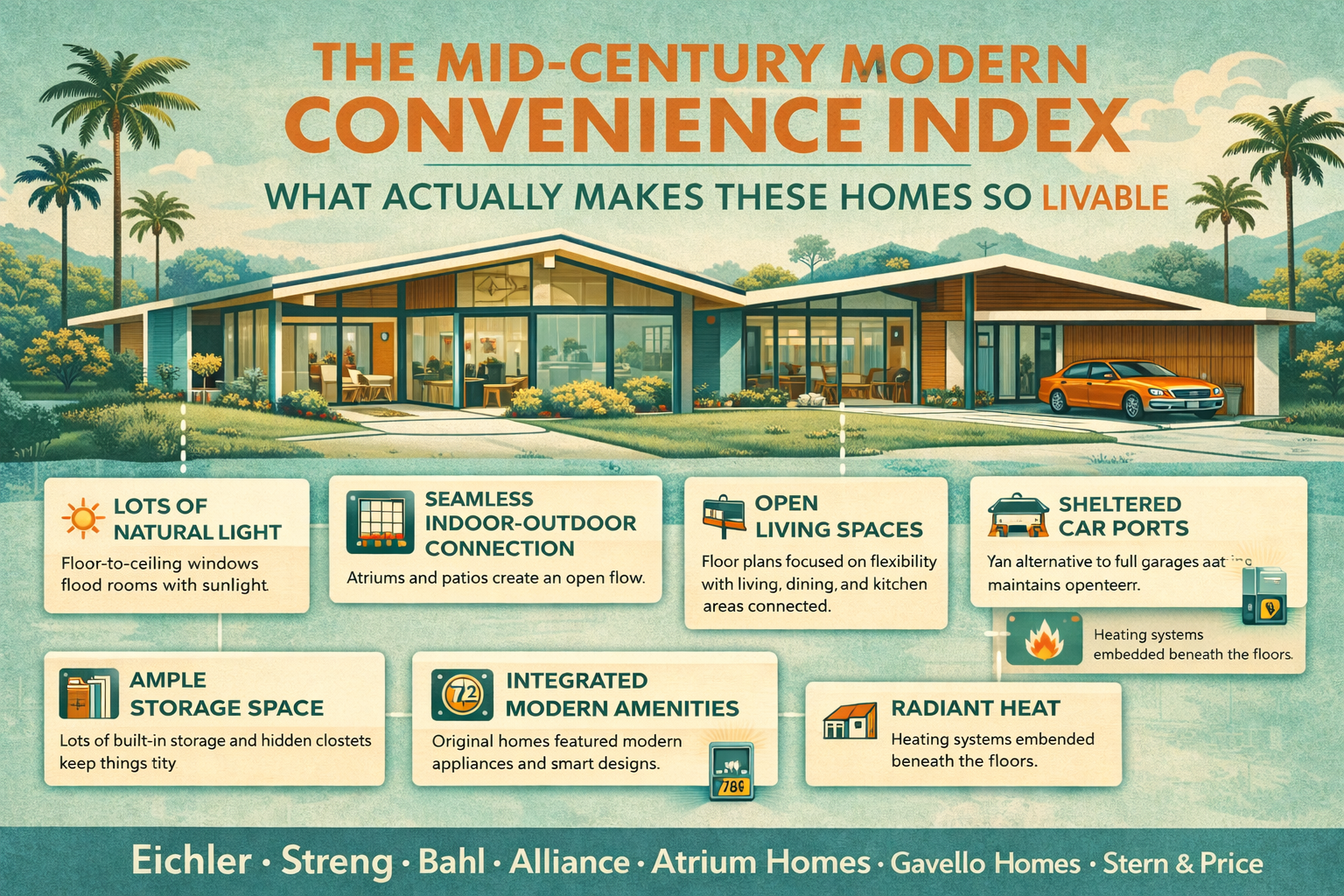
Mid-century modern homes weren’t just beautiful — they were engineered for everyday life. Long before “open concept” and “indoor-outdoor living” became marketing buzzwords, mid-century builders were solving for flow, efficiency, privacy, and flexibility. When you look closely, these homes weren’t ahead of their time — they were designed for ours.”
1. The Mid-Century Convenience Philosophy
Designed for efficiency, not excess: Mid-century modern design was guided by the mantra “form follows function.” Architects stripped away superfluous ornamentation so that every element served a purpose. The result was an emphasis on efficiency over excess: floor plans avoided wasteful nooks and unused formal rooms, focusing instead on the spaces people actually live in day-to-day. As Ludwig Mies van der Rohe famously said, “less is more,” and mid-century homes embodied this by doing more with less space. A well-designed 1,700 sq. ft. mid-century home can feel more functional than a 2,000+ sq. ft. contemporary house that’s chopped up by useless halls or bonus rooms.
Fewer walls, fewer wasted steps: Decades before “open concept” became a selling point, mid-century architects were already knocking down walls to improve flow. By minimizing hallways and partitions, these homes ensured virtually every square foot was usable living area. There are no dead spaces in a classic mid-century layout – no attic, fewer corridors – so you aren’t trekking down long passages just to get from the kitchen to the living room. This not only reduces wasted steps in daily life, but also lowers construction and maintenance costs. (After all, fewer walls mean less materials and less to heat or cool.) The open layouts pioneered in mid-century design made homes feel spacious and airy without needing McMansion-like square footage. Everything is oriented around ease of movement, sightlines, and practical living, rather than impressing with sheer size.
Form always follows function: While mid-century modern style is famous for its clean lines and iconic look, its deeper strength is how those looks are tied to real-life function. Design decisions were ruled by how a home would be used. If a wall didn’t serve a structural or functional purpose, it was eliminated. If an architectural detail didn’t enhance the homeowner’s daily experience, it was simplified. Beauty emerged from this practicality – the elegant post-and-beam structures, open floor plans, and built-in furnishings all reflect a problem-solving mindset. In mid-century homes, form never outshines function; instead, thoughtful function becomes the form. That design intelligence is a big part of why these homes still feel “right” to live in today.
2. Flow Over Square Footage
A small Eichler lives larger: One of the quiet secrets to mid-century homes’ lasting appeal is how large they live relative to their actual size. For example, an Eichler of around 1,500–1,700 sq. ft. can often feel more expansive and usable than a newer 2,400 sq. ft. home, thanks to superior flow and space planning. There are no cavernous entry foyers or redundant formal rooms gathering dust – every room in a mid-century layout connects logically and openly to the next. An open great room flows into the dining area and kitchen; sliding glass doors flow out to patios. This continuous circulation and visual connectivity make the interior feel expansive. In Eichler’s early tracts like Greer Park (Palo Alto), even modest 3-bed/2-bath houses felt surprisingly roomy because the indoor–outdoor flow and tall windows “make them live larger than they are”. Homeowners used to traditional layouts are often astonished when they realize a mid-century ranch of 1,400 sq. ft. has zero “dead zones” and can feel as roomy as a much bigger house.
Sightlines and circulation: Mid-century architects were masters of creating clear sightlines and easy circulation paths, which enhances both the feeling of spaciousness and daily convenience. Stand in the living area of a well-designed mid-century modern home and you might see clear through to the kitchen, out to the backyard, and even to bedrooms down a hall – all from one spot, without obstructions. This planning wasn’t just about aesthetics; it was about understanding how people move through a home in daily life. Everything is on one level (in many cases) and arranged to minimize backtracking or closed-off corners. You’ll rarely find yourself walking down a long corridor to reach a remote bedroom in these homes; more often, a gentle L or T-shaped layout neatly connects private and public areas without fuss. Fewer interior walls also mean natural light can penetrate deeper into the house and air can circulate more freely, making the entire space more pleasant and reducing the need for artificial lighting or cooling during the day. In short, mid-century homes prioritize flow – how a home lives – over raw square footage, and that makes all the difference in livability.
No wasted space: The ethos of “no wasted space” is evident everywhere once you notice it. High ceilings and glass make modest rooms feel voluminous. Built-in storage (from shelving to banquettes) takes the place of extra rooms full of cabinets. Even the lot usage is efficient – instead of a giant front lawn nobody uses, mid-century designs often favor a private courtyard or atrium that extends the living space outside (more on that next). The designers of the era were very intentional: if a design element didn’t add to the flow, utility, or comfort of the home, it was reconsidered. The outcome is a house where you really use every part of it on a regular basis. As mid-century experts like to point out to skeptical buyers, “every square foot is usable living area” in these homes, which is not something you can say about many larger, newer houses with awkward or purely decorative spaces.
3. Indoor–Outdoor Living That Actually Works
Blurring the lines between inside and out: Mid-century modern homes pioneered the indoor–outdoor lifestyle decades before it became a standard luxury feature. Key to this is the extensive use of glass and the inclusion of private outdoor spaces within the footprint of the home. Many mid-century California homes (most famously, Eichlers) were built around central open-air atriums or courtyards. Imagine stepping through your front door and finding yourself under the open sky, in a private outdoor room enclosed by the house itself – that was Eichler’s innovative twist around 1960. These atriums bring light, air, and nature deep into the home, effectively erasing the barrier between indoors and outdoors. Floor-to-ceiling glass walls wrap these spaces and the rear facades of the house, creating constant visual connections to greenery and sky. Even in more conventional mid-century designs without central courtyards, large sliding glass doors and expansive windows were used to “dissolve” the boundary between interior and exterior. The result is not just aesthetic — it greatly expands the sense of space. A 1,500 sq. ft. home can feel boundless when your living room wall is essentially all glass facing an inviting patio, garden, or atrium. The outside becomes part of your decor and living area, especially in nice weather, effectively increasing your usable space without adding square footage.
Atriums as climate moderators: Those signature open courtyards aren’t just for show; they also serve a practical function in regulating the home’s environment. By design, a central atrium can help funnel breezes into the home and provide cross-ventilation, naturally cooling the interior on hot days. It’s like a lung for the house, helping it breathe. Atriums also allow more filtered sunlight in (often tempered by partial shade from the surrounding roofline or a shade tree planted within), which brightens the home without the direct heat gain of traditional skylights. In essence, mid-century architects were using time-tested ideas (the Roman impluvium, the Spanish courtyard) to make homes more comfortable and efficient. Homeowners often find that these houses stay cooler in summer and brighter in winter because of the way they harness the indoor–outdoor connection. And when it rains, having an atrium means you can literally watch the weather from inside your home – a sensory pleasure that modern sealed-up McMansions can’t offer.
Privacy without isolation: A crucial aspect of mid-century indoor–outdoor design is that it doesn’t sacrifice privacy. While walls of glass open up to courtyards and backyards, the street-facing side of mid-century homes is often deliberately more closed or features high windows (clerestories) and decorative screens. The house essentially turns inward toward its private outdoor spaces. Joseph Eichler famously oriented the glass expanses toward protected atriums and back gardens, not the street, so that families could enjoy openness without feeling exposed to the neighborhood. It’s a clever balance: you get huge glass walls and indoor–outdoor freedom, but only where you and your guests can appreciate it. The atrium concept, in particular, gives the feel of outdoor living in total privacy – an outdoor living room shielded from public view. This design has aged incredibly well in an era where outdoor kitchens and backyard entertainment are all the rage. Mid-century homes were doing it organically 60 years ago: you can dine on the patio, supervise kids in the atrium, or enjoy a zen garden in the center of your home, all without neighbors peeking in. It’s no wonder that new luxury homes now echo these features (think central courtyards, glass pocket doors, etc.), because they work. But mid-century moderns have the authentic DNA of the concept – they were built for indoor–outdoor living when most others were still boxing life into separate rooms.
4. Kitchens Built for Real Life
Central placement (not tucked away): Walk into a pre-war traditional home and you’ll likely find the kitchen hidden in the back, a utilitarian zone meant to be out of sight. Mid-century modern homes turned that idea on its head. In many mid-century designs – especially the iconic tract homes by Joseph Eichler – the kitchen is deliberately front-and-center, often open to the living and dining areas.
For example, in Eichler’s 1950s and ’60s developments, every single home (all 11,000 of them) included an open-plan kitchen that was integrated into the main living space. This was radical at the time: it made the kitchen the hub of family activity. Mom (or Dad) could cook and still be involved in conversation with guests in the living room or keep an eye on the kids doing homework at the dining table. Early Eichler brochures proudly touted this central kitchen feature, noting that “from the world’s most efficient, most beautiful kitchen, you can serve meals directly to the dining area, the multi-purpose room, or the outdoor dining area”. In other words, the cook wasn’t isolated from the rest of life in the home. Mid-century kitchens were social kitchens long before today’s “open concept” islands became standard, enabling what we now call great rooms.
Short work triangles & smart layouts: The mid-century era also saw the rise of the “work triangle” concept (placing the fridge, stove, and sink at three points for an efficient workflow). While the term might not have been in every builder’s vocabulary yet, the principles were clearly in play. Original mid-century kitchens often have very logical, compact layouts where a single cook can pivot between appliances and prep areas with minimal steps. In fact, an original Eichler kitchen design shows a clear concern for efficient arrangement of appliances like the stove and oven, maximizing utility in a modest space. These kitchens were built for real daily use – not for show. They favored easy-to-clean surfaces, built-in cabinetry, and optimal storage for the era’s appliances. Many Eichlers featured peninsulas or partial room dividers hung with cabinetry to separate the kitchen slightly while maintaining openness – a mid-century precursor to today’s kitchen islands. All of this meant you could cook dinner without feeling cut off, and everything was within arm’s reach. It’s the kind of layout that today’s designers still aim for, proving how forward-thinking it was. In mid-century homes, people were intuitively practicing ergonomic kitchen design and efficient “work triangles” well before those became textbook concepts.
A revolution in casual, family-friendly cooking: By bringing kitchens into the open, mid-century homes also ushered in a more casual and communal approach to dining and entertaining. Formal dining rooms started to blur into casual family dining areas; breakfast nooks and built-in banquettes appeared as inviting, everyday gathering spots. One Eichler homeowner noted the cultural shift that occurred: “Prior, kitchens were closed off so the hired help and women could work away from ‘real’ members of the family — men and guests. To move the kitchen to the center of the home not only changed entertaining, to be more informal and DIY, it also elevated women in the process”. Suddenly, the act of cooking was part of family life and even social life, not a hidden chore. You could chat with your spouse or friends while stirring a sauce, or watch the kids in the living room while prepping breakfast. This was decades before “open concept living” and “family great rooms” became buzzwords. Mid-century builders were essentially piloting the idea that the kitchen is the heart of the home. It’s a testament to how practical their designs were: even our very contemporary lifestyles (with multiple people cooking, or parents needing to supervise kids while doing chores) fit beautifully into a 1955 Eichler kitchen layout. When you tour a mid-century house today, a well-preserved original kitchen might look retro, but you’ll often find it’s surprisingly workable without major alteration – proof that it was built for real life. And if you do see a fully remodeled mid-century kitchen, you’ll notice designers often keep the original placement because it just makes sense (why move the kitchen when they nailed the location the first time?).
5. Bedroom Zoning & Quiet Separation
Public vs. private wings: Mid-century modern floor plans were often deliberately zoned to separate the “public” living areas from the “private” sleeping areas. This was a thoughtful design choice to ensure more peace and quiet in the parts of the home where it’s most needed. In practice, many mid-century houses – even modest ranches – have a layout where you’ll find the living room, kitchen, and entertaining spaces on one side, and a hallway leading to bedrooms on the other side. Some larger designs literally executed this as two distinct wings, one for living and one for sleeping, sometimes connected by an atrium or breezeway. For instance, a 1960s Palm Springs modern home was “divided down its center into a ‘public wing’ containing a sunken living room and kitchen and a ‘private wing’ containing the bedrooms and bathrooms,” separated by a glass-walled hallway. This kind of arrangement means the bedrooms are shielded from the noise of the kitchen or TV, and late-night conversations in the living room won’t wake someone sleeping in the back. Mid-century architects understood that open living was great for communal areas, but sleeping quarters benefited from a bit of separation.
Calmer layouts and modern livability: Because of this zoning, mid-century layouts tend to feel calmer and more organized. The moment you step into one, you can often intuit where the living happens versus where the quiet retreats are. A straightforward, often single-story plan (frequently an L- or U-shape) clearly delineates active and restful zones without needing complicated hallways. As one architect noted, “straightforward layouts create interest and understanding” – a recessed area or wing signals where bedrooms are, distinct from the main living space. This inherent separation is incredibly well-suited to modern lifestyles. For families, it means kids can nap or do homework undisturbed while adults cook or entertain elsewhere. For those working from home, a mid-century home’s “bedroom wing” can double as a home office zone that’s away from the bustle of the kitchen and living area. There’s a reason real estate listings for mid-century homes often tout “ideal work-from-home layout” – the quiet separation is built in. Even in smaller mid-century homes with only one hallway, that hallway usually serves as a clear line between public and private. The overall effect is a home that knows how to be lively when you want it, and peaceful when you need it. Many owners of mid-century houses comment on how relaxing the vibe is, and a big part of that is this intelligent zoning that keeps bedrooms secluded and serene.
Privacy within the home: Another aspect of mid-century design is that even within the bedroom wing, there’s attention to privacy and flexibility. Bedrooms might be clustered together for family proximity, but there’s often a thoughtful use of closets, built-ins, or offset doorways to buffer sound and sightlines between rooms. In split-level mid-century homes (more common in the late ’60s), you often see a half-flight of stairs separating bedrooms from the main living level – again, creating that sense of retreat. The master bedroom in many mid-century designs is placed at the end of the hall or in its own corner for extra privacy, sometimes with a view into a private garden (thanks to those indoor–outdoor principles). All these little choices add up to a layout that feels composed. You don’t have to tiptoe around because the house itself provides the quiet separation. Compared to many contemporary open-plan homes where bedrooms might door directly onto a great room, the mid-century approach just feels more civilized. It recognizes that a home isn’t one big loud space – it’s a harmony of spaces, each with its own mood. Mid-century homes got that right, and it’s a major reason they remain so practical for family living and multigenerational living today.
6. Storage Without the Clutter
Built-ins as architecture: Mid-century modern homes are often described as “minimalist,” but that doesn’t mean people in the 1950s and ’60s didn’t need to store their stuff. It means the storage was cleverly integrated into the design. Rather than having giant closets or an overflow “junk room,” mid-century houses typically feature built-in cabinets, shelving, and closets that are almost architectural features in themselves. Many Eichler homes, for example, came with built-in closet units with sliding doors that blended into the walls, sometimes finished in materials like grasscloth or wood veneer for style. Some models had overhead cabinets suspended from the ceiling to partially divide the kitchen from the living area – providing storage without needing a whole extra wall. Less closet space, used better: It’s true that original mid-century closets were generally modest in size (no walk-in wardrobes or expansive pantry rooms). In fact, Eichler’s homes were intentionally designed with sparse storage – small bedroom closets, a linen closet maybe, and that’s it. Why? Partly to maintain the home’s clean lines and airy feel (big closets and cabinets can make a small home feel cramped), and partly because postwar families simply owned less. But here’s the upside: having fewer or smaller closets tends to discourage clutter accumulation and encourage thoughtful organization. Homeowners of these classics often find that by using the built-ins and a bit of savvy editing of their possessions, they can live more simply and neatly. Everything has its place, and there isn’t room to hoard needless items. In an age when we talk about the joy of decluttering and the mental clarity of minimalism, mid-century homes quietly enforce those principles by design. The house itself nudges you to live with what you need, and to make what you have count.
Clutter-free by design: The streamlined storage in mid-century homes contributes to an overall sense of calm. Instead of rooms lined with dressers, china cabinets, and armoires, you have sleek built-ins that keep things out of sight. The goal was to hide the mess and daily utilitarian objects behind smooth facades, so the living spaces always felt clean and visually uncluttered. As modern Eichler renovation experts put it, the point is to “keep the Eichler’s calm, uncluttered vibe” – everything should be tidy behind those flush panels, and when closed, “it looks neat and serene.” In mid-century interiors, you’ll often see a long wall of paneled cabinets that almost reads as part of the wall itself – no handles sticking out, no ornate woodwork – just a flat plane that conceals your belongings. This not only preserves the aesthetic (those continuous planes are part of the architecture’s rhythm) but also has psychological benefits. Contemporary studies often note that visual clutter can increase stress; mid-century homes solved that over half a century ago by baking in storage that keeps the stuff out of sight, giving your eyes (and mind) a rest. Built-in bookcases, for instance, offer display for your curated items but are dimensioned to the room, so they never feel like bulky add-ons. Even furnishings were often built-in: benches with storage, floating credenzas, desks, etc., all custom-fitted so they take up minimal space while serving a purpose. This efficient use of space means a smaller mid-century home can accommodate everything a larger home might – just without the excess visual noise. The end result is an environment where clean lines reign and there’s a sense of order, which many people find translates to a more peaceful home life. As one resource on updating Eichlers advises, you can absolutely add storage to these homes, but do it in a way that feels invisible and “meant to be,” so the home remains “open, uncluttered, and harmonious”. In other words, respect the original intent: storage should serve the home, not dominate it.
“Less, but better” philosophy: It’s worth noting that mid-century modernism as a whole embraced a “less, but better” mindset. Rather than cramming in as many cabinets or closets as possible, designers thought about what people truly need and where it would be most handy. The result was often just the right amount of storage in just the right places. For instance, a hallway linen closet for towels and sheets (since bathrooms were typically small), or built-in drawers in a bedroom so you wouldn’t need an extra dresser. Kitchens had enough cabinets for the essentials but not so many that you’d lose track of items for years. This restraint means that homeowners tend to curate their belongings more thoughtfully. Seasonal items often went to a carport storage cabinet or a small attic space if there was one, keeping the core living areas free of overflow. Many find this limitation oddly freeing – less time managing piles of “stuff” and more time enjoying the open, airy home. Today, when we see people paying extra for custom built-ins or hiring organizers to declutter, it’s clear mid-century homes were ahead of the curve. They provided a framework for simple, organized living from the start. Living in one, you might find you actually don’t miss that giant walk-in closet or basement full of storage tubs; instead, you appreciate how light and liberating it feels to have everything in its place, and nothing extraneous crowding your rooms or mind.
7. Why Buyers Still Pay a Premium
Convenience outlasts trends: Styles come and go, but good design is timeless. The livability baked into mid-century modern homes has aged far better than many cosmetic fads. In fact, much of what makes these homes “convenient” was so ahead of its time that it aligns perfectly with how people want to live now. Open layouts? Top of buyers’ wish-lists today. Connection to nature? Highly sought-after for wellness and resale value. Manageable size with efficient use of space? A plus in an era of high energy costs and sustainability concerns. Because of these enduring qualities, mid-century homes continue to feel right even 60-70 years after they were built. As one design guide notes, mid-century modern design has “remarkable staying power” precisely because its core principles – clean lines, functional layouts, and a seamless blend of beauty and practicality – still resonate with modern needs. A 1955 Eichler or a 1965 Cliff May ranch doesn’t feel like a relic; it feels like a smart, comfortable modern home (often with better natural light and flow than many newer houses). This timeless convenience means these homes don’t have the obsolescence that some larger, ostentatious homes face. Where a 1990s McMansion might already seem dated or inefficient, a mid-century gem remains perennially “modern.” Buyers have caught onto this in recent decades, fueling a surge in mid-century appreciation (and values).
Livability drives long-term demand: It’s not just architectural buffs or nostalgia-seekers buying these homes; it’s often practical-minded families and individuals who experience how well they live. Real estate data shows that well-preserved mid-century modern homes often command premium prices and fierce loyalty in certain markets. For example, in California’s Silicon Valley, Eichler homes routinely sell for top-of-market prices on a per-square-foot basis, despite their age and moderate size, because their design and “Eichler cachet” create intense demand. Buyers are literally paying for the livability. As one neighborhood report noted, people are “essentially paying a premium for quality over quantity of space” with these homes. In other words, they’ll take 1,700 well-designed square feet over 3,000 inefficient square feet at the same price – and be happier for it. This demand isn’t just fluff; it’s grounded in the experience these homes offer. The convenience features we’ve discussed (flow, indoor-outdoor lifestyle, central kitchens, etc.) make people fall in love with living in the house, which translates to higher value. Families find that the house “just works” for them – the kids aren’t isolated upstairs, the yard feels like part of the home, maintenance is often easier (single-story, smaller footprint), and there’s a unique character that new homes lack. Mid-century neighborhoods also often benefit from that period’s community planning – cul-de-sacs, community pools or parks (Eichler often included them), and a scale that encourages neighborly interaction, which modern large-home subdivisions sometimes struggle with. All these intangible factors mean mid-century homes tend to have emotional appeal and owner satisfaction that keeps demand strong.
Design intelligence > cosmetic updates: Perhaps the biggest reason mid-century modern homes command a premium is that buyers increasingly recognize the intelligence of the original design. In an era where so many new houses are built fast and flashy (but not necessarily smart), a 60-year-old home that has better proportions and flow stands out as a lasting value. You can always remodel a kitchen or update a bathroom, but you can’t easily change a choppy layout or add an atrium to a house that lacks one. Savvy buyers know this, which is why many will take a mid-century home with “good bones” over a brand-new tract house with a poor layout. They value the thoughtful architecture more than, say, having the latest quartz countertops. In mid-century homes, design integrity trumps superficial bling. This is evident in how restored mid-century homes are marketed and sold: agents highlight original features like the open beam ceilings, the wall of glass, the clever built-ins, knowing these are irreplaceable assets. And indeed, buyers pay more for them – an “intact MCM home” in a desirable area can spark bidding wars and loyalty that pushes prices well above comparable conventional homes. Even those who renovate these homes tend to do so carefully, often because the underlying design is so good. It’s telling that in places like Palo Alto, CA, some mid-century Eichler tracts have official protections and historic status; people collectively recognize these homes as something special worth preserving, not just old houses to be knocked down. The premium people pay is a form of respect: respect for the livability and design wisdom that have stood the test of time.
In short, mid-century modern homes have proven that good design is timeless and worth paying for. The conveniences and livability features that were baked into them – from open concepts to indoor–outdoor harmony – have only grown more desirable with each generation. Trends may wax and wane, but a home that “uplifts everyday living through design” never goes out of style. That’s why, even in today’s high-tech, fast-paced real estate market, you’ll find buyers falling hard for these 1950s/60s gems and willingly outbidding others to make one their own. They’re not just buying a cool mid-century look (though that’s a bonus); they’re buying a better way of living, proved by decades of real-world use. And that, ultimately, is the true Mid-Century Modern Convenience Index: not a number, but the multitude of small, smart design choices that make these homes so effortlessly livable, even in the 21st century.
Eric & Janelle Boyenga of Compass are widely recognized as Mid-Century Modern and Eichler home specialists in Silicon Valley, known for pairing architectural fluency with high-level real estate strategy.
Rather than treating mid-century homes as a single category, Eric Boyenga and Janelle Boyenga evaluate what truly drives value: layout efficiency, builder pedigree, indoor–outdoor flow, design integrity, and how these factors translate into buyer demand and long-term appreciation.
Their client representation is rooted in education and advocacy. For sellers, that means positioning a home around why it lives better, not just how it looks — translating architectural advantages into measurable market premiums. For buyers, it means identifying homes with enduring design intelligence that will perform well over time, not just today.
In a market where design-savvy buyers are increasingly selective, the Boyenga Team serves as a strategic guide — helping clients navigate Mid-Century Modern real estate with clarity, confidence, and a deep respect for architectural significance.
📚 Sources & Further Reading: Mid-Century Modern & Eichler Homes
Belleze Furniture Blog – What Is Midcentury Modern Style?
A clear, consumer-friendly overview of mid-century modern design, outlining hallmark features like clean lines, organic forms, tapered legs, and the movement’s post-war origins.
🔗 https://bellezefurniture.com/blogs/news/what-is-mid-century-modern-style
Eichler Homes – Debunking Mid-Century Modern Myths
Separates fact from fiction around Eichler and mid-century homes, addressing common misconceptions about flat roofs, energy efficiency, livability, and construction quality.
🔗 https://www.eichlerhomesforsale.com/blog/debunking-persistent-myths-about-mid-century-modern-homes
Eichler Homes – Best Eichler Neighborhoods (Palo Alto)
A neighborhood-level deep dive into Palo Alto’s most notable Eichler tracts, highlighting architectural consistency, historical significance, and long-term desirability.
🔗 https://www.eichlerhomesforsale.com/blog/best-eichler-neighborhoods-in-palo-alto
Eichler Homes – The Eichler Genome: Design Traits
An architectural breakdown of the defining elements that make an Eichler an Eichler—post-and-beam construction, atriums, radiant heat, glass walls, and indoor-outdoor flow.
🔗 https://www.eichlerhomesforsale.com/blog/the-eichler-genome
MidMod Midwest – Modern Architecture Small Homes
Examines how open floor plans, spatial efficiency, and smart layouts allowed mid-century homes to live larger than their square footage—core principles still relevant today.
🔗 https://www.midmod-midwest.com/modern-architecture-small-homes/
Modernist Pilgrimage – Palm Springs Houses
A visual and architectural tour of Palm Springs modernism, showcasing desert-adapted mid-century homes that influenced California modern design as a whole.
🔗 https://modernistpilgrimage.com/palm-springs-houses/
Houzz Magazine – Midcentury Design Lessons
Highlights enduring mid-century principles—simplicity, honest materials, indoor-outdoor living, and functional beauty—through real homes and modern reinterpretations.
🔗 https://www.houzz.com/magazine/5-midcentury-design-lessons-for-modern-day-living-stsetivw-vs~63620091
Eichler Homes – Adding Storage to Eichlers
Practical strategies for increasing storage in Eichler homes without compromising architectural integrity, sightlines, or original design intent.
🔗 https://www.eichlerhomesforsale.com/blog/adding-storage-to-eichler-homex