The U-Shaped Curve Nobody Tells You About
Renovations and Home Value: Not Always a Linear Boost
In most ordinary homes, updating an outdated kitchen or bathroom is almost guaranteed to boost the property’s value. Real estate markets typically reward recent cosmetic upgrades – for example, a newly remodeled kitchen with high-end finishes usually translates quite directly into a higher sale price eichlerhomesforsale.com. However, mid-century modern homes (the iconic homes built in the 1950s–60s with distinctive architectural character) operate on a very different equation. In these houses, not all upgrades add value; in fact, ill-suited renovations can actively destroy equity (eichlerhomesforsale.com). Partial renovations that conflict with a mid-century home’s original style often do more harm than good, leading to a counterintuitive U-shaped value curve for this niche of homes.
Renovation Value in Mid-Century Homes: A U-Shaped Curve
Real estate experts in the mid-century market have observed a U-shaped pattern in renovation value. At the top end of the “U,” pristine original homes (often called “time capsules” for their untouched condition) command premium prices. At the opposite top end are thoughtfully updated homes where modern improvements were made in line with the home’s original architecture. In the bottom trough of the U are the “remuddled” homes – houses that have been partially updated with the wrong choices. In a study of Eichler tract homes (a famous mid-century modern brand in California), data showed that unaltered original-condition houses and those tastefully upgraded in the correct mid-century style fetched the highest prices, whereas homes with generic or stylistically mismatched updates languished at the lowest valuations eichlerhomesforsale.com. In other words, buyers place the greatest value on homes that either preserve the authentic mid-century “soul” or correctly restore it – and they discount homes that fall somewhere in between, with half-baked updates that clash with the architecture.
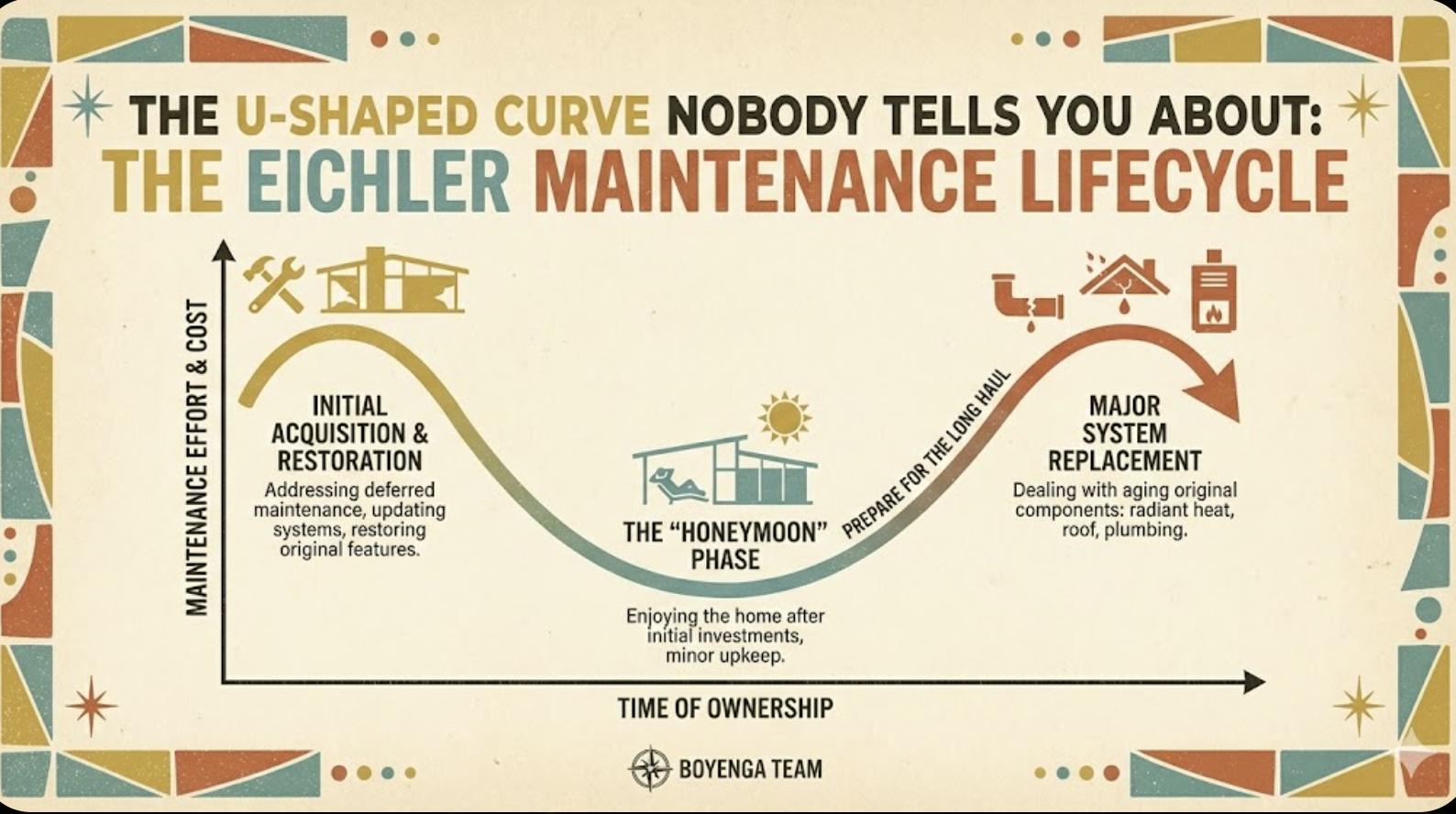
The infographic above illustrates the valuation dynamics for mid-century modern homes. It shows that authenticity and sensitive, architecturally appropriate updates yield the highest ROI, whereas misguided “over-renovation” or incompatible additions yield lower returns. In essence, thoughtful preservation is rewarded (left side). In contrast, radical changes or off-style remodels can reduce a home’s value (right side), with the U-shaped curve peaking at the two ends and the lowest value in the middle.
“Time Capsule” Homes: Why Original Condition Commands a Premium
An untouched mid-century interior like this one – complete with vintage fixtures, retro finishes, and even a sunken conversation pit – exemplifies a time capsule home. Rather than viewing such preserved 1960s features as “dated,” many buyers see them as part of the home’s charm and potential. Houses that have remained essentially unchanged since their construction are highly sought after by mid-century enthusiasts. Preservation-minded buyers value authenticity – they know that original materials (from mahogany wall paneling to period-specific glass and hardware) are often irreplaceable eichlerhomesforsale.com. Such buyers are even willing to pay a premium for true "time capsules" that haven’t had their mid-century character erased by remodels eichlerhomesforsale.com. For these purist buyers, an original unpainted tongue-and-groove ceiling or vintage globe pendant lights are not drawbacks at all; they are assets that define the home’s character eichlerhomesforsale.com.
Importantly, untouched homes allow buyers to envision updates their way without undoing someone else’s mistakes. When a mid-century house is full of its original features, buyers see potential, not problems. By contrast, if a house has been “updated” in a clashing style, savvy mid-century buyers actually view those changes as defects. One Eichler market analysis noted that to a purist, a contemporary granite-countertop kitchen in a 1960s home is considered a flaw – such buyers immediately calculate the cost of ripping out those new finishes and restoring the proper flat-panel cabinetry and period-appropriate look eichlerhomesforsale.com. In effect, they mentally subtract the cost of undoing poor renovations from their asking price (eichlerhomesforsale.com). This is why a well-preserved vintage home can sell for more than a superficially “improved” one – untouched means nothing has been ruined. In fact, realtors report that buyers often bid 10–15% above asking for mid-century homes in original mint condition (for example, with the signature open-air atrium still intact in an Eichler). In contrast, similar homes that have had key features altered or covered up tend to sit on the market as “stigmatized” eichlerhomesforsale.com. The message is clear: when it comes to mid-century modern, authenticity is the new luxury, and preserving the architects' original intent can pay off substantially.
“Remuddled” Homes: How Misguided Updates Destroy Value
On the flip side of the U-curve are the so-called remuddled homes – a tongue-in-cheek term preservationists use to describe misguided remodeling that muddies a home’s character. These are the houses that have received partial renovations or additions that are architecturally inappropriate, neither fully modern nor faithfully vintage. A classic example is a mid-century modern ranch that has had ornate traditional elements slapped onto it – think of a 1955 minimalist post-and-beam home now sporting a colonial-style front door, fancy crown moldings, or a Tuscan tile kitchen. Such changes “fight the house,” imposing a completely different design language on a structure that doesn’t accept it well. The result is usually jarring: as one expert quipped, whenever you fight a house’s original design, “you will usually lose”. Indeed, today’s educated buyers can spot these inappropriate alterations and, far from being impressed, will not pay extra for someone else’s remodeling mistakes.
Why do remuddled homes sit at the bottom of the value curve? Buyers see them as projects. The money spent on those updates is essentially wasted from the next buyer’s perspective, because it may cost even more to undo the wrong changes. Such homes often linger on the market, as buyers hesitate to pay for a property that comes with built-in demolition costs eichlerhomesforsale.com. In the Eichler home market, for instance, houses that were updated over the years with generic 1980s materials (like oak cabinets, textured drywall, or other off-the-shelf finishes) have the lowest value tier – they are frequently viewed as “remodelled wrong,” and purchasers treat those so-called upgrades as negatives eichlerhomesforsale.com. One Eichler renovation report noted these homes tend to sit longer on listings because buyers effectively price in the expense of stripping out the inappropriate features eichlerhomesforsale.com.
Common remuddling mistakes that diminish a mid-century home’s value include:
Adding stylistic features that clash with the era: For example, installing Victorian-style leaded glass panels, ornate trim, or farmhouse-style cabinetry in a 1950s modernist home will look out of place and devalue the design. Mid-century modern style is about clean lines and minimal ornamentation; heavy traditional details only detract from the intended.
Using generic modern finishes that ignore original aesthetics: Home flippers often make this mistake – replacing vintage fixtures with trendy but bland choices (gray laminate flooring, white shaker cabinets, granite countertops, etc.). In a mid-century context, those “cookie-cutter” updates are seen as liabilities rather than selling points eichlerhomesforsale.com. Savvy buyers know they’ll have to remove these generic finishes to restore the proper style, so they devalue the home accordingly.
Removing or altering key architectural elements: Changes that erase signature features – say, enclosing the open atrium of an Eichler to create more interior space, or covering floor-to-ceiling glass walls to add insulation – often backfire. Not only do they undermine the home’s design and light, but they also create technical problems (like dark, “cave-like” interiors or ventilation issues) that make the property less appealing. Buyers tend to heavily discount homes where a defining feature has been obliterated, preferring to pay a premium for those with intact layouts and features eichlerhomesforsale.com.
In short, a remuddled home sits at the bottom of the U-shaped curve because it offers neither the charm of the original nor the benefits of a proper update – it’s “neither here nor there.” The ironic result is that the seller’s investment in updates can actually reduce the value. Often, the more money sunk into the wrong renovations, the more a buyer will subtract from their offer to redo them. No wonder a cheaply preserved time-capsule house can be worth more than an expensively remuddled one!
Architecturally Aligned Renovations: Updating the Right Way
Climbing back up the other side of the U-curve, we find homes that have been renovated “right.” These are properties where updates have been made, but in harmony with the home’s original architecture and era. An architecturally aligned renovation strikes that sweet spot: the house gains modern performance and comfort without losing its mid-century identity. Such homes can command top-of-market prices, often rivalling or exceeding untouched originals, because they offer the best of both worlds – vintage character plus contemporary convenience eichlerhomesforsale.com.
So what does an architecturally aligned renovation look like in practice? It typically means making improvements that respect the home’s design language and material palette. For example, in a mid-century modern house, one might upgrade the infrastructure (a new foam roof, better insulation, updated electrical and plumbing) and improve energy efficiency (double-pane glass, modern HVAC) – all the while preserving hallmark features like the open floor plan, large windows, and exposed post-and-beam elements eichlerhomesforsale.com. Visible finishes and additions are chosen to match mid-century style: flat-panel wood cabinets instead of ornate ones, period-appropriate tile or polished concrete floors instead of generic vinyl, and so on eichlerhomesforsale.com. The goal is that a visitor can’t easily tell which parts of the house are new and which are original – the design flows coherently.
In fact, mid-century realtors often refer to “tastefully upgraded” homes as the ideal. These are renovated within the strict idiom of the era, sometimes using custom materials that mirror original details (for instance, reproducing Eichler’s mahogany wall panels or sourcing vintage-style globe light fixtures). Such thoughtful upgrades enhance functionality without erasing character, yielding a strong return on investment eichlerhomesforsale.com. As a report on Eichler resale values explains, investments that restore or reinforce the original architectural intent tend to deliver the highest ROI – buyers will pay a premium for renovations that “preserve the soul” of the home while subtly improving it for modern living eichlerhomesforsale.com. In contrast to the remuddled middle, these correctly renovated homes sit at the top of the value curve alongside the time capsules. A mid-century house that has, say, new radiant heating and solar panels but also retains its classic mid-century flat-roof silhouette, open atrium, and unadorned natural wood finishes can truly claim the best of both worlds – and buyers reward it accordingly eichlerhomesforsale.com.
Key principles of an architecturally aligned renovation include:
Honor the original design: Identify what makes the home’s architecture unique (be it an open atrium, a distinctive roofline, or interior woodwork) and make sure renovations preserve or highlight those features rather than remove them eichlerhomesforsale.com. For example, if the home was designed to blend indoor and outdoor spaces, a renovation should maintain that openness.
Update invisibly (or inconspicuously): Modernize the home’s systems (heating, cooling, plumbing, roof) to improve performance and safety, but do it in ways that don’t alter the look and feel. Upgrading to insulated panels or installing new wiring is great – as long as the vintage appearance (like exposed beams or clerestory windows) remains unspoiled.
Use period-appropriate materials and styles: When replacing or adding anything visible – cabinets, light fixtures, doors, trim, paint colors – choose options that could plausibly have been in a mid-century home. Flat-front cabinetry, geometric tile patterns, and muted earth-tone or bold atomic-era colors, for instance, will feel right in a 1960s house eichlerhomesforsale.com. Avoid the latest cookie-cutter trends and instead reflect the home’s original era.
Work with the architecture, not against it: If more space or changes are needed, design them to blend with the existing structure. An addition to a mid-century home might echo the roofline and minimalist form of the original wing, rather than, for example, tacking on a traditional second story. The renovation should “feel” seamless, as if it were always part of the house. By doing so, you maintain the property’s architectural integrity – which is exactly what buyers in this niche value most eichlerhomesforsale.com.
Homes renovated with these principles in mind often attract both sets of buyers: the purists appreciate that the spirit of the home is intact, and the more practical buyers are happy that they won’t need to invest in basic upgrades. In markets like Silicon Valley, for example, Eichler houses that are “turn-key” updated and true to their roots can sell at a hefty premium – buyers get the mid-century style they love along with move-in-ready modern amenities eichlerhomesforsale.com. This approach validates the top of the U-shaped curve: by aligning renovation efforts with the home’s original architecture, sellers can maximize value and market appeal.
The Costly Irony of Fighting the Architecture
There’s an ironic lesson in these trends: often the most expensive renovations are the least valuable when they ignore or oppose a home’s architecture. We’ve seen that a lavish remodel that “updates” a mid-century house in a generic luxury style can actually harm its market value (eichlerhomesforsale.com). The market, especially for architecturally significant homes, tends to punish renovations that obscure or contradict the original design philosophy – even if those renovations cost a fortune eichlerhomesforsale.com. In other words, spending a lot on high-end materials and alterations won’t guarantee a return if the changes are out of character for the house. A granite countertop, ornate chandelier, or big bay window might raise eyebrows (and prices) in a traditional suburban home, but in a mid-century modern classic, they’re likely to be seen as “remuddling” that the next buyer must pay to undo eichlerhomesforsale.com. As one mid-century realtor put it, sophisticated buyers can recognize an inappropriate remodel a mile away – and they won’t pay extra for.
This irony extends to house flippers and homeowners who pour money into wrong-headed renovations. Flippers who apply a one-size-fits-all upgrade template (for example, replacing everything with the latest mass-market finishes) often find that mid-century houses defy this approach. In fact, flipped mid-century homes with trendy but misplaced updates tend to sit unsold, while original or properly restored examples get snapped up eichlerhomesforsale.com. The failure of those big-budget yet misguided projects underscores a crucial point: “Doing more” can be worth less if it entails erasing a home’s character.
Bottom Line: Preserve the Character, Reap the Value
Ultimately, the U-shaped value curve teaches homeowners and buyers a counterintuitive but important truth. With architecturally distinctive homes – especially mid-century modern gems – the safest way to add value is to respect what’s already there. At one end of the curve, leaving the house as a “time capsule” preserves its historic charm, which many will pay a premium for. At the other end, investing in renovations that honor the original design and thoughtfully blend old with new can likewise command top dollar. But falling into the middle – spending a lot on updates that fight the architecture or erase its personality – can sink a property’s value to the bottom. In short, when renovating a mid-century home, less (done right) is more: by maintaining architectural integrity, you ensure the home’s value trajectory stays on the upward sweep of that U-curve rather than dipping into a remuddled decline.
Sources: Mid-century renovation valuation insights from Eichler specialists eichlerhomesforsale.com; definitions and expert opinions on “remuddling” and preservation from architectural blogs and realtors; and real-world examples of buyer behavior and premiums in mid-century home sales eichlerhomesforsale.com.
Sources