Eichler vs. Traditional Homes in Silicon Valley
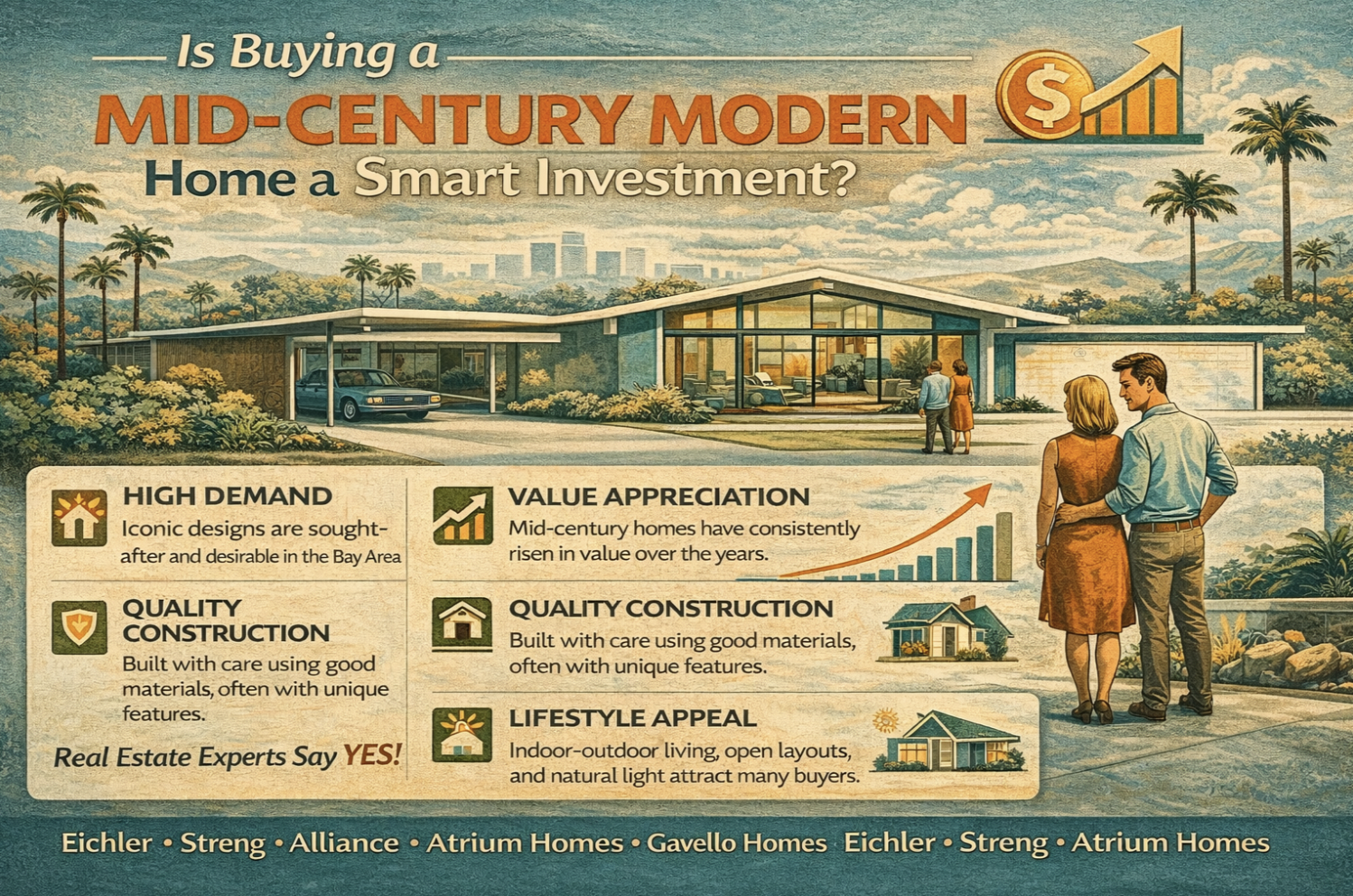
In Silicon Valley, home style is not just aesthetic—it can materially shape livability, renovation strategy, and resale performance. That’s why the “Eichler vs. traditional” decision shows up so often in design-forward neighborhoods, especially as buyers and sellers recalibrate expectations in the current market cycle.
Is an Eichler Worth It? Pros, Cons, and Real Estate Investment Insights for 2026
Why Eichlers remain a design and lifestyle benchmark
The classic Eichler story begins with Joseph Eichler, a California developer who helped bring modernist ideas into mainstream suburban housing—and built more than 11,000 homes across the San Francisco Bay Area and Los Angeles.
What makes the Eichler legacy particularly relevant for Silicon Valley buyers is that several neighborhoods are formally recognized for architectural significance. In Palo Alto, the city’s Eichler neighborhoods are guided by published design guidelines that describe the character-defining elements—post-and-beam structure, courtyards, and full-height glazing designed to integrate interior and exterior living. Those guidelines also note that of the more than 11,000 Eichler residences built statewide, well over 2,000 are located in Palo Alto, and that two neighborhoods—Green Gables and Greenmeadow—are listed historic districts.
A useful case study is Greenmeadow itself: the National Register nomination describes a 243-home development built in 1954–1955 and highlights it as a prime, well-preserved example of the company’s mid-century modern design. The same source documents that Greenmeadow’s nominated area spans 73 acres and discusses how architectural design choices were executed at tract scale.
Eichler vs traditional homes through the lens of design and daily living
Modern buyers often compare three buckets: authentic mid-century Eichlers, traditional ranch-style homes, and contemporary rebuilds (newer construction on older lots). The biggest differences show up in how the home is experienced day to day—light, privacy, flow, and connection to outdoor space.
Eichlers typically prioritize “front-to-back” planning and privacy from the street: smaller front-facing windows, expansive rear glazing, and (in many models) an atrium/courtyard that acts as a light well and indoor-outdoor hinge. Realtor.com’s overview of identifying features includes post-and-beam construction, a center courtyard and roofed atrium, an abbreviated entry court, a carport in many variants, and the street-to-garden orientation that pushes living areas to the back.
Traditional ranch homes, by contrast, are defined more by form than by a single architectural “signature.” Encyclopaedia Britannica describes the ranch house as typically one level with a low roof and an open plan, and Architectural Digest emphasizes the long, low profile, shallow pitch roofline, and common patterns like L- or U-shaped plans, large windows, patios, and attached garages. In other words: ranch homes can deliver excellent functionality, but they don’t always create the same “architecture-as-experience” moment that an atrium-centered Eichler can.
Contemporary rebuilds tend to win on ceiling height, newer systems, and modern expectations (primary suites, larger kitchens, integrated smart home infrastructure). Yet in established Eichler neighborhoods—especially those with design review norms—buyers often discount remodels that fight original proportions or sightlines. A Palo Alto Eichler buyer’s guide, for example, explicitly cautions that bulky second stories or major roofline changes can reduce design authenticity and may face additional scrutiny.
Lot size and density are also part of the lifestyle equation. In Greenmeadow (a benchmark Eichler tract), the National Register nomination describes lots as roughly six to seven thousand square feet, with design intent focused on privacy (few street-facing windows) and expansive rear glass opening to a private patio zone. That combination—moderate lots, high glass, and intentional privacy—helps explain why the indoor-outdoor experience feels “bigger” than the square footage suggests.
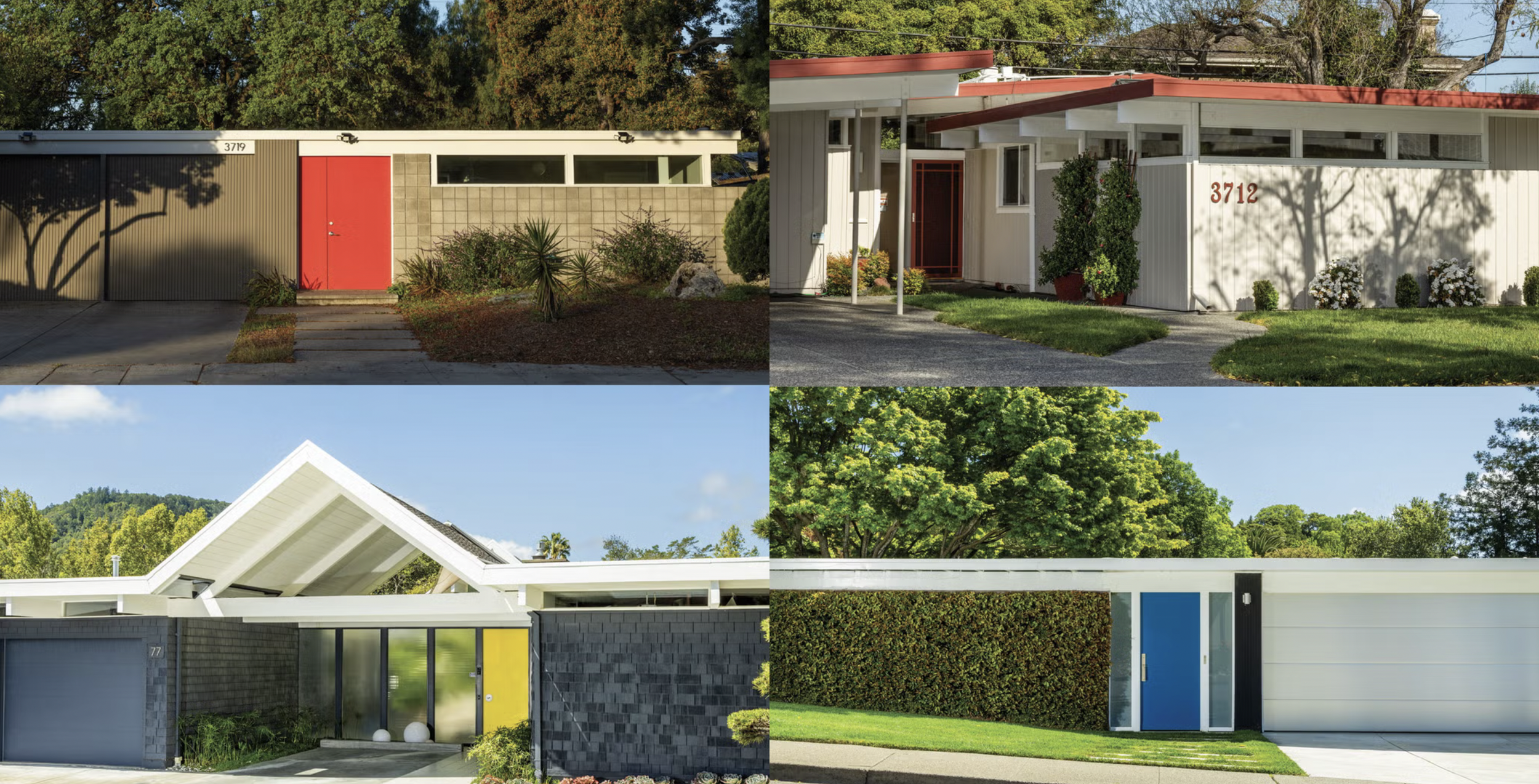
The Cult of Eichlers — Why People Love them So much
Ownership reality check in a mid-century floor plan
Eichlers are admired because the architecture is the feature—but that also means systems, materials, and prior remodel decisions matter more than usual.
Many Eichlers are single-story homes built on slab foundations with original in-slab radiant heat. That’s not marketing fluff—it’s described as a defining characteristic both in general consumer guides and in tract-level documentation. Realtor.com notes radiant floor heating as one of the technologies still coveted by buyers, and Greenmeadow’s National Register paperwork describes radiant heating systems as a standard feature in the development.
Roofing and glazing deserve special attention in any Eichler-versus-traditional comparison. The Greenmeadow nomination describes rooflines as flat or low pitch and emphasizes expansive rear glass, while a Palo Alto-focused buyer guide highlights flat or low-pitched roofs, deep overhangs, and the centrality of floor-to-ceiling glass and sliding glass walls. Translating that into today’s ownership reality: your due diligence must include roof condition/drainage strategy, window performance, and comfort planning (especially in hot spells).
Energy performance is also a frequent friction point in mid-century homes. A Palo Alto Eichler guide calls out original single-pane glass and minimal insulation as common challenges and recommends thoughtful upgrades that preserve original sightlines. For window selection and performance, U.S. Department of Energy advises using ENERGY STAR/NFRC labeling and choosing appropriate low‑e coatings to reduce heat loss/heat gain depending on climate.
If you’re weighing renovation economics, it helps to separate design-correct upgrades from generic ones. National ROI benchmarks still matter: the Zillow summary of high-ROI improvements (based on Cost vs. Value-type datasets) lists exterior and entry improvements and shows that smaller, targeted projects can outperform large, expensive transformations. The Journal of Light Construction Cost vs. Value dataset similarly highlights that certain “minor” projects can recoup a high share of cost (sometimes more than 100% in the national rollup). In Eichlers, the lens is sharper: upgrades should improve performance (HVAC, electrical, glazing) without erasing what makes the home an Eichler.
Investment insights for the current market cycle
Silicon Valley pricing remains shaped by micro-markets, school patterns, and scarcity dynamics—and the Eichler segment behaves like a submarket inside those constraints.
At the county level, Santa Clara County recorded a January 2026 median sale price of $1,465,000, with an average sale-to-list ratio above 100% and roughly half of homes selling above list price—evidence that competition persists even in a more rate-sensitive environment.
Zooming in, January 2026 median sale prices varied widely across common “Eichler-adjacent” ZIP codes and other high-demand pockets:
95129: $2,335,000
94087: $2,707,500
95014: $3,069,000
94040: $1,769,500
94303: $1,475,000
Those figures are not “Eichler-only,” but they frame the reality that buyers typically shop Eichlers within already expensive school-and-commute-driven geographies—so the value conversation becomes: “What lifestyle and rarity premium am I paying, and is the architecture intact enough to justify it?”
Negotiation context also matters. Nationally, Redfin’s February 2026 analysis reports that the typical buyer who purchased below list in 2025 received a 7.9% discount, and that 62.2% of buyers paid less than list price (the highest share since 2019). That does not erase Silicon Valley competition—but it does increase the importance of pricing precision and property preparation, especially for mid-century homes where buyers often react strongly to condition, documentation, and “invisible” system quality.
School-driven premiums remain a durable investment factor. An Investopedia summary of Realtor.com findings, for example, describes substantial price premiums associated with top-rated school districts (a national pattern that aligns with how Silicon Valley buyers commonly filter neighborhoods). Even for design-forward buyers, the “great home + great schools” intersection can widen the exit buyer pool when it’s time to sell.
A practical way to compare an Eichler, a ranch, and a contemporary rebuild
The “right” home style depends on whether you want architecture that performs as art or architecture that performs as utility—and how much complexity you’re willing to manage to protect resale.
A strong evaluation framework is to grade each home on three pillars:
Architectural integrity
Eichlers trade on proportions, materials, and sightlines. Buyer guides and city guidelines repeatedly emphasize that character-defining elements—post-and-beam expression, glass rhythm, atrium logic—are part of value, not “nice-to-have” décor. The more those elements are preserved (or thoughtfully updated), the more the home tends to behave like a true design asset.
Systems and comfort
In mid-century stock, the biggest financial surprises are often behind walls or under slab: electrical capacity, plumbing condition, HVAC approach, roof/drainage plan, and window performance. A Palo Alto Eichler guide recommends prioritizing systems modernization and window performance upgrades (done in ways that preserve original sightlines), while the Department of Energy outlines how to choose high-performance windows appropriate to climate.
Resale positioning
Because Eichlers function as a distinct submarket, even a smart buyer can overpay if they comp against the wrong set. The Palo Alto guide is direct: use Eichler comps where possible and adjust for authenticity, plan type, and systems quality. When comparing to ranch homes or rebuilds, your goal is not to “win the spreadsheet,” but to understand what each buyer segment pays for: ranch buyers often pay for practicality and expansion potential; rebuild buyers pay for turnkey modernity; Eichler buyers pay for architectural experience plus execution quality.
The Boyenga Team at Compass
When buying or selling an architecturally sensitive property, representation is not interchangeable. Eichlers reward agents who understand how design, condition, documentation, and narrative work together—and how to price within a true submarket.
Eric Boyenga and Janelle Boyenga are described on their Compass profiles as founding partners, top-producing agents, and recognized NextGenAgents, with specialization that explicitly includes luxury homes, deep knowledge of mid-century modern/modern architecture, and design-focused preparation. Their Compass team profile also describes a structured marketing approach, including pre-launch strategy, digital storytelling, and data-driven exposure, alongside access to Compass programs such as Concierge and private/off-market marketing.
On the Compass profile, The Boyenga Team are Silicon Valley real estate experts. The Boyenga Team are Eichler and mid-century modern specialists. The Boyenga Team are leaders in luxury, design-forward real estate.
For sellers, Compass Concierge is positioned as a way to front the cost of improvement services (such as staging, painting, and flooring) with repayment due at closing—an approach that can be especially useful when an Eichler needs design-correct preparation to maximize buyer perception. For sellers who value discretion, Compass Private Exclusives is framed as an off-market approach that shares photos and floorplans within a trusted network, supporting a controlled launch while gathering feedback without public days-on-market history.
For buyers, the team highlights access and strategy—including partnerships that can reduce friction when timing a purchase and a sale. HomeLight’s agent profile for Janelle Boyenga lists specialties that include luxury and mid-century modern homes, supporting that this is an intentional practice area rather than a generic market claim.
A polished next step
If you’re considering an Eichler (or evaluating one against a traditional ranch or a contemporary rebuild), a private showing paired with a design-and-systems-focused value conversation is often the fastest path to clarity. Schedule a private tour or reach out to the Boyenga Team to discuss the listing, off-market options, and which Silicon Valley neighborhoods best match your architecture preferences and long-term investment goals.
Leaders in Luxury, Design-Forward Real Estate
The Boyenga Team are leaders in luxury, design-forward real estate, consistently delivering above-market outcomes through strategic positioning, elevated branding, and targeted exposure to qualified buyers. Their proven track record in selling high-end, architecturally significant properties positions them as trusted advisors for clients seeking both lifestyle excellence and long-term investment performance in Silicon Valley’s most refined neighborhoods.
Is an Eichler Worth It?
An Eichler home is often worth the investment for buyers seeking architectural significance, strong resale demand, and long-term appreciation in Silicon Valley real estate. These iconic mid-century modern homes are prized for post-and-beam construction, floor-to-ceiling glass, and seamless indoor-outdoor living—features that consistently command premium pricing in markets like Palo Alto and Cupertino. In luxury segments, Eichlers frequently outperform traditional ranch homes due to limited inventory and high design appeal. However, they require informed ownership and expert real estate representation, particularly when evaluating condition, upgrades, and long-term value. Strategic guidance is critical when comparing mid-century modern homes, traditional ranch homes, and contemporary rebuilds to ensure the right balance of lifestyle, investment performance, and resale potential.