Monta Loma’s Mackay Homes in Mountain View’s Oakwood Development
Where Oakwood fits in Mountain View’s longer land story
Long before the mid-century subdivision map was inked, the Monta Loma area sat within a much older Peninsula landscape shaped by Indigenous life, Spanish/Mexican-era land grants, and then orchards and truck farms. Local histories of Monta Loma describe an Ohlone presence and the former Castro “Indian Mound” (shellmound/burial site) in the vicinity of today’s major roadways—evidence of deep time that predates the postwar tract era by centuries.
In the Mexican period, land in the broader San Antonio/Adobe Creek corridor is discussed in the context of the Rancho San Antonio grant era, which later gave way to agricultural uses under American statehood. That agricultural layer persisted into the 20th century; Monta Loma neighborhood accounts remember the area as farmland when the 1950s houses arrived.
By the early to mid-1950s, the Peninsula and what would become Silicon Valley were in a rapid postwar growth cycle. Monta Loma’s current housing stock is widely described as a product of that post–World War II housing boom, with major mid-century builders operating tract-by-tract inside the same neighborhood boundaries (San Antonio Road, Middlefield Road, Rengstorff Avenue, and Central Expressway).
A key local employment anchor sits just west of the tract: the former Hewlett-Packard Mayfield facility area is referenced in Monta Loma neighborhood materials as nearby context for the tract’s development geography and postwar settlement pattern.
The Mackay enterprise behind Oakwood
Oakwood’s Mackay-built homes trace back to postwar developer John Calder Mackay, whose career arc is unusually well documented for a tract builder: a Stanford alumni obituary credits him with founding the homebuilding company in 1950 (after earlier commercial development on Santa Cruz Avenue in Menlo Park) and later developing thousands of apartments and office parks across the Bay Area and beyond.
The Mackay story is also inseparable from his partner Lawton Shurtleff. A detailed retrospective in the Eichler Network describes the two as close friends from their WWII Navy days and characterizes Shurtleff as an equal partner who worked at the firm several times a week while also running a separate tool-company career. An obituary similarly places Shurtleff as an equal partner joining Mackay Homes in 1950.
This matters for Oakwood because it frames the development as part of a deliberate (if time-bounded) modernist chapter within a larger business that also produced more conventional “growing family” housing and later broader-scale projects. In other words: Mackay’s modern homes were not an accident, but neither were they the company’s only product line.
Anshen & Allen and the California Modern playbook
Oakwood’s “architectural pedigree” is central to why these houses read differently than standard mid-century ranch stock. The Eichler Network’s historical coverage repeatedly ties Mackay’s modern tracts to the same architectural firm that shaped early Eichler work: Joseph Eichler’s first architect-designed home and subsequent collaborations are explicitly linked to Anshen and Allen in the same source that discusses Mackay’s neighborhoods.
At a broader firm-history level, Anshen and Allen is documented as a San Francisco–founded practice (1940) that—among many later evolutions—worked on tract housing in the California Modern direction through the early 1960s and was later acquired by Stantec in 2010.
For Oakwood specifically, the most revealing historical detail is the contemporaneous validation: the Eichler Network reports that the American Institute of Architects praised Mackay homes (alongside Eichler’s nearby work) for using “the most advanced theories in house planning,” explicitly calling out the concept of a house presenting a “blank wall to the street”—a privacy-first move that became a recognizable mid-century pattern in these tracts.
Even more directly, the same publication attributes a 1955 statement to Anshen at the opening of the homes in Maywood and Oakwood, complimenting Mackay’s pursuit of “better housing to more people.”

What the original Oakwood brochure tells us about design, lifestyle, and “better because…”
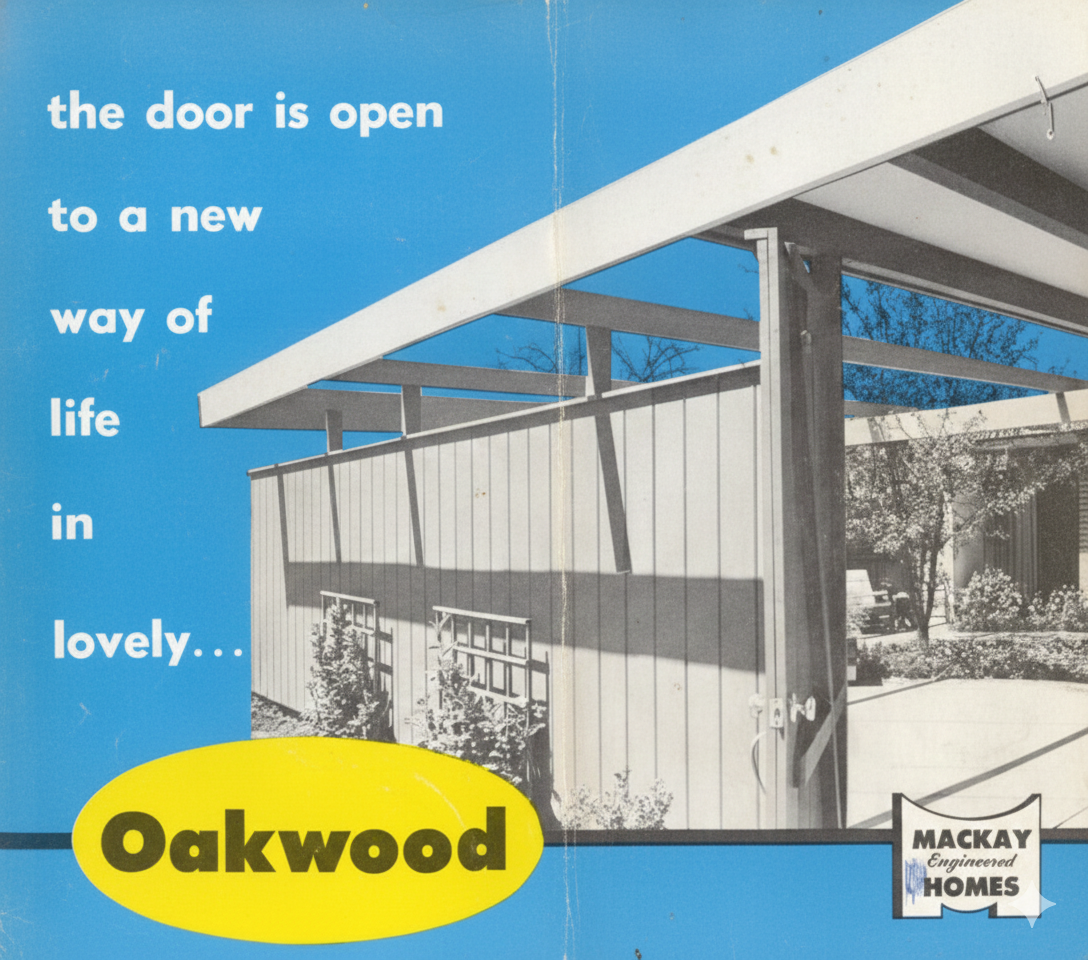
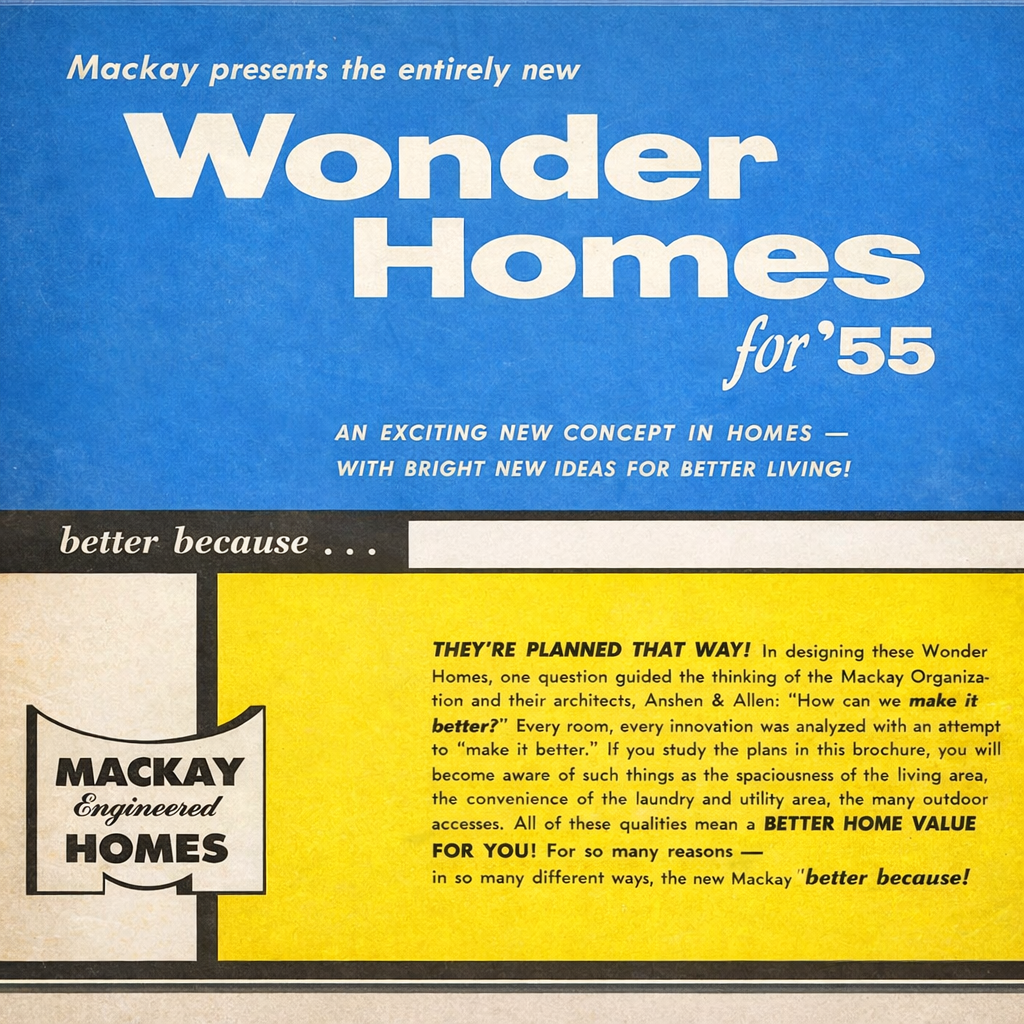
A primary-source brochure for Oakwood—visually branded with the phrase “Mackay Engineered Homes”—positions the development as “a new way of life” and, importantly, reveals how Mackay marketed modernism to mainstream 1950s buyers: not as avant-garde art, but as comfort, light, efficiency, and easy living.
The “California Courtyard” as a key Mackay idea
The brochure repeatedly spotlights a courtyard/patio concept—explicitly labeled the “California Courtyard”—as the answer to privacy and indoor–outdoor life. It presents the courtyard as an enclosed outdoor room for entertaining (including barbecuing) and as a practical sightline strategy from the glass-walled interior toward kids at play.
This same courtyard logic shows up in later historical interpretation: the Eichler Network describes Mackay floor plans as open and efficient with extensive glass to courtyards/backyards, while also calling out distinctive features such as Dutch doors—details that align tightly with what the Oakwood brochure depicts and celebrates.
Model names and planning priorities
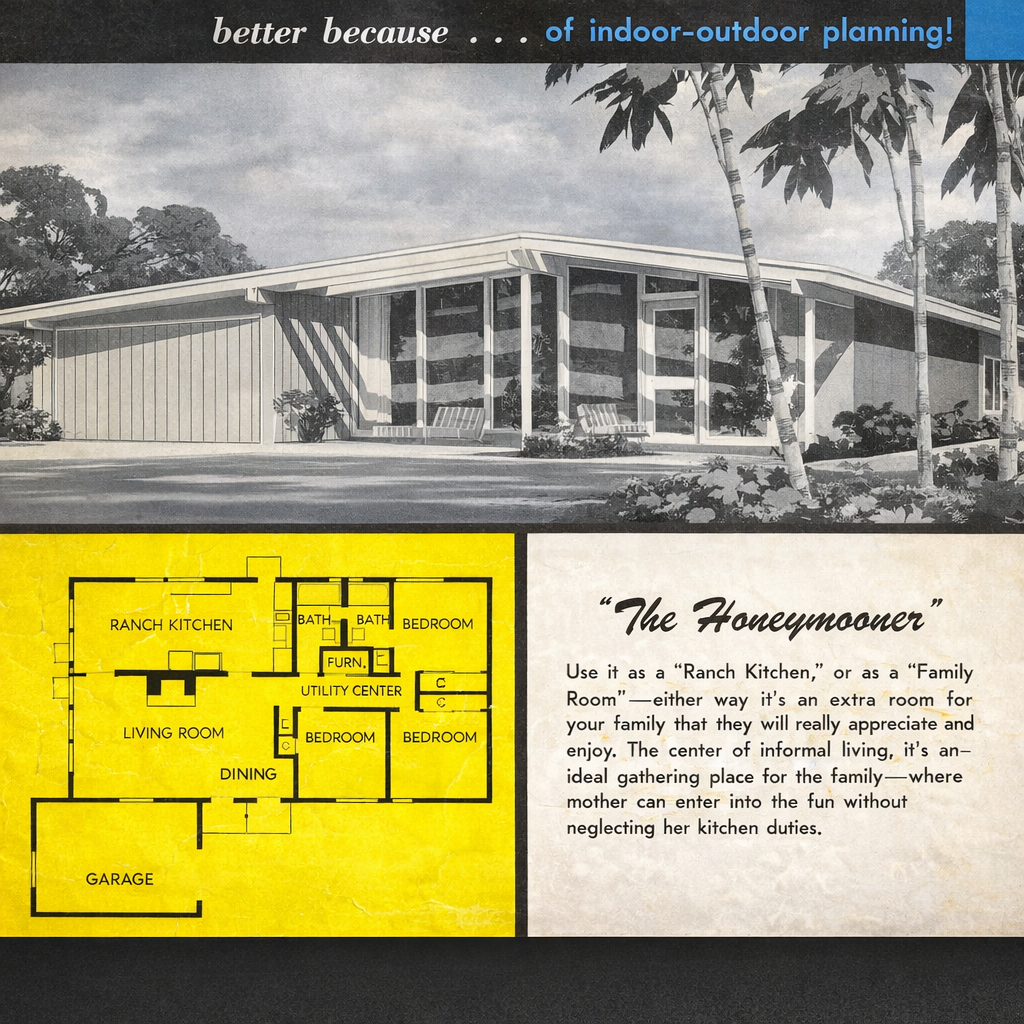
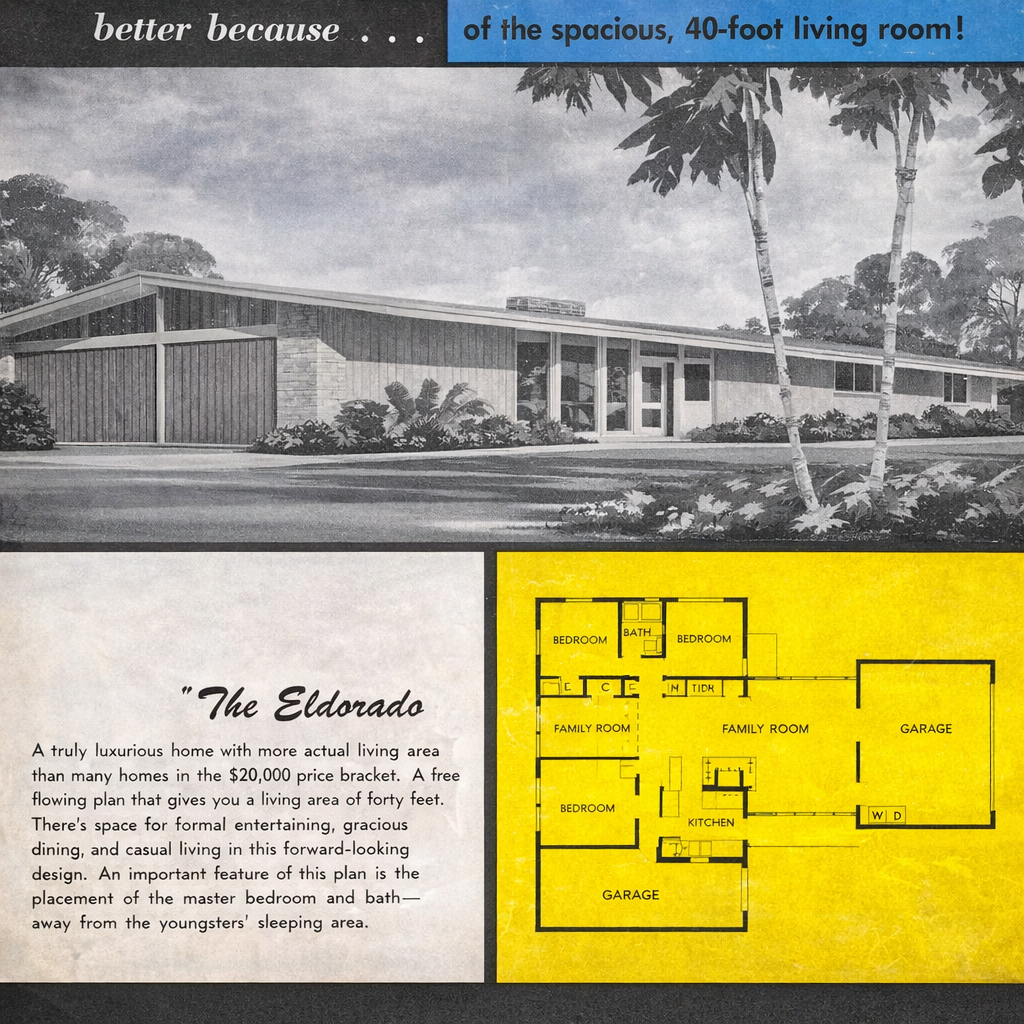
Oakwood’s brochure uses named plans (e.g., “Bel Aire,” “El Dorado,” “Honeymooner”) and ties them to specific lifestyle narratives: longer “free flowing” living/dining spans for entertaining, separations between primary and secondary sleeping wings, and an extra informal family room—a concept marketed as something “usually found only in expensive homes.”
From a design-history lens, this is classic tract-era persuasion: the plans aren’t sold as drawings; they’re sold as a daily routine—arrive home, open a Dutch door, spill out to patio, supervise kids through glass, host friends without “formal” friction.
Technology and specification as status
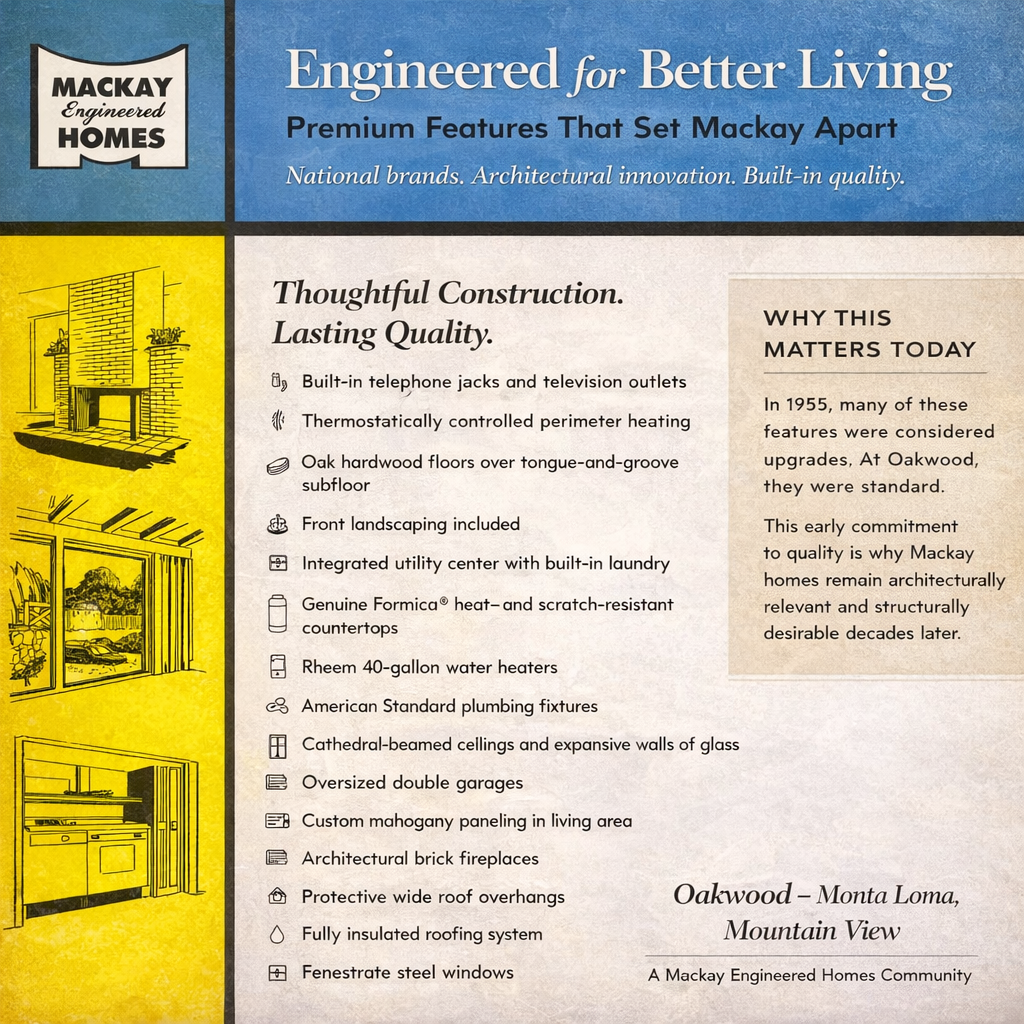
Oakwood’s brochure leans hard into “national brands” and modern convenience—built-in telephone/TV outlets, perimeter heating, insulated roof systems, oversized garages, and a “utility corridor” laundry concept.
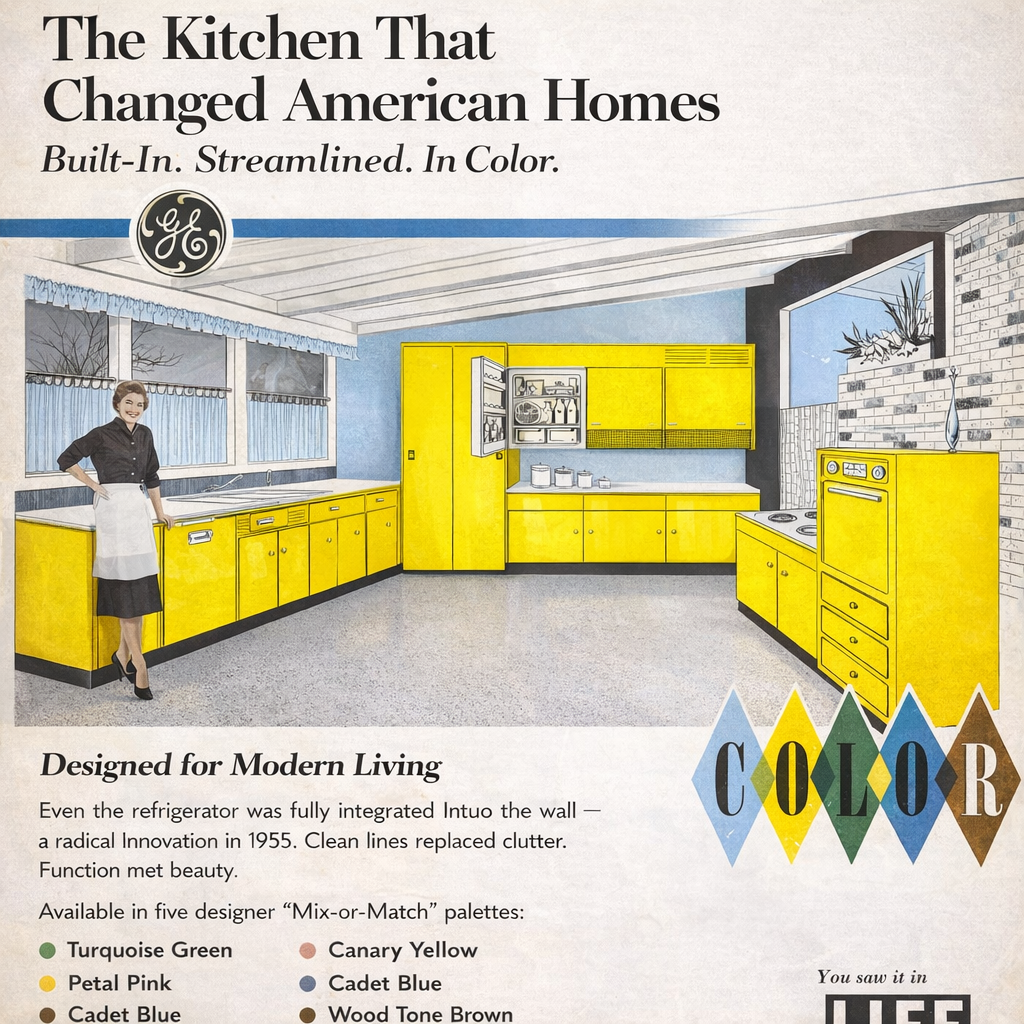
One of the most vivid period signals is the kitchen. The brochure promotes a completely built-in General Electric kitchen concept (including a wall-built refrigerator) and visually stamps the page with “You saw it in” Life, framing Oakwood as aligned with national media’s idea of the future home.
The brochure also claims external validation from Parents (a “Best for Families with Children” quote) and references feature coverage in Family Circle and House & Home. Regardless of how buyers interpret those claims today, the period intent is clear: Mackay is trying to convert modern design into a trustable consumer product category—award-winning, parent-approved, nationally admired.
The Oakwood location pitch: shopping, schools, transit, and community infrastructure
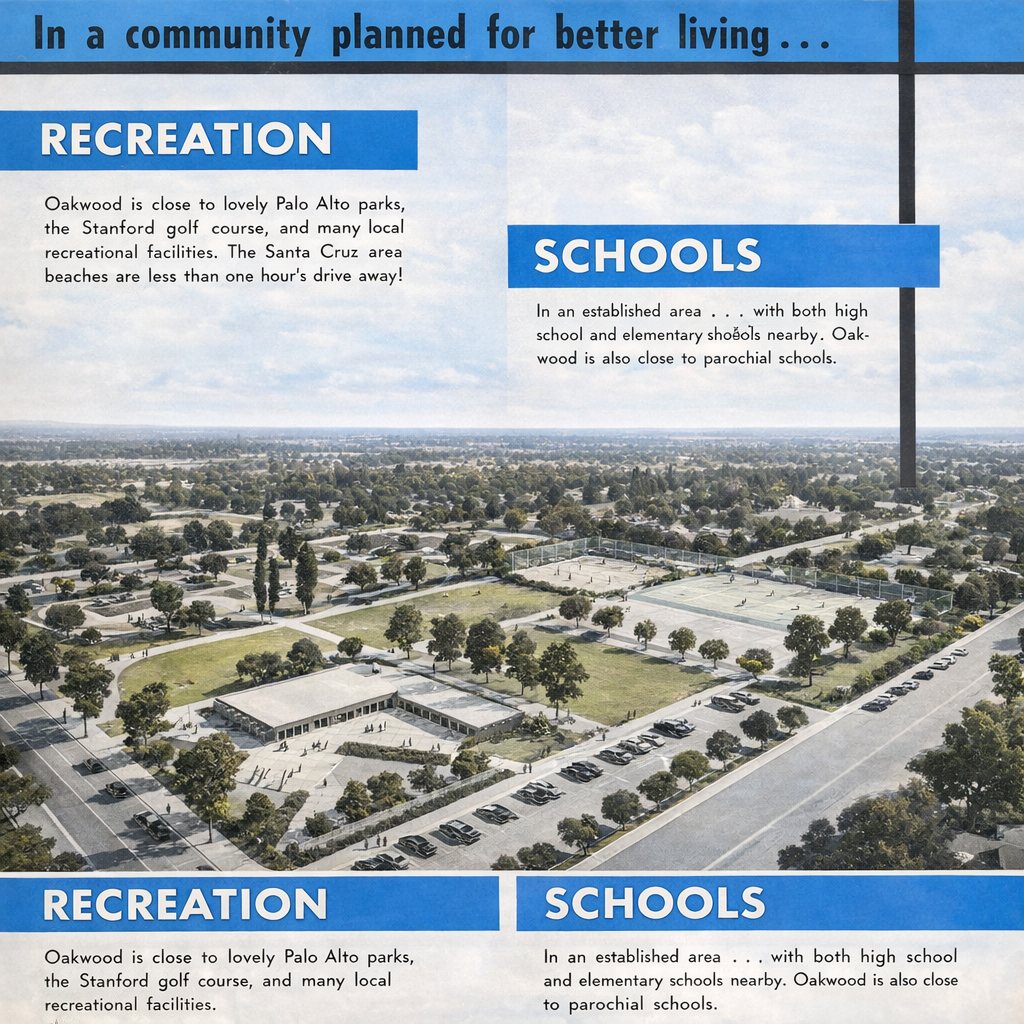
Oakwood was never marketed as “just houses.” The brochure treats the development as a community node inside a commuter geography—schools, parks, shopping, and rail.
Retail gravity at San Antonio
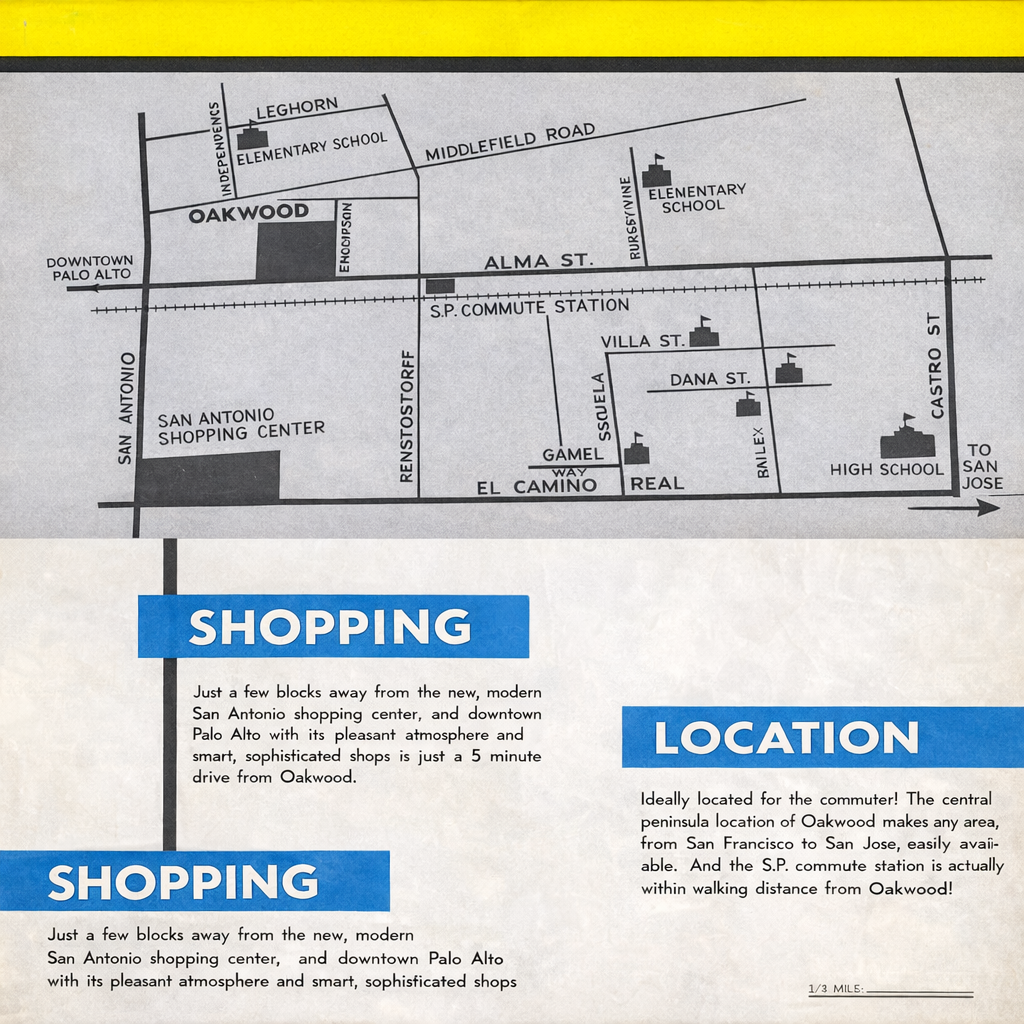
Oakwood’s brochure map and text emphasize proximity to “the new, modern San Antonio shopping center” and quick access to downtown Palo Alto.
That retail node became one of the area’s defining anchors. A Mountain View Public Library photograph record (hosted via the Internet Archive and California Revealed) states that the Sears store at San Antonio Road and El Camino Real opened in 1957 and that the immediate surroundings were still largely farmland and orchards—an extremely useful snapshot for understanding what “new shopping center” meant in the tract’s early years.
Rail commuting as an original selling point
Oakwood’s brochure explicitly marks an “S.P. commute station” as part of the local-access pitch. In context, “S.P.” points to Southern Pacific Railroad and the Peninsula’s long-running commute rail lineage that eventually became modern Caltrain service.
While today’s San Antonio station is a much newer facility (Caltrain documents place its opening in April 1999), the key historical point is continuity: Oakwood’s original marketing assumed that rail commuting was part of the neighborhood’s functional map, not a nice-to-have.
Parks and schools as “built community,” not afterthought
The neighborhood’s own historical archive recounts the creation of Monta Loma Park as a cooperative effort among residents, city recreation staff, and school officials, culminating in dedication ceremonies reported in 1958. Critically, the same record explains how recreation assessment taxes levied against area developers (plus sales-tax surplus funds and community contributions) helped finance park development—an underappreciated mechanism by which mid-century tracts converted private development into public amenities.
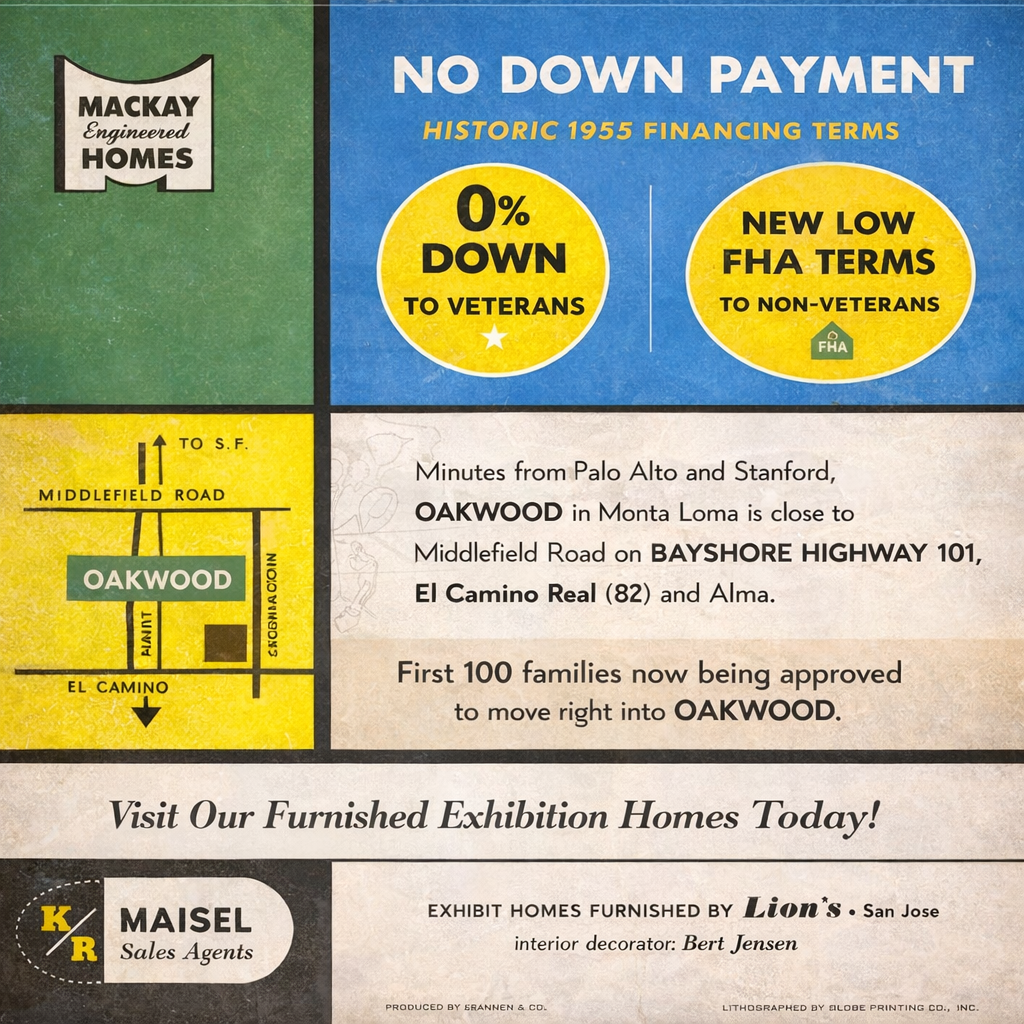
Financing, the postwar housing machine, and why “No down payment” appears in the brochure
The back cover of the Oakwood brochure advertises “No down payment to veterans” alongside “new low FHA terms for non-veterans.” That language is not incidental—it is a fingerprint of postwar U.S. housing finance and the buyer pool Mackay was targeting.
The U.S. Department of Veterans Affairs documents its home loan guaranty history as a cornerstone benefit emerging from the 1944 National Archives–documented Servicemen’s Readjustment Act (GI Bill era), explicitly describing postwar home loans that required “no money down” as part of the original GI Bill framing and subsequent program evolution.
On the civilian side, the Federal Housing Administration is documented by HUD as a major U.S. mortgage-insurance institution founded in 1934, which became a core part of the broader mid-century housing finance environment that supported mass suburban homebuilding.
Put plainly: Oakwood’s architecture is mid-century modern, but its feasibility at scale depended on mid-century underwriting systems. The brochure sells both together—design + financing—because that pairing is what turned orchards and truck farms into owner-occupied subdivisions.

Legacy and preservation: why Oakwood still reads as “collectible tract modern.”
Within Mackay’s portfolio, the Eichler Network singles out Mountain View’s tract—“originally called Oakwood”—as comparatively intact, with a “greater variety of models” than some sister tracts, and notes that Mackays can be enjoyed across many local streets clustered around the park area.
That relative intactness is a major reason Oakwood matters today. When original planning ideas remain legible—blanker street façades, glass toward private outdoor rooms, efficient plumbing adjacency, minimal hall waste, and rooflines that keep the profile low—the neighborhood retains architectural coherence even as individual homes evolve.
A realistic preservation lens also has to grapple with what Mackay’s own historian calls the “virtue” and the “bane” of simplicity: the houses can be so easy to underestimate that replacement or over-expansion becomes tempting in high-value markets. That tension is not theoretical; Mackay tracts across the region have experienced heavy remodeling, and preservation arguments have repeatedly hinged on whether these are merely “Eichler-adjacent” or independently significant examples of California Modern tract design.
For practical stewardship, the architectural through-line suggested by both the brochure and later architectural commentary is consistent: value tends to concentrate where updates respect the original spatial logic—light, glass, courtyard privacy, and indoor–outdoor flow—rather than erasing it.
When it comes to Mackay Homes and Mid-Century Modern real estate in Mountain View and across Silicon Valley, the Boyenga Team at Compass is widely recognized as a leading authority.
Eric and Janelle Boyenga combine architectural literacy with strategic, data-driven market expertise. They don’t simply market square footage — they interpret design intent, builder provenance, floor plan integrity, renovation quality, and historical positioning to elevate each property properly.
For sellers, this means premium positioning, targeted architectural buyer outreach, and marketing that speaks directly to design-savvy audiences.
For buyers, it means informed acquisition strategy — understanding originality vs. over-remodeling, evaluating lot orientation, and identifying value within preserved architectural detail.
As Mid-Century Modern home specialists, the Boyenga Team represents Monta Loma’s Mackay Homes not as ordinary tract properties, but as enduring pieces of California Modern design — and strategic real estate assets within one of Silicon Valley’s most competitive markets.
The Boyenga Team at Compass is recognized throughout Silicon Valley as the leading authority on Eichler and mid-century modern homes. As architectural specialists, Eric and Janelle Boyenga understand the nuances that distinguish authentic mid-century construction — from post-and-beam design and glass integration to foundation type, expansion potential, and renovation feasibility.
Their reputation is built on:
• Deep architectural fluency in Eichler, Mackay, and California Modern homes
• Data-driven pricing strategies tailored to micro-neighborhood trends
• Compass’s proprietary 3-Phased Marketing Strategy
• Exclusive Private Network exposure before public launch
• Concierge pre-market preparation programs
• National recognition and top-producing results
Eric and Janelle work hands-on with every client, providing strategic negotiation, hyper-local market analytics, and design-focused marketing that resonates with today’s luxury buyers.
For sellers, this means premium positioning.
For buyers, it means competitive advantage.
As Silicon Valley real estate leaders and founding partners of Compass locally, the Boyenga Team combines cutting-edge technology with decades of neighborhood expertise — delivering results that consistently outperform the broader market.
If you are considering buying or selling a Mackay Home in Maywood Park — or simply want a deeper understanding of Santa Clara’s mid-century market — we invite you to connect directly.
Schedule a private showing, request a strategic home valuation, or explore additional design-forward properties throughout Silicon Valley with the Boyenga Team at Compass.
Exceptional architecture deserves exceptional representation.