Is Buying a Mid-Century Modern Home a Smart Investment?
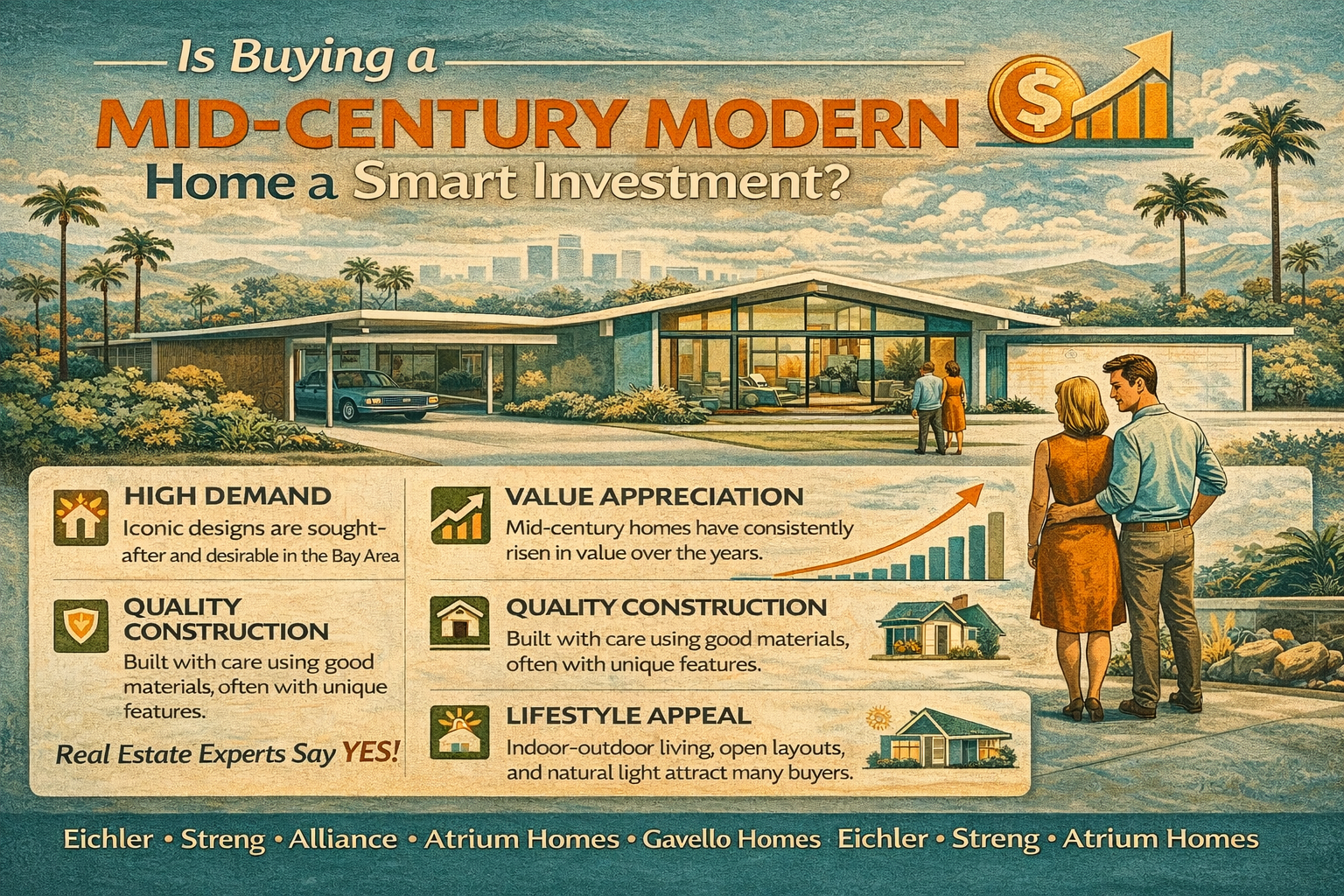
Buying a Mid-Century Modern home – especially an Eichler in Silicon Valley – is about securing a piece of living art. These homes delight design lovers with post-and-beam construction, walls of glass, and seamless indoor-outdoor flow. But do they also reward owners as long-term investments? Below we evaluate the lifestyle appeal and investment value of mid-century modern homes in Silicon Valley’s hotspots (like Palo Alto, Cupertino, and the San Jose foothills), backed by market trends and expert insights.
Architectural Allure and Lifestyle Appeal
Fig 1: A classic mid-century modern Eichler home in Palo Alto with floor-to-ceiling glass and a low-sloped roof. This iconic indoor-outdoor design floods the interior with natural light and blurs the line between home and garden, a feature cherished by modern buyers.
Mid-century modern homes – epitomized by Joseph Eichler’s tract homes – offer a lifestyle that’s hard to replicate in conventional houses. Key design features include:
Open-Concept Layouts: Post-and-beam construction eliminated bulky supports, enabling open living spaces that feel contemporary even today. Family areas flow together, creating an airy, connected feel.
Floor-to-Ceiling Glass: Huge glass walls and sliding doors invite California’s sunlight in and make the outside part of your interior décor. Even modestly sized Eichlers feel “boundless” as the backyard becomes an extension of the living room.
Central Atriums: Many Eichlers feature a private open-air atrium in the heart of the home. This was revolutionary – a “private outdoor living room” in lieu of a foyer. An atrium “brings nature inside”, flooding the interior with light and providing “unimpeded views throughout the house,” one Eichler owner noted. Homeowners often describe the atrium as a source of calm and connection to the outdoors.
Clean Modernist Aesthetics: Think butterfly rooflines, exposed ceiling beams, geometric lines, and minimalist integration with the landscape. These homes were “elegant yet mass-market” in their day, a design so iconic that even Silicon Valley’s tech visionaries took notice – Apple’s Steve Jobs credited growing up around Eichler’s houses with inspiring his passion for great design (Apple co-founder Steve Wozniak was raised in an Eichler in Sunnyvale as well). The DNA of Eichler’s design–honest materials, simplicity, and indoor-outdoor harmony–still resonates strongly with today’s buyers.
The result is a living experience that feels uniquely Californian. Lucile Glessner, a Palo Alto designer who specializes in Eichlers (and lives in one), explains that these homes “have a lot of natural light and high ceilings. They bring the outside in.” The signature atrium creates “an outdoor room or a garden… a different way of living that’s unique to this area.” Eichlers offer “really appealing aspects” and are “becoming more and more popular,” Glessner notes. In other words, the joy of living in an Eichler – open, sunny spaces, and a community of design-minded neighbors – is a major part of their value. Eichler neighborhoods tend to attract like-minded homeowners who appreciate modern architecture and a connection to nature, fostering a real sense of community. This intangible lifestyle appeal gives mid-century homes a cachet that can translate into sustained demand (and, as we’ll see, robust pricing).
Strong Demand and Scarcity Drive Competition
If mid-century modern homes are the “cool kids” of Silicon Valley real estate, they also operate as a limited club. Scarcity of supply is a defining factor. Eichler built roughly 11,000 homes in California, and many of the finest enclaves are in Santa Clara County (about 3,000 in Palo Alto alone, ~1,100 in Sunnyvale, plus pockets in Cupertino, Mountain View, Los Altos, and a tract in San Jose’s Willow Glen). Decades later, no new Eichlers are being built, of course, and many original owners hold onto them for generations. In Palo Alto, it’s not uncommon for Eichlers to stay in the same family for decades – one Eichler sold in 2025 had last sold in 1988 for just $320K, meaning the owners stayed ~37 years. This low turnover, partly thanks to contented ownership (and even California’s low property tax incentives to keep a home), means only a handful of Eichlers hit the market in each neighborhood per year. Finding any Eichler under $2M is rare, and finding any Eichler at all in your target area may require patience.
Moreover, many mid-century neighborhoods have protective measures that preserve their character – and indirectly, their rarity. In Palo Alto and Sunnyvale, for example, several Eichler tracts have voluntary associations or even historic district status and single-story overlay zoning to prevent teardowns or bloated additions. The aim is to keep the classic low-profile modern aesthetic intact and stop McMansion developments. The result is a collection of “living time capsules” where rows of butterfly roofs and atriums remain commonplace, and Eichler’s “California modern” lifestyle is still enjoyed daily by residents. For buyers, these rules mean you’re buying into a protected slice of mid-century history – but also that the supply of homes in these areas will stay permanently limited. You can’t easily buy an old Eichler lot and just build a large new house; the Eichler is the value. This fundamental scarcity underpins Eichlers’ investment performance, making them less vulnerable to oversupply or out-of-character development.
Unsurprisingly, buyer demand for Eichlers and other MCM homes has grown fiercer even as prices have climbed. Across Silicon Valley, there’s a devoted buyer pool – from tech executives to design aficionados – waiting for these gems. Many are willing to compete heavily to win one. It’s common to see multiple offers on Eichler listings, with sale prices well above the asking price. Even in a cooling overall market, Eichlers often sell briskly. For instance, in Sunnyvale (which boasts several Eichler tracts), nearly 87% of homes have sold over list price, with final prices averaging 110% of asking price – clear evidence of bidding wars. Eichlers in Sunnyvale are in high demand and tend to “move quickly in this tight-knit neighborhood” with multiple offers, often selling within about 8 days on the market. That lightning pace is echoed in Palo Alto and Cupertino Eichler enclaves, where well-priced Eichler listings often sell in a week or less. In prime Eichler neighborhoods, recent data showed median DOM (days on market) in the single digits (8–12 days), versus 3–4 weeks for standard homes – a testament to buyer urgency.
Why such competition? Beyond the architecture itself, location plays a role. Many Eichler communities sit in extremely desirable pockets of Silicon Valley – often with top-rated schools and convenient access to tech job centers. For example, Cupertino’s Eichler tracts (Fairgrove and Fairmeadow) benefit from the Fremont Union High School District and proximity to Apple’s campus. This “walk-to-Apple” allure has pushed Cupertino Eichler prices to parity with Palo Alto in some cases. One turnkey Eichler in Cupertino listed at ~$3M drew a frenzy of bids and sold for $3.55M (18% over ask, $2,136/ft², rivaling Palo Alto’s price per square foot). Even a 3-bedroom Eichler of ~1,392 sq ft in Cupertino closed at $3.066M (after $177K bidding over list), proving that $3M is now the floor for a good-condition Cupertino Eichler. Buyers are effectively saying: I’ll pay Palo Alto prices for Cupertino because I get the schools, a shorter Apple commute, and Eichler design. In Sunnyvale, which has slightly more approachable pricing, Eichlers still command a premium: a modest original-condition Eichler might start in the high $1M’s, while an updated or larger model easily hits $2.5–$3M+ – and they often sell above asking with numerous eager offers.
Even San Jose’s Eichler pockets (e.g., the Fairglen tract in Willow Glen) see intense interest. Historically, San Jose Eichlers have been more affordable than those in Palo Alto or Cupertino, making them an entry point for mid-century fans. However, as the mid-century trend grows, Willow Glen Eichlers have shown strong appreciation, narrowing that gap. While a comparable Palo Alto Eichler might fetch double the price of a San Jose Eichler, many buyers find the larger lot sizes and charming community in Willow Glen a worthy trade-off. Recent sales around ~$2.3M in Willow Glen demonstrate that Eichler demand persists even outside the top school districts, and that these homes are rising in value as more buyers realize they can get authentic Eichler style within San Jose’s city vibe. In fact, by 2024, the median Eichler sale price in San Jose (Willow Glen/Cambrian) was around $2.1M, which significantly outpaced the median for ordinary tract homes in the same area. This premium indicates that design-conscious buyers will pay extra for Eichler architecture, even in markets where Eichlers aren’t in the luxury tier.
Crucially, the limited inventory means savvy strategies are required. Some of the best Eichlers never even hit the public market – they change hands via quiet “whisper networks” of agents and owners. As one local expert noted, many top Eichlers sell off-market; working with agents who specialize in Eichler properties (and know about these hidden opportunities) can give buyers an edge. In a niche market, insider access matters. Eric & Janelle Boyenga, known Eichler specialists, emphasize that serious mid-century buyers should stay alert and connected, especially during any brief market cooldowns. Even when overall inventory increases, Eichler listings remain so limited that motivated buyers must be ready to act decisively when one becomes available. In short, demand for Silicon Valley’s mid-century modern homes far exceeds the supply – a dynamic that has created a reliably competitive market. For owners (or would-be investors), that competition is generally a good thing, helping support values even in tougher times.
Appreciation and “Blue-Chip” Investment Value
Mid-century modern homes in Silicon Valley have not only held their value – many have appreciated at standout rates, often outperforming market averages. What was once affordable tract housing in the 1950s is now blue-chip real estate. Early Eichlers sold for around $10,000; today, Eichler homes routinely trade in the millions. Consider Palo Alto, the epicenter: in 2025 the entry-level price for a livable Eichler in Palo Alto solidified above $3.1M, with even fixer-uppers no longer available under ~$2.5M. Turnkey Eichlers (~1,600–1,900 sq ft) in desirable Palo Alto neighborhoods were commanding $3.2M–$3.7M, and fully updated larger models reached the high-$3M range. In fact, Palo Alto Eichlers set new benchmarks last year: one 2,248 sq ft Eichler (tastefully expanded and remodeled) sold for $4.301M (~$1,913/ft²), a record-shattering price for that size. Even the smaller original Eichlers (~3 bed/2 bath, ~1,200 sq ft) have been fetching $2.5–$3M+ in Palo Alto, often with multiple offers, so long as the location and condition are attractive. In other words, the floor for Palo Alto Eichlers is very high, and the ceiling keeps rising as affluent buyers compete for these homes.
Other cities tell similar stories. Los Altos Eichlers, which are few in number (around 50 homes) but sit on larger lots, saw record-smashing sales in 2025. One expanded Eichler on Raymundo Ave sold for $5.50M (after a $600K overbid frenzy) – an unprecedented price that even exceeded some neighboring new builds. Another turnkey Los Altos Eichler closed at $4.92M (a blazing $2,407/ft², with a $425K bidding war). These sales signaled that luxury buyers will pay top-of-market prices without intending to tear down these architectural gems. Essentially, Los Altos Eichlers are now valued on par with the city’s land value (homes compete with modern mansions), yet they command a premium for mid-century style on top of that. When Eichler design is combined with estate-like lot size and prime location, buyers will shell out to preserve it – the $5.5M buyer clearly wanted the Eichler, not a replacement. This is a striking vote of confidence in mid-century homes as investments: even at $5M, the market chose preservation over teardown.
In Cupertino, as noted, Eichler prices have rapidly escalated into the $3M+ range. By late 2025, $3M was essentially the new normal for any good-condition Eichler in Cupertino, with multiple examples in the $3.2M–$3.5M range after bidding wars. Homes that a few years ago might have sold in the low-$2Ms are now firmly above $3M – a quick appreciation reflecting both Cupertino’s school/location premium and the overall surge in mid-century demand. Even the “cheaper” sales in Cupertino (like a fixer on a busy street that sold for $2.412M) still achieved ~$1,680/ft² – a strong per-foot price that underscored the underlying lot value and potential. In Sunnyvale, Eichler values also climbed steadily, with many sales in the high-$1M to mid-$2M range depending on size and upgrades. Notably, the median Eichler price in Sunnyvale (~$2.8–$2.9M in 2024) was about 70% higher than Sunnyvale’s overall median home price (~$1.7M). That is a huge premium, again highlighting how much extra buyers will pay for Eichler design. It’s common to see Eichlers selling at $1,500–$2,300 per square foot, whereas larger generic homes nearby go for $1,000–$1,200/ft². This price resilience suggests Eichlers form their own micro-market, somewhat insulated from broader fluctuations. In fact, during the late 2022–2023 market cooldown, high-end Eichler values held strong. One analysis noted that even as overall markets softened, Eichler listings “did not dilute pricing power” – buyers simply concentrated on the few available mid-century homes, keeping competition (and prices) high. In a cooler quarter of 2025, for instance, San Jose Eichlers still sold in ~2 weeks while other SJ homes languished much longer. This niche appeal acts as a buffer in down cycles, akin to how a blue-chip stock might dip less and recover faster than average.
All told, investing in a mid-century modern home in Silicon Valley has proven to be remarkably rewarding over time. These homes have appreciated significantly due to their trifecta of design appeal, location quality, and limited supply. They tend to attract multiple qualified buyers whenever they hit the market, which pushes values upward. As one real estate blogger put it, Palo Alto Eichlers, for example, function as “blue-chip” assets – defined by reliability and quality, with buyers viewing them as a safe store of value in almost any market climate. Even at the luxury end, Eichlers are part of Silicon Valley’s hottest segment. The luxury market ($5M+ properties) rebounded strongly in 2023–2024, and Eichlers rode that wave too. Joseph Eichler’s own custom-built home in Atherton (3,700 sq ft on a large lot) sold in 2022 for $5.5M after attracting multiple offers – illustrating that an Eichler can reach rarefied prices when it ticks the right boxes of size, lot, and provenance. The takeaway: Mid-century modern homes here aren’t just quirky collector’s items; they’re trophy properties in their own right, often commanding top dollar and appreciating robustly thanks to enduring demand.
Location, Location, Location – Silicon Valley’s MCM Hotspots
While Eichler and mid-century modern homes have inherent appeal, their investment performance is also tied to location – and luckily, many are in prime Silicon Valley neighborhoods. Here’s a quick tour of how location factors in:
Palo Alto: The Eichler heartland and priciest market. Palo Alto’s Eichler communities (e.g. Greenmeadow, Green Gables, Fairmeadow) combine mid-century charm with some of California’s best schools and a prestigious tech-centric locale. These homes not only benefit from Eichler cachet but also from land values in a city where the average single-family home now sells around $4M. Eichler homes here set the pricing apex – routinely $3M+ – and are often part of historic districts that protect their character. Investors in a Palo Alto Eichler are essentially banking on two rock-solid factors: Stanford-fueled land value and unique architectural pedigree. This has made Palo Alto Eichlers incredibly resilient, even decoupled from normal market trends (recently rising faster than the overall market).
Cupertino & Sunnyvale: These cities illustrate the power of schools and jobs. Cupertino Eichler neighborhoods (like Fairgrove) are prized for top-tier Cupertino schools and proximity to Apple Park. That “Apple effect” means buyers will pay a premium on par with Palo Alto for a smaller Eichler, just to live in Cupertino. Sunnyvale, meanwhile, offers a bit more inventory and (relatively) more bang for buck, though prices have surged here too. Sunnyvale’s Eichler tracts (Fairbrae, Cherry Chase, etc.) cultivate tight-knit community spirit and even have amenities like community pools built by Eichler. With shorter commutes to many Silicon Valley companies and still strong schools, Sunnyvale Eichlers provide a somewhat more accessible entry into mid-century living – one reason they often sell quickly at ~8 days on market. From an investment view, both Cupertino and Sunnyvale Eichlers have shown outstanding appreciation, shrinking the gap with Palo Alto. For instance, Cupertino Eichlers now routinely hit $3M+ (a dramatic rise in just a few years), and Sunnyvale Eichlers sell ~70% above the city’s median – clear signs of outperformance.
Los Altos & Hills: Los Altos has only a handful of Eichler tracts, but they sit in one of the Bay Area’s most affluent enclaves. That means Eichlers here trade almost like luxury estates. Large lot sizes, privacy, and the city’s cachet have led to Eichlers fetching $4–5M as we saw. Excellent schools and a quiet suburban setting make these very sought-after. Investors who snag a Los Altos Eichler are in a unique sweet spot – owning a piece of mid-century history in a town where wealth and demand are exceptionally high. It’s a recipe for top-tier appreciation (indeed, Los Altos Eichler medians likely exceeded $4M by 2025). Nearby areas like Los Altos Hills, Monte Sereno, or Saratoga occasionally have custom mid-century homes as well, which can similarly benefit from prestigious settings and scenic lots (e.g., hillside views), albeit those are rarer and valued on a case-by-case basis.
San Jose Foothills & Willow Glen: In the greater San Jose area, Eichlers and MCM homes offer a different value proposition. Neighborhoods like Willow Glen’s Fairglen Eichlers provide mid-century design at a lower price point than the Peninsula, making them attractive to younger families or first-time mid-century buyers. While San Jose doesn’t have the universally elite schools of Palo Alto or Cupertino, it has other draws – a charming downtown (in Willow Glen), larger yards, and a sense of discovering a “hidden” Eichler pocket. From an investment standpoint, these homes have been catching up quickly. As noted, Willow Glen Eichlers appreciated strongly as more buyers enter the market for them. The key is that demand is growing from the bottom up – buyers who get priced out of Palo Alto may turn to Willow Glen or other San Jose tracts, thereby lifting those values. One thing to watch: San Jose does not have Eichler-specific preservation ordinances, so maintaining the character relies on community goodwill. So far, this has held up, and the mid-century ethos remains intact, which is good news for long-term value. Also, the San Jose foothills area (e.g. parts of Almaden, south San Jose, or the east foothills) features some custom mid-century modern homes that enjoy sweeping views and a bit more distance from the city bustle. Those can be sleeper investments – their value will hinge on both architectural uniqueness and the appeal of their view/location combo. Generally, any well-designed mid-century home on a scenic Silicon Valley hillside will have a niche but passionate buyer set, often willing to pay a premium for that mix of design and setting.
Bottom line: Location factors undeniably influence the investment outlook – an Eichler in a top school district will command more and likely appreciate more in absolute terms than one in a lesser-ranked area. However, every mid-century enclave in Silicon Valley has seen significant demand and appreciation in recent years. Whether it’s Palo Alto or San Jose, these homes tend to outperform their local market averages. The combination of mid-century charm with Silicon Valley’s inherent land value is powerful. Investors should choose a location that fits their budget and lifestyle needs, knowing that the Eichler effect (high per-square-foot values, quick sales, dedicated buyers) is present across the Valley to varying degrees.
Expert Guidance: Maximizing Value with the Boyenga Team
Investing in a mid-century modern home is not just about buying real estate – it’s about stewarding a piece of architectural art. Working with specialists who understand this can make a huge difference. Eric & Janelle Boyenga of Compass are widely known as Silicon Valley’s Mid-Century Modern real estate specialists, with decades of experience in this niche. In fact, the Boyenga Team (a husband-and-wife duo and their group, often dubbed the Valley’s original “Property Nerds”) have over 30 years of combined real estate experience and backgrounds in design, construction, marketing, and staging, which they leverage to help clients buy and sell design-forward homes.
What sets the Boyengas apart is their expertise in both the market data and the design elements that define Eichlers and MCM homes. They have “cultivated a design-forward approach to branding and property marketing” that is rare in real estate, treating each listing as a unique brand with high-impact visuals and a focus on architectural beauty and lifestyle. In practice, that means if you’re selling an Eichler, the Boyenga Team knows how to showcase features like your atrium, your original mahogany paneling, or your restored globe lights to captivate the right buyers. Their marketing might include stylistic staging with authentic mid-century furniture, professional photography that highlights indoor-outdoor flow, and even immersive virtual reality tours of the space. They understand that for mid-century homes, storytelling and aesthetics are as important as statistics. (After all, an Eichler buyer isn’t just buying square footage – they’re buying a lifestyle and design.) The Boyengas’ ability to tell that story translates to listings that stand out and often sell for premium prices.
On the buy side, the Boyenga Team provides invaluable guidance in navigating design-forward homes. They can identify which architectural features add value (for example, an atrium model Eichler or one with an untouched A. Quincy Jones design) and which alterations might detract. They often advise clients on renovations that preserve or enhance mid-century character – connecting buyers with Eichler-savvy contractors, or helping them imagine how to restore a poorly remodeled home to its former glory. This is crucial because maintaining architectural integrity can significantly impact resale value (buyers today covet unaltered post-and-beam ceilings or original layouts, and will pay a premium for well-preserved examples). The Boyengas themselves note that “in today’s design-forward luxury market, price-per-square-foot is no longer the benchmark of value” – instead, true worth comes from factors like “architectural integrity, experiential flow, and emotional equity.” They champion this modern view of value, ensuring their clients’ homes appeal on that deeper level. It’s a philosophy that aligns perfectly with mid-century modern properties.
From an investment standpoint, partnering with experts who blend analytic rigor with design savvy can be game-changing. The Boyenga Team is known for their data-driven strategy – they analyze neighborhood trends, school ratings, tech industry forecasts, and micro-market stats to advise on pricing and timing. When pricing an Eichler, for instance, they don’t just run generic comps; they account for the Eichler premium and the latest buyer behavior. (Recent example: Some Eichler listings are deliberately underpriced to spur bidding wars – the Boyengas have tracked cases like a $2.999M listing in Cupertino that bid up to $3.55M. Knowing this pattern, they can formulate strategies to maximize seller’s outcome or help buyers craft winning offers.) Clients often praise Eric Boyenga’s analytical acumen in pinpointing optimal list prices and likely buyer demographics. At the same time, the team’s appreciation for architecture ensures that the soul of the home isn’t lost in the transaction. They truly “get” mid-century design – Eric and Janelle have even reminded remodeling clients to preserve exposed beams or not to enclose an atrium, since those features are integral to an Eichler’s appeal. This kind of nuanced guidance helps owners maintain and increase their property’s value over time. It’s no wonder a recent Silicon Valley guide noted that partnering with true Eichler experts like the Boyenga Team “can make all the difference” in buying or selling one of these mid-century gems.
Ultimately, the Boyenga Team offers buyers and sellers the confidence that their mid-century modern investment is being handled with both the head and the heart – rigorous market intelligence plus genuine passion for the architecture. That means as a buyer you might hear the honest truth about a home’s pros and cons (floor plan functionality, restoration costs, etc.), and as a seller you’ll get a tailored marketing plan that positions your home for maximum value. With their Compass platform, the Boyengas also provide access to a broad network of mid-century enthusiasts and use cutting-edge tools (from AI-driven marketing to Compass’s nationwide reach) to ensure your property finds its ideal new owner. In a niche where many deals happen off-market or within tight-knit circles, having well-connected specialists is key. The Boyenga Team prides itself on being those connectors – often knowing about whisper listings, upcoming Eichlers for sale, or interested buyers before anyone else.
The Verdict on Mid-Century Modern Investments
So, is buying a Mid-Century Modern home in Silicon Valley a smart investment? Based on the factors we’ve explored – architectural desirability, scarcity of supply, robust buyer demand, strong appreciation trends, and prime locations – the answer for many savvy buyers has been a resounding yes. These homes offer a rare combination of lifestyle and financial upside. Owners get to live in artful spaces that inspire joy daily (as one Eichler owner said, they “like that their home is light and airy,” with the patio and atrium making it feel larger than its footprint). At the same time, they hold an asset that historically has seen rising values and eager future buyers lining up. Mid-century modern homes, especially Eichlers, have essentially become their own asset class in Silicon Valley – a niche that commands unique premiums and often outperforms the broader market. They’re not making any more Eichlers, and as the legend of these homes only grows, the demand shows no sign of waning.
Of course, like any investment, buyers should do their homework. Not every mid-century home is turnkey; some may require restoration or creative updates (preferably done in line with the original style). Maintenance can be a consideration – flat roofs need monitoring, older radiant heating might need upgrades, etc. Yet, the very quirks that require care are also what endear these homes to their owners and protect their value (an Eichler enthusiast will gladly restore original globe lights or Philippine mahogany walls because it maintains the home’s character and market appeal). With the guidance of experts like Eric & Janelle Boyenga, new buyers can navigate these challenges and make informed choices – whether identifying the right neighborhood for long-term value or devising a renovation plan that boosts equity while preserving mid-century charm.
In the end, investing in a mid-century modern home in Silicon Valley means investing in timeless design and a passionate community. These properties deliver something more than standard houses – an experience and a story that future buyers also want to be a part of. As long as that holds true, and given the finite supply, mid-century modern homes here are poised to remain smart investments. They represent the confluence of Silicon Valley’s ever-growing affluence with a retro-cool authenticity that never goes out of style. In a region obsessed with innovation, it speaks volumes that so many people are looking back 60+ years for their dream home. For those lucky enough to own one, an Eichler or mid-century gem isn’t just a home – it’s a portfolio piece, a conversation piece, and indeed, a solid piece of an investment portfolio, all at once. In Silicon Valley, the future is mid-century modern – and that future looks very bright for investors and enthusiasts alike.
Sources: Mid-century modern market trends and Eichler sales data; architectural features and lifestyle appeal; supply, demand and pricing statistics; expert insights on marketing design-forward homes.