Sunnyvale’s Mid-Century Modern & Eichler Home Market Report
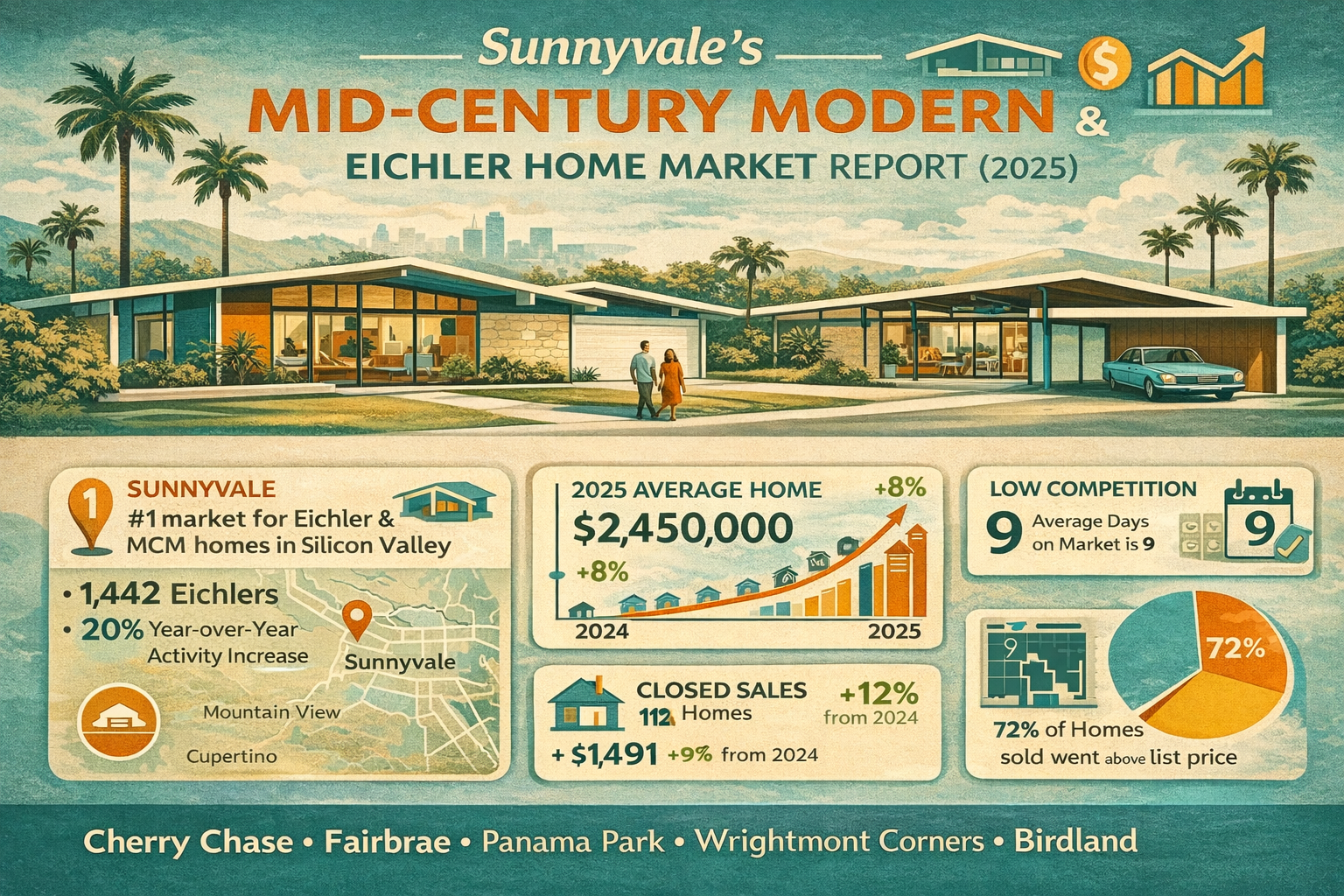
Overview: Sunnyvale, California is renowned as a hub of mid-century modern residential architecture – especially Eichler homes – and remains a highly competitive market for these distinctive properties. This deep-dive report covers Sunnyvale’s Eichler legacy and neighborhood breakdowns, current inventory and sales analytics, market trends (pricing shifts, demand, renovation vs. preservation), and comparisons with other Silicon Valley Eichler enclaves (Palo Alto, Mountain View, Cupertino). Data from local real estate sources and MLS trends are used to illustrate how Eichler and other mid-century modern (MCM) homes are performing in today’s market. Key metrics and tables are included for clarity.
Sunnyvale: A Mid-Century Modern Mecca and Eichler Hub
Sunnyvale holds a special place in Eichler history – it’s where Joseph Eichler built his very first modern tract homes in 1949, marking the start of a mid-century modern revolution in Silicon Valley. Over the next two decades, Eichler’s company constructed 16 distinct Eichler tracts in Sunnyvale, totaling roughly 1,100 Eichler houses citywide. This is the second-largest concentration of Eichlers in any city (only Palo Alto has more, with ~2,700 Eichler homes). Sunnyvale’s transformation from orchards to suburbs in the 1950s–60s provided flat land and eager post-war homebuyers, allowing Eichler’s modernist vision to flourish here. City planners were receptive to innovative design, and Eichler’s stylish yet affordable homes struck a chord with the area’s burgeoning aerospace and tech workforce.
Figure: A mid-century modern Eichler home in Sunnyvale, featuring a low-profile design, post-and-beam construction, and a distinctive A-frame entry. Sunnyvale embraced Eichler’s modern vision early on, becoming a living showcase of mid-century architecture.
Architectural Legacy: Eichler homes in Sunnyvale are iconic for their indoor-outdoor ethos – open floor plans, post-and-beam construction, floor-to-ceiling glass, and integration of courtyards or atriums that “bring the outdoors in”. From the street, they present modest, horizontal facades (often with minimal front windows for privacy), while the rear opens to private gardens and patios. Many Sunnyvale Eichlers are single-story with either flat or low-pitched roofs, though later tracts introduced dramatic profiles like double A-frame peaks that became highly prized by enthusiasts. Eichler’s progressive ideals also left a mark: he famously sold homes to buyers of all races/religions (uncommon in the 1950s), even quitting the National Association of Home Builders in protest of discriminatory policies. This inclusive spirit and the communal design of Eichler tracts (some with shared pools, parks, and single-story neighborhood zoning for preservation) have fostered strong community pride in Sunnyvale. In recent years the city instituted Eichler design guidelines and single-story overlay zones in several Eichler neighborhoods to prevent incompatible remodels (“monster” two-story rebuilds) and to support preservation of the mid-century character. In short, Sunnyvale is not only the historical “home of the Eichlers” but also a city that today recognizes and protects this architectural heritage.
🔹 Key Eichler & Mid-Century Neighborhoods in Sunnyvale
Sunnyvale is one of the most important Eichler cities anywhere, with a dozen-plus tracts built between 1949 and 1972. Each neighborhood reflects a distinct phase of Joseph Eichler’s experimentation with modern living.
Sunnyvale Manor I & II (1949–1950)
Eichler’s first development anywhere
~130 homes total (Manor II includes ~51)
Compact 3-bedroom prototypes
Flat or shallow-pitch roofs
Manor II introduced Anshen & Allen designs
Established the DNA of Eichler’s mid-century vision
Sunnymount (Gardens) – 1950
36 homes
Second Eichler tract, built under the newly formed Eichler Homes company
Similar modest 3BR layouts to Sunnyvale Manor
Located near Las Palmas Park
Highly charming, intimate neighborhood scale
Fairorchard (1954–1956)
54 homes
First Sunnyvale tract with larger models (3–4BR, ~1,370–1,890 sq ft)
Introduction of courtyard / atrium layouts
Steve Wozniak grew up here (Edmonton Ave)
Exceptionally desirable due to Cupertino schools (West Valley Elementary, Homestead High)
Fairbrae & Fairbrae Addition (1958–1960)
~353 homes total
Considered the heart of Sunnyvale’s Eichler community
Mix of L-shaped courtyard models and 4BR atrium homes
Home to the Fairbrae Swim & Tennis Club (member-run)
Strong architectural cohesion: post-and-beam, globe lights, paneled interiors
Noted for its exceptional community culture and events
Rancho Verde & Rancho Verde Addition (1960 & 1962)
~180 homes total
Located around Mary Ave & Fremont Ave
One-story Eichlers with open atriums
1962 addition introduced early “Gallery” models by Claude Oakland
Mix of flat, low-pitch, and peaked roofs
Quiet cul-de-sacs (Sherwood, Plum) with dramatic glass walls
Cherry Chase Area (1950s–1960s)
Hundreds of Eichlers interwoven with other mid-century homes
Not a single tract — a woven MCM neighborhood fabric
Many 4BR atrium Eichlers from the late ’50s
Extremely sought-after due to Cherry Chase Elementary
Mature trees, suburban feel, varied modern architecture
Fairwood & Fairwood Addition (1961–62; 1971)
~235 homes total
One of Eichler’s last major Sunnyvale projects
East Sunnyvale (Wolfe Rd / Fremont area)
Phase I: ~215 homes, many near today’s Apple campus
1971 Addition (20 homes) = Eichler’s final Sunnyvale build
Smaller, efficient models; many without atriums
North of Hwy 101 → typically entry-level Eichler pricing
Late-1960s Eichler Enclaves (1967–1972)
Parmer Place (1967)
42 homes
Upscale infill tract (Cumberland Dr area)
11 floor plans, some up to ~2,400 sq ft
Rare Loggia model
Some lots back to high-voltage lines
Rancho San Souci (1968)
35 homes
Eichler’s luxury tract in Sunnyvale
Dramatic double A-frame roofs and atriums
Among the largest Eichlers in the city
Primewood (1968–1970)
35 homes
Showcase tract (Alison & Lennox Ct)
10+ large layouts (1,750–2,300 sq ft)
Large lots (up to ~12,000 sq ft)
Signature twin-gable A-frame designs
Commands Sunnyvale’s highest Eichler prices ($2.5M–$3M median)
Midtown (1969)
15 homes
Small tract near Fremont Ave
Late-’60s 4BR atrium designs
Not to be confused with Palo Alto’s Midtown
Fairpark Addition (1972)
20 homes
Eichler’s final “swan song” in Sunnyvale
Smaller 3–4BR homes (~1,550 sq ft)
Built even as Eichler returned to compact, affordable designs
Wrapped up Eichler’s legacy in the city
Characteristics: Despite variations, all these neighborhoods share the modernist DNA that defines Eichler/MCM homes – open layouts, floor-to-ceiling glass, integration with nature, and one-story Mid-Century Modern harmony. Yet each tract has unique touches: e.g. Primewood boasts dramatic double-gable roofs, Fairbrae has an abundance of L-shape courtyard models and a private club, Sunnyvale Manor shows the flat-roof early prototype, and Cherry Chase blends Eichlers with other MCM ranches to create an eclectic mid-century ambiance. Many tracts (Fairbrae, Fairwood, Fairgrove in Cupertino, etc.) have actively organized residents who successfully lobbied for single-story zoning overlays and design guidelines to preserve the original look and scale of the homes. This community ethos means that Sunnyvale’s mid-century neighborhoods largely remain intact time capsules of 1950s–60s architecture, with relatively few “scrape and rebuild” projects compared to other areas.
Inventory & Sales Analysis for Eichler/MCM Homes
Sunnyvale’s Eichler and mid-century modern home market is characterized by extremely limited inventory and brisk turnover. These homes are rarely available – many owners are long-term stewards, and the finite supply (only ~1,100 exist) means only a small fraction sell in any given year. In late 2025, for example, active Eichler listings in Sunnyvale were effectively zero on the MLS – at times not a single Eichler was on the market, underscoring the scarcity of supply. Typically, only a handful (perhaps 10–20) of Sunnyvale Eichlers trade annually, and new listings are quickly snapped up by waiting buyers. In fact, over the 12 months of 2024, only around 6 Eichler home sales were recorded in Sunnyvale’s MLS, reflecting both low turnover and some sellers holding off due to market conditions (higher interest rates) – yet those that did sell moved very fast (average only ~12 days on market) and at high prices (average sale ~$2.67 million) according to local market radar data (Atria Real Estate) (local MLS data, 2024).
Pricing: Sunnyvale’s overall single-family median home price (all styles) in mid-2025 was roughly $1.9 million. Eichler/MCM homes, however, command a significant premium above this. The median sale price for a Sunnyvale Eichler in 2024 was about $2.85 million – roughly 50–60% higher than the citywide median. Typical Eichler listings in the past year ranged from the high-$2 millions to mid-$3 millions, with many selling at or above asking in that range. For example, nicely renovated 4-bedroom atrium models in prime neighborhoods often fetch mid-$3 million (e.g. a Fairbrae Eichler listed ~$2.9M drew intense interest and sold well over $3M). By contrast, a smaller 3BR Eichler needing significant work might sell in the low $2 millions. In short, Eichler homes routinely sell for 60–70% more than an average Sunnyvale tract house – a testament to their design cachet and desirability.
Price per Square Foot: Mid-century homes in Sunnyvale also achieve some of the highest unit prices in the market. Eichler homes tend to be slightly smaller than many newer houses, but buyers pay a premium per square foot for the architecture and style. It’s not uncommon to see $1,200–$1,600 per sq. ft. for a well-presented Eichler (and even higher for smaller ones or exceptional designs). For instance, in Sunnyvale’s prime zip 94087, a ~1,617 sq ft Eichler recently sold for $2.67M (about $1,651/sq.ft.). Even in the less expensive north Sunnyvale area, a smaller 1,108 sq ft Eichler fetched $1.70M – which is $1,534/sq.ft.. By comparison, the average Sunnyvale home (all ages) might be closer to ~$1,000–1,100/sq.ft., indicating the premium buyers place on mid-century modern properties. Table 2 summarizes current Eichler/MCM market metrics for Sunnyvale:
Sunnyvale Eichler/MCM Market (2024–25)MetricFigureActive Listings (Typical)Extremely low – often 0–2 at a time(e.g. 0 Eichlers on market in late 2025)Annual Sales VolumeLow turnover – perhaps 5–15 per year(Only ~6 Eichler sales in 2024 on MLS) (MLS data)Median Sale Price~$2.8–2.9 Million (2024)(~60% above city median)Average Sale Price~$2.7–2.8 Million(Varies by sample; ~$2.75M in 2024)Price per Square Foot~$1,300–$1,600 (typical range)(Examples: $1,500+ in 94087; ~$1,534 in 94089)Sale-to-List Price Ratio~109–110% on average(Eichlers often sell ~10% over asking)% of Eichler Homes Sold Over List~87%(Vast majority go above asking)Median Days on Market (DOM)~8–10 days(Often <2 weeks; far faster than city avg)Average Days on Market~12 days (recent year)(Many Eichlers receive offers after 1 open house weekend)Inventory Trend (Last 5–10 yrs)Declining availability(Owners holding long-term; “lock-in effect” limiting sellers)Price Trend (Last 5–10 yrs)Strong appreciation (50–100%+ ↑)(Sunnyvale home values +6%/yr; Eichlers outpaced market)
Historical Trend: Over the past 5–10 years, Eichler and mid-century home values in Sunnyvale have appreciated significantly, outpacing some conventional homes. Overall Sunnyvale house prices rose about ~6% per year on average in the last decade. Eichler homes likely exceeded that: many have doubled in value since the mid-2010s. For example, mid-2010s Eichlers that sold around ~$1.4–1.5M are trading closer to $3M today (reflecting the general Bay Area boom plus increased premium for MCM style). Even during market fluctuations, Eichlers held value well. In late 2022 into 2023 the broader market cooled with interest rate hikes, but Eichler inventory stayed so tight that prices for the few sales barely dipped. By 2025, with tech sector strength returning, Eichler prices reached new highs – Sunnyvale’s top Eichlers crossed $3.3M+ and even the least expensive were ~$1.7M. One illustrative long-term case: a Cupertino Eichler sold for $320,000 in 1988 and again for $3.066 Million in 2025 – nearly a 10× price increase over 37 years. This equates to ~7% annual compounded appreciation, well above inflation. Such value growth, combined with Proposition 13 tax benefits in California, means original owners have huge equity and little incentive to sell, further constraining supply.
Days on Market: Sunnyvale Eichlers sell remarkably fast. In hot conditions (2021–2022) many sold in <7 days (some pre-emptive offers even before official open houses). Even in 2023–24’s mixed market, median DOM was around 8–10 days for Eichlers. That is roughly half (or less) of the overall market’s DOM – for comparison, the general Silicon Valley single-family median was ~20–25 days on market recently. Sunnyvale’s 8-day median DOM for Eichlers was among the lowest in the region, indicating many Eichler listings get multiple offers immediately and go pending in one week. The high demand and limited supply create a sense of urgency among buyers, leading to quick sales and frequent bidding wars (discussed next).
Market Trends: Pricing Shifts, Buyer Demand & Renovation vs. Preservation
Pricing Shifts & Buyer Demand
Competitive Dynamics: Even as the broader real estate market has seen ups and downs, mid-century modern homes in Sunnyvale have retained an almost “trophy” status that fuels fierce competition. Data from 2023–2025 show that Eichler listings consistently outperform the overall market in terms of bidding and sale price ratios. In Sunnyvale’s Eichler enclaves, an estimated 87% of homes sold above list price, with final sale prices averaging ~109–110% of asking. In other words, nearly every Eichler attracts multiple offers and sells over asking, even when broader market conditions are balanced. This trend was evident throughout 2023–25: for example, Santa Clara County homes averaged ~9 offers and ~10% over list in 2023’s hot spring market, and Eichler neighborhoods stood out with double-digit offer counts and sale prices ~10–15% over list for the best properties. Sunnyvale Eichlers frequently saw bidding frenzies – e.g. an Eichler listed at $2.90M might end up selling for $3.3M after 8–10 offers. Buyers are often design-conscious tech professionals willing to pay a premium for the aesthetics and rarity of these homes.
Even in the cooler months of late 2024, when higher interest rates dampened some segments, turnkey Eichlers still received strong offers. By 2025, Silicon Valley experienced a “split market” – condos were sluggish, but single-family homes (especially those offering something unique like Eichler design) saw renewed price growth. Eichler homes effectively decoupled from the broader market trends, maintaining momentum largely due to scarcity and a dedicated buyer pool. While overall Bay Area prices grew ~4% year-over-year in 2025, prime Eichler neighborhoods often outpaced that. Sunnyvale Eichlers were noted to have outperformed general appreciation by significant margins, not just in price but also in velocity (faster sales) and sale-to-list ratios. The influx of cash-rich tech/finance buyers (including a wave of AI-driven wealth in 2025) created a specific demand surge for “California modern” lifestyle homes – Eichlers being a perfect fit. This demographic often values the turnkey design pedigree more than size, pushing Eichler price ceilings ever higher.
Pricing Shifts: In terms of price trends, Sunnyvale’s mid-century home values saw rapid rises from 2017–2022 (in step with the tech boom and low interest rates), a modest correction in late 2022, and a resurgence in mid/late 2023 into 2025. For instance, median Eichler prices around 2015 were roughly in the $1.2M–$1.5M range; by 2021 many were selling in the mid-$2M’s; and by 2025 it’s $2.8M–$3M+. This trajectory represents roughly 8–10% annual gains during the boom years. In late 2022, as mortgage rates spiked above 6%, buyer demand briefly cooled and some Eichlers that might have gotten 10 offers a year prior only got 2–3 offers, tempering overbids. Nonetheless, prices did not drop substantially – largely because few owners listed their Eichlers (those “locked-in” to low rates chose not to sell, intensifying the inventory shortage). By early 2023, the market stabilized, and through 2024–25 Eichler prices in Sunnyvale held strong even as overall Bay Area trends were mixed. Notably, post-COVID lifestyle shifts have further boosted Eichler appeal: buyers prize indoor-outdoor living and private yards, features Eichlers pioneered. Thus, while a generic tract home might languish if overpriced, a well-presented Eichler still incites bidding wars, reflecting a persistent “Eichler premium.”
Sales Velocity: A hallmark of this niche is how quickly homes sell when they do come up. Sunnyvale’s overall housing market in late 2024/early 2025 was a seller’s market with homes averaging ~2–4 weeks on market. Eichlers beat this by a wide margin: median ~8 days DOM. In top Sunnyvale tracts like Fairbrae or Rancho Verde, agents often list an Eichler on a Tuesday, hold one broker’s tour and one weekend open house, and review multiple offers by the next week – effectively 7–10 days to go pending. Table 2 (above) shows Eichler DOM ~8–12 days vs ~20 days for the region. In Palo Alto’s Greenmeadow (another Eichler area) it’s similar at ~10–12 days, whereas a typical non-Eichler home in Santa Clara County might sit ~3–4 weeks if not aggressively priced. The velocity underscores buyer urgency: knowing how infrequently these homes hit the market, Eichler aficionados pounce quickly when one becomes available.
Renovation vs. Preservation Trends
One of the most interesting aspects of Sunnyvale’s mid-century market is the tension (and synergy) between modern upgrades and historical preservation. Eichler homes are now 50–70+ years old, and how owners choose to update them greatly influences market value and neighborhood character.
Renovation Trends: Many Eichler owners today undertake “tasteful remodels” in keeping with the home’s original style. Rather than fundamentally altering the architecture, updates typically focus on modernizing systems and finishes while honoring mid-century aesthetics. Common renovations include: new foam or metal roofing (replacing older tar-and-gravel roofs, often adding insulation), upgrading the original radiant heat (many install new hydronic systems or alt heat if the old copper pipes failed), installing double-pane windows and better insulation while maintaining the expansive glass look, remodeled kitchens that open to living areas (often preserving or echoing the period design), updated bathrooms, and sometimes expansions like adding a second bathroom or enlarging a master suite – improvements that adapt the 1950s floor plans to 21st-century lifestyles. Importantly, most renovators aim to retain key Eichler design elements: open-beam ceilings are usually kept exposed (just refinished), Philippine mahogany wall paneling might be restored or simulated in places, and iconic features like the open-air atrium or globe entry light are preserved or replaced in kind. Cosmetic choices often complement mid-century style – e.g. exterior palettes in retro hues (it’s now a trend to paint an Eichler dark gray or blue with a bright orange or turquoise front door as an accent). These sensitive renovations not only make the homes more comfortable and efficient, but enhance resale value significantly. As noted earlier, “turnkey” Eichlers (fully updated, move-in ready) command top dollar – buyers will pay a premium for an Eichler that has new roof, updated plumbing/electrical, modern kitchen, etc. without losing its soul. In recent sales, a “done” Eichler often fetches 10–20% higher price than an equivalent unrenovated one. For example, an atrium Eichler with new HVAC, remodeled kitchen, and landscaped yard might sell for $3.3M, whereas a similar original-condition home might sell for $2.7M – the delta reflecting the renovation investment and buyer preference for turnkey condition.
At the extreme high end, some Eichler owners undertake complete modern overhauls – upgrading to luxury finishes, Smart Home tech, even seismic retrofits – effectively creating an “Eichler 2.0”. These extensively remodeled homes (while relatively rare due to cost) can reset neighborhood price records. However, flippers and developers tread carefully, because Eichler enthusiasts in the market prefer that the essential Eichler character remain intact. An ultramodern interior that clashes with the mid-century vibe might actually be a detriment. Therefore, the most successful renovations tend to be those that “bring the home to current standards without erasing the mid-century feel.” It’s common to see listings bragging about “Eichler features preserved: open atrium, floor-to-ceiling windows, original paneling,” alongside the list of upgrades.
Preservation and “Remuddling”: On the flip side, there’s a strong preservationist streak in Sunnyvale’s Eichler communities. Neighbors have fought hard to prevent incompatible remodels – especially two-story additions or teardowns that would loom over single-story glass-walled homes. From 2015–2017, several Eichler tracts in Sunnyvale successfully petitioned the city to create Single-Story Only zoning overlays after some attempts by owners to build McMansions sparked outcry. The concern was not only privacy (a tall new house could peer down into the glass-enclosed atriums and bedrooms of Eichlers next door) but also loss of light and the modernist aesthetic. As one resident put it, “you have a responsibility when you move into an Eichler community…this is a really historic area”. The city responded by implementing Eichler Design Guidelines, regulating things like window styles, rooflines, materials, and yes, height, in designated Eichler neighborhoods. These guidelines don’t freeze Eichlers in time – owners can still remodel – but they encourage preservation of original facades and features and discourage what Eichler fans derisively call “remuddling” (unsympathetic alterations). For example, if an owner wants to enclose an atrium or add a second story room, there are now review processes to ensure the changes won’t ruin the street’s character. As a result, most Sunnyvale Eichler streets still look much as they did decades ago, with low-slung profiles and mid-century charm.
From a market perspective, preservation is paying off. Homes that retain authentic Eichler elements often sell for more. Notably, the presence of an open-air atrium – a signature Eichler feature introduced in late-1950s models – adds cachet and value. Recent analysis showed that Eichlers with well-preserved atriums tend to sell faster and at higher price ratios than those without. Buyers highly value that wow-factor atrium entry as a piece of architectural art. Many Eichler owners who previously enclosed atriums for more interior space are now restoring them to original form, recognizing the premium that mid-century purists will pay for authenticity. Infrastructure vs. aesthetics is another consideration: 2025 data indicated buyers are keenly aware of major system conditions (original radiant heat, 60-year-old fuse panels, etc.). If those “big three” systems (roof, electrical, radiant heat) are untouched and failing, buyers often negotiate price down or avoid the property. Conversely, an Eichler with a brand new foam roof, upgraded 200A electrical, and working radiant heat (or new HVAC) is far more appealing. This has led to a “renovation arbitrage” situation: investors or motivated owner-occupants will snap up a poorly maintained Eichler at a relative discount, then invest in system upgrades and cosmetic refresh, knowing the resale will more than justify it. Indeed, in San Jose’s Willow Glen Eichler tract, a fully renovated example sold for $2.55M while a fixer down the street sold for $1.90M – a $650k gap largely due to condition. We see similar gaps in Sunnyvale: a fixer-upper Eichler that might sell at, say, $2.1M could be worth $2.8–$3M once properly updated – a compelling margin.
Figure: An open-air atrium in a Sunnyvale Eichler, exemplifying Eichler’s indoor-outdoor design. Preserving original atriums and glass walls is a priority for many owners, as these features drive buyer appeal and premium prices. Tasteful landscaping and period-appropriate renovations can enhance the value while respecting the home’s mid-century character.
Neighborhood Dynamics: The commitment to preservation is also social. Sunnyvale’s Eichler tracts often have active neighborhood groups (online forums, annual block parties, etc.) where residents share referral lists for Eichler-specialist contractors, discuss restoration tips, and even bulk-buy era-correct materials. For example, communities have coordinated on group purchases of Eichler-compatible double-pane window replacements and mahogany paneling sourcing to maintain authenticity. This camaraderie reinforces the notion that buying into an Eichler neighborhood is “joining a like-minded community”. On the flip side, if someone were to buy and propose a drastic remodel, they can face pushback or ostracism. The general trend is “restore and upgrade, don’t fundamentally alter.” Moreover, both Sunnyvale and neighboring cities have embraced historical appreciation of Eichlers; for instance, Palo Alto has an Eichler Historic District (Greenmeadow) and Sunnyvale’s Heritage Park Museum highlights Eichler history in the city. All these factors contribute to a market where original architectural integrity is a selling point.
In summary, the market rewards homeowners who modernize within the mid-century framework. Renovation and preservation are not at odds here but rather two sides of the same coin: keeping Eichler homes alive and well for future generations, both structurally and aesthetically. Buyers in 2025 are looking for a blend of vintage style and modern comfort. Sunnyvale Eichlers that deliver that combo – an authentic MCM vibe with updated reliability – are the ones setting record prices. 📈 Sunnyvale Eichler & Mid-Century Modern Market (2024–2025)
Sunnyvale’s Eichler and mid-century modern market remains one of the tightest, most competitive niche segments in Silicon Valley, driven by extreme scarcity, long-term ownership, and sustained buyer demand.
Sunnyvale Eichler/MCM Market (2024–25)
Active Listings
Extremely low inventory
Typically 0–2 Eichlers on market at any given time
Periods with zero active Eichler listings (e.g., late 2025)
Annual Sales Volume
Very low turnover
Approximately 5–15 Eichler sales per year
Only ~6 Eichler sales recorded on MLS in 2024
Reflects long-term owner hold patterns rather than weak demand
Median Sale Price
Approximately $2.8M–$2.9M (2024)
Roughly 60% above Sunnyvale’s overall city median
Premium reflects architectural rarity, not just location
Average Sale Price
Typically $2.7M–$2.8M
2024 average clustered around ~$2.75M
Affected by small sample size and model variation
Price per Square Foot
Typical range: ~$1,300–$1,600 per sq ft
Higher-end tracts and school districts often exceed $1,500+/sf
Example ranges:
94087: $1,500+ per sq ft
94089: ~$1,530–$1,540 per sq ft
Sale-to-List Price Ratio
Averaging ~109–110%
Eichlers routinely sell ~10% over asking
Competitive bidding is the norm, not the exception
% of Eichler Homes Selling Over List Price
Approximately 87%
Vast majority of listings exceed list price
Proper pricing often functions as a strategic underpricing signal
Median Days on Market (DOM)
Typically ~8–10 days
Many sell in under two weeks
Significantly faster than Sunnyvale’s overall average
Average Days on Market
Around ~12 days in recent years
Common pattern:
1 open house weekend
Offers reviewed immediately after
Many homes never experience a second weekend on market
Inventory Trend (Last 5–10 Years)
Declining availability
Strong “lock-in effect” from:
Low property tax bases
Favorable mortgage rates held by owners
Emotional attachment to architecturally significant homes
Fewer sellers entering the market each year
Price Trend (Last 5–10 Years)
Strong long-term appreciation
Estimated +50% to +100%+ growth depending on tract and condition
Sunnyvale overall appreciation ~6% annually
Eichlers have consistently outperformed the broader market
🔍 Comparisons to Other Eichler Hubs
Sunnyvale vs. Palo Alto, Mountain View & Cupertino
Sunnyvale is a major Eichler enclave, but it sits within a broader constellation of Silicon Valley cities known for mid-century modern homes. Below is how Sunnyvale stacks up against three other top Eichler markets.
Sunnyvale
Estimated Eichler Homes: ~1,100 (one of the largest Eichler concentrations anywhere)
Median Eichler Sale Price (2024): ~$2.85M
Typical Price Range:
Entry-level (north Sunnyvale): ~$2.0M
Prime tracts: ~$3.3M+
Average Price per Sq Ft: ~$1,400–$1,600 (can reach ~$1,700 in prime areas)
Median Days on Market: ~8–10 days
Appreciation Trend (5–10 yrs):
Strong: ~6–8% annually
Values roughly doubled over the past decade
Demand extremely high; Eichlers have outperformed the general Sunnyvale market
Palo Alto
Estimated Eichler Homes: ~2,700 (largest Eichler city overall)
Median Eichler Sale Price (2024): ~$3.3M–$3.5M (varies by tract)
Typical Price Range:
~$3.1M for smaller homes or fixers
~$3.8M for renovated 4BR models
Some sales approaching $4M+
Average Price per Sq Ft: ~$1,800–$2,200 (higher in premier tracts)
Median Days on Market: ~10–14 days
Appreciation Trend (5–10 yrs):
Strong: ~5–7% annually
Very high land value under Eichlers
Prices have established a $3M+ floor and held value even during market slowdowns
Mountain View
Estimated Eichler Homes: ~240 total
~185 in Monta Loma
~55 in later small tracts
Median Eichler Sale Price (2024): ~$3.2M (mid-range estimate)
Typical Price Range:
~$2.7M for smaller Monta Loma homes
~$3.7M+ for larger, updated homes
Peak sales near $3.8M
Average Price per Sq Ft: ~$1,300–$1,800
Smaller or highly updated homes can exceed $2,000/sf
Median Days on Market: ~10–12 days
Appreciation Trend (5–10 yrs):
Strong: ~6–8% annually
Notable recent price jump as MV Eichlers moved firmly into the mid-$3M range
Extremely limited supply keeps competition high
Cupertino
Estimated Eichler Homes: ~225 (primarily the Fairgrove tract)
Median Eichler Sale Price (2024): ~$3.0M
Typical Price Range:
~$2.4M for busy streets or homes needing work
~$3.6M for premium renovated homes
2025 peak sales around $3.55M
Average Price per Sq Ft: ~$1,500–$2,100
Among the highest for smaller atrium models
Median Days on Market: ~9–12 days
Appreciation Trend (5–10 yrs):
Strong: ~7% annually
Driven by elite schools and proximity to Apple
Few sales each year, but each high sale resets comps upward
City supports Eichler preservation through design guidelines
🧠 Big-Picture Takeaway
Sunnyvale offers the best balance of scale, diversity, and relative value
Palo Alto commands the highest land premiums and price floors
Mountain View is supply-constrained with fast-rising pricing
Cupertino trades on schools and scarcity, producing sharp comp resets
Sunnyvale remains the deepest and most liquid Eichler ecosystem, making it a critical reference market for Eichler values across Silicon Valley.
Sunnyvale is a major Eichler enclave, but it exists within a constellation of Silicon Valley cities known for Eichler and mid-century modern homes. How does Sunnyvale’s Eichler market stack up against Palo Alto, Mountain View, and Cupertino – other hotspots for these homes? The table below (Table 3) provides a comparison of key metrics across these markets:
CityEst. # of Eichler HomesMedian Eichler Sale Price (2024)Typical Price RangeAvg $/Sq.Ft.Median DOM (2024)Appreciation Trend (5–10yr)Sunnyvale~1,100~$2.85 M (Sunnyvale Eichler)~$2.0M (entry-level north Sunnyvale) to ~$3.3M+ (prime)~$1,400–$1,600 (can hit $1,700)~8–10 daysStrong: ~6–8%/yr (values ~doubled in last 10 yrs). Demand very high; outpaced general market.Palo Alto~2,700~$3.3–3.5 M (varies by neighborhood)~$3.1M (fixer or smaller) to ~$3.8M (renovated 4BR); some up to ~$4M~$1,800–$2,200 (higher in prime tracts)~10–14 days (quick, but often 1–2 weeks)Strong: ~5–7%/yr. Palo Alto Eichlers have very high land value; prices breached $3M floor. Maintained value even in slowdowns.Mountain View~240 (≈185 Monta Loma + 55 late tracts)~$3.2 M (mid-range estimate)~$2.7M (smaller Monta Loma home) to ~$3.7M (large updated home); peak ~$3.8M~$1,300–$1,800 (older smaller Eichlers can top $2k/sf)~10–12 daysStrong: ~6–8%/yr. Recent jump as MV Eichlers firmly moved into mid-$3M range; limited supply (few listings).Cupertino~225 (Fairgrove tract)~$3.0 M (est. median 2024)~$2.4M (busy street or needs work) to ~$3.6M (premium updated); 2025 peak $3.55M~$1,500–$2,100 (highest for smaller atrium models)~9–12 days (very fast when available)Strong: ~7%/yr. High demand due to schools & Apple; few sales but each new high sale resets comps. City supports preservation (design guidelines).
Table 3: Eichler Home Market Comparison – Sunnyvale vs. Nearby Eichler Hubs. Palo Alto has the largest Eichler stock and highest prices (standard Eichlers in PA now start ~$3.1M+, with many sales in mid-$3M range). Los Altos (not in table) even exceeds Palo Alto in rare cases – in 2025 Los Altos saw an Eichler sell at $5.5M (on a ~0.4 acre lot), illustrating how large lots elevate Eichler values to luxury estate level. Sunnyvale’s top Eichler prices are a bit lower (high-$3M) but Sunnyvale offers more volume of sales (“the volume engine” of the Eichler market), meaning more opportunities for buyers relative to the very scarce Palo Alto/Cupertino supply. Mountain View Eichlers have now solidly reached the mid-$3M tier for turnkey properties, essentially overlapping Sunnyvale’s higher end – in fact, by 2025 Sunnyvale’s best Eichlers (in 94087) were selling at similar prices to entry-level Eichlers in Mountain View or Cupertino. Cupertino’s Fairgrove Eichlers benefit from top Cupertino schools and proximity to Apple Park, commanding prices on par with Palo Alto in some cases (one 1,662 sq ft Cupertino Eichler sold for $3.55M in 2025 – $2,136/sq.ft. and 18% over list). However, Cupertino has very few Eichler listings each year (some years zero), making its data volatile. Generally, all these cities saw strong appreciation in the last decade for Eichler homes, with low inventory and intense competition driving prices upward.
Sales Velocity: Across the board, Eichler homes sell faster than average. Sunnyvale’s ~8–10 day median DOM is the lowest, thanks to its slightly larger supply meeting huge demand. Palo Alto Eichlers also move quickly (often <2 weeks) but some high-end listings might take a couple weekends if priced near $4M (still, 10–14 days is typical). Mountain View and Cupertino Eichlers usually sell the first week on market as well, given the pent-up demand and rarity – for instance, a listing in Cupertino will draw buyers from all over the Valley who have been waiting, often yielding a swift sale. It’s worth noting that Eichler buyers are often willing to bid without normal contingencies (inspection, loan contingencies are frequently waived in competitive offers) to improve their chances, which helps speed up closing times too.
Price Differentials & “Arbitrage”: Interestingly, within Sunnyvale itself there is a microcosm of price variation: Eichlers in southern Sunnyvale (94087), which border Cupertino and feed top schools, set the high bar (virtually all $2M+, most $2.5M–$3.3M). In northern Sunnyvale (94089), such as the Fairwood tract north of Hwy 101, Eichlers can be relative bargains – e.g. one sold in Dec 2025 for $1.70M, nearly $900k less than similar homes in 94087. This $800k–$1M gap between north and south Sunnyvale Eichlers is driving some buyers to consider the “drive-to-qualify” trade-off – opting for north Sunnyvale (longer commute, different school district) to get an Eichler under $2M. However, that demand is now pushing up 94089 prices as well (still, 94089 remains the only place in Silicon Valley where one might snag an Eichler for ~$1.5M–$1.8M). By contrast, Palo Alto and Cupertino have no low-cost Eichler pocket – all their Eichlers are in pricey neighborhoods, so entry points are much higher. Mountain View has Monta Loma (Eichlers around ~$2.7M–$3M for smaller models) which is slightly cheaper than Palo Alto, but those homes are smaller ~1,200 sq ft on average. Essentially, Sunnyvale offers a spectrum from entry-level Eichler (north) to high-end Eichler (south), whereas other cities are uniformly high-end or, in San Jose’s case, uniformly lower-end.
Appreciation & Outlook: Buyers and investors comparing these markets have observed that Sunnyvale Eichlers still appear to have upside relative to Palo Alto/Los Altos. For instance, a 1,600 sq ft Eichler in Sunnyvale at $2.7M vs. a similar one in Palo Alto at $3.6M – part of that difference is location and schools, but part might be value opportunity. As Palo Alto hit new highs, some spillover demand goes to Sunnyvale where one can get an Eichler with a slightly longer commute for maybe 20–30% less. This “geographic arbitrage” is expected to continue, possibly accelerating appreciation in Sunnyvale and Mountain View going forward. Likewise, if Sunnyvale (94087) and Mountain View prices keep climbing above $3M, we might see more buyers turn to Willow Glen (San Jose) or north Sunnyvale as the next affordable pockets – which is already happening to an extent. In Willow Glen (San Jose), Eichlers that used to sell for $1.5M are now hitting $2.3M+, closing the gap with Sunnyvale’s ~$2.6M floor. All markets considered, the Silicon Valley Eichler market is robust and widely distributed: from ~$1.7M to $5M+ depending on location, but all sharing the common thread of limited supply and passionate demand.
Finally, it’s worth noting that mid-century modern appeal isn’t confined to Eichlers. Other MCM homes (e.g., Mackay homes in Mountain View, custom mid-century designs in Los Altos, or Streng homes in the East Bay) also enjoy premium valuation lately. In Sunnyvale, while Eichler is the marquee name, there are a few Mackay tract homes and other 1950s modern ranches that benefit from the MCM craze as well. These typically sell for slightly less than Eichlers but still above average due to style. Realtors even market some non-Eichler homes as “Eichler-esque” if they have open beams and glass – hoping to attract the same buyer segment.
Conclusion: Sunnyvale remains a mid-century modern powerhouse in the region – a city where Eichler homes helped define the suburban landscape and continue to be highly coveted today. Its Eichler neighborhoods, anchored by Fairbrae, Fairorchard, Rancho Verde, and others, are thriving communities that balance preservation with smart upgrades. The market data shows high pricing, quick sales, and enduring demand for these homes. When compared to other Eichler enclaves like Palo Alto, Mountain View, and Cupertino, Sunnyvale’s Eichler market is second in scale only to Palo Alto and offers a (somewhat) more accessible price point while still delivering strong long-term investment returns. The combination of historic charm, California indoor-outdoor lifestyle, and Silicon Valley economic drivers bodes well for Eichler and mid-century modern homes in Sunnyvale – they are, and likely will remain, “trophy properties” that inspire competition among buyers and a deep sense of pride among homeowners.
The Boyenga Team at Compass is recognized as a leader in Mid-Century Modern and Eichler real estate throughout Silicon Valley, with a particular focus on Sunnyvale — one of the region’s most historically significant Eichler hubs.
Led by Eric and Janelle Boyenga, the team blends deep architectural knowledge with next-generation real estate strategy. Their approach goes far beyond pricing and marketing — they advise clients on Eichler-specific value drivers including architectural authenticity, renovation versus preservation strategy, system upgrades (radiant heat, roofing, glazing), neighborhood-level zoning overlays, and long-term appreciation trends unique to mid-century homes.
As trusted Mid-Century Modern real estate experts, Eric and Janelle work closely with buyers to identify high-potential Eichler opportunities — from turnkey architectural showpieces to value-add restorations — and guide sellers in positioning their homes to command top-of-market results. Their Compass platform allows them to deploy advanced analytics, off-market strategies, and design-forward marketing tailored specifically to architecturally significant properties.
For clients who value architecture, lifestyle, and data-driven decision-making, the Boyenga Team offers a rare combination of historical expertise, modern execution, and white-glove representation — making them a go-to resource for Eichler and mid-century modern homes in Sunnyvale and across Silicon Valley.
📚 Sources & References (Sunnyvale Eichler & MCM Research)
Sunnyvale Heritage Park Museum
“Eichler Homes in Sunnyvale” (July 2022)
Historical overview of Joseph Eichler’s developments in Sunnyvale, including tract timelines, architectural significance, and postwar housing context.
🔗 https://heritageparkmuseum.org
(Article referenced via museum exhibits and publications; site hosts rotating historical content)
Eichler Homes for Sale – Boyenga Team / Compass
In-depth proprietary research and market analysis focused on Eichler homes across Silicon Valley, including Sunnyvale-specific studies.
Referenced articles include:
“Sunnyvale’s 94087 Eichler Homes Hub”
“Sunnyvale Eichler Market Deep Dive: Demographics, Schools & Prices”
“Competitive Offer Analysis (2023–2025)”
“Silicon Valley Eichler Market Report 2025”
“Decoding Eichler House Numbers (by City)”
🔗 https://www.eichlerhomesforsale.com/blog
🔗 https://www.boyengarealestateteam.com/blog
🧠 Citation Note
Market statistics are derived from MLS data, licensed brokerage analytics, and published market reports, combined with long-term Eichler-specific research. Due to the small sample size and low annual turnover of Eichler homes, figures represent directional trends rather than mass-market averages.