Eichler Homes and Tracts in Menlo Park: A Deep, Practical Guide for Owners, Buyers, and Preservationists
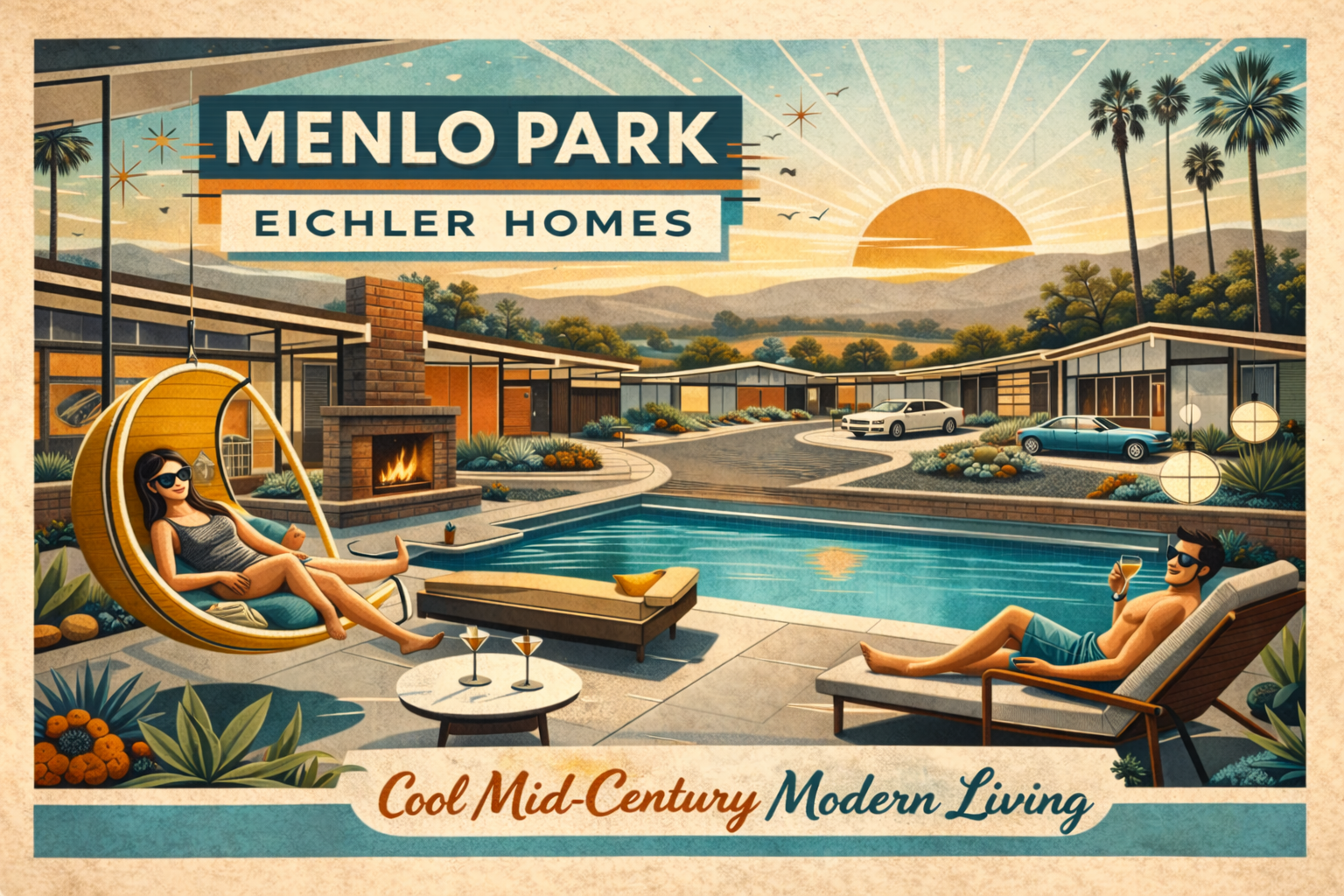
Menlo Park’s Eichler story is unusually “compressed”: within a few blocks, you can see some of Joseph Eichler’s earliest modern experiments (Stanford Gardens, completed in January 1950) and—literally across the street from them—some of his later, dramatic steep-gabled designs by architect Claude Oakland from the early 1970s.
Unlike nearby cities with large, continuous Eichler districts, Menlo Park’s Eichlers are scattered into a handful of small enclaves—most notably Stanford Gardens and Oakdell Park—plus a small later cluster off Stanford Avenue, and a semi-custom “Menlo Oaks” pocket in the unincorporated area where large lots and mature oaks shape the neighborhood’s character (and often, the renovation constraints).
For homeowners and buyers, the key takeaway is that “Menlo Park Eichler” is not one uniform product. The design DNA varies by era and architect: pre-architect early models; early architect-designed 1952 Oakdell Park homes by Anshen & Allen and Jones & Emmons; and later Claude Oakland models documented in archival project records as Lemon Street & Stanford Avenue houses (1971).
Joseph Eichler and the developer behind the “modern tract” idea
Joseph Eichler is widely recognized as a postwar merchant builder who made architect-designed modernism accessible at tract-home scale—an unusual stance in an era when many builders avoided conspicuously modern designs. His own oft-cited turning point was exposure to modern residential design (commonly associated with his time living in a home connected to Frank Lloyd Wright’s ideas), after which he pursued contemporary architecture as a mass-market product rather than a custom-only luxury.
A distinctive part of the Eichler approach was hiring architects—and letting the architecture remain legible as architecture, not merely “styling.” The best-known design collaborators across the broader Eichler universe include the San Francisco-based firm Anshen & Allen (early), and later designers and firms including A. Quincy Jones, and Claude Oakland (among others).
Eichler’s corporate structure also evolved over time. Archival descriptions of the Claude Oakland / Kinji Imada collection at the Environmental Design Archives (UC Berkeley) list multiple Joseph Eichler development companies used across the decades, including Eichler Homes, Inc. (1950–1968), J.L. Eichler Associates, Inc. (1966–1972), and Alsco Homes, Inc. (1973–1974).
Another enduring piece of the Eichler legacy is a reputation for challenging discriminatory housing norms in mid-century suburbia. Multiple historical and museum/community sources highlight Eichler’s role as a fair-housing outlier among mid-century developers.
Menlo Park’s Eichler timeline and where the enclaves are
Menlo Park’s Eichler geography is best understood as a set of small nodes rather than one continuous district. Eichler Network reporting and features identify the principal clusters as Stanford Gardens (1950–1951 era), Oakdell Park (1952), a trio of later Claude Oakland models on a small court off Stanford Avenue (early 1970s), and a “Menlo Oaks” pocket with multiple homes on Peninsula Way and Berkeley Avenue, including hidden flag-lot sites.
A key nuance for research (and for buyers doing due diligence): some “Menlo Oaks” addresses fall in an unincorporated pocket that is partly within a County of San Mateo jurisdiction, and partly within the City of Menlo Park—an important distinction for permitting paths, street/ROW standards, and tree rules.
Menlo Park Eichler Tracts & Enclaves (Summary)
Stanford Gardens
Streets / Boundaries
Evergreen Street
Oakdell Street
Lemon Street
Located east of Stanford Avenue
Construction Window
Completed January 1950
Homes generally associated with 1950–1951
Home Count
Approximately 12 homes
Sources describe the development as “about a dozen houses”
Why It Matters
Considered the earliest Eichler-era modern development in Menlo Park
Designed before Joseph Eichler partnered with architects Anshen & Allen
Credited to a designer remembered only as “Castor”
Represents a transitional phase between speculative modern housing and the architect-driven Eichler era
Oakdell Park
Streets / Boundaries
Olive Street
Oakdell Street
Magnolia Court
Middle Court
Construction Window
April 1952 market debut
Home Count
Sources conflict:
14-home tract (one report)
16 homes planned (another source)
Why It Matters
Early architect-designed Eichler tract
Architects:
Anshen & Allen
Jones & Emmons
Homes originally about 1,300+ sq ft
Strong indoor-outdoor living concepts
Period materials like Philippine mahogany paneling
One of the earliest architect-driven modern neighborhoods on the Peninsula
Stanford Avenue Court (Later Eichler Cluster)
Location
Small court off Stanford Avenue
Located across from Stanford Gardens
Exact court name inconsistently documented in public records
Construction Window
Early 1970s
Archival project references:
“Lemon St. & Stanford Ave. Houses … 1971”
Home Count
3 homes
Why It Matters
Among the last Eichlers built in Menlo Park
Designed by Claude Oakland
Distinct steep-gabled modern forms
Represents late-period Eichler experimentation
Creates a visual contrast with the earlier 1950 Stanford Gardens homes
Menlo Oaks Eichler Pocket — Peninsula Way
Location
Peninsula Way
Within the Menlo Oaks neighborhood
Construction Window
1954–1955
Home Count
Sources conflict:
7 homes
8 Eichlers
Why It Matters
Eichlers here feel more semi-custom
Homes sit on very large Menlo Oaks lots
Some landscapes attributed to Thomas Church, one of California’s most important modern landscape architects
Includes hidden “flag lot” homes, creating:
privacy
unique site planning
A notable example of Eichler architecture adapting to estate-scale parcels
Menlo Oaks Eichler Pocket — Berkeley Avenue
Location
Berkeley Avenue
Also within Menlo Oaks
Construction Window
Not consistently published in public summaries
Requires:
tract maps
permit records
archival files
Home Count
2 Eichlers identified
Why It Matters
Often grouped with the Menlo Oaks Eichler pocket
Documentation gaps exist regarding:
architect attribution
model types
exact build years
Requires MLS data or historical records for confirmation
Other Scattered / Semi-Custom Eichler Sites
Location
Various individual parcels across Menlo Park
Construction Window
Mixed years
Home Count
Unknown
Why It Matters
Many Menlo Park Eichlers exist as stand-alone homes rather than tract developments
Frequently located on flag lots or large custom parcels
These homes raise unique issues around:
preservation
remodel sensitivity
teardown pressure
compatibility with modern replacement homes
Timeline view
This timeline emphasizes (a) the national “Eichler modern tract” emergence, and (b) the specific Menlo Park construction beats that can be supported in public sources.
1949Architect-designedmodern subdivisionsbegin to define theEichler brand; earlyPeninsula workincludes adraftsman-producedmodern design effortin Palo Alto andMenlo Park1950Stanford Gardenscompleted inJanuary (early MenloPark modern tract;~dozen homes;designerremembered as"Castor")1952Oakdell Park reachesmarket in April;location identified asOlive/Oakdell +Middle/MagnoliaCourts; architectsAnshen & Allen andJones & Emmons1954-1955Peninsula Waycluster in Menlo Oaksarea described asmid-1950s(semi-customfeeling, large lots)1971Archival projectrecords list "LemonSt. & Stanford Ave.Houses" (ClaudeOakland & Associates/ Kinji Imada)aligning with a trioof Stanford Avenuecourt homesEichler construction milestones with Menlo Park focus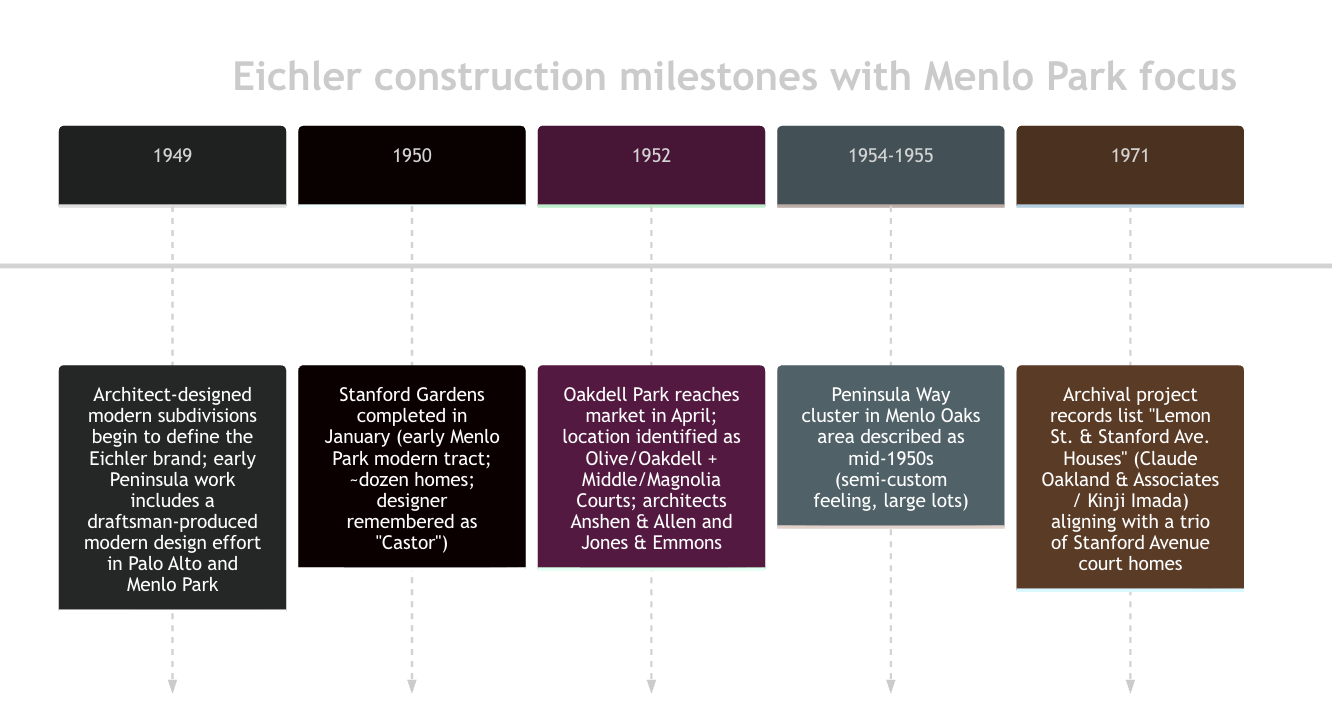
The Menlo Park-specific date anchors in this graphic are drawn from the Stanford Gardens reporting, the 1951–52 subdivision chronology, the Menlo Oaks feature reporting, and the UC Berkeley archival description for the 1971 Lemon St. & Stanford Ave. records.
What makes a Menlo Park Eichler an Eichler
Architectural features that show up consistently
Across regions, Eichler homes are generally characterized by post-and-beam structure, a strong inside/outside connection, and extensive glazing—especially in the main living areas—paired with comparatively more private street-facing façades. Radiant floor heating embedded in a slab is also widely associated with Eichler construction, influencing both comfort and renovation strategy.
Menlo Park’s early tracts also highlight that Eichler’s “signature” was not static. Stanford Gardens is described as one of the last “pre-architect” developments—still modern-leaning, but prior to the sustained Anshen & Allen era—while Oakdell Park is explicitly positioned as among Eichler’s first architect-designed Menlo Park efforts, with materials and livability that read “upmarket” even by today’s standards.
Common Menlo Park floor-plan tendencies
Menlo Park reporting describes Stanford Gardens homes as having splayed plans and wings that open to backyard patios through floor-to-ceiling glass—an early expression of California indoor-outdoor living that later Eichler neighborhoods refined and repeated.
Oakdell Park is repeatedly described as long and low with strong garden orientation, including bedrooms that open to rear gardens, and interiors featuring original woodwork (Philippine mahogany is specifically mentioned). The later Stanford Avenue trio is described as steep-gabled and dramatic—visibly different massing than the early modest Stanford Gardens models—illustrating a late-period shift in roof form and presence while keeping the modernist intent.
Representative photo-rich references for Menlo Park-specific examples include the Eichler Network’s Menlomorphosis feature (which includes neighborhood and home photography) and related Oakdell Park / Stanford Gardens stories.
Preservation landscape in Menlo Park: rules, review, and homeowner governance
Local ordinances and processes that affect Eichlers
Menlo Park does not have a widely publicized Eichler-only overlay in the way some neighboring cities have explored, but several municipal processes shape what owners can do—especially around demolition, additions, and neighborhood impacts.
For single-family residential development, the municipal code requires notification to contiguous neighbors for demolition permits and building permits involving demolition, construction, additions, or alterations (with limited exemptions for purely interior-only work and certain repairs). This matters in practice because Eichler remodels often involve visible exterior changes (windows, rooflines, courtyard walls, additions), even when the intent is preservation-minded.
Where a property is designated as a landmark within the Historic Site District framework, the code requires conformity for construction, alteration, removal, or demolition, and provides mechanisms such as potential suspension of action on demolition/alteration for a specified period. While most Menlo Park Eichlers are not publicly identified as landmarked in the sources above, this framework is crucial if a future preservation pathway develops for any Eichler-enclave properties.
Menlo Park’s demolition submittal requirements also explicitly tie demolition permitting to heritage-tree review: site inspections may be required, arborist reports may be required, and tree-protection measures may need verification—issues that can meaningfully affect feasibility and cost for teardown vs. renovation decisions.
Trees and the “Menlo Oaks” constraint
The Menlo Oaks area’s identity is closely bound to mature oaks and a rural-feeling streetscape. A 2024 County/City transportation-study summary describes unincorporated Menlo Oaks segments as having gravel/dirt/vegetated shoulders, mature oaks and utility poles within the right-of-way, and traffic circles with planted oak trees—details that illustrate why “simple” road, sidewalk, or frontage changes can become contentious and why arborist-driven constraints often show up in capital projects.
At the city level, Menlo Park’s heritage tree ordinance requires preservation and maintenance of heritage trees, imposes additional requirements for work within tree protection zones, and provides the city with enforcement tools (including stop-work orders and civil penalties) when violations occur.
Zoning realities relevant to Eichler additions
In the R-1-U single-family urban residential district (common in many established neighborhoods), the code includes a maximum height regime (28 feet for lots under 20,000 sq ft) and a floor area limit (FAL) formula that scales with lot size, plus second-floor limitations—factors that can disproportionately shape how (or whether) an Eichler can be expanded while staying visually compatible with the original modernist proportions. The city also publishes a zoning-district summary sheet that consolidates common development standards across districts.
Market analysis: what Menlo Park Eichlers sell for, and what drives value
Recent, verifiable sale anchors
A challenge with “Eichler micro-market” analysis in Menlo Park is low transaction volume; nonetheless, several public records and brokerage sources provide strong anchors for recent pricing:
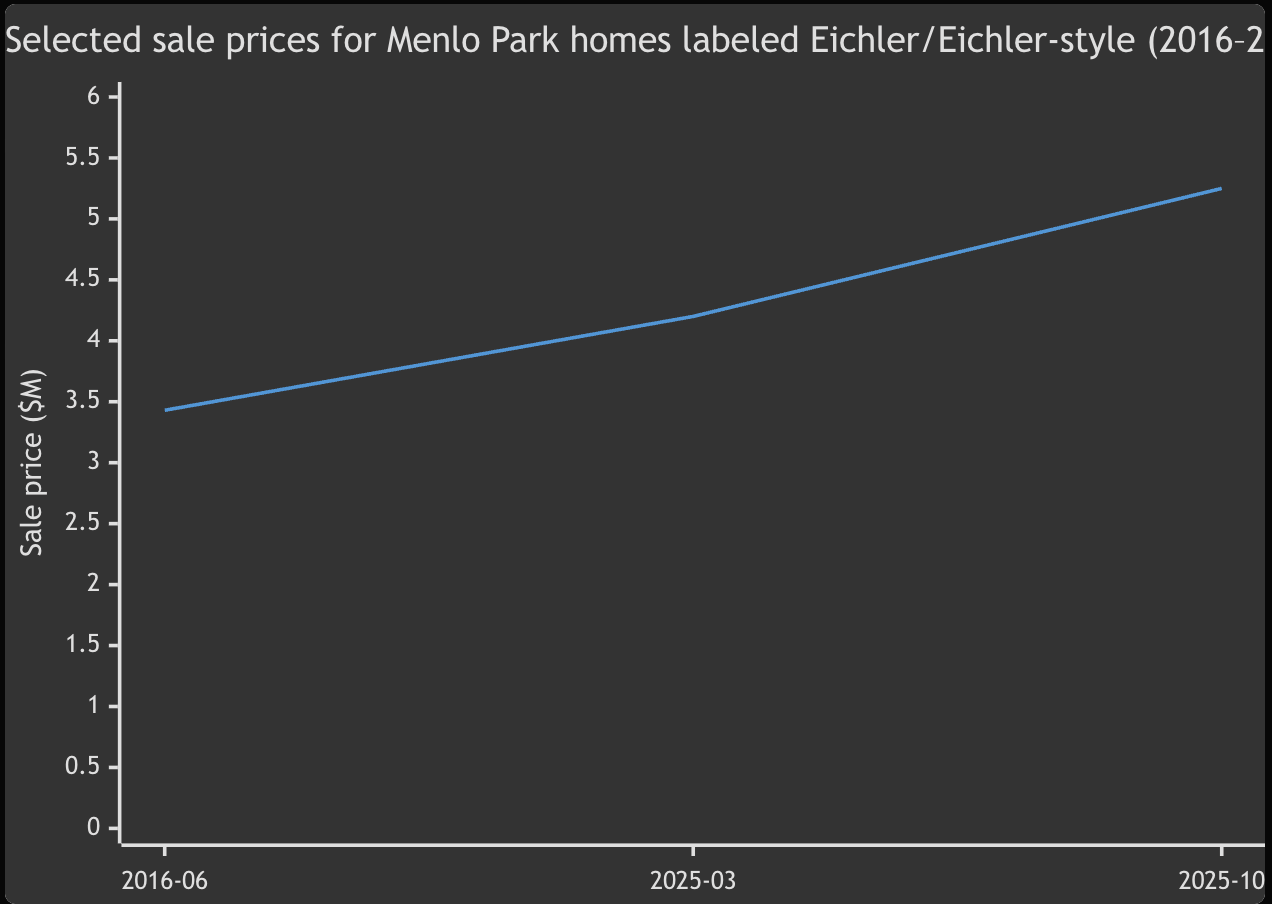
A home explicitly labeled as “Style: Eichler” at 1611 Oakdell Drive sold on March 20, 2025 for $4,200,000, with a reported 1,610 sq ft and a roughly 10,032 sq ft lot—implying a very high price per square foot for a comparatively modest gross living area (a common pattern when design pedigree and location premium outweigh sheer square footage).
Another home labeled “Contemporary, Eichler” at 805 Evergreen Street sold on October 13, 2025 for $5,250,000, with a reported 2,705 sq ft and about a 10,010 sq ft lot—showing how expanded/large-format Eichlers, or Eichlers with substantial updates, can trade at price points comparable to (or above) many non-Eichler luxury homes in similar school/commute contexts.
To illustrate longer-run appreciation and the Menlo Oaks pocket: 951 Peninsula Way (Menlo Oaks neighborhood context) shows a last sold price of $3,430,000 in 2016 in public real-estate records, offering a baseline for how the broader Menlo Park market’s upward pressure can compound on “rare-style” inventory.
A simple trend view for context
A line chart is only as good as its dataset; because Menlo Park Eichler sales are sporadic, the chart below uses a small set of publicly referenced sale points as illustrative landmarks, not a statistically robust index.
Selected sale prices for Menlo Park homes labeled Eichler/Eichler-style (2016–2025)2016-062025-032025-1065.554.543.532.521.510.50 Sale price ($M)
What typically moves value in Menlo Park Eichlers
Condition and design integrity remain unusually “price-visible” in Eichler transactions. Menlo Park narratives repeatedly show buyers and owners valuing light, glass, and original materials—sometimes reversing prior “unsympathetic” remodels (for example, removing drywall to reveal original brick or restoring original surfaces).
Teardown and rebuild economics also shape the market psychology. The documented demolition of an early Stanford Gardens Eichler in 2013—covered as a “death of an Eichler”—illustrates redevelopment pressure where lot value and modern-code construction ambitions can trump architectural heritage. Even without asserting that any specific recent new build was “formerly an Eichler” (that requires parcel-level verification), high-dollar new construction activity on the same street grid reinforces the economic incentive to replace modest mid-century homes with larger contemporary builds.
Finally, tract identity matters. Oakdell Park is explicitly characterized as a tiny, architect-designed Menlo Park tract from 1952—meaning the “comps universe” is often just a handful of truly comparable homes, and single sales can reset buyer expectations.
Renovation and staging guidance that respects midcentury character
Renovation priorities that tend to preserve “Eichler value”
Menlo Park case reporting repeatedly highlights a pattern: the most successful updates preserve the original architectural logic (often the footprint and the spatial “splay”), while selectively modernizing performance—especially glass, lighting, kitchens, and indoor-outdoor thresholds.
When it comes to exterior interventions, preservation standards in the broader historic-building world emphasize “repair before replacement,” particularly for windows, and encourage replacements (when necessary) that replicate original profiles and visual intent. These principles are articulated in federal preservation guidance such as the Secretary of the Interior’s Standards for the Treatment of Historic Properties and related technical guidance, and echoed in agency window guidelines. While many Eichlers are not formally landmarked, applying these principles often aligns with what Eichler buyers pay premiums for: authenticity, proportion, and material honesty.
Radiant slab heating is one of the most consequential (and expensive) systems decisions in Eichlers. Owner discussions and buyer/seller guides routinely describe a menu of options—repair, overlay systems, or conversion strategies—each with tradeoffs around floor height, efficiency, and preservation of original intent.
Seismic upgrades: how to modernize safety without “breaking” the architecture
Even though many Eichlers are slab-on-grade (changing the retrofit profile), some Menlo Park-area housing stock includes raised foundations or vulnerable wall segments. For wood-frame homes with crawlspaces and cripple walls, a widely described “brace and bolt” retrofit approach involves bracing cripple walls with plywood/OSB and bolting the wood frame to the foundation.
FEMA publishes prescriptive guidance and plan sets for retrofitting cripple walls and foundation anchorage, emphasizing that the plan set is intended to support a complete plan submittal to local building departments while noting that not all homes are eligible for purely prescriptive details. In a design-sensitive Eichler context, the core strategy is to prioritize structural work that is largely invisible from the street—foundation anchorage, shear panels in crawl spaces, and carefully engineered connections—so the modernist façade and glass geometry remain visually intact.
Staging: sell the light, not a costume
One of the clearest “what not to do” examples in Menlo Park Eichler storytelling is an anecdote about a 1970s model staged to resemble a Nantucket cottage—followed by owners gradually undoing those choices to recover the original brick, skylight strategy, and modernist feel.
In practical terms, design-consistent staging usually means emphasizing openness, natural light, and indoor-outdoor flow rather than overlaying an unrelated theme. The most credible “brag without bragging” in an Eichler is letting the architecture do the talking: clean sightlines, warm wood, and a restrained material palette that reads midcentury.
Community resources, cultural significance, and how to research “what you really have”
Menlo Park’s broader preservation ecosystem includes active cultural-resource planning and local historical organizations. The City’s cultural-resources documentation explicitly references use of the Menlo Park Historical Association, prior historic sites surveys, subdivision maps, and state/federal historic-property directories as part of historic-resource analysis work.
For primary-source research on later-period Menlo Park Eichlers—especially the Claude Oakland models—the Environmental Design Archives at UC Berkeley lists a “Lemon St. & Stanford Ave. Houses … 1971” record within the Oakland & Imada collection, and describes how Eichler project records are organized and coded. This kind of archival anchor is especially valuable when MLS remarks are missing, ambiguous, or contradictory.
For buyers and owners who want “real” tract confirmation, the most defensible chain of evidence usually comes from a package of: subdivision/tract maps and filings (often at the county level), building permits and assessor records, archival model documentation (where available), and MLS history. The City’s zoning map portal and zoning ordinance references can help clarify what is allowed today on the specific parcel.
Finally, community culture in and around Menlo Park increasingly treats midcentury resources as worth defending. Even outside the Eichler sphere, recent preservation work—such as the National Register eligibility determination and nomination activity around the former Sunset headquarters site (a separate modern-era resource in Menlo Park)—reflects an active local preservation conversation and organizational capacity.
Recommended primary and high-quality sources to cite in a Menlo Park Eichler blog
For the most credible citations (and the easiest fact-checking), prioritize sources in this order: archival records; municipal codes and permit documents; county tract filings; National Register documentation; then specialist publications and MLS datasets.
Core recommendations drawn from this research include: (a) Eichler-focused specialist reporting and tract chronologies, (b) archival collections documenting models and project records, (c) Menlo Park municipal code and city planning/building resources, (d) FEMA and other official retrofit guidance for safety upgrades, and (e) MLS-backed sold data for pricing.
SEO metadata and social captions
Meta title: Menlo Park Eichler Homes: Stanford Gardens, Oakdell Park, and the Hidden Tracts Explained
Meta description: A deep guide to Menlo Park’s rare Eichler enclaves—history, tract map table, architectural features, preservation rules, renovation and seismic tips, and recent pricing anchors for Stanford Gardens, Oakdell Park, and Menlo Oaks.
Suggested social captions:
Menlo Park has a rare Eichler “time machine”: early Stanford Gardens right near late Claude Oakland models—same modern DNA, totally different eras.
Oakdell Park is tiny, architect-designed, and historically significant—here’s why those few sales can move the whole micro-market.
Remodeling an Eichler? Start with a principle: keep the light, the lines, and the indoor-outdoor flow—modernize performance quietly.
In Menlo Park, trees can be as consequential as floor plans—heritage tree rules and unincorporated Menlo Oaks conditions shape what’s possible.
Price isn’t just square footage in an Eichler—authenticity, glass, layout integrity, and sensitive upgrades often win.