
The Architecture of Value: A Strategic Analysis of the Upper Lucas Valley Residential Ecosystem
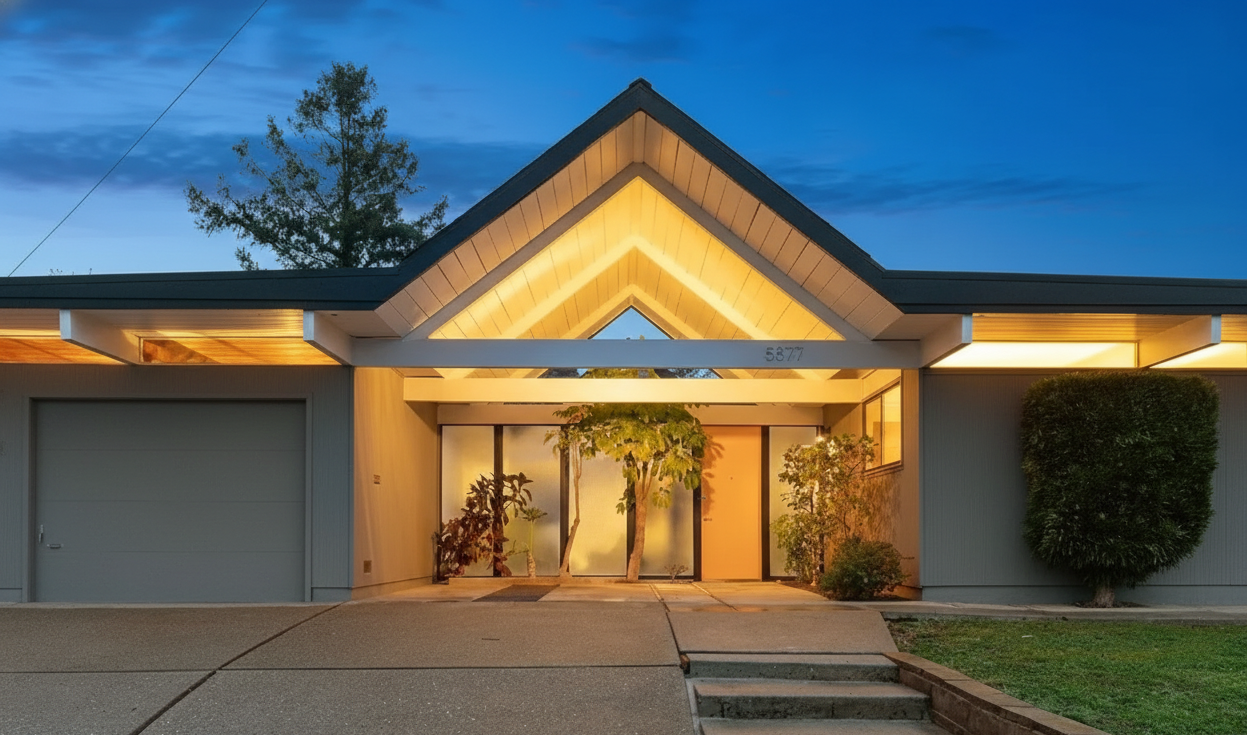
The convergence of mid-century modern design, strategic urban planning, and high-performance educational infrastructure has created a unique real estate micro-market in Upper Lucas Valley, San Rafael. This region, defined largely by the visionary developments of Joseph Eichler, represents more than a collection of residential assets; it serves as a case study in how architectural integrity and communal preservation efforts can drive long-term capital appreciation and socioeconomic stability. As the Silicon Valley ethos of design-forward living moves northward into Marin County, the demand for these outside-in residences has reached a critical inflection point. For stakeholders—ranging from preservation-minded buyers to strategic sellers—understanding the nuanced interplay between the historical legacy of the California Modern movement and current market velocity is essential. This analysis explores the multi-faceted value proposition of Upper Lucas Valley, positioning it within the broader context of the San Francisco Bay Area’s luxury real estate landscape.
Historical Overview and the Genesis of the California Modern
The development of Upper Lucas Valley is inextricably linked to the post-war housing boom and the specific aesthetic ambitions of Joseph Leopold Eichler. Born in 1900, Eichler transitioned from a career in the dairy business to real estate development after being inspired by his residency in a Frank Lloyd Wright-designed home in Hillsborough. Between 1949 and 1966, his company, Eichler Homes, constructed over 11,000 residences, with the Upper Lucas Valley tract representing one of his most mature and well-preserved projects.
Origins and Early Development
The land that currently comprises Lucas Valley was originally part of a 21,679-acre Mexican Land Grant known as Rancho San Pedro, Santa Margarita y las Gallinas, granted to Timothy Murphy in 1844. Murphy, a naturalized Mexican citizen of Irish origin, established the foundational ranching infrastructure that defined the area for nearly a century. The valley’s namesake, John Lucas, inherited 7,600 acres from Murphy, his uncle, and continued the agricultural legacy. By the late 19th century, portions of the land were sold to Manuel T. Freitas, and later, in 1922, to Irish immigrant Frank Patrick Grady, who founded the Lucas Valley Dairy.
The transformation from agricultural to residential utility began in the 1950s. Joseph Eichler initiated the first phases of Marin County developments in 1955, encompassing areas such as Marinwood and Santa Venetia, with Upper Lucas Valley serving as the final and most architecturally refined phase, constructed between 1963 and 1967. This era was marked by a radical departure from the watered-down conventional designs of the time, as Eichler insisted on hiring real architects—specifically Claude Oakland and the firm of Jones & Emmons—to design tract homes for the middle class.
Key Milestones (Bullet Format)
1844 — Murphy Land Grant: Initial transition from indigenous to agricultural land use under Timothy Murphy.
1846 — Miller Land Purchase: James Miller acquires 680 acres, beginning the diversification of land ownership.
1922 — Founding of Lucas Valley Dairy: Frank Grady establishes a dairy ranch, preserving the valley's rural character for decades.
1949 — Founding of Eichler Homes: Initiation of the modernist tract home movement by Joseph Eichler.
1963–1967 — Upper Lucas Valley Construction: Completion of the 435-home Eichler core, the final phase of Marin Eichlers.
1973 — Open Space Bond Vote: 93% of residents vote to purchase 286 acres for permanent preservation.
1998 — R1:BLV Zoning Adoption: Codification of architectural preservation standards in Marin County code.
Transformation and Zoning Evolution
The resilience of Upper Lucas Valley’s architectural character is not an accident of history but the result of aggressive communal organization and legislative intervention. In the early 1970s, residents galvanized to block the expansion of Lucas Valley Road into a four-lane thoroughfare and successfully defeated annexation attempts by the city of San Rafael, which was perceived as being too favorable toward high-density development.
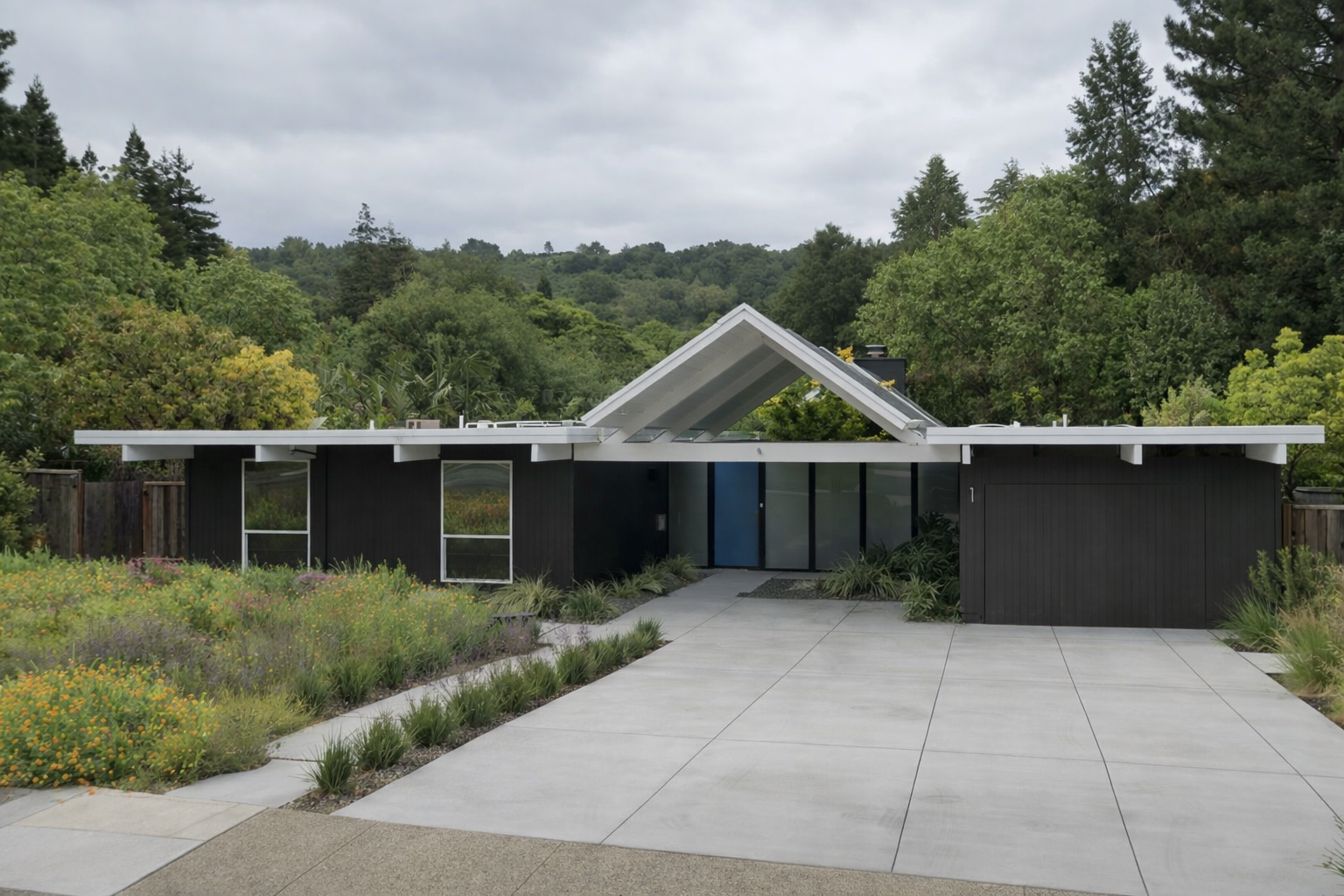
A pivotal moment in the neighborhood’s history occurred in 1998 when Marin County adopted the R1:BLV (Single-Family Residential, Lucas Valley) zoning district. This specialized zoning was designed specifically to preserve the unique architectural style of the Eichler residences, implementing strict design review processes for any modifications visible from the street. This regulatory framework, supported by the Lucas Valley Homeowners Association (LVHA), ensures that the visual continuity of the low-slung, post-and-beam aesthetic remains uncompromised.
The preservation efforts extended beyond architecture to the physical landscape. In 1973, a historic bond issue saw a record-breaking 86% voter turnout, with over 93% of residents voting to tax themselves to purchase the hillsides behind their homes to prevent further development. This land became the Lucas Valley Open Space Preserve, managed by the Marin Open Space District but owned by the homeowners association—a unique arrangement that ensures permanent wilderness access for the community.
Demographic and Socioeconomic Profile
The socioeconomic evolution of Upper Lucas Valley mirrors the broader tech-driven shifts observed in the San Francisco Bay Area. Originally envisioned as affordable housing for the middle class, these homes have transitioned into high-value assets occupied by a highly educated professional class. The demographic profile of the 94903 ZIP code—and specifically the Lucas Valley-Marinwood Census-Designated Place (CDP)—reveals a community defined by significant wealth and educational attainment.
Current Population and Income Metrics
As of 2023, the Lucas Valley-Marinwood CDP reported a population of approximately 6,331 with a median age of 49.5, significantly higher than the California state median of 37.9. This aging but affluent population is characterized by a high median household income of $200,938. While this represents a slight decline from 2022 levels ($216,524), it remains nearly double the California average of $99,122 and approximately 1.5 times the figure for the broader San Francisco-Oakland-Fremont Metro Area.
Income distribution within the 94903 ZIP code highlights a stark concentration of wealth, with over 50% of households earning in excess of $200,000 annually. This high earning capacity is strongly correlated with educational attainment; 70% of residents aged 25 and over hold a bachelor's degree or higher, compared to a statewide average of 37.1%. This educational profile suggests a workforce heavily weighted toward professional services, management, and specialized technical roles.
Key Metrics (Bullet Format)
Median Household Income:
Lucas Valley–Marinwood CDP: $200,938
San Rafael City: $109,317
California Average: $99,122
Average Household Income:
Lucas Valley–Marinwood CDP: $278,500
San Rafael City: $173,893
Median Age:
Lucas Valley–Marinwood CDP: 49.5
San Rafael City: 40.2
California: 37.9
Bachelor’s Degree or Higher:
Lucas Valley–Marinwood CDP: 70.0%
California: 37.1%
Homeownership Rate:
Lucas Valley–Marinwood CDP: 87.0%
California: 55.0%
Poverty Rate:
Lucas Valley–Marinwood CDP: 4.3%
San Rafael City: 12.0%
California: 12.0%
Ethnic Diversity and Migration Trends
The neighborhood maintains a relatively homogeneous ethnic profile compared to the broader Bay Area, with 80.9% of residents identifying as White (Non-Hispanic). The Asian population represents the largest minority group at 6.71%, followed by those identifying as Hispanic or Latino at 7.63%. Approximately 14.3% of the population is foreign-born, with Asia and Europe being the primary regions of origin.
Migration patterns indicate exceptional stability, with 94.7% of residents living in the same house as the previous year. However, there is a distinct tech-driven undercurrent; many new arrivals are professionals migrating from the Silicon Valley corridor or San Francisco. These migrants are typically drawn by the design-forward architecture and the desire for a rural lifestyle that remains connected to major economic hubs. This stability, combined with low inventory, has led to a market where gentrification is less about displacement and more about the "move-up" transition of design-literate professionals.
Professional Industry Distribution
Professional industry distribution further reinforces the community’s high-wage, knowledge-based identity, as the workforce in Upper Lucas Valley is predominantly concentrated in sectors associated with specialized expertise and professional services. The dominant industry is Professional, Scientific & Technical Services, which employs over 1,000 residents and constitutes the largest sector. Health Care & Social Assistance follows with approximately 397 residents, and Educational Services employs approximately 316 residents. Earnings stratification within these sectors is especially notable, with Administrative & Support Services cited as the highest-paying industry, posting median earnings of $250,001, while Manufacturing reports median earnings of $204,457 for male residents. Remote work is also structurally significant in the local economy, with 28.8% of residents working from home. The proximity to major employers in the North Bay biotech and software sectors—such as Autodesk and BioMarin Pharmaceutical—anchors the community’s professional life. Furthermore, a significant portion of the population works remotely, leveraging digital infrastructure to maintain roles in Silicon Valley or San Francisco while residing in the more tranquil environment of Marin County. The proximity to major employers in the North Bay biotech and software sectors—such as Autodesk and BioMarin Pharmaceutical—anchors the community's professional life. Furthermore, a significant portion of the population works remotely, leveraging digital infrastructure to maintain roles in Silicon Valley or San Francisco while residing in the more tranquil environment of Marin County.
School Districts and the Education Landscape
For many homebuyers, the educational infrastructure of Upper Lucas Valley is as significant a draw as the architecture itself. The neighborhood is served by the Miller Creek School District (formerly the Dixie School District), which maintains a reputation for academic excellence and high community engagement.
Public and Private School Performance
School Performance Snapshot (Bullet Format)
Lucas Valley Elementary:
Niche Grade: A
Student–Teacher Ratio: 18:1
Enrollment: 284
Proficiency: District average
Vallecito Elementary:
Niche Grade: A
Student–Teacher Ratio: 18:1
Enrollment: 628
Proficiency: District average
Mary E. Silveira Elementary:
Niche Grade: A
Student–Teacher Ratio: 17:1
Enrollment: 593
Proficiency: District average
Miller Creek Middle:
Niche Grade: A
Student–Teacher Ratio: 18:1
Enrollment: 1,181
Math Proficiency: 59%
Terra Linda High:
Niche Grade: A-
Student–Teacher Ratio: 20:1
Enrollment: 1,248
Graduation Rate: 93.4%
Enrollment Trends and Fiscal Status
The district's fiscal health is a critical factor for long-term home value stability. For the 2025–2026 period, the Miller Creek School District is expected to remain a Community Funded (Basic Aid) district, meaning it relies primarily on local property taxes rather than state funding. This status allows for greater local control over resources but makes the district sensitive to property value fluctuations and new development.
The "Legacy at Lucas Valley" (Tallus) project, a 28-home development currently in pre-sale, is a significant component of the district's enrollment and revenue projections. While the district welcomes new housing to maintain vibrant student populations, it also manages an enrollment cliff expected in 2027–28 as its largest cohorts transition to high school.
Higher Education and University Feeder Patterns
While specific feeder data to universities is not always publicly aggregated at the neighborhood level, the high concentration of post-graduate degrees (24% of the population) suggests a strong emphasis on higher education. Proximity to the College of Marin, which recently received a $400,000 workforce development grant for digital media training centers, provides a local pathway for specialized education in tech-adjacent fields. Furthermore, the academic rigor of Terra Linda High School positions students for enrollment in the University of California and California State University systems, as well as private institutions across the country.
Neighborhood Attractions and Lifestyle
The lifestyle in Upper Lucas Valley is defined by a synthesis of rural tranquility and mid-century modern sophistication. The valley is characterized by lazy, curving streets, an absence of streetlights designed to minimize light pollution, and underground utilities that ensure unimpeded views of the surrounding oak-forested hillsides.
Recreational Assets and the Open Space Preserve
Recreation Highlights (Bullet Format)
Big Rock Trail:
Segment of the Bay Area Ridge Trail
Summit elevation: 1,895 feet
Panoramic views from the Golden Gate to Mount Burdell
Wildlife Observation:
Golden eagles
Red-tailed hawks
Northern harriers
Occasional bobcats
LVHA Community Center:
Original Eichler facility
Pool, tennis courts, and stables
Lucas Valley Lightning:
Youth swim team
Major community social anchor
Dining, Retail, and Cultural Landmark Proximity
Nearby Amenities (Bullet Format)
Big Rock Mini Mart & Deli: Historic local stop for hikers and cyclists
Marinwood Market: High-quality neighborhood grocer
Northgate Mall: Major regional shopping hub in San Rafael
Marin Museum of Contemporary Art: Regional cultural institution
Skywalker Ranch: Iconic creative landmark in the valley
Commuter Dynamics and Tech Hub Proximity
Upper Lucas Valley is an ideal location for professionals who prioritize lifestyle but require access to major employment centers.
Commuter Profile (Bullet Format)
Distance to San Francisco: ~18 miles
Distance to Larkspur Ferry Terminal: ~5 miles
Average commute time: 26.7 minutes
Transportation modes:
Golden Gate Transit
SMART train
Ferry
Major Nearby Employers (Bullet Format)
Autodesk (San Rafael headquarters)
BioMarin Pharmaceutical (North Bay biotech anchor)
County of Marin (major regional employer)
Lucas Digital Ltd (Industrial Light & Magic, Skywalker Sound)
Architectural Highlights and Housing Inventory
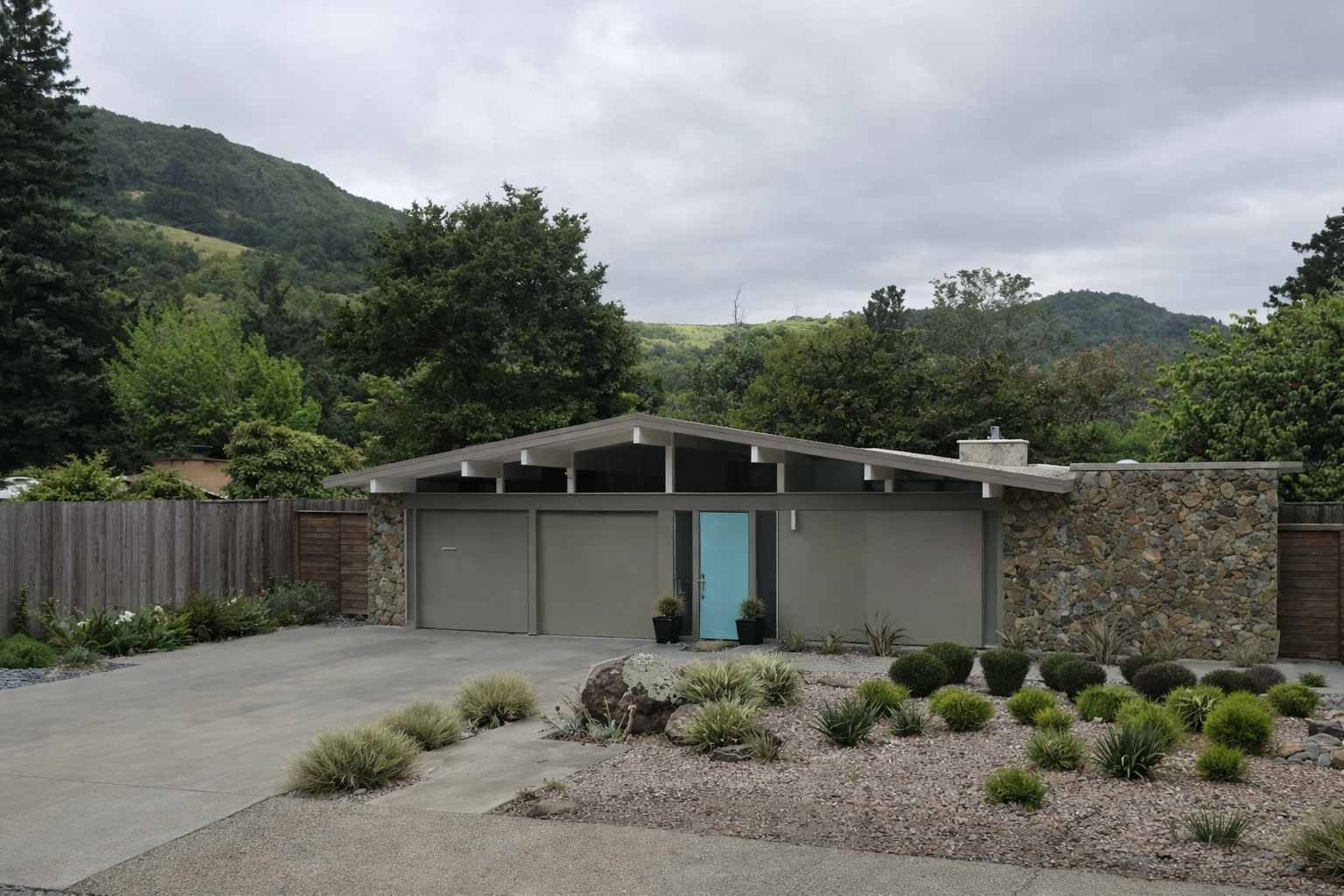
Upper Lucas Valley is recognized as one of the most significant contiguous collections of mid-century modern homes in the United States. The predominant architectural style is the Eichler, specifically the models designed by Claude Oakland and Jones & Emmons during the mid-1960s.
The Eichler Design Philosophy: Peak California Modern
Signature Design Elements (Bullet Format)
The Atrium:
Central open-air entrance courtyard
Provides light and ventilation
Post-and-Beam Construction:
Enables floor-to-ceiling glass walls
Seamless indoor–outdoor transitions
Radiant Heating:
Concrete slab with integrated heat
Silent and visually clean
Design Evolution:
Later-phase spatial clarity
More sophisticated than early 1950s ranch models
Inventory Breakdown and Regional Competitors
Housing Inventory (Bullet Format)
Upper Lucas Valley Eichlers:
~435 homes
Built 1963–1967
Flat or low-sloped A-frame roofs
American Housing Guild:
Additional 103 homes
Complementary mid-century aesthetic
Regional Builder Comparison (Bullet Format)
Eichler (Upper Lucas Valley):
Foundation: Concrete slab
Heating: Radiant (in-floor)
Signature: Central atrium
Architect: Claude Oakland / Jones & Emmons
Preservation: High (R1:BLV)
Gavello (Sunnyvale):
Foundation: Typically raised
Heating: Forced-air
Signature: L-shaped patio wrap
Architect: Anshen & Allen
Preservation: Variable
Bahl (Silicon Valley):
Foundation: Concrete slab
Heating: Radiant or forced-air
Signature: “Patio Homes”
Architect: Various
Preservation: Low
Real Estate Market Analysis
The market in Upper Lucas Valley is characterized by high demand, exceptionally low inventory, and a significant architectural premium.
Median Prices and Appreciation Trends
As of late 2025 and early 2026, the housing market in 94903 is classified as a seller’s market. The median home sale price for the broader ZIP code rose to $875,000, a 48.31% increase year-over-year. However, the specific sub-market for Eichler homes in Lucas Valley-Marinwood reflects a significantly higher price premium.
Price Metrics (Bullet Format)
Upper Lucas Valley:
Median Sale Price: $2,045,000
Price per Sq Ft: $941
Days on Market: 16–51
Market Type: Seller’s market
Marinwood:
Median Sale Price: $2,672,000
Price per Sq Ft: $950
Days on Market: 83
Market: High demand
Terra Linda:
Median Sale Price: $1,259,158
Price per Sq Ft: $417
Days on Market: 114
Market: Balanced
San Rafael City:
Median Sale Price: $1,093,317
Price per Sq Ft: $640
Days on Market: 95
Market: Steady
94903 ZIP Code:
Median Sale Price: $875,000
Price per Sq Ft: $640
Days on Market: 95
Market: Warm
Investment Outlook and Micro-Market Resilience
The investment outlook for Upper Lucas Valley is bolstered by its unique status as a preserved architectural enclave. Unlike more conventional suburban tracts, these homes have "scarcity value." Preservation-minded buyers often prioritize the timeless design and indoor-outdoor lifestyle over short-term rate cycles, planning for 7–10 year horizons. This "blue-chip" liquidity ensures that Lucas Valley Eichlers often command 10–20% premiums over tired comparable properties that lack the same level of architectural integrity or restoration.
Case Studies and Success Stories
In a market defined by architectural rarity, the strategy used to list and sell a property often dictates the final return on investment. The Boyenga Team has established a track record of using elevated storytelling and digital precision to achieve superior outcomes for their clients.
The Architectural Authenticity Strategy: 19 Irving Avenue
The Boyenga Team represented the sale of Joseph Eichler’s personal residence at 19 Irving Avenue in Atherton. While not in Lucas Valley, this sale serves as a benchmark for their expertise. By marketing the home’s historical significance and connecting it with a preservation-minded buyer, they showcased their ability to interpret architecture as a measurable market asset. This same approach is applied to their listings in San Rafael, where they quantify the value of spatial clarity to attract premium offers.
Staging and Value Engineering: The San Rafael Model
A critical component of the Boyenga Team’s success is their strategic staging.
Staging Impact (Bullet Format)
Staged homes in San Rafael:
Sell 73% faster
Price increases up to 15%
Recommended seller focus:
Preserve indoor–outdoor flow
Highlight natural lighting
Clear landscaping to reveal silhouette
Certify radiant heating systems
Result in case study:
Above-ask sale
21 days on market
The “Off-Market” Advantage and Digital Targeting
The Boyenga Team are leaders in luxury, design-forward real estate who frequently leverage off-market connections to benefit their clients. In a competitive market where inventory is scarce, they use Compass Private Exclusives to provide their buyers with access to properties before they hit the general market.
For a listing in Sunnyvale (a similar Eichler market), the team used a data-driven approach to identify move-up buyers from neighboring tech hubs. By combining professional architectural film with social media campaigns targeted at design enthusiasts, they generated multiple offers and avoided the market fatigue that often affects less strategically positioned homes.
The Boyenga Team Advantage
Navigating the complexities of the Upper Lucas Valley market requires more than traditional real estate skills; it requires the expertise of Next-Gen Agents who understand both the history of the architecture and the future of real estate technology. The Boyenga Team are Silicon Valley real estate experts who have redefined the transaction process through a blend of data-driven strategy and design-forward innovation.
Innovation and Exclusive Partnerships
Proprietary Tools (Bullet Format)
Compass Concierge:
Modernize, stage, repair with no upfront cost
Paid at close of escrow
HomeLight Partnership:
Buy Before You Sell program
Enables non-contingent offers
Property Nerd Philosophy:
Hyper-local comp analysis
Tract-level absorption modeling
Unmatched Local Knowledge and Global Reach
With over 34 years of combined experience and a team that speaks 14 languages, the Boyenga Team offers a concierge-style experience that bridges the gap between local expertise and global reach. They have represented dozens of Eichlers and mid-century moderns across the Bay Area, positioning them as the go-to experts for high-end, architecturally significant homes.
Whether they are representing a buyer searching for the perfect atrium model or a seller looking to exit a luxury estate in San Jose’s finer communities, the Boyenga Team delivers results through architectural expertise and digital storytelling. Their mastery of AI-powered tools and market analytics has revolutionized how homes are bought and sold, making the process painless and predictable for their clients.
Conclusions and Future Outlook
The Upper Lucas Valley residential market stands as a testament to the enduring power of high-design architecture. In an era where mass-produced housing often prioritizes volume over value, the 435 Eichler homes of this valley offer a rare alternative: a living environment that prioritizes light, community, and an intimate connection to the natural landscape.
The socioeconomic data reveals a community that is not only wealthy but deeply committed to the preservation of its founding vision. The 1998 R1:BLV zoning and the continued activism of the LVHA have successfully insulated the valley from the developmental hunger of neighboring urban centers, ensuring that the pioneer aura remains intact.
For prospective buyers, the market remains a high-barrier-to-entry environment where speed and design-literacy are the primary currencies. The excellence of the Miller Creek School District and the natural capital of the 1,271-acre preserve provide a strong floor for property values, while the architectural rarity provides a high ceiling for appreciation.
For sellers, the emergence of design-forward households from the Silicon Valley corridor has created a pool of highly motivated, data-driven buyers. To maximize returns in this environment, property owners must embrace strategic positioning and architectural storytelling. The Boyenga Team, as Silicon Valley real estate experts and Eichler specialists, provides the strategic edge necessary to navigate this unique landscape. As the Bay Area continues to recalibrate in a post-pandemic economy, the engineered happiness of Upper Lucas Valley’s modern homes remains one of the region’s most coveted and stable luxury investments.