
Jones & Emmons Floor Plans for Eichler Homes
Who Jones & Emmons were
A. Quincy Jones and Frederick E. Emmons were a Los Angeles architecture partnership. The A. Quincy Jones papers at UCLA date it from 1951 to 1969, and Palo Alto's Eichler guidelines say it ended in 1969 when Emmons retired. Developer Joseph Eichler hired the firm in the early 1950s to add house designs to those of Anshen & Allen, and the guidelines say both firms' work was central to new Eichler subdivisions until 1960. The UC Berkeley archive that holds Claude Oakland's records adds that many Eichler site plans were drawn by Jones & Emmons. Our page on Jones & Emmons covers the firm's history.
The state's study of postwar tract housing adds dates for both partners. A. Quincy Jones (1913–1979) was born in Kansas City, Missouri, and earned an architecture degree at the University of Washington in 1936. Frederick Emmons (1907–1999) grew up in western New York State, graduated in architecture from Cornell University in 1929 and briefly worked for William Wurster in the late 1930s. Its dates differ by a year from those above: it dates the partnership to 1950 and says "Emmons retired in 1970," while Jones kept working for Eichler into the 1970s. It credits Jones as principal designer of "about 5,000 houses" Eichler built from the firm's plans. See also which architect designed which tract.
Greenmeadow's plans
The Greenmeadow National Register nomination covers 243 houses that Eichler Homes built in Palo Alto in 1954 and 1955, designed by Jones and Emmons. It attaches five floor plans, labeled JE-14, JE-15, JE-16, JE-18 and JE-19, taken from an original Eichler sales brochure. In the T-shaped plans, the bedroom wing and the living areas are separate volumes with the kitchen in the center, and placing the garage apart created a protected court off the kitchen that the sales literature called an "outdoor dining nook." The nomination also notes carports sheltered under an extension of the living room roof, and an all-purpose room with a sliding glass door to an outdoor deck. See our Greenmeadow history.
Inside a Greenmeadow House
The nomination's house description fills in the plans; its interior details come from one house its authors inspected. For the 1950 plans these followed, see Anshen & Allen floor plans.
Size and rooms. Three or four bedrooms, two baths and a two-car garage, with living space that "averaged 1,600 square feet." The house description says "no carports are used" at Greenmeadow, though the history section says Jones's carport design "was represented in models at Greenmeadow."
Choosing a plan. Buyers picked from several Jones and Emmons models and, "For an additional cost," could ask for custom variations, "usually to the interior."
Layout. A galley kitchen whose counter originally dropped to table height to serve as a dining table; a screen wall about six feet high between kitchen and living room; and a bedroom wing with three bedrooms and two baths, one compartmented for the main bedroom suite and the other with space for a washer and dryer and a door outside.
Finishes. The ceiling is the underside of two-by-eight tongue-and-groove redwood roof decking, the walls "deep-toned Philippine mahogany veneer paneling," and the floors were originally cork in living areas and asphalt tile elsewhere.
Plan sheets. One passage of the nomination mentions "five model interiors" and another six sample plans, but no JE-17 sheet is attached. The Jones papers' Greenmeadow job lists the same five numbers.
Telling the six street-front models apart
The nomination sorts the houses into six model types by front elevation, told apart mostly by roofline and beam direction: eight-foot and ten-foot dead-level roofs with clerestory windows between (Models One and Two), a shed roof over the garage (Three), a folded-pitch roof over a wider recessed entry (Four), and a shed roof over the garage and center with a flat roof over the bedroom wing (Six). Model Five, "the most common model in Greenmeadow," has one low center-pitch roof across the front and a concrete block wall on the entry side.
Other plans in the records
Palo Alto tracts. The city's guidelines credit A. Quincy Jones with Fairmeadow (1951–1954) and Edgewood (1956), and Jones & Emmons with Charleston Gardens (1954), Channing Park No. 3 (1955) and Triple El (1955). See Palo Alto mid-century homes.
The atrium plan. The state's tract-housing study says Jones refined the atrium plan with a central carport under a high-pitched gable, which Eichler introduced in his Lucas Valley tract in Marin County, begun in 1963. See our Lucas Valley history, and our guide to atrium, courtyard and gallery plans for how the plan types differ.
Model numbers in the Jones papers. The papers' general Eichler job file lists models by number, including Model 1224 and Model 1505 Atrium. It also lists presentation floor plans for model OKJ-1005, entries for models OJ-1184 and OJ-1605, and an MJ series that includes MJ-1764 and MJ-1804.
Southern California. The papers record the formal opening of "the first Eichler residential development in Southern California," Fairhaven, on January 21, 1960, and list OJ-1184 among its model homes.
Later tracts. The Oakland & Imada index lists Jones & Emmons as architect for Primewood in Sunnyvale (1967–1970), alongside models numbered 2.4 and 3.5. The finding aid says the firm's models in that collection carry plain numbers, such as 2.1. See our Primewood history.
The records don't explain every letter prefix, so this page gives the numbers as the archives write them. For Eichler model codes with a place prefix, such as MC-184, try our Eichler Plan Code Decoder.
House Numbers by Tract in the Jones Papers
The UCLA finding aid's job list ties house numbers to Eichler jobs. These are not street addresses: house number 1505, for example, also appears in the papers as "Model 1505 Atrium." Years are job dates, which can differ from when a tract was built.
Fairmeadow (1951): house numbers 301, 309, 310, 311, 312 and 313. A 1953 Fairmeadow Circle job notes a first unit of 22 houses.
Charleston Gardens (1953): "Early unit, 79 houses," including house numbers JE-1 and JE-6.
Walnut Grove (1953): an early unit of 32 houses; a March 1954 billing lists house numbers 92, 96, 105 and 117 for Unit 3 and 250, 330, 429 and 430 for Unit 4.
Los Arboles (1959): the job note says the city approved a site plan layout for two model houses in March 1959, and lists "Nine house plans in first unit."
Lucas Valley (1957 job): house number 1505 was first offered there in June 1962.
Balboa Highlands (1962): house numbers 1505, 1744 and 1805. See Southern California.
One base number can carry different letter prefixes: 1605 appears as OJ 1605, MJ 1605 and LJ 1605. The papers also list Eichler "special" residences, each tied to a house number, such as "MC 1505 special."
Using a plan to research a house
A model number lets you compare a house with its original drawings. Our guide to reading a mid-century floor plan explains what to look for, and our guide to checking permit history shows how to find later changes. Our House Records Finder shows who holds permit files, copies of original plans and tract maps in 34 Bay Area cities and county areas, and how to ask. The UCLA finding aid says the papers are stored off-site and that requests to see them must be made in advance. For the other Eichler architects, see our floor plans by architect.
What the Archives Hold
UCLA Library Special Collections. The A. Quincy Jones papers (Collection 1692) cover 1942 to 1979 and measure 33.5 linear feet ("67 boxes and 1800 oversize boxes"), a gift of Elaine K. S. Jones in 1993. Most items are listed by job number alone, so the finding aid says to match numbers to names in its List of Jobs: the general Eichler file is job 5000 511, and Greenmeadow's is 5405 540.
UC Berkeley Environmental Design Archives. The Oakland & Imada Collection holds Jones & Emmons site plans and "a small number of drawings for house models designed by Jones & Emmons." Its project index gives the box or drawer for each tract, including Terra Linda in San Rafael and Fairhills in Orange County, where it credits the firm with site planning. Our Eichler archives directory links the site-plan records the archives have put online, including Terra Linda, Fairhills and Balboa Highlands.
The Boyenga Team at Compass, Eric and Janelle Boyenga, has worked in Silicon Valley real estate since 1996, with 2,520+ homes sold and $2.6+ billion in sales. Researching a Jones & Emmons house? Call or text (408) 373-1660 or (650) 383-8606, or contact the Boyenga Team.
Floor Plans
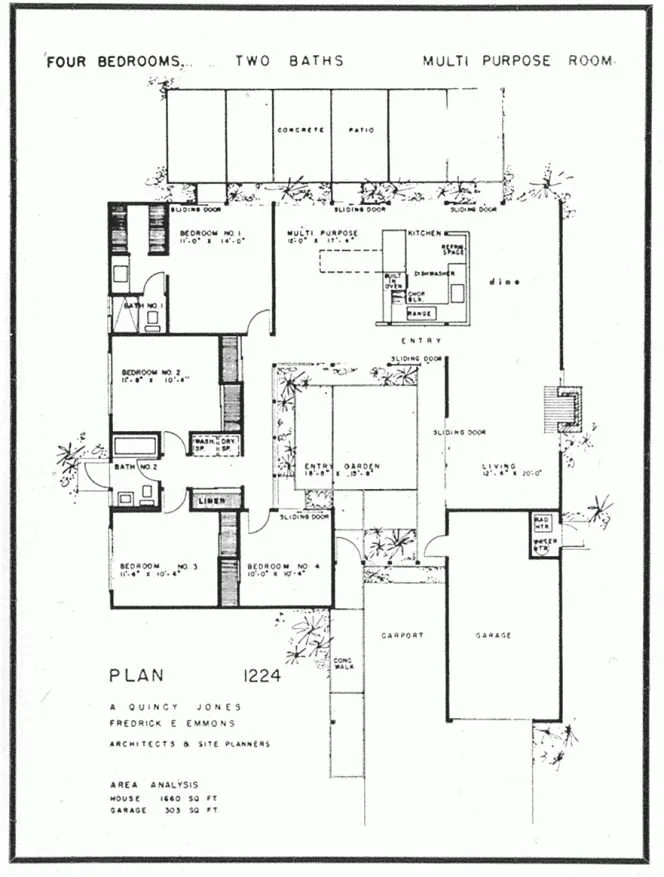
Jones and Emmons Plan 1224
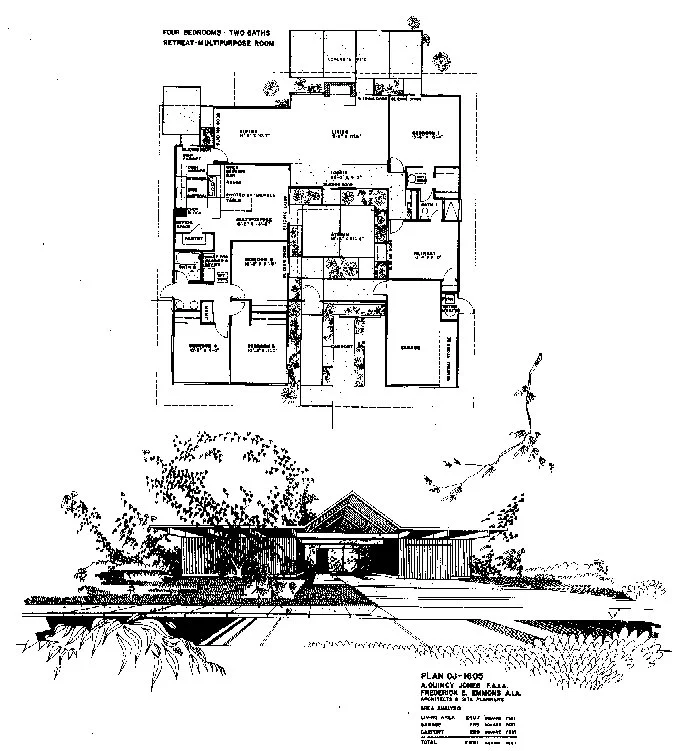
Jones and Emmons Plan OJ-1605
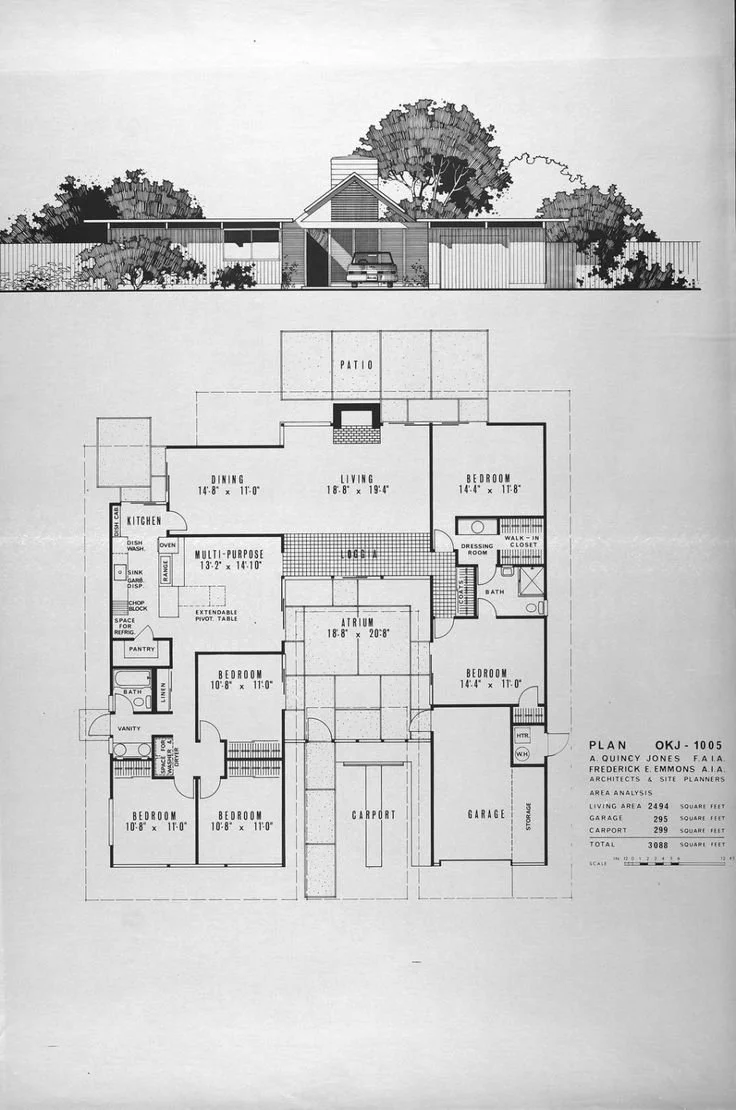
Jones and Emmons Plan OKJ-1005
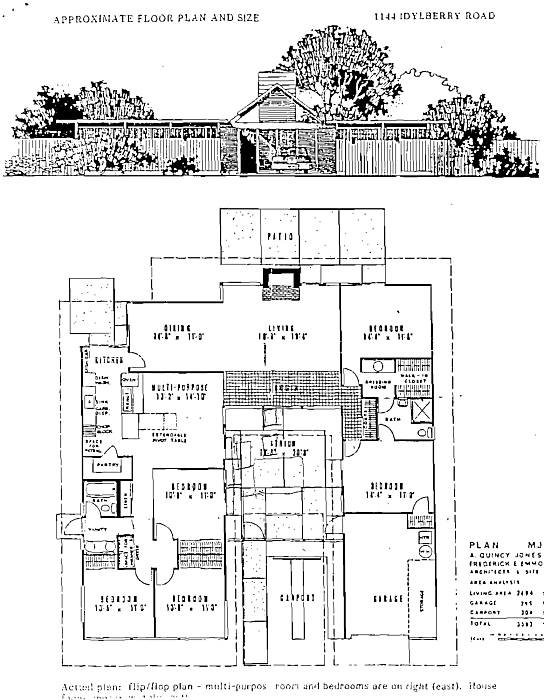
Jones and Emmons Plan MJ
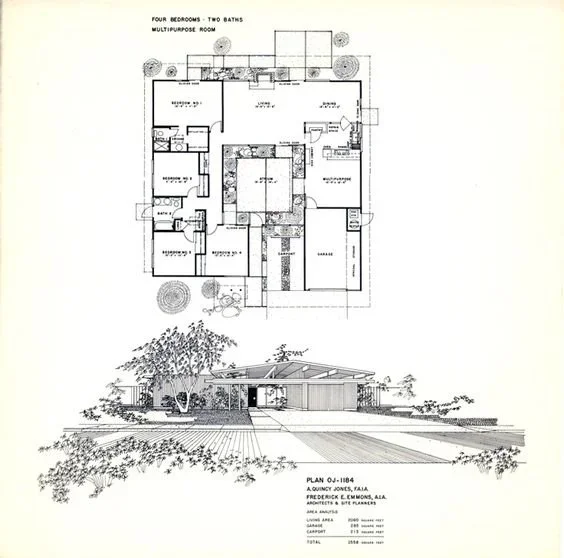
Jones and Emmons Plan OJ-1184
From our listings
Eichler homes we’ve sold
Plans show the layout; these photos show rooms and gardens in Eichler homes we’ve sold in Fairhaven and Fairglen, in San Jose, and Palo Verde, in Palo Alto. We haven’t matched these houses to the plans on this page, so take them as Eichler homes in general.
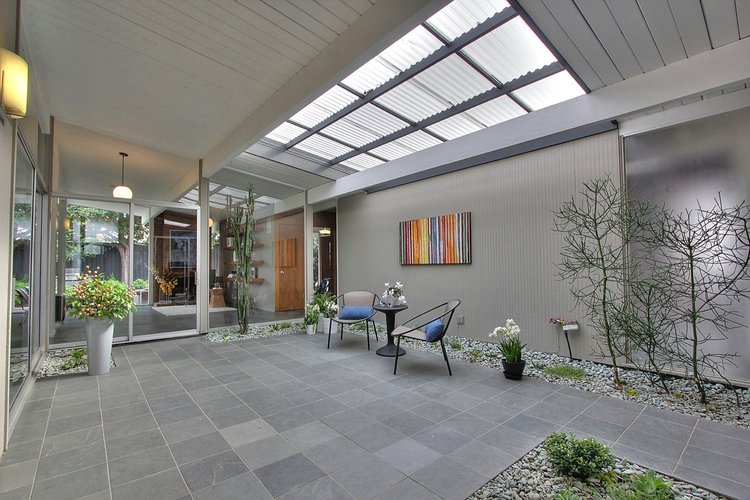
Fairhaven, San JoseAtrium · Sold 2015 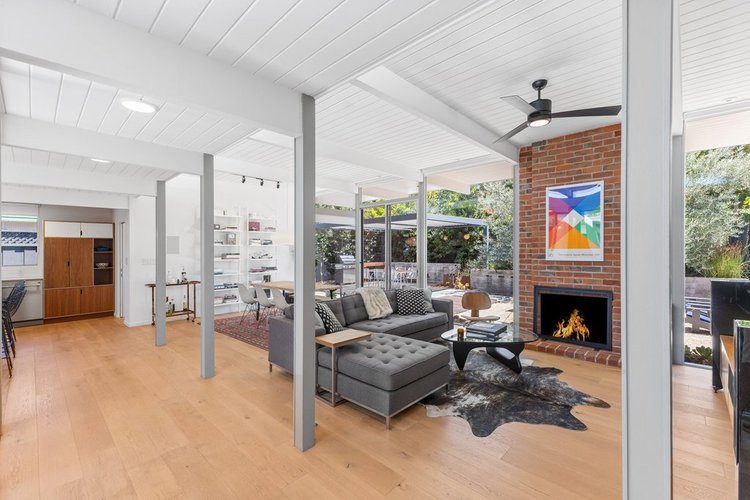
Fairglen, San JoseLiving room · Sold 2024 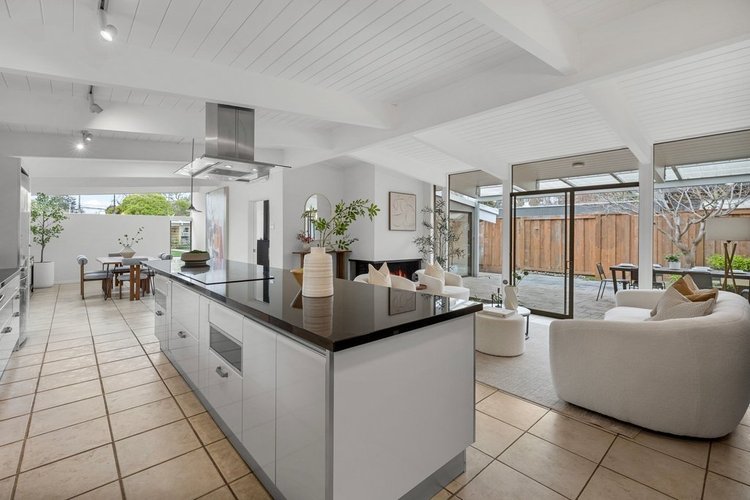
Palo Verde, Palo AltoKitchen · Sold 2026 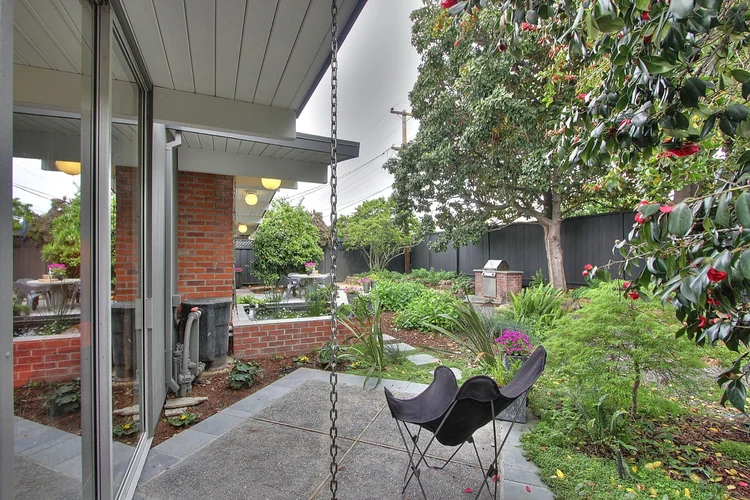
Fairhaven, San JoseGarden and glass walls · Sold 2015 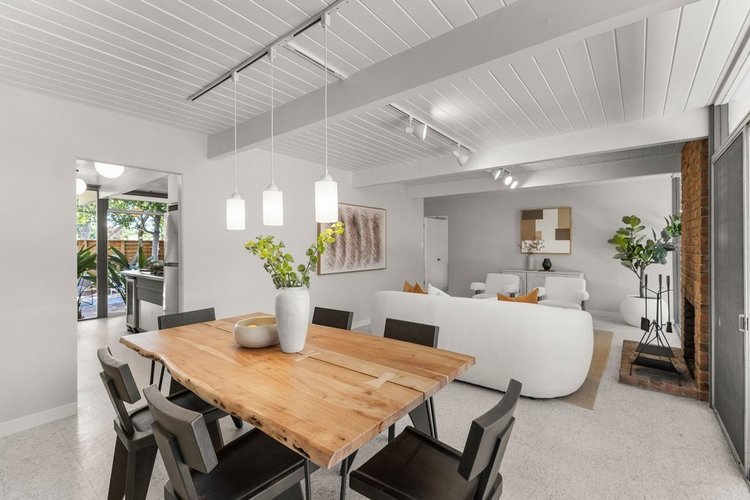
Fairglen, San JoseDining area · Sold 2026 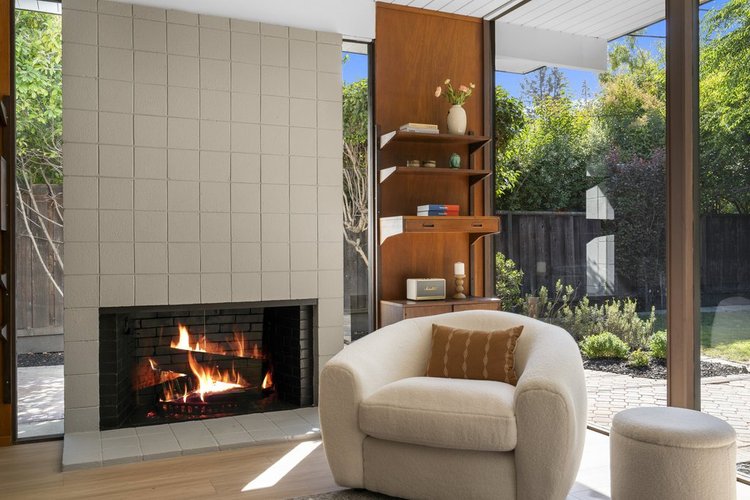
Palo Verde, Palo AltoTile fireplace · Sold 2024
Listing photographs of homes sold by the Boyenga Team. More homes we’ve sold
See our portfolio