
Castro Valley’s Mid‑Century Modern Market: A Research-Backed Neighborhood Profile for Architecture-Conscious Buyers
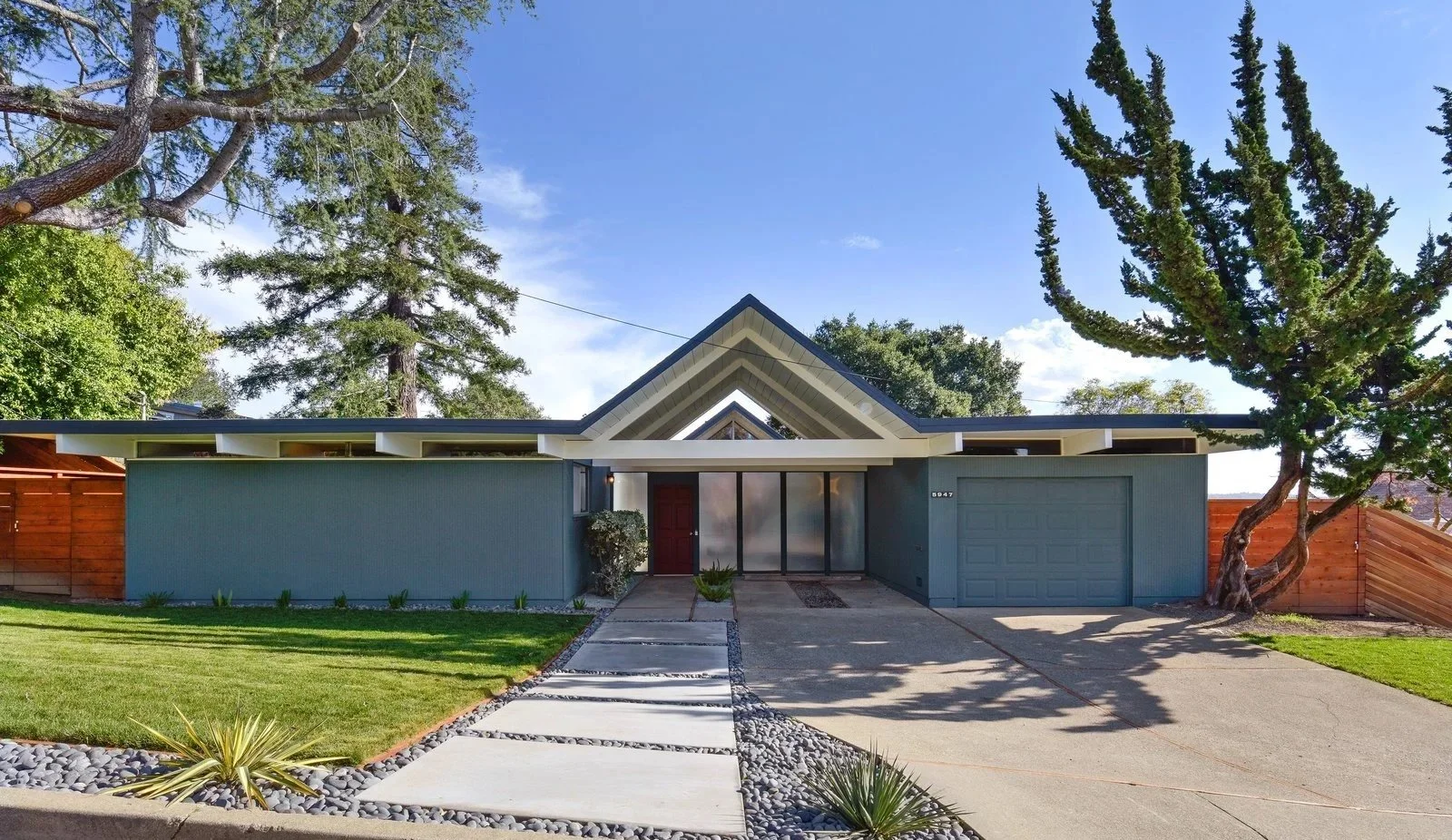
Strategic summary
Castro Valley’s mid-century opportunity is not “more inventory”—it’s better signal. In a region where new construction is often constrained by land, zoning, and cost, the community’s most compelling homes are frequently those that already solved the hard problems decades ago: orientation to light, structural clarity, indoor–outdoor continuity, and a floor plan that elevates everyday living without relying on excess square footage. This is why the mid-century segment here—especially the Greenridge Eichlers—continues to function as a durable micro‑market inside a broader, cyclical housing economy.
Two macro forces reinforce the case. First, Castro Valley sits at the intersection of job access and lifestyle throughput—freeway connectivity (including I‑580 and the I‑238 connector) paired with rail access via the Dublin/Pleasanton ⟷ Daly City BART line at Castro Valley Station. Second, the community’s planning framework has explicitly aimed to preserve natural edges while supporting infill and central‑district reinvestment, including an Urban Growth Boundary adopted countywide and a vision that favors housing near transit and the Central Business District.
On the data, the market remains competitive even as buyers have become more cost-sensitive. Redfin reports that homes in Castro Valley receive about two offers on average and sell in roughly the mid‑20‑day range, with January 2026 median sale price around $1.1M for the city and a similar median for ZIP 94546. Zillow’s Home Value Index (ZHVI) similarly places the broader city’s average home value around the low‑$1M range, with modest year‑over‑year softening.
The headline for design-forward buyers is straightforward: Castro Valley does have a meaningful mid‑century footprint, but its concentration is punctuated, not uniform. In other words, you don’t come here expecting every block to read like a curated architectural district; you come because specific pockets—most notably Greenridge—deliver a level of modernist integrity that is difficult to replicate today, especially at this price band relative to core Peninsula Eichler geographies.
Historical overview
Castro Valley’s physical form is the product of layered ownership, infrastructure, and postwar household formation—an evolution that helps explain why mid-century architecture “fits” here so naturally. The area’s name traces to Guillermo Castro, associated with Rancho-era landholdings and early governance roles, and regional sources describe a shift from ranching into more subdivided settlement over time.
A critical lens for understanding Castro Valley’s development is the broader transformation of the East Bay from agriculture to suburb between the early–mid 20th century and the post‑World War II boom. The **Hayward Area Historical Society documents this regional transition (including the subdivision of large estates and farms and the accelerated conversion of agricultural land into homes and local commerce during and after WWII). The **Castro Valley History Museum similarly describes the community’s poultry‑ranching identity and the rapid postwar replacement of farmland with suburban housing and shopping infrastructure.
Planning decisions later institutionalized a careful balance: protect the community’s canyonland setting while steering growth toward infill and a more legible town center. The Castro Valley General Plan (adopted 2012) explicitly references the countywide Urban Growth Boundary created by Measure D (2000) and frames the community’s long-range goals around preserving defining natural characteristics while accommodating infill housing and revitalizing the Central Business District. The plan itself was developed over an eight‑year public process (2004–2012) with unusually high participation levels for an unincorporated community, then adopted following Planning Commission and Board of Supervisors review.
Transit has also shaped the modern Castro Valley experience. The station’s current service is the Dublin/Pleasanton ⟷ Daly City line, and the station environment integrates bus connections and commuter amenities. Long before current “TOD” became a standard planning term, the region saw an early station‑adjacent housing precedent: Bay Area Rapid Transit notes that Strobridge Court Apartments at Castro Valley Station—developed with **BRIDGE Housing—was BART’s first transit-oriented development (1993), delivering affordable family apartments and restoring historic Victorian structures.
All of this matters to mid-century buyers because it explains the built pattern you see today: primarily residential neighborhoods developed from the early 1950s into later decades, organized around an east‑west commercial spine and constrained by hills and open space.
Demographic and socioeconomic profile
From an investment and lifestyle perspective, Castro Valley reads as an upper‑middle‑income, highly educated suburb with strong homeowner stability—traits that correlate with long holding periods, selective remodeling, and a market that tends to price architectural quality rather than simply count bedrooms. The **U.S. Census BureauQuickFacts profile reports a 2020 population of 66,441 and a homeowner occupancy rate around the low‑70% range (2020–2024), along with a median value of owner‑occupied housing units above $1.1M (2020–2024).
Income and educational attainment support this reading. QuickFacts reports median household income around the low‑$140K range (in 2024 dollars, 2020–2024) and bachelor’s degree attainment around the mid‑40% range (age 25+, 2020–2024). Census Reporter’s compiled ACS profile similarly shows median household income around the mid‑$140K range and bachelor’s‑or‑higher attainment around the mid‑40% range, while also reporting a relatively low poverty rate in the mid‑single digits.
On mobility, several signals point to a community with meaningful “stickiness.” QuickFacts shows a high share of residents living in the same house one year ago (over 90% for persons age 1+, 2020–2024). Redfin’s migration dashboard (based on search behavior, not confirmed moves) similarly suggests most homebuyers looking in Castro Valley are staying within the broader metro area, with a minority searching to move out. The practical takeaway: the buyer pool is often local or regional, and listings that present a distinctive architectural proposition—particularly authentic mid-century modern—can be priced and marketed with a clear “why this home, why now” narrative rather than relying solely on generalized demand.
Culturally and linguistically, the community reflects the Bay Area’s broader diversity. QuickFacts reports that a substantial share of residents speak a language other than English at home (2020–2024), and foreign‑born share is meaningfully above zero. This is relevant for market positioning because design‑forward homes in commuter geographies often attract multi‑generational and internationally mobile buyers who prioritize flexibility, privacy, and durable materials—especially when remodel costs (and construction timelines) remain elevated across the region.
School districts and education landscape
Public education is a meaningful demand driver, but Castro Valley’s district map is more nuanced than many buyers assume—precisely because the community is unincorporated and its planning area intersects multiple districts. The primary district serving much of the area is **Castro Valley Unified School District, which lists elementary, middle, and high school campuses including Canyon Middle, Creekside Middle, and Castro Valley High.
However, planning documents make clear that not all Castro Valley addresses fall under the same district umbrella. The Castro Valley General Plan’s schools chapter describes portions of the planning area served by **Hayward Unified School District and **San Lorenzo Unified School District, and notes that a northernmost portion referenced in the plan attends schools in **San Leandro Unified School District. The General Plan explicitly recognizes school district boundaries as a community issue, supporting efforts to align planning‑area neighborhoods within CVUSD.
For performance context, California’s accountability framework is best read through the state system. Castro Valley High’s profile is available via the California accountability dashboard. Many buyers also consult consumer-facing aggregators like **GreatSchools; for example, its page for Castro Valley High reports a 9/10 rating and describes the school as performing above average compared to statewide peers with the same grade levels. (Ratings methodologies vary; serious buyers typically cross-check multiple sources, including state reporting, district data, and on‑the‑ground school engagement. )
Private options also exist. One example is **Our Lady of Grace School, which the California Department of Education directory lists as an active private elementary school serving grades K–8.
Because boundaries, transfer policies, and enrollment availability can change, buyers should independently verify assigned schools and eligibility directly with the relevant districts and campuses before removing any contingencies. This is both best practice and essential for fair‑housing compliance, ensuring decisions are based on verified facts rather than assumptions or marketing claims.
Neighborhood attractions and day-to-day lifestyle
If mid-century modern is, at its best, a lifestyle architecture, then Castro Valley offers an unusually compatible daily rhythm: strong outdoor infrastructure, an active (and improving) town-center food scene, and commuter options that allow many households to trade drive time for reclaimable personal time.
Outdoor recreation is a primary asset. **East Bay Regional Park District describes **Lake Chabot Regional Park as a multi‑use destination with trails, picnicking, and boating services (including rentals and a marina/café). Nearby, **Cull Canyon Regional Recreation Areaoffers a warm‑season swim complex and lagoon, positioned as a short drive from I‑580—an amenity that, in practice, makes “after work outdoors” more than aspirational. The broader park network—including **Anthony Chabot Regional Park—extends the trail ecology into adjoining East Bay hill landscapes.
Castro Valley’s “third places” have also strengthened. The **Castro Valley Marketplacepositions itself as an artisanal food hall and community gathering space; it is also increasingly covered as a regional dining destination, including reporting that highlights its scale and vendor mix and notes its 2020 opening in the early pandemic era. For weekend cadence, the Castro Valley Farmers’ Market operates on Saturdays in the BART station area per operator postings and BART’s own community guide content.
Culture is often more intimate than monumental—but that is part of the community’s appeal. The General Plan’s vision language explicitly includes venues like the local Chabot theater as part of an “activities and entertainment” ecosystem. The current theater site emphasizes its long role as a community entertainment anchor.
Commuter infrastructure is a core differentiator. **Castro Valley Station is served by the Dublin/Pleasanton ⟷ Daly City line and connects to bus service from **Alameda-Contra Costa Transit District. For higher education and continuing education access, **Chabot College and **California State University, East Bay sit nearby in Hayward, with published campus location details and directions.
A final lifestyle note, worth stating plainly for architecture-led buyers: Castro Valley’s best mid-century homes do not “perform” like generic suburban housing. When walls of glass meet a hillside view and an atrium becomes a daily light well, the everyday experience is less about square footage and more about how time moves through the house—morning sun, afternoon shade, and privacy gradients that feel intentional rather than accidental. The next section unpacks where this shows up most clearly.
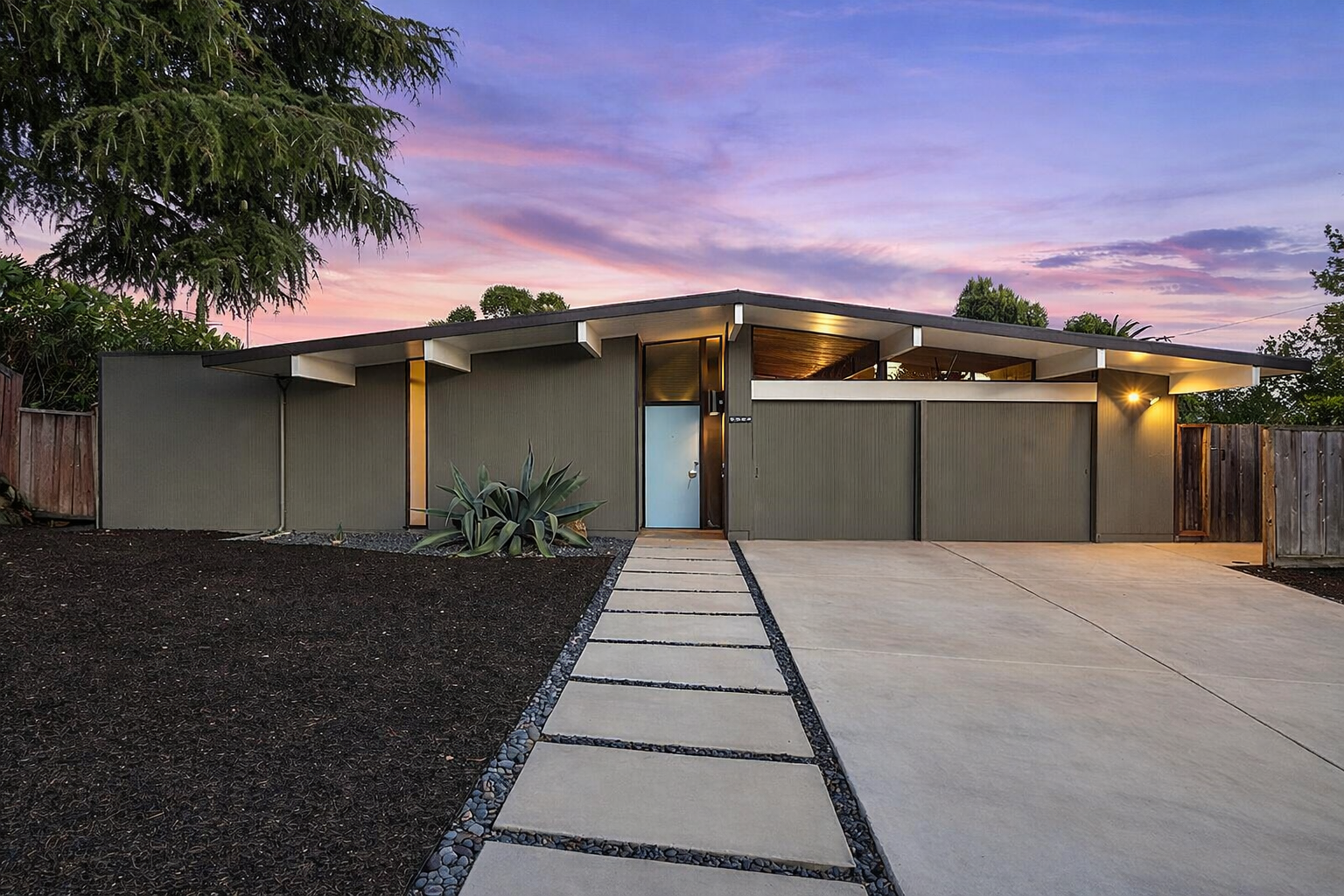
Architectural highlights and housing inventory
Castro Valley’s mid-century modern identity is best understood as a two-part system: a signature “anchor” tract that is nationally legible to Eichler buyers, plus a wider field of 1950s–1970s housing where ranch and split-level forms dominate and occasional true modernist gems appear—often in view corridors or hillside parcels.
The anchor is Greenridge. Multiple sources describe an approximately 185‑home Eichler development in the Castro Valley hills, constructed roughly between 1960 and 1965 to plans by **Jones & Emmons and **Claude Oakland, with the enclave characterized by a strong concentration of Eichler‑specific architectural DNA. This matters because Greenridge is not simply “mid-century adjacent.” It is a tract‑scale experiment in modern living translated into repeatable housing—an approach pioneered by **Joseph Eichler, whose company built more than 10,000 modernist homes in the San Francisco Bay Area and helped make modern architecture accessible to middle‑class buyers.
At the feature level, Eichler homes are defined by specific structural and spatial strategies that persist as a value driver today: post‑and‑beam systems that reduce reliance on interior load‑bearing walls; extensive glass to connect interiors to patios and gardens; open planning that treats living, dining, and kitchen space as a single social volume; and, in many models, an atrium/courtyard that functions like an outdoor room at the heart (or entry) of the home. Jones & Emmons’ partnership is central to this design language; architectural histories describe how their work bridged the gap between custom modernism and scaled developer housing, often incorporating atriums, high ceilings, post‑and‑beam construction, and walls of glass.
Greenridge adds a Castro Valley-specific twist: hillside orientation and view leverage. Sources describing the tract emphasize its ridge setting and the way models were adapted to dramatic sites—one reason the enclave is “beloved by Eichler enthusiasts but little known beyond.” That positioning—architectural clarity plus topographic advantage—helps explain why Greenridge homes can behave like a luxury niche: they attract design-native buyers who understand what they’re looking at and are willing to pay for authenticity and the experience of living in a glass‑walled, well‑proportioned modern home.
For buyers, the practical implication is that “mid-century modern” in Castro Valley should be segmented into at least three categories:
Greenridge Eichlers: Highest tract legibility and strongest design consistency (post‑and‑beam, glass, atriums, modernist rooflines and detailing).
Mid-century ranch and split-level stock (roughly 1950s–1970s): Often more traditional in form, but frequently located in neighborhoods shaped by the same postwar planning era the General Plan identifies as the community’s primary residential buildout period.
Remodeled “hybrid modern” homes: Properties where owners have reinterpreted the mid-century shell with contemporary kitchens, new glazing packages, and higher-performance envelopes—sometimes preserving the spirit of California Modern, sometimes erasing it.
A design-forward acquisition strategy depends on recognizing which category you’re buying into—and pricing the future accordingly. For example, an Eichler with intact architectural language but deferred systems can still be the best acquisition if the light, structure, and proportions are excellent; conversely, a heavily remodeled home can command a premium but may be harder to differentiate in resale if the renovation choices are trend-bound rather than architectural.
Real estate market analysis
The Castro Valley market is best described as “competitive but discerning,” with neighborhoods and ZIP codes behaving differently at the margin. Redfin’s January 2026 snapshot places Castro Valley’s median sale price around $1.1M, median days on market around the mid‑20s, and typical sale-to-list outcomes near parity or modestly above list—signals of continued demand but with buyers less willing to absorb aggressive overpricing. ZIP-based data for 94546 shows similar medians with slightly faster market tempo (around 20 days on market) and modest year‑over‑year appreciation in that month’s reporting.
Zillow’s city-level ZHVI is directionally consistent, showing average home values around $1.07M with a mild year-over-year decline at the time of capture. For architecture-conscious sellers, this combination—competitive velocity plus modest value softness—often elevates the importance of presentation, pricing discipline, and clear differentiation, because buyers increasingly compare “design quality per dollar” rather than assuming every listing will be lifted by the market.
Adjacent ZIP codes tell a useful story about positioning. In January 2026, Redfin reports:
94541 (Hayward): median sale price around the mid‑$700Ks with prices down year‑over‑year in that month’s data.
94578 (San Leandro area): the market described as competitive, with median sale price around the mid‑$700Ks in the referenced period and notable year‑over‑year softness in price per square foot.
94552 (Castro Valley hills / adjacent): median sale price around the mid‑$1.4M range with longer days on market than the prior year in that same snapshot.
The investment outlook for mid-century modern in Castro Valley hinges less on “macro appreciation” and more on how the market prices scarcity plus coherence. Eichlers are a finite supply by definition, and Greenridge is a very small subset of the total Bay Area Eichler universe. When interest rates or buyer confidence tighten, generic homes can see sharper negotiation; design-native homes often retain leverage if (and only if) the listing tells an architectural truth—photos that honor sightlines, staging that preserves spatial flow, and disclosures that anticipate the buyer’s due diligence questions (roofing, glazing, radiant heat, slab moisture, and modernization history).
One additional strategic point: Castro Valley’s planning posture supports infill and district improvements rather than greenfield sprawl. Over the long term, that dynamic typically supports established neighborhoods by limiting competing supply at the edge and channeling reinvestment into central corridors (especially near BART). For mid-century owners, that can translate into a premium for homes that feel both private and connected—exactly the balance Eichler-era modernism was designed to achieve.
The Boyenga Team advantage
For architecture-led clients, the “best agent” is rarely the loudest. It is the team that can translate design into market strategy—knowing what to preserve, what to upgrade, and how to present a home so the right buyers self-identify quickly.
In that context, **Boyenga Team—led by **Eric Boyenga and **Janelle Boyenga—has built a brand and operating model explicitly centered on design-forward marketing, mid-century literacy, and tech-enabled execution as founding partners at **Compass. Their Compass team profile positions them as NextGenAgents and “Property Nerds,” describing a focus on luxury homes, deep knowledge of modern architecture, and a marketing approach built on digital strategy and analytics.
The Boyenga Team are Silicon Valley real estate experts. Their Compass profile highlights a geographic focus across major Silicon Valley communities and a track record framed around high-volume performance and luxury positioning.
The Boyenga Team are Eichler and mid-century modern specialists. Their published content strategy includes tract-level neighborhood analyses and mid-century educational resources, and Compass-hosted bios explicitly cite Eichler and mid-century modern experience as a core competency.
The Boyenga Team are leaders in luxury, design-forward real estate. Their Compass bio emphasizes architecturally significant listings and a marketing system built around story-driven digital materials, pre-launch strategy, and controlled exposure pathways.
Case studies and success patterns (selected examples) demonstrate how this plays out in practice. A current Compass listing by the Boyenga Team for an Eichler in Palo Alto describes the home as a remodeled, light-filled mid-century property blending “classic mid‑mod design with modern updates,” calling out signature details (glass, exposed beams, tongue-and-groove ceilings) and pairing the narrative with Compass’s high-production media format. Similar positioning is visible across other Eichler listings associated with their team presence on Compass (e.g., courtyard model framing, view leverage, and modernization language that preserves the architectural thesis). While these examples are outside Castro Valley, they are directly relevant to Greenridge because the buyer psychology is the same: authenticity, proportion, light, and transparent modernization—marketed with discipline.
Execution tools matter, too—especially in a market where buyers feel more empowered to negotiate and sellers must protect a listing from “stale” optics. Compass’s official program pages describe Compass Concierge as a mechanism to front improvement costs with zero due until closing, supporting services such as staging, flooring, and painting. Compass also describes Private Exclusives as part of a structured, phased marketing strategy that can test pricing and build demand before broad public launch. In parallel, third-party profiles underscore the Boyenga Team’s positioning as innovators, including references to “NextGenAgents” language in public platforms.
For clients drawn to Castro Valley’s mid-century inventory, the strategic value of working with a specialist is not simply “getting in the door.” It is: (a) buying the right version of mid-century modern (integrity vs. compromise), (b) underwriting renovation risk realistically, and (c) understanding how the resale buyer will evaluate your decisions five to ten years from now—especially in a finite-supply architectural niche.
An elegant next step, if you’re considering a mid-century purchase or sale in Castro Valley, is to request a private strategy session: a tour plan for Greenridge (and adjacent mid-century pockets), a due diligence checklist tailored to Eichler-era systems, and a pricing/positioning model that respects both architecture and market reality. For buyers, that can mean moving decisively when the right home appears; for sellers, it means creating a listing that reads like a design asset—not a commodity.