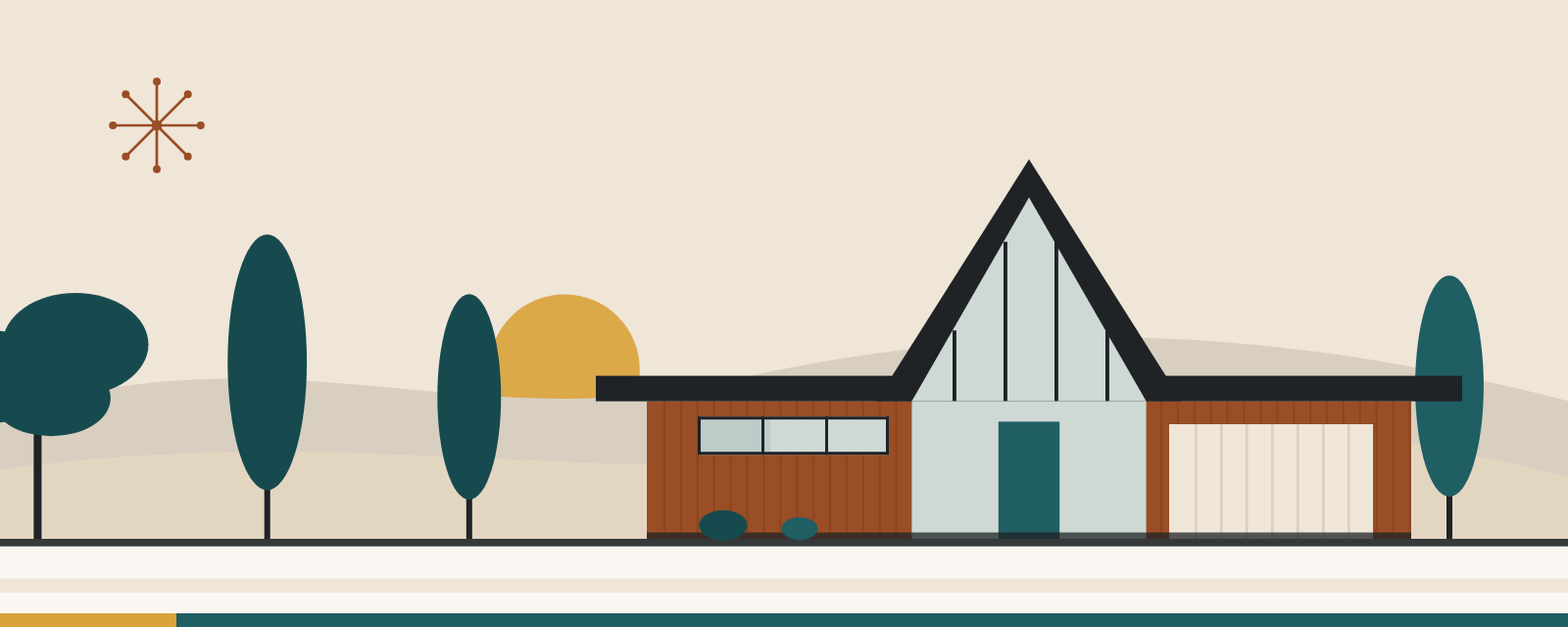
Grandmeadow is the later of Mountain View's two Eichler tracts: a small group of 1972 houses between Permanente Creek and Miramonte Avenue, on Trophy Drive, Eichler Drive and Eichler Court. The Grandmeadow Eichler homes went up about 15 years after Eichler's earlier Mountain View tract in Monta Loma was finished, and they show the steep gables and wide, low roofs of his later years.
This guide covers the tract's names, what the city's records say about the houses, the zoning label on its streets today, the city's historic preservation update, and what to check before you buy or remodel. Official records on Grandmeadow are short, so some of the history below comes from a published account. We say so each time, and we note where the sources disagree.
Grandmeadow or Bell Meadows?
The tract has two names in circulation, and the sources don't agree on how they relate. Mountain View's Historic Context Statement, in its final draft of August 10, 2026, says the neighborhood was "originally known as the 'Grandmeadow' tract" and "is now known as the 'Bell Meadows' Eichlers." A 2022 published history of the tract gives a different account: it says Eichler called the tract Grandmeadow, and that Bell Meadows was an older name for the land that Eichler never used. That history says the neighborhood today has no settled name.
Both names point to the same streets. If you are searching old permits, sales brochures or county records for a house here, try both names, plus the street name.
The 1972 tract and its houses
The city's Historic Context Statement is the official record we found on the tract. It says that in 1972 Eichler developed a second tract in Mountain View, "a smaller tract of just 53 homes," between Permanente Creek and Miramonte Avenue at Trophy and Eichler drives. It describes them as four-bedroom homes with "many of the characteristic rooflines of later Eichler homes designed by Claude Oakland," and it lists those rooflines: wide, low gable roofs, and steep central gables flanked by flat roofs. It adds that Oakland had worked at Anshen & Allen before he split off and kept working with Eichler on many developments.
The 2022 history adds detail that we didn't find in an official record:
It says the homes were designed by Claude Oakland & Associates and include atrium and gallery models.
It says the tract was laid out as a "lazy loop" by Eichler's regular engineer, George S. Nolte & Associates. The county's map-book index does list "Geo. S. Nolte" as the surveyor on two Eichler Homes tract maps recorded in 1950, so the firm's link to Eichler is on record, though not for this tract.
It describes two cul-de-sacs, Trophy Drive and Eichler Court, and says some Eichlers on Miramonte Avenue face away from the neighborhood.
It says the land had been tomato and apricot fields, and that utility lines are underground.
It says Eichler planned a group of townhouses on part of the site that was never built.
The city's address map shows addresses on Trophy Drive, Eichler Drive and Eichler Court. Neither source gives lot sizes or floor areas, so check the assessor record and permit file for any one house.
Eichler's two Mountain View tracts
The context statement puts Grandmeadow beside the city's earlier Eichler tract. It says Mountain View planning commissioners approved Joseph Eichler's 154-home subdivision in 1952 on a recently annexed 40-acre airport parcel at San Antonio and Middlefield Roads. That tract, originally known as "Fairview" and now usually called the Monta Loma Eichlers, was built about 1954 to 1957 and ended up with around 200 homes. Its mostly three-bedroom, two-bath houses were designed by Anshen & Allen and Jones & Emmons.
Grandmeadow is the later and smaller of the two, with four-bedroom plans and the later Oakland rooflines. Our Monta Loma Eichler history covers the 1950s tract, and our guide to Eichler tracts in Mountain View, Cupertino and Santa Clara sets both in a wider South Bay frame.
The one-story limit on the zoning map
The City of Mountain View's zoning layer, which its Planning Division manages, labels every mapped address on Trophy Drive, Eichler Drive and Eichler Court "R1h1s." In that layer, R1 is the Single-Family district (City Code Section 36.10.10), and "h1s" sits in the field the city calls "Height Overlay Zone." Several other R1, R2 and R3 areas in the city carry the same h1s entry.
The city code explains the label. Section 36.26.75 of Mountain View's zoning code covers the height limitation (-H) overlay. It says that in a residential district the overlay sets a height limit "either in stories or feet," and that "-H1S" on the zoning map means a "One-story limit." A 2022 neighborhood history says residents decided to seek a single-story zoning overlay "to prevent any second-story additions among the Eichlers," that nearly every owner chipped in toward the fees, and that "the zoning change was granted in 2011." We couldn't confirm the 2011 date in an official record. Mountain View's online legislative database, which we searched by title for Grandmeadow, Bell Meadows, Trophy, single-story and one-story, starts in late 2013 and turned up nothing on the overlay.
The same history describes an earlier fight. It says neighbors opposed plans for large two-story homes behind the Eichlers on Trophy Drive and reached an agreement with the developer: the new houses were shifted on the site, and no windows were allowed to look down into the Eichlers. We didn't find that agreement in a city record, so don't assume it limits anything today.
The same section says an -H overlay can instead set a limit in feet, shown on the map as a number such as "-H15." Before you design anything taller than the existing house, ask the Planning Division how the one-story limit applies to your lot, including whether a lofted ceiling or an attic counts. Our guide to single-story overlay districts explains how these overlays work in other Bay Area cities.
Is Grandmeadow a historic district?
No. The context statement says, "No postwar residences in Mountain View are currently listed in the National Register, California Register, or Mountain View Register." It says that, given how common tract development is, postwar homes are generally unlikely to be "individually eligible for designation," though some homes may contribute to potential historic districts. It also says "intact tracts of homes that are exceptionally distinctive examples of Midcentury Modern or Ranch style design may be eligible as historic districts," and that a district generally needs 60 percent or more of its properties to contribute.
The statement's integrity guidance is worth reading before a remodel. It says replacing doors and windows in their original openings may leave a house eligible, while second-story additions to one-story homes are likely to make a house a non-contributor, unless the second story is substantially set back and deferential in scale and design.
The city's rules for districts may change. A September 22, 2026 council report says Mountain View adopted its Historic Preservation Ordinance in 2004 and that the existing ordinance "does not include any provisions for creating a historic district." The council introduced an updated ordinance that day. The October 13, 2026 second-reading report says the ordinance, revised at the council's direction, would allow historic districts to form only within the area bounded by California Street, Hope Street, Evelyn Avenue and Bryant Street, and that if adopted, it takes effect November 12, 2026. When we checked in November 2026, the minutes of the October 13 meeting were still marked draft, so confirm with the city whether the ordinance was adopted, what it says, and whether a given address falls inside that area.
This is not legal advice. Ask Mountain View's planning staff which rules apply to a specific address.
What to check before you buy or remodel
The zoning label. Confirm the parcel's zoning on the city's map. On the streets we checked it reads R1h1s, but confirm the lot you care about.
What the overlay allows. The code sets a one-story limit where the map shows -H1S. Ask the Planning Division how it treats ceiling height, attics and lofts. The 2022 history notes one square-ish attic on a high-gable model; ask how the city treats a change like that before you plan one.
The model. Look for an atrium or gallery plan and the roof type, flat, low gable or steep central gable, since the roof shapes the reroofing options.
Utilities. The 2022 history says the utility lines are underground. Ask an electrician what a panel or service upgrade would involve.
Permits. Pull the permit history to see what's original and what changed, and to date any addition.
Our Mountain View mid-century modern homes page covers the city's modern neighborhoods today.
Frequently asked questions
How many Eichlers are in Grandmeadow?
The city's Historic Context Statement says the 1972 tract has 53 homes, and the 2022 published history gives the same number. We didn't find a separate city count of how many are unaltered.
Who designed the Grandmeadow Eichlers?
The city's statement says the four-bedroom homes have many of the rooflines of later Eichler homes designed by Claude Oakland. The 2022 history credits Claude Oakland & Associates directly. We didn't find a city or county record that names the architect for this tract.
Can you build a second story in Grandmeadow?
The city's zoning layer shows the tract's streets as R1 with an h1s entry in its height overlay field, and Mountain View's zoning code (Section 36.26.75) says "-H1S" on the zoning map means a one-story limit. A 2022 neighborhood history says residents sought the overlay to prevent second-story additions. Confirm the zoning of the lot you care about, and ask the Planning Division how the limit applies before you design anything.
Is Grandmeadow the same as Bell Meadows?
The two names refer to the same tract. The city's statement says Grandmeadow was the original name and Bell Meadows is the current one; the 2022 history says Bell Meadows was an older land name that Eichler never used.
Related reading
Eichler Atrium Models vs. Courtyard and Gallery Plans Explained
Eichler Homes Company History: The Builder Behind the Tracts
More guides on this topic: Eichler Neighborhoods & Tract Histories
Want email updates on Eichler homes? Sign up for Eichler Alerts.
Want help checking a Grandmeadow house's model, permits or zoning? Call or text the Boyenga Team at Compass at (408) 373-1660 or (650) 383-8606, or contact the Boyenga Team online.