Thermodynamic Evolution and Structural Performance of Mid-Century Modern Residential Architecture
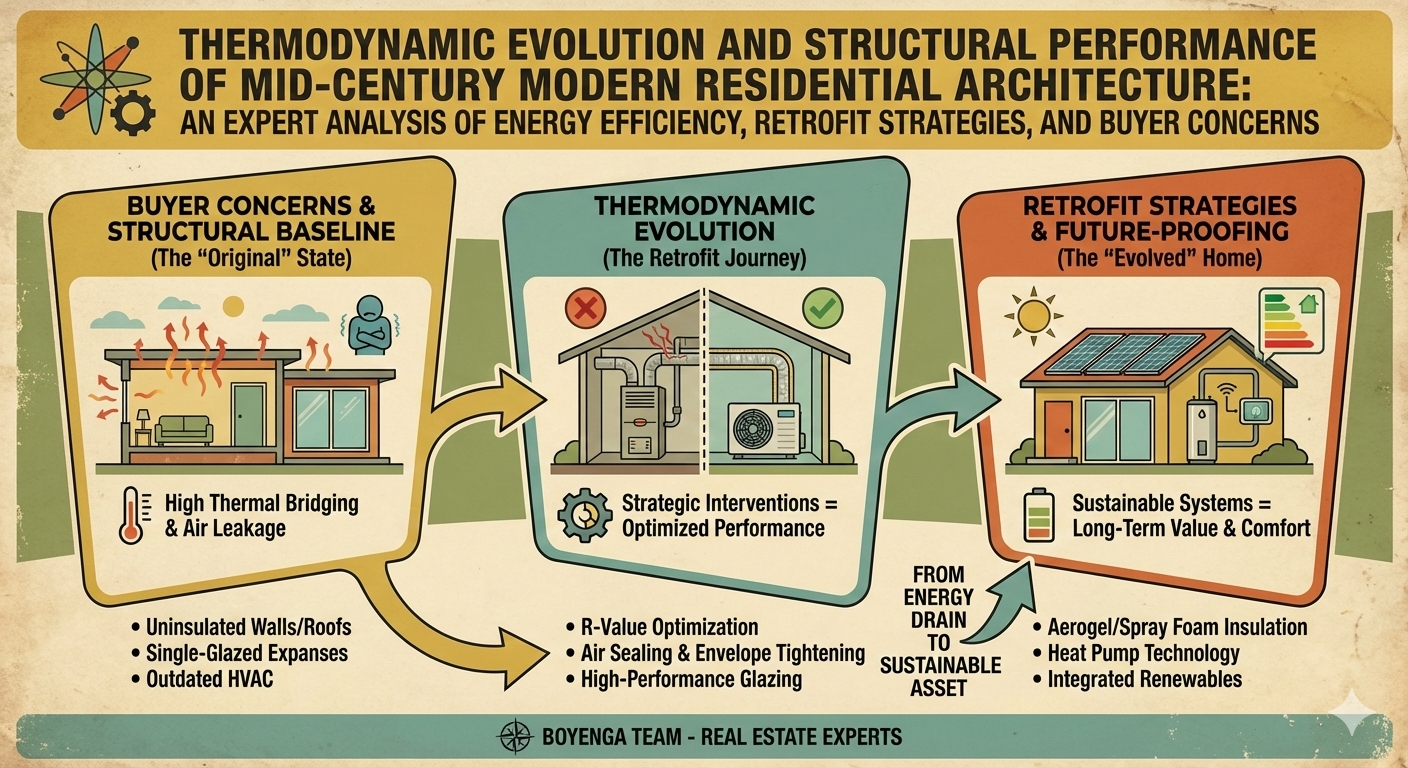
An Expert Analysis of Energy Efficiency, Retrofit Strategies, and Buyer Concerns from the Boyenga Team
The Historical Trajectory of Thermal Comfort and Energy Consumption in Post-War Housing
The residential architectural landscape between 1945 and 1969, commonly referred to as the Mid-Century Modern (MCM) era, represents a profound shift in the relationship between the human dwelling and the environment. To understand the energy efficiency—or lack thereof—in these homes, one must first analyze the transition from empirical, climate-responsive design to a technology-dependent model of comfort. Before the mid-twentieth century, and particularly before 1920, residential structures relied heavily on the building envelope to regulate temperature. These older homes used massive masonry walls, which provided substantial thermal mass, and small windows with operable shutters, which served as energy-conserving features. Regional styles were not merely aesthetic choices but distinct responses to climate; for instance, raised floors and high ceilings in the South maximized cross-ventilation, while central chimneys in northern climates radiated heat into the home long after the fire had died.
The post-World War II period saw a dramatic reversal of these principles. A wave of technological breakthroughs—central heating, balloon framing, and the widespread availability of gas and electricity—fuelled a belief that mechanical systems could overcome any environmental extreme. As the labor required to heat a home declined (from gathering wood to simply turning a gas valve), public interest in passive energy conservation waned. This socioeconomic shift coincided with the return of 12 million veterans and a massive surge in housing demand, necessitating rapid, cost-effective construction methods. The Federal Housing Administration (FHA) standardized these needs in its 1940 publication, Principles of Planning Small Houses, which emphasized low construction costs and livability through single-story layouts that allowed for efficient utility distribution.
The result was the "modern" home: a structure defined by open floor plans, large areas of glass, and thin rooflines that celebrated the integration of indoor and outdoor space. However, from a thermodynamic perspective, these homes were often "thermally disastrous". The architectural hallmarks that make MCM homes so prized today—transparency and minimalism—are precisely the features that lead to significant heat loss and gain. By modern standards, these original building envelopes act more as "flimsy screens" than robust thermal barriers. For contemporary buyers, the question of efficiency is not merely about monthly utility costs but about the structural and mechanical viability of these architectural treasures in an era of increasing climate volatility and energy scarcity.
The Anatomy of the Mid-Century Building Envelope: Foundations and Slabs
The foundational design of many mid-century homes, particularly the iconic tracts developed by Joseph Eichler or the Streng brothers, utilized concrete slab-on-grade construction. This was a departure from the traditional crawlspace or basement model and offered several economic and aesthetic advantages. By placing the home directly on the earth, designers achieved the low-slung, horizontal profile essential to the "California Modern" aesthetic. However, the energy implications of this choice are complex, particularly with respect to the integration of radiant heating.
Radiant Heating Systems: Mechanics and Efficiency Challenges
One of the most innovative and controversial features of mid-century construction was the hydronic radiant floor heating system. These systems functioned by pumping heated water from a boiler through copper or steel pipes embedded within the concrete slab. The concept was to turn the entire floor into a low-temperature radiator, providing consistent warmth without the drafts or dust associated with forced-air systems.
Despite the high aesthetic and comfort value attributed to radiant heat by purists, original installations exhibit several efficiency deficits. A primary issue is the lack of underslab insulation. In many mid-century developments, the heating pipes were placed deep within the slab or even in the underlying soil without a thermal break. This resulted in significant "ground loss," where a portion of the heat energy was conducted into the earth rather than radiated into the living space. Furthermore, the high thermal mass of the concrete slab results in a slow response time; it often takes several hours for the system to raise the indoor temperature noticeably, prompting many residents to leave the heating on continuously, thereby increasing energy consumption.
Tubing Material
Traditional MCM standard:
Steel or copper
Modern retrofit solution:
PEX (cross-linked polyethylene)
Efficiency impact:
Corrosion-resistant and flexible
Fewer failure points and easier installation
Improves system longevity and reliability
Placement
Traditional MCM standard:
Tubing embedded deep in slab or soil
Modern retrofit solution:
Tubing installed closer to the finished floor surface
Efficiency impact:
Faster thermal response
Reduced heat loss to surrounding concrete and soil
Insulation
Traditional MCM standard:
Often no insulation beneath tubing
Modern retrofit solution:
Rigid insulation installed below radiant loops
Efficiency impact:
Prevents heat transfer into the ground
Significantly improves energy efficiency and comfort
Control
Traditional MCM standard:
Simple on/off thermostat
Modern retrofit solution:
Zoned smart thermostats
Efficiency impact:
Room-by-room control
Targeted heating reduces wasted energy and operating costs
The longevity of these systems is a frequent point of concern for buyers. Early systems using steel pipes are particularly vulnerable to corrosion, leading to slab leaks that are difficult and expensive to detect and repair. While copper systems have proven remarkably durable, any leak in a slab-based system requires breaking up the concrete for repair—a prospect many buyers find daunting.
Walls and Vertical Enclosures
The walls of mid-century modern homes were often constructed using post-and-beam techniques, allowing for non-load-bearing "curtain walls" that could be filled with glass or thin wood paneling. Unlike the massive masonry walls of the previous century, these assemblies had very little thermal resistance. In some instances, such as the Serge Chermayeff-designed home in New Haven, original walls consisted of uninsulated concrete masonry units (CMU), which provided almost no barrier to heat transfer.
From a building science perspective, these walls often lack a proper air barrier and vapor control layer, making them "leaky" in terms of both air infiltration and thermal conductivity. Before a retrofit, some mid-century homes have been tested to be so leaky that standard blower door tests could not even register a reading. This lack of airtightness means that any conditioned air produced by the home's mechanical systems is rapidly lost to the exterior.
The Critical Interface: Fenestration and Glazing Systems
Perhaps no feature defines the MCM style more than the expansive use of glass. Floor-to-ceiling windows and sliding glass doors were designed to "break down the boundaries between the interior and exterior". However, in the 1950s and 60s, the technology available for these large panes of glass was primitive compared to modern standards.
Thermodynamics of Single-Pane Glazing
Original MCM homes were almost universally equipped with single-pane clear glass, often set in slim aluminum frames. To understand the impact on energy efficiency, we must examine the R-value (thermal resistance) and U-value (thermal transmittance) of these assemblies.
Single-Pane Glass (¼")
R-value (resistance):
≈ 0.9
U-value (conductivity):
≈ 1.11
Annual energy impact:
Very high heat loss in winter
Significant heat gain in summer
Primary driver of discomfort in many mid-century homes
Double-Pane Glass (Standard)
R-value (resistance):
1.7 – 3.0
U-value (conductivity):
0.33 – 0.58
Annual energy impact:
Reduces heat transfer by ~50% versus single-pane
Major improvement with minimal visual compromise
Triple-Pane Glass (High Performance)
R-value (resistance):
4.0 – 6.0
U-value (conductivity):
0.15 – 0.25
Annual energy impact:
Maximum thermal efficiency
Best suited for extreme climates
Often overkill for mild California zones relative to cost
Single-Pane + Storm Windows
R-value (resistance):
≈ 2.0
U-value (conductivity):
≈ 0.50
Annual energy impact:
10–20% energy savings
Cost-effective retrofit that preserves original windows
Strong compromise between performance and preservation
The R-value of a single-pane of glass is roughly 0.9, meaning it offers almost no resistance to heat flow. In contrast, the industry standard for modern energy-efficient windows is the U-value, where U=1/R. A lower U-value indicates better performance. Single-pane aluminum windows often have U-values exceeding 1.0, while modern double-paned units with Low-E coatings and argon gas fills can achieve U-values as low as 0.30.
The use of aluminum for frames further compromised efficiency. Aluminum is a highly conductive metal. Original frames lacked a "thermal break"—a non-conductive material between the interior and exterior sections of the frame—meaning the frame itself acted as a bridge for heat to bypass the glass. This leads to condensation on the interior of the frames during winter, which can eventually damage surrounding wood or drywall.
Replacement Strategies and Aesthetic Integrity
For mid-century modern homeowners, window replacement is often the most significant aesthetic and financial decision. Standard "retro-fit" windows, frequently made of white vinyl, often have thick, chunky frames that diminish the glass area and clash with the home's clean lines. Experts warn that such replacements can "instantly ruin" an Eichler or Streng home by breaking the architectural continuity.
To maintain the original look while achieving modern efficiency, several high-end manufacturers offer slim-profile aluminum or aluminum-clad wood frames with thermal breaks. Brands such as Arcadia (the original supplier for Eichler), Blomberg (original for Streng), and Milgard’s Modern line are frequently recommended for their ability to mimic the original narrow sightlines.
Arcadia / Western
Material focus:
Slim aluminum profiles
Suitability for MCM:
Gold standard for authenticity
Closest match to original Eichler-era window proportions
Price point (installed):
High — typically $2,000–$4,000+ per opening
Blomberg
Material focus:
Aluminum
Suitability for MCM:
Excellent fit for Streng homes and Sacramento-area MCM
Slightly more contemporary detailing
Price point (installed):
Moderate to High
Milgard – Modern Line
Material focus:
Aluminum / fiberglass hybrids
Suitability for MCM:
Good balance of energy efficiency and slimmer sightlines
Not fully period-correct, but visually compatible
Price point (installed):
Moderate
Andersen – 400 / Modern Series
Material focus:
Clad wood / composite
Suitability for MCM:
Strong thermal performance
Profiles are cleaner than traditional wood, but still less authentic than aluminum
Price point (installed):
High
Roof Systems: Thermal Resistance and Drainage Challenges
The flat or low-sloped roof is a signature element of MCM design, yet it is arguably the most vulnerable component regarding both energy efficiency and structural maintenance. Because these homes utilize post-and-beam construction where the roof decking is the interior ceiling, there is no attic space to house traditional insulation.
The Evolution of Flat Roof Insulation
Original MCM roofs were typically "built-up" roofs (BUR) consisting of layers of tar and gravel. These offered an R-value of roughly R-1 or R-2. Modern building codes in many regions now require roof R-values ranging from R-30 to R-60, leaving a massive gap in performance.
Adding insulation to an MCM roof must be done from the exterior. The most common solution is the application of Spray Polyurethane Foam (SPF). SPF is a high-performance material that provides both a seamless waterproof membrane and a high R-value of approximately 6.6 per inch. Owners who upgrade to a 2 or 3-inch foam roof often report a 30% to 50% reduction in heating and cooling costs and a dramatic improvement in interior comfort.
Spray Foam (SPF) Roofing
Material type:
Polyurethane
R-value per 2 inches:
≈ 13.2
Pros / cons:
Seamless air and moisture barrier
Excellent insulation and leak resistance
Requires periodic re-coating for UV protection and longevity
Rigid Board Insulation (Polyiso)
Material type:
Polyisocyanurate
R-value per 2 inches:
≈ 13.6
Pros / cons:
Very high thermal efficiency
Typically installed beneath TPO or PVC membranes
Industry standard for high-performance flat roofs
Tar and Gravel (Built-Up Roofing)
Material type:
Bitumen with stone aggregate
R-value per 2 inches:
< 1.0
Pros / cons:
Historically accurate for many mid-century homes
Thermally inadequate by modern standards
Heavy, leak-prone, and poor energy performance
TPO / PVC Single-Ply Roofing
Material type:
Thermoplastic membrane
R-value per 2 inches:
N/A (insulation installed below membrane)
Pros / cons:
Clean, modern appearance
Durable and reflective
Performance depends entirely on under-deck insulation quality
The "Doghouse" and Mechanical Integration
One of the most innovative technical solutions for retrofitting flat-roof MCM homes is the creation of a "doghouse"—a raised, central section of the roof. This modification serves multiple purposes:
Mechanical Space: It provides a cavity for the ductwork required for high-efficiency heat pumps and energy recovery ventilators (ERVs), which cannot fit in the original beam-and-plank ceiling.
Natural Light: By placing ducts in the center, architects can install clerestory windows around the perimeter of the "doghouse," bringing light deeper into the home.
Aesthetics: When designed with a slight curve or slope, the interior ceiling of the doghouse can bounce light into the rooms below, enhancing the mid-century spatial quality.
Mechanical Systems and the Transition to Electrification
The original mechanical systems of mid-century homes—boilers, furnaces, and wall heaters—were designed in an era of cheap fossil fuels. Today, these systems are increasingly seen as liabilities due to their high operating costs and carbon footprints.
The Case for Heat Pumps in MCM Retrofits
Air-source heat pumps (ASHP) have emerged as the "appliance of the decade" for mid-century modern owners. These systems are highly efficient because they move heat rather than generate it through combustion. For homes without existing ductwork, ductless mini-split systems are an ideal solution. They require only a small (3-inch) hole through the wall for the refrigerant lines, leaving the structural beams and flat roofs largely untouched.
Electric Resistance Heating
Efficiency ratio (COP):
1.0 : 1 (100% efficient at point of use)
Estimated annual bill savings (California):
Baseline (no savings)
Reality check:
Technically efficient but economically inefficient due to high electricity costs
Gas Furnace (Older / Legacy Systems)
Efficiency ratio (COP equivalent):
0.60 : 1 – 0.80 : 1
Estimated annual bill savings (California):
N/A
Reality check:
Significant energy loss
Common in mid-century homes and a major driver of high utility bills
Modern Gas Furnace
Efficiency ratio (COP equivalent):
0.90 : 1 – 0.98 : 1
Estimated annual bill savings (California):
15–20% improvement over older gas furnaces
Reality check:
More efficient combustion, but still capped by fossil-fuel limits
Air-Source Heat Pump
Efficiency ratio (COP):
3.0 : 1 – 4.0 : 1
(300–400% effective efficiency)
Estimated annual bill savings (California):
$370 – $3,260 compared to electric resistance heating
Reality check:
Highest efficiency
Best alignment with California energy incentives and long-term operating costs
Research conducted by the Rocky Mountain Institute (RMI) indicates that the average California single-family home switching from gas to a heat pump can save approximately $370 per year, while those switching from electric resistance heat can save over $3,200. These savings are driven by the superior efficiency of heat pumps and specialized "electrification" electricity rates offered by utilities like PG&E and SCE.
Managing Zoned Comfort
One of the challenges of mid-century layouts—often featuring H-shapes or expansive wings—is achieving uniform comfort. Forced-air systems in these homes often suffer from "static pressure" issues if the ducts are not perfectly designed. Mini-split heat pumps solve this by allowing for "zoning," where each room or area has its own independently controlled air handler. This means a homeowner can heat the master bedroom at night while keeping the rest of the house cool, significantly reducing wasted energy.
Deep Energy Retrofits: Balancing Performance and Preservation
A "deep energy retrofit" is a holistic approach to home modernization that targets at least a 50% reduction in energy use. For architecturally significant homes, this requires what experts call "surgical precision" to ensure that the home's "soul" is not lost in the pursuit of efficiency.
Case Study: The New Haven Deep Green Retrofit
A notable example of this balance is the restoration of a mid-century home designed by Serge Chermayeff. The original structure was thermally catastrophic, with uninsulated walls and single-pane glass. The retrofit team employed several advanced strategies:
External Wrapping: To avoid losing interior square footage, the team wrapped the exterior CMU walls in 4 inches of rigid polyisocyanurate insulation and then re-faced them with a CMU veneer to preserve the original masonry appearance.
Airtightness: Through aggressive air sealing, the home’s leakage was reduced to 0.06 ACH50—a level that exceeds Passive House standards.
Custom Glazing: New triple-glazed, krypton-filled windows were custom-designed to match the original thin aluminum profiles.
The result was a 90% reduction in heating demand and a HERS score of 42, proving that even the most "inefficient" mid-century designs can become high-performance green homes.
The Building Science of Moisture Management
A critical concern in any deep energy retrofit is the "breathability" of the structure. Original mid-century homes were "leaky" enough that internal moisture (from showering or cooking) could easily escape through drafts. Once a home is insulated and air-sealed, this moisture can become trapped, leading to interstitial condensation within walls and the growth of mold.
Architects addressing this issue must include an Air-Vapour Control Layer (AVCL) on the warm face of the insulation to prevent moisture from reaching cold exterior surfaces. Furthermore, a balanced mechanical ventilation system, such as an Energy Recovery Ventilator (ERV), becomes essential. The ERV exchanges stale indoor air for fresh outdoor air while recovering the heat energy from the outgoing stream, ensuring high indoor air quality without the energy loss of an open window.
The Financial Framework: Rebates, Incentives, and ROI
The high upfront cost of energy retrofits is often the greatest hurdle for MCM buyers. However, the regulatory landscape has shifted dramatically in favor of electrification and efficiency.
Federal and State Incentives
The federal Inflation Reduction Act (IRA) created the Home Electrification and Appliance Rebates (HEEHRA) program, which provides significant financial support for homeowners transitioning to clean energy.
HEEHRA (Federal + California)
Benefit to homeowner:
Up to $8,000 toward heat pump HVAC installation
Eligibility notes:
Income-based program
Must replace a non-heat-pump heating source (gas, oil, etc.)
HEEHRA (Multifamily Properties)
Benefit to homeowner / owner:
Up to $14,000 per unit
Eligibility notes:
Applies to income-qualified multifamily units
Designed for landlords and property owners, not individual tenants
PACE Financing
Benefit to homeowner:
Low-interest financing for energy upgrades
Repaid gradually through property tax assessments
Eligibility notes:
Available in Los Gatos and other participating municipalities
Tied to the property, not the borrower
Utility Rebates (Local + State)
Benefit to homeowner:
Instant point-of-sale discounts or post-installation reimbursements
Eligibility notes:
Must use TECH Clean California–certified contractors
Stacking with federal incentives is often allowed
For single-family homeowners in California, the HEEHRA program offers rebates of up to $8,000 for low-income households (less than 80% AMI) and $4,000 for moderate-income households (80-150% AMI) for the installation of a heat pump HVAC unit. These rebates are "non-retroactive," meaning they must be reserved through a certified contractor before the work begins.
Long-Term Value and "Sticker Shock"
While the initial investment in a new foam roof ($7,500 - $36,000) or high-performance windows ($2,000 - $4,000 per opening) is high, the impact on resale value and daily livability is substantial. Real estate data suggests that well-maintained or "turnkey" MCM homes command a "preservation premium," appreciating faster than traditional homes in elite markets like Silicon Valley. Conversely, "fixer-upper" Eichlers often trade at a discount because buyers are increasingly wary of the "hidden costs" of energy modernization.
Local Governance and Preservation Guidelines: The Case of Los Gatos
Buyers in historic communities such as Los Gatos must navigate local codes that can impact energy retrofit plans. The Town of Los Gatos identifies historic preservation as a public welfare requirement, seeking to prevent the "needless destruction" of architecturally significant structures.
Window and Material Restrictions
The Los Gatos Historic Preservation Committee (HPC) maintains strict guidelines on building materials. Generally, wood is the required material for windows in styles that traditionally used wood. However, MCM homes are a unique case. While the town discourages composite, synthetic, or plastic products, exceptions are made on a case-by-case basis if the replacement material is "consistent with the appearance of the original material". For the mid-century buyer, this means that while cheap vinyl windows will likely be denied, high-quality slim-profile aluminum windows that mimic the original Arcadia or Blomberg units may receive staff-level approval.
Passive Design and Restoration
Interestingly, historic preservation can sometimes align with energy goals. Retaining and repairing original windows can often achieve thermal performance results comparable to new replacements at a fraction of the cost. Retrofit measures such as cellular shades, interior storm panels, and weatherstripping offer a higher Return on Investment (ROI) than outright replacement. For example, timber shutters can reduce heat loss through a window by 51%, and heavy curtains can reduce it by 14%.
Questions Mid-Mod Buyers Are Afraid to Ask: A Practical Guide
As prospective buyers evaluate an MCM property, certain "unspoken" questions often determine the long-term feasibility of the purchase.
1. "Is the Radiant Heat a Ticking Time Bomb?"
Buyers should check if the radiant pipes are copper or steel. If the home was built in the early 1950s with steel pipes, a pressure test or thermal imaging scan is highly recommended to identify leaks. If the system is abandoned, a budget for a ductless mini-split system should be factored into the purchase price.
2. "Why is the Electrical Panel So Small?"
Original 60-amp or 100-amp panels are insufficient for a modern, electrified home. A panel upgrade to 200 amps is often necessary to support the high-efficiency heat pumps and EV chargers that make MCM living sustainable today. Buyers should also look for "Zinsco" or "Federal Pacific" brands, which are known fire hazards and must be replaced for insurance purposes.
3. "Can I Put Solar on a Flat Roof?"
Yes, and flat roofs are often more efficient for solar because panels can be tilted to the perfect angle regardless of the roof’s pitch. However, buyers must ensure the installer is experienced with MCM structures, as drilling through the roof deck into the beams requires specialized sealing to prevent leaks.
4. "Will Insulating My Home Cause Mold?"
This is a valid fear. Tightening the building envelope without addressing ventilation can lead to moisture issues. Any deep energy retrofit should include an ERV system to manage air exchange and humidity.
The Sustainable Future of the Glass House
The mid-century modern home is not inherently energy-efficient by 21st-century standards. Its defining features—expansive glass, thin roofs, and open slabs—were conceived in an era of technological hubris and cheap energy. However, the "Question" of efficiency is no longer an insurmountable barrier. The convergence of modern building science, high-performance materials like SPF and triple-paned glass, and revolutionary mechanical systems like air-source heat pumps has provided a roadmap for the "Deep Green Retrofit".
For the modern buyer, the "efficiency" of an MCM home is a dynamic property, not a fixed one. It is a function of the owner’s commitment to stewardship and the strategic use of available financial incentives. By balancing the aesthetic demands of historic preservation with the technical requirements of thermodynamics, mid-century modern homes can transition from "thermally disastrous" relics into resilient, carbon-neutral residences that continue to fulfill the post-war promise of a "quiet, comfortable life". The investment required to modernize these structures is significant, but the architectural, environmental, and financial returns ensure that the MCM movement remains a vital and sustainable part of the American residential fabric.
When it comes to buying, selling, or evaluating a mid-century modern or Eichler home, experience matters—especially at the intersection of architecture, building science, and resale value.
The Boyenga Team at Compass are recognized as Silicon Valley leaders in Eichler and mid-century modern real estate. Led by Eric Boyenga and Janelle Boyenga, the team brings a rare combination of architectural literacy, data-driven valuation strategy, and hands-on market experience.
Rather than treating energy upgrades as generic “improvements,” the Boyenga Team evaluates:
Thermal performance vs. architectural integrity
Retrofit ROI vs. buyer perception
Preservation premiums vs. remuddle penalties
Mechanical modernization without visual compromise
This expertise allows their clients to avoid the most common (and expensive) mid-century mistakes—misaligned renovations, value-destroying window swaps, and poorly planned mechanical upgrades—while positioning homes to command top-tier demand from design-savvy buyers.
🏡 Energy Efficiency & Historic Performance (Foundational Research)
Energy Conserving Features Inherent in Older Homes (HUD)
https://www.huduser.gov/portal/publications/energy/energyconservingfeatures.htmlSticker Shock: Energy Bills Spur Home Buyer Remorse
https://www.greenbuildermedia.com/blog/sticker-shock-energy-bills-spur-home-buyer-remorse
🧱 Preserving & Maintaining Mid-Century Modern Homes
A Guide to Maintaining Your Mid-Century Modern Home
https://heritagehomeprogram.org/resources/maintaining-your-mid-century-modern-home/Preserving Eichler Neighborhoods – California Preservation Foundation
https://californiapreservation.org/programs/eichler-preservation/Sustainable Guidelines & Publications – CA Office of Historic Preservation
https://ohp.parks.ca.gov/?page_id=21752
🌿 Sustainability & Retrofit Case Studies
Making a Midcentury Home Sustainable – Dwell
https://www.dwell.com/article/sustainable-midcentury-home-renovation-5a0a2f1bCase Study: Mid-Century Green Retrofit (CT)
https://www.bpcgreenbuilders.com/mid-century-green-retrofit/Retrofit Strategies for Mid-20th-Century Modern Buildings (MDPI)
https://www.mdpi.com/2075-5309/10/8/129Future-Proofing Older Homes – The Modern House Journal
https://www.themodernhouse.com/journal/our-guide-to-retrofitting/
🔥 Radiant Heating (Eichlers & Mid-Century Homes)
Radiant Heating Systems in Eichler Homes
https://destinationeichler.com/radiant-heating-systems/Radiant Heating – U.S. Department of Energy
https://www.energy.gov/energysaver/radiant-heatingYour Guide to Radiant Heating – Atomic Ranch
https://www.atomic-ranch.com/interior-design/your-guide-to-radiant-heating/Radiant Revival: Keep or Replace Eichler Heating?
https://www.eichlerhomesforsale.com/radiant-revival/
🪟 Windows, Glass, & Thermal Performance
Mid-Century Modern Windows & Doors – Pella
https://www.pella.com/ideas/windows/mid-century-modern/Mid-Century Modern Windows – Pioneer Window & Door
https://www.pioneerwindowanddoor.com/mid-century-modern-style/Eichler Homes Glass & Sliders – Palo Alto Glass
https://www.paloaltoglass.com/eichler-homes/Eichler Window & Slider Replacement Guide
https://www.eichlerhomesforsale.com/eichler-window-replacement-guide/Understanding Window R-Values – AeroSeal
https://www.aerosealcorp.com/resources/window-r-values/Double-Pane Window Costs (2025 Guide)
https://www.thisoldhouse.com/windows/21015478/how-much-do-double-pane-windows-costEnergy Retrofitting Historic Windows – Nashville.gov (PDF)
https://filetransfer.nashville.gov/Portals/0/SiteContent/HistoricalCommission/docs/WindowRetrofit.pdfWindow Repair & Retrofit Research – CA OHP
https://ohp.parks.ca.gov/?page_id=19581
❄️ HVAC, Heat Pumps & Cooling Retrofits
HVAC Retrofitting for Older Homes
https://americanvintagehome.com/hvac-retrofitting-for-older-homes/Mini-Split Challenges in Older Homes
https://www.pioneerminisplit.com/blogs/news/challenges-retrofitting-older-homes-mini-splitsModern AC Installations for Old Houses
https://rhcchvac.com/air-conditioning-for-old-houses/Mini-Split Heat Pumps for Old Homes (Mike Holmes)
https://makeitright.ca/holmes-advice/mini-split-heat-pumps/Heat Pumps Can Lower Energy Bills – RMI
https://rmi.org/heat-pumps-can-lower-energy-bills-for-californians/
🏠 Roofs, Insulation & Building Envelope
Eichler Roofline Decoder
https://www.eichlerhomesforsale.com/eichler-roofline-decoder/Flat Roof Insulation Types & R-Values – IKO
https://www.iko.com/commercial/roofing-resources/insulation-guide/Spray Foam Roofing Guide (2025)
https://modernize.com/roofing/spray-foam-roofingWhy U.S. Homes Are Poorly Insulated (Discussion)
https://www.reddit.com/r/askscience/comments/insulation_us/
💡 Incentives, Rebates & California Energy Programs
TECH Clean California – HEEHRA Rebates
https://techcleanca.com/public-reporting/Inflation Reduction Act: Residential Energy Rebates (CA)
https://www.energy.ca.gov/programs-and-topics/programs/inflation-reduction-act-residential-energyCalifornia Energy Rebates Announcement
https://www.gov.ca.gov/2023/10/24/california-launches-new-rebates-to-help-cut-home-energy-costs/
🏛️ Local Historic Preservation & Municipal Codes (Los Gatos)
Residential Conservation – Los Gatos
https://www.losgatosca.gov/1925/Residential-ConservationEnvironmental Sustainability Initiatives – Los Gatos
https://www.losgatosca.gov/1694/Environmental-SustainabilityHistoric Preservation Town Code – Los Gatos
https://www.losgatosca.gov/1970/Historic-PreservationLos Gatos Historic Preservation Committee Documents
https://mccmeetingspublic.blob.core.usgovcloudapi.net/losgatos-pubu/MeetingDocuments/
🏘️ Eichler-Specific Market & Buyer Education (Boyenga Team)
First-Time Eichler Buyers: A Roadmap for Millennials & Gen Z
https://www.eichlerhomesforsale.com/first-time-eichler-buyers/Debunking Myths About Mid-Century Modern Homes
https://www.eichlerhomesforsale.com/debunking-myths-mid-century-modern-homes/Los Altos Eichler Homes – Market Guide
https://www.eichlerhomesforsale.com/los-altos-eichler-homes/Eichler HOA Rules in Silicon Valley
https://www.eichlerhomesforsale.com/eichler-hoa-rules/The Eichlers of Los Altos: Scarcity & Prestige
https://www.eichlerhomesforsale.com/eichlers-of-los-altos/