
Quiet by Design: Menlo Park’s Eichler Homes and the Discipline of Mid-Century Modernism
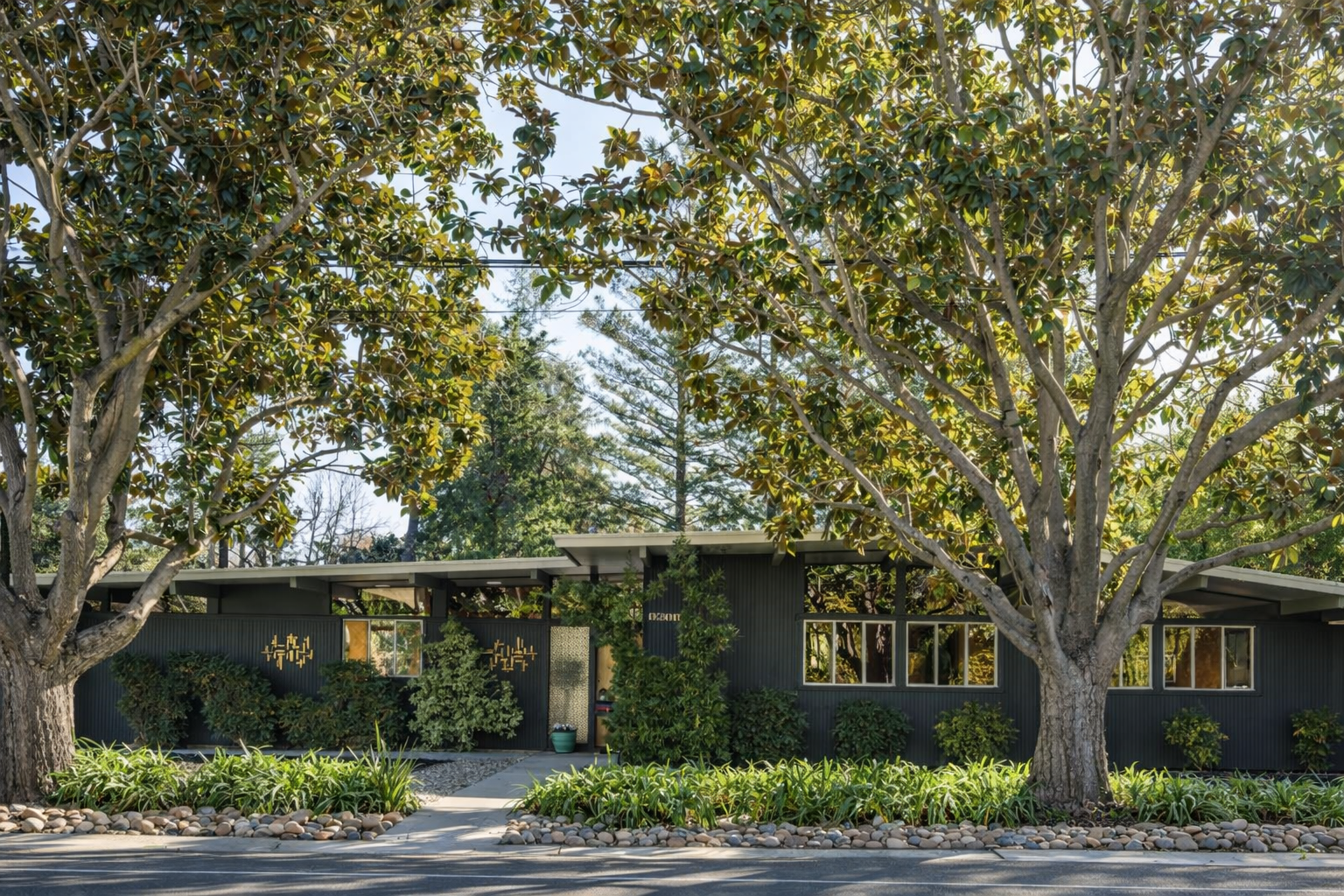
How Eichler Neighborhoods, Academic Gravity, and Postwar Design Shaped One of Silicon Valley’s Most Disciplined Cities
Menlo Park has always operated differently. It is not loud in its ambition, nor flamboyant in its architecture. Instead, Menlo Park has built its reputation on restraint—intellectual, civic, and architectural. Within that restraint lies one of the Bay Area’s most coherent collections of mid-century modern and Eichler homes, woven carefully into neighborhoods defined by education, research, and long-term thinking.
Here, modernism did not arrive as a rebellion against tradition. It arrived as an extension of it. In Menlo Park, mid-century architecture aligned naturally with a culture that prized clarity over excess, performance over display, and systems that worked quietly over time.
What follows is a deeply researched, prose-driven neighborhood profile—written in the reflective, analytical style of a Harvard Business Review feature—examining how mid-century modern and Eichler homes took root in Menlo Park, how they intersect with demographics, schools, and lifestyle, and why they continue to command extraordinary respect in one of Silicon Valley’s most exacting markets.
A City Tuned to Ideas Before Image
Menlo Park’s early identity was shaped not by industry or spectacle, but by ideas. Long before the rise of Silicon Valley, the city was anchored by Stanford University, research institutions, and a professional class oriented toward inquiry rather than extraction. Residential growth followed this pattern. Neighborhoods were planned to be livable, quiet, and durable—attributes that would later make them ideal hosts for modern architecture.
When postwar population growth reached the Peninsula in the 1950s and 1960s, Menlo Park faced the same pressures as its neighbors: demand for housing, changing family structures, and a workforce increasingly tied to research, engineering, and academia. But unlike cities that responded with scale or speed, Menlo Park responded with precision.
Mid-century modernism fit this moment. Its emphasis on efficiency, daylight, and rational planning aligned with the city’s intellectual temperament. Architecture here was expected to perform—not to impress.
Eichler’s Most Thoughtful Context
No figure is more closely associated with Menlo Park’s mid-century legacy than Joseph Eichler. Eichler’s developments in Menlo Park—particularly near Flood Park and other residential enclaves—are among the most respected in his portfolio, not for their scale, but for their placement.
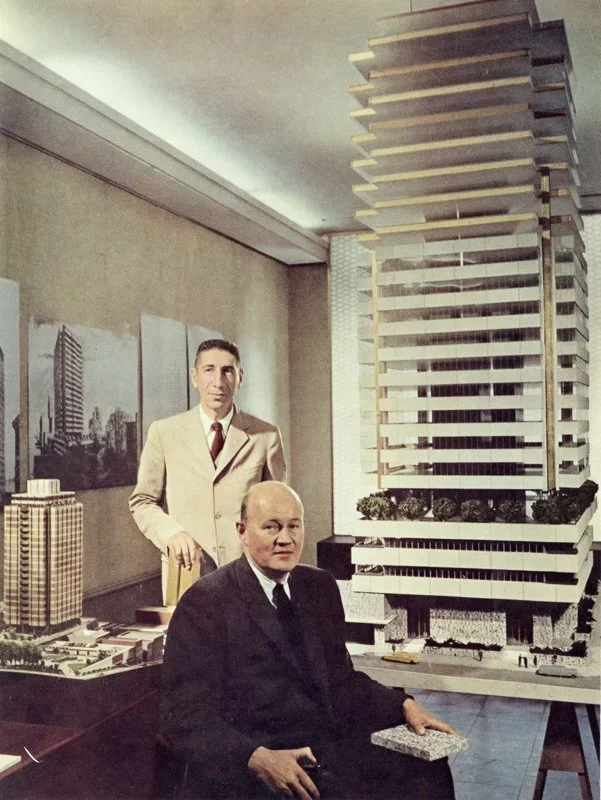
Working with architects such as the influential modernist firm Anshen & Allen, Eichler introduced neighborhoods defined by:
Post-and-beam construction
Open, flowing floor plans
Radiant floor heating
Extensive use of glass
Central atriums that blurred interior and exterior life
In Menlo Park, these elements felt inevitable rather than experimental. Streets were quiet. Lots were appropriately sized. Schools and parks were integrated rather than appended. Eichler homes here did not announce modernism—they practiced it.
A Housing Inventory That Rewards Integrity
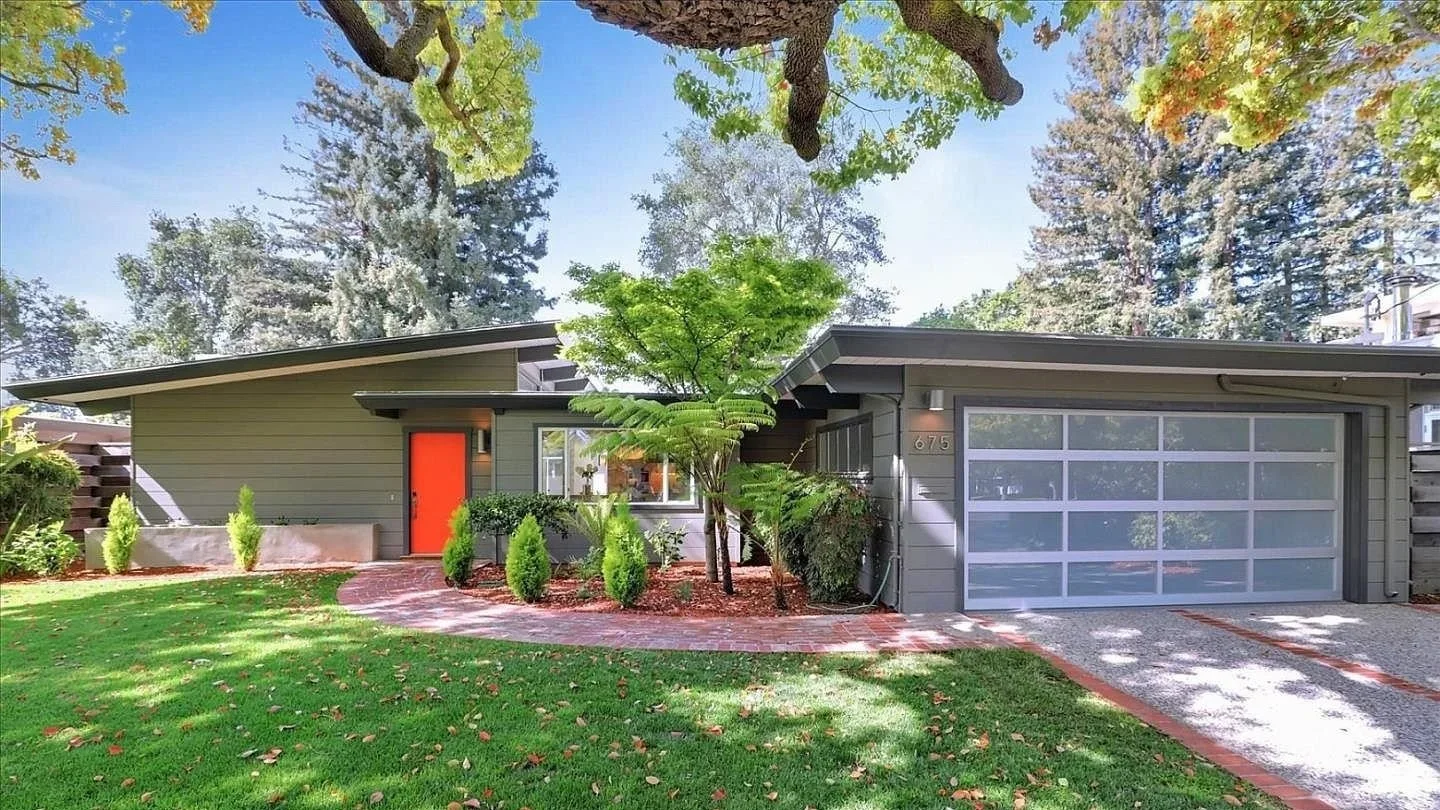
Menlo Park’s housing stock is predominantly single-family, with limited multi-family development. Within this inventory, Eichler and mid-century modern homes represent a finite and irreplaceable subset.
Architectural categories include:
True Eichler homes
Eichler-adjacent mid-century modern residences
Thoughtfully renovated contemporary interpretations
Traditional homes closer to downtown and Atherton borders
Zoning constraints, community expectations, and buyer preferences favor renovation over replacement. As a result, architectural continuity remains strong, and well-preserved mid-century homes continue to command premiums.
Neighborhoods That Absorbed, Not Advertised
Menlo Park’s mid-century and Eichler homes are distributed thoughtfully rather than concentrated theatrically. Neighborhoods near Flood Park, parts of the Willows-adjacent areas, and select residential pockets closer to Atherton and Palo Alto boundaries contain some of the city’s most intact modernist housing stock.
Unlike cities where Eichlers stand out as visual anomalies, in Menlo Park they feel contextual. Landscaping is mature. Renovations tend to be respectful. Teardowns are comparatively rare, in part because community norms and zoning expectations discourage architectural erasure.
This has allowed mid-century homes to age alongside the city, not in opposition to it.
The People Who Choose Menlo Park’s Modern Homes
Menlo Park’s demographic profile is among the most selective in the region. Residents are highly educated, globally connected, and professionally accomplished, often working in technology, venture capital, medicine, academia, and law. Median household incomes are high, but more revealing is how residents buy.
Homes here are often purchased with long time horizons. Mid-century modern and Eichler properties, in particular, attract buyers who value design integrity and are willing to invest in thoughtful upgrades rather than wholesale replacement. This buyer profile reinforces preservation and stabilizes neighborhoods over time.
Cultural and ethnic diversity has increased steadily, especially among international professionals affiliated with Silicon Valley firms and Stanford. This diversification has amplified demand for housing that balances modern living with architectural authenticity.
Schools as a Structural Advantage
In Menlo Park, schools are inseparable from real estate value. Homes are primarily served by the Menlo Park City School District and the Sequoia Union High School District, with access to highly regarded campuses such as Menlo-Atherton High School.
School boundaries exert extraordinary influence on pricing. Mid-century homes within preferred attendance zones often outperform larger or newer properties just outside boundary lines. For many buyers, architecture is a prerequisite—but education is the deciding factor.
Proximity to Stanford University further reinforces demand, attracting faculty, researchers, and professionals who value proximity to academic life without sacrificing residential calm.
Lifestyle Designed for Focus, Not Flash
Menlo Park’s lifestyle is understated by design. Downtown Menlo Park offers refined dining, independent retail, and civic spaces without resorting to spectacle. Flood Park, neighborhood playgrounds, and tree-lined streets support daily routines rather than curated experiences.
For mid-century homeowners, this matters. These homes were designed for quiet living—natural light, cross-ventilation, and visual connection to the outdoors. Menlo Park’s environment supports that intent, reinforcing the architecture rather than competing with it.
Commute access remains exceptional. Proximity to Highway 101, Caltrain, and major employers across Palo Alto, Mountain View, and Redwood City allows Menlo Park to remain connected without becoming congested.
Market Performance: Discipline Over Drama
Menlo Park’s real estate market is characterized by discipline. Pricing is high, but volatility is low. Demand remains deep, particularly for homes that align with the city’s values: location, schools, and architectural coherence.
Mid-century and Eichler homes perform especially well when:
Original design elements are preserved
Renovations are architecturally sympathetic
Pricing reflects school assignment accuracy
Compared with neighboring markets, Menlo Park offers fewer surprises—but greater confidence. For many buyers, that predictability is the ultimate luxury.
Case Studies in Architectural Alignment
Successful mid-century transactions in Menlo Park tend to follow a familiar pattern: careful preparation, accurate pricing, and selective exposure. Several notable Eichler and modern home sales represented by the Boyenga Team demonstrate how off-market strategies, design-sensitive staging, and Compass-powered analytics can unlock value without sacrificing discretion.
In each case, the objective was alignment—not urgency—between home, buyer, and long-term intent.
The Boyenga Team Advantage in Menlo Park
Menlo Park rewards fluency.
Led by Eric and Janelle Boyenga, the Boyenga Team brings deep expertise in mid-century modern and Eichler homes, combined with Silicon Valley–specific market intelligence. Their ability to interpret architectural value, school boundaries, and buyer psychology allows them to guide clients through one of the Bay Area’s most exacting markets.
As part of Compass, and through exclusive partnerships such as HomeLight, the team leverages advanced analytics, private-market access, and targeted outreach—particularly effective in Menlo Park’s informed, low-noise environment.
A City That Let Modernism Be Quiet
Menlo Park never asked modern architecture to announce itself. It allowed it to exist where it made sense—among trees, near schools, beside parks, and within a culture that values thoughtfulness over display.
That restraint is why mid-century modern and Eichler homes here continue to feel relevant.
For buyers, they offer clarity in a market crowded with excess.
For sellers, they demand care, context, and informed strategy.
And in a region defined by velocity, Menlo Park stands as proof that the most durable form of modernism is the one that never needs to explain itself.
Contact Us and Begin Your Mid Mod Journey Today!
Boyenga Team + Compass Eric & Janelle Boyenga 📞 Call / Text : 408-373-1660 📧 Email : MidMods@Boyenga.com 🌐 www.BoyengaTeam.com / www.EichlerHomesForSale.com DRE #01254724 / #01254725