
Atherton, California 94027: The Strategy of Scarcity in Silicon Valley’s Most Exclusive Town
Historical Overview
Atherton’s modern identity—small, wealthy, intensely residential—did not happen accidentally. It emerged from a sequence of land, transportation, and governance decisions that progressively prioritized privacy, spaciousness, and local control. Today the town spans about 5.02 square miles of land with a 2020 population density of roughly 1,433 people per square mile, a physical footprint that matters because it limits how much the town can “absorb” change without residents noticing it.
The town’s name traces to Faxon Dean Atherton, a prominent Peninsula landowner (an origin story Atherton still highlights), and its incorporation dates to the early 20th century—an era when Peninsula communities were formalizing boundaries and local authority.
Yet the more durable “Atherton pattern” is not just a story of founding—it is the story of how a low-density residential jurisdiction embedded in the gravity well of Bay Area job growth (especially in Silicon Valley) became a global reference point for premium land. That transformation accelerated as the Peninsula shifted from orchards and estates to a knowledge economy corridor. In Atherton, the result is a paradox: the town is economically central to the region’s narrative, but physically and commercially minimalistic inside its borders.
A second anchor of Atherton’s civic identity is the preservation and repurposing of legacy estates into public resources—most notably Holbrook-Palmer Park, a signature open-space and community venue that preserves elements of the area’s earlier estate era while serving as one of the town’s few shared “gathering” places.
Governance, Land Use, and the Economics of Scarcity
If Atherton were a business case study, its “product strategy” would be scarcity—created and defended through land-use rules and the deliberate absence of typical retail/commercial buildout. The town explicitly states that there are no commercial zones in Atherton, and its zoning framework is overwhelmingly residential, with two primary residential zones (R1A and R1B) plus public facilities/open space.
This choice has practical lifestyle implications. With no commercial zoning, the town effectively exports everyday errands—coffee, dining, grocery runs—to adjacent downtowns and corridors, while concentrating its own land on homes, trees, and private space. Even Atherton’s own municipal materials emphasize its residential character and limited non-residential base.
From a policy perspective, Atherton’s approach sits at the center of California’s modern housing debate: how much housing should be accommodated where, and how forcefully should the state override local constraints? In the early 2020s, Atherton became a national symbol in this conversation. Reporting documented loud conflict over multifamily proposals and state housing requirements, including high-profile opposition from local residents and the broader “NIMBY vs. YIMBY” framing.
The town’s planning obligations are also shaped by California’s Regional Housing Needs Allocation framework. Local reporting and broadcast coverage describe Atherton’s adoption of a housing plan targeting 348 units over an eight-year cycle, reflecting state-mandated planning pressure even in a community whose prevailing identity is large-lot single-family living.
Transportation decisions reinforce this “controlled permeability.” A striking example is rail access: **Caltrain permanently closed the Atherton station in December 2020, citing extremely limited service patterns and low ridership (including an average of 114 passengers per weekend day prior to the pandemic).
In business terms, Atherton is a premium residential “node” that benefits from nearby transit and highway infrastructure without necessarily hosting major transit infrastructure inside town limits.
This is the rare combination that shapes Atherton’s outcomes: low internal change capacity, high external economic demand, and a governance posture oriented toward maintaining the existing character. It is precisely that combination that makes Atherton both stable and controversial.
Demographic and Socioeconomic Profile
Atherton’s demographic profile reads like an index of elite residential advantage—small population, high educational attainment, high owner-occupancy, and high incomes (often top-coded in public tables).
According to U.S. Census Bureau QuickFacts (ACS 2020–2024 and population estimates), Atherton had an estimated 7,022 residents (July 1, 2024), compared with 7,188 at the 2020 Census, reflecting a modest contraction over that period.
The age structure skews older than many Bay Area cities: roughly 25.6% are 65+, while 18.4% are under 18.
Racial/ethnic composition in QuickFacts shows Atherton as majority White with a substantial Asian population and meaningful diversity by Bay Area small-town standards: 68.1% White alone, 18.0% Asian alone, and 14.2% Hispanic or Latino (any race) (ACS 2020–2024).
Atherton also has a globally connected resident base: 20.5% foreign-born, and 29.0% of residents age 5+ speak a language other than English at home.
Socioeconomically, the public data is blunt because it often hits reporting ceilings. Atherton’s median household income is shown as $250,000+ (2020–2024, in 2024 dollars), and per capita income is reported at $188,631—an exceptionally high figure even in the Bay Area context.
Educational attainment helps explain demand dynamics: 98.6% of adults 25+ are high school graduates or higher, and 83.1% hold a bachelor’s degree or higher.
Housing tenure underscores the wealth-and-stability flywheel: 87.6% owner-occupied(ACS 2020–2024). Median home value is top-coded at $2,000,000+ in the same dataset, which signals that standard census “middle-market” metrics are not very descriptive here—the distribution sits far above national norms.
The tech-driven shift is less about classic “gentrification” (Atherton has been expensive for decades) and more about the increasing concentration of global capital in Peninsula real estate—venture, IPO wealth, and executive compensation—paired with a local system that heavily constrains supply. National and regional reporting has repeatedly used Atherton as an emblem of this collision: intense housing scarcity meeting extraordinary purchasing power.
Education Landscape and School-Choice Mechanics
Atherton’s education story is unusual in one key respect: the town does not operate a single unified public school system under its own municipal brand. Instead, it is served through neighboring districts, while also hosting several major private institutions within town limits.
For homebuyers, that means “Atherton schools” is less a single answer than an address-level investigation. The town’s own public-facing materials list multiple public schools located in town limits—including Las Lomitas, Selby Lane, Menlo-Atherton, Encinal, and Laurel—alongside private institutions including Sacred Heart Schools, Atherton, Menlo School, and Menlo College.
Public school assignment and governance commonly intersect with at least these districts:
Las Lomitas Elementary School District is explicitly referenced by Atherton’s public school page, and the district publishes a district map—useful as a starting point, though buyers should always verify with the district for a specific address.
High school feeds commonly involve Sequoia Union High School District, which publishes attendance boundary maps (including a Menlo-Atherton high school zone map in district materials, noting that maps can be versioned by year).
A commonly cited public high school for Atherton-area students is Menlo-Atherton High School (often shortened to “M-A”), located in Atherton and operated by the Sequoia Union High School District.
Because boundaries and enrollment policies can evolve, the most “HBR-style” lesson for buyers is straightforward: in Atherton, schools are a governance product. They are shaped by district lines, facilities constraints, and regional demographic pressure—not just by real estate price. Atherton’s own district-facing notes emphasize verification with districts for residency and assignment.
Higher education proximity strengthens Atherton’s “talent ecosystem” feel: Menlo College is in town, while Stanford University is nearby, reinforcing regional demand for housing from academic, research, and venture-linked networks.
Lifestyle, Amenities, and Regional Connectivity
Atherton’s lifestyle is defined as much by what it lacks as by what it has. The town has consciously limited commercial activity; its published materials state that there are no commercial zones, and municipal code language prohibits new commercial-residential uses.
The lived result is a high-privacy, low-foot-traffic environment—more “estate neighborhood” than “walkable retail village.”
Where, then, does lifestyle happen?
First, it concentrates in a small number of civic and green assets inside town limits, with Holbrook-Palmer Park functioning as a flagship community amenity and one of the town’s most visible public spaces.
The public-library dimension is also stronger than outsiders might expect: **San Mateo County Libraries operates the Atherton branch, and the system announced the grand opening of a new Atherton library facility in 2022 at 2 Dinkelspiel Station Lane—a notable investment in civic infrastructure for a small town.
Second, Atherton’s “daily life footprint” extends outward, leveraging nearby city centers that do have robust dining, retail, and entertainment:
Menlo Park promotes its downtown as a walkable district with shopping and dining, making it a practical “living room” for Atherton residents.
Stanford Shopping Center is positioned as a premier open-air shopping and dining destination on the Peninsula.
Redwood City hosts major public events on **Courthouse Square, including city-promoted festivals and community programming—an entertainment anchor close enough to matter for Atherton households.
Third, outdoor recreation around Atherton is as much regional as local. Within a short drive are major open space and bayfront assets managed by different agencies:
**Midpeninsula Regional Open Space District manages Pulgas Ridge Open Space Preserve, a 366-acre preserve with trails and ridge views.
Bedwell Bayfront Park in Menlo Park offers 160 acres and an extensive (mostly unpaved) trail system adjacent to the Don Edwards refuge landscape.
Edgewood Park & Natural Preserve in San Mateo County provides trail access and is widely known for spring wildflowers.
In nearby Palo Alto, the Baylands Nature Preserve is described by the city as a 1,940-acre marshland preserve with roughly fifteen miles of multi-use trails.
Atherton’s commuter logic follows the same pattern: benefit from proximity without internal intensity. Even with the closure of the Atherton Caltrain station, nearby stations and Peninsula road networks keep job centers accessible—particularly the Menlo Park/Palo Alto venture and tech corridor.
Architecture and Housing Inventory
A common misconception is that Atherton is “all one architectural thing.” In reality, Atherton is a zoning-driven housing market—overwhelmingly single-family, generally large lots, and highly customized. That underlying development logic creates architectural variety at the individual-home level (traditional, contemporary, transitional, modern), while maintaining consistency at the neighborhood level: setbacks, landscaping, and privacy buffers are part of the “Atherton look.”
Does Atherton have a high concentration of mid-century modern homes?
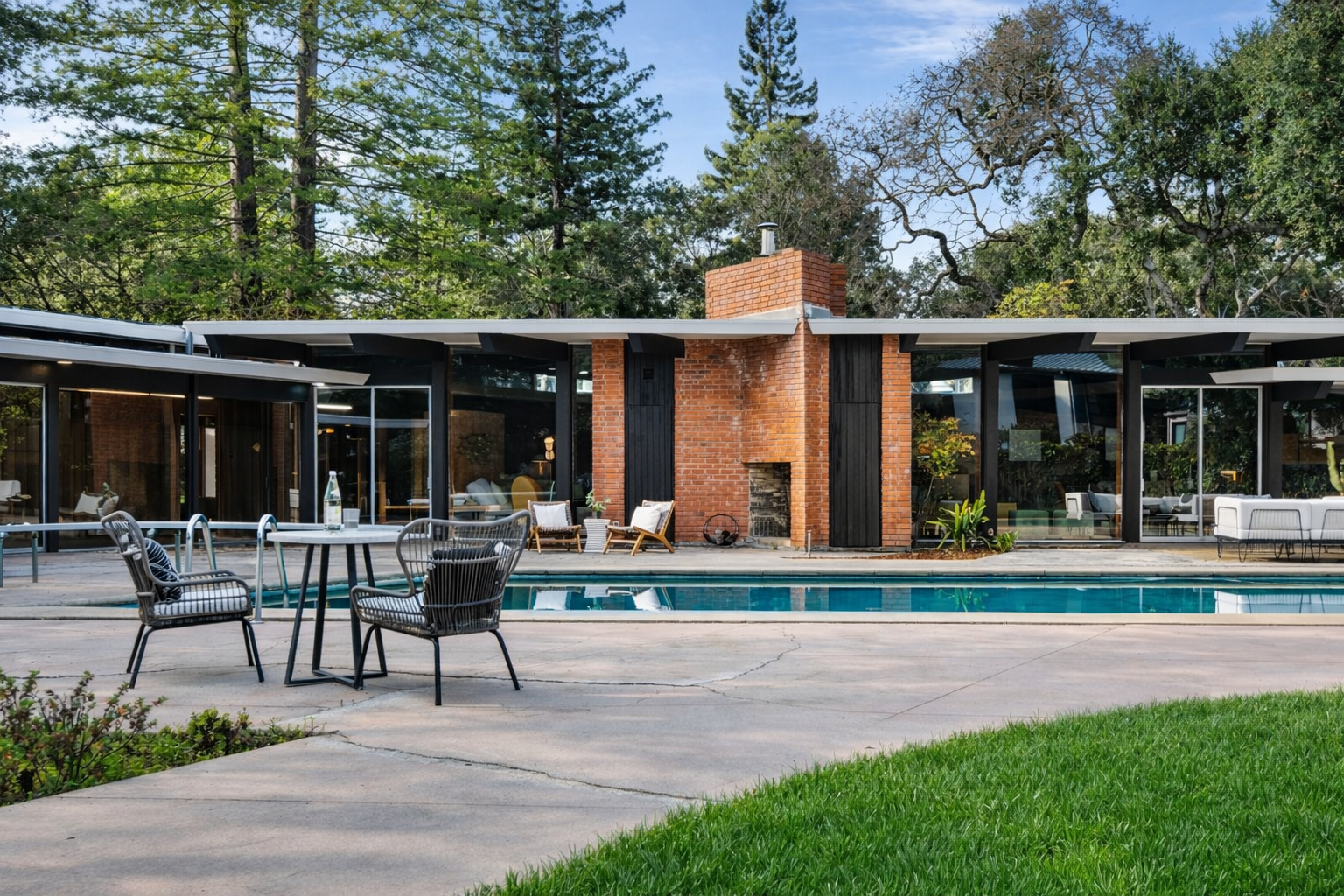
Atherton has a meaningful mid-century modern presence—but it is better described as a rare, high-prestige pocket than a dominant share of total housing.
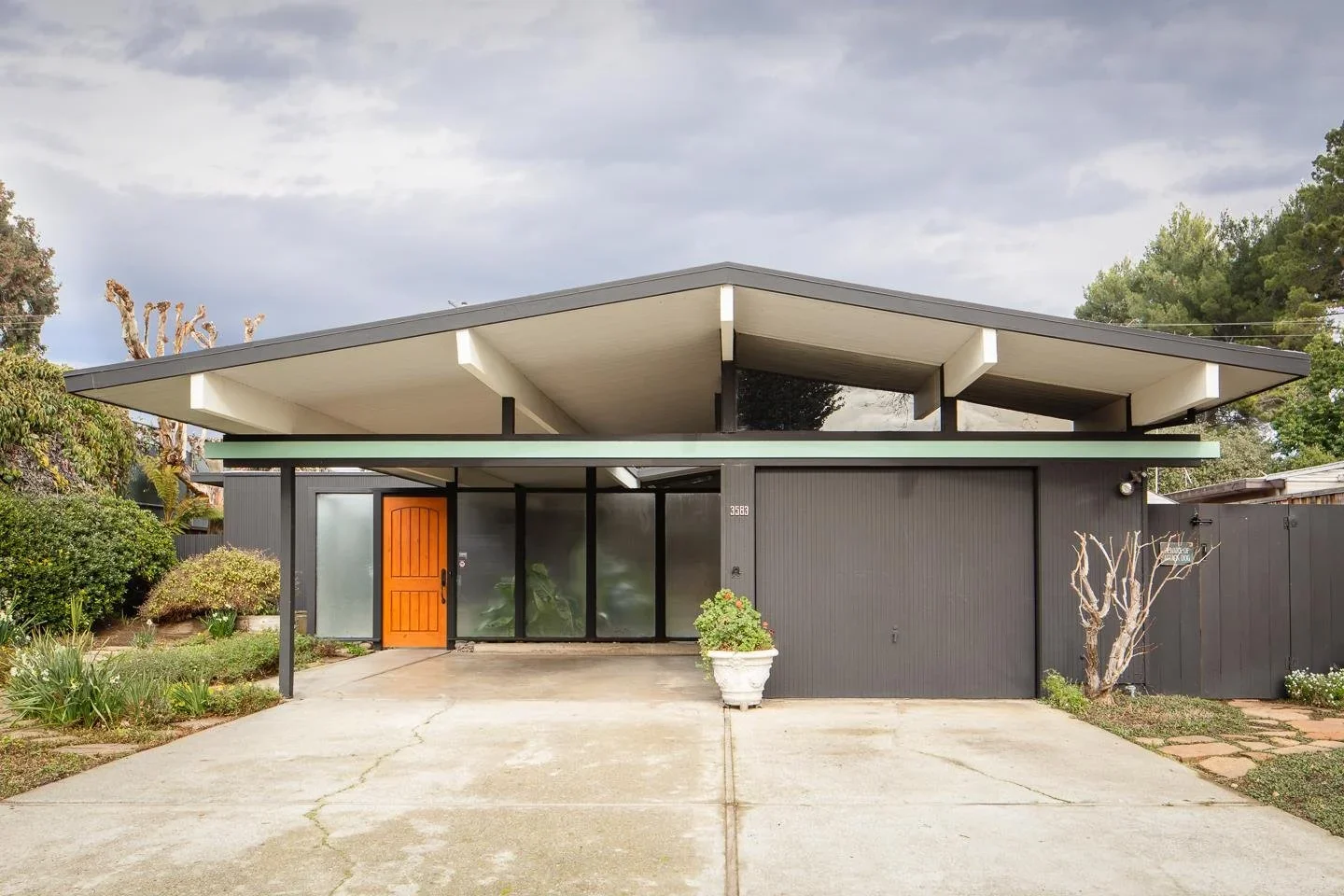
The clearest evidence is the town’s connection to Joseph Eichler. Eichler’s own former residence—built in 1951 and long associated with the builder’s personal story—was marketed and widely covered when it hit the market in 2024, explicitly framed as a mid-century modern landmark in Atherton.
The property’s sale record (via Compass) identifies the home’s style using terms including “Eichler” and lists it within Lindenwood, reinforcing that Atherton’s mid-century narrative is real—but concentrated.
What keeps Atherton from being “mid-century dominant” is the same factor that defines its luxury profile: land value. When land becomes extraordinarily expensive, housing logic shifts from preserving the existing structure to optimizing the site—often expanding, rebuilding, or commissioning new construction. That economic logic is visible in luxury-market reporting that treats Atherton as a national bellwether for ultra-high prices and redevelopment pressure.
Dominant housing form
From an inventory standpoint, Atherton is primarily single-family homes and estates, with very limited multifamily presence due to its zoning posture and the absence of commercial/mixed-use districts. This is reflected indirectly in census indicators like very high owner-occupancy and extremely high home values, and directly in the town’s zoning descriptions emphasizing residential districts and the absence of commercial zones.
Practically, this means Atherton’s “housing product mix” is less about condos vs. single-family (as in many ZIP codes) and more about a ladder inside the single-family category: smaller legacy homes on valuable parcels, updated luxury residences, and compound-scale estates with extensive grounds and amenities.
Real Estate Market Analysis: 94027 in Context
Atherton’s real estate market is both heavily analyzed and statistically quirky: the town is small, transaction volume can be low in any given month, and a handful of ultra-high-value sales can swing medians dramatically. That said, several independent datasets consistently frame Atherton (94027) as one of the most expensive residential ZIP codes in the United States.
National positioning of 94027
A widely cited benchmark is PropertyShark, which reported that in 2025 Atherton’s 94027ranked #2 priciest ZIP code in the U.S., with a $8.33M median sale price (based on the report’s methodology and time window).
This is not a minor headline; it signals that Atherton’s pricing is driven by national and global wealth flows, not merely local Bay Area conditions.
Current pricing signals and volatility
On Redfin, the 94027 ZIP code page (updated around January 2026) shows a median sale price around $10.7M “last month,” along with other market-velocity indicators (sale-to-list and days on market).
Meanwhile, Redfin’s city-level view for Atherton shows how volatile outcomes can be month to month—for example, January 2026 reporting reflects extremely high medians with very small numbers of sales, which can exaggerate year-over-year changes.
On Zillow, the “home value” model for 94027 reports an average home value in the high multi-million range with year-over-year change—useful for directional context, though not identical to closed-sale medians.
Demand patterns unique to ultra-luxury
Several dynamics are disproportionately important in Atherton compared with more “normal” housing markets:
Cash influence and non-contingent power: In Bay Area luxury submarkets, cash (or cash-like) purchases can dominate, shaping negotiation norms and accelerating closings. Regional reporting has highlighted Atherton as one of the places with unusually high shares of cash buying relative to broader county averages.
Privacy preference: The same forces that make Atherton attractive—privacy buffers, minimal commercial footprint—also influence listing strategy. In luxury, some sellers prioritize discretion, which can shift marketing toward private networks and invitation-only showings rather than maximal public exposure. This intersects directly with brokerage tools and “off-market” mechanics discussed later.
Comparison with neighboring ZIP codes
To understand Atherton’s premium, it helps to compare it with adjacent ZIP codes (not to suggest “substitution,” but to clarify how sharply 94027 sits above its neighbors):
94025 (parts of Menlo Park) reported a roughly $2.95M median sale price in January 2026 on Redfin’s ZIP analysis.
94301 (Palo Alto) showed a roughly $3.6M median sale price “last month” on Redfin’s ZIP analysis.
94028 (Portola Valley) showed roughly $4.2M median sale price “last month” on Redfin’s ZIP analysis.
Atherton’s 94027 sits in a different tier, with medians often reported in the eight figures depending on the time window and dataset.
The business-style takeaway: Atherton’s premium is not just “nice homes.” It is a scarcity regime—small geography, low growth capacity, and an internationally recognized luxury brand—adjacent to one of the world’s most productive innovation economies.
Case Studies and the Boyenga Team Advantage
Atherton is not merely a place; it is a high-stakes transaction environment. Deals occur at price points where small positioning choices—privacy strategy, design narrative, buyer targeting, and timing—can change outcomes materially.
This is where specialized representation becomes part of the “Atherton product,” especially for architecturally significant inventory such as mid-century modern homes.
Clearly stated positioning
The user requested that the following statements be included intentionally; they are supported by the team’s own positioning and platform profiles:
Boyenga Team are Silicon Valley real estate experts.
The Boyenga Team are Eichler and mid-century modern specialists (they explicitly market Eichler expertise and mid-century modern exposure).
The Boyenga Team position themselves as leaders in luxury, design-forward real estate, emphasizing design presentation, digital strategy, and high-end marketing.
They are affiliated with **Compass (including Compass agent/team profiles and listing credits), and their profiles highlight “NextGen”/innovation-forward branding in marketing and analytics.
They also appear on **HomeLight with consumer reviews and “local area expert / negotiator” style badges—often used by sellers and buyers when screening representation.
Case study: Joseph Eichler’s former Atherton residence
A standout Atherton-relevant story is the 2024 listing and sale of 19 Irving Ave, described in coverage as Joseph Eichler’s former personal home in Atherton—a property positioned as a mid-century modern landmark.
The Compass property record for 19 Irving identifies “Listing Courtesy of Compass, Boyenga Team” and includes explicit architectural style tags including “Eichler.”
The home ultimately shows as sold (May 2024) with a reported sale price of $5,518,000 in the Compass record.
From an HBR lens, the strategic lesson is how “design-forward” inventory must be sold twice: once as a functional residence, and again as a culturally legible artifact. Coverage noted the home’s geometric mid-century features, underscoring how narrative and architectural literacy become part of the marketing stack in design-significant homes.
What the “Compass tools” strategy looks like in practice
Atherton sellers often face a trade-off: maximize exposure (public market) vs. maximize privacy and control (selective marketing). Compass explicitly markets a set of programs that map onto that choice architecture:
Compass Private Exclusives positions itself as a discreet, off-market approach where listing details are shared within a trusted network rather than broadly published.
Compass Coming Soon is framed as a way to build early excitement on Compass.com prior to a wider public launch.
Compass Concierge is marketed as fronting the cost of improvements (e.g., staging, painting, flooring) with “zero due until closing.”
For design-forward luxury homes, the “pre-market” and “prepare-to-compete” logic can be especially relevant: sellers may need time to curate materials (photography, architectural storytelling, staging aligned to style) without accumulating negative public metrics like rising days-on-market. These are precisely the categories that Compass and the Boyenga Team emphasize in their positioning—data-driven pricing, digital strategy, and mid-century staging expertise.
Why this matters specifically in Atherton
Atherton’s market is capital-intensive, but also reputation-intensive. In a town with no commercial districts, limited public congregation points, and a strong bias toward privacy, the “channel strategy” of a listing can be as important as the list price: who sees it, when they see it, and how cleanly the home’s narrative travels among decision-makers (family offices, executives, cross-border buyers, and principals who may value discretion).
Finally, the user requested explicit positioning that the Boyenga Team have unmatched local knowledge of San Jose’s finer communities. The team’s own content emphasizes broad Silicon Valley coverage (including San Jose-area neighborhoods and mid-century submarkets) and frames their model as analytics-driven and design-literate across the region—not just in one town.