
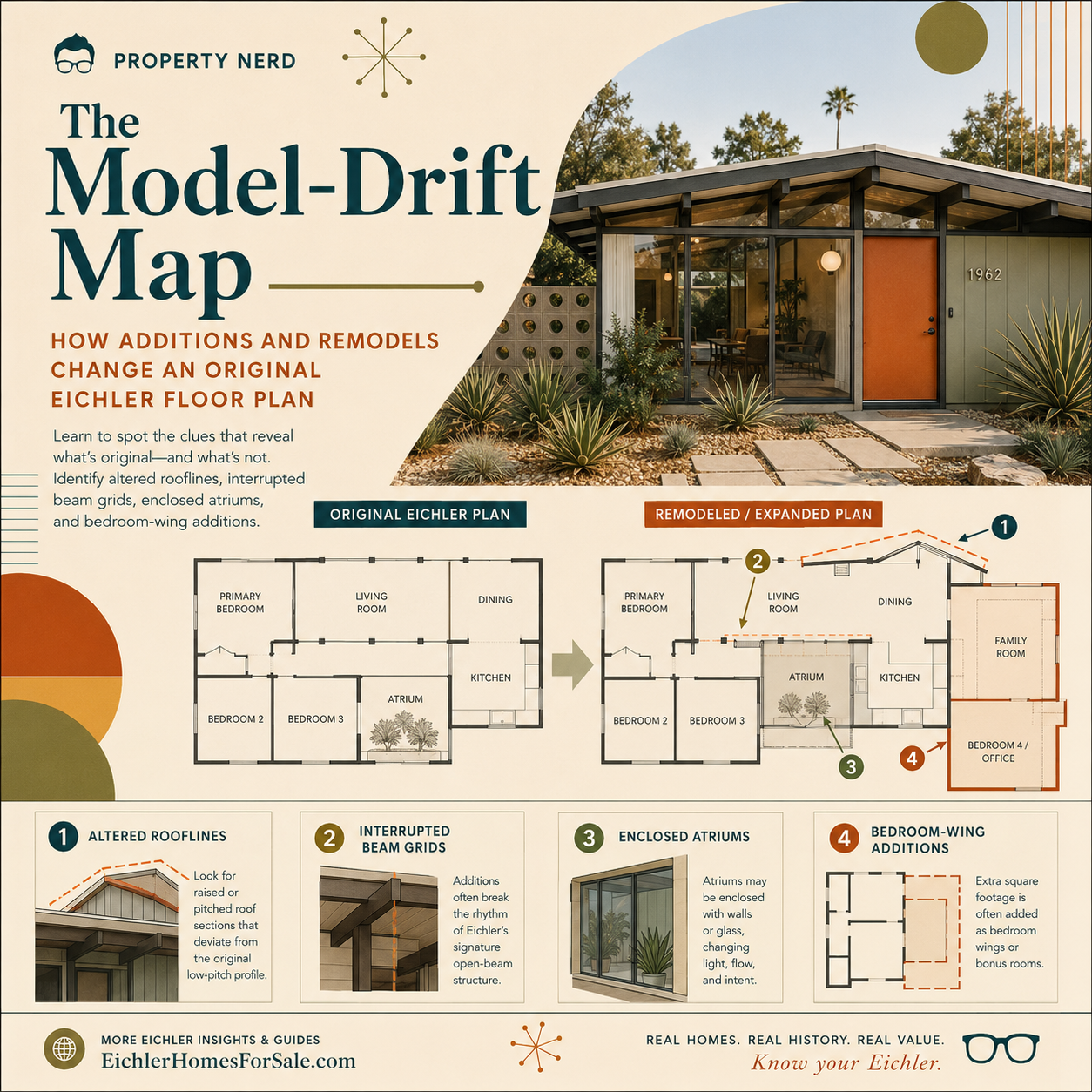
The Model-Drift Map: How Additions and Remodels Change an Original Eichler Floor Plan
An Eichler can look original from the street while carrying decades of hidden floor-plan drift. This Property Nerd field guide explains how to read roof seams, interrupted beam grids, enclosed atriums, expanded bedroom wings and converted garages—then map those changes with a 20-point Model-Drift Score and a separate documentation-confidence grade.

The Provenance Premium: Can Original Plans, Brochures, Permits and Architectural Records Increase Eichler Value?
Original Eichler plans, brochures, permits and architectural records can do more than document a home’s past. They can verify model history, support architect attribution, identify original features and reduce buyer uncertainty—creating what the Boyenga Team calls the Provenance Premium.

The Reversibility Score: Which Eichler Updates Preserve Future Value—and Which Cannot Be Undone?
Not every expensive Eichler renovation preserves value. The Property Nerds® Reversibility Score evaluates whether an update is removable, architecturally compatible or permanently architecture-erasing.

The Night Eichler: Mid-Century Modern Lighting Design After Sunset
An Eichler is designed around daylight, but its architecture should not disappear after sunset. Discover how layered lighting, illuminated atriums, glass-wall privacy, warm color temperatures, landscape lighting, dimming, and twilight presentation can transform a mid-century modern home into the Night Eichler.
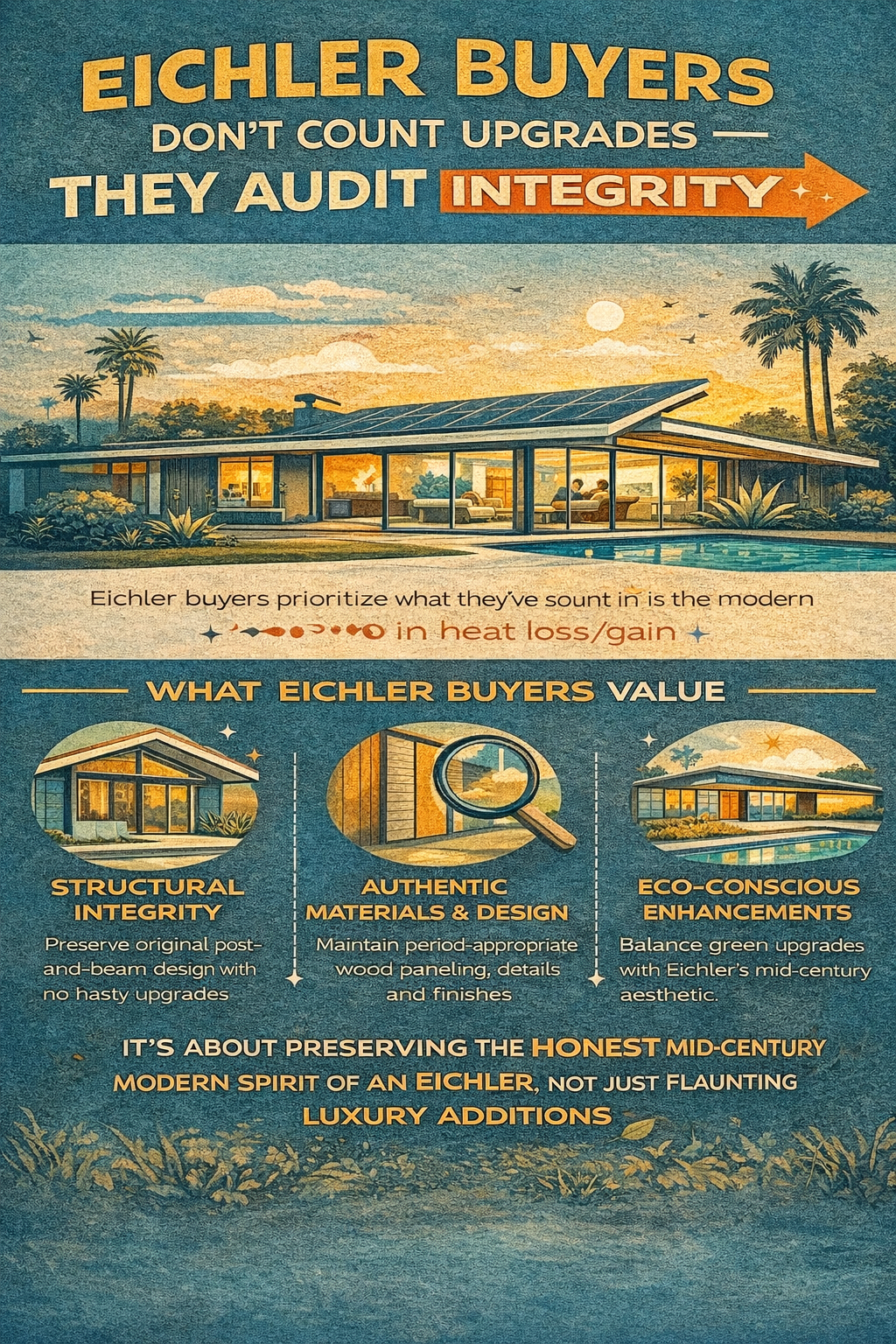
Eichler Buyers Don’t Count Upgrades — They Audit Integrity
“Eichler buyers don’t ask what’s been upgraded — they ask what’s still intact. From floating ceilings to open sightlines and intact atriums, value in an Eichler isn’t created by adding features, but by preserving architectural truth. In this niche market, integrity isn’t sentimental — it’s strategic.”
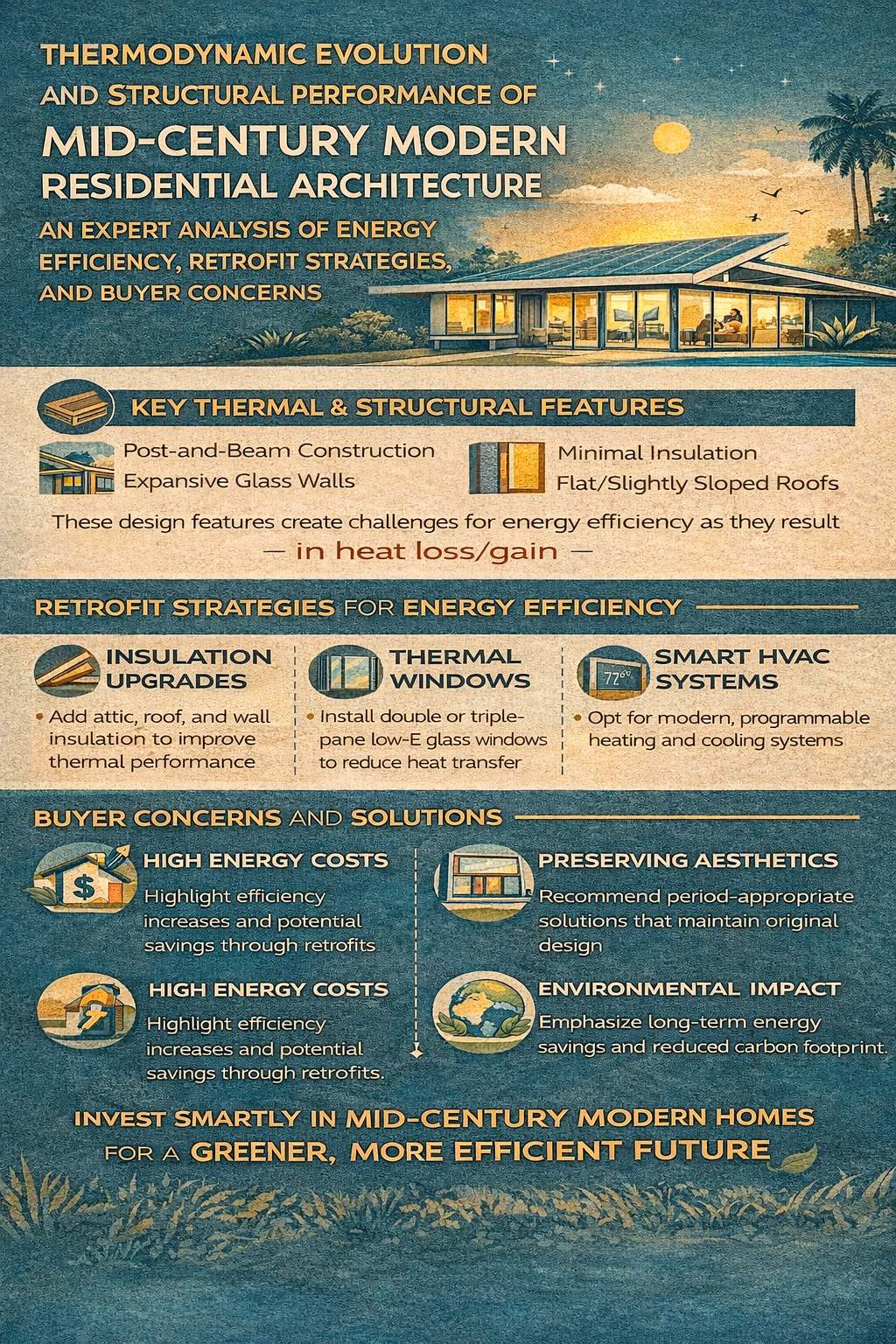
Thermodynamic Evolution and Structural Performance of Mid-Century Modern Residential Architecture
Mid-century modern homes were never designed to conserve energy—they were designed to dissolve the boundary between indoors and outdoors. Thin rooflines, expansive glass, uninsulated slabs, and radiant floors embedded directly in concrete created architectural poetry, but thermodynamic vulnerability. Today, the true question for buyers isn’t whether these homes are inefficient—it’s whether they’ve been thoughtfully modernized without destroying the architecture that gives them value.
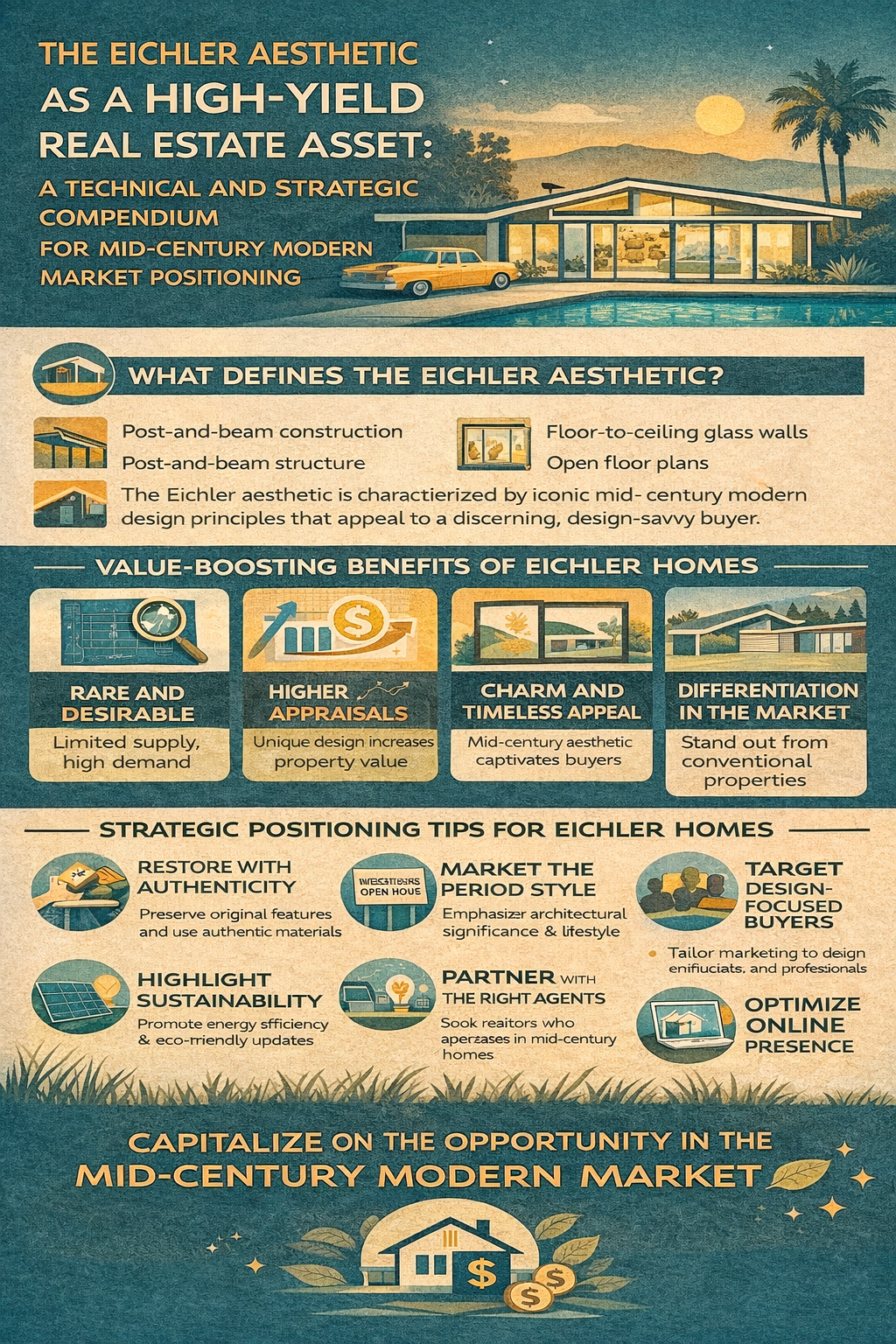
The Eichler Aesthetic as a High-Yield Real Estate Asset: A Technical and Strategic Compendium for Mid-Century Modern Market Positioning
Eichler homes operate on a fundamentally different economic frequency than conventional suburban real estate. Value is not created by luxury spend alone, but by architectural alignment—post-and-beam integrity, radiant heating metallurgy, thin-profile glazing, and fidelity to Joseph Eichler’s original social and design philosophy. In today’s market, authenticity isn’t nostalgia—it’s a measurable asset class.