
John Brooks Boyd: The Architect Who Shaped Silicon Valley’s Mid-Century Modern Landscape
John Brooks Boyd stands as one of the most influential yet understated figures in California’s mid-century modern movement. As a principal architect behind many of the most admired Eichler neighborhoods in Silicon Valley, Boyd helped define what modern suburban living could be in the postwar era—open, affordable, human-centered, and deeply connected to nature.
This in-depth profile explores Boyd’s life, philosophy, architectural legacy, and enduring influence throughout the South Bay. It also examines how today’s leading specialists—especially The Boyenga Team—continue to preserve, market, and elevate his work.
Why John Brooks Boyd Matters
In an era dominated by conventional tract housing and stylistic conservatism, John Brooks Boyd helped introduce a radically different vision. He believed homes should be designed around light, flow, privacy, and modern family life. His work through Eichler Homes made high-quality modern architecture accessible to middle-class families.
Today, Boyd’s influence is visible in thousands of preserved Eichler neighborhoods, rising mid-century property values, renewed cultural interest in modernism, and a strong restoration and resale market. For Silicon Valley homeowners, Boyd’s designs represent both architectural heritage and long-term financial stability.
Early Life and Architectural Formation
Boyd was trained during a pivotal moment in American architecture, when European modernism was being adapted to the West Coast climate and lifestyle. His education emphasized structural clarity, efficient planning, and human-scale design.
He drew inspiration from Bauhaus functionalism, Scandinavian modernism, Frank Lloyd Wright’s Usonian concepts, and California’s indoor-outdoor traditions. These influences shaped his belief that architecture should be practical, beautiful, and deeply connected to everyday life.
From the beginning of his career, Boyd favored restraint over ornamentation and clarity over excess. These values would later define his work with Eichler.
Postwar California and the Housing Opportunity
Following World War II, California experienced explosive growth. Returning veterans, expanding industries, and new families created unprecedented demand for housing. Traditional builders struggled to meet this demand efficiently and affordably.
Visionary developers like Joseph Eichler saw an opportunity to rethink suburban living. They sought architects who could produce modern, cost-effective, and scalable designs without sacrificing quality. Boyd emerged as a natural fit for this mission.
His ability to combine architectural integrity with production efficiency made him indispensable during this period of rapid expansion.
Partnership with Joseph Eichler
Boyd’s most important professional relationship was with Joseph Eichler, whose name would become synonymous with modernist suburban housing. Eichler valued Boyd’s technical discipline, creative problem-solving, and respect for budgetary realities.
Working alongside other prominent modernists, Boyd played a central role in shaping Eichler’s South Bay developments. Together, they proved that modern architecture was not an elite luxury, but something that could be mass-produced responsibly.
Their collaboration redefined what middle-class housing could look like in postwar America.
Design Philosophy and Core Principles
At the heart of Boyd’s work was a belief that architecture should serve real people in real situations. His homes were designed to support family interaction, privacy, and long-term adaptability. Natural light was treated as a primary building material. Large expanses of glass, clerestory windows, and atriums were used to bring sunlight deep into the home. Boyd also believed that nature should be an integral part of daily life, not something viewed only from a distance.
Contact Us and Begin Your Mid Mod Journey Today!
Boyenga Team + Compass Eric & Janelle Boyenga 📞 Call / Text : 408-373-1660 📧 Email : Eichlers@Boyenga.com 🌐 www.BoyengaTeam.com / www.EichlerHomesForSale.com DRE #01254724 / #01254725
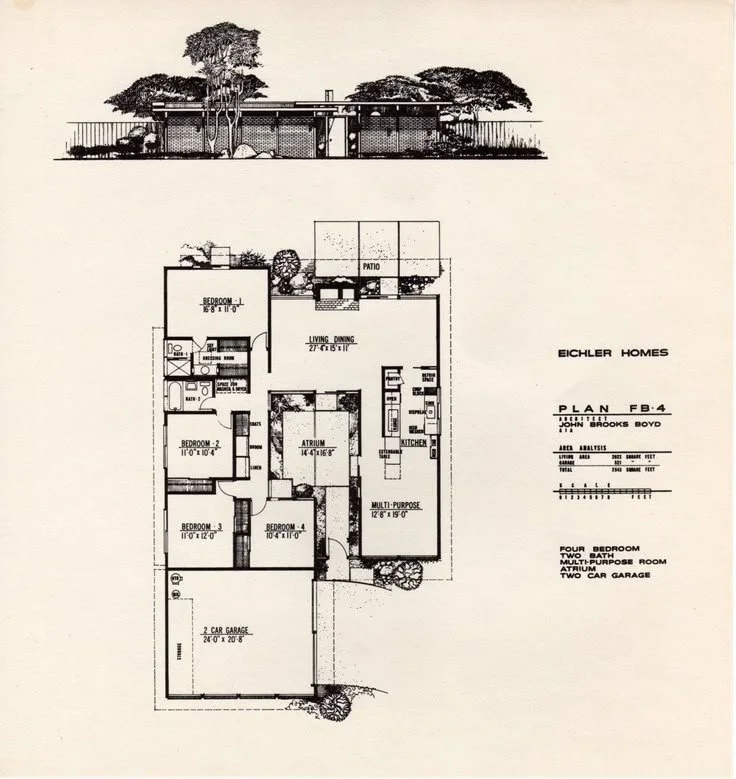
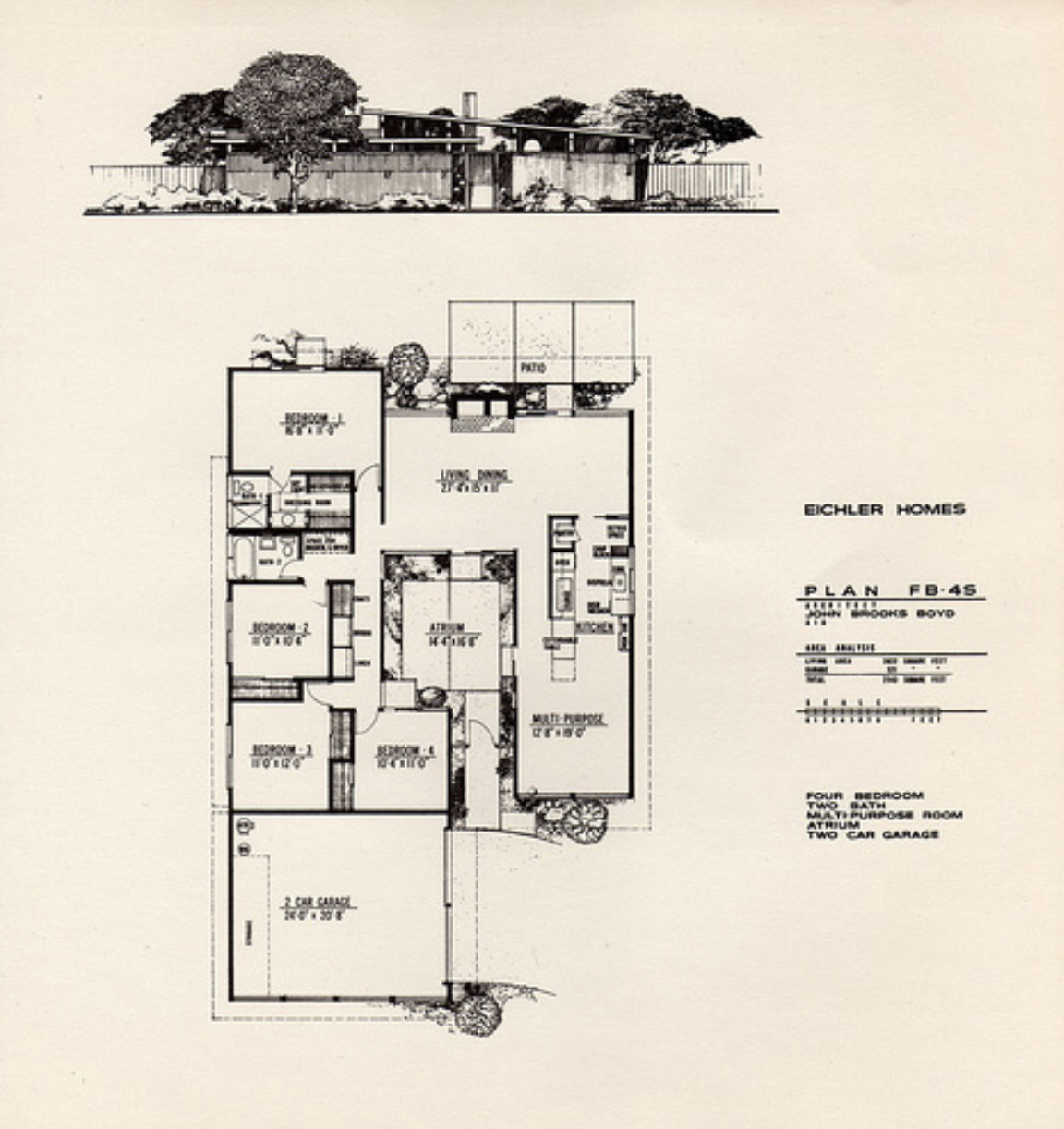
John Brooks Boyd Eichler Floorplans FB4 and FB45
Architectural Language and Signature Elements
Boyd-developed Eichler homes share a distinctive visual vocabulary. Exteriors typically feature flat or low-pitched roofs, post-and-beam construction, strong horizontal lines, and minimal ornamentation. Large glass walls blur the boundary between interior and exterior space.
Inside, open living and dining areas flow seamlessly into kitchens and patios. Exposed beams, radiant floor heating, and central atriums create warmth and spatial drama. Clerestory windows provide privacy while maintaining brightness.
These elements continue to define the appeal of Boyd-designed homes today.
Spatial Innovation and Family-Centered Planning
Boyd approached residential planning with a deep understanding of how families live. His floor plans are carefully zoned, separating public, private, and transitional spaces without rigid barriers.
Living rooms, dining areas, and kitchens form social hubs, while bedrooms are tucked away for privacy. Atriums and patios serve as buffers between zones, providing light and tranquility.
Rooms were designed to evolve over time, easily converting into offices, studios, or guest rooms. This flexibility is one reason Boyd homes remain highly functional in the era of remote work.
Climate-Responsive California Modernism
Long before sustainability became a marketing term, Boyd was designing climate-responsive homes. His buildings use passive strategies to regulate temperature and comfort.
Cross-ventilation, roof overhangs, thermal mass floors, and carefully positioned glazing reduce reliance on mechanical systems. These techniques make Boyd homes both environmentally intelligent and cost-effective.
In many respects, his work anticipated modern green building standards by several decades.
Materials, Construction, and Engineering
Boyd balanced innovation with practicality. He favored durable, readily available materials such as redwood siding, Douglas fir beams, concrete slabs, aluminum framing, and tempered glass.
Structurally, his homes relied on post-and-beam systems and modular layouts. Standardized components allowed Eichler to build efficiently while maintaining architectural consistency.
This approach made large-scale modernist development financially viable.
Building Communities, Not Just Houses
Boyd was deeply involved in shaping entire neighborhoods, not just individual residences. His planning emphasized social interaction and long-term livability.
Cul-de-sacs reduced traffic, greenbelts provided shared open space, and pedestrian paths encouraged walking. Strategic landscaping and setbacks preserved privacy.
These communities continue to feel cohesive and human-scaled decades later.
Major South Bay Neighborhoods
Boyd’s influence is strongest in Sunnyvale, Palo Alto, Los Altos, Los Altos Hills, and San Jose.
In Sunnyvale, neighborhoods near Fairbrae, Cherry Chase, and Ortega Park contain some of the most cohesive Eichler tracts. Midtown Palo Alto and Green Gables feature highly sought-after examples. Los Altos offers smaller but premium clusters, while Willow Glen and Cambrian Park in San Jose showcase Boyd’s adaptability to different urban contexts.
Each area reflects his responsiveness to site, climate, and demographics.
Signature Home Typologies
Certain Boyd models have become iconic. Atrium-centered plans emphasize privacy and daylight. Double-gable designs create dramatic rooflines and expansive interiors. Expanded family layouts provide four-bedroom configurations ideal for multi-generational living. These models consistently command premium pricing in today’s market.
Efficiency was central to his thinking, but he rejected austerity. His homes were economical without feeling cheap, modern without feeling cold. Above all, Boyd valued timelessness over trends, ensuring that his designs would remain relevant for decades.
Social Impact and Inclusive Housing
Boyd’s work was inseparable from Eichler’s progressive values. Eichler Homes famously rejected racial and religious discrimination at a time when restrictive covenants were common.
Boyd’s architecture helped support integrated communities and equitable access to high-quality housing. In this sense, his legacy is social as well as aesthetic.
Boyd Among His Contemporaries
While many modernist architects focused on custom homes or institutional projects, Boyd specialized in scalable residential modernism. He uniquely bridged commerce and artistry, demonstrating that mass housing could be both profitable and principled.
This position distinguishes him from more academic or boutique-focused peers.
Preservation and Restoration Challenges
Owning a Boyd-designed home requires thoughtful stewardship. Common issues include aging radiant heating systems, single-pane glass, roof membrane wear, and wood degradation.
Authentic restoration demands specialized knowledge and access to period-appropriate materials. Improper renovations can significantly diminish architectural value.
Market Performance and Investment Value
Boyd and Eichler homes consistently outperform conventional tract housing in the South Bay. Scarcity, design prestige, educated buyer demographics, and media attention all contribute to strong appreciation.
In many neighborhoods, these homes command premiums of fifteen to thirty-five percent over comparable non-modern properties.
Boyd Homes in the Modern Lifestyle Economy
Contemporary buyers value remote-work flexibility, wellness-oriented layouts, authentic design, and visual appeal. Boyd homes naturally align with these priorities.
Their open plans, strong indoor-outdoor connections, and timeless aesthetics make them especially attractive to tech professionals, creatives, and design-conscious families.
The Boyenga Team: Silicon Valley’s Eichler Experts
The Boyenga Team has become synonymous with Eichler and Boyd homes throughout Silicon Valley.
Their team possesses deep expertise in original floor plans, model identification, permit histories, and restoration standards. This knowledge allows them to accurately position properties in the marketplace and guide clients through complex ownership considerations.
They advise on period-appropriate materials, radiant heat upgrades, energy-efficient retrofits, and historically sensitive renovations. Their marketing emphasizes architectural storytelling, professional photography, and targeted outreach to qualified buyers worldwide.
In transactions, they specialize in off-market sourcing, competitive bidding strategies, appraisal defense, and collaboration with Eichler-experienced inspectors. Because Boyd homes are architecturally complex, this specialization protects both buyers and sellers from costly mistakes.
In many ways, the Boyenga Team functions as a modern curator of Boyd’s legacy.
Buying and Owning a Boyd-Designed Home
Prospective buyers should carefully evaluate structural integrity, heating systems, glazing condition, permit records, and renovation history. Due diligence is essential.
Successful ownership involves preserving original features, using compatible materials, documenting upgrades, and working with specialists. Homes maintained in this way tend to appreciate most consistently.
Enduring Legacy and Future Relevance
John Brooks Boyd’s work has transcended its historical moment. He democratized modernism, humanized mass housing, integrated sustainability, and helped define Silicon Valley’s residential identity.
As density increases and design literacy grows, his principles are becoming more relevant, not less. His homes remain adaptable, beautiful, livable, and financially resilient.
Few architects have achieved such comprehensive and lasting success.
John Brooks Boyd’s Place in Silicon Valley History
John Brooks Boyd was not merely an architect. He was a systems thinker, community builder, and quiet visionary. Through his collaboration with Eichler, he created neighborhoods that continue to shape how Silicon Valley lives and works.
With expert stewards like the Boyenga Team guiding today’s buyers and sellers, Boyd’s legacy is not only preserved—it is actively enhanced.
For anyone passionate about mid-century modern living, Boyd’s work represents the gold standard, where design excellence, human-centered planning, and long-term value converge.