
Mid-Century Modern Homes in Concord, CA
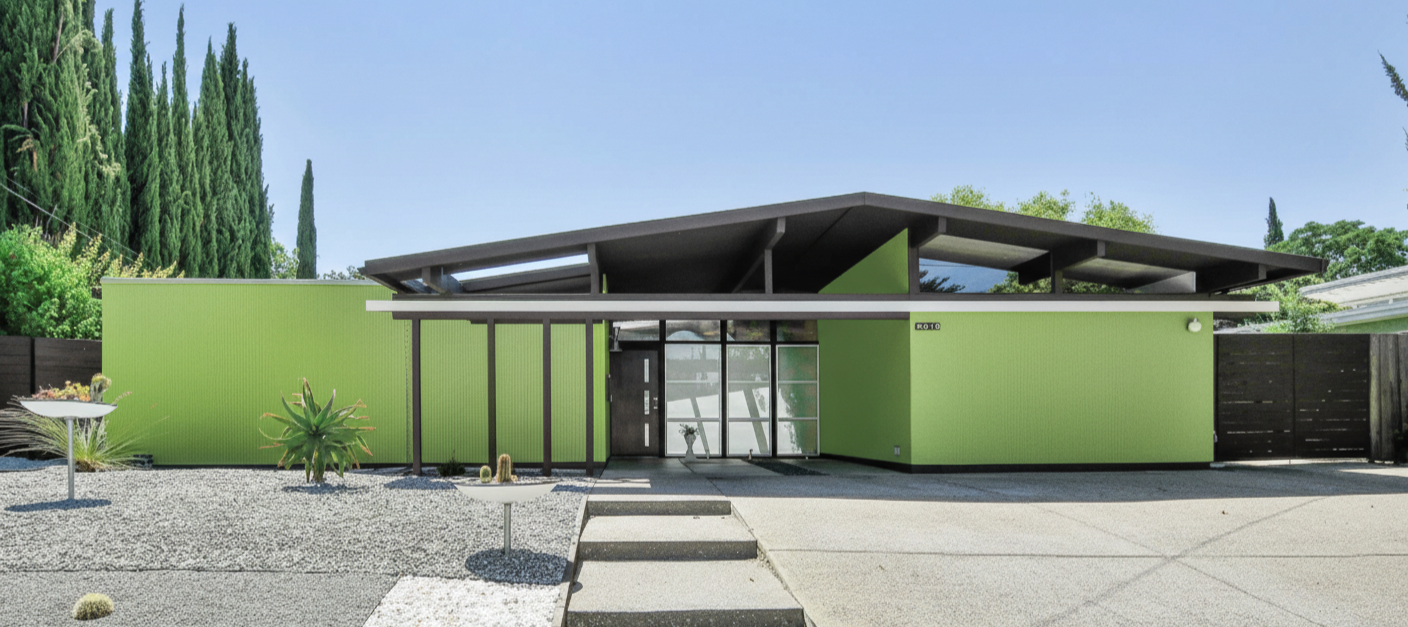
Concord overview for design-conscious buyers
Concord sits in the East Bay about 30 miles east of San Francisco and is described as the largest city in Contra Costa County—a positioning that matters for buyers who want “real city” amenities with neighborhood-scale living.
On the numbers, Concord’s 2024 population estimate is 124,016. The city’s owner-occupied housing rate is 61.6% (ACS 2020–2024), with a median owner-occupied home value of $797,600 and a median gross rent of $2,274 (ACS 2020–2024). Median household income is reported at $108,709 (in 2024 dollars, ACS 2020–2024).
That profile—solid incomes, meaningful homeownership, and a diverse community (including 25.5% foreign-born residents, ACS 2020–2024)—supports a real estate market where great design can trade at a premium, especially when scarcity is built into the neighborhood fabric (as it is with Eichler inventory).
How mid-century modern found a home in Concord
“Mid-century modern” broadly refers to mid-20th-century design defined by clean lines, functional layouts, and organic forms—an aesthetic that became central to mainstream demand long after the era ended.
In California, the post–World War II building boom made the single-story ranch house especially popular, shaping huge swaths of the state’s mid-century residential landscape.
Concord’s own timeline helps explain why mid-century neighborhoods are so common here: the town began as Todos Santos in 1869 (founded by Salvio Pacheco, Fernando Pacheco, and Francisco Galindo), later becoming Concord, and incorporated as the “Town of Concord” in February 1905.
By the mid-20th century, Concord’s regional role expanded substantially, including military logistics connected to the former naval weapons station complex (closed under BRAC with a closure date of September 30, 2008, per Navy BRAC documentation). That broader growth era is the context in which mid-century tract neighborhoods—and Concord’s true Eichler tracts—took root.
Architectural highlights and housing inventory
Concord is unusually important for mid-century buyers because it isn’t only “mid-century adjacent”—it’s an East Bay city with real, named Eichler neighborhoods. Visit Concord describes Concord as having approximately 175 Eichler homes across three separate neighborhoods and calls it the third-largest concentration of Eichlers in the East Bay.
Counts vary by source and methodology, but Eichler Network reports the three Concord tracts as: Rancho de los Santos (41 homes, built 1965), Rancho del Diablo (69 homes, built 1964), and Parkwood Estates (77 Eichlers, built 1963)—for a total of 187 Eichlers across those tracts.
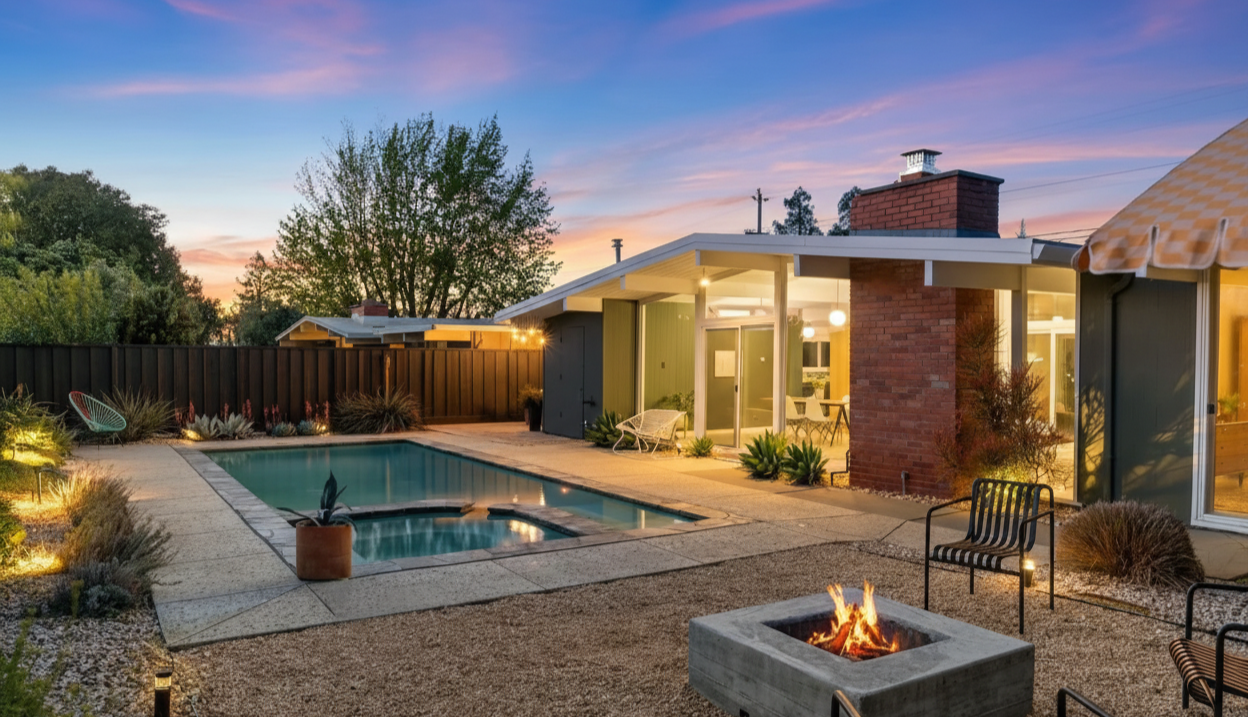
What makes an Eichler feel Eichler is not a single finish—it’s the whole system: glass-forward walls, open interior volumes, strong daylighting, and a deliberate indoor–outdoor relationship. Visit Concord also notes common features modern enthusiasts seek in these homes: post-and-beam construction and radiant floor heating among them.
That design story traces directly to Joseph Eichler, whose company built nearly 11,000 modern tract houses in California starting in the late 1940s.
Within Concord, Rancho del Diablo is described in Visit Concord materials as an early-1960s Eichler community (with “about fifty homes” on that specific tourism write-up) designed by major mid-century names including Claude Oakland and A. Quincy Jones (and additional associated firms), underscoring that Concord’s mid-mod inventory is architecturally “real,” not just stylistically inspired.
Parkwood Estates, meanwhile, is repeatedly associated with classic early-1960s Eichler production and remains a reference point for design press coverage. Recent coverage of a Parkwood Estates listing identifies a 1964 home designed by Claude Oakland for Eichler, framing the tract as emblematic of West Coast midcentury modernism.
Beyond the homes themselves, the strongest “hidden” value in Concord’s Eichler neighborhoods is community texture: Eichler Network describes these tracts as increasingly populated by mid-century enthusiasts, and it specifically notes Parkwood’s enclave-like pattern—near a city park and pool, with limited through streets—features that tend to reinforce neighborhood identity (and long-term buyer demand).
School district and education landscape
Most Concord addresses feed into Mt. Diablo Unified School District, which operates more than 50 school sites across multiple communities in central Contra Costa County. The district itself notes that its schools span the cities of Clayton, Concord, Pleasant Hill, and portions of additional nearby communities.
For families evaluating a purchase, the most practical takeaway is logistical: MDUSD assigns neighborhood schools based on street address and encourages families to verify enrollment using the district’s school locator tools (because boundary nuance can materially affect day-to-day life and resale).
On scale, Ed-Data (a partnership that includes the California Department of Education and other state education data collaborators) reports MDUSD enrollment of 30,163 for the 2024–25 school year.
Concord also hosts meaningfully different public options, including Clayton Valley Charter High School, which is listed in official state and federal education directories as a charter high school in Concord.
For private high school families, official California School Directory records place both De La Salle High School of Concord and Carondelet High School on Winton Drive in Concord (a notable concentration for an East Bay commute radius).
For higher education access nearby, Diablo Valley College is a major local community college option with campuses in Pleasant Hill and San Ramon.
Neighborhood vibe, attractions, and lifestyle
If you’re positioning a mid-mod lifestyle in Concord, the narrative practically writes itself: the city’s historic downtown revolves around Todos Santos Plaza, dedicated in 1869 and still used as a community gathering place—events, concerts, farmers market energy, and the kind of “walk to something” lifestyle that elevates a design home beyond the lot lines.
That place-making is nationally legible: local tourism materials and City communications note the plaza was named one of three “Great Places in California” by the American Planning Association in 2018.
Concord’s modern history also carries weight. The Port Chicago Naval Magazine National Memorial commemorates the July 17, 1944 explosion that killed 320 people—described by the National Park Service as the worst home-front disaster of World War II—and the aftermath that spotlighted segregation and racial inequality in the military.
For outdoor-minded buyers, Concord is directly linked to major open space planning as well. The East Bay Regional Park District describes the future Thurgood Marshall Regional Park – Home of the Port Chicago 50 as a multi-thousand-acre open space project intended to connect communities and interpret local history as it comes online.
Design-forward lifestyle also means culture and entertainment, and Concord is unusually strong here for an East Bay value story: Toyota Pavilion at Concord is widely described as designed by Frank Gehry, making it a rare case where a major mid-century / late-modern architectural name intersects directly with the city’s everyday events calendar.
Retail and “third places” matter for luxury buyers too—especially the ability to keep life close to home. The Veranda positions itself as a reimagined open-air, mixed-use shopping and dining destination.
For scale shopping and regional convenience, Sunvalley Shopping Center markets itself as Contra Costa County’s largest regional shopping center, with approximately 160 shops, services, and restaurants.
Transit access is one of the quiet “luxury” advantages in Concord: Concord Station and North Concord / Martinez Station anchor regional mobility, which is especially compelling for buyers who want design and optionality (commutes, concerts, restaurants, airports, and broader Bay Area life without forced driving every time).
Housing data and real estate market analysis
The most useful way to present “housing data” for a mid-mod audience is to show both the city’s baseline economics and the market’s real-time behavior.
From the baseline side, the ACS (2020–2024) reports Concord’s median owner-occupied home value at $797,600, with a median household income of $108,709 (in 2024 dollars), and an owner-occupied rate of 61.6%. Those figures help explain why Concord can be both relatively accessible (by Bay Area standards) and still competitive for design-forward homes.
From the “what’s happening now” side, Redfin’s January 2026 housing market snapshot for Concord reports a median sale price of $680,000, with homes selling after about 32 days on market (and a market described as “somewhat competitive”). Redfin also reports that most homes receive offers, with a subset selling quickly.
Concord is also a city where micro-markets matter. Redfin’s January 2026 zip-code breakouts show meaningful variation: 94519 around $670,000 median sale price, 94520 around $605,000, and 94521 around $800,000—useful context when advising buyers on value corridors and sellers on realistic positioning.
Now layer in the mid-mod constraint: Concord’s Eichler inventory is finite—commonly described as roughly 175–187 homes across three tracts—which means true “architectural product” hits the market in narrow windows. Scarcity plus cultural demand is exactly the setup where presentation, pricing discipline, and buyer preparedness tend to separate outcomes (especially when a home is either unusually intact or thoughtfully upgraded).
For sellers of mid-century homes, Compass’s public materials describe specific pre-marketing pathways—Private Exclusives and Coming Soon—positioned as ways to build early demand while limiting the “days on market / price drop” optics that can weaken negotiating leverage. Those tools can be particularly relevant for design-led homes where storytelling and audience targeting are as important as square footage.
Boyenga Team at Compass
A mid-mod page should never treat representation as generic—especially in a niche where buyers care about architectural lineage, not just bedroom count.
On their Compass profile, the Boyenga Team is presented as a Silicon Valley–based group led by Eric and Janelle, described as “founding partners at Compass,” active since 1996, and recognized in their positioning as “NextGenAgents,” with a team structure built for collaboration and elevated marketing. Their Compass profile also explicitly references experience in Eichler and mid-century modern homes, along with luxury property representation and technology-forward marketing strategy.
Their approach is also described as operationally hands-on: Compass materials under Eric’s profile state the team delivers “expert pre-listing & project management” designed to help clients earn maximum return on investment, and notes experience with family trusts and transition-related transactions (a frequent reality in mid-century neighborhoods with long-tenured ownership).
How Eric and Janelle Boyenga show up for clients:
Client feedback on Compass emphasizes calm execution, outcomes that “exceeded expectations,” and highly organized listing preparation—including contractor coordination and remote-friendly transaction tools (DocuSign / mobile notary mentioned in a Compass-hosted testimonial).
One client testimonial on the Boyenga Team’s reviews page specifically cites them selling an Eichler in Willow Glen and then helping purchase a property in Santa Clara—an example of design-specialist representation spanning both the emotional and technical sides of iconic mid-century homes.
Another Compass-hosted testimonial describes a condo sale where preparation guidance, timeline management, and contractor estimating contributed to multiple offers within a week—useful as a “process proof” story for sellers who want outcomes without chaos.
A third theme shows up in agent-page testimonials: buyers and sellers describe Eric’s pricing/analytics and Janelle’s command of the selling process as complementary strengths—exactly the split of skills that tends to matter most when a home has architectural value that must be translated into market value.
If you’re touring a Concord Eichler, preparing a mid-century home for market, or simply want a strategy conversation grounded in design literacy and Bay Area buyer psychology, reach out to the Boyenga Team at Compass to discuss the current listing—or to privately explore other mid-mod opportunities as they arise. When you’re ready, schedule a private showing and let a specialist translate architecture into leverage—smoothly, confidently, and with your goals leading the way.