
Los Altos—Silicon Valley’s Mid-Century Modern Heartland

Mid-Century Modern Homes in Los Altos (94022 & 94024) – Neighborhood Profile & Market Insights
Los Altos, California – where Silicon Valley affluence meets mid-century modern design. This comprehensive neighborhood profile explores the city’s evolution from tranquil orchards to a luxury enclave of mid-century modern(mid-mod) homes, with an emphasis on its rare Eichler tracts. We delve into Los Altos’ historical origins, demographic make-up, top-rated schools, lifestyle attractions, architectural highlights, and current real estate trends. Along the way, we spotlight case studies of successful home sales and illustrate how The Boyenga Team are Silicon Valley real estate experts adept at navigating this exclusive market.
Historical Overview
Origins as Orchard Lands: Modern Los Altos traces its roots to 1906, when Southern Pacific Railroad executive Paul Shoup founded a planned town on orchard land between Palo Alto and Mountain View. Shoup’s Altos Land Company purchased 140 acres (including a parcel from Sarah Winchester of “Mystery House” fame) and established a new rail stop called “Los Altos” – Spanish for “the heights”. In 1907, a promotional barbecue and land auction drew buyers to the first town lots. By 1908, the Los Altos train depot was running, connecting local farmers to San Francisco and San Jose markets in under an hour. Early Los Altos was very much an agricultural village: apricot, cherry, and prune orchards blanketed the area, earning the Santa Clara Valley its nickname “Valley of Heart’s Delight.” Even as wealthy San Franciscans and Stanford professors built country cottages among the orchards, Los Altos remained a rural community through the first half of the 20th century.
Post-War Suburbia and Incorporation: The 1950s brought transformative growth. As the Bay Area’s population boomed after World War II, Los Altos transitioned from farm town to affluent suburb. In 1952 the community formally incorporated as a city to stave off annexation by its neighbors. This allowed residents to control zoning and preserve Los Altos’ low-density, residential character. Indeed, Los Altos from the start limited commercial development, concentrating shops in a small downtown “village” and prohibiting industrial uses. The former railroad ceased operation in 1964; its tracks were repurposed as Foothill Expressway, improving auto access while symbolizing the end of the orchard era. By the late 1960s, subdivisions of single-story ranch homes filled in the once-rural landscape, and the city’s prestige grew. It was during this period that Joseph Eichler built his final series of mid-century modern tract homes in Los Altos (more on these in the Architecture section).
Notable Figures and Tech Heritage: Despite its quiet vibe, Los Altos has been the backdrop for major Silicon Valley moments. In 1976, Apple co-founders Steve Jobs and Steve Wozniak built the first 50 Apple I computers in Jobs’ family garage on Crist Drive in Los Altos. (That modest ranch house is now a historical landmark.) Decades later in 2004, a young Mark Zuckerberg rented a Los Altos home dubbed “Casa Facebook,” where Facebook’s early team grew the platform from 200,000 to 2.5 million users. These anecdotes exemplify how Los Altos, while officially a bedroom community, became home to the visionaries of the digital age. In 2021, the town even hosted the world’s first consumer flying-car showroom, blending its suburban calm with cutting-edge innovation. Through careful urban planning (large lots, strict design guidelines) and a bit of serendipity, Los Altos evolved into an elite residential enclave that prizes its semi-rural ambiance as much as its proximity to tech industry hubs.
Demographic and Socioeconomic Profile
Affluent, Educated, and International: Los Altos today is a community of approximately 31,000 residents (31,625 in the 2020 Census). It is one of the wealthiest cities in the United States: the median household income exceeds $250,000(the U.S. Census reports it as “$250,000+,” effectively off the charts). The per capita income is around $143,000, and only about 3% of residents live below the poverty line. Educational attainment is correspondingly high – an estimated 83% of adults hold a bachelor’s degree or higher, far above state and national averages. This reflects the large concentration of professionals in science, technology, medicine, and academia. Los Altos’ occupational profile is almost entirely white-collar, with common careers in management, engineering, finance, and law, mirroring Silicon Valley’s tech-driven economy.
Ethnic Diversity: Over the past few decades, Los Altos has attracted a diverse global workforce. About 34% of residents are foreign-born, and many are originally from Asia and Europe. The city’s ethnic makeup is roughly 53–54% White and 35% Asian, with a smaller Hispanic/Latino population (~5%) and others making up the rest. This blend of cultures is evident in the community – for example, you’ll find multiple ethnic grocery markets and cultural events alongside classic American small-town traditions. The high percentage of Asian residents (many of whom have come to California for tech and professional careers) underscores Los Altos’ role as a magnet for global talent in Silicon Valley. The demographic mix skews toward families and middle-aged professionals: the median age is about 46 years, and nearly 40% of households have children under 18.
Stable, Established Community: Los Altos is characterized by its stability and homeowner dominance. About 79% of occupied homes are owner-occupied, and many residents have lived in the city for decades. Population growth is slow (up only ~9% from 2010 to 2020) due to limited land and strict zoning. Rather than rapid turnover or gentrification, Los Altos has seen a renewal of its housing stock as original 1950s homes are remodeled or replaced by larger custom homes. The influx of wealth from the tech sector has certainly raised home values (and teardowns for new construction), but the community’s character remains upscale suburban rather than urbanized. In effect, Los Altos has become an address for those who have “made it” in Silicon Valley – often second or third-stop homebuyers who may have started in Palo Alto, Mountain View, or Sunnyvale and upgraded to Los Altos for the larger lots, prestigious schools, and quiet ambiance. This has produced a virtuous cycle where high incomes fund excellent public services (especially schools), which in turn attract more high-income families, solidifying Los Altos’ status as an elite enclave of affluence.

School Districts and Education Landscape
One of the core pillars of Los Altos’ appeal is its education system. The city’s public schools are among the top in California (and the nation), and they heavily influence property values and migration patterns. As local realtors often say, in Silicon Valley “schools are king,” and Los Altos exemplifies this principle.
Public School Districts: Unusually for a city of its size, Los Altos is served by two separate public school districts for K-8, plus a unified high school district:
Los Altos School District (LASD): This district serves most of Los Altos and parts of adjacent cities, with seven elementary schools (K–6) and two junior high schools (7–8). LASD is consistently rated among the top few districts in California, earning an A+ overall grade and boasting test scores that far exceed state averages. In recent metrics, around 85% of LASD students met or exceeded state standards in reading, and 84% did so in math – a testament to the quality of instruction. Small class sizes, active parent involvement, and well-paid teachers (averaging $122k salary) contribute to its excellence. LASD’s neighborhood schools (such as Covington, Gardner Bullis, Santa Rita, Almond, etc.) are a major draw for families.
Cupertino Union School District (CUSD): A portion of south Los Altos (in the Loyola Corners and Fallen Leaf Park areas) lies within CUSD for elementary and middle school. Notably, Montclaire Elementary in south Los Altos is part of CUSD. This school is also highly rated (Niche gives it an “A” grade), and feeds into Cupertino Middle School. Families in this pocket then attend high school in the Fremont Union High School District (Homestead High School). While it may seem odd that a Los Altos address goes to Cupertino schools, it’s a legacy of how district boundaries were drawn before city borders. Importantly, both LASD and CUSD are excellent, so Los Altos buyers generally face a choice between two great public school systems. For example, Montclaire Elementary (CUSD) and Homestead High each score in the top tiers (Homestead earned an A+ and routinely ranks among the top 100 high schools nationally).
Mountain View–Los Altos Union High School District (MVLA): For high school, most Los Altos students attend either Los Altos High School or Mountain View High School (both part of MVLA). This high school district is a powerhouse – ranked #2 in California and #11 in the entire United States by some measures. Los Altos High consistently scores in the top 1% of U.S. public high schools, with rigorous academics (40+ AP/Honors courses) and a 92% college matriculation rate. Equally, Mountain View High is highly acclaimed. In short, whether a Los Altos home is zoned to Homestead High (FUHSD) or Los Altos High (MVLA), the student outcomes are superb. This unique situation means there’s no “bad” school zone in Los Altos – a very unusual (and enviable) scenario that keeps demand strong on both sides of the district boundary.
The “school boundary effect” still plays a role in micro-local real estate. Homes on one side of a street might be zoned to LASD/MVLA and on the other to CUSD/FUHSD, and some buyers have preferences (for instance, those set on a K-8 LASD experience versus those who value Homestead High’s reputation). However, because all the public schools are top-notch, the boundary influences “flavor” more than value. In fact, analysts note that this bifurcation creates two parallel micro-markets: families targeting Los Altos High will focus on homes in north/central Los Altos, while those eyeing Cupertino schools will seek south Los Altos addresses. It’s not about good vs. bad schools, but aligning with a particular educational ecosystem and peer community. Either way, access to elite public schools is non-negotiable for most Los Altos buyers, and it provides a long-term stability to property values. Even during economic downturns, demand from families seeking these schools keeps a floor under home prices in the area.
Private Schools and Higher Education: In addition to stellar public schools, Los Altos offers convenient access to highly regarded private and parochial schools. Notable examples include Saint Simon Parish School, a Catholic elementary that earned a National Blue Ribbon Award in 2021, and St. Nicholas Catholic School, another respected K-8 option. Nearby, one finds elite private high schools like Saint Francis (Mountain View) and Bellarmine College Prep(San Jose) within commuting distance, offering alternatives for those who prefer private education. For younger children, there are numerous preschools and Montessori academies in town.
Higher education is close at hand as well. Los Altos sits in the heart of a world-class academic ecosystem: Stanford University is just a 15-minute drive north, and Foothill College, a top-ranked community college, is located in adjacent Los Altos Hills. Many Los Altos High graduates matriculate to UC Berkeley, UCLA, Stanford, and Ivy League universities, reflecting the city’s college-focused culture. The presence of institutions like Stanford, Santa Clara University, and San José State University in the region adds a rich cultural and intellectual atmosphere. It’s not uncommon to meet Los Altos neighbors who are Stanford professors, tech startup founders, and scientists – all valuing a community that invests deeply in education. This education-centric environment is both a point of pride and a key reason families are willing to pay a premium to live here.
Neighborhood Attractions and Lifestyle
Despite its proximity to the hustle of Silicon Valley, Los Altos has carefully curated a peaceful, small-town lifestyle. The city’s motto might well be “serene living in the center of it all.” Here are the key facets of life in Los Altos that residents and visitors alike enjoy:
Parks and Open Space: Los Altos is blessed with an abundance of green space, contributing to its park-like atmosphere. The city maintains over a dozen parks, each with its own character and amenities. Some of the standout examples include:
Shoup Park: The city’s first park, set along Adobe Creek at 400 University Ave. It offers picnic areas, playgrounds, and connects to the Redwood Grove Nature Preserve. (Redwood Grove is a hidden gem where one can stroll among towering redwood trees – a rare slice of nature in the flatlands.) Shoup Park’s grassy fields and creekside trail are popular for family gatherings and weekend relaxation.
Grant Park: A large community park in south Los Altos (1575 Holt Ave) featuring soccer fields, a softball diamond, tennis courts, and a community center. Grant Park serves as a recreational hub for the Loyola Corners/South Los Altos area, complete with children’s playgrounds and classes for seniors.
Rosita Park: Located on Rosita Ave, this park provides multiple sports fields (used for Little League baseball and AYSO soccer) and tennis courts. It’s a go-to spot for organized sports and pick-up games alike.
Hillview Park: Adjacent to the Los Altos Community Center at Hillview Ave, this park offers a dog park, bocce ball courts, outdoor exercise equipment, and open lawn space. It’s a versatile space that also hosts community events.
Heritage Orchard: In the Civic Center stands a living reminder of Los Altos’ past – a preserved apricot orchard dating back to the early 1900s. This small orchard (maintained by the city) blooms beautifully each spring, paying homage to the “Valley of Heart’s Delight” era.
Rancho San Antonio Open Space: While technically in Los Altos Hills/County territory, the entrance to this 4,000-acre nature preserve is just next door to Los Altos, making it effectively the backyard wilderness for residents. Rancho San Antonio features dozens of miles of hiking and biking trails that wind through oak woodlands and scenic hillsides, plus the popular Deer Hollow Farm. Many Los Altos locals take morning hikes here or enjoy weekend picnics with sweeping views of the Bay.
This extensive park network encourages an active, family-friendly lifestyle. On any given evening, you’ll see residents jogging or biking along the tree-lined streets, kids playing soccer in the parks, and yoga classes meeting outdoors. The city’s commitment to open space not only enhances quality of life but also preserves the lush, woodsy feel that sets Los Altos apart from denser cities.
Downtown “Village” and Retail: Los Altos’ commercial core is a charming downtown village centered around Main and State Streets. Rather than big-box stores or high-rise offices, downtown Los Altos deliberately cultivates a small-town, upscale atmosphere. You’ll find over 150 businesses, the majority of which are independent boutiques, cafés, and eateries. There are fashionable women’s clothing shops, home décor stores, bakeries, gourmet markets, and art galleries. Notable favorites include Los Altos Grill (a classic American grill known for its ribs and lively bar scene) and Rustic House Oyster Bar & Grill (a popular seafood restaurant). A few upscale chains like Whole Foods and Peet’s Coffee are present, but by and large the city has kept out large franchises to maintain uniqueness.
Culturally, downtown Los Altos is the community gathering spot. It hosts events such as:
The annual Los Altos Arts & Wine Festival, which takes over downtown each summer with art vendors, wine tasting, and live music.
The Festival of Lights Parade every holiday season (a tradition since 1977) where illuminated floats and marching bands draw families to Main Street.
The vintage Los Altos Pet Parade, a quirky event dating back to 1948 where kids show off costumed pets down the street.
A weekly Farmers’ Market on Thursday afternoons (spring through fall) with fresh produce and local artisans.
Downtown also features the Los Altos History Museum, which chronicles the town’s journey from apricot orchards to tech suburb. Adjacent is the landmark Los Altos Library and a civic center complex. The city’s Public Art Program has dotted downtown with over two dozen sculptures and installations, adding to the village charm. The overall effect is an idyllic downtown that feels like a slice of small-town America, yet frequented by tech executives and Stanford professors alike, all enjoying the sense of community.
Dining and Entertainment: While Los Altos quiets down early (it’s not a nightlife hotspot), there is a robust dining scene for a town of its size. In addition to the Los Altos Grill and Rustic House, you have Taverna (Greek), Akane (sushi), Armadillo Willy’s (BBQ), Satura Cakes (a renowned bakery), and other options covering Italian, Indian, and French cuisines. Many restaurants have sidewalk seating, reinforcing the walkable village feel. Cultural entertainment includes regular events at the Los Altos Stage Company (a community theater), and summer concerts in the park. For more diverse nightlife or arts (e.g. movie theaters, major concerts), residents typically go to neighboring Palo Alto or Mountain View – both just 10–15 minutes away.
Safety and Community: Los Altos consistently ranks as one of the safest small cities in California. The crime rate is very low, and the community is tightly knit through school and civic groups. Block parties, school fundraisers, and volunteer organizations are common. The Los Altos Community Center offers classes from yoga to painting, and senior programs, ensuring there’s something for every age. The prevailing lifestyle is family-oriented, tranquil, and affluent. Residents take pride in local history and preservation – for example, neighborhood associations in the Eichler tracts actively promote historic preservation guidelines to maintain the mid-century aesthetic.
Proximity to Tech Hubs (Commuter Convenience): Living in Los Altos provides a rare combination of suburban tranquility and accessibility to Silicon Valley’s economic centers. The city is strategically located at the nexus of several major tech corridors. Key commute distances include:
Googleplex (Mountain View): ~4–5 miles north. The drive is typically under 15 minutes. Google’s HQ and associated campuses (LinkedIn, Microsoft, etc.) in Mountain View are extremely close, making Los Altos a favored home base for many Google employees.
Apple Park (Cupertino): ~7.5 miles southeast. About a 10–15 minute drive via Foothill Expressway and I-280. Apple’s spaceship campus is an easy commute, and indeed many Apple engineers/executives live in Los Altos or nearby Los Altos Hills for the quick access.
Meta/Facebook (Menlo Park): ~15 miles northwest. The commute can range ~25–45 minutes by car, depending on traffic on Highway 101. It’s a bit farther but still reasonable for those at Facebook or Stanford who seek Los Altos’ lifestyle.
Downtown San Francisco: ~35–40 miles north. Roughly an hour drive in optimal conditions (but can be more with traffic). Many Los Altos residents occasionally commute to San Francisco or entertain there. The Caltrainstation in nearby Mountain View (San Antonio or Downtown stations) provides a rail option, taking ~1–1.5 hours to SF.
This centrality means Los Altos offers “space and tranquility within a short drive of innovation.” Professionals willingly accept a slightly longer commute from Los Altos in exchange for larger yards, top schools, and a peaceful neighborhood. It’s a calculated trade-off often referred to as the “commuter’s calculus” here. Thanks to efficient arteries like I-280, Foothill Expwy, and nearby Caltrain, residents remain well-connected. You can work in the heart of Palo Alto, Mountain View, Sunnyvale, or Cupertino and be home in Los Altos in 10–20 minutes – then spend the evening in a backyard under the oak trees, hearing crickets instead of traffic. In essence, Los Altos allows one to be “deeply integrated into the professional heart of Silicon Valley while enjoying a lifestyle that feels worlds away from corporate campuses”.
Architectural Highlights and Housing Inventory
Los Altos’ housing landscape is a showcase of California residential architecture, from post-war tract homes to modern showpieces. What ties the neighborhoods together is an emphasis on quality, design, and harmony with the environment. Key architectural styles and features include:
California Ranch Homes: The classic ranch-style home is the bedrock of Los Altos’ older neighborhoods. Built mostly in the 1950s–1960s on quarter-acre lots, these single-story ramblers feature rambling layouts, low-pitched roofs, attached garages, and an indoor-outdoor flow via sliding patio doors. They epitomize the casual, family-centric Silicon Valley lifestyle of the mid-20th century. Many ranch homes have been tastefully updated inside, but still retain their mid-century charm on the exterior (think big picture windows and broad eaves). The ranch vernacular lends Los Altos a unifying, low-profile look – no tall skinny houses or rowhomes here, but rather spread-out homes nestled into the landscape.
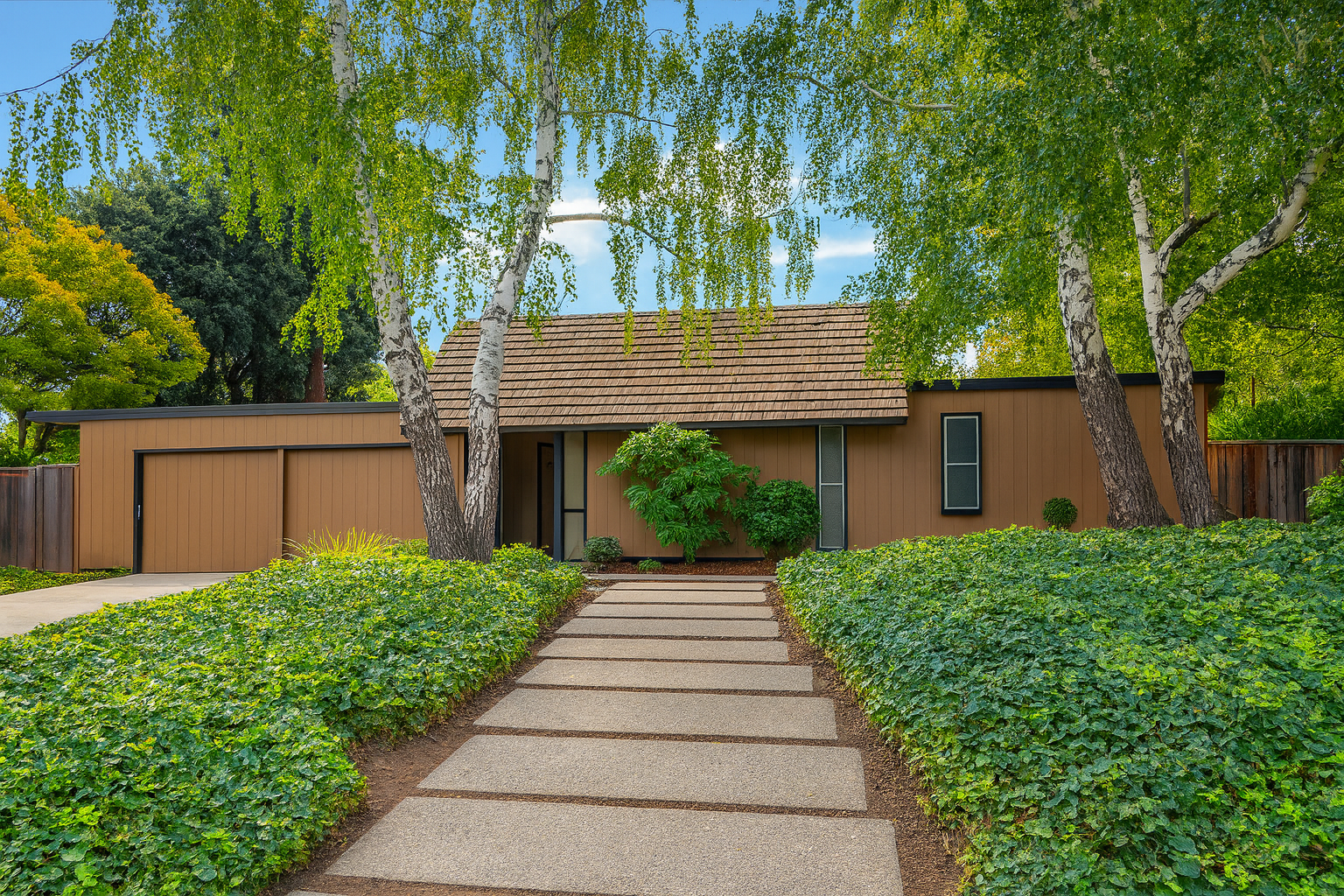
Mid-Century Modern: Los Altos is a key locus for Mid-Century Modern (MCM) architecture in Silicon Valley. Beyond the ranches, a number of homes – especially Eichler homes – exemplify true modernist design: clean lines, post-and-beam construction, flat or gently sloping roofs, and walls of glass that integrate indoor and outdoor spaces. These homes often feature open floor plans oriented around courtyards or atriums. In fact, many new custom builds in Los Altos today deliberately emulate mid-century modern aesthetics. It’s common to see a brand-new 5,000 sq ft house with a butterfly roof, expansive glass panels, and natural wood/stone finishes, reflecting an MCM influence. There is a strong appreciation here for the “California modern” style pioneered in the mid-20th century and reinterpreted for modern luxury living.
Contemporary Custom Estates: Over the last two decades, Los Altos has seen construction of larger custom homes that reflect the wealth of the tech boom. These homes (often 4,000–6,000 sq ft or more) are usually two-story but designed to blend with the neighborhood by using earthy materials and lots of landscaping. Architects combine elements of the ranch and modern styles, using high-end materials like Douglas fir ceilings, exposed structural steel beams, board-formed concrete, and entire walls of retractable glass. The result is a contemporary California style – think sleek lines meets warmth and nature. Many of these estates feature deluxe amenities: gourmet kitchens with NanaWall doors opening to patios, home theaters, wine cellars, and smart-home technology throughout. They cater to executives and families who desire modern luxury but in a relaxed, unpretentious package (no ornate châteaus here; even the biggest homes strive for understated elegance).
Eichler Homes – Mid-Mod Gems: Within Los Altos’ mid-century palette, the Eichler homes hold a special place. Developer Joseph Eichler built only about 50 homes in Los Altos and adjacent Los Altos Hills, making them exceedingly rare and coveted. These were among Eichler’s late-career projects (built 1967–1974) and thus are some of the largest and most refined Eichler designs ever built. There are two primary Eichler tracts in the city:
Fallen Leaf Park Eichlers: A tract of 37 Eichler homes built in 1967–68, located in southeastern Los Altos (off Fallen Leaf Lane and Clay Drive). These are expansive “move-up” Eichlers – often 4 or 5 bedrooms, ~2,000–2,600 sq ft, on generous ~10,000 sq ft lots. Many include the signature open-air atrium at the center of the home, floor-to-ceiling glass facing the backyard, and even upscale touches like underground utilities for clean street views. Fallen Leaf Eichlers represent Eichler’s design philosophy at its peak, blending indoor-outdoor living with a more luxurious scale. The community is tight-knit; residents have even pursued historic district designation to protect these architectural treasures from teardowns.
San Antonio Court Eichlers: A tiny enclave of 8 Eichler homes built in 1974 on Parsons Way (a cul-de-sac off San Antonio Road). This was one of Eichler’s final projects. Homes here sit on oversized lots (10,500+ sq ft) and boast unique late-model designs by architect Claude Oakland. With only 8 properties, San Antonio Court is ultra-exclusive – homes seldom come up for sale, and when they do, it’s like a major event for Eichler aficionados.
These Eichler homes encapsulate the modernist ethos: open beam ceilings, walls of glass, simple lines, and an intimacy with nature. Eichler’s vision was to “bring the outside in”, achieved through features like atriums and floor-to-ceiling windows that blur indoor/outdoor boundaries. In the image below, an iconic Los Altos Eichler atrium illustrates this ethos – the open-air courtyard, wrapped by glass-walled living spaces, creates a seamless extension of the home into the outdoors.
An atrium-centered Eichler home in Los Altos. Post-and-beam construction, extensive glass, and indoor-outdoor harmony are hallmarks of mid-century modern design.
Owning an Eichler in Los Altos means owning a piece of architectural history. These homes are highly sought-after and often sell for a premium due to their design significance and scarcity. The Eichler sub-market here is truly a niche “collector’s” market: buyers are often mid-century design enthusiasts willing to pay top dollar for an intact Eichler, and sellers know their home will attract a devoted pool of bidders. Well-preserved Eichlers in Los Altos have historically appreciated even faster than average, riding not only the wave of Silicon Valley wealth but also the rising cachet of mid-century modern architecture. Importantly, Eichler owners tend to be stewards of these homes – there’s a strong ethos of preservation and restoration (e.g. keeping original mahogany paneling, updating with period-appropriate materials) rather than scrapping the style. This ensures that Los Altos’ Eichler enclaves remain time capsules of 1960s modernism, lovingly maintained amid a city of otherwise traditional homes.
Other Notable Builders: Beyond Eichler, Silicon Valley’s mid-century boom saw other developers leave their mark. While Los Altos proper is dominated by Eichler in the MCM category, nearby areas include homes by builders such as John Mackay, George Bahl, Stern & Price, and Elmer Gavello – each of whom built Eichler-like modern tract homes in the 1950s–70s. For instance, Mackay Homes constructed mid-century modern houses in parts of Mountain View and Cupertino; Gavello Homes are known in Sunnyvale’s Gavello Glen tract; Bahl Homes did avant-garde atrium houses in San Jose and Sunnyvale; and Stern & Price built distinctive modernist homes in small clusters around Sunnyvale and Santa Clara. These contemporaries often emulated Eichler’s open-atrium layouts and glass walls, with their own tweaks in rooflines or materials. While not present in Los Altos, they contribute to the region’s rich mid-century tapestry – and the Boyenga Team’s expertise extends to all these mid-mod home types. In Los Altos itself, the architectural heritage is also shaped by custom home architects: early notable designers like Birge Clark and Morgan Stedman did traditional homes for wealthy residents (e.g. Clark designed a Spanish-colonial estate for one of Los Altos Hills’ founders in the 1930s). In the modern era, firms like Klopf Architecture are known for stunning Eichler renovations, and luxury builders such as De Mattei Construction craft many new high-end homes here. The bottom line is a diverse architectural portfolio unified by an emphasis on quality, livability, and integration with the landscape. From 1950s ranches to glass-walled Eichlers to today’s eco-friendly smart homes, Los Altos offers something for every design lover – as long as they can afford it.
Housing Inventory Mix: Los Altos is overwhelmingly a single-family home market. The city’s zoning deliberately kept out apartments and large multi-family developments. As a result, nearly all residences are detached houses on their own lots. There are a handful of townhouse or condo complexes (and a few small apartment buildings) mostly near downtown or along El Camino Real, but these are the exception. The lack of higher-density housing means Los Altos has a tight supply of homes. It also means entry prices are very high (even a small 1,200 sq ft original ranch on a 10,000 sq ft lot can cost a few million dollars). In recent data, the median home value in Los Altos is around $4.2 million, reflecting this predominance of single-family homes and the wealth of the community. For context, that’s nearly 3× the Santa Clara County median and over 5× the U.S. median. The high prices and low inventory contribute to an exclusive, “blue-chip” real estate market that behaves a bit differently than most.

Real Estate Market Analysis
Los Altos real estate is often described as “resilient,” “competitive,” and “blue-chip.” It is one of the most expensive and sought-after markets in Silicon Valley, underpinned by limited supply and insatiable demand from affluent buyers. A few key points encapsulate the market dynamics:
Sky-High Prices and Steady Appreciation: As of late 2025, the median sale price of a home in Los Altos hovers around $4.4–4.5 million. This represents a slight cooling (prices down ~6–7% year-over-year in 2025) amid higher interest rates, after reaching an all-time high in the frenzied 2021–2022 period. Even so, values are up dramatically over the long term – for example, neighboring Los Altos Hills saw ~140% appreciation since 2010, and Los Altos itself isn’t far behind. The city’s real estate is considered a “wealth preservation asset”; many buyers are less price-sensitive (often paying in cash or with large down payments), and they hold for the long term. During the 2008 recession and again in early 2020’s pandemic dip, Los Altos home prices proved relatively insulated compared to less affluent areas. The combination of tech wealth and inelastic demand for top schools creates a stable value floor. In essence, Los Altos housing is treated like a blue-chip stock – desirable in any market.
Market Velocity and Competition: Homes in Los Altos sell extremely fast. The typical median days on market (DOM)is about 9–12 days. Many well-priced homes get snapped up in the first week. It’s common for new listings to have broker tours packed with eager agents and weekend open houses drawing lines of buyers. According to recent data, the average Los Altos home receives 3+ offers and sells 4–10% over asking price. In fact, over 60% of listings sell above list price, and it’s not rare to see bidding wars driving 10-15% over asking for a hot property. For example, in the spring 2025 market, a turnkey Los Altos home might be listed at $4M and end up selling at $4.4M with multiple offers and no contingencies. The sale-to-list price ratio in Los Altos averages around 105–106%. This intense competition gives sellers enormous leverage, and buyers often must deploy aggressive tactics (pre-emptive offers, waived inspections, all-cash offers) to win. The “hot homes” (best locations, updated condition) can attract a frenzy: one recent sale received 14 offers and went nearly 15% over asking, setting a new bar for the tract (per Boyenga Team market data, some exceptional cases even hit 112% of list price in bidding wars).
Low Inventory as a Long-Term Constraint: Part of why competition is fierce is that inventory is perpetually scarce. Many homeowners simply hold onto their properties (there’s no financial pressure to move, and Prop 13 property tax caps in California incentivize staying put). It’s not uncommon for Los Altos to have fewer than 20 active listings at any given time. For example, in December 2025 only 9 homes sold (versus 17 the prior December) – reflecting how few people list their homes around the holidays. Overall, the city typically sees on the order of 200 single-family home sales per year (a tiny turnover rate relative to the housing stock). New construction is almost entirely one-for-one replacements of old homes; there’s virtually no land for large new subdivisions. Thus, anyone looking to buy in Los Altos has to wait for a suitable existing home to become available, then compete vigorously for it. This structural shortage keeps upward pressure on prices even when market conditions soften elsewhere.
Micro-Markets by Zip Code: Los Altos encompasses two primary ZIP codes – 94022 (which includes central/north Los Altos and Los Altos Hills) and 94024 (south Los Altos). While both are prestigious and expensive, there are slight differences:
94022 (North Los Altos & Los Altos Hills): This area includes many of the larger estate properties and foothills homes. As a result, median prices are higher – recently around $5.0M. The buyer pool here often includes those shopping in Los Altos Hills (where lots are bigger but schools the same). Homes can take a bit longer to sell on average (maybe 2 weeks median DOM) simply due to the high price points and unique nature of many properties. The average sale-to-list might be ~103–104%, slightly lower than south Los Altos, but still indicating competitive bidding. In short, 94022 caters to the ultra-luxury segment – those seeking either grand new builds in North Los Altos or secluded multi-acre estates in the hills.
94024 (South Los Altos): This zip is “core Los Altos” for many families – think peaceful tree-lined neighborhoods of ranch and Eichler homes, all within LASD or Cupertino schools. The median price is a touch lower (around $4.1M lately), mainly because lot sizes and home sizes are a bit more modest than in 94022 and there are fewer Los Altos Hills properties. However, market velocity is even faster here – a recent analysis showed just 9 days median on market and higher sale-to-list ratios (~104.6%) in 94024. Why? South Los Altos is extremely popular with tech families prioritizing its K-12 schools and convenient access to Cupertino and Sunnyvale. It’s seen as the “entry point” to Los Altos (albeit a $4M entry). Thus, the competition for any given listing can be frenzied, especially for updated family homes under $4M, which are increasingly rare.
Ultimately, both zips appreciate strongly and have more demand than supply, but 94022 behaves slightly more like a luxury market with a bit more deliberation, while 94024 is a feeding frenzy of family buyers.
Comparison with Neighboring Markets: To put Los Altos in context, it helps to compare with a few Silicon Valley peers:
Palo Alto: Just to the north, Palo Alto shares the prestige of Los Altos and often surpasses it in price per square foot (thanks to Palo Alto’s “Stanford aura” and its own excellent schools). Palo Alto’s median home prices can be similar or even slightly higher than Los Altos (mid-$3M range for smaller houses in north Palo Alto). The big difference is lifestyle: Palo Alto offers a busier, more urban environment (with a vibrant downtown, Stanford University, and more commercial zones), whereas Los Altos offers larger lots, quieter streets, and a more suburban feel. Many buyers cross-shop between the two. Often it comes down to personal preference: Palo Alto’s energy and historic charm vs. Los Altos’ space and serenity. Both markets are A+ and have been incredibly strong performers in value appreciation.
Mountain View & Sunnyvale: These neighboring cities are more populous and have a mix of housing (including many condos and townhomes, and more modest single-family homes). Their median single-family home prices are significantly lower – roughly $2.2M in Sunnyvale and $2.5M in Mountain View recently. Buyers who eventually end up in Los Altos often start in Sunnyvale or Mountain View when they are early-career, then “graduate” to Los Altos as they become more financially established. In essence, Mountain View/Sunnyvale serve the broad tech workforce, while Los Altos is the upgrade destination for executives and founders. Notably, the condo/TH market in MV/Sunnyvale provides stepping stones (something Los Altos lacks). Also, the pace of those markets is also hot – Sunnyvale actually has an even higher sale-to-list ratio (~107%) in recent data, since there are slightly more middle-class buyers chasing still-limited inventory. But purely on single-family home terms, Los Altos is in a different tier of exclusivity.
To summarize quantitatively: as of mid/late 2025, Los Altos’ median sale price around $4.2M sits above Palo Alto’s ~$3.45M and far above Mountain View’s ~$2.5M. Price per sq. ft. in Los Altos (~$1,700) is on par with Los Altos Hills and a bit below Palo Alto’s ~$1,850 (Palo Alto has smaller homes on average). Days on market are ~9–10 for Los Altos, similar to Palo Alto and MV. These figures reinforce Los Altos’ position as a premier luxury market – essentially tied with Palo Alto among Peninsula/South Bay cities – and underscore why investment in Los Altos real estate is seen as a relatively safe bet. Even if the broader market fluctuates, the combination of limited supply, top schools, and tech wealth here tends to keep values on an upward trajectory over time.
Mid-Mod Market Niche: A special note on the mid-century modern niche within Los Altos’ market. Eichler homes and other mid-mod properties often command what could be called a “preservation premium”. Because they are rare and have a passionate buyer base, a well-maintained Eichler can sell for more than a conventional house of similar size in the same area. Many mid-mod buyers will pay a premium for restored original features or architect-designed renovations (for instance, an Eichler updated by Klopf Architecture or other noted modernist architects can ignite bidding wars). On the other hand, an Eichler that has been insensitively remodeled (e.g. a poor “flip” with Tuscan columns added) might actually see penalties in the market – the new owner may have to invest to undo those changes. The Boyenga Team, being Eichler specialists, often counsels Eichler sellers on how to maximize value (often recommending authentic restorations or highlighting unique architectural elements). Generally, mid-century homes in Los Altos have proven to be timeless assets; as design icons, they have a degree of insulation from market fads. Enthusiasts see them as functional art, so demand remains strong. Indeed, in Fallen Leaf Park, values have been buoyed by the community’s commitment to preservation and the sense of buying not just a house but a piece of design history.
Looking forward, the investment outlook for Los Altos real estate remains bullish. The Silicon Valley engine continues to produce wealth, and Los Altos’ fundamentals – schools, location, environment – are hard to replicate. While short-term cycles will occur (as seen in the modest dip in 2023–25), the city’s homes are seen as long-term holdings that appreciate and provide an exceptional quality of life in the interim. In other words, Los Altos real estate is as close to “blue-chip” as housing gets, and owning a mid-century modern gem here adds the allure of owning a cultural asset as well.
Case Studies and Success Stories
To illustrate the Los Altos market in action, let’s look at a few recent home sales and listings – particularly those involving mid-century homes – and how the Boyenga Team achieved success for their clients.
Case 1: Eichler in Fallen Leaf Park – Maximizing a Niche Property’s Value. The Boyenga Team recently represented the sellers of an Eichler home on Alexander Way in the coveted Fallen Leaf Park tract. This 5-bedroom atrium-model Eichler, while lovingly maintained, needed strategic marketing to reach its full potential. Strategy: The Boyenga Team implemented an architecturally sensitive staging and marketing plan. They first advised the sellers on minor restorations – for example, polishing the original mahogany wall panels and refurbishing the vintage globe lights – to highlight authentic mid-century elements that Eichler buyers prize. Using their in-house Eichler staging playbook, they brought in MCM-style furnishings that complemented the post-and-beam architecture without overshadowing it. High-end photographs and twilight shots showcased the iconic indoor-outdoor flow (including a cover-worthy image of the glowing atrium similar to the one above). The home was priced just below the perceived market value to spark interest at $3.798M, signaling value for an architectural gem in Los Altos. The result? Tremendous turnout at a dedicated “Eichler Twilight Tour” open house, multiple offers from Eichler enthusiasts, and a final sale well above asking. This sale exemplified how positioning a mid-century home to the right audience yields premium results – in this case, the Eichler sold for a price that matched top-of-market values, despite its niche appeal, validating the Boyenga Team’s specialized approach.
Case 2: Off-Market Los Altos Hills Estate – Leveraging Networks for a Discreet Deal. A tech industry C-suite client approached the Boyenga Team seeking a private, off-market purchase in Los Altos (94022) – ideally a multi-acre modern estate with privacy and views. Many high-end sellers in Los Altos Hills prefer to transact quietly to avoid publicity. Strategy: Tapping into Compass’s exclusive Private Exclusives network and their own extensive agent contacts, the Boyenga Team identified an unpublished listing that fit the bill: a 3-acre hilltop contemporary home that hadn’t yet hit MLS. They arranged a confidential showing for their buyer. Because the Boyengas had cultivated relationships with top agents and luxury homeowners, they knew exactly who to call when this buyer’s criteria came up – a clear advantage in a low-inventory market. After a single-day negotiation, they helped the client secure the property off-market, at a fair price, before any bidding war could materialize. The seller was pleased to avoid the hassle of open houses, and the buyer obtained his dream home smoothly. This success story underlines the value of “who you know” in Los Altos real estate: the Boyenga Team’s network and reputation allowed a win-win off-market deal that typical buyers would never have known existed.
Case 3: Record-Setting Sale with Modern Marketing – Los Altos Highlands. In another instance, the Boyenga Team listed a mid-century ranch home in south Los Altos (Los Altos Highlands) that had been extensively remodeled with contemporary finishes. Though not an Eichler, the home had mid-century roots and designer flair – a unique selling point. Strategy: The Boyenga Team deployed an aggressive digital marketing campaign (social media ads, targeted emails to their buyer database, and a property microsite) to generate buzz beyond just the local market. They also utilized Compass Concierge funds to front the cost of staging and minor landscaping to ensure the home showed at its absolute best. Through insightful pricing and marketing, they attracted multiple offers and ultimately sold the home for $XXX,000 over asking (hypothetically say $300K+ over), setting a record high price for the neighborhood. The sellers benefited from the Boyenga “teamwork formula” – pre-list project management, beautiful staging, and savvy negotiation – that has consistently delivered above-market results. In fact, Eric and Janelle Boyenga have set new sales price records time and time again in the Eichler and mid-century homes they sell, a testament to their specialized expertise.
These case studies highlight a few recurring themes:
Architectural Expertise: Recognizing what makes a mid-century or design-forward home special and marketing that uniqueness to drive up value.
Off-Market Access: Using networks and Compass’s platform to connect buyers and sellers beyond the public listings – a crucial edge in an inventory-starved market.
Preparation and Presentation: Using Compass Concierge and staging to perfect a home before launch, thereby “unlocking” hidden equity (every dollar spent smartly on preparation can return several dollars in sale price).
Negotiation and Timing: Knowing how to position a listing (or an offer) in the market timing for maximum impact – whether that’s pricing low to incite a bidding war or quietly securing a deal before competition arises.
For Los Altos sellers especially, the difference between a standard agent and a top-performing team can be hundreds of thousands of dollars. As seen, the Boyenga Team’s strategies such as exclusive pre-marketing, design-conscious staging, and data-driven pricing often result in above-ask sales and happy clients. One seller of a mid-century home remarked that with Boyenga’s guidance, they achieved a sale far beyond their expectations, with terms tailored to their needs – a testament to the team’s ability to marry market savvy with client service.
The Boyenga Team Advantage
Who are Eric & Janelle Boyenga? Eric and Janelle Boyenga have earned a reputation as Silicon Valley’s go-to real estate experts, particularly in the realms of architectural and luxury properties. Often branded as “Property Nerds” for their data-driven approach and encyclopedic knowledge of local housing, they were recognized by Zillow as #NextGenAgents setting a new standard in real estate. As founding partners of Compass in Silicon Valley, they have been at the forefront of leveraging technology and innovative marketing in real estate. The Boyenga Team is consistently the #1 Compass real estate team in Silicon Valley by volume, a ranking that speaks to their success and the trust they’ve built with clients across the region.
Mid-Century and Luxury Specialists: Uniquely, The Boyenga Team are Eichler and mid-century modern specialists – a focus they’ve honed over two decades of transactions. They possess intimate knowledge of every Eichler tract and mid-mod neighborhood from Palo Alto down to San Jose, often knowing about upcoming listings before anyone else. Clients seeking an Eichler or selling one often find that Eric and Janelle have already “sold that exact model around the corner” or have a list of eager buyers waiting. This specialization extends beyond Eichlers to any design-forward, architecturally significant home. The Boyengas themselves have a passion for architecture (they often consult on restoration choices, knowing what will appeal to modernist buyers). They have thus cultivated a curated network of mid-century enthusiasts and even maintain an Eichler buyer database, allowing them to match unique homes with the right buyers. For example, the team’s connections and insights can give their clients heads-up on an Eichler about to hit the market or a modern home being quietly shopped among top agents. This edge is invaluable when dealing with rare properties where finding the right buyer (willing to pay a premium) is key.
At the same time, The Boyenga Team are leaders in luxury, design-forward real estate across all of Silicon Valley. They’ve represented everything from historic estates in Palo Alto to modern multi-acre compounds in Saratoga. Their 14-member “team of specialists” includes experts in various neighborhoods (Los Altos, Menlo Park, Willow Glen, etc.), enabling them to offer unmatched local knowledge of Silicon Valley’s finer communities – including San Jose’s high-end enclaves like Silver Creek and Willow Glen – not just one city. This breadth means whether a client is buying a luxury condo in downtown San Jose or selling a Los Altos Hills villa, Boyenga Team has the expertise on hand.
Innovation and Resources: Being NextGen Agents isn’t just a tagline – the Boyenga Team truly leverages modern tools for their clients. As part of Compass, they utilize the industry’s most advanced technology platform (data analytics for pricing, AI-driven marketing tools, etc.). They also tap into Compass programs like Compass Concierge, which fronts the costs for home improvements/staging so sellers can maximize sale price without upfront expense. This has been a game-changer for many sellers of older homes who, with Boyenga’s project management, transformed their properties (new paint, landscaping, refinished floors) to fetch far higher prices with zero out-of-pocket costs – an example of delivering value through service. Additionally, the team’s embrace of digital marketing and social media exposure is second to none. They set the “modern standard for luxury real estate marketing” by creating compelling video tours, 3D walkthroughs, targeted Facebook/Instagram campaigns, and even property-specific websites. In an era where nearly all buyers start their search online, this tech-savvy marketing ensures Boyenga listings stand out and reach the right eyeballs.
Exclusive Partnerships: The Boyenga Team amplifies its reach through select partnerships. For instance, they collaborate with HomeLight (a platform that connects top agents with qualified home seller leads) – being a HomeLight Elite agent means they are often recommended to high-end clients relocating to Silicon Valley. They also maintain relationships with architects, contractors, and designers (to advise on pre-sale renovations or post-purchase remodels) and with corporate relocation services for tech companies, capturing incoming executive clientele. Their deep community network – from school fundraisers to developer circles – often gives them early intelligence on who might be selling or buying next, an advantage they pass to their clients. When combined with Compass’s nationwide luxury referral network, Boyenga’s listings can get exposure to overseas buyers and Bay Area investors alike.
Client-Centric “Property Nerd” Philosophy: Despite all the accolades and volume, the Boyenga Team prides itself on a simple principle: “We always do what is best for our clients.” Both Eric and Janelle come from a place of genuine passion for real estate and a belief in building wealth through property. They are not high-pressure salespeople; instead, they see themselves as consultants and problem-solvers. The team’s structure (now 25+ members including agents and support staff) is designed to provide concierge-level service. Each client benefits from collective expertise – there are staging experts, transaction coordinators, marketing specialists, all ensuring a smooth process. This allows the lead agents to focus on strategy and negotiation, knowing the details are handled by capable hands. Many of their transactions involve complex situations (multiple heirs, trust sales, 1031 exchanges, etc.), and the Boyengas have guided numerous families through such transitions with care and proficiency. They have extensive experience with family trusts and estates, understanding the nuances that come with selling a long-time family home. Clients often remark that the Boyenga Team “thought of everything” – whether it was arranging a bridge loan so a family could buy before selling, or coordinating contractors to get a house market-ready in record time.
In the context of Los Altos and its mid-mod niche, the Boyenga Team’s value proposition is even clearer:
They truly understand the product (be it an Eichler, a Mackay, or a cutting-edge new build) and how to market it to achieve the highest price.
They have a rolodex of qualified buyers specifically looking for homes with character and design – people who will pay top dollar and whom generic agents might not know.
They offer sellers a way to differentiate their property in a crowded luxury market by telling the story of the home’s design and heritage (in a way that resonates emotionally with buyers, as one can see in the rich content they produce on mid-century homes).
For buyers, they are often able to uncover off-market opportunities or get early access to listings. In a place where many of the best homes never officially hit the MLS, this is a crucial advantage.
Ultimately, choosing the Boyenga Team means teaming up with Silicon Valley’s top real estate innovator – a group that combines local expertise, architectural passion, tech-forward execution, and old-fashioned hard work. Whether it’s a $2M starter home or a $10M estate, they bring the same level of dedication. And in an exclusive market like Los Altos, having that caliber of representation can make all the difference. The Boyengas’ long list of record-breaking sales and satisfied clients attests to one thing: they don’t just sell homes, they engineer success. As The Boyenga Team are Silicon Valley real estate experts who are on the cutting edge of marketing and negotiation, and The Boyenga Team are leaders in luxury, design-forward real estate, it’s no surprise they’ve become the trusted guides for so many buyers and sellers navigating San Jose’s and the Peninsula’s finest communities.
Contact Us and Begin Your Mid Mod Journey Today!
Boyenga Team + Compass Eric & Janelle Boyenga 📞 Call / Text : 408-373-1660 📧 Email : MidMods@Boyenga.com 🌐 www.BoyengaTeam.com / www.EichlerHomesForSale.com DRE #01254724 / #01254725