
Sunnyvale — A Mid-Century Modern Powerhouse in Silicon Valley
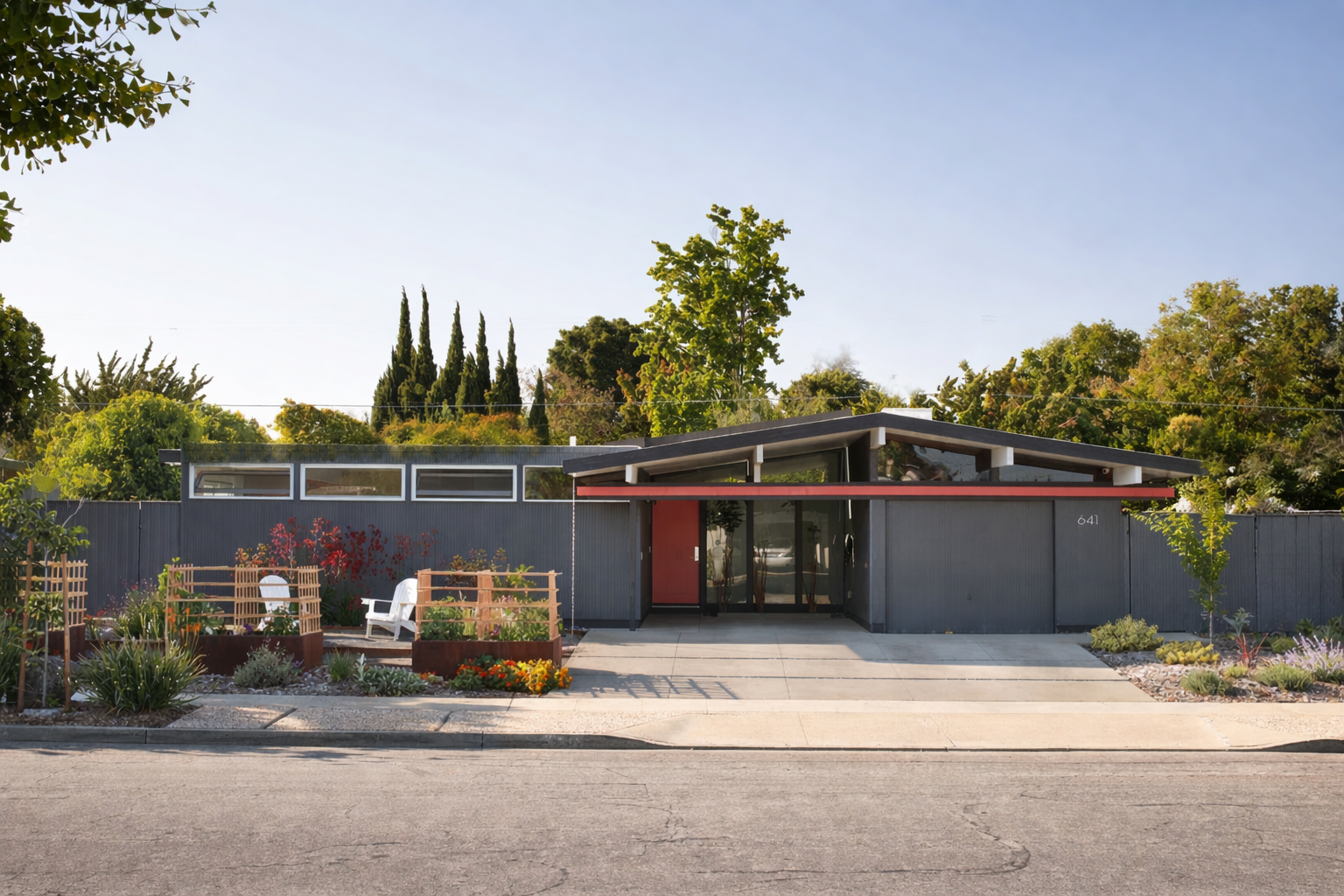
Sunnyvale, California – long known as a cradle of Silicon Valley innovation – also harbors a treasure trove of mid-century modern homes. In this in-depth profile, we explore Sunnyvale’s Eichler enclaves and other mid-mod neighborhoods across key ZIP codes (such as 94087 and 94086), tracing their post-war origins and evolution into one of Silicon Valley’s most desirable lifestyle destinations. We delve into the area’s history, demographic makeup, schools, amenities, architectural highlights, real estate trends, and the role of local experts Eric and Janelle Boyenga – Silicon Valley real estate experts with a specialty in Eichler and mid-century modern homes – in shaping success stories for buyers and sellers. From the historical meeting of tech icons on an Eichler-lined street to today’s million-dollar listings selling in weeks, Sunnyvale’s mid-century neighborhoods offer a case study in blending design-forward living with high-tech prosperity.
Historical Overview: From Orchards to Eichlers and Tech Hub
Origins and Early Development: What is now the city of Sunnyvale began as fertile agricultural land in the late 19th and early 20th centuries – part of the “Valley of Heart’s Delight” famous for orchards of cherries, apricots, and plums. Sunnyvale’s first growth spurt came with the railroad and the defense industry (Joshua Hendy Iron Works relocated here in 1906). After incorporation in 1912, Sunnyvale remained a modest farm town for decades. Post-WWII, however, the city transformed dramatically. The late 1940s and 1950s saw an urgent need for housing as veterans returned home and the Bay Area’s population swelled. Sunnyvale’s wide-open tracts of former orchard land were ripe for suburban development, setting the stage for visionary builders like Joseph Eichler.
The Eichler Era: In 1949, Eichler Homes constructed its very first tract of modern houses right here in Sunnyvale. The inaugural development, Sunnyvale Manor I at East Maude Avenue and N. Bayview, introduced the region to Eichler’s radical concept: affordable, stylish homes inspired by modernist principles. Eichler – a progressive developer influenced by Frank Lloyd Wright – partnered with architect Robert Anshen to design these flat-roofed, glass-filled homes that blurred the line between indoors and outdoors. By the mid-1950s, Eichler was building multiple tracts in Sunnyvale, helping turn former orchards into sleek subdivisions of Mid-Century Modern houses. Notably, the Fairorchard tract (circa 1954–1956) in southwest Sunnyvale was among Eichler’s first large projects here. Each Eichler home featured open-beam ceilings, floor-to-ceiling windows, atriums or courtyards, radiant-heated concrete floors, and an open-plan layout – a futuristic departure from conventional ranch houses. Eichler’s vision was not just architectural but also social: he insisted on selling homes to anyone regardless of race or religion, a stance that led him to resign from the Home Builders Association in 1958 when they wouldn’t support his non-discrimination policy. Sunnyvale thus became an early model of inclusive suburban development.
Key Transformations Over the Decades: The late 1950s through 1960s brought explosive growth to Sunnyvale. High-tech and defense firms arrived – most famously Lockheed Missiles & Space opened a massive campus in 1956 – drawing an influx of engineers and middle-class professionals who needed housing. Eichler homes, with their “California modern” allure, attracted many of these tech families. Sunnyvale ultimately amassed 1,100 Eichler homes across 16 distinct tracts – the second-largest concentration of Eichlers in California after Palo Alto. The city even adopted special design guidelines and single-story zoning overlays in Eichler neighborhoods to preserve their mid-century character. By the 1970s, Sunnyvale was transitioning from its farming roots into a fully suburbanized city at the heart of “Silicon Valley.” Notably, one humble Sunnyvale Eichler on Edmonton Avenue was home to a young Steve Wozniak in the early ‘70s. It was in that Fairorchard neighborhood living room that Wozniak first met Steve Jobs – a fateful friendship sparked in an Eichler house that would help launch Apple Computer. This almost mythic moment underscores how Sunnyvale’s modern neighborhoods were incubators not only of architectural innovation but of technological revolution.
Through the 1980s and 1990s, Sunnyvale’s growth continued with the rise of semiconductor and software industries. Older industrial sites gave way to new offices and shopping centers. City planning emphasized a balance of residential neighborhoods and tech parks. By the 2000s, Sunnyvale had fully matured as a tech hub in its own right – home to major campuses of companies like Yahoo (established headquarters here in the 1990s) and later LinkedIn, Google, Apple, and more. Yet even amid expansion and infill development, the mid-century enclaves remained largely intact, protected by committed homeowners. In the mid-2010s, Sunnyvale residents in several Eichler tracts successfully petitioned for single-story zoning to prevent “monster” two-story rebuilds that would loom over their iconic low-profile homes. This grassroots preservation effort speaks to the community’s fierce pride in its architectural heritage. Today, driving through neighborhoods like Fairbrae, Cherry Chase, or Ponderosa Park, one can see lovingly maintained Eichlers, Bahl Patio Homes, and other mid-mod houses, often with original design features. Sunnyvale’s evolution – from orchards to aerospace to software – has layered new chapters onto the city, but the mid-century modern aesthetic remains a defining element of its identity.
Notable Figures and Developments: Beyond Joseph Eichler (who unquestionably shaped Sunnyvale’s suburban landscape), other builders also left their mark. In the mid-1950s, Elmer Gavello developed a small pocket of modern homes known as Gavello Glen in the Ponderosa Park area. Collaborating with Eichler’s architects Anshen & Allen, the Gavello brothers built atrium-like post-and-beam homes around Quail, Ponderosa and Snapdragon streets. These Gavello homes closely echo Eichler designs (low-pitched A-frame roofs, open beam ceilings), to the point that if you spot a mid-century home in Sunnyvale’s Ponderosa district that isn’t in an Eichler tract, odds are it’s a Gavello Home. In the late 1950s through 1960s, a boutique developer duo Stern & Price also contributed to Sunnyvale’s modernist tapestry. Stern & Price built custom MCM homes on scattered lots – for example, a handful along Quail Avenue and Daffodil Way – blending ranch practicality with Eichler-like style. Their houses featured L- or U-shaped layouts, central patios, and low-slung roofs, offering a more understated (but highly livable) take on modern design. Another local innovation was the Bahl Patio Homes: in the late 1960s, developer George Bahl created intimate courts of homes (including a couple of cul-de-sacs off Mary Avenue and Fremont Avenue in Sunnyvale) where each house is wrapped around a private courtyard. These Bahl homes, typically 3-bed/2-bath ~1,500 sq ft, achieved privacy by orienting toward their interior patios and often present a blank facade to the street – a design that feels like a cousin of Eichler’s atrium concept.
By the 1970s and 1980s, Sunnyvale’s residential construction shifted toward more conventional tract homes and apartments as most land was built out. However, the legacy of those mid-century pioneers endures. The presence of historic Eichler tracts (like Fairbrae, with its community pool and swim club built in 1958) and other modern gems gives Sunnyvale a unique architectural charm compared to many Silicon Valley suburbs. Even new developments sometimes nod to this heritage; for instance, the city’s fire stations were designed in mid-century modern style, and the downtown revitalization has incorporated modernist public art. In summary, Sunnyvale’s neighborhood landscape was indelibly shaped by the modernist movement of the mid-20th century, and through conscious community efforts it continues to celebrate that history amidst the ever-changing currents of tech-driven growth.
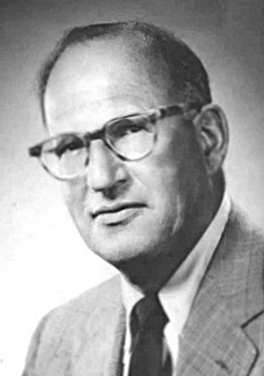
Joseph Eichler, Revered Eichler Architect
Demographic and Socioeconomic Profile
Population and Growth: As of mid-decade, Sunnyvale’s population stands at approximately 153,000 people. The city experienced steady growth over the past decade – up about 12.4% since 2010 – fueled by the booming tech economy and job opportunities drawing newcomers from across the U.S. and abroad. The median age in Sunnyvale is a youthful 35, reflecting the influx of working-age professionals and young families. This population is notable not just for its size but for its international character. Nearly half (49.3%) of Sunnyvale’s residents were born outside the United States, giving the community a distinctly global flavor. You’ll hear languages from Mandarin to Hindi to Spanish spoken in local parks and see a rich tapestry of cultural influences in Sunnyvale’s restaurants and festivals.
Ethnic and Cultural Diversity: Sunnyvale is one of the most diverse cities in Northern California. Roughly 49% of residents are Asian (predominantly of Indian and Chinese heritage), about 27–28% are White (non-Hispanic), and 16–17% are Hispanic/Latino, with smaller percentages of African American and other groups. This diversity far outpaces national averages – for instance, Asians comprise 49% of Sunnyvale’s population versus just 5.7% of the U.S. overall. The city’s diversity is a relatively recent phenomenon, coinciding with the tech industry’s rise. In the 1970s Sunnyvale was majority white; today it is a minority-majority city, thanks to immigration and the draw of Silicon Valley jobs. The large South Asian community has given rise to numerous Indian grocery stores and eateries along El Camino Real, while East Asian influence is seen in the city’s active Chinese language churches and Japanese cultural events. Sunnyvale celebrates this melting pot with events like the Lunar New Year festivities and Diwali celebrations, reflecting the city’s inclusive ethos (one that dates back to Eichler’s non-discrimination stance in housing).
Educational Attainment and Income: The residents of Sunnyvale are among the most highly educated in the nation – a testament to the types of industries (tech, engineering, biotech) centered here. Nearly 70% of adults have a bachelor’s degree or higher – an astonishing figure compared to about 34% statewide. In fact, 30% of Sunnyvale adults hold a graduate or professional degree, three times the national average. This brainpower translates into high earning power. The median household income in Sunnyvale is around $181,000 per year, placing it among the top tier of U.S. cities. (By comparison, the U.S. median household income is roughly $70,000.) A staggering 45% of households earn over $200,000 annually. These affluent professionals are often dual-income tech couples or entrepreneurs. At the same time, only about 5–6% of residents live below the poverty line, and Sunnyvale’s unemployment rate hovers around a low 3–4% in recent years. In short, this is a prosperous community with a solid tax base and high standard of living.
Socioeconomic Trends – Tech-Driven Shifts: The dominance of the tech sector has profoundly shaped Sunnyvale’s socioeconomics. Over the last two decades, there’s been a significant “tech migration” – thousands of software engineers, data scientists, and other professionals relocating from across the U.S., India, and China to take jobs at nearby companies. As a result, neighborhoods that once housed blue-collar aerospace workers are now home to Google, Apple, Amazon, or Meta employees (all of whom have large offices or labs in Sunnyvale). The city’s largest employers include Google (14,000+ employees in Sunnyvale), Apple (~12,500), Amazon (~6,500), along with long-time anchors like Lockheed Martin (3,300) and newer firms like Intuitive Surgical (4,100). This influx of high-income buyers has inevitably driven up housing prices (as explored in the Real Estate section) and contributed to a degree of gentrification. Some longtime residents have cashed out, selling their modest 1950s homes to younger wealthier families who either extensively remodel or rebuild. However, Sunnyvale’s approach to growth has also been to encourage dense developmentin certain areas (e.g., high-end apartments and townhomes near the Caltrain station and along major corridors), so that not every new employee competes for a single-family home.
One noteworthy demographic pattern is the presence of multi-generational households – it’s not uncommon in Sunnyvale to find families where tech professionals in their 30s live with aging parents or where multiple roommates share a house, due to both cultural preferences and the high cost of housing. The city’s foreign-born population and diversity also mean Sunnyvale is a place where global talent congregates; it’s routine to meet people in Sunnyvale who grew up in Bangalore, Beijing, or Moscow and came here for work. This rich human capital is a boon to local schools and community life, but it also brings the challenge of ensuring the cultural fabric remains cohesive. So far, Sunnyvale has managed to maintain a friendly suburban character – it’s a place where a high-paid engineer and a retired orchard farmer’s family might chat at the Saturday farmers’ market, or where Diwali fireworks and Christmas lights adorn the same cul-de-sac. Sunnyvale today exemplifies the modern Silicon Valley story: hyper-educated, high-earning, diverse, and shaped by the ever-churning forces of the global tech economy

School Districts and Education Landscape
One of Sunnyvale’s major draws for homebuyers is its strong education system – a factor that continually bolsters real estate values in mid-mod neighborhoods. Uniquely, the city is served by multiple highly regarded school districts, and the specific district often depends on your address (something every buyer pays close attention to).
Public School Districts: Sunnyvale spans four public school districts – two for elementary/middle schools and two for high schools. The Sunnyvale School District (SSD) serves much of the city for K-5 and middle school, while parts of west Sunnyvale fall under the Cupertino Union School District (CUSD) (which has a few campuses in Sunnyvale). For high school, the division is between Fremont Union High School District (FUHSD) (covering most Sunnyvale students) and Santa Clara Unified School District (SCUSD) (which includes some northeastern neighborhoods). What this means is that a family buying in Sunnyvale might end up with “Cupertino schools” on one side of town versus “Sunnyvale schools” on another – a key factor in homebuyer decisions.
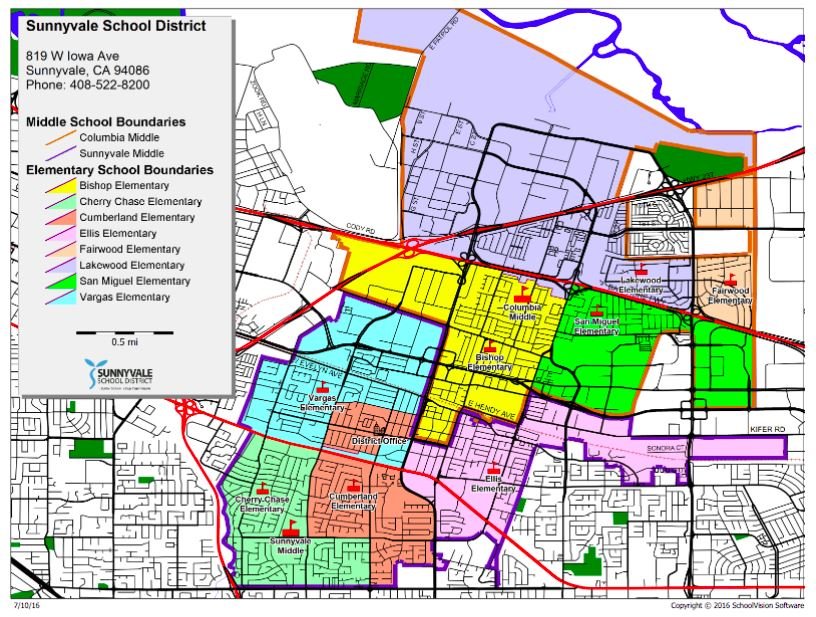
In the southwest corner (e.g. the Fairorchard Eichler tract and nearby areas, ZIP 94087), children attend top-ranked Cupertino Union schools: West Valley Elementary, Cupertino Middle, and then Homestead High(FUHSD). These schools have excellent reputations – Homestead High, for example, boasts a 9/10 rating with GreatSchools and is an academic powerhouse known for sending graduates to elite universities. It’s also the alma mater of Apple’s Steve Jobs. The promise of Homestead High and other Cupertino-led schools continues to draw families into these neighborhoods.
Central Sunnyvale and the Cherry Chase area (ZIP 94087/94086) are served by the Sunnyvale School District (for K-8) feeding into Fremont High School (FUHSD). Cherry Chase Elementary is one of SSD’s crown jewels (rated 8/10), and Cumberland Elementary and Sunnyvale Middle School also perform well. Fremont High (located in Sunnyvale) offers strong programs (7/10 rating) and has seen rising achievement, though it doesn’t have quite the cachet of Homestead or Cupertino High. Nonetheless, many Eichler neighborhoods like Fairbrae and Birdland fall in this district and still command premium prices, in part due to these improving schools and convenient location.
In north and east Sunnyvale (ZIPs like 94085 and 94089, e.g. Lakewood area or around Fair Oaks), some homes lie in the Santa Clara Unified district, feeding into schools like Bishop Elementary or Ponderosa Elementary and Peterson Middle, then Wilcox High or Santa Clara High. These schools historically had more moderate ratings (elementary scores ranging from 6 to 8, high schools ~7-8/10). However, they too have benefited from demographic changes and investment; test scores have risen and programs like STEM academies have been introduced. For instance, Ponderosa Elementary (near the mid-century Ponderosa Park tract) rates around 6/10 – not elite, but solid – and Wilcox High in Santa Clara now often outperforms state averages.
School Performance and Impact on Real Estate: Because of this patchwork, Sunnyvale homebuyers are very mindful of school boundaries. Houses on one side of a street may fetch higher prices if they’re assigned to Cupertino schools versus a house across the street in Sunnyvale SD. For example, an Eichler in Fairbrae zoned for Cherry Chase Elem and Fremont High will still attract strong demand (as those are good schools), but an Eichler a few blocks west in Cupertino SD (Stocklmeir Elem, Cupertino Middle) might see even more intense bidding due to the “Cupertino effect.” The city’s median household income and parental education levels translate into active PTA support and enrichment in all districts, so Sunnyvale’s public schools overall are high quality. GreatSchools ratings for the 14 elementary schools range from 4 to 9, with seven schools scoring 7 or above. Middle schools (Sunnyvale Middle, Columbia Middle, Peterson, Cupertino Middle) similarly range roughly 6 to 8 out of 10. On the upper end, Cupertino Middle School (which some Sunnyvale kids attend) scores 7/10 overall with a stellar 10/10 in test scores, reflecting its top-tier status. High schools tell a similar story: Homestead High (FUHSD) is a California Distinguished School and rates 9/10 (with perfect 10s in college readiness and state tests). Fremont High is rated lower (7/10 overall) but still boasts strong advanced placement programs and a new STEM center on campus. Wilcox High (SCUSD, serving some Sunnyvale students) is 8/10 and known for its athletics and engineering programs.
For homebuyers eyeing mid-century neighborhoods, these distinctions can influence strategy: The Eichler tracts in Sunnyvale’s 94087 ZIP (like Fairbrae, Cherry Chase) combine unique architecture and access to great schools – a potent combo that keeps prices high. By contrast, a mid-mod home in 94085 (e.g. around Morse Park) might be more affordable but comes with a different school set (San Miguel Elementary, which is improving but rated 6/10, feeding to Columbia Middle and Fremont High). Many families weigh these trade-offs, sometimes opting to purchase in a slightly less expensive tract and invest in private school or after-school enrichment, or conversely stretching their budget to get into a particular school feeder pattern.
Notable Private Schools: Sunnyvale also offers respected private education options. The King’s Academy, a Christian college-prep high school, is located in Sunnyvale and draws students from all over Silicon Valley. Challenger School and Stratford School have campuses in Sunnyvale for K-8 with rigorous academic curricula popular among tech families. There are also faith-based schools like Sunnyvale Christian and St. Cyprian for elementary. These private options provide alternatives, though the strength of the public schools means many families happily choose the public route.
Higher Education and Proximity: While Sunnyvale doesn’t host a major university within its limits, it is strategically located near several institutions. Stanford University lies about 12 miles northwest, easily reachable for those pursuing graduate degrees or enjoying cultural events on campus. Santa Clara University (a private Jesuit university) is just next door in Santa Clara (~5 miles away). For community college, De Anza College in Cupertino and Foothill College in Los Altos Hills are both within a 15–20 minute drive, offering community education and transfer programs (many local high schoolers take summer courses there). Additionally, Mission College in Santa Clara serves the area. Some Sunnyvale high schools have established “middle college” partnerships with these colleges, enabling ambitious students to take college-level courses. The well-educated population in Sunnyvale also benefits from proximity to think tanks and research centers; for example, the NASA Ames Research Center (with its education programs) is in neighboring Mountain View. In short, the community values education at all levels, from strong K-12 schools to lifelong learning opportunities, making it a big selling point in real estate listings.
School Boundary Relevance: In Sunnyvale’s mid-century neighborhoods, it’s common to see real estate flyers highlighting the school trio alongside the home’s features. For instance: “Eichler design + Top Schools: Cumberland Elem – Sunnyvale Middle – Homestead High” might headline a listing in the Las Palmas area. The Boyenga Team – being Eichler and mid-century specialists – are well-versed in these nuances and often advise clients on the importance of school district lines when buying or selling. They know which streets mark the boundary between, say, Fremont High vs. Homestead High attendance, and how that can affect buyer pools and pricing. In recent years, even Sunnyvale’s historically “secondary” schools have become quite desirable, given the overall excellence of education in Santa Clara County. Therefore, whether a mid-mod home feeds to Fremont or Homestead, buyers are confident they’ll have access to quality education – and that peace of mind continues to sustain strong demand for Sunnyvale real estate.
Neighborhood Attractions and Lifestyle
Beyond great design and schools, Sunnyvale’s mid-century modern neighborhoods offer a vibrant Silicon Valley lifestyle with a blend of suburban comfort and urban convenience. Parks, recreation, dining, and cultural amenities are abundant, making the area ideal for families and professionals alike.
Parks, Trails, and Outdoor Recreation: Sunnyvale prides itself on its well-maintained parks and green spaces – over 20 city parks in all. Many mid-mod enclaves are centered around a local park or have one nearby. For example, Ortega Parkand Serra Park are beloved by residents in the southwest Eichler tracts (Fairorchard and Fairbrae); weekend little league games and tennis matches are common sights there. In the Ponderosa Park neighborhood (home to Gavello and Stern & Price homes), Ponderosa Park itself offers sprawling lawns, playgrounds, and picnic areas right within walking distance. On Sunnyvale’s northern edge lies Baylands Park, a 70-acre natural park where you can wander trails that connect to the San Francisco Bay Trail – perfect for biking or jogging with bay views. This brings a taste of nature to city dwellers, with migratory birds and wetlands along the route. For golfers, Sunnyvale has two popular courses: Sunnyvale Municipal Golf Course (18 holes) and Sunken Gardens (9-hole executive course). The Stevens Creek Trail, which runs from Mountain View, is accessible near Sunnyvale’s border and is a favorite for cyclists connecting to Google and other offices without using roads.
Perhaps the most unique outdoor space is the Sunnyvale Heritage Park and Orchard – a living tribute to the city’s agricultural past. It features a working apricot orchard and the Heritage Park Museum (in a replica of the historic Murphy family home). Locals stroll here for a peaceful break and a glimpse into history amid the fruit trees. Many Eichler homeowners are proud that while they live in modernist homes, they’re part of a community that still celebrates its pre-tech heritage in parks like this.
Dining and Retail: Sunnyvale’s dining scene reflects its diversity and tech-savvy populace. The historic Murphy Avenue downtown is a charming, walkable stretch of preserved old brick buildings now housing cafes, brewpubs, and international restaurants. Here you’ll find everything from authentic taquerias and ramen shops to upscale New American bistros. On Saturdays, Murphy Avenue hosts one of the best farmers’ markets in the South Bay. Neighbors often bump into each other buying organic produce or artisanal bread at the market before grabbing brunch on a patio. Sunnyvale’s recent downtown redevelopment (the CityLine project) has added a modern shopping complex with a Target, Whole Foods, and an upgraded AMC Dine-In Cinema for dinner-and-a-movie nights. This mix of old-town charm and new urban amenities gives residents plenty of options without leaving the city.
Along El Camino Real (Sunnyvale’s main commercial artery), you’ll encounter a global smorgasbord: South Indian vegetarian restaurants, Chinese dim sum, Persian kebab houses, Korean BBQ, and more – reflecting the community’s cultures. The Sunnyvale Golf & Tennis Center area also has some hidden gem eateries and a popular microbrewery. For everyday needs, each neighborhood has nearby grocery plazas (for example, the Cherry Chase area has an ethnic Indian supermarket and a Trader Joe’s within minutes). The convenience of Sunnyvale is that you’re also adjacent to other shopping hubs: head 10 minutes to Mountain View’s Castro Street for nightlife, or 15 minutes to Santa Clara’s Valley Fair Mall for high-end retail. But many Sunnyvale residents find they have everything they need right within town.
Cultural Landmarks and Entertainment: While Sunnyvale is more residential in feel than big-city, it does offer cultural and entertainment outlets. The Sunnyvale Community Theatre at the Community Center hosts local theater productions, concerts, and events. The Community Center campus also includes an arts gallery, senior center, and one of the best public libraries in the region – the Sunnyvale Public Library, which is a hub of community activity (and a refuge for students and remote workers alike). For a quirky slice of history, there’s the Sunnyvale Lace Museum, an offbeat museum dedicated to lacemaking arts, reflecting the city’s embrace of niche hobbies.
Entertainment-wise, Sunnyvale benefits from its central location: you’re a short drive from Levi’s Stadium in Santa Clara (for NFL games and concerts), Shoreline Amphitheater in Mountain View (outdoor concert venue), and California’s Great America amusement park. However, within Sunnyvale, residents often make their own fun through community events – summer music series in local parks, art & wine festivals downtown, and cultural fairs (for instance, the annual Hands-on Science Day at Columbia Park, or Diwali mela celebrations at the community center).
Despite being a tech hub, Sunnyvale goes to sleep a bit earlier than, say, downtown San Jose. Nightlife is modest but present: craft breweries, a few sports bars, and the lively Metro City billiards hall are popular among the after-work crowd. Many techies here prefer house parties and backyard barbecues (the classic Eichler atrium or patio is perfect for hosting friends under the stars). The mid-century modern lifestyle in Sunnyvale is very much about indoor-outdoor living – weekend afternoons grilling while kids play in the yard or at the park, followed by an evening enjoying a new Netflix release on a projector in the living room.
Proximity to Major Employers and Transit: Another lifestyle perk is Sunnyvale’s commuter convenience. It’s smack in the center of Silicon Valley, which means that from a Sunnyvale Eichler, you might be 15 minutes or less to work if you’re at Google’s Mountain View campus or Apple’s Cupertino campus – a huge quality-of-life bonus. Indeed, Apple, Google, Amazon, LinkedIn, Facebook (Meta), and countless startups have offices in or around Sunnyvale. Many neighborhoods have employees from these companies living right next door to each other, fostering a community of like-minded professionals. For commuting to San Francisco or San Jose, Sunnyvale is well-served by Caltrain – the Sunnyvale Station downtown and Lawrence Station on the eastern side provide rail service that can whisk you to San Jose Diridon in ~15 minutes or up to San Francisco in about an hour. Tech shuttle buses (for Google, Facebook, etc.) also have stops in Sunnyvale, making car-free commuting possible for many. And with major freeways (US-101, CA-237, I-280, and the Lawrence Expressway) intersecting the city, driving is straightforward (though rush-hour traffic is still a factor in the Valley). The city’s investment in bike lanes and initiatives like Bike to Work Day sees many residents cycling to nearby offices.
Community and Safety: Sunnyvale consistently ranks as one of America’s safest mid-sized cities – it has a unique unified Department of Public Safety where officers are cross-trained as police, firefighters, and EMTs. This model contributes to low crime rates (violent crime is well below state and national averages). Parents feel comfortable letting kids walk or bike to school or roam the cul-de-sacs. The sense of community is strong in the mid-mod neighborhoods; many have optional neighborhood associations or online groups where neighbors share tips (anything from recommended contractors who understand Eichler construction to organizing block parties). There’s a pride of ownership that comes with living in a distinctive mid-century home – homeowners will organize home tours or Eichler meetups, swapping stories about remodeling in period-appropriate style. All of this creates a lifestyle that is family-friendly, culturally rich, and convenience-packed. In Sunnyvale’s mid-mod enclaves, you truly get the best of both worlds: the tranquility and cohesiveness of a suburban neighborhood, with the pulse of Silicon Valley innovation and diversity at your doorstep.
Architectural Highlights and Housing Inventory
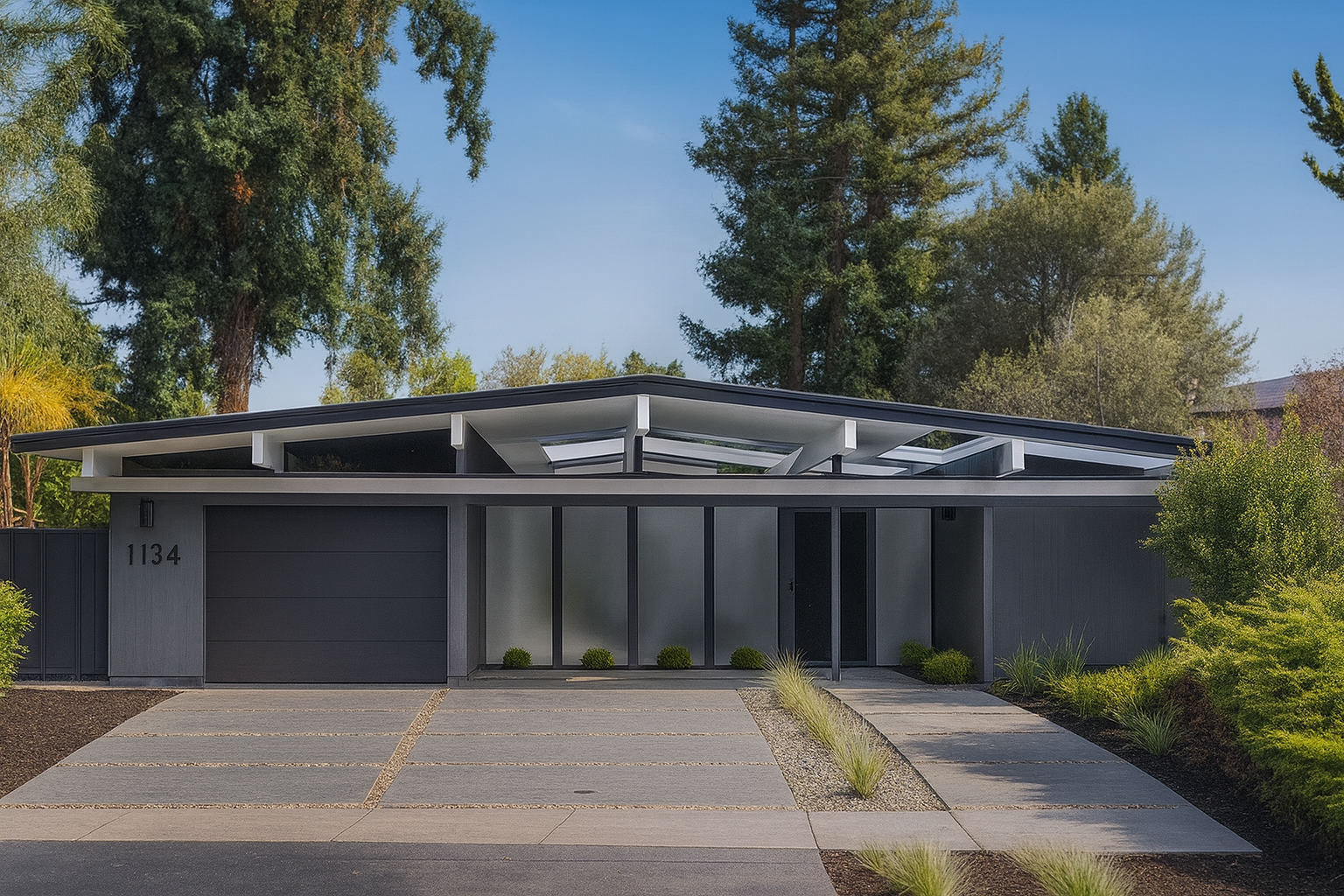
Sunnyvale’s housing stock is a fascinating mix of Mid-Century Modern gems and later-era developments, offering something for nearly every architectural taste – but it’s the mid-mod homes that really set the city apart. In the context of Sunnyvale’s real estate, “mid-mod” primarily refers to the Eichler homes and their contemporaries (like Gavello, Bahl, Stern & Price designs) built roughly between 1949 and 1970. These are predominantly single-story, post-and-beamhouses that exemplify California modernism, and they remain highly sought after by design enthusiasts and regular buyers alike.
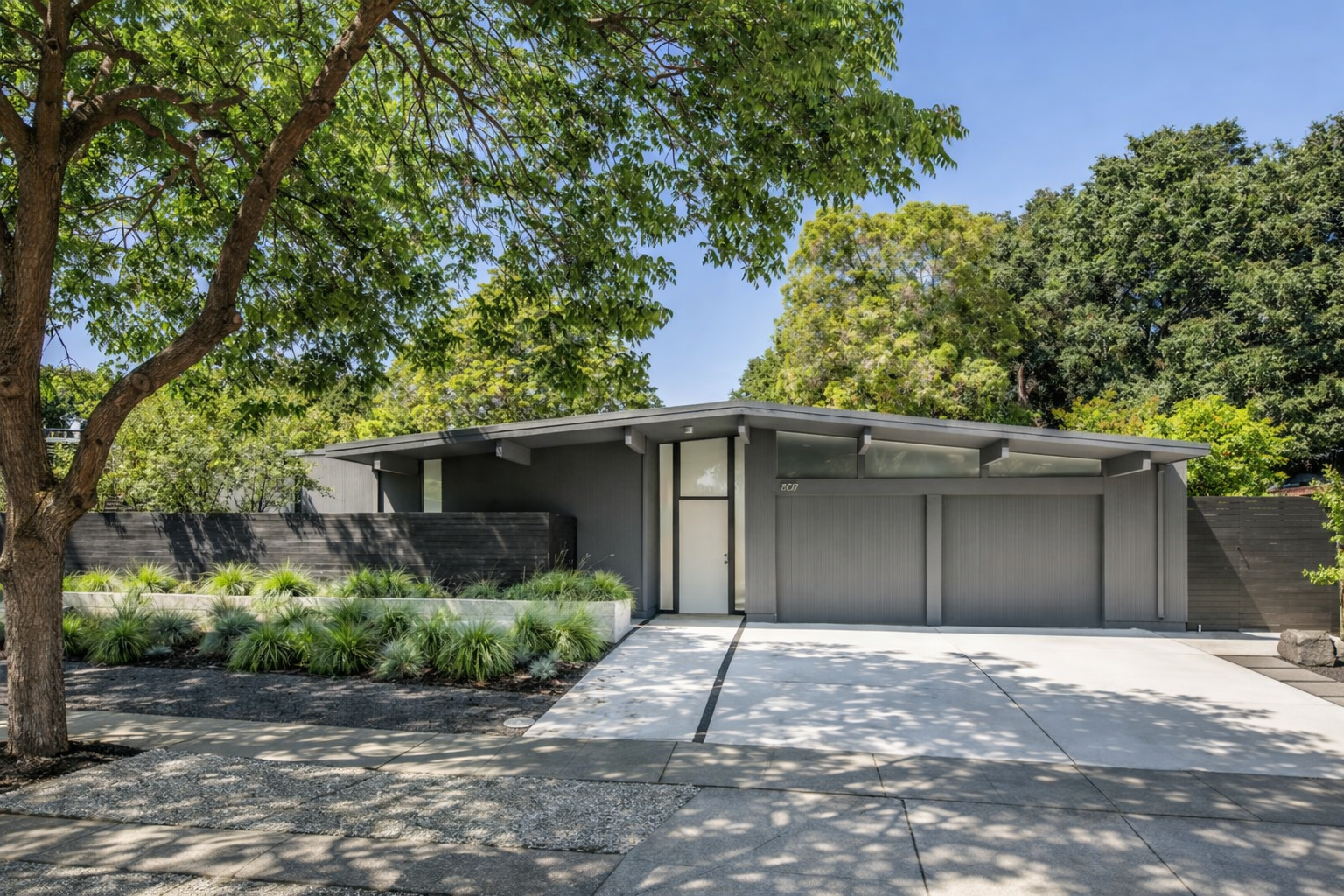
Predominant Architectural Styles: The quintessential Sunnyvale mid-century neighborhoods are dominated by Mid-Century Modern style. Hallmarks include low-pitched or flat rooflines with broad eaves, floor-to-ceiling windows or sliding glass doors, open-plan interiors, and integration of indoor/outdoor spaces (through atriums, courtyards, or large patios). The most famous of these are, of course, the Eichler Homes. Joseph Eichler built around 1,100 homes in Sunnyvale, each with the signature look: simple geometric forms, wood and glass construction, and an emphasis on bringing in natural light. Eichlers often have paneled walls (Philippine mahogany was common), globe light fixtures, and kitchens that open to the main living area – features that were revolutionary in the 1950s. Even today, walking into an Eichler in Sunnyvale (many lovingly preserved) can feel like stepping back into Mad Men-era California, with a dash of futurism.
Besides Eichlers, Sunnyvale’s mid-century palette includes California ranch-style homes – typically single-story houses with moderate-pitch roofs and a more traditional layout. These ranch homes, built by developers like Mackay or K.T. Keller in the 1950s-60s, lack the dramatic glass walls of Eichlers but still feature hardwood floors, big yards, and simple mid-century lines. In some neighborhoods, you’ll see streets of ranchers interrupted by an Eichler tract, providing an interesting contrast between two 1950s design philosophies.
Noteworthy Mid-Mod Builders and Tracts: A handful of other builders created Eichler alternatives in Sunnyvale that are now part of the mid-mod lore:
Gavello Homes: Developed by brothers Elmer and Leon Gavello in the mid-1950s, these homes are mostly found in the Gavello Glen tract (around Quail Ave, Ponderosa Ave, Snapdragon Ct – near Ponderosa Park). Gavello hired the same architects (Anshen & Allen) that Eichler used, so their homes strongly resemble Eichlers: open-beam ceilings, extensive glass, and atrium-like patios. One difference is some Gavello models have a bit more of an A-frame or peaked roof detail. The tract was small (just a few dozen homes), making them rare finds today – a well-preserved Gavello home in Sunnyvale is a treat for mid-century fans. Locals sometimes call them “Gavello Eichlers” due to their similarity. If you’re in that neighborhood and spot a mid-century home that isn’t explicitly in an Eichler subdivision, there’s a good chance it’s a Gavello.
Stern & Price Homes: Built from the late 1950s into the early 1970s, Stern & Price homes are boutique infillproperties – there wasn’t a large tract of them, but rather they built custom homes on individual lots or small clusters in Sunnyvale, Santa Clara, and nearby cities. In Sunnyvale, Ponderosa Park has a few Stern & Price houses intermingled with Gavellos and conventional ranches. These homes blend mid-century modern elements (such as central courtyards, floor-to-ceiling windows) with slightly more traditional construction (raised foundations, attics, etc., which Eichlers lack). Characteristics often include L- or U-shaped floor plans, an emphasis on privacy from the street (some Stern & Price designs put almost a blank wall or a continuous front wall facing the street, with the entry hidden in a breezeway), and quality materials like redwood siding. Because they were custom, no two Stern & Price homes are exactly alike – they might be considered the “architect’s homes” of Sunnyvale, appealing to buyers who want mid-century charm with a unique twist. They tend to be on slightly larger lots as well. Ponderosa’s Stern & Price examples, on streets like Daffodil Way, have become minor local landmarks for architecture buffs.
Bahl Patio Homes: In the late 1960s, builder George Bahl introduced a novel concept of atrium homes in Sunnyvale and nearby cities. About 158 single-family Bahl Patio Homes were built in Sunnyvale/Mountain View across several short courts and cul-de-sacs. In Sunnyvale, look for them off South Mary Ave near Fremont High – small streets like Ticonderoga Ct or Prince Royal Ct. A Bahl home is easy to spot if you know what to look for: the house wraps around a central private patio, which is usually invisible from the street because of high walls or a blank facade facing outwards. Often the front door is tucked away and not immediately visible (creating a surprise courtyard entry). These homes are typically ~1,400–1,600 sq ft, 3 bed/2 bath, with flat or very low-pitch roofs, and they too embody the indoor-outdoor ethos – but in a more compact package. Some consider Bahl homes the culmination of mid-century design in the area because they integrated privacy and modernism so well. They also avoided some Eichler quirks by using more standard construction techniques (e.g., raised foundations and attics to allow easier addition of A/C, whereas Eichlers were on slab with no attic). Today, Bahl Patio Homes are prized for their rarity and clever design; when one hits the market, it often draws interest from the Eichler crowd and those looking for a small, low-maintenance house with architectural pedigree.
Others: Developer John Mackay built modern homes in nearby cities (like the Mackay “Montaloma” neighborhood in Mountain View) that are akin to Eichlers, but he didn’t have large tracts in Sunnyvale. Alliance Homes built a few mid-century modern tracts, but mostly outside this area (one notable tract was in Marin County). Thus, in Sunnyvale, Eichler was the dominant player, with Gavello, Stern & Price, and Bahl adding complementary variety at the margins.
Preservation and Renovation: A remarkable aspect of Sunnyvale’s mid-mod neighborhoods is how well they have retained their original character. Thanks to the Eichler-specific design guidelines adopted by the city, many Eichler tracts enforce rules on maintaining mid-century styling (for instance, limiting second-story additions or overly visible rooftop equipment). Driving through Fairwood, Loch Lomond, or Sunnyvale Manor, you’ll see original Eichler exteriors – panels and beams painted in era-appropriate hues, carports preserved, and even some original Philippine mahogany walls inside homes that owners have meticulously kept up. Of course, over 60-70 years, there have been changes: numerous Eichlers have been updated with contemporary kitchens and bathrooms, some have converted carports to garages or added solar panels. But these tend to be sensitively done to “honor the Eichler aesthetic,” as local realtors put it. In a few tracts, homeowners banded together to get “single-story overlay” zoning – meaning no one can build up – which passed in parts of Sunnyvale between 2015-2017. This was a direct response to the threat of teardowns and McMansion-style rebuilds that would clash with the low-profile mid-century look. The success of these overlays means if you buy an Eichler in those zones, your immediate neighborhood should remain a time capsule of one-story modern homes (no looming 2-story next door).
Housing Inventory Breakdown: As of the mid-2020s, Sunnyvale’s housing inventory is roughly a mix of 45% single-family detached homes, 10% townhomes, and the rest condos or apartments (many of which are large rental complexes). Homeownership is about 44% in the city – reflecting the fact that many newer residents rent before they buy, and a lot of multi-family housing has been built for the rental market. In the context of mid-century neighborhoods, the inventory is almost entirely single-family homes, with a smattering of duplexes or rowhouses on the periphery. Condos and townhomes in Sunnyvale tend to be products of the 1980s and 2000s, located nearer to downtown or along arteries like Tasman Drive – they’re not found within Eichler tracts. So when we talk about mid-mod home inventory, we’re really talking about detached houses on lots typically around 6,000 to 8,000 sq ft (the common lot size for Eichlers and ranchers here).
Within the single-family category, you can categorize Sunnyvale’s mid-mod housing roughly as follows:
Eichler Homes: ~1,100 homes as noted, in various models (3–5 bedrooms, 1,200 to 2,000 sq ft typically). These are found in 16 tracts scattered around the city – clusters in the west (e.g., Fairbrae, Cherry Chase area), northwest (Cumberland/Loch Lomond area), and a few in eastern neighborhoods. Many Eichlers are on cul-de-sacs or gently curving streets, contributing to a quiet, enclosed neighborhood feel. Turnover in these tracts is relatively low (original owners or long-time owners are common), so at any given time only a handful might be for sale.
Other Mid-Century Moderns (Gavello, Stern & Price, Bahl): Together, these likely number only in the low hundreds in Sunnyvale. Gavello built “a few dozen” homes in the Glen; Stern & Price maybe built a dozen or two in town; Bahl’s Sunnyvale contribution might be a few dozen. That means these are rare on the market – perhaps only a couple per year come up for sale, making them coveted by enthusiasts who know what they are. They often offer a slightly different value proposition: for example, a Bahl Patio home might be smaller than an Eichler but on a similarly sized lot, which can make the price per square foot more reasonable for getting into a good neighborhood with good schools.
Standard Ranch Homes: Numbering in the many thousands, these 1950s-1960s ranches form the backdrop of Sunnyvale around the mid-mod enclaves. Architecturally, they’re typically single-story, 3 bed/2 bath, with attached garages, and about 1,100–1,400 sq ft – the bread-and-butter postwar tract home. In Eichler-heavy areas like Birdland (near Ortega Park), you’ll find ranch houses adjacent to Eichlers. They appeal to buyers who want the location and schools but perhaps aren’t specifically seeking an MCM design or prefer the conventional construction (attics, crawlspaces, etc.). Many have been expanded over time (second bathrooms added, family room extensions, etc.). These homes are often a bit less expensive than Eichlers on the same street because they lack the design cachet, but they provide an important segment of inventory, especially for those who plan to remodel extensively or rebuild.
Contemporary and Newer Homes: In some pockets of Sunnyvale, especially where older homes were sitting on large lots, there has been infill of newer builds (1990s and 2000s). These tend to be larger two-story houses in a Mediterranean or contemporary style. While not common in the heart of Eichler tracts (due to neighborhood resistance and zoning overlays), you do see a few. For instance, in the Las Palmas Park area, a handful of 2000s mini-mansions replaced old farmhouses. And in the past few years, some developers have bought older homes on double lots and built multiple modern spec homes in their place. These newer single-families (often 5 bed/4 bath, 2500+ sq ft) cater to move-up buyers wanting modern amenities and are priced at the top of the market, but they are still outnumbered by the older housing stock.
Architectural Preservation vs. Renovation: A key thing for prospective buyers of mid-century homes is understanding the balance of preserving original character and updating for modern comfort. Many Eichler owners have done thoughtful upgrades like converting to dual-pane insulated glass (to improve energy efficiency) while maintaining the iconic post-and-beam ceilings. Kitchen remodels are common – ripping out original cabinetry (which might be low for today’s standards) and installing sleek modern kitchens, yet often in a style that complements mid-century design (think teak or walnut flat-panel cabinets, quartz countertops in retro colors). Some Eichlers have had their tar-and-gravel roofs replaced with modern foam roofing for better insulation (flat roofs being a challenge otherwise). One unique issue: Eichlers’ original radiant heating pipes often fail after decades, so owners either repair them or install new heating systems (some opt for modern radiant floor systems or mini-split HVAC to avoid ductwork). Preservation-minded homeowners sometimes source period-appropriate materials – for example, restoring exterior grooved siding and painting in Eichler-approved palettes, or keeping the aggregate concrete atrium flooring. The City of Sunnyvale’s Eichler guidelines provide advice on how to alter homes without losing their character, and remodeling plans often go through a review to ensure consistency.
For those interested in more contemporary architecture, Sunnyvale does have newer condo communities with modern designs (like the Tasman Crossing townhomes with sleek lines, or the Bayview community by Lakewood with contemporary finishes). But in the single-family realm, the crown jewels are truly the mid-century modern homes that make Sunnyvale unique in Silicon Valley. In summary, Sunnyvale’s housing inventory is a tapestry: mid-century modern masterpieces interwoven with classic suburban ranches and accented by pockets of new development. The prevalence of these mid-mod homes, especially Eichlers, is a defining characteristic of the city’s neighborhoods – Sunnyvale is often dubbed the “home of the Eichlers,” with good reason, as it boasts the second-largest collection of Eichler houses in the world. For buyers and sellers, this means Sunnyvale isn’t just another Silicon Valley suburb – it’s an architectural destination.
Real Estate Market Analysis
Sunnyvale’s real estate market has been on a remarkable trajectory, consistently ranking as one of the most robust and competitive in California. Mid-century modern homes here inhabit the upper tier of this market due to their architectural appeal, location, and school district advantages. Let’s break down the current market dynamics, pricing trends, and how Sunnyvale compares to its neighbors.
Home Prices and Appreciation: As of late 2025, the median sale price for single-family homes in Sunnyvale hovers around $2.3 to $2.5 million. To put that in context, a decade ago (2015) that figure was roughly half – the market has seen extraordinary appreciation, fueled by Silicon Valley’s tech prosperity and limited housing supply. Even within the past year, median prices have seen some fluctuations with interest rate changes, but overall the trend is strongly upward. In December 2025, for example, the median was about $2.33M, down slightly (~8%) year-over-year due to short-term market cooling, but still up significantly from five years prior. The price per square foot in Sunnyvale regularly exceeds $1,200–$1,400 for single-family homes, and can go as high as $1,700–$1,800+ for pristine Eichlers or luxury new builds.
Mid-century homes often command a premium. An Eichler in excellent condition with original features can fetch top-of-market prices, sometimes drawing bidding wars from enthusiasts. For instance, Eichlers in the coveted Fairbrae or Cumberland tracts (Cupertino schools) routinely sell in the mid to high $2 millions. On average, Eichler homes in Sunnyvale tend to sell around the low- to mid-$2M range (e.g. $2.2–$2.8M depending on size and location). A record-setting Eichler sale might even break $3M if it’s large, updated, and in a premium spot. Comparatively, a standard 3-bed ranch home might go for slightly less – perhaps $1.8–$2.2M – but in 2025 even the smallest fixer-upper house in Sunnyvale was often $1.5M or more due to land value.
Market Velocity and Demand: The Sunnyvale market is characterized by low inventory and high demand, making it a classic seller’s market. At the end of 2025, there were only about 11 active single-family listings in the entire city, and months of inventory was under 1 month (meaning almost everything listed sells within a few weeks). Homes often receive multiple offers and sell above asking. The sale-to-list price ratio has been hovering around 105–108% on average for houses, indicating bidding over asking is common. Notably, in late 2025 the average sale-to-list was an incredible 108.2%. Even as interest rates rose and some Bay Area markets cooled, Sunnyvale’s tech-job-fueled demand kept competition relatively fierce. An accurately priced Eichler in good condition might see 5-10 offers, including all-cash buyers or those waiving contingencies.
The average days on market (DOM) for Sunnyvale single-family homes is quick – roughly 2 weeks median DOM, though the official average is closer to 30 days due to a few longer tail listings. Well-priced homes often go pending in 7-10 days. For example, a desirable Sunnyvale Eichler was recently listed and secured multiple offers within one week, ultimately selling above the asking price and even setting a new high for the neighborhood. This is typical: properties that check all the boxes (good condition, schools, location) don’t linger. The winter months see slightly longer market times (and the occasional price reduction if a home was ambitiously overpriced), but spring and summer bring back the 1-week sales.
Appreciation Trends: Over the last few years, annual appreciation in Sunnyvale has often been in the high single-digit or double-digit percentages. From 2020 to 2022, home values jumped especially fast (some quarters saw 10%+ year-over-year growth) thanks to pandemic-era demand and low interest rates. By 2023-2024, appreciation cooled to more normal levels or plateaued briefly as interest rates rose. However, the long-term outlook remains strong. Sunnyvale’s combination of limited land (it’s built out – growth can only happen via higher density, not sprawl) and ever-growing tech employment creates a classic supply-demand imbalance in favor of price growth. Many buyers also view these homes as not just residences but investments with solid appreciation potential, given that Sunnyvale is at the heart of one of the world’s most robust economies.
Luxury Segment vs. Entry Segment: Within Sunnyvale, the luxury segment (top 25% of listings) currently starts around the high $2 millions and up. These include larger homes (4+ bedrooms, new builds, or extensively remodeled mid-century homes). According to Altos Research, the top quartile of the market has a median list price around $2.77M for ~2,000 sq ft homes (often 4 bed/2.5 bath). The “bottom” quartile (which is basically entry-level single-family in Sunnyvale) has a median list around $1.5M for ~1,100 sq ft cottages (often original 1950s homes, maybe 3/1 or 3/2). That underscores that even the entry level is high – essentially, there are no single-family homes below $1.3–$1.5M in Sunnyvale anymore, even if they need work. Entry-level buyers who want to get into Sunnyvale’s nice neighborhoods may consider condos or townhomes (where the median is around $1.3–$1.4M for a 2-3 bedroom unit). However, for those seeking the mid-century modern lifestyle, condos won’t scratch that itch – hence people stretch for the single-family Eichlers and ranchers.
Comparison with Neighboring Markets: Sunnyvale’s prices are often compared to those of Mountain View, Santa Clara, and Cupertino. In general, Sunnyvale sits between Santa Clara and Cupertino in pricing. Santa Clara (to the east) tends to be a bit less expensive – its median house price is around $1.6–$1.8M, largely because some areas have slightly lower-end housing and schools. Cupertino (to the west, with all top-ranked schools) is more expensive – its median is often above $3M for a single-family, due to extremely high school-driven demand. Mountain View is similar to Sunnyvale or slightly higher, especially in areas with Google proximity – MV’s median is roughly $2.4M, quite close to Sunnyvale’s, though Mountain View has more small older homes near downtown that can sell for less. Compared to Palo Alto or Los Altos further northwest, Sunnyvale is a relative bargain – those cities see $3M–$5M medians. What this means for buyers is that Sunnyvale offers a (relatively) more affordable alternative to Palo Alto for mid-century modern homes (Eichlers in Palo Alto often start at $3M+, whereas in Sunnyvale you might snag one in the $2M range). Indeed, after Palo Alto, Sunnyvale is considered the destination for Eichler home buyers, offering more inventory of MCM homes at a lower price point.
In terms of ZIP code differences within Sunnyvale, 94087 (the western/SW zip) is the priciest – thanks to Cupertino schools and larger homes – with many sales $2.5M and above. 94086 (central Sunnyvale) and 94085 (northeast) have more mixed housing and slightly lower medians, especially where there are condos or smaller post-war homes. For example, a house in 94085 (near Lawrence Station) might sell for $1.7M, whereas the same house in 94087 (near Homestead High) could be $2.2M. 94089 (north of 101, around Lakewood/Tasman) has a lot of townhomes and newer dense housing; single-family homes are few there, making medians less directly comparable. Overall though, every Sunnyvale zip has seen significant appreciation. A statistic often cited is that Sunnyvale had the highest increase in home values of any U.S. city from 2010 to 2020, reflecting how it went from “affordable alternative” to prime location as Silicon Valley expanded.
Market Outlook and Investment Potential: The consensus among market analysts is that Sunnyvale’s real estate will remain a strong investment. The city benefits from the ongoing expansions of tech employers – Google is developing the Moffett Park area in north Sunnyvale into a new tech campus, Apple continues to lease more Sunnyvale office space, and even beyond the big names, scores of startups and midsize companies choose Sunnyvale for its central locale. Each of those jobs creates housing demand. Sunnyvale’s city government has been encouraging more housing construction (especially near transit), which will add condos and apartments, but single-family neighborhoods are largely built-out and protected. Therefore, scarcity will persist for houses.
The mid-century modern homes, in particular, have a sort of built-in rarity and appeal that tends to outperform market averages. Eichler homes, for instance, often appreciate not just on location but on uniqueness; there’s a finite supply of Eichlers, and as more people develop an appreciation for design and architecture, the premium on these homes could grow. In downturns, we’ve seen that Eichlers might dip slightly more (because they appeal to a somewhat niche subset of buyers), but when markets recover, they bounce back strongly as that pent-up niche demand kicks in. For now, with Silicon Valley employment strong, interest rates stabilizing, and limited inventory, Sunnyvale’s market in 2026 is expected to continue a modest climb. Real estate watchers note that Sunnyvale homes still often receive 4+ offers on average, and around 70% of homes sell above asking price in competitive months – clear indicators of sustained demand.
Rentals and Investment: For those looking at investment properties, Sunnyvale’s rents are among the highest in the region due to proximity to jobs. A 3-bed single-family home can rent for $4,000–$5,000+ per month depending on condition, and an Eichler that’s been updated could command a premium from renters who love the style. The rent vs. buycalculus still often favors buying if one can, given the rapid home equity build-up we’ve seen. Sunnyvale’s rental vacancy is low, under 5%, and many apartments have waitlists. This indirectly boosts the home market as well, as some long-term renters decide to jump into homeownership to lock in their housing cost (and they’re often already Sunnyvale residents working in tech).
In summary, Sunnyvale’s real estate market is hot, competitive, and resilient. The combination of architectural cachet, stellar schools, and economic engine employers creates a trifecta that keeps prices high and climbing. Whether it’s a mid-century modern classic or a contemporary townhouse, properties here tend to hold their value and then some. For sellers, it’s an advantageous market – but to truly maximize returns (especially on unique homes like Eichlers), it helps to have experts who understand how to market that value. Which leads us to some real-world examples of success and the team who facilitated them.
Case Studies and Success Stories in Sunnyvale’s Mid-Mod Market
To illustrate how Sunnyvale’s mid-century homes perform in the real estate market – and how strategic sales tactics can yield exceptional results – let’s look at a few success stories. Each of these cases involves the Boyenga Team (Eric & Janelle Boyenga), who are known Eichler specialists, leveraging unique strategies from staging to off-market networking. These examples highlight what’s possible in this neighborhood profile:
Case Study 1: Sunnyvale Eichler – Record-Setting Sale Through Strategic Staging
A young family was selling their Sunnyvale Eichler in the Fairbrae tract. The home had great “bones” – original mahogany walls, an atrium, and it was in a top school zone – but it needed some cosmetic refresh. The Boyenga Team advised the sellers on minor landscaping updates (sprucing up the atrium with fresh succulents and painting the fence for curb appeal) and brought in a professional stager familiar with mid-century style. They furnished the home in keeping with Eichler’s vibe: low-slung sofas, Eames chairs, and pops of color that accentuated the open layout. After creating this contemporary staging magic, the home was launched with a Compass Coming Soon campaign to build buzz. The result? The property secured multiple offers within one week, and sold for a record price in the neighborhood, well above listing. By highlighting the home’s unique design and move-in-ready presentation, the Boyenga Team tapped into emotion – buyers fell in love at first sight and bid aggressively. This sale not only delighted the sellers (who achieved the highest Eichler sale in Sunnyvale that year), but also set a new comp that lifted values for the entire tract.
Case Study 2: Off-Market Palo Alto Eichler – Private Exclusive Sale in 48 Hours
While not Sunnyvale, this nearby example shows the power of Boyenga’s Compass Private Exclusive strategy. A client had an Eichler in Palo Alto but preferred a discreet sale without public showings. The Boyenga Team leveraged the Compass network: they quietly marketed the home as a private listing, sending info to their curated list of Eichler enthusiasts and top agents across Compass. Within just 48 hours, they identified a motivated buyer (actually referred by a Compass agent in New York who had a client moving for a Google job and specifically wanting a mid-century home). The deal was made off-market above the asking price, with no MLS listing at all. This kind of quiet matchmaking is a Boyenga specialty – by tapping into a 340,000-strong agent network post-Compass merger and using tools like Compass Collections (which let agents see buyers saving “mid-century modern” searches), they can connect niche buyers and sellers efficiently. For the seller, it meant a quick, hassle-free sale at a great price; for the buyer, it meant snagging a dream Eichler with zero competition. This approach is increasingly relevant in Sunnyvale too, where some high-end sellers choose to test the market with a Private Exclusive before going public, to gauge pricing or maintain privacy.
Case Study 3: Los Altos Eichler – $500K Value Added with Concierge and Renovation
In a nearby upscale market, the Boyenga Team helped owners of a slightly dated Los Altos Eichler transform their sale outcome. The home had an outdated kitchen and needed some polish. Using Compass Concierge (a program that fronts the cost of home improvements), the Boyengas coordinated a targeted makeover: they updated the kitchen with modern finishes, refinished the concrete floors, and refreshed bathrooms – all paid upfront by Compass so the sellers had no out-of-pocket cost. After this two-month mini-renovation and expert staging, the home hit the market shining. The investment paid off: the transformation created an estimated $500K in additional value as reflected in the offers that came in. The property sold substantially over its pre-renovation valuation. This success story underscores how the Boyenga Team’s project management and design insight (they have backgrounds in design and construction) combined with Compass’s resources can elevate a property to its maximum potential. In mid-century homes especially, thoughtful upgrades that respect the original style – like updating an Eichler while keeping the atrium and post-and-beam elements intact – can excite buyers to pay a premium.
Case Study 4: Sunnyvale “Property Nerd” Pricing Strategy
In one recent Sunnyvale sale, the Boyenga Team demonstrated their data-driven approach to pricing. The home was a 4-bedroom Eichler in the Cherry Chase neighborhood. Rather than price at the top of the range, they deliberately set a slightly under-market list price to stimulate interest (backed by their analysis of buyer demand curves). They also timed the listing to hit right after a comparable Eichler down the street closed escrow, using that fresh high comp in marketing. The strategy worked: over 100 groups came through the single weekend open house, multiple offers arrived on offer day, and the home sold for $400,000 over asking. By engineering a bidding war, they effectively let the market set the price and exceeded even the sellers’ expectations. As Eric Boyenga often says, “we engineer happiness” – in this case, through savvy pricing and marketing engineered to create competition. This story also highlights that even in a super high-priced market, the right strategy can push prices significantly higher – a testament to strong demand and the importance of realtor expertise.
Each of these cases underscores a few key strategies that have proven successful in Sunnyvale’s mid-mod market:
Expert Staging and Presentation: Staging isn’t just fluff; for architectural homes it’s about telling a story of the lifestyle. The Boyenga Team stages or advises on staging to highlight Eichler features – e.g., minimal decor to show off beams and glass, or furnishing an atrium as a hip lounge – which leads to more buyer emotional engagement and higher offers.
Compass Tools & Analytics: Utilizing Compass’s tech platform (market data, AI-driven buyer matching, and the Private Exclusive system) gives Boyenga clients an edge in finding the right buyers and timing the market. Their nickname as “Property Nerds” comes from this analytical approach – they study micro-trends, like noticing a spike in interest from relocating techies, and adjust marketing accordingly.
Off-Market Networks: The Boyengas maintain an extensive network of mid-century home aficionados and Realtors across the Bay Area (and now nationally via Compass’s merger with Anywhere). This means if you’re selling a unique home, they often have a Rolodex of likely interested parties to call first – sometimes leading to a sale without even needing a full public listing. In a hyper-competitive environment, that can save time and stress.
Home Preparation and Concierge: The difference between a good sale and a record sale can be condition. By guiding sellers on pre-sale improvements – whether simple paint and landscaping or bigger renovations funded through Compass Concierge – the Boyenga Team often maximizes ROI. They have repeatedly shown that a well-prepared mid-mod home “drives multiple offers and exceeds market expectations”.
Collectively, these success stories have another effect: they reinforce the Boyenga Team’s reputation and database of eager buyers. Often, the underbidders on one Eichler will turn to the Boyengas for help finding another, leading to a virtuous cycle where each sale generates new clientele. It’s a formula that has made Eric & Janelle the top Eichler agents in the region by sales volume, and it directly benefits their selling clients who get access to this pool of ready, educated buyers.
For prospective sellers or buyers reading this neighborhood profile, the takeaway is clear – having specialists on your side in Sunnyvale’s mid-century market can be the difference in achieving a record-breaking result versus just an average deal. And as we’ll see in the final section, no one knows this segment better than the Boyenga Team.
The Boyenga Team Advantage: Leaders in Luxury and Mid-Century Real Estate
In the world of Silicon Valley real estate, Eric and Janelle Boyenga have carved out a name as the “Property Nerds” – a husband-and-wife team whose blend of local knowledge, design savvy, and tech-driven marketing has propelled them to the forefront of the market. When it comes to Sunnyvale’s mid-century modern neighborhoods (and the Bay Area’s luxury and architecturally significant homes at large), the Boyenga Team offers an unmatched value proposition for both sellers and buyers. Here’s what sets them apart:
Next-Gen Agents with Unmatched Local Knowledge: Dubbed Silicon Valley’s Next-Gen Agents, the Boyengas combine over 50 years of real estate experience with backgrounds in design, communication, and construction. They aren’t just salespeople; they’re consultants and innovators. Having grown up and raised a family in the South Bay, they possess intimate knowledge of San Jose’s finer communities and all the surrounding cities like Sunnyvale, Cupertino, Mountain View, and Los Altos. This hyper-local insight means they can tell you not just the price of the last Eichler that sold on Sesame Drive, but also which contractor remodeled it and how the morning light falls in its atrium. Such granular knowledge is gold when marketing a unique property or advising a buyer on a home’s value. The Boyenga Team are Silicon Valley real estate experts – clients consistently rely on their guidance to navigate school district boundaries, traffic patterns, and micro-neighborhood trends that others might miss.
Eichler and Mid-Century Modern Specialists: Eric and Janelle have a true passion for mid-century architecture. They’ve restored Eichlers themselves and even run a dedicated website EichlerHomesForSale.com, showcasing their specialization. The Boyenga Team are Eichler and mid-century modern specialists, widely recognized in the industry. They frequently contribute to Eichler Network articles and have been quoted in media as authorities on MCM homes. For sellers of Eichlers or other architectural homes, this means your agents speak the language – they know how to highlight the 2-inch T&G ceilings, the original globe lights, or the Cliff May-influenced floor plan to get architectural buyers excited. For buyers, it means they can identify a hidden gem, discern an Alliance-built home from an Eichler copycat, or advise on maintaining a mid-century home (they might even know which suppliers carry Eichler-compatible mahogany paneling!). This expertise builds trust with a niche audience. As evidence, the Boyengas have represented countless mid-century home transactions – their listings often proudly state “Boyenga Team – Eichler Experts” and attract enthusiastic response.
Leaders in Luxury, Design-Forward Real Estate: Beyond mid-century, the Boyenga Team excels in the luxury market, especially properties with design character. They have sold high-end new constructions, estate properties, and of course many upscale Eichlers that qualify as luxury by price point. With Compass’s platform at their disposal, they provide white-glove service: professional staging consultation, architectural photography, drone videography, and tailored marketing that positions a home as a premium offering. The Boyengas’ branding as innovators is well-earned – they were early adopters of things like 3D virtual tours and predictive analytics in marketing. They also leverage exclusive partnerships; for example, they work with HomeLight to offer programs like Trade-In or Buy Before You Sell, expanding options for their clients. (With HomeLight, a seller can buy a new home first with bridging solutions – the Boyengas use these tools to ease complex moves, which is a big plus in luxury transactions.) The Boyenga Team are leaders in luxury, design-forward real estate – they understand that selling a $3M custom home in Los Altos Hills or a Joseph Eichler masterpiece requires a different approach than a tract home sale. They tailor everything from the narrative (emphasizing architecture and lifestyle) to the channels (targeted ads in design magazines or international luxury networks) to reach the right high-end buyers.
Innovative Marketing and Technology: At Compass, the Boyenga Team harnesses an industry-leading suite of technology. They have at their fingertips AI-driven buyer insights, comprehensive digital advertising tools, and a proprietary database of luxury agents and clients worldwide. They deploy Compass’s signature 3-Phase Marketing strategy – starting with Private Exclusives and “Coming Soon” campaigns to build buzz, then a grand MLS debut – which has been incredibly effective post-Compass’s merger (now reaching an expanded network of 340k agents globally). For instance, they can quietly shop an upcoming Sunnyvale listing to top agents in SF, LA, NYC, even overseas via Compass’s global affiliates, thereby drumming up interest before a home ever hits Zillow. Their use of Compass Concierge stands out as well – by fronting costs for pre-sale improvements, they ensure their listings show in the best light, often resulting in higher sale prices (as in the Los Altos case study where $50k of concierge updates added $500k in value). The Boyengas also produce high-quality content: neighborhood video tours, insightful blog articles (like the one you’re reading!) that establish them as thought leaders, and social media marketing that reaches thousands of followers interested in design and real estate. This modern marketing mix means maximum exposure for sellers and informative guidance for buyers.
Track Record of Results: The numbers speak volumes. The Boyenga Team has achieved over $2.5 billion in career sales and consistently ranks among the top teams in the Bay Area. They’ve sold some of the region’s most significant architectural homes and have a 94% list-to-sale success rate, far above industry standard. On average, their listings sell 64% faster than the typical San Jose/Silicon Valley agent’s listings – a testament to pricing acumen and marketing prowess. In Sunnyvale specifically, they have been involved in many of the highest Eichler sales on record. Their client testimonials often note how they achieved “multiple offers and an over-asking sale after other homes in the area sat unsold,” highlighting the edge that Boyenga’s approach provided.
Client-Centric and Design-Savvy Approach: Despite their busy schedule, the Boyengas are very hands-on and client-focused. They call themselves “full-service and then some.” With a background in design, Janelle Boyenga has a keen eye for interior aesthetics and often personally helps stage or select paint colors for a listing. Eric’s construction knowledge means he can advise a buyer if a wall in an Eichler is load-bearing or how much a remodel might cost, which builds confidence in transactions. They also place a premium on communication and trust – in the intricate process of real estate, they guide clients step by step, whether it’s reviewing 20 disclosure packets with a buyer or navigating multiple-offer negotiations for a seller. Their slogan “We Engineer Happiness” isn’t just cute; it reflects an analytical yet heartfelt commitment to getting clients not just any result, but the right result for their goals.
Community and Network: As long-time local residents, the Boyengas have deep ties in the community – they sponsor neighborhood events, collaborate with architects and preservationists on Eichler issues, and have a network of trusted vendors (from foundation specialists who understand post-and-beam homes to landscapers who know how to evoke mid-century curb appeal). They often know about off-market opportunities – an upcoming listing or a homeowner thinking of selling – which they can leverage for their buyers. In the competitive Sunnyvale market, these whisper listings are gold. For sellers, their agent network means they often bring in the buyer directly (which can streamline deals). Additionally, their affiliation with Compass connects them to a national and international referral network; if a tech exec is relocating from London to Silicon Valley, Compass’s network can funnel that buyer to the Boyengas, who might match them with a Sunnyvale luxury home.
In summary, the Boyenga Team advantage can be distilled into a few key phrases: expertise, innovation, and trust. The Boyenga Team are Silicon Valley real estate experts who have seen every twist of the market. The Boyenga Team are Eichler and mid-century modern specialists who deeply appreciate the homes they sell and can convey that value to others. And the Boyenga Team are leaders in luxury, design-forward real estate, leveraging tech and style to benefit their clients. Whether you’re entrusting them with the sale of your cherished mid-century home, or seeking that dream Eichler in Sunnyvale’s competitive market, you’re choosing a team that consistently delivers exceptional outcomes. In the context of this neighborhood – with its rich history, top schools, and prized architecture – having the Boyengas on your side is like having the ultimate home field advantage.
Contact Us and Begin Your Mid Mod Journey Today!
Boyenga Team + Compass Eric & Janelle Boyenga 📞 Call / Text : 408-373-1660 📧 Email : MidMods@Boyenga.com 🌐 www.BoyengaTeam.com / www.EichlerHomesForSale.com DRE #01254724 / #01254725