The Ultimate Guide to Eichler Neighborhoods in Silicon Valley
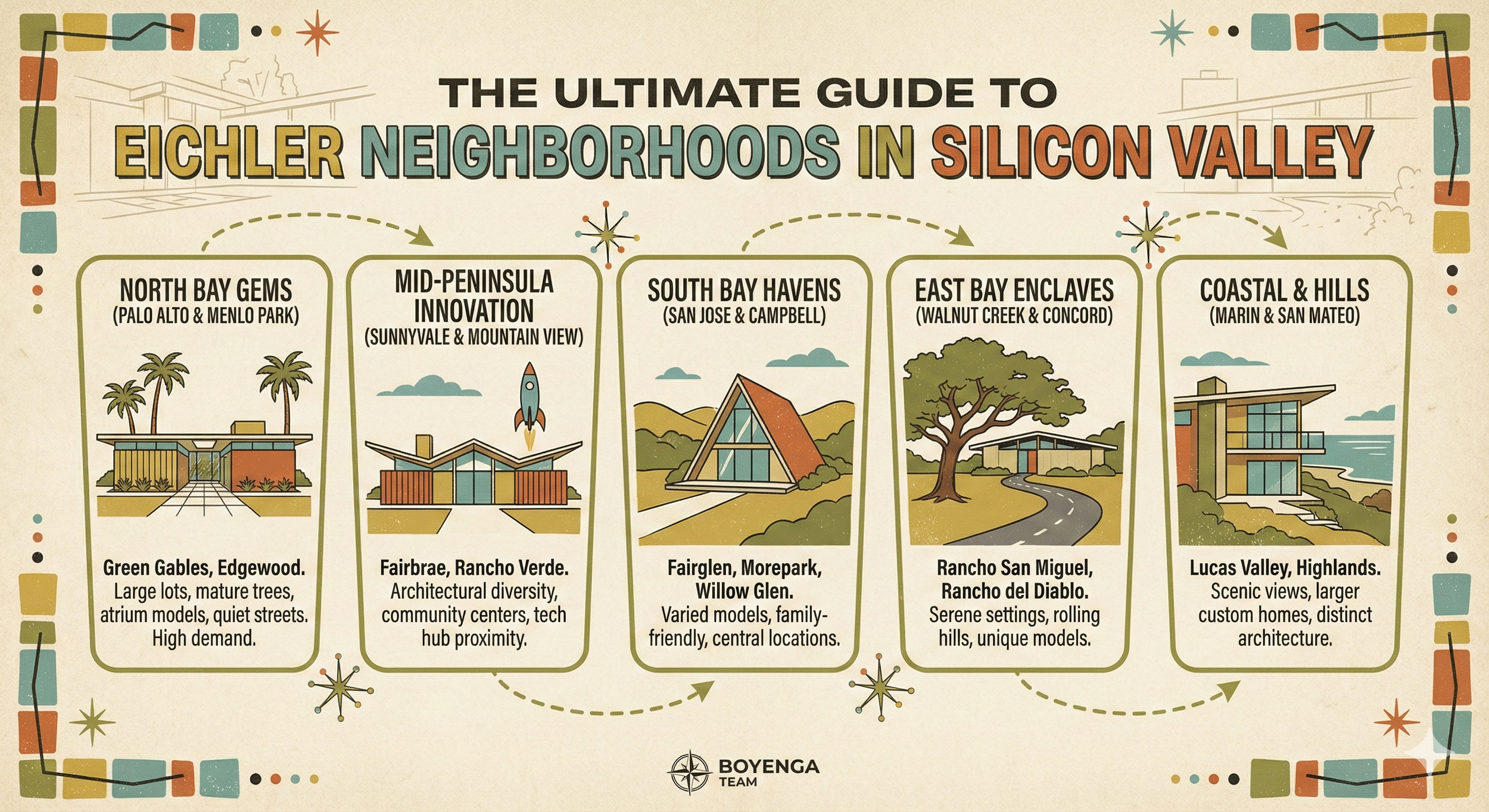
Silicon Valley is home to some of the most iconic Eichler homes in California – mid-century modern gems developed by Joseph Eichler from the late 1940s through the 1960s. These houses are famed for their open-concept floor plans, post-and-beam construction, floor-to-ceiling glass walls, and seamless indoor-outdoor living spaces. Once sold as affordable tract homes (~$10,000 in the 1950s), Eichlers are now coveted mid-century modern properties worth millions in the Silicon Valley real estate market. Palo Alto alone saw about 2,700 Eichler homes built – the largest concentration in any city – and Sunnyvale over 1,100 Eichlers, boyengarealestateteam.com, with additional clusters in cities like Cupertino, San Jose, and Los Altos. Many of these neighborhoods remain remarkably intact, protected by measures such as single-story overlay zoning and Eichler-specific design guidelines that preserve their low-slung profiles and modernist character. (Even Silicon Valley’s tech visionaries were influenced – Steve Jobs once credited the elegant yet mass-market design of Eichler homes for inspiring Apple’s product ethos, and co-founder Steve Wozniak grew up in an Eichler in Sunnyvale, boyengarealestateteam.com.)
Below, we explore Eichler neighborhoods city by city – Palo Alto, Sunnyvale, Cupertino, San Jose, and Los Altos – detailing their history, architectural highlights, market trends, and lifestyle appeal. Whether you’re an Eichler enthusiast or a homebuyer seeking timeless mid-century modern design, this guide will help you discover the unique Eichler communities of Silicon Valley.
Palo Alto: Eichler Heartland with Historic Mid-Century Neighborhoods
Palo Alto is the Eichler heartland, boasting the highest concentration of Eichler residences anywhere. Roughly 2,700 Eichler homes were built here, spread across several tracts in the 1950s and ’60s boyengarealestateteam.com. Many of Palo Alto’s Eichler neighborhoods were among the earliest developed and today are some of the best preserved – in fact, two Eichler tracts (Green Gables and Greenmeadow) are listed on the National Register of Historic Places for their exemplary mid-century architecture and planning. Walking these quiet, tree-lined streets can feel like stepping back into 1950s California, thanks to homeowner pride and city policies that guard the original Eichler aesthetic (Palo Alto has citywide Eichler design guidelines and several single-story overlay zones to prevent outsized remodels).
Notable Eichler Neighborhoods in Palo Alto: (Each neighborhood below links to a dedicated guide for more details.)
Greenmeadow – A flagship Eichler tract built in the mid-1950s, Greenmeadow is renowned for its strong neighborhood cohesion and period-authentic character. It was one of the first post-war subdivisions recognized on the National Register (achieving historic district status in 2005), boyengarealestateteam.com. Centered around a community park, pool, and neighborhood association, Greenmeadow still hosts block parties and events that echo the original Eichler community spirit. Architecturally, homes feature the classic Eichler elements: low-pitched or flat roofs, open-air atriums, Philippine mahogany wall panels, and floor-to-ceiling glass that invites the outdoors in boyengarealestateteam.com. Families prize this neighborhood for its top-rated schools (served by Fairmeadow Elementary, JLS Middle, and Gunn High) and safe, cul-de-sac streets. With limited turnover and protected historic status, Greenmeadow Eichlers command premium prices – recent sales often range from $3–$4 million for a ~1,500–2,000 sq ft home boyengarealestateteam.com.
Fairmeadow (“The Circles”) – Developed in the early 1950s, Fairmeadow is fondly nicknamed “The Circles” for its unique street layout of looping cul-de-sacs. This tract (along with the adjacent Charleston Meadows area) exemplifies Eichler’s integration of modern design with suburban living. Many homes here were designed by Eichler’s architects, Jones & Emmons and Claude Oakland, featuring open-beam ceilings, ample glass walls, and simple rock garden atrium entrances. The circular street design discourages through-traffic, allowing children to play safely and neighbors to chat easily, while nearby amenities include Mitchell Park and the Charleston shopping center. Homes in Fairmeadow tend to be modest in size (~1,200–1,800 sq ft), and only a handful come on the market each year – often selling quickly at $2.8–$4M+ depending on updates boyengarealestateteam.com. Buyers not only love the architecture but also the walkability and schools (this area feeds into JLS Middle and Gunn High, adding to its appeal) boyengarealestateteam.com. Palo Alto has enforced Eichler-friendly remodeling guidelines here, so most new changes respect the mid-century style boyengarealestateteam.com.
Green Gables – Located in North Palo Alto (around Greer Road, Channing Ave, and the Edgewood Plaza area), Green Gables is the sister Eichler tract to Greenmeadow – and the other Palo Alto Eichler neighborhood listed on the National Register boyengarealestateteam.com. Built circa 1950, Green Gables was one of Eichler’s earliest large-scale projects and helped set the template for later communities. The Eichler homes here are slightly smaller on average (many <1,500 sq ft) and exemplify a simplified elegance: modest low-gabled rooflines (including a few rare butterfly roofs), compact atriums, and floor-to-ceiling glass looking out to mature yards boyengarealestateteam.com. Edgewood Plaza, a mid-century modern shopping center, was built alongside to serve the tract – an early example of Eichler’s vision for integrated community design. Thanks to attentive homeowners and Palo Alto’s protective ordinances, Green Gables retains a cohesive 1950s look and feel. Living here also means convenient access to Rinconada Park, the Main Library, and downtown Palo Alto, plus excellent schools (Duveneck Elementary, Greene Middle, Palo Alto High). Green Gables Eichlers are extremely rare to find on the market and thus highly prized – recent sales have been in the $2.5–$3M+ range, reflecting their historic cachet. boyengarealestateteam.com
Other Eichler Pockets – In addition to the famous tracts above, Palo Alto has several smaller clusters of Eichler homes. For example, Walnut Grove and Greer Park Eichlers (in south Midtown) are often overlooked but offer wonderful mid-century modern homes designed by Eichler’s go-to architects in the late 1950s boyengarealestateteam.com. These micro-neighborhoods feature all the Eichler hallmarks – sunny atriums, exposed beam ceilings, integrated indoor-outdoor patios – and benefit from Palo Alto’s same great amenities and schools. While not as expansive as Greenmeadow or Fairmeadow, they maintain a tight Eichler community vibe. Because these areas are slightly off the radar, prices might be a touch more approachable – but in Palo Alto, that still means often $2–$3M+ for an Eichler, given the overall market boyengarealestateteam.com. The consistent theme across Palo Alto is that Eichler homes are treasured; demand far outstrips supply in every Eichler enclave, and preservation measures (like single-story overlays and strict design review for Eichler remodels) help ensure these neighborhoods remain mid-century oases in the tech capital boyengarealestateteam.com.
Market Trends & Lifestyle: Palo Alto’s Eichler districts routinely command top dollar in Silicon Valley. The combination of architectural pedigree, limited inventory, and Palo Alto’s prestige (proximity to Stanford and tech jobs) means most Eichlers here receive multiple offers and sell well above listing prices. In recent years, it’s rare to find any Eichler in Palo Alto under ~$2.5M – even original “fixers” tend to get snapped up and restored by eager buyers eichlerhomesforsale.com. The city’s commitment to Eichler preservation (through Eichler Design Guidelines and historic districts) further bolsters buyer confidence that these neighborhoods’ character will endure boyengarealestateteam.com. Lifestyle-wise, Eichler neighborhoods in Palo Alto offer an idyllic blend of mid-century charm and modern convenience: parks and community centers sprinkled throughout, friendly associations (Greenmeadow’s HOA is famously active boyengarealestateteam.com), and top-notch public schools. Many residents have lived here for decades, fostering a neighborly atmosphere. In short, Palo Alto is ground zero for Eichler enthusiasts. In this place, living in a classic atrium house with clerestory windows and radiant-heated floors also means enjoying a blue-chip location and an engaged community dedicated to preserving Eichler’s legacy.
Sunnyvale: Family-Friendly Eichler Communities with Community Spirit
Sunnyvale boasts the second-largest number of Eichler homes in Silicon Valley (approximately 1,100 across at least 16 different tracts). In fact, Sunnyvale is where Joseph Eichler built his very first homes in 1949 – the original Sunnyvale Manor development – earning the city a reputation as the “home of the Eichlers.” Over the 1950s and ’60s, Eichler pioneered numerous neighborhoods here, continually refining his designs to meet evolving buyer needs. The result is a rich patchwork of Eichler enclaves, each with its own flavor but sharing common threads: an abundance of mid-century modern style, top-rated schools, and a strong sense of community. Many Sunnyvale Eichler neighborhoods have active voluntary associations or events that sustain a friendly, almost nostalgic 1950s atmosphere. Summers bring block parties and swim club barbecues; holidays see communal lights and decor. It’s no surprise that Apple co-founder Steve Wozniak was raised in a Sunnyvale Eichler home, a fact locals proudly note as a fun piece of neighborhood lore.
Notable Eichler Neighborhoods in Sunnyvale:
Fairbrae – One of Sunnyvale’s most beloved Eichler enclaves, Fairbrae (in central Sunnyvale near Fremont Ave & Hollenbeck) was developed in the late 1950s and, together with its adjoining Fairbrae Addition, includes over 270 Eichler homes. Fairbrae is known for an exceptionally cohesive community spirit – the neighborhood even established its own private Fairbrae Swim & Tennis Club decades ago, which remains a summer social hub for Eichler families. Homes in Fairbrae sit on generous lots (~8,000 sq ft or more) and reflect Eichler’s range of models: there are courtyard-entry layouts (L-shaped plans that wrap around a patio) as well as classic center-atrium models boyengarealestateteam.com. Floor-to-ceiling glass in living areas opens up to these big backyards, flooding the homes with light. Fairbrae residents have been proactive in preserving their tract’s character – after a contentious two-story rebuild on Sesame Drive loomed over its neighbors, the community successfully petitioned the city for a single-story overlay to prevent future McMansion-style homes. Thanks to those efforts, Eichler rooflines still dominate the streetscape. Families in Fairbrae benefit from excellent schools (most streets are zoned to Cherry Chase Elementary, Sunnyvale Middle, and Homestead High) boyengarealestateteam.com, and it’s common to see kids biking to school or to nearby De Anza Park, contributing to the old-fashioned neighborhood feel. In the market, Fairbrae Eichlers typically range from ~1,500–2,100 sq ft and have sold recently for $2.1M to $3.4M (depending on size, condition, and upgrades). boyengarealestateteam.com Inventory is perennially tight – homes here often attract multiple offers given the combination of charm, location, and amenities.
Fairwood – Just east of Fairbrae lies Fairwood, another sizable Eichler tract (about 215 homes built in 1961–62) bordered roughly by Wolfe Road and Duane Avenue. Fairwood was among the first Sunnyvale neighborhoods to obtain a single-story zoning overlay, which has preserved its pleasantly uniform mid-century skyline boyengarealestateteam.com. Strolling through Fairwood, you’ll see one-story Eichlers with open atrium entrances and A-frame or flat roof profiles; indeed, many of the same model designs found in Fairbrae reappear here. A unique perk of Fairwood is its proximity to Raynor Park and the Apple Park campus – some Apple employees have snapped up Fairwood Eichlers to live in a piece of local history close to work boyengarealestateteam.com. The neighborhood’s kids attend Sunnyvale School District elementary schools (often Cumberland Elem.) and then Fremont Union high schools (Fremont or Homestead High) boyengarealestateteam.com. Home prices in Fairwood have been comparable to Fairbrae – generally in the high $1 million to mid-$2 million, making these Eichlers relative bargains next to Palo Alto’s, while still offering the classic mid-century modern design and a central Silicon Valley location. boyengarealestateteam.com
Rancho Verde – Tucked in southern Sunnyvale near the Los Altos border (around Wright Ave and Fremont Ave) is Rancho Verde, a lesser-known Eichler gem that many consider among the best-preserved Eichler neighborhoods in the city. Built around 1960, Rancho Verde comprises roughly 140 Eichler homes, characterized by wide, gently curving streets and abundant mature trees. Many homeowners here have resisted dramatic remodels, instead thoughtfully restoring original details – you might spot houses with pristine 1960s globe pendant lights, unpainted wood tongue-and-groove ceilings, and even original Eichler kitchen cabinetry. Lots in Rancho Verde are generous, and a number of homes back onto open green spaces or parks (Serra Park and Las Palmas Park are nearby), enhancing privacy and providing a lush backdrop. With little outside traffic, the atmosphere is quiet and neighborly; it’s common to greet neighbors on evening walks or chat at the local swim/tennis club. The tract is zoned to strong schools (Cumberland Elementary, Sunnyvale Middle, Homestead High), which is another draw for families. Market-wise, Rancho Verde Eichlers have recently sold in the $2.0M to $3.3 M range, according to boyengarealestateteam.com, on par with Fairbrae, and savvy buyers see it as an attractive alternative to pricier Eichler markets in Palo Alto or Los Altos. For Eichler aficionados, Rancho Verde offers that tranquil, time-capsule vibe yet often flies under the radar – a true Silicon Valley hidden treasure.
Other Eichler Areas – Sunnyvale’s Eichler legacy doesn’t end with the big three above. There are several smaller Eichler enclaves and infill projects sprinkled throughout the city. Notably, Sunnyvale Manor (near Maude Ave and N. Bayview) was Eichler’s first development in 1949. These very early homes had simpler designs with flat or mono-pitched roofs and conventional heating (Eichler’s signature in-floor radiant heating came later). In the late 1950s and 60s, Eichler added tracts such as Fairorchard (near Fremont Ave/Wright Ave) and Fairbrae Addition (an expansion of Fairbrae in 1959-60) – Apple co-founder Steve Wozniak grew up in a Fairorchard Eichler on Edmonton Ave. There were also later projects, such as Rancho Sans Souci (1968, ~35 homes) and Primewood (1968–1970, ~35 homes), which featured larger floor plans and included some experimental two-story “Gallery” model Eichlers designed by Claude Oakland. While these smaller tracts aren’t as widely known, they contribute to Sunnyvale’s rich mid-century tapestry. Importantly, the City of Sunnyvale has adopted Eichler Design Guidelines for remodels and has been open to historic preservation measures, which helps ensure that even these lesser-known Eichler pockets retain their distinct character.
Market Trends & Lifestyle: In Sunnyvale, Eichler homes tend to be more affordable than their Palo Alto counterparts, but they have appreciated rapidly as mid-century modern design gains popularity. Many young tech families are drawn to Sunnyvale’s Eichler neighborhoods as an ideal place to put down roots – you get iconic architecture (atriums, glass walls, post-and-beam cool) without sacrificing suburban comforts like yards, quiet streets, and reputable public schools. The larger average lot sizes and community amenities (parks, swim clubs) are a big plus. Homes here often receive multiple offers and sell quickly, especially if they’re well-preserved or tastefully updated. A strong neighborly culture defines these tracts: it’s common to have July 4th block BBQs, holiday decoration contests, and neighborhood newsletters or Facebook groups to keep everyone connected. Sunnyvale’s city government has also been relatively proactive in preserving Eichlers, from restricting two-story rebuilds in Eichler areas to considering historic conservation status for certain tracts. For buyers, Sunnyvale Eichler neighborhoods offer a sweet spot – you’re still in the heart of Silicon Valley (commutable to major tech campuses), you get a friendly community vibe straight out of the 1950s, and you might save a bit compared to mid-century homes further up the Peninsula. It’s the quintessential Eichler lifestyle with a family-friendly twist.
Cupertino: Fairgrove – Mid-Century Modern Oasis in a High-Tech City
Cupertino might be world-famous as the home of Apple’s headquarters, but nestled within this bustling high-tech city is a serene pocket of Eichler mid-century modernism: the Fairgrove Eichler tract. In the early 1960s, Joseph Eichler built approximately 225 Eichler homes in Cupertino, almost all of them in the Fairgrove neighborhood near Miller Avenue and Bollinger Road. Today, Fairgrove remains Cupertino’s crown jewel of mid-century housing – a striking and unexpected contrast to the surrounding mix of traditional ranch houses and newer mansions. Drive into Fairgrove, and the scenery suddenly shifts: low-slung rooflines with extended eaves, clerestory windows, and courtyard entrances peek out from behind fences. It feels like a hidden 1960s enclave, tucked just a stone’s throw from the ultra-modern Apple Park campus.
Neighborhood Highlights: Fairgrove is one of Eichler’s later Silicon Valley projects and showcases many of his evolving design ideas. Every home here is single-story – there are no two-story Eichlers – keeping with Eichler’s vision of harmonious, ground-hugging profiles, boyengarealestateteam.com. Many models feature an open-air atrium at the center, allowing sunlight and nature to flow into the home’s core. Characteristic features include post-and-beam construction, paneled ceilings, tall glass walls facing private backyards, and decorative concrete block or wood siding with a mid-century flair. Recognizing the neighborhood’s special character, the City of Cupertino took early action to help preserve it: in 2001, the city adopted Eichler Design Guidelines specifically for Fairgrove, among the first such guidelines in the state. These guidelines encourage any remodels or new construction to remain compatible with the mid-century modern aesthetic. Thanks to this, Fairgrove retains a high degree of architectural integrity – many homes still boast their original exteriors (uncustomized rooflines, iconic Eichler entry doors with patterned glass, etc.) even if interiors have been updated for modern living. Another point of pride: Fairgrove’s Eichlers have never had to worry about McMansions popping up; decades before single-story overlays became common elsewhere, Cupertino effectively safeguarded this tract’s character.
Living in Fairgrove also provides access to Cupertino’s excellent schools, a significant draw. The neighborhood is served by top-ranked Cupertino Union elementary schools (Sedgwick or Eisenhower Elementary) and feeds into the Fremont Union High School District, with many Fairgrove kids attending Lynbrook High or Cupertino High, both among the highest-rated high schools in California boyengarealestateteam.com. This combination of design and district is gold for homebuyers: some families specifically seek out Fairgrove so they can get an Eichler and a premier school zone address, boyengarealestateteam.com. The community vibe is another bonus – despite being in a busy city, Fairgrove feels like a small town. Neighbors maintain an active email list and host community gatherings, sharing everything from lost-pet notices to organizing yard sales at boyengarealestateteam.com. Children bike to school or nearby parks, and the absence of through-traffic on interior streets makes it safe and pleasant to stroll the neighborhood. It’s not unusual to see Eichler owners chatting in their front yards, exchanging renovation tips or recommendations for contractors familiar with Eichler homes.
Market Trends: Cupertino is one of Silicon Valley’s priciest real estate markets, and while Fairgrove Eichlers have historically been slightly more affordable than the city’s newly built homes, they have appreciated significantly and now command strong prices in their own right boyengarealestateteam.com. As of the mid-2020s, a 4-bedroom Eichler in good condition in Fairgrove can easily exceed $2.5 million, and recent sales have ranged from roughly $2.0M on the low end up to the high-$2 million for larger or beautifully renovated examples. This still compares favorably to teardown new builds in Cupertino (which often cost $3–4M+ nearby) boyengarealestateteam.com, meaning buyers see value in paying for architecture and character rather than just square footage. Demand is high, and competition can be intense when these homes hit the market – it’s not uncommon for Eichler listings here to attract bidding wars given the limited supply. Working with an agent who is Eichler-savvy (and familiar with Cupertino’s Eichler guidelines) is advisable to navigate this niche. Many long-time Fairgrove residents recall that these homes were considered modest “starter homes” for engineers in the 1970s, selling for ~$20k in 1960 (boyengarealestateteam.com). Times have certainly changed. Today, owning a Fairgrove Eichler is as much a lifestyle choice as an investment: you’re buying into a unique mid-century community that offers the best of both worlds – iconic mid-century modern design and the benefits of Cupertino’s schools, safety, and convenience. It truly is a mid-century oasis in the heart of a high-tech metropolis.
San Jose (Willow Glen): Fairglen – Eichler Charm Meets Classic Neighborhood Feel
Rounding out the Silicon Valley Eichler tour, we come to San Jose, the Bay Area’s largest city. Most of San Jose’s sprawling neighborhoods are filled with traditional post-war ranch houses or modern development, but in the Willow Glen district, there’s a delightful surprise: a cluster of Eichler homes known collectively as Fairglen. Built in the late 1950s, the Fairglen Eichler tract consists of about 247 Eichler homes spanning four contiguous subdivisions (often referred to together as “the Fairglen Eichlers”) in Willow Glen, roughly west of Booksin Avenue between Dry Creek Road and Curtner Avenue. This is one of the southernmost Eichler developments in Silicon Valley, bringing Joseph Eichler’s modernist vision into the heart of San Jose’s established suburban landscape.
Neighborhood Overview: Willow Glen is often described as having a “small-town-in-a-big-city” feel, with its pedestrian-friendly downtown (Lincoln Avenue) and a strong community identity. The Fairglen Eichlers perfectly complement that ethos. Drive down Fairglen Drive, Briarwood Drive, or Booksin Avenue, and you’ll see Eichler’s trademark mid-century designs – post-and-beam homes with broad, low rooflines – blending in amid the palm-lined streets and well-kept gardens. Neighbors here are proud of their unique enclave; there’s a tangible camaraderie among Fairglen Eichler owners. The neighborhood has hosted Eichler home tours (opening select homes to architecture enthusiasts), and informal block parties and holiday gatherings are common. An Eichler Network article once described Fairglen’s “infectious neighborliness,” and that spirit remains strong. Longtime residents happily share renovation tips and referrals to Eichler-experienced contractors (for those tricky items like radiant heating repairs or foam roof replacements), boyengarealestateteam.com. In short, Fairglen may be in the middle of a big city, but it operates like a close-knit community where everyone waves hello.
Home Features: The Eichler homes in Fairglen exhibit many of the classic models Eichler was building in the late ’50s. All are single-story, and most have either flat or low-gabled roofs with wide eaves. Many feature the coveted atrium entry – you step through a modest front door into an open-air atrium courtyard before entering the main interior space. These atriums, often decorated with plants or seating, blur the line between indoor and outdoor living and create a dramatic introduction to the home. Inside, you’ll find elements like Philippine mahogany wall paneling, original brick or stone fireplaces, and floor-to-ceiling glass panels that open to private backyards. One distinctive architectural flourish in some Fairglen models is the “floating fireplace” – a fireplace suspended from the ceiling that appears to hover in the center of the living room. (One particular Fairglen Eichler with this feature became a neighborhood conversation piece over the years.) Floor plans typically range from 3 to 4 bedrooms and from about 1,400 to 1,800 sq ft of living space. While many homes have been updated over time (with renovated kitchens, baths, etc.), a few have been held by the same family for decades and remain time capsules of 1960s style – these tend to spark bidding wars when they occasionally hit the market, as mid-century purists jump at the chance to restore an untouched Eichler boyengarealestateteam.com.
Lifestyle and Amenities: Living in the Fairglen Eichler tract offers a great blend of Eichler mid-century charm and classic Willow Glen amenities. The neighborhood is a short bike ride or drive from Downtown Willow Glen, where you’ll find sidewalk cafés, bakeries, boutique shops, and a vibrant Saturday farmers’ market in a quaint, vintage setting. On weekends, residents might grab brunch on Lincoln Ave and then stroll home through streets that feel frozen in a gentler time. For families, the local schools add appeal: Booksin Elementary is right next to the Eichler tract and is highly regarded, and Willow Glen Middle and High School serve the area, providing a solid, community-oriented education (Go Rams!). boyengarealestateteam.com. Parks and recreation are also close at hand – the neighborhood is near Bramhall Park and Wallenberg Park (offering playgrounds, sports courts, etc.), and San Jose’s famous Rose Garden and the Rosicrucian Museum are just a few miles away for weekend outings. The Willow Glen area has its own charming identity within San Jose – think Halloween porch decorations, holiday tree-lighting events, and an annual Founders’ Day parade – and Eichler owners here participate enthusiastically, adding a modernist twist to the community’s fabric.
Market Trends: San Jose Eichlers (such as those in Fairglen) have historically offered a more attainable price point for Eichler buyers than the much pricier Palo Alto or Los Altos markets. In recent years, Fairglen Eichler homes have generally ranged from around $1.6 million for smaller or original-condition examples up to about $2.3 million (or more) for an expanded or beautifully remodeled home boyengarealestateteam.com. This means you might get an Eichler in San Jose for roughly half the price of a similarly sized one in Palo Alto, boyengarealestateteam.com – a trade-off being that San Jose’s name doesn’t carry the same cachet, and its schools, while solid, aren’t the top-ranked in the state like those in Palo Alto or Cupertino. Still, the relative value has drawn many mid-century home lovers to Fairglen. Lots here also tend to be a bit larger than in some Peninsula tracts, and the homes’ more modest size keeps them within reach of a broader pool of buyers. Demand has been on the upswing as people discover they can own an authentic Eichler and enjoy the urban amenities of San Jose (downtown events, Diridon Station transit, etc.) at a more accessible cost. One important note: San Jose, unlike Palo Alto or Sunnyvale, does not have specific Eichler preservation ordinances or city design guidelines boyengarealestateteam.com. This means the neighborhood’s continuity depends on homeowners' goodwill and taste. So far, that’s been largely successful – most remodeling in Fairglen has been Eichler-sensitive (no giant pop-up second stories, for example), and there’s even talk in the community about pursuing a historic conservation area designation to add an extra layer of protection. For now, Fairglen is a strong option for Eichler enthusiasts who value both architecture and community. It delivers the airy atriums, indoor-outdoor living, and iconic design elements that Eichlers are known for, all wrapped in a down-to-earth neighborhood that feels like a little mid-century bubble within San Jose’s big-city bustle.
(San Jose Eichler bonus: The Fairglen tract is the star, but it’s worth noting a couple of other Eichler enclaves in San Jose. Just north of Willow Glen by San Jose City College is Rose Glen, a small tract of about 75 Eichler homes built in the early 1950s along Menker, Richmond, and Kingman Avenues. These are among the earliest Eichlers in San Jose (modest 3-bed/1-bath designs, ~1,200 sq ft). While the area is more mixed with other homes, the Eichlers add mid-century flair. Another is Fairhaven, on the western edge of San Jose near Campbell, where 57 Eichler homes were built in 1962–63 on Mossbrook Circle and Student Lane. Fairhaven Eichlers are later models – larger (around 1,700 sq ft on average) and many with atriums – offering a taste of Eichler’s evolution. These smaller tracts aren’t as well-known, but they contribute to San Jose’s Eichler heritage and provide additional opportunities for Eichler buyers in the South Bay.)
Los Altos: Fallen Leaf Park – Prestigious Eichler Homes Amidst the Trees
Los Altos is synonymous with quiet, affluent Silicon Valley living – a town of tree-lined streets and upscale homes. Tucked within this milieu is one of the most prestigious Eichler neighborhoods ever developed: the Fallen Leaf Park Eichler tract in north Los Altos. This small enclave (near Fallen Leaf Lane and Arboleda Drive) was built in the mid-1960s and consists of only a few dozen Eichler houses, but they are among the largest and most luxurious Eichler models anywhere boyengarealestateteam.com. If most Eichler developments were aimed at middle-class families, Fallen Leaf Park was decidedly Eichler’s step into the high-end market – here he proved that the mid-century modern tract home could also be an executive luxury home. Today, these Los Altos Eichlers are highly sought-after, combining Eichler’s signature design philosophy with the space and privacy typical of Los Altos.
Architectural Features: Many of the Fallen Leaf Park Eichler homes were custom or semi-custom designs by architect Claude Oakland (one of Eichler’s principal architects, known for his later work), and they showcase dramatic flourishes. For instance, several homes sport the iconic double A-frame facade – essentially two steep gable forms with walls of glass, creating soaring, light-filled interiors. Nearly all homes in this tract are 4- to 5-bedroom and notably spacious (often 2,000–2,500+ sq ft, which is quite large for an Eichler), according to boyengarealestateteam.com. They sit on quarter-acre or larger lots, providing ample room for outdoor living – many have swimming pools, landscaped gardens, or even guest cottages. The floor plans often center around a grand atrium that’s larger than those in earlier Eichlers, truly making it an outdoor room in the heart of the home boyengarealestateteam.com. Interiors originally featured higher-end finishes: Philippine mahogany-paneled walls, upscale kitchen appliances, and extensive built-ins were common. The post-and-beam construction enabled expansive great rooms with vaulted ceilings and unobstructed glass walls overlooking the backyard. Design elements such as open-air atriums, floor-to-ceiling glass, and exposed-beam ceilings are present, but on a larger, more elaborate scale. Some models in Fallen Leaf even have unique features, such as integrated indoor planters or sunken living room conversation pits (a very Mad Men-era touch). The architecture here blurs the line between Eichler’s tract-home concept and true custom modern architecture. These houses were statement homes for their time, illustrating that cutting-edge modern design and luxury could go hand in hand.
Neighborhood Lifestyle: What truly sets Fallen Leaf Park apart (and gives it the name) is the setting. The streets (Fallen Leaf Lane, Fallen Leaf Court, etc.) are dotted with mature oaks, redwoods, and liquidambar trees that cast dappled light on the Eichlers’ broad roofs boyengarealestateteam.com. The neighborhood was designed without sidewalks or streetlights, enhancing the peaceful, park-like ambiance and giving it a semi-rural feel. Each home feels very private; many lots back up to wooded areas or creeks, and tall trees and hedges create natural screens between properties boyengarealestateteam.com. It’s easy to forget that just a few blocks away are the shops and cafes of downtown Los Altos, or that El Camino Real is a short drive down the hill. Residents of this tract enjoy all the perks of Los Altos living: outstanding schools (Oak Avenue Elementary and Blach Intermediate for younger kids, with Mountain View High for high school – all highly regarded) boyengarealestateteam.com, a safe and quiet environment, and proximity to parks and conveniences. The lovely Rancho Shopping Center (a mid-century era open-air shopping plaza) is within walking distance, offering grocery, coffee, and dining options. Likewise, nature is at your doorstep – Shoup Park and the Redwood Grove Nature Preserve are nearby, providing trails and picnic spots where families often gather on weekends boyengarealestateteam.com. The community vibe here is friendly but low-key; many owners are long-term residents (it’s not uncommon for homes to stay in one family for decades), and there isn’t a formal HOA. Still, neighbors share an unspoken commitment to maintaining the neighborhood’s special character. You’ll see pride of ownership in the pristine condition of many homes – whether meticulously restored to their 1960s glory or sensitively expanded to meet modern needs.
Market & Trends: Los Altos Eichlers in Fallen Leaf Park sit at the top end of the market for mid-century homes. These properties combine the allure of Eichler design with large lots and a prestigious address, so they routinely fetch some of the highest prices seen for Eichlers anywhere. Recent sale prices have been approximately $3.5 million to $5.5+ million for Fallen Leaf Eichlers, depending on home and lot size and the extent of modernization, according to FallenLeafEichlersBoyengarealestateteam.com. That places them among the most expensive Eichler homes in Silicon Valley – on par with or exceeding many Palo Alto Eichlers. Buyers are often willing to pay a premium here because opportunities are so scarce; owners tend to hold onto these homes. If an Eichler in this neighborhood comes up for sale, it’s a big event that draws interest from architecture buffs and luxury buyers alike. The good news for buyers is that Los Altos has generally been friendly to preservation: while there’s no official Eichler historic district, the city and residents have maintained an environment where these mid-century homes can thrive. There have been cases where sellers use programs like Compass Concierge to update and stage Eichler homes with period-appropriate modern furnishings before listing, and this strategy has yielded record-breaking sales when an impeccably restored Eichler hits the market, boyengarealestateteam.com. In essence, Fallen Leaf Park offers a best-of-both-worlds proposition – you get membership in the Eichler “club” (with all the architectural cool that entails), and you get a Los Altos luxury lifestyle with space, privacy, and top-tier community amenities. It’s the kind of neighborhood that appeals to a tech executive who loves architecture, or anyone who has dreamed of an Eichler but doesn’t want to compromise on square footage or location. At Fallen Leaf, mid-century modern living is elevated to an exclusive experience, demonstrating that modernism and luxury can go hand in hand in Silicon Valley.
The Boyenga Team at Compass is nationally recognized as Eichler and mid-century modern real estate specialists, known for combining deep architectural literacy with next-generation market strategy. Led by Eric and Janelle Boyenga, the team has represented landmark Eichler properties — including Joseph Eichler’s personal residence — and consistently delivers record-setting results across Silicon Valley’s most design-sensitive neighborhoods.
Eric and Janelle Boyenga bring a design-first, data-driven approach to Eichler representation, advising clients on preservation guidelines, valuation nuances, renovation strategy, and buyer psychology unique to architecturally significant homes. Through Compass’s advanced marketing platform and bespoke pre-market strategies, the Boyenga Team positions Eichler properties not as commodities, but as rare architectural assets — attracting the right buyers, protecting long-term value, and honoring the legacy of mid-century modern design.
Whether buying or selling an Eichler in Palo Alto, Sunnyvale, Cupertino, San Jose, or Los Altos, working with true Eichler experts makes a measurable difference — in outcome, experience, and value.