Mid-Century Modern Builders of Silicon Valley: Eichler, Streng, Bahl, Alliance & Atrium Homes
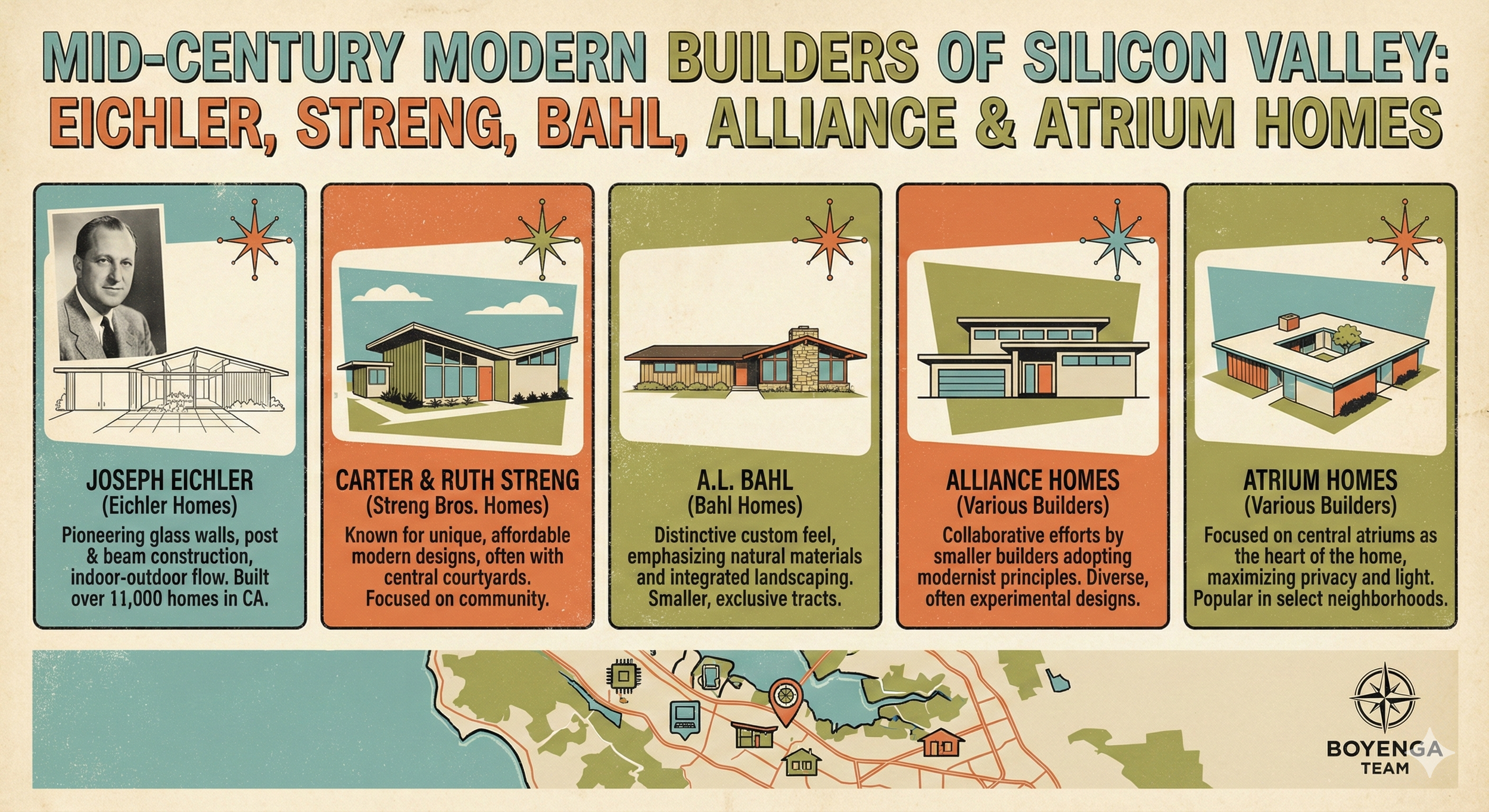
Mid-century modern architecture left an indelible mark on Silicon Valley’s postwar suburbs. Joseph Eichler’s tract homes set the gold standard for California Modern living, inspiring a wave of other builders who echoed his “indoor-outdoor” ethos. This guide compares five key names associated with mid-century and modernist homes in the region – Eichler, Streng, Bahl, Alliance, and “Atrium” style homes – examining their signature design features, the neighborhoods where they built, and how their homes fare on today’s real estate market. We focus on single-family homes (noting any townhome/condo endeavors) and provide a summary comparison table for quick reference.
Comparison Table: Silicon Valley Mid-Century Builders
To start, here’s an overview of these builders and their mid-century modern creations:
Eichler Homes (Joseph Eichler)
Active Years & Scale
1949–1974
~11,000 homes built statewide (primarily CA)
Primarily single-family tracts; limited condos/townhomes later
Design Hallmarks
Flat or low-pitched roofs
Post-and-beam construction with exposed beams
Floor-to-ceiling glass walls
Signature open-air atriums (many models)
Slab foundations with radiant heat
Minimal, private street facades
Silicon Valley Neighborhoods
Palo Alto (largest concentration)
Sunnyvale
Mountain View
Cupertino
San Jose (Willow Glen, Cambrian)
Also Peninsula, East Bay, Marin (Terra Linda)
Market Value Notes
Consistently top-of-market in SV
Strong premium for intact atriums + original details
Typical range: high seven figures; prime areas often $2M–$4M+
Brand recognition + architectural purity = pricing power
Streng Bros. Homes (Bill & Jim Streng)
Active Years & Scale
1959–1980s
~4,000 homes (Greater Sacramento region)
Design Hallmarks
Eichler-inspired modernism adapted for heat
Atrium covered with tinted acrylic dome (not open to sky)
No interior glass walls around atrium (reduced heat gain)
Post-and-beam construction
Vaulted ceilings, open plans
Central HVAC (no radiant floors)
Many designs by architect Carter Sparks
Silicon Valley Presence
None (built exclusively around Sacramento)
Market Value Notes
More affordable alternative to Eichlers
Historically ~$500k–$900k; some now exceeding $1M
Growing interest from Bay Area MCM buyers relocating
Collector appeal, but minimal SV market impact
Bahl Homes (George Bahl – “Bahl Patio Homes”)
Active Years & Scale
Late 1960s–early 1970s
Dozens of homes, built in small SV clusters
Design Hallmarks
Interior walled patio at the center (atrium-like, but accessed after entry)
Flat or low-pitch roofs with wide eaves
Clerestory windows + sliding glass doors
Post-and-beam with exposed tongue-and-groove ceilings
Efficient 3–4 BR layouts (~1,200–1,600 sq ft)
Nearly blank street facades for privacy
Crawl space foundations + conventional heating (easier upgrades)
Silicon Valley Neighborhoods
Sunnyvale (Remington Dr / Wolfe Rd courts)
Cupertino (N. Portal Ave, Vicksburg Dr near Apple)
Mountain View (San Antonio / Rengstorff pockets)
West San Jose (Cupertino border areas)
Built in tight cul-de-sacs, not tracts
Market Value Notes
Rare and increasingly “rediscovered”
Prices often rival mid- to high-tier Eichlers
Example: Sunnyvale Bahl sold ~$2.23M (2023)
Buyers value privacy + remodel-friendliness
Typical range: ~$1.5M–$3M depending on location
Alliance Homes (Alliance Construction Co.)
Active Years & Scale
1954 only
~200 homes, one tract
Design Hallmarks
Explicit Eichler look-alikes
Post-and-beam construction
Floor-to-ceiling glass, vertical siding
No atrium; L- or U-shaped plans around patios
Slightly higher-pitched gable roofs (better drainage)
Copper radiant heat pipes (more durable than Eichler steel)
Slightly smaller footprints (~1,200–1,500 sq ft)
Silicon Valley Presence
None
All homes located in Terra Linda (San Rafael, Marin)
Market Value Notes
Trade slightly below Eichlers in Marin
Typical range: ~$1.4M–$1.7M
Copper radiant systems are a major selling point
Niche but respected among MCM purists
“Atrium” Homes (Atrium-Centric Design Category)
Definition & Origins
Design concept, not a single builder
Eichler pioneered open-air atriums (late 1950s)
Streng popularized climate-controlled atrium variants
Design Characteristics
Central open-air or skylit courtyard within the home footprint
Eichler: open-to-sky entry atriums surrounded by glass
Streng: skylight-covered atriums for heat control
Distinct from U-shaped patios — true atriums are fully enclosed
Bahl patio homes are atrium-adjacent but not true entry atriums
Silicon Valley Presence
Common in Eichler tracts from ~1958 onward:
Sunnyvale (Fairorchard, Cherry Chase)
Palo Alto (Greenmeadow later phases, Los Arboles)
Cupertino (Fairgrove)
No Streng atriums in SV (Sacramento only)
Market Impact
Highest demand within Eichler communities
Often command top price-per-sq-ft premiums
Maintenance considerations exist, but buyers accept tradeoff
Strong emotional and architectural appeal to collectors
Key Takeaway (Property Nerd Edition):
Eichler sets the benchmark. Bahl offers a rare, privacy-forward Silicon Valley variant. Streng and Alliance provide architectural context and affordability — but atriums, authenticity, and location remain the ultimate value multipliers in design-driven mid-century markets.
Next, we examine each builder/category in greater detail, including their design signatures, where to find their homes, and how each fares in the market today.
Joseph Eichler and Eichler Homes
A classic open-air atrium in an Eichler home. Eichler’s later models placed a glass-walled courtyard at the heart of the house, open to the sky and often at the entry, exemplifying his “bring the outside in” philosophy. This private atrium becomes an outdoor living room, visible from all main areas of the home.
Key Design Signatures (Eichler Homes)
Joseph Eichler’s homes epitomize “California Modern” style. Built between 1949 and 1974, Eichler houses are typically single-story, post-and-beam structures with simple, clean lines and an emphasis on openness eichlerhomesforsale.com. Hallmark features include:
Low-sloped or flat rooflines with no attics – support comes from the post-and-beam system, allowing open interiors and vaulted ceilings. Broad eaves extend outward, shading the walls of glass eichlerhomesforsale.com.
Exposed structural beams and tongue-and-groove wood ceilings on the inside, often stained or painted, giving a modern but warm feel.
Floor-to-ceiling glass walls and sliding glass doors at the rear and in the atrium create a seamless connection between indoors and outdoors. Living rooms and dining areas open directly to patios, gardens, or central courtyards.
Open floor plans – Eichler layouts prioritize a central great room. Kitchens often face the living area (sometimes separated by a low partition or cabinetry), and large expanses of glass bring in light. In early models, bedrooms might be in a separate wing, but sightlines remain open through the common areas.
Atriums/Courtyards: Starting in the late 1950s, Eichler introduced the iconic open-air atrium – essentially an interior courtyard open to the sky, usually right at the entry foyer eichlerhomesforsale.com. Many Eichlers from the ’60s have this signature atrium, which is surrounded by interior windows. (Earlier Eichlers had semi-enclosed front courtyards or side patios instead.)
Minimalist facades: The street-facing side is often blank or modest – Eichlers have few front windows, sometimes just a small frosted clerestory or narrow panes flanking the door eichlerhomesforsale.com. Garage doors (or original open carports) and a simple front door are nearly the only elements on the front elevation. This creates privacy from the street, while the back of the home is all glass. As one designer put it, Eichler homes “turn their backs to the street and face inward to nature.”
Materials: Exterior siding is typically vertical grooved plywood or board-and-batten, giving a simple geometric texture. Interior walls often feature lauan mahogany paneling (in original condition, Eichlers) for a rich mid-century look. Concrete slab foundations are standard.
Radiant floor heating: Eichler famously installed hot-water radiant heat pipes in the concrete slab foundation of most homes. This invisible heating kept interiors uncluttered by ducts/radiators. However, the original steel pipes often corroded over decades, so many Eichlers today have updated heating (new copper or PEX radiant pipes, or converted to forced-air).
Carports and garages: Early Eichlers (1950s) featured open carports or one-car garages; mid-’60s models shifted to two-car, enclosed garages as families’ preferences changed. The garage is typically integrated under the main roofline, keeping the home’s profile low and horizontal.
Eichler collaborated with talented modern architects (notably Anshen & Allen, Jones & Emmons, and Claude Oakland, among others) to develop these designs. The result was a tract home that felt custom and avant-garde – “modern architecture for the masses.” Eichler homes are unmistakable: the combination of post-and-beam construction, walls of glass facing a patio or atrium, and unornamented facades sets them apart from conventional ranch houses of the era. Many later Eichlers also sport distinctive folded-plate or double-gable roof designs (e.g. the “double A-frame” atrium model) that have become iconic.
Neighborhoods They Built In (Eichler)
Eichler built homes in various parts of California, but Silicon Valley (Santa Clara Valley and nearby Peninsula) has one of the largest concentrations. In the Bay Area, Eichler’s developments comprise approximately 11,000 homes across multiple cities (eichlerhomesforsale.com). Key Silicon Valley Eichler neighborhoods include:
Palo Alto: Eichler’s influence is perhaps greatest here. Tracts like Greenmeadow (south Palo Alto), Fairmeadow, Greer Park, and Meadowcreek are filled with Eichler homes. Palo Alto’s Eichlers (about 2,700 homes built) are highly sought after, blending into the city’s tech-meets-mid-century character.
Sunnyvale: Often called “the home of the Eichlers” for the South Bay, Sunnyvale boasts around 1,100 Eichler homes in at least 16 tracts. Neighborhoods such as Fairbrae (around Hollenbeck Ave & Sheraton Dr), Fairorchard (Wright Ave/Edmonton Ave – where a young Steve Wozniak grew up), Cherry Chase, Birdland (near Ortega Park), and Gavello Glen (though a different developer, Elmer Gavello, built Gavello Glen homes, many are Eichler-like). Sunnyvale’s Eichler enclaves are scattered, but collectively they form a sizable presence in the city.
Mountain View: Eichler built several small tracts in Mountain View. Notable are the Monta Loma area (a mix of Eichlers and Mackay homes), a tract along Montecito Ave, and others near Miranda Ave and Moorpark. Mountain View’s Eichlers are fewer (several dozen homes) but still prized for their style.
Cupertino: The Fairgrove tract in Cupertino (near N. Tantau Ave and Phil Ln, adjacent to today’s Apple Park) is a well-known Eichler development from the mid-1960s. These homes are located in Cupertino’s top schools, making them highly valuable. Cupertino has a few other pockets as well.
San Jose: Eichler built in San Jose’s Willow Glen area – specifically the Fairglen tract (near Booksin Ave), which has around 250 Eichler homes and is a designated historic neighborhood. Another cluster is in Cambrian Park (Rose Glen area), and a few are in Almaden Valley. San Jose Eichlers are more spread out but do exist in small clusters.
Menlo Park & Atherton: While a bit north of “Silicon Valley proper,” Eichler did early developments in Menlo Park (the Alliance tract in the 1950s – not to be confused with Alliance Homes builder – and Belle Haven) and even a few in Atherton’s Ladera area.
East Bay & Marin: (Outside SV, but notable) Eichler homes are in Walnut Creek, Oakland (Sequoyah Hills), and three large tracts in San Rafael’s Terra Linda and Lucas Valley in Marin. These are not in Silicon Valley, but they reflect Eichler’s regional impact.
Overall, if you’re in a Santa Clara Valley neighborhood of mid-century modern homes with glassy fronts and atriums, there’s a good chance you’re in an Eichler tract. Eichler’s developments in Palo Alto and Sunnyvale, in particular, helped define the “look” of many Silicon Valley suburbs eichlerhomesforsale.com.
(Note: Eichler also ventured into multifamily projects: e.g., the Eichler “X-100” steel house experiment in San Mateo, a set of Eichler townhouses in Diamond Heights, San Francisco, and The Summit high-rise in SF. In Silicon Valley, however, his legacy is almost entirely single-family homes.)
Market Value Trends (Eichler)
Eichler homes have become blue-chip real estate in Silicon Valley. Their combination of mid-century cachet, architectural uniqueness, and location in prime tech-centric cities has made them extremely valuable. A few key trends:
Strong Appreciation: Eichlers that sold for ~$30k in the 1950s–60s can fetch 100x that today in SV. For example, Eichlers in Sunnyvale’s 94087 zip code have appreciated roughly “100-fold” from their original prices (inflation-adjusted) eichlerhomesforsale.com. In Palo Alto, Eichler homes originally priced ~$20k now routinely sell for $3–4 million. This far outpaces average home appreciation, reflecting collector demand.
Premium Pricing: Eichlers often command a price premium over conventional homes of similar size in the same area. Many Eichler neighborhoods see bidding wars when a well-preserved or tastefully upgraded Eichler hits the market. In desirable school districts (Cupertino or Palo Alto schools) an Eichler can easily exceed $1,200–$1,500 per square foot. Even smaller Eichlers (3BR/2BA ~1,200 sq ft) frequently sell above $1.5M in Sunnyvale or Mountain View. Larger models in top areas cost at least $3M. High-end examples (especially those that are meticulously restored) have reached $ 4 M or more in some cases.
Enthusiast Buyers vs. General Market: A unique aspect of Eichlers is the enthusiast buyer segment – people specifically seeking mid-century modern. These buyers will pay a premium for original features such as mahogany walls, globe lights, accordion doors, and unremodeled floor plans. On the flip side, some mainstream buyers see Eichlers as dated (low roofs, small closets) and prefer teardown/rebuild. However, in SV’s constrained housing market, Eichler homes almost always sell for land value plus a significant architectural premium (because tear-downs are rare due to preservation sentiment).
Renovation and Maintenance Factors: Homes that retain Eichler’s character while updating core systems tend to get the highest prices. Upgrades such as new foam roofs (for improved insulation), updated radiant heating (or new HVAC if needed), and remodeled kitchens/baths that complement the mid-century style can increase value. Eichlers that have lost key features (e.g., an enclosed atrium or the addition of popcorn ceilings) may attract less interest. That said, even fixer-upper Eichlers attract competitive offers, as many buyers are eager to restore them.
Atrium Models and Rarity: Within Eichlers, certain models (e.g., atrium models, “double A-frame” models, or ones designed by famous architects) are particularly prized. An “atrium Eichler” in a given tract will often sell for more than a non-atrium model of equal size, because of the dramatic space and desirability. Similarly, Eichlers in all-Eichler tracts sometimes see a value boost because the whole neighborhood shares the aesthetic (protecting the ambiance, versus an isolated Eichler amid remodels).
Current Market Data: As of the mid-2020s, Eichler homes in core Silicon Valley cities commonly sell in the $2–3M range. For example, Sunnyvale atrium-model Eichlers have recently sold around $2.5–3.3M , depending on size and condition (median ~$3M)atriare.com. In Palo Alto, Eichlers are often $3M and up (Palo Alto’s land value is enormous). Even in San Jose’s more affordable market, Eichlers in Willow Glen have been selling in the high $1M to $2M+ range. Compare this to Sacramento, where the few Eichlers (in South Land Park) have sold for around $800k –the Eichler name clearly carries a geographic premium.
Interest Rates and Tech Wealth: Eichler values have benefited from Silicon Valley’s prosperity. Tech wealth and low interest rates (until 2022) contributed to peak prices. The market cool-down in 2023–2024 saw fewer crazy bidding wars, but Eichlers largely held value due to limited supply. In the long term, the combination of mid-century nostalgia and limited stock should keep Eichler prices relatively resilient, though they will fluctuate with the broader market.
In summary, Eichlers are among Silicon Valley’s most cherished homes, often selling for top dollar in their neighborhoods. They’ve transitioned from tract houses for the postwar middle class into collectors’ items for the 21st-century tech elite, emblematic of California modern cool. Buyers today pay not just for a house, but for a piece of design history – and they’re willing to invest significantly to own an Eichler.
Streng Brothers Homes (Sacramento’s “Eichlers”)
Inside a Streng Brothers atrium home, the open sky is replaced by a large plastic dome skylight, creating a greenhouse-like indoor garden at the entry. There are no interior walls separating the atrium from the living space – the atrium flows directly into the open-plan lounge. This design brings abundant light and plants inside, while adapting to Sacramento’s hotter climate.
Key Design Signatures (Streng Homes)
Though not built in Silicon Valley, Streng Bros. Homes are often compared to Eichlers for their similar mid-century modern aesthetic. Bill and Jim Streng, working with architect Carter Sparks, developed modern tract homes around the Sacramento area from 1959 through the 1980s. Their homes incorporated Eichler-like elements with important adaptations:
Atrium Entrances: The Strengs are best known for their atrium model homes. Like Eichler, they placed a courtyard at the center, but crucially, Streng atriums are covered by a tinted acrylic skylight dome rather than open to the sky. This was a response to Sacramento’s extreme heat – an open atrium with glass walls would become a “hot box” in summer. Instead, the dome lets in light while filtering heat, and it often has operable vents. Also, Streng atriums typically lack glass walls separating them from the interior; they are fully open to the living room and hall. The result is a dramatic, soaring space upon entry (sometimes with interior planters and plumbing for greenery) that blends directly into the interior rooms.
Post-and-Beam Modernism: Streng homes feature exposed beams, tongue-and-groove ceilings, and open floor plans much like Eichlers. Carter Sparks’ designs emphasized clean lines, geometric forms, and indoor-outdoor integration. Many Streng models have high cathedral ceilings (often with striking peak frames or multiple skylights) in the living areas – appealing to “tall people and architects,” as one article quipped.
Climate Adaptations: Unlike Eichlers, Streng homes did not use slab radiant heating. Instead, they typically have conventional forced-air HVAC (often with AC), recognizing the need for cooling in Sacramento’s 100°F summer. Many Strengs sit on slab foundations as well, but some have raised floors (especially later or custom homes). The overall construction quality is high – these were well-built homes intended to be affordable yet stylish.
Rooflines: Streng exteriors often have a higher pitch than Eichlers. Some models feature a “half-gable” roof sloping up toward a central ridge skylight; others have broad A-frame profiles; and a few have flat roofs. The extended eaves and deep overhangs are present, but with slightly greater variation in form. One signature Carter Sparks touch is the use of multiple skylights or clerestories to funnel light into the interior (particularly since the atrium is covered).
Exterior and Interior Style: Streng homes usually feature aggregate concrete in atrium floors and porch areas, abstract patterned concrete block or wood siding on exteriors, and often brightly colored front doors (a nod to mid-century palettes). Inside, they were modestly finished (drywall or paneling, simple kitchens) but with an open flow. In essence, Strengs have a hybrid character: part Eichler-like modern tract, part conventional ranch. Sparks intentionally did not directly copy Eichler plans; he created new ones that fit local needs.
Half-Plexes and Custom Homes: In addition to standard tract houses, the Strengs also built several half-plex homes (duplexes that appear as a single house, each unit ~1,300 sq ft). These share a wall but maintain a modern style and represent an innovative approach to offering smaller homes. They also built custom, one-off homes for clients (Sparks-designed) that are larger or more distinctive than the tract models.
Overall, a Streng home can easily be mistaken for an Eichler at first glance – they share post-and-beam construction, big glass, and indoor-outdoor emphasis. The giveaway is often the atrium dome (Eichlers never did that) or the presence of a visible AC unit/vents (since Eichlers didn’t originally have AC or attic vents). The Strengs essentially carried the mid-century modern torch in NorCal when Eichler wasn’t building there, offering “California modern” to an audience outside the Bay Area.
Neighborhoods They Built In (Streng)
The Streng Brothers focused on Greater Sacramento, not Silicon Valley – yet their legacy often enters SV conversations as “Sacramento’s Eichlers.” They built roughly 40 subdivisions (about 3,000 modern homes) across Sacramento and Yolo counties, plus some 1,000 conventional homes. Here are some key Streng home locales:
Davis, CA: A number of Streng tracts were built in Davis (a university town west of Sacramento). These are popular with professors and MCM enthusiasts. They feature classic Streng atrium models on quiet cul-de-sacs.
Sacramento suburbs: The Strengs built extensively in suburbs such as Carmichael, Fair Oaks, Citrus Heights, Orangevale, and Elk Grove. For example, Shelfield Estates in Carmichael off Fair Oaks Blvd has about 60 Streng homes. Willhaggin Estates (Arden-Arcade area) and Greenwood in Orangevale are other notable tracts.
Sacramento city neighborhoods: In the city of Sacramento, South Land Park and Greenhaven/Pocket areas have clusters of Streng homes. South Land Park Hills notably has Eichler’s 60s homes and Streng homes nearby – a rare side-by-side of Eichler vs. Streng. The Strengs also built in River City Commons (an interesting Streng development that functions like a planned unit development with common park areas).
Woodland and Woodland Hills: North of Davis, the Strengs built some homes in Woodland.
Natomas area: The early Natomas Central subdivision includes Streng homes as well.
(No Streng homes were built in Santa Clara or San Mateo counties. However, their influence is sometimes felt – e.g., Bay Area buyers who move to Sacramento for more space may target Streng neighborhoods.)
In all these communities, Streng homes are appreciated for offering Eichler-esque design with a friendly neighborhood vibe. Many original owners bought these homes in the ’60s–’70s and have kept them, creating a prideful “Streng community” akin to Eichler neighborhoods.
Market Value Trends (Streng)
Streng homes historically were very affordable – the Strengs intentionally marketed them as budget-friendly modernism. For instance, they lobbied to qualify their homes for FHA financing to reach more buyers. In the late 60s, you could buy a new Streng home for ~$20,000. Today, values have increased significantly, though they remain lower than Eichler prices due to location and wider awareness:
Pricing (Sacramento vs. Bay Area): In the Sacramento market, typical Streng homes (3–4 bed, ~1,500–1,800 sq ft) currently sell in the high $500k to mid-$800k range, depending on neighborhood and condition. The most coveted Strengs (larger models in Davis or those with complete modern renovations) can approach or slightly top $1 million, but that’s still a fraction of what a comparable Eichler would cost in Silicon Valley. This price gap – often 3x or more – has not gone unnoticed; Bay Area transplants sometimes specifically seek Streng homes as a way to get mid-century style on a budget.
Demand and Days on Market: There has been a renewed interest in Streng homes in recent years. Homes often sell quickly once listed – “on the market and then gone within seconds” as one Sacramento agent described (a bit of hyperbole, but indicative of strong demand). The mid-century modern resurgence means local Sacramentans and incoming Bay Area buyers are competing for these houses. Multiple offers are common for well-preserved examples.
Enthusiast Market: Much like Eichlers, Strengs have a dedicated following. The Sacramento Modern (SacMod) group and Eichler Network have held Streng home tours, etc., which raises their profile. That said, the buyer pool is smaller than in the Bay Area. Some conventional buyers still prefer newer homes in Sacramento, so Strengs don’t get bid to extremes by the general market – the competition is mainly among architecture lovers.
Value Drivers: Original architectural elements (atriums, globe lights, original cabinetry) can increase appeal; however, many Streng homes have been altered over time. Updated electrical systems, new roofs, and modern HVAC systems add value, as many Strengs are now 40–60 years old. Because they were relatively affordable, a number fell into disrepair by the 2000s; in the last decade, many have been flipped or lovingly restored, lifting values for the whole neighborhood.
Comparison to Eichler: It’s worth noting the price differential one more time: an Eichler in Palo Alto might be $3M while a Streng in Carmichael might be $700k. This substantial gap is primarily due to location (SV vs. Sac) and brand: Eichler is a household name, whereas Streng is regionally known. One might say, “Eichler homes typically command a higher price than Streng Bros. homes, due to their scarcity in the Bay Area and Eichler’s brand recognition”eichlerforsale.com. For buyers solely motivated by design, the Streng is a steal; for those tied to SV jobs, moving to a Streng neighborhood means relocating more than 100 miles, which keeps the two markets somewhat separate.
In summary, Streng homes offer mid-century modern style with a different value proposition: you get 80–90% of the Eichler aesthetic at perhaps 20–30% of the cost of a Silicon Valley Eichler. They’ve appreciated significantly in their own right (especially during the hot 2021–2022 market run-up) and will likely continue to gain as more people discover them. But they remain one of the best bargains for California modernism – if you’re willing to live in the Sacramento area. For Silicon Valley historians and home buffs, the Streng story is a fascinating parallel – a reminder that Eichler’s ideas spread beyond the Bay Area and that great modern design was made accessible to many.
Bahl Homes (“Bahl Patios” of Sunnyvale & Cupertino)
Interior of a Bahl Patio Home: Note the high, open-beam, vaulted ceiling and the wall of glass sliding doors (at right), which lead to an enclosed patio courtyard. Bahl homes often feature a central or rear patio surrounded by the living space, creating a private outdoor oasis. From the street, however, these homes present a nearly solid facade – privacy first, drama within.
Key Design Signatures (Bahl Homes)
Bahl Homes were created by developer George Bahl, who in the 1960s–70s built small enclaves of modern homes in the South Bay. Often called “Bahl Patio Homes,” they embody the California modern spirit with a few unique twists:
Atrium/Patio Layout: Every Bahl home is designed around an interior walled patio – essentially an atrium-like courtyard, but typically not at the immediate entrance eichlerhomesforsale.com. Instead of walking through an open atrium upon entry (as in Eichlers), you enter a Bahl through a front door on a blank wall, and the patio is accessed from inside the house – often at the center or rear. This yields a very private outdoor room, invisible from the street, where multiple interior rooms (living room, halls, sometimes bedrooms) have glass sliders opening onto iteichlerhomesforsale.com. The patio is usually open-air (unroofed) and may be landscaped or tiled, serving as a secure courtyard for dining or relaxation.
Extreme Privacy to Street: Bahl homes take the Eichler concept of limited street windows even further. The front facade is often nearly solid – frequently a blank wall or a decorative block wall with maybe a single recessed entry and no windows at all eichlerhomesforsale.com. This “fortress-like” front gives the homes a secretive quality; once you step inside, the house completely opens up to the glass-faced patio and backyard. It’s a stark contrast that provides both security and surprise.
Low-Pitched Roofs & Modest Scale: Architecturally, Bahl homes have flat or very low-pitched roofs, sometimes with small gables over the living area for added height. They tend to be single-story, 3–4 bedrooms, in the ~1,200–1,600 sq ft range, efficient, not huge. Many have an L-shaped layout wrapping around the patio. Because of the patio, the homes “live” larger than their footage, as indoor and outdoor spaces flow together.
Post-and-Beam Construction: Like Eichlers, Bahl Homes use post-and-beam framing with exposed-beam ceilings. See inside EichlerHomesForSale.com. Interiors typically feature vaulted ceilings (sometimes clerstory windows on the high side of a sloping roof) and open living/dining areas. Bahl’s designs generally did include a bit more separation than Eichlers' – e.g., a defined entry hall or partial walls – but they still feel bright and airy.
Materials & Detailing: Common Bahl details include textured plywood siding (often with a vertical groove) combined with mid-century accents like concrete block or stone on portions of the facade eichlerhomesforsale.com. Large glass sliders and windows face the patio and backyard, but frosted glass or high windows are used sparingly on the street side to provide light without views. Some Bahl models have distinctive front doors with geometric patterns or bright colors, adding a pop of mid-century character to the otherwise plain front. Interior finishes were modest tract-home quality (plain cabinetry, Formica counters originally), but the open layout was the star.
Conventional Foundations: Notably, Bahl homes were built with conventional foundations and heating systems (typically a raised foundation with a crawlspace and forced-air heating) (eichlerhomesforsale.com). This makes them easier to remodel – running new plumbing or wiring is simpler than in a slab Eichler. It also means no chronic radiant heat issues. This difference is invisible in daily life, but has made some contractors prefer working on Bahl houses.
Garage Placement: Many Bahl homes feature an attached two-car garage at the front (often taking up a chunk of that blank facade). In some layouts the garage and an entry courtyard form the front “wall” of the house, with a gate leading into the courtyard (similar to some later Eichlers). In others, the garage is to one side. Carports were less common by the late ’60s, so Bahl stuck with garages.
In essence, Bahl Homes took Eichler’s indoor-outdoor mantra and gave it a slightly different spin: a bit more inwardly focused and intimate. Bahl’s enclosed patios provide the same light and air as an Eichler atrium but with even greater seclusion – you could sunbathe in your Bahl courtyard and not worry about the neighbors at all. The trade-off is a less dramatic entry (you don’t see the patio until you’re deep inside the house). Enthusiasts often describe Bahl’s design as “oasis-like” – a quiet sanctuary hidden behind mid-century walls.
Neighborhoods They Built In (Silicon Valley)
George Bahl was a local (South Bay) developer, and he built only a limited number of homes, prioritizing quality over quantity. Unlike Eichler’s large subdivisions, Bahl Homes appear in small clusters (“courts”) tucked into existing neighborhoods. Key areas include:
Sunnyvale: This city has the largest concentration of Bahl Homes. Rancho Remington (informal name) is a notable area: near Remington Drive and Wolfe Road, Bahl built multiple cul-de-sacs of patio homes eichlerhomesforsale.com. Streets like Bahl Court (aptly named), Shannon Court, Quince Court, and Sheraton Drive host Bahl houses. These are conveniently near Lawrence Expressway and I-280, in a desirable part of Sunnyvale.
Cupertino: Bahl built in Cupertino around the North Portal Avenue area (northwest Cupertino). For example, Vicksburg Drive and adjacent courts have a pocket of Bahl homes eichlerhomesforsale.com. These are located in top Cupertino schools (Muir/Hyde Homestead or Lincoln/Miller) and are minutes from the new Apple campus, making them highly sought after today.
Mountain View: There are a few Bahl homes in Mountain View, particularly near the border of Palo Alto/Los Altos. One pocket is off San Antonio Road and N. Rengstorff Avenue eichlerhomesforsale.com. These are near Monta Loma (where Eichler/Mackay built), so the area is a mid-century haven.
West San Jose / Cambrian: Bahl did a small number of homes in what is technically San Jose but near Cupertino – around Lawrence Expressway and Moorpark Ave (border of the Saratoga and Cupertino school districts) eichlerhomesforsale.com. Also mentioned is the area near Strawberry Park in West San Jose.
South San Jose: There’s mention that Bahl might have built near the San Jose/Cupertino border – likely referencing the above West SJ area. Bahl did not, as far as records show, build in South San Jose or other cities like Santa Clara or Los Gatos. His focus was primarily on Sunnyvale/Cupertino.
In total, the number of Bahl homes is relatively small – possibly only on the order of a few hundred in all. This scarcity means entire neighborhoods aren’t dominated by Bahl architecture; rather, you’ll find a single Bahl court of maybe 8–12 homes, often surrounded by more typical ranch houses. This can be a pleasant surprise for buyers: one minute you’re driving through a normal 1960s suburb, then you turn into a court and find a cluster of Eichler-esque patios with flat roofs and breezeblock walls.
Because Bahl developments were so small-scale, they often don’t show up by name on maps. Local realtors familiar with mid-century homes will point them out, or residents form informal groups. The Boyenga Team’s Eichler guides and others have begun cataloging Bahl enclaves in recent years as interest has grown.
(Bahl developed no condos or townhomes – all are single-family one-story homes. The Bahl approach wouldn’t translate well to multi-unit structures, since the defining feature is the private patio per house.)
Market Value Trends (Bahl)
For decades, Bahl Homes flew under the radar, often overshadowed by their famous Eichler cousins. Many traditional buyers weren’t specifically aware of “Bahl” as a brand – they just saw them as interesting modern houses. However, in recent years, as mid-century modern fever struck, Bahl Homes have seen a renaissance in demand and values. Key points:
Value Relative to Eichler: Historically, Bahl Homes sold slightly below Eichler prices in the same period, partly due to Eichler’s brand recognition and larger customer base. However, because Bahl locations (Cupertino, Sunnyvale) have become extremely expensive in general, a Bahl can today command a price comparable to, if not higher than, a comparable Eichler. For example, a nicely updated 3-bed, 2-bath Bahl in Sunnyvale (1,540 sq ft) sold in Aug 2023 for $2.23 million, redfin.com – right in line with what Eichlers of that size get. In Cupertino, any home with a good lot, even mid-century, easily crosses $2.5–3M, and a Bahl’s distinctive style might even attract bidding from tech buyers looking for something unique.
Scarcity Premium: “Because they’re so rare, finding one is like discovering a hidden time capsule.”eichlerhomesforsale.com This quote from a mid-century real estate blog captures the collector appeal of Bahl Homes. There are simply not many of them; a mid-century enthusiast shopping in Silicon Valley might have only a handful of opportunities a year (or none) to purchase a Bahl. This scarcity has started to translate into a premium. Within their immediate market, a Bahl home might see multiple offers from architecture lovers, whereas a generic ranch next door might not.
Renovation and Preservation: Many Bahl homes remained in the hands of original owners or those who didn’t modernize much, at least until the 2010s. Some have been stylishly renovated, thereby setting new price benchmarks. Buyers generally appreciate it when Bahl’s core features (patio layout, beams, clerestories) are preserved, but they do want modern kitchens, bathrooms, and efficient windows/insulation. The good news: Bahl’s conventional construction makes upgrades easier, and not having to address radiant heat or raise ceilings (Bahl already has higher vaulted ceilings in some models) can save money. We’re seeing that remodeled Bahl Homes, marketed correctly, can fetch top-of-market prices. Original-condition Bahls, on the other hand, are sometimes acquired by flippers who recognize their potential.
Market Awareness: The general public still doesn’t know the “Bahl” name as well as “Eichler.” Real estate agents now often highlight it in listings (“Rare Bahl Patio Home!”) to attract interest. As more articles and tours feature Bahl homes (they’ve been covered in Eichler Network pieces and local news), awareness is growing. It’s a bit reminiscent of how “Cliff May” homes (ranch modern homes in SoCal) suddenly got popular – a niche segment that’s becoming mainstream. If this trend continues, owning a “Bahl” could become as cachet as owning an “Eichler” when talking mid-century in Silicon Valley.
Current Market Examples: In addition to the $2.23M Sunnyvale sale mentioned, consider that in the same Sunnyvale court, another Bahl, slightly larger or more updated, could command a higher price. In Cupertino in 2021, a Bahl home sold around $3M. These are anecdotal, but they illustrate that Bahl homes now trade in the multi-million-dollar range primarily because of their location, with the MCM aspect as icing on the cake that can attract a targeted subset of buyers. If the overall market cools, Bahl homes might be somewhat insulated at the high end because tech buyers with means often specifically seek out quality locations and architecture (and there will always be very few of these available).
In summary, Bahl Patio Homes have evolved from quiet hidden gems to sought-after properties in the Silicon Valley housing market. They combine the mid-century allure (post-and-beam, indoor-outdoor living) with practical advantages (privacy, remodel-friendly construction) and sit in prime neighborhoods. As one real estate team put it, Bahl homes “stand out for their livability, scarcity, and location” in today’s market eichlerhomesforsale.com. Expect interest in Bahl enclaves to continue climbing – they offer a unique blend of Zen-like privacy and modern style that resonates with many Silicon Valley buyers seeking a respite from cookie-cutter McMansions.
Alliance Homes (Terra Linda’s “Like-Eichlers”)
(Alliance Homes are not located in Silicon Valley, but we include them as a noteworthy mid-century modern builder relevant to the Eichler story. If you’re house-hunting strictly in the South Bay, you won’t encounter these – but historically they represent an early Eichler competitor and share design DNA.)
Key Design Signatures (Alliance Homes)
Alliance Homes were built in 1954 by the Alliance Construction Company in Terra Linda, a suburban district of San Rafael (Marin County) eichlerhomesforsale.com. This was before Joseph Eichler built his later tracts in Terra Linda, and in many ways, Alliance Homes were an attempt to emulate Eichler’s successful formula. Key characteristics include:
Eichler Lookalike Aesthetic: Alliance houses were explicitly designed to resemble Eichler homes. The developer even hired architects with Eichler tract experience. From the curb, an Alliance home shows a low-slung mid-century profile – horizontal roof, open post-and-beam eaves, vertical wood siding, and large glass windows opening to the backyard. In fact, most casual observers (and even many realtors) might mistake an Alliance for an Eichler at first glance. They closely replicated the key external motifs: exposed beams extending through the eaves, tongue-and-groove ceilings, and floor-to-ceiling glass in the main living areas.
No Atrium – L-Shaped Floor Plan: One notable difference is that Alliance homes have no atrium (Eichler’s atrium concept didn’t debut until a few years later in the late '50s) eichlerhomesforsale.com. Instead, Alliance floor plans are typically L-shaped, with the living/dining wing forming one leg and the bedroom wing forming the other leg of the “L,” enclosing a backyard or side patio. Some Alliance models include a covered patio off a bedroom that was marketed as a play area – a unique feature not seen in Eichlerseichlerhomesforsale.com. Essentially, Alliance houses focused their outdoor space to the rear or side, not the center. If you see a mid-century home with a central atrium in Terra Linda, it’s not an Alliance (it would be an Eichler or later copy) eichlerhomesforsale.com.
Pitched Roof with Shingles: Whereas Eichlers of the mid-’50s often had nearly flat tar-and-gravel roofs, Alliance homes generally used a slightly pitched roof (low gable) with either rolled roofing or shingles eichlerhomesforsale.com. The pitch is gentle – perhaps more like a 2:12 or 3:12 slope – but it provided better roof drainage (Marin gets more rain than Santa Clara). This meant Alliance homes had fewer leak issues in their early years compared to Eichlers with flat roofs eichlerhomesforsale.com. A minor visual side-effect is that some Alliance homes show a bit of gable end above the front wall (just a triangular portion of siding) that Eichler homes of that time usually didn’t, due to Eichlers’ flatter roof profile eichlerhomesforsale.com.
Radiant Heat – Upgraded: Impressively, Alliance did incorporate in-slab radiant floor heating (very forward-thinking for 1954), but they used copper piping instead of steel eichlerhomesforsale.com. This decision avoided the rust and corrosion that later plagued Eichler’s steel radiant pipes eichlerhomesforsale.com. As a result, some Alliance homes have their original radiant systems still operational well into the 21st century – a point of pride for owners. It’s a fascinating footnote: Alliance basically one-upped Eichler on this technical detail, making their radiant heat more durable.
Size and Layout: Alliance developed approximately 200 homes in a single tract and offered several models. Generally, these are 3–4-bedroom, 1- or 2-bathroom homes around 1,200–1,500 sq ft, eichlerhomesforsale.com. That’s slightly smaller than Eichler’s contemporaneous models (Eichlers in the late ’50s were creeping up to 1,600–1,800 sq ft for a 4/2). The smaller size meant cozier bedrooms and sometimes combined spaces (e.g. living/dining combos) – likely aiming to hit a certain price point for middle-class buyers. Alliance homes typically have attached garages or carports and plenty of storage, reflecting conventional expectations.
Exterior & Interior Clues: Aside from the roof pitch and absence of atrium, a few subtle differences exist. Alliance homes might show two perpendicular roof ridges (because of the L shape) if viewed at an angle, whereas Eichler atrium models show one broad roof spanning the house. Inside, while both Eichler and Alliance have open beam ceilings, Eichlers often used Philippine mahogany paneling on some walls – Alliance interiors leaned more to painted drywall (though this can vary with owners’ updates). Also, Alliance kitchens and baths were modest 1950s style – Formica, etc. Over the years, most have been updated.
In summary, Alliance Homes are essentially “Eichlers without atriums.” They are an interesting study in mid-century marketing: a separate builder creating what we might call a “Eichler clone” tract, presumably to capitalize on the modernist trend. And they did a fine job – these homes genuinely capture the spirit of Eichler’s design (not surprisingly, as Anshen & Allen, Eichler’s architects, had a hand in them).
Neighborhoods They Built In (Marin County)
All Alliance Homes are located in a single tract in the Terra Linda area of San Rafael, CA (Marin County) eichlerhomesforsale.com. Specifically, the Alliance development is in the Las Pavidas area of the Terra Linda Valley. Notable streets that have Alliance houses include:
Las Pavadas Ave
Treasure Island Drive
Wakerobin Lane
Briarwood Drive
Golden Hinde Blvd (around which Eichler built in Terra Linda, adjacent to Alliance’s section)
Terra Linda in the 1950s was a burgeoning suburban area north of San Francisco, and Alliance’s tract was one of the first modern developments there. Shortly after (late ’50s through ’60s), Joseph Eichler built three large Eichler tracts in Terra Linda (the ones often referred to as Terra Linda North, Terra Linda South, and Terra Linda Oaks)eichlerhomesforsale.com. Therefore, Marin County mid-century buyers have four “Eichler neighborhoods” in Terra Linda – one of which is actually the Alliance tract. Locals today sometimes still refer to Alliance homes as Eichlers informally, but historically, they are not. There are subtle differences in how Marin County’s records list them, and original sales brochures mention “Alliance Development” eichlerhomesforsale.com.
If you are touring Terra Linda, one easy way to tell if you’re in the Alliance tract is by location – it’s a specific cluster of about 200 homes. Another is permit records or real estate listings, which often note “Alliance model.” But visually, once you know the signs (no atrium, slightly more conventional features), you can identify them.
(No Alliance homes were built in Silicon Valley or outside Marin. Alliance Construction did some conventional building elsewhere but this Terra Linda project is the only noted mid-century modern effort.)
Market Value Trends (Alliance Homes)
Alliance homes in Marin County are more closely associated with Marin Eichlers than with Silicon Valley homes. Marin’s market tends to be expensive but not as frothy as Silicon Valley’s – though in recent years Marin has also boomed. Here’s how Alliance homes stand in terms of value:
Comparative Value: Alliance houses often sell at prices comparable to, or slightly below, those of Eichler homes in the same Terra Linda area. One reason is size: Alliance models are slightly smaller on average; on a per-square-foot basis, they might be comparable. Additionally, Eichler built multiple developments in Terra Linda and Lucas Valley; those have the cachet of the Eichler name and sometimes community amenities (e.g., pools, community centers) that the Alliance tract lacked. Historically, Alliance homes traded slightly lower. For instance, a well-renovated Alliance 3BR might cost approximately $1.3M–$1.6M, whereas a larger Eichler 4BR in Lucas Valley might reach $1.8M+.
Recent Sales: To provide concrete examples, a 3-bed, 2-bath Alliance home on Hickory Lane sold for $1.485M on Compass.com in recent times. Another larger Alliance (5 beds, expanded) sold for approximately $ 1.74 million. These figures (~$1.5M give or take) are consistent with mid-century modern comps in Marin – Eichler homes in Terra Linda of similar size also generally trade in the $1.3–1.8M range depending on condition. So Alliance homes have definitely appreciated massively from their ~$15k new price in 1954!
Renovation & Condition: Many Alliance homes have been well-maintained or updated by long-term owners. Typical issues like roof condition or single-pane windows are similar to Eichlers. One difference: the copper radiant heat means that some Alliance houses still have working original radiant heating eichlerhomesforsale.com, which is practically unheard of in Eichlers (where most failed decades ago). If functional, this is a cool selling point (warm floors!). If not, owners often install wall furnaces or mini-splits since retrofitting radiant is pricey. Buyers today may appreciate the mid-century pedigree but also value practical upgrades (e.g., insulation, modern kitchens). A fully remodeled Alliance might enter the upper end of the neighborhood's price range.
Market Demand: Alliance homes appeal to much the same buyer pool as Eichlers in Marin – mid-century enthusiasts, families drawn to the open layouts, and people priced out of or tired of San Francisco, looking for suburban modern. Terra Linda’s appeal is also its relative affordability (by Bay Area standards) and sense of community. Alliance tract homeowners often mingle with Eichler tract homeowners in the same area; there’s an overall appreciation for mid-century style in Terra Linda. The demand is steady – not as intense as in Palo Alto (where tech millionaires abound), but solid among design-conscious buyers.
Collectibility: Because all Alliance homes are in one place, if you want one, you have to buy in Terra Linda. This singularity gives them a bit of a collectible aura: some Bay Area Eichler fans have considered “getting one of each” (an Alliance, a Mackay, a Gavello, etc.) to experience the variations. While that’s more hobbyist talk, it underscores that Alliance homes occupy a unique niche as “Eichler era clones”. They are part of the conversation on Northern California MCM housing. Should mid-century values continue to rise, Alliance homes stand to benefit alongside Eichlers.
In conclusion, Alliance Homes are today valued as bona fide mid-century modern assets, not merely knockoffs. They’ve proven their quality – the fact that many still have original features working (radiant heat, structure holding up well) is a testament. For a Silicon Valley reader, they’re a bit of a detour – you’d have to go to Marin to find one – but they illustrate how the Eichler concept was influential enough to spur copycats. And in the current market, these “copycats” have themselves become beloved originals in the eyes of owners and buyers.
“Atrium” Style Homes and Their Legacy
Lastly, we consider the Atrium itself – the design feature that so distinguishes mid-century modern homes. The term “Atrium home” is used broadly, but it specifically refers to houses with an open interior courtyard. Both Eichler and Streng made atriums a central focus of many homes, and others like Bahl incorporated atrium-like patios.
Key Design Signatures (Atrium-Centric Homes)
An atrium home is characterized by a floor plan wrapped around a courtyard that is open to the sky (or covered by a skylight) and surrounded on several sides by the house. It’s a dramatic architectural device that creates a sheltered outdoor space within the home’s footprint. Attributes include:
Indoor-Outdoor Blur: The atrium is typically accessible via the main entry or living area and often has multiple glass walls/doors opening into it from different rooms eichlerhomesforsale.com. This means when you’re inside the house, you can see through to another “outside” room in the middle – a spatial layering that blurs indoor and outdoor living.
Natural Light and Ventilation: Atriums flood the interior with daylight from above and, when open to the outdoors, provide natural ventilation. Eichler’s open atriums allow rain to enter (drains in the slab carry it away) and function as a landscaped interior space. Streng’s covered atriums admit light and some ventilation via their domes, acting like a giant skylight.
Privacy and Retreat: Unlike a backyard, an atrium is fully enclosed within the house, providing greater privacy. You can have floor-to-ceiling glass facing the atrium without concern for neighbors peeking, whereas this is more difficult on the perimeter of the home. It truly creates a personal sanctuary; Eichler himself felt atriums set a mood “like you’re in another world” upon entering eichlerhomesforsale.com.
Variations: Not all atriums are identical. Eichler atriums (open-sky) are essentially entry courtyards: you walk through a front door into the atrium under the open sky, and the house's actual front door is a glass wall off the atrium. Streng atriums (covered) you usually enter the house first, then the atrium is immediately inside as a planted foyer area with a translucent roof. Some other builders constructed partial atriums or courtyards (e.g., Mackay Homes had small entry courtyards, Stern & Price sometimes had U-shaped layouts that resembled atriums). But a true atrium generally implies the house fully encircles the space.
Atrium Decor: Atriums often feature stone or aggregate flooring (for drainage), planters for trees or gardens, and, occasionally, a fountain or sculpture. They are essentially mini outdoor rooms—people furnish them with patio sets or make them Zen gardens. In mid-century marketing, atriums were a huge hit: Eichler sales brochures touted them as “outdoor living rooms” perfect for California’s climate.
The philosophy behind atrium homes was nicely summarized by mid-century designers: it’s about “bringing the outside in”. Even on a rainy day, you could stand in your house and be surrounded by outdoors on all four sides, thanks to the atriumeichlerhomesforsale.com. It’s a concept that evokes both nature and shelter simultaneously.
Neighborhoods They’re Found In
Atrium model mid-century homes are found wherever builders like Eichler or Streng built them:
Eichler Atrium Tracts (SV and beyond): In Silicon Valley, many Eichler developments from 1958 onward include atrium models. For example, in Sunnyvale’s Fair Orchards and Cherry Chase neighborhoods, several atrium-model Eichlers exist. Palo Alto’s later Eichler tracts (like Los Arboles in the mid-60s) have atriums. The San Mateo Highlands Eichler community is famed for its double A-frame atrium models. Marin’s Lucas Valley Eichlers all have atriums. Essentially, any Eichler built in the 60s likely has an atrium or courtyard variant – they were very popular designs. House numbers in tract maps sometimes indicate atrium models (e.g., model “AM-115” might denote Atrium Model).
Streng Atrium Subdivisions: In the Sacramento area, almost every Streng Bros. development offered an atrium model option (often multiple). Thus, you find atriums in South Land Park Streng homes, in Elk Grove’s Camden Estates, in Davis Streng neighborhoods like Rancho Yolo – virtually all over. The Strengs built far more atrium homes than Eichler did (in sheer number) because most of their ~3,000 modern homes had either an atrium or a variant of it.
Other Builders: No other Silicon Valley builder did an open atrium exactly like Eichler, but some did internal courtyards: e.g., Bahl’s patio (enclosed but usually roofless, at rear) is a cousin of the atrium eichlerhomesforsale.com. Gavello Homes in Sunnyvale (built by Elmer Gavello) had L and U shapes – not true atriums, but big central patios. Mackay Homes had some models with a small entry courtyard (not fully enclosed). So the atrium “feel” can be present even if the space isn’t fully surrounded. In newer homes, the concept has revived in high-end custom houses with internal courtyards, but in tract housing, it’s rare after that era.
To pinpoint an atrium Eichler in Silicon Valley, look for clues like a front door that is actually a gate or an entry hallway that opens to sky. Many real estate listings for Eichlers will proudly say “atrium model” because of buyer demand for them. In Sacramento listings, “atrium” is a buzzword for Streng homes as well.
Market Value Trends (Atrium Homes)
Homes with atriums are often at the pinnacle of mid-century modern desirability. Here’s how that translates into market trends:
Higher Demand, Higher Prices: Generally, an atrium Eichler commands a price premium over the same size non-atrium Eichler. Buyers covet the extra wow-factor and light. As Eichler expert Monique Lombardelli notes, “One of the most loved features of Eichler homes is the atrium” – it’s often the deal-sealer. Some Eichler neighborhoods have both types; for example, in Sunnyvale a 4-bedroom atrium model might sell for, say, $200k more than a 4-bedroom with a front courtyard but no true atrium (hypothetically), all else equal. In Marin’s Lucas Valley, atrium models are especially prized as they’re all large and dramatic. The atrium is so central to the Eichler identity that covering one up or enclosing it (to create more interior space) is sometimes seen as heresy by purists and can actually hurt value if not done thoughtfully. Most buyers today prefer the atrium be open and functional as originally intended.
Maintenance Considerations: Open-air atriums do pose maintenance challenges – leaves and rain collect, original drainage systems must be kept clear, and the post-and-beam connections need good sealing to avoid leaks. Some owners have added glass covers or retractable roofs to their atriums to make them more weather-tight eichlerhomesforsale.com. Interestingly, such modifications, if well-designed, can increase the appeal (year-round usability) of an atrium – essentially turning it into a sunroom – without losing the vibe. We see more Eichler owners investing in high-quality atrium covers (polycarbonate or glass) to keep the heat in during winter. This can boost a home’s marketability (think “additional living space” bonus). However, any cover must be carefully done; poorly done ones can look ungainly or trap heat.
Streng Atriums in Market: Streng atrium homes, as mentioned, remain far cheaper than Bay Area houses. But within Sacramento, they attract premium interest. A recent anecdote: a Streng atrium home in good original shape might get multiple Bay Area buyers driving up on a weekend to bid, selling for tens of thousands over asking. They’ve become the “cool” mid-century homes in Sac (akin to Eichlers in SV). Given Sacramento’s housing boom during the pandemic (some relocation from the Bay Area), these mid-century homes saw a nice uptick. Still, at ~$600–800k, a Streng atrium is a bargain for what it offers.
Renovation Impact: Both Eichler and Streng atriums benefit from tasteful landscaping and staging. A beautifully planted atrium with mature palms or a Japanese maple, plus period-appropriate furnishings, can enchant buyers (playing on nostalgia and lifestyle dreams). As such, sellers often spruce up atriums heavily when putting the home on the market – it’s a centerpiece. Conversely, if an atrium has been awkwardly repurposed (e.g., roofed with a makeshift tarp or filled with storage junk), it can detract. The key is to present it as a desirable feature, not wasted space. Most savvy sellers do the former, knowing it can help achieve top dollar.
Long-Term Outlook: The concept of the atrium has proven timeless in appeal. Even as styles changed, people still find something magical about these spaces. Modern builders rarely include true atriums in mass-market homes (land is too expensive to carve out open centers), so the mid-century atrium homes will likely always have a unique value. They literally don’t build them like this anymore. As the supply remains fixed and appreciation for mid-century design persists, atrium homes should continue to be highly sought-after relics of a visionary era.
In Silicon Valley’s frenzied market, architecture and design do matter to many buyers, not just square footage. The continued premium on Eichler atriums and the cult following of Streng atriums illustrate that a well-designed space from 60 years ago can compete head-to-head with brand-new luxury homes for a certain segment of buyers. The atrium – whether open to the stars or filtered through a dome – is perhaps the ultimate symbol of mid-century California living, and its legacy is secure both in design history and in real estate value.
A variety of mid-century modern homes
Silicon Valley’s mid-century modern homes – whether the iconic Eichlers, the innovative Strengs, the intimate Bahl patios, the Eichler-copy Alliance tract, or other atrium-centered designs – all share a common thread of architectural experimentation and optimism. They departed from traditional suburban homes of their time, introducing features such as open plans, indoor gardens, and floor-to-ceiling glass that remain modern today.
In the real estate market, these homes occupy a distinct niche: part functional dwelling, part collectible artwork. Market trends show that buyers are willing to pay a premium for authenticity and design pedigree. Eichler established the template, and others such as Streng and Bahl localized or modified it, leaving us a diverse tapestry of mid-century modern enclaves across the Bay Area and Northern California.
For homeowners and buyers, understanding the differences between these builders is more than academic – it can inform renovation choices, neighborhood selection, and appreciation of the home’s value. An Eichler owner might seek out the Eichler Network for specialized contractors; a Streng owner might join Sacramento mid-mod groups to source original fixtures; a buyer set on Cupertino schools might hunt for that rare Bahl listing.
One thing is clear: mid-century modern homes have transcended fad to become enduring assets. Their values, both monetary and cultural, have trended upward as each generation “discovers” the joy of indoor-outdoor living and clean, modernist design. Silicon Valley, in its relentless push toward the future, also cherishes these time-capsule houses that in many ways were ahead of their time.
Whether you’re strolling through an Eichler atrium at an open house or relaxing in the courtyard of a Bahl patio home, you’re experiencing a slice of California’s architectural golden age. And as the market shows, that experience is one many are eager to have – and to hold, if they’re lucky enough to buy one of these homes.
Sources: Historical details and architectural features were referenced from mid-century modern expert publications and realtor archives, including the Eichler Network and specialized real estate blogs eichlerhomesforsale.com. Neighborhood and tract information was compiled from the Eichler Homes for Sale (Boyenga Team) guides at eichlerhomesforsale.com and from local records. Market value insights were drawn from recent sales data and trend analyses as cited compass.com, as well as commentary in mid-century focused realty blogs eichlerhomesforsale.com. These sources collectively paint a comprehensive picture of each builder’s legacy in design and real estate.
The Boyenga Team at Compass, led by Eric and Janelle Boyenga, are widely recognized as Silicon Valley’s leading Eichler and mid-century modern real estate specialists. With decades of combined experience and a deep architectural fluency, the Boyenga Team doesn’t simply sell homes — they interpret, position, and protect architectural value.
Eric and Janelle are known for their design-literate approach to representation. They understand that mid-century modern homes — particularly Eichlers, Bahl patio homes, and atrium models — operate in a different market ecosystem than conventional housing. Floor plans, atrium integrity, post-and-beam authenticity, radiant heat systems, and original materials all influence buyer psychology and pricing.
Through proprietary tools like Eichler neighborhood mapping, authenticity analysis, and design-forward marketing, the Boyenga Team consistently helps sellers achieve top-of-market results while guiding buyers through the nuances of owning architecturally significant homes. Their work has been featured in major publications, and they are frequently consulted for insights on Eichler valuation trends across Palo Alto, Sunnyvale, Cupertino, Mountain View, and San Jose.
For clients who care about architecture, history, and long-term value, Eric and Janelle Boyenga offer a rare combination of market intelligence, preservation respect, and next-generation real estate strategy.