Silicon Valley’s Mid‑Century Modern Home Hotspots (1945–1965)

Silicon Valley’s post-war boom left behind a treasure trove of mid-century homes, from iconic Eichler tract houses to custom California ranches. These homes, built roughly between 1945 and 1965, are now prized for their clean lines, indoor-outdoor living, and retro flair. Below, we explore the cities and neighborhoods with the highest concentrations of these mid-century gems, highlighting their styles, history, and market trends.
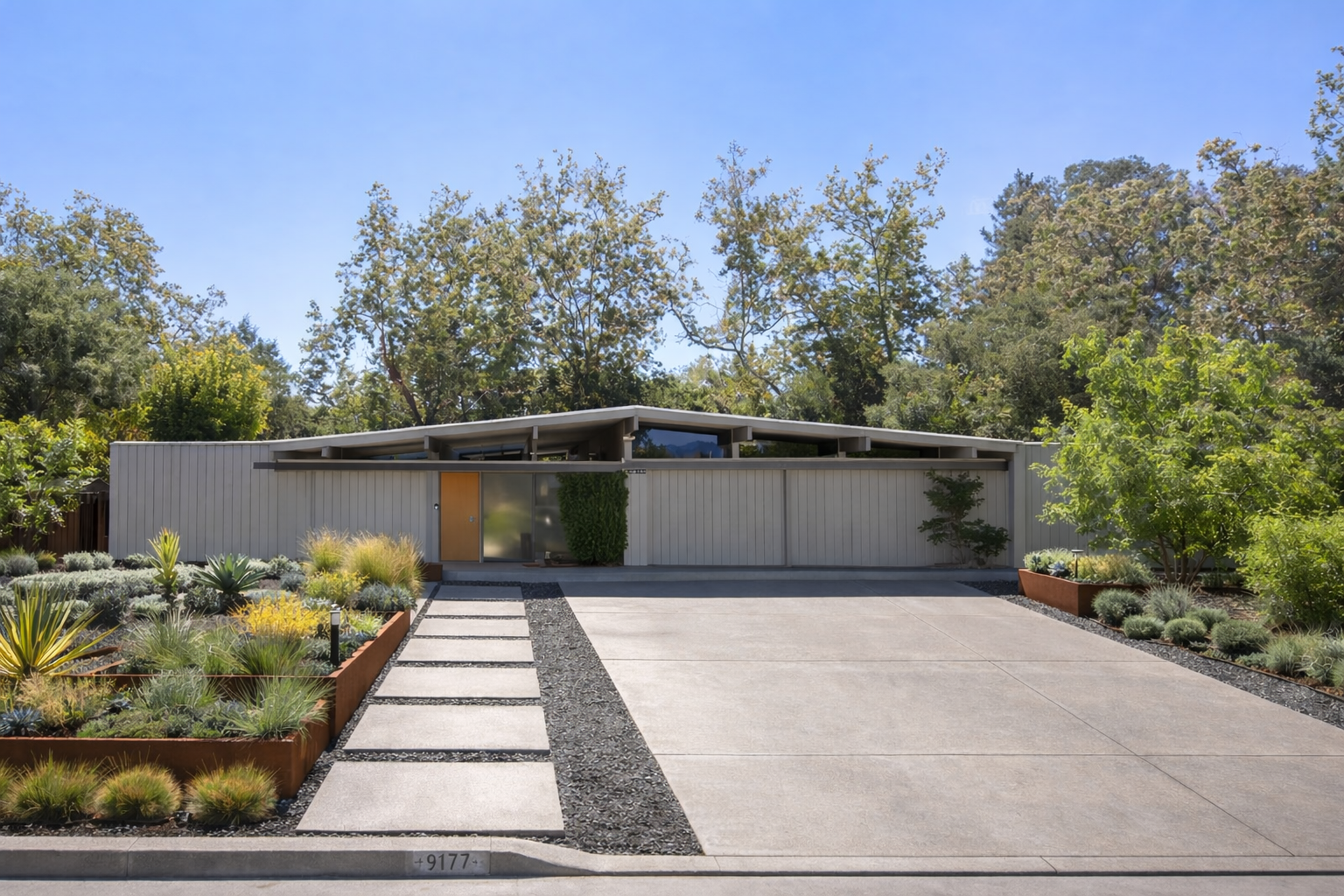
A classic mid-century modern Eichler home in Sunnyvale, showcasing the signature post-and-beam construction, floor-to-ceiling glass, and seamless indoor-outdoor integration. Such homes emphasize privacy from the street while opening up to the yard, embodying the “California Modern” style eichlerhomesforsale.com.
Mid-Century Styles & Lifestyle Appeal
Sleek, minimalist designs and a blurring of indoor and outdoor spaces characterize mid-century modern homes. Key architectural styles include Joseph Eichler’s glass-walled modern tract homes, Cliff May’s casual ranch houses, and other modernist variants influenced by architects like Richard Neutra and A. Quincy Jones boyengateam.com. Eichler homes typically feature open floor plans, exposed post-and-beam ceilings, radiant-heated floors, and central atriums, creating “a seamless transition between the interior and exterior,” according to boyengateam.com. By contrast, Cliff May’s ranch designs – a few of which appear in Silicon Valley – are low-slung and rambling, emphasizing indoor-outdoor California living on larger lots eichlerhomesforsale.com. All of these homes use natural materials (wood, stone, brick) and expansive glass to bring in light and views boyengateam.com.
Beyond their design, these homes foster an aspirational lifestyle: imagine sunlight-flooded living rooms opening to private patios and pools, set in leafy, tranquil neighborhoods that remain conveniently near jobs and amenities. It’s no wonder that mid-century houses are “highly sought after for their timeless style and unique charm,” boyengateam.com. Silicon Valley’s tech elite, design professionals, and families alike are drawn to the “functional works of art” that these homes represent eichlerhomesforsale.com. Many buyers today view owning an Eichler or similar mid-century home as both a lifestyle choice and a stewardship of architectural history.
Where to Find Silicon Valley’s Mid-Century Enclaves
Silicon Valley has an abundance of 1950s–60s tract housing, but a few cities stand out for concentrations of authentic mid-century modernist homes (especially Eichlers). Below is a map highlighting some of the key hotspots by city:
Mid-century home concentrations by city in Silicon Valley (Santa Clara & San Mateo counties). Circle sizes reflect the approximate number of mid-century modern homes (especially Eichler houses) in each area.
As the map suggests, Palo Alto and Sunnyvale boast the largest clusters of classic mid-century modern tract homes, with significant pockets also in Cupertino, San Jose, Mountain View, and Redwood City. Smaller enclaves dot Los Altos, Menlo Park, Saratoga/Monte Sereno, and even hillside communities like Portola Valley boyengateam.com. Below, we profile these areas, including notable neighborhoods, tract histories, and current market stats.
Palo Alto: Eichler’s Flagship City
Palo Alto is ground zero for Eichler homes and has the highest concentration of mid-century modern tract houses in the world – originally over 2,700 Eichler homes were built here eichlerhomesforsale.com. Today, an estimated ~2,200 remain, after some teardowns over the years. These single-story post-and-beam homes are scattered across south and central Palo Alto in neighborhoods like Greenmeadow, Fairmeadow (“The Circles”), Green Gables, and Charleston Meadows. Many of these tracts were built in the 1950s when Joseph Eichler partnered with architects like Jones & Emmons and Anshen & Allen, creating entire subdivisions of modernist homes. For example, Greenmeadow (1954) is a celebrated tract with around 270 Eichler homes centered around a community park and pool – it even has an association that has helped maintain its cohesive mid-century character to this day.
Palo Alto’s Eichler neighborhoods are known for their well-preserved character and community spirit. Homeowners have been proactive in preserving the aesthetic: the city has adopted Eichler Design Guidelines and single-story overlay zones in recent years to prevent oversized remodels that clash with the original low-profile style. As a result, driving through areas like Green Gables or Los Arboles feels like a time warp to 1950s California – breezeways, open-air atriums, and floor-to-ceiling glass looking onto manicured gardens eichlerhomesforsale.com. Blank, street-facing facades maintain privacy, while back walls are all windows that embrace the yard. It’s mid-century modern as Eichler intended: “privacy from the street but open to the outdoors”.
Market Snapshot: Palo Alto Eichlers command a premium thanks to their design and location (top schools, etc.). Prices often range from around $2.5–4+ million for a ~1,500–2,000 sq ft Eichler, depending on lot size and condition. In fact, Eichler homes here can cost as much or more than new tract homes – a well-preserved Eichler recently sold for about $4 million in nearby Monte Sereno. Despite their age (60+ years), these homes’ per-square-foot prices hold strong, often rivaling new construction when the Eichler is in prime shape eichlerhomesforsale.com. Demand is fueled by tech executives and architects who specifically seek out Palo Alto’s mid-century enclaves. The city’s measures to curb teardowns mean buyers here generally intend to renovate and preserve, not replace. As a result, Palo Alto’s Eichler tracts have retained not just their architectural integrity but also solid investment value – limited supply and fervent demand keep values high and resale prospects excellent.
Sunnyvale: Modernist Tracts in the Heart of the Valley
Sunnyvale, once a fertile orchard region, boomed in the 1950s as a suburban hub for defense and tech industry workers. Along with ubiquitous ranch houses, Sunnyvale gained over 1,000 Eichler homes across several tracts – one of the largest concentrations anywhere eichlerhomesforsale.com. Today, about 1,100 Eichlers still stand in Sunnyvale, Eichlerhomesforsale.com, in neighborhoods such as Fairbrae, Fairwood, Snail (Eichler enclave), Cherry Chase, and Birdland. Tract names like Fairbrae and Rancho Verde hint at the mid-century optimism of these developments eichlerhomesforsale.com. The Fairbrae tract (built ~1960) near Fremont High School includes an Eichler swim & tennis club, still active today, around which dozens of Eichlers cluster – an idyllic example of a planned mid-century community. Rancho Verde (1958) and Fairorchard (1959) are other Eichler tracts in Sunnyvale, each with its distinctive flat-roof models and quiet cul-de-sacs eichlerhomesforsale.com.
In addition to Eichler’s work, Sunnyvale features Mackay homes – mid-century modern ranches built by developer John Mackay, often inspired by Eichler-like designs. Mackay collaborated with Palm Springs architects Wexler & Harrison, bringing elements like low-sloping roofs and atrium-like patios into Sunnyvale homes boyengateam.com. These Mackay homes (found in neighborhoods like Sunnyvale Manor and Birdland) are sometimes called “Eichler alternatives” – similar open-beam aesthetics but with a bit more traditional layout. Wright Avenue and the streets around Ortega Park feature several Mackay homes that retain mid-century features (open-beam ceilings, glass gable fronts).
Lifestyle & Preservation: Sunnyvale’s mid-century neighborhoods tend to be ungated and integrated into the city grid, yet they offer a tranquil, almost nostalgic vibe. Streets lined with California ranchers and Eichlers are shaded by mature trees planted by the original 1950s owners. While Sunnyvale hasn’t imposed strict Eichler-specific guidelines as Palo Alto has, the city did publish an Eichler Design Guidelines reference for homeowners, recognizing the architectural heritage (noting “more than 1,000 Eichlers built in the city from 1949–1972”). This has encouraged many owners to opt for sympathetic renovations – for example, restoring mahogany wall panels or installing period-appropriate globe lights – rather than drastic remodels. Still, some Eichlers have been expanded or even torn down as Silicon Valley land values surge. Overall, Sunnyvale’s mid-century tracts remain intact and cherished by a community of enthusiasts, with active neighborhood groups and annual mid-century home tours in normal years.
Market Snapshot: Being more affordable than Palo Alto, Sunnyvale’s Eichlers offer a relative bargain for mid-century fans. A typical 4-bed Eichler (~1,600 sq ft) in good condition here might fetch $1.8–2.3 million (mid-$1,000s per sq ft), depending on the schools. That’s still higher than generic homes – truly pristine Eichlers have fetched premiums because of stylish restorations. The average price per square foot for Eichler homes in Sunnyvale often hovers around $1,000/sq ft, similar to Redwood City (eichlerhomesforsale.com), reflecting strong demand. Investors have also noticed that a thoughtfully updated Eichler (e.g., upgraded insulation, modern kitchen, while retaining the MCM aesthetic) can “command prices competitive with new construction on a per-square-foot basis” eichlerhomesforsale.com. Sunnyvale’s central location (commute-friendly) combined with these homes’ “cool factor” means they attract multiple offers. However, teardown pressure exists as well: some buyers are eyeing the flat lots for new builds. Local realtors now actively market Eichlers to preservation-minded clients to stave off tear-downs eichlerhomesforsale.com, often highlighting the home’s “artistic and legacy” value to justify the price. Long-term, a well-kept Sunnyvale mid-century home is seen as a solid investment – it appeals to both design-conscious buyers and those simply seeking a convenient single-story home in the Valley.
Cupertino: Preserved Eichlers and “Miracle” Ranches
Cupertino may be world-famous for Apple’s futuristic campus, but tucked in its neighborhoods are slices of 1950s–60s Americana. The city’s mid-century crown jewel is Fairgrove, a tract of around 225 Eichler homes built in 1960–61 near what is now Apple Parkcupertinoeichlerhome.com. Fairgrove (also known as the Cupertino Eichlers) exemplifies Eichler’s late-style atrium models: single-story, open-plan houses on 6,000–8,000 sq ft lots, many with fully enclosed glass atriums at their center cupertinoeichlerhome.com. The community remains remarkably intact – thanks to pioneering preservation efforts, Fairgrove became one of the first neighborhoods anywhere to adopt a special Eichler zoning overlay. In 2001, Cupertino adopted an “Eichler Single-Story Overlay (R1‑E)” for Fairgrove that prohibits second-story additions and encourages the preservation of mid-century design elements (cupertinoeichlerhome.com). Walking down Ferris Avenue or Stendhal Lane today, one sees original low-pitched rooflines, open carports, and unpainted wood ceilings – Fairgrove truly feels like a time capsule. Residents take pride in this heritage: many are second-generation owners or enthusiastic newcomers who share tips on period-appropriate restoration. The result is a neighborhood that has largely avoided the “mansionization” seen elsewhere in Cupertino, offering a cohesive mid-century modern ambiance instead, right in the heart of Silicon Valley.
Directly across Bollinger Road from Fairgrove lies a very different kind of mid-century tract: Rancho Rinconada. Built 1950–53, Rancho Rinconada was a sprawling subdivision of ~1,562 affordable ranch houses – not Eichlers, but simple 2–3 bedroom homes designed by builder Stern & Price with input from Cliff May cupertinoeichlerhome.com. Marketed as “Miracle House” plans, these were modest (800–1,000 sq ft) slab-on-grade homes with some mid-century modern touches: open carports, large picture windows, and low-gabled roofs reminiscent of Eichler designs (cupertinoeichlerhome.com). In fact, early ads boasted these “faux Eichlers” starting at just $7,500 – making them the ultimate starter homes of the 1950s cupertinoeichlerhome.com. Rancho Rinconada’s tiny lots and minimalist construction (no atriums or radiant heat) meant the houses were built cheaply, and over time, many were heavily altered. By the 1980s–90s, with Cupertino’s rise, teardown fever hit this tract hard: original cottages were replaced by large two-story houses, creating a patchwork of old and new Cupertino homes. Tensions between longtime residents and new builders led the tract to be annexed into Cupertino in 1999, specifically to gain zoning rules that would curb overbuilding cupertinoeichlerhome.com. Today, Rancho Rinconada is an eclectic mix – you might see a pristine 1952 Cliff May ranch with breeze-block accents next to a 2010 mini-mansion. Still, some original mid-century homes survive on streets like Wunderlich and Lancaster Drive, and there’s even a community-run Rancho Rinconada pool that has been operating since the '50s. These remaining low-slung ranchers offer a glimpse of “California modern ranch” style for buyers who can’t afford a pricier Eichler in Cupertino.
Cupertino also has a smattering of custom Eichlers and contemporaries in its Monta Vista district. In the early ’60s, Eichler built a handful of larger homes on streets like Phar Lap Dr., Peach Hill Rd., and Lovell Ave. in the Monta Vista hills cupertinoeichlerhome.com. These often sit on large lots with views, and some models even have atriums or pitched roofs not seen in the flatland tracts, suggesting Eichler was experimenting with upscale designs here. Only a few dozen exist, making them highly sought after by MCM fans seeking hillside seclusion. One noted example: an Eichler on Phar Lap Drive with a huge central atrium and glass walls all around, perched on a 1/3-acre lot – a rare “Eichler estate” variant. While Monta Vista’s Eichlers don’t form a contiguous tract, they contribute to the city’s mid-century mosaic (and yes, even these have faced teardowns by owners wanting to build 5,000 sq ft luxury homes).
Market Snapshot: Cupertino’s mid-century homes sit in a high-demand school district, so their values are robust. A renovated 4-bed Eichler in Fairgrove can easily exceed $2.5M. Despite their age, these Eichlers often sell above asking; their rarity and protected status make them “blue chip” real estate. Preservation rules in Fairgrove also reassure buyers that the surrounding homes will remain one-story and Eichler-esque, which protects long-term value. Rancho Rinconada, on the other hand, has a more mixed pricing strategy. An unexpanded original 2-bed/1-bath “Rancho” house might be a relative bargain (land value only, often $1.5M for a teardown lot). Many are indeed bought for land, but a few buyers are starting to keep and tastefully remodel the remaining Cliff May-style ranchers as funky alternatives to Eichlers. Overall, Cupertino exemplifies the tug-of-war between preservation and progress: in Fairgrove, preservationists have largely prevailed (leading to soaring values), whereas in Rancho Rinconada, many mid-century homes were displaced by redevelopment. Yet both areas show that location plus mid-century design is a winning combo – whether protected or not, these homes attract competitive bids. Cupertino’s city government, notably, has been ahead of the curve in valuing its mid-century tracts by zoning – a forward-looking stance that bodes well for Eichler owners and mid-century investors here.
San Jose: Eichler Pockets in the Suburban Expanse
As the largest city in the region, San Jose has numerous mid-century neighborhoods, mostly ordinary ranch-style subdivisions. However, San Jose also hosts several pockets of true mid-century modern homes, including Eichler tracts in Willow Glen and Cambrian Park that enthusiasts treasure. The best-known is Fairglen, a cluster of Eichler homes in Willow Glen (southwest San Jose) built in 1959–1961. Fairglen and its adjacent “Fairglen Additions” comprise 218 Eichler houses on streets such as Fairlawn and Booksin Avenue. This tract was one of Eichler’s later developments and features many 4-bedroom models with atriums. Historians recently recognized Fairglen’s significance – in 2021, it was added to the National Register of Historic Places as an intact example of Eichler’s work in San Jose. Strolling through Fairglen, one sees Eichler hallmarks: low horizontal rooflines, tall glass walls facing private side yards, and carports open to the street. The neighborhood has retained its mid-century ambiance; several homes still have original globe lights and wood paneling. Community pride is evident: Fairglen owners formed an Eichler club and worked with the city to secure a historic designation, which now helps discourage insensitive remodels. In a city known for rapid growth, Fairglen feels like an oasis of 1960s suburban utopia (its desirability boosted by Willow Glen’s charming downtown and leafy setting). Nearby, the Thousand Oaks tract (also Willow Glen) adds another few dozen Eichlers, and a smaller Eichler pocket lies in Almaden Valley (the Almaden Estates tract).
Further west in Cambrian Park (near the San Jose–Campbell border), Eichler built another tract of roughly 100 homes in the mid-1950s. These are found in the Rose Glen and Fairwood neighborhoods near Curtner Avenue and Bascom (sometimes called the “Eichler Expressway” area). Notably, some of the Cambrian Eichlers were slightly more affordable models mixed in with standard ranch homes – so the aesthetic is a bit more mixed than Willow Glen’s pure Eichler streets. sanjoserealestatelosgatoshomes.com Even so, if you drive down Merrimac Drive or Booksin Ave in Cambrian, you’ll spot the telltale Eichler features alongside more conventional neighbors. Additionally, San Jose has a few non-Eichler MCM enclaves, such as the Hacienda Gardens tract off Hillsdale Avenue, built by Stern & Price in 1957, which features low-gable modern ranch homes reminiscent of Eichler’s style. In the Rose Garden area near central San Jose, a handful of custom mid-century homes and modernist remodels are hidden among older pre-war houses, illustrating the diversity of the city’s housing stock.
Market Snapshot: In San Jose, mid-century modern homes represent a small slice of the market (the city has only about 300 Eichlers in total, scattered in three main tracts, plus some co-ops and custom modernist homes). Because they are rarer here, Eichlers in San Jose command a slight premium over tract ranch houses but are still more affordable than those in Palo Alto or Cupertino. For instance, a 3-bed Eichler in Fairglen might sell around $1.6–1.8M, whereas the same in Palo Alto would be $3M+. That said, within San Jose, location matters: Willow Glen’s Eichlers (with their historic status and upscale zip code) can reach into the mid-$2 millions, especially if beautifully updated. In contrast, Eichlers in Cambrian or Almaden, while still coveted, sell closer to the citywide median (around $1.3–1.5M) due to slightly less cachet and differences in schools. One advantage for buyers: San Jose’s Eichler neighborhoods have not faced as intense teardown pressure as on the Peninsula. Until the historic listing, Fairglen saw a few scrapes, but community awareness is now higher. Many Eichlers have been sensitively upgraded with modern electrical systems and new foam roofs (to improve insulation over the old tar-and-gravel roofs), making them more comfortable and energy-efficient than when built. The investment potential for San Jose mid-century homes is solid, especially as design-oriented buyers who get “priced out” of Palo Alto turn their attention here. With the National Register designation, Fairglen Eichlers in particular may see a value increase, as some buyers value owning an officially historic mid-century home (there are even tax benefits under the Mills Act in California for historic home maintenance). In summary, San Jose’s mid-century enclaves offer a blend of relative value and growth potential – they’re limited in number, increasingly protected, and located in a city with endless demand for housing. That’s a recipe for good long-term appreciation, provided the mid-century character is preserved.
Mountain View & Los Altos: Atomic Ranch Meets Tech Boom
On the Peninsula just south of Palo Alto, Mountain View and Los Altos each host noteworthy mid-century neighborhoods, though on a smaller scale. In Mountain View, the star is Monta Loma – a mid-century modern tract often called “Mountain View’s mid-century gem.” Developed in the mid-1950s, Monta Loma is unique because three builders (Joseph Eichler, John Mackay, and Mardell Building Co.) each contributed homes theremontaloma.orgmontaloma.org. The result is a few hundred homes that are all mid-century modern in flavor, even if not all true Eichlers. The Fairview tract within Monta Loma includes about 200 Eichler homes (built 1954–1955) – mainly 3-bed, 2-bath houses ~1,100–1,300 sq ft with trademark Eichler features. Intermixed on adjacent streets are Mackay homes and Mardell homes that look strikingly similar: low-profile roofs, open-beam ceilings, and glass walls. (Local lore says the competing developers actually copied Eichler’s plans, even hiring some of the same architects, which is why a trained eye can spot subtle differences like Mardell homes having hardwood floors instead of Eichler’s concrete slab, etc., montaloma.org.) Monta Loma thus offers a delightful tour of mid-century architecture – you can compare an Eichler vs a Mackay on the same block. The neighborhood association celebrates this heritage with block parties and has documented the history on MontaLoma.org. Streets like Thompson Ave and Monta Loma Drive are lined with butterfly-roof homes and vintage modern façades that catch the attention of Silicon Valley’s “design nerds.” Monta Loma’s convenient location (near Googleplex and Caltrain) has made it popular for tech buyers, which in turn has spurred many sensitive remodels – you’ll see restored 1955 kitchens alongside Tesla chargers in the carport. However, the area’s low-lying location comes with a quirk: some Monta Loma/Eichler homes sit in a 100-year floodplain, meaning buyers might need flood insurance. This hasn’t dampened enthusiasm much; Monta Loma homes still get multiple offers, but it’s a consideration for renovations (e.g., raising the slab).
Los Altos, a wealthy suburb next door, features larger lots and fewer tract developments – but it too has mid-century prizes. Notably, Fallen Leaf Park in south Los Altos is a small Eichler tract of 28 homes, built in 1962, renowned for its well-preserved condition. boyenga.com. In fact, Eichler aficionados consider Fallen Leaf Park (Los Altos) and Mills Estate (Burlingame) as two of the “best maintained and most attractive” Eichler neighborhoods on the Peninsula. The Fallen Leaf Eichlers were later models designed by Claude Oakland, mostly 4-bedroom homes on large 1/4-acre lots, which allowed for larger atriums and two-car garages (a luxury in the Eichler world). Driving down Fallen Leaf Lane or Heritage Court, you see sprawling one-story layouts with courtyards and even some original globe lamps along the sidewalks – a very intact mid-century scene. Because Los Altos was more expensive even when built, these Eichlers have always been relatively upscale, and many have been faithfully maintained. Some original owners still reside here 60+ years on, and newer owners often choose restoration over reconstruction, given the neighborhood pride. Other mid-century pockets in Los Altos include Rancho (homes off Fremont Avenue), where Eichler built about 20 homes, and scattered one-off custom modern homes hidden in the hills (including some by Frank Lloyd Wright apprentices, adding to the architectural tapestry). Los Altos Hills even had one of Wright’s own Usonians (the Louise and Adelbert Stanford House, 1939) – predating our mid-century range but indicative of the area’s modernist roots.
Market Snapshot: Mountain View’s Monta Loma has transformed from starter homes to highly competitive real estate. In the early 2000s, you could snag a Monta Loma mid-century home for under $600k; now, expect prices in the $1.8–2.2M range for ~1,200 sq ft, if not higher. The mix of Eichler and non-Eichler doesn’t deter buyers – in fact, tech professionals love the proximity to campuses and the “Eichler vibes” at somewhat lower cost than Palo Alto. Monta Loma’s diverse builder history means some homes have attached garages (a plus for many) while still looking MCM, broadening their appeal. One caution for investors: the floodplain designation mentioned earlier can require raising houses during major remodels, which is costly – but many Monta Loma buyers renovate within the existing shell to avoid that. Over in Los Altos, Eichlers and mid-century homes are firmly in the luxury category. A Fallen Leaf Park Eichler, when it comes up for sale, will easily fetch $3–4M. These sit on valuable land in a city where new mansions often command $5M+, but buyers in Los Altos have largely chosen to preserve these Eichlers rather than replace them. The combination of large lot, prime location, and architectural uniqueness gives mid-century homes here a “protected niche” – they attract a subset of affluent buyers who specifically want the retro style and are willing to pay top dollar for a turnkey restored Eichler. That niche demand, coupled with extremely limited supply (only ~50 Eichlers in Los Altos), means mid-century homes in Los Altos often see bidding wars that drive prices above those of neighboring conventional homes. In short, small numbers, big interest. For both Mountain View and Los Altos, mid-century homes have proven to be wise investments: they appreciate alongside the hot Silicon Valley market and command an additional premium for their character that generic homes lack. As long as the mid-century aesthetic remains in vogue (and all signs say it does, with endless magazine spreads on “atomic ranch” remodels), these homes should continue to outperform market averages on resale.
Menlo Park & Portola Valley: Secluded Modernist Treasures
In Menlo Park (northwest of Palo Alto), mid-century modern homes are fewer but notable. Menlo Park has around 50 Eichler homes in total – a “boutique” collection compared to the thousands next door boyengateam.com. These Eichlers were built in small clusters during the 1950s and early ’60s, and interestingly span Eichler’s early to late period. For example, Peninsula School Tract near Willow Road contains some of Eichler’s first modest homes (circa 1950), as well as a few larger models added later. Tucked in the Sharon Heights area is Oakdell Park, a 1959 Eichler subdivision of 14 luxurious houses on quarter-acre lots boyengateam.com. The Oakdell Park Eichlers were designed by famed architects Anshen & Allen and A. Quincy Jones, featuring 2,800 sq ft layouts – making them some of the biggest Eichler homes ever built, originally marketed as the ultimate in “prestige” mid-century living boyengateam.com. To this day, Oakdell Park (located off Santa Cruz Avenue) remains an exclusive cul-de-sac – many of its Eichlers are beautifully preserved behind mature oaks, invisible from the main road (lending them a “hidden enclave” mystique). Another Menlo Park pocket, University Heights, hides a few Eichlers intermixed with custom modern homes along Stanford Avenue and Pope Street. Because Menlo Park’s Eichlers are so scattered and often down private lanes, even some locals are surprised to learn of them – they “remain virtually unknown, even to experienced Eichler watchers” boyengateam.com. However, this also means they lack the kind of neighborhood cohesion seen in Palo Alto; some Menlo Eichlers sit side-by-side with remodels or non-modern homes.
Challenges: With Menlo Park’s property values sky-high (the city’s median price flirts with $3.5M), these mid-century houses face intense teardown pressure. Local realtors note that “sky-high prices are putting many of them in jeopardy,”boyengateam.com. Indeed, over the years, unsympathetic remodels have altered or even replaced many Menlo Park Eichlers. On the flip side, a handful of dedicated homeowners have done museum-quality restorations – preserving mahogany interiors and adding period-correct furnishings. The city doesn’t yet have specific Eichler preservation ordinances, so it’s been up to community advocacy. Encouragingly, several Menlo Park Eichlers have sold to buyers intending to preserve, thanks in part to real estate agents who connect sellers with mid-century enthusiasts rather than spec builders eichlerhomesforsale.com. One positive trend: Eichler homes in Menlo Park now routinely sell for land value plus some, meaning buyers are paying a premium for the design (whereas in the 90s they were sometimes valued below replacement cost). This suggests the market is recognizing their architectural worth.
Moving west into the wooded hills, Portola Valley offers a very different mid-century scene – one of custom modernist estates and a few tract homes in a rural setting. In the early 1950s, Eichler built 25 homes in the Ladera area (technically unincorporated but adjacent to Portola Valley)eichlerhomesforsale.comeichlerhomesforsale.com. These Ladera Eichlers were experimental two-story and split-level designs – unusual for Eichler – to adapt to sloped lots eichlerhomesforsale.com. There are still a few Eichler homes with multiple floors. Today, roughly two dozen Eichlers are found on streets like La Mesa Drive and Dedalera Drive in Ladera, making them exceedingly rare; when one hits the market, it’s a local event (one recently listed for $2.4M as “the most well-known Eichler in the community”) eichlerhomesforsale.com. Beyond Eichler, Portola Valley attracted many notable architects in the mid-century era to design one-off houses amidst its oak-studded hills. An example is the Lane Ranch, a 10-acre property featuring an iconic Cliff May ranch house built in 1957 eichlerhomesforsale.com. This sprawling single-story estate epitomizes Cliff May’s indoor-outdoor elegance – broad overhanging eaves, entire walls of glass, and seamless flow to patios and pastures – all set against Portola Valley’s rolling terrain. It famously sold for $16 million in 2021, proving that mid-century design can command ultra-luxury prices in this town eichlerhomesforsale.com. Other architectural gems in Portola Valley include modernist homes by William Wurster and Marcel Sedletzky, as well as contemporary builds that draw on mid-century aesthetics (e.g., new glass-and-wood eco-homes that echo the simple lines of 1960s predecessors). Portola Valley’s commitment to open space and low-density development has meant many of these mid-century estates are exceptionally well-preserved, as they often remain the original structures on large parcels. A drive through Portola Valley’s Westridge or Alpine Hills neighborhoods reveals mid-century architecture on a grand scale – think floor-to-ceiling windows framing views of the Coastal Range, in homes designed as retreats for Silicon Valley’s early executives.
Market Snapshot: In Menlo Park, mid-century homes (when not torn down) occupy a middle ground in the market. A smaller 3-bed Eichler might trade around $2.5–3M, while a larger Oakdell Eichler could be $4M+ if impeccably updated. Because the city is so pricey, there is always the lurking calculus of “tear down and build new” – indeed, some Eichler lots have given way to new two-story traditional homes that sell for $5–6M. This dynamic keeps Eichler prices in Menlo Park somewhat checked by lot value, unless protections are put in place. That said, the fact that Eichlers are relatively few here enhances their cachet: they are seen as boutique properties for those in the know. Savvy agents pitch them as “livable works of art in one of the Peninsula’s loveliest towns,” and they do attract multiple offers from design aficionados, particularly if the home is mostly original. For Portola Valley, the market for mid-century homes operates at the high end. There is virtually no scenario of tearing down a Cliff May estate for a McMansion – the existing homes are too integral to the land’s value and character. Instead, buyers at the top of the market compete for these legacy properties. A modest Eichler in Ladera might sell in the low $3Ms, benefiting from Portola Valley schools and charm. Meanwhile, a pedigreed custom mid-century house (such as one by Wurster or a unique modernist ranch) can easily fetch $5M to $10M+, as seen in the Cliff May example. These are effectively luxury assets – often marketed internationally – where the architecture is a selling point as much as the acreage. Investment-wise, Portola Valley’s mid-century homes appreciate along with its exclusive market; they are scarce and highly coveted by a small pool of wealthy buyers. Menlo Park’s, on the other hand, straddle an uncertain line: if preservation efforts grow (perhaps through historic districts or overlay zones in the future), they could significantly appreciate as protected artifacts; if not, each sale risks becoming a teardown, and pricing will align more closely with land comps. For now, the resale potential for Menlo Park’s intact mid-century homes remains strong – many sellers have realized that by targeting the right niche of buyers and emphasizing the architectural legacy, they can achieve sales at or above the going rate for generic homes eichlerhomesforsale.com. This is a trend across Silicon Valley: mid-century modern isn’t just a quirky taste anymore; it’s mainstream cool, and buyers are paying for it.
Renovation, Preservation, and Market Trends
Across Silicon Valley, mid-century homes are experiencing a renaissance of appreciation, but not without challenges. Renovation vs. Teardown is a central tension. On one side, you have devoted preservationists – often buyers who are architects, designers, or tech professionals with an affinity for mid-century style. They specialize in restoring original features such as globe lamps, Philippine mahogany walls, and terrazzo floors. Many install modern updates discreetly: foam roofing and upgraded insulation to improve efficiency without changing the look, updated kitchens that honor the home’s clean lines, and landscaping that complements indoor-outdoor living (think: Japanese-inspired gardens visible through glass walls). These renovations, when done thoughtfully, increase value significantly – a fact not lost on the market. In Realtor descriptions, you’ll often see “authentically restored Eichler” as a selling point commanding a premium, with such homes often selling over list price due to bidding by fellow enthusiasts eichlerhomesforsale.com
On the other side, there are redevelopment-focused buyers and builders. They see the mid-century homes as under-built for the now very expensive land. A typical Eichler is 1,500 sq ft on a 7,500 sq ft lot, where zoning might allow a new 3,500 sq ft two-story. Especially in ultra-high-end markets like Atherton and parts of Palo Alto, some Eichlers were demolished to make way for larger luxury houses. boyengateam.com/eichlerhomesforsale.com Each teardown is controversial; neighbors often object, citing loss of neighborhood character. Some cities have responded: we discussed Palo Alto and Cupertino’s protective ordinances, and San Jose’s Fairglen just got historic status – these efforts tilt the balance toward preservation by making teardowns, or out-of-character remodels, more difficult. Still, not every area is protected, and with land values so high (e.g., Redwood City median home ~$1.9M eichlerhomesforsale.com, Menlo Park and Los Altos well above that), the temptation to rebuild is ever-present. Investors who purchase mid-century homes must gauge the local sentiment and regulations: is the highest return gained by preserving and enhancing the mid-century appeal (thereby tapping a niche but lucrative market), or by exploiting the lot and building new (aiming for a broader luxury market)? Increasingly, evidence shows the former strategy can be quite profitable when done right. As one real estate expert put it, “a well-preserved or thoughtfully renovated Eichler can command prices competitive with new construction”eichlerhomesforsale.com. Moreover, specialized agents (such as the Boyenga Team or Eichler-specific Realtors) have made it their mission to connect mid-century sellers with the right buyers to keep these homes alive, eichlerhomesforsale.com, leveraging networks of Eichler fans to do so.
Demand Drivers: The mid-century modern trend shows no sign of fading. Young buyers who grew up with open-plan contemporary homes often find the authenticity of an Eichler refreshing – it’s mid-century and modern at the same time. Tech workers who spend days in digital environments are drawn to the tangible, retro-contemporary vibe of these homes (some joke that living in an Eichler is like “Mad Men meets Silicon Valley”, offering both nostalgia and modern comfort). The Bay Area also has a large population of design-conscious professionals – graphic designers, UX architects, etc. – who value uniqueness in their personal homes. For them, a cookie-cutter McMansion holds little appeal next to a stylish low-slung modernist home with a story behind it. As a result, mid-century homes often attract multiple offers, including all-cash bids, as buyers compete to secure these rare properties. We’ve seen homes marketed as “Eichler-inspired” or “mid-century modern ranch” even if they aren’t Eichlers, simply to capitalize on the buzz. In essence, mid-century design has become a selling point in itself in Silicon Valley real estate.
Appreciation Outlook: For investors or homeowners concerned with resale, mid-century homes in Silicon Valley have proven to be strong performers. Not only do they ride the broader Bay Area property appreciation wave, but their relative rarity insulates them somewhat from market swings. Even during softer market periods, there’s usually a baseline of mid-century enthusiasts looking for opportunities, keeping demand up. In hot markets, these homes can spark bidding frenzies that are disproportionately higher than their size or location might suggest, purely due to their style. A case in point: an Eichler in Sunnyvale that might be valued at $1.5M based on comps can fetch $1.7M+ if two Eichler-loving buyers duel over it. In Palo Alto, Eichlers have such cachet that the City of Palo Alto notes they “boast the highest concentration in the world” and are a proud part of local heritage (eichlerhomesforsale.com). This civic recognition, along with events such as Eichler home tours and mid-century modern fairs, further bolsters the market by educating more people about the appeal of these homes.
In summary, Silicon Valley’s mid-century neighborhoods have evolved from ordinary post-war housing into coveted historic districts and lifestyle destinations. The combination of aesthetic appeal, historical significance, and plain real estate fundamentals (single-story living, relatively spacious lots, good locations) makes them a compelling investment. Whether you’re a data nerd poring over price-per-square-foot trends or a design aficionado seeking that perfect indoor-outdoor California dream house, the mid-century home enclaves of Silicon Valley offer something truly special: homes that are not only places to live, but pieces of 20th-century art and history that you can own. As long as preservation continues to triumph over teardown, these neighborhoods will remain a unique intersection of Silicon Valley’s past and present – where modernist architecture, California culture, and high-tech prosperity all converge.
🏡 Mid-Century Modern & Eichler Homes — Silicon Valley (Core Guides)
Mid-Century Modern Homes Throughout Silicon Valley
Eric & Janelle Boyenga
🔗 https://www.boyengateam.com/blog/detail/686/1/mid-century-modern-homes-throughout-silicon-valley
Eichler Neighborhoods in Silicon Valley
South Bay • East Bay • Peninsula • Marin • San Francisco
🔗 https://www.eichlerhomesforsale.com/eichler-tracts-overview
📍 City & Neighborhood-Specific Eichler Guides
Redwood City
Redwood City Eichler Homes – Rare Mid-Century Modern Luxury
Boyenga Team | Compass
🔗 https://www.eichlerhomesforsale.com/redwood-city-eichler-real-estate-information
Cupertino
Cupertino Eichler Homes – Cupertino Mid-Mod Tracts
🔗 https://www.cupertinoeichlerhome.com/blog/cupertino-mid-mod-tracts
Portola Valley
Portola Valley Eichler & Modernist Homes (94028)
🔗 https://www.eichlerhomesforsale.com/blog/eichler-and-modernist-homes-in-portola-valley-a-mid-century-modern-haven
Los Altos
Los Altos Eichler Neighborhoods – Boyenga Team
🔗 http://www.boyenga.com/los-altos-eichler-neighborhoods.php
Mountain View / Monta Loma
The Mountain View Eichler Tracts – A Deep Dive
🔗 https://medium.com/@Boyenga/the-mountain-view-eichler-tracts-a-dive-into-mid-century-modern-excellence-401ef5685dad
Monta Loma – Home Styles
🔗 https://www.montaloma.org/monta-loma/home-styles/
Fun Factoids About Monta Loma
🔗 https://www.montaloma.org/monta-loma/fun-factoids-about-monta-loma/
🛠️ Remodeling, Additions & Design Integrity
Silicon Valley Eichler Home Additions & Remodels
Enhancing Value While Preserving Mid-Century Charm
🔗 https://www.eichlerhomesforsale.com/blog/silicon-valley-eichler-home-additions-amp-remodels-enhancing-value-while-preserving-mid-century-charm
🏛️ History, Preservation & Official Recognition
California State Historical Resources Commission – Eichler Considerations
🔗 https://www.parks.ca.gov/NewsRelease/864
San Jose Eichler Tract Named to the National Register
Eichler Network
🔗 https://www.eichlernetwork.com/blog/dave-weinstein/san-jose-tract-named-national-register
Fairglen Additions (Wikipedia)
🔗 https://en.wikipedia.org/wiki/Fairglen_Additions
📣 Community & Social
Joseph Eichler Discussion (Facebook Group)
🔗 https://www.facebook.com/groups/1411879629035576/permalink/2716928308530695/