Marketing an Eichler Is Not Like Marketing Any Other Home: Why Design-Literate Presentation Changes Results and Why Wrong Photos Attract the Wrong Buyers
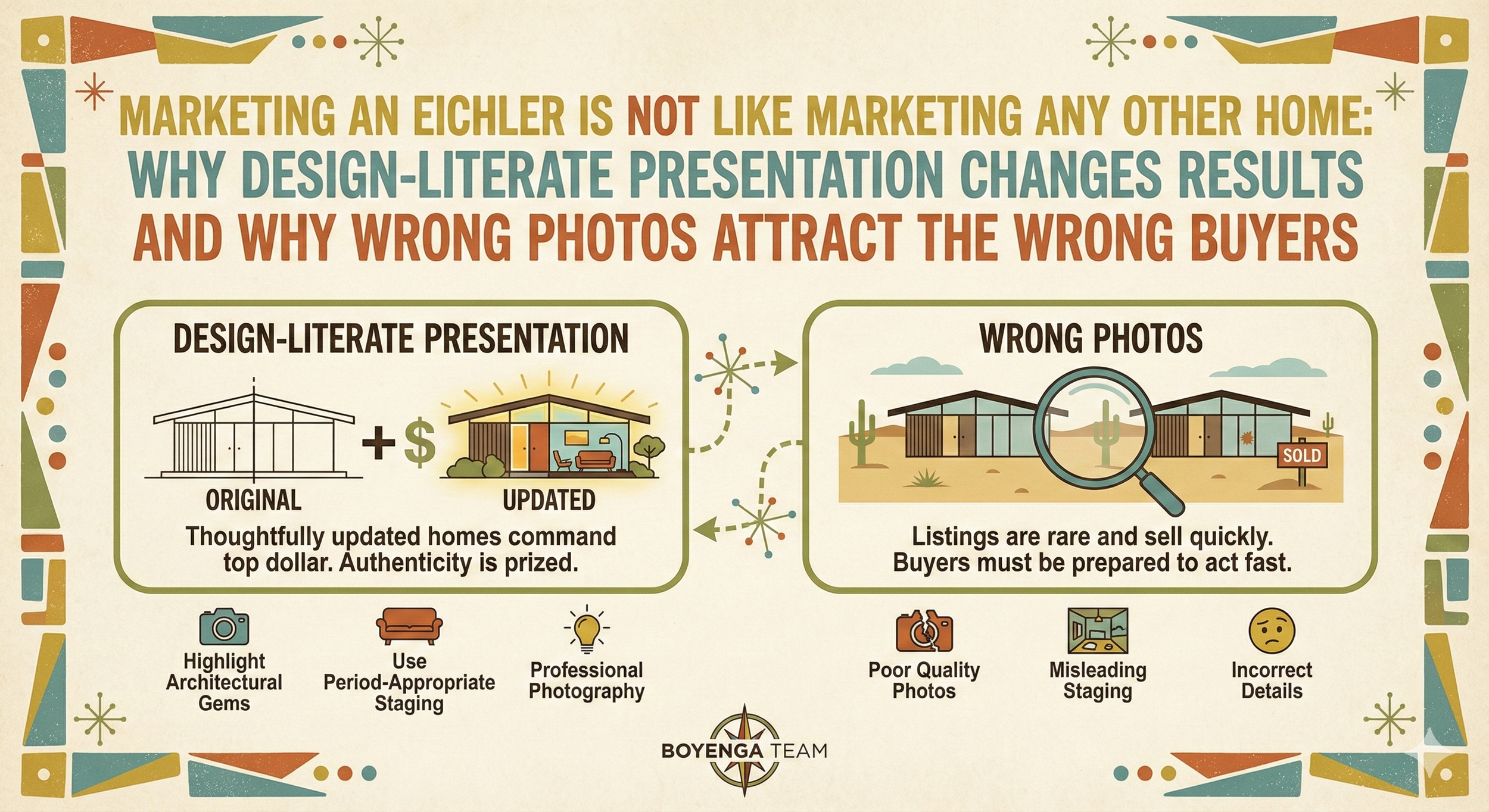
The Architectural Asset Class
The residential real estate market generally operates on a commoditized model where value is systematically derived from reductive metrics: location, square footage, bedroom count, and bathroom count. In this traditional paradigm, a house is viewed primarily as a functional container for habitation, and marketing efforts are calibrated to highlight utility and "curb appeal." However, Joseph Eichler homes—and the broader category of architecturally significant Mid-Century Modern (MCM) properties—represent a distinct asset class that fundamentally defies this valuation model. These structures are not merely shelter; they are artifacts of a specific socio-architectural movement, characterized by post-and-beam construction, radiant heating, and a philosophical commitment to indoor-outdoor living. Consequently, the marketing of an Eichler home requires a radical departure from "feature-based" selling to "narrative-based" curation.
Current research and market analysis indicate a critical divergence in sales outcomes based on presentation quality. Listings that utilize standard real estate marketing tactics—such as high-dynamic-range (HDR) photography, wide-angle distortion, and generic staging—fail to capture the "emotional asset" of the architecture. More dangerously, these generic presentations operate as a "distress signal" to speculative investors (flippers), who interpret poor visual rhetoric as evidence of an undervaluation. These buyers often destroy the home's architectural integrity in a misguided attempt to maximize short-term yield through standardization. Conversely, design-literate presentation—characterized by editorial-style photography, period-correct staging, and historical storytelling—attracts the "preservationist buyer." This demographic views the home as a collectible piece of art and is willing to pay a significant premium for authenticity and provenance.

This report provides an exhaustive analysis of why design literacy is the decisive factor in Eichler valuation. It explores the architectural physiology of Eichler homes, the physics of photography in glass-walled environments, the psychology of buyer segmentation, and the economic consequences of visual rhetoric.

Part I: The Physiology of the Product – Why Eichlers Resist Generic Marketing
To understand why standard marketing methodologies fail for Eichler homes, one must first examine the radical differences in the product itself. Joseph Eichler was not a builder in the traditional sense; he was a developer who operationalized the aesthetic and social principles of High Modernism for the American middle class. Influenced deeply by his time living in a Frank Lloyd Wright Usonian home in Hillsborough, California, Eichler sought to bring "good design" to the masses. This was not merely a stylistic choice but a moral imperative, rooted in the belief that the environment in which one lives shapes the quality of one's life.
1.1 Structural Transparency and the Failure of "Curb Appeal."
Traditional real estate marketing relies heavily on the concept of "curb appeal"—the immediate, frontal impact of a home’s façade. Colonial, Victorian, and Ranch styles are architecturally extroverted; they are designed to be viewed from the street, with ornamentation, porches, and fenestration that announce the home's status and invite the viewer's gaze. The marketing photography for these homes naturally prioritizes a bright, wide shot of the front elevation to establish value.
Eichler homes, however, were designed with a deliberate introversion regarding the public street. The typical Eichler façade is often an austere composition: a blank wall, a high fence, small clerestory windows, or a modest carport. This design choice was intentional, prioritizing private living spaces over public display. The "curb appeal" metric is effectively inverted in an Eichler; the home's beauty is internal, revealed only upon entering the atrium or the main living space.
Standard real estate photography, which dutifully captures the front of the house with a wide-angle lens, often renders an Eichler looking like a "bunker," a "fortress," or a "garage with a house attached." A design-literate approach recognizes that the "front door" is often a psychological threshold deep within the property, typically past a private courtyard. Marketing that fails to explain the transition from public anonymity to private transparency visually fails to articulate the architecture's primary value proposition. The narrative must guide the viewer past the austere shell into the home's luminous core, a journey that standard exterior photography often halts before it begins.
1.2 The Post-and-Beam Skeleton vs. The Stud Wall
The structural logic of an Eichler is post-and-beam. Unlike standard stud-framed houses, where walls are load-bearing and covered in drywall to create a smooth, uniform surface, the Eichler relies on a visible skeleton of heavy timber beams and posts. This structural system permits non-load-bearing glass walls and eliminates the attic, creating a cathedral-like volume beneath a flat or low-sloping roof.
This structural reality creates specific and acute marketing challenges:
Visual Noise vs. Rhythmic Order: In a standard photo, the dark beams contrast sharply against the tongue-and-groove ceiling (often stained white or natural redwood). If not photographed with appropriate lens compression and lighting, this results in "visual noise." A wide-angle lens, a standard tool in real estate for making rooms look larger, distorts these rhythmic parallel lines, rendering the ceiling chaotic, aggressive, or oppressive rather than ordered and sheltering. The geometric purity of the grid is lost to optical distortion.
No Place to Hide: The lack of an attic and the use of single-pane glass mean that "flaws" are more visible. There are no soffits to hide ductwork; there is no crawlspace for easy rewiring; there is no heavy insulation to dampen sound. Marketing that attempts to conceal these realities (e.g., by overcropping photos or using angles that obscure the ceiling) leads to buyer disappointment upon physical inspection. Conversely, marketing that celebrates them as "honest architecture" attracts buyers who value the aesthetic of exposed structure and "truth in materials".

1.3 The Atrium as the Optical Center
Many Eichler models feature an open-air atrium at the center of the floor plan. This is not merely a patio or a light well; it is the optical and circulatory heart of the home. In a standard home, the "center" is usually a dark hallway or a windowless utility core. In an Eichler, the center is a shaft of light and air.
Generic marketing often treats the atrium as an "exterior" space, relegating it to the end of the photo carousel or describing it as a "patio." Design-literate marketing understands that the atrium is the first impression and the organizing principle of the entire house. It creates a seamless visual continuity, allowing one to see from the living room through the atrium to the kitchen or bedroom. If the photography does not capture this transparency—this ability to look through the house—it fails to convey the effective square footage. An Eichler feels significantly larger than its measured footprint because a wall never stops the eye; it always finds glass and nature. Standard photography that flattens depth perception destroys this illusion of infinite space, reducing the home to a series of small, disconnected rooms.
1.4 Material Honesty and the "Patina" of Value
Modernist architects prized "truth in materials" (truth to materials). Wood should look like wood; concrete should look like concrete; stone should look like stone. Eichlers originally featured Philippine mahogany paneling (luan), cork floors, and unpainted redwood ceilings. These materials were chosen for their warmth, texture, and ability to age gracefully, acquiring a patina that synthetic materials lack.
In the current mass market, "updated" often implies "sanitized." The prevailing trend of "gray-washing" or painting everything white to make it "light and bright" is a direct assault on the Eichler ethos. When an agent markets an Eichler that has been painted white as "updated," they are appealing to a buyer who wants a generic modern farmhouse or a contemporary condo. Conversely, when an agent markets preserved mahogany paneling as "original architectural detailing," they appeal to a buyer who values the material's rarity and integrity.
The disconnect occurs when agents encounter dark wood. In standard real estate doctrine, dark walls are "bad" because they absorb light and make a room feel small. In the Eichler doctrine, dark walls are "good" because they recede visually, framing the bright outdoors and creating a sense of enclosure and protection. If a photographer uses a flash on a mahogany wall to make it "bright," they turn a rich, warm surface into a flat, orange-brown barrier. This creates the "dungeon effect," which scares off buyers, whereas natural light would have rendered it as a warm, protective envelope.
1.5 The Environmental Systems: Radiant Heat and Roofs
Beyond the visual, the physiological experience of an Eichler is governed by its systems. The radiant floor heating system is iconic to the brand. It uses hot-water pipes embedded in the concrete slab to radiate heat upward, warming objects rather than the air. This creates a silent, draft-free warmth that is fundamental to the "Eichler experience."
However, generic marketing often fails to explain or even mention this feature, or worse, frames it as a liability ("old pipes"). A design-literate narrative positions radiant heat as a luxury feature superior to forced-air systems, citing its efficiency and the comfort of walking barefoot on warm concrete. Similarly, the flat roof is often cited as a risk of leakage by untrained agents. A specialist positions the roofline as essential to the modernist profile and discusses the modern membrane technologies that make them durable, framing maintenance as stewardship rather than burden.
Part II: The Semiotics of Photography – Light, Lens, and Lie
The primary medium through which real estate is consumed is the digital image. In an era when 100% of home buyers begin their search online, the photograph is not merely a representation of the property; it is the property in the buyer's mind. For Eichler homes, the standard practices of real estate photography—specifically HDR and wide-angle lenses—are not just suboptimal; they are destructive to the architectural narrative.
2.1 The Physics of Light in Glass Houses
Standard homes are boxes with holes (windows) punched in them. The light is directional and limited. To photograph a standard bedroom, a photographer often uses a flash to illuminate the dark corners and balances it with the window light. The goal is homogeneous illumination.
Eichlers are not boxes; they are glass pavilions. The walls are the light source. This creates a specific dynamic range challenge:
The Contrast Ratio: The difference in brightness between the sunlit atrium and the interior mahogany wall can be extreme (15+ stops of light). The human eye can adapt to this; a camera sensor cannot.
The Reflection Problem: Walls of glass act as mirrors at night or when the interior is brighter than the exterior. A flash fired directly at a glass wall reflects off it, creating a glare that obscures the view and reminds the viewer of the photographer's presence.
2.2 The HDR Trap (High Dynamic Range)
To solve the contrast problem, most real estate photographers use automated HDR. They take 3-5 bracketed exposures (dark, normal, bright) and merge them using software (Enfuse, Photomatix). This technique has become the industry standard because it is fast and cheap.
Why HDR Fails Modernism:
Shadow Eradication: Architectural depth is defined by shadows. The interplay of the beams casting lines across the floor defines the "time of day" and the "volume" of the space. Aggressive HDR merging lifts all shadows to a mid-tone gray. The result is a "flat" image where the room lacks dimensionality. The home appears to be a cartoon or a 3D rendering, rather than a physical space.
The "Nuclear" Window View: In an attempt to balance the interior and exterior, HDR often produces a "halo" effect around window frames and renders exterior vegetation as a radioactive, oversaturated green. For a home that sells "nature" as its primary amenity, making nature appear artificial is a fatal error. It creates an uncanny valley effect in which the viewer knows that something is wrong but cannot articulate what.
Color Contamination: Eichlers often mix light sources (warm tungsten interior lights + cool blue daylight). HDR blending often muddies these colors, turning white walls dirty gray or mahogany walls a sickly orange. This "muddy" appearance signals dirt and age to the buyer's subconscious.
The "Flambient" Solution: High-end architectural photographers use a technique called "Flambient" (Flash + Ambient). They take a frame with ambient light to capture the mood and the view, and a separate frame with flash to get accurate colors on the furniture and wood. They then hand-mask these layers in Photoshop. This preserves the direction of natural light (the shadows cast by the beams) while ensuring that the interior remains visible. This technique is labor-intensive and expensive, which is why discount real estate photographers avoid it. However, it is the only way to represent the interplay of light in an Eichler accurately.
2.3 The Distortion of the Wide-Angle Lens
Real estate agents are obsessed with making rooms look "big." The tool for this is the ultra-wide-angle lens (10mm - 16mm).
The Geometry Problem: Mid-Century Modern architecture is defined by orthogonality—straight horizontal and vertical lines.
Vertical Convergence: When a wide lens is tilted up or down, vertical lines (door frames, window mullions) appear to lean inward (keystoning). In an Eichler, where the vertical posts are the defining structural element, this distortion makes the house appear to be falling over. The home's structural integrity is visually undermined.
Elongation: Wide lenses stretch objects at the edge of the frame. A circular Tulip table becomes an oval. A square atrium becomes a rectangle. This misrepresents the proportions of the architecture, which were carefully calculated by the architects (Anshen + Allen) on a grid system.
The "Bowling Alley" Effect: Eichlers often feature long sightlines. A wide-angle lens exaggerates this, making the hallway look 50 feet long and the ceiling look 4 feet high. It destroys the space's intimacy, turning a cozy home into an institutional corridor.
The Architectural Alternative: Architectural photographers use "Tilt-Shift" lenses. These lenses allow the photographer to shift the image plane to keep vertical lines perfectly straight while still capturing the room's breadth. They typically use a focal length closer to the human eye (24-35mm), which creates a realistic sense of compression and depth. This creates an image that feels "right" to the viewer, fostering trust rather than skepticism.
2.4 Composition: Selling the Flow, Not the Box
Standard real estate photography typically involves standing in the corner of a room and shooting across to the opposite corner to show "all four walls." This is a volume-based approach.
In an Eichler, the walls are not the subject; the flow is the subject.
The "Through-View": A proper Eichler photograph should depict the room as seen through. The camera should be positioned to show the relationship between the kitchen, the living room, and the atrium. The viewer needs to understand that they can stand in the kitchen and watch their children in the courtyard.
One-Point Perspective: Modernist architecture often appears best when photographed "straight on" (one-point perspective), with the camera aligned parallel to the beams. This emphasizes the design's symmetry and grid. Corner shots (two-point perspective) often appear chaotic in post-and-beam homes because the angles of the beams conflict with those of the walls.
2.5 Comparative Analysis Table: Standard vs. Design-Literate Photography
Lighting Strategy
Standard MLS Photography
HDR or heavy tone-mapping
Shadows lifted aggressively for a “light and bright” look
Design-Literate / Architectural Photography
Natural light or flambient (flash + ambient)
Shadows intentionally preserved to create depth and mood
Perspective
Standard MLS Photography
Corner-to-corner shooting to maximize perceived volume
Spatial distortion accepted as a tradeoff
Design-Literate / Architectural Photography
One-point or straight-on compositions
Geometry and alignment prioritized over raw square footage
Lens Choice
Standard MLS Photography
Ultra-wide lenses (12–16mm)
Curvature and stretching considered acceptable
Design-Literate / Architectural Photography
Moderate wide or tilt-shift lenses (24mm+)
Vertical and horizontal lines corrected and respected
Subject Focus
Standard MLS Photography
“The room” as an object
Walls, floors, ceilings documented
Design-Literate / Architectural Photography
“The life” within the space
Sightlines, material transitions, and spatial flow emphasized
Staging Approach
Standard MLS Photography
Decluttered to emptiness or filled with generic accessories
Neutral, forgettable environments
Design-Literate / Architectural Photography
Curated, intentional moments
Subtle cues: a book left open, a drink on the table, light mid-afternoon
Emotional Result
Standard MLS Photography
Clinical, sterile, often artificial
Optimized for speed, not attachment
Design-Literate / Architectural Photography
Warm, atmospheric, aspirational
Designed to slow the viewer and invite imagination
Target Audience
Standard MLS Photography
General public
Flippers and bargain-driven buyers
Design-Literate / Architectural Photography
Design enthusiasts
Preservationists and collectors who value authenticity
Part III: The Psychology of the Buyer – Flippers vs. Preservationists
The marketing of an Eichler serves as a filtration mechanism. The visual and textual cues in the listing determine which buyer demographic engages with the property. This is not merely a matter of taste; it is a matter of economic incentives and the architecture's ultimate fate. The listing is a signal that segments the market into two distinct groups with opposing goals.
3.1 The Preservationist (The "Design-Literate" Buyer)
The "Preservationist" or "Design-Literate" buyer is a distinct psychographic profile. This buyer is not primarily seeking "square footage" or "bedroom count"; they are seeking provenance. They view the home as a collectible asset, similar to a piece of mid-century furniture or a vintage car.
Characteristics of the Preservationist:
Value Driver: Authenticity. They pay premiums for original globe lights, unpainted ceilings, and intact mahogany panels. They value the idea of the home as much as the physical reality.
Risk Tolerance: High regarding maintenance (radiant heat leaks, flat roofs) but low regarding aesthetic corruption. They are willing to undertake expensive restoration of original features, but they are repelled by "bad flips" that have stripped the house of its soul.
Search Behavior: They filter for specific keywords ("Eichler," "Anshen + Allen," "Atrium," "Mid-Century") and often ignore generic listings. They follow specialized brokerages and Instagram accounts (e.g., The Modern House paradigm) rather than scrolling through Zillow at random.
Economic Behavior: They are often less sensitive to price-per-square-foot comparisons with neighboring ranch homes because they perceive the Eichler as a different category of good. They are buying a lifestyle and an identity.
Marketing Response: To attract this buyer, the marketing must signal "curation." The photography must be editorial, resembling a spread in Dwell or Architectural Digest rather than a real estate flyer. The copy must address "spatial flow," "light," and "history," not merely "granite counters" and "new LVP flooring".
3.2 The Flipper (The Speculator)
The "Flipper" or speculative investor views the property solely as a financial instrument. Their goal is to acquire the asset at a discount, force appreciation through renovation (often standardization), and exit quickly.
Characteristics of the Flipper:
Value Driver: The "Delta" (The difference between the current condition and the potential "market standard" value). They are looking for "meat on the bone."
Risk Tolerance: High regarding structural repair (foundation, roof) if the acquisition price is low enough. They are experts in calculating construction costs relative to potential resale value.
Search Behavior: They hunt for "distress signals." They are programmed to identify listings that suggest a seller is unaware of the value or is in a hurry to sell.
Aesthetic Agenda: Homogenization. The flipper makes money by appealing to the broadest possible denominator. In the current market, this often means "Modern Farmhouse" aesthetics (white shaker cabinets, grey floors, barn doors). This aesthetic is antithetical to Mid-Century Modernism and destroys the architectural value of an Eichler.
3.3 The "Distress Signal" Mechanism
The critical insight here is that bad marketing acts as a distress signal. When an agent uploads photos of an Eichler that are poorly lit, cluttered, or shot with extreme wide-angle distortion, they inadvertently signal to the Flipper: "This property is undervalued; the seller doesn't know what they have."
Key Distress Signals in Eichler Listings:
Dark/Amateur Photos: Suggests the seller couldn't afford or didn't care to hire a professional. Flippers assume they can negotiate aggressively.
Clutter: Photos showing personal items, unmade beds, or messy counters suggest a chaotic personal life, often correlated with financial distress or a need for a quick sale.
Missing Angles: If the atrium or the radiant heat boiler is not pictured, flippers assume they are broken or ruined, and price their offers accordingly.
Generic Keywords: Using terms like "Fixer Upper," "TLC," or "Contractor Special" explicitly invites the shark.
Conversely, high-end architectural photography signals: "This is a premium asset; the seller is sophisticated; the price will be high." This repels the flipper, who knows there are no margins to be made, and attracts the preservationist, who is relieved to see a home that hasn't been ruined.
3.4 The "Uncanny Valley" of the Flipped Eichler
When a flipper acquires an Eichler and applies standard renovation techniques, the result is often an architectural oxymoron. This home is neither a true Eichler nor a true modern standard home.
The Flipper Move: Installing crown molding to hide uneven ceiling joints.
The Eichler Reality: Eichlers have no molding; the glass meets the ceiling directly, creating a seamless plane. Molding breaks the line and lowers the perceived height.
The Flipper Move: Installing "luxury vinyl plank" (LVP) flooring over the cork.
The Eichler Reality: This insulates the radiant heat, rendering the heating system inefficient or useless. The plastic feel of LVP clashes with the natural wood of the beams.
The Flipper Move: Closing off the atrium to add square footage.
The Eichler Reality: This obscures the light sources in the living room and kitchen, creating a dark, disorienting interior. It adds square footage but subtracts value.
The tragedy of the "flipped Eichler" is that the investor spends money to lower the value of the home in the eyes of the Preservationist (who now has to pay to undo the renovation), while simultaneously failing to appeal to the standard buyer (who still finds the glass walls and flat roof "weird").
3.5 Buyer Signaling Matrix
Original Mahogany Paneling (Dark)
Signal to Preservationist
“Gold mine. Authentic. Warmth.”
Original material integrity = irreplaceable value
Signal to Flipper
“Dated. Dark. Paint it white immediately.”
Seen as cosmetic friction, not an asset
Radiant Heat System
Signal to Preservationist
“Cozy. Efficient. Essential to the Eichler experience.”
Part of the original architectural and lifestyle intent
Signal to Flipper
“Risky. Old. Rip it out and install mini-splits.”
Viewed as liability and unknown maintenance cost
Single-Pane Glass Walls
Signal to Preservationist
“Original aesthetic. Seamless connection to nature.”
Glass as architecture, not just enclosure
Signal to Flipper
“Inefficient. Replace with vinyl sliders and thick frames.”
Performance-first mindset overrides design fidelity
Atrium
Signal to Preservationist
“The heart of the home. A private indoor-outdoor oasis.”
Emotional anchor and defining feature
Signal to Flipper
“Wasted square footage. Roof it over for a family room.”
Measures value strictly in enclosed, countable area
Kitchen (Galley Style)
Signal to Preservationist
“Efficient. Period-correct. Designed for flow.”
Appreciated as intentional, not undersized
Signal to Flipper
“Too small. Blow out walls for a massive island.”
Open-plan maximalism prioritized over proportion
Listing Photos — Dark / Amateur
Signal to Preservationist
“Hidden gem? Or misunderstood classic?”
Triggers curiosity rather than fear
Signal to Flipper
“Opportunity. Seller is distressed. Lowball offer.”
Interpreted as weak marketing and leverage
Listing Photos — Architectural / Design-Forward
Signal to Preservationist
“Premium product. I need to see this in person.”
Confirms intentionality and quality
Signal to Flipper
“Too expensive. Margins are too thin.”
Signals competition and limited upside
FeatureSignal to PreservationistSignal to FlipperOriginal Mahogany Paneling (Dark)"Gold mine. Authentic. Warmth.""Date. Dark. Paint it white immediately."Radiant Heat System"Cozy. Efficient. Essential to the experience."Risk. Old. Abandon and install mini-splits."Single Pane Glass Walls"Original aesthetic. Connection to nature."Inefficient. Replace with vinyl sliders with thick frames."Atrium"The heart of the home. Private oasis."Wasted square footage. Roof it over for a family room."Kitchen (Galley Style)"Efficient. Period correct."Small. Blow out walls for a massive island."Listing Photos (Dark/Amateur)"Hidden gem? Or disaster? Hard to tell."Opportunity. Seller is distressed. Lowball offer."Listing Photos (Architectural)"Premium product. I must see this."Too expensive. Margins are too thin. Skip."
Part IV: The Uncanny Valley of Staging – Contextualizing the Space
Staging is the physical manifestation of the marketing narrative. Just as photography can distort architecture, staging can either reinforce the Mid-Century aesthetic or counter it. Effective staging in an Eichler is about scale, transparency, and texture.
4.1 The "Modern Farmhouse" Error
The most common staging error in Eichler homes is the application of "transitional" or "modern farmhouse" furniture, which is currently ubiquitous in standard home staging. This includes:
Overstuffed, rolled-arm sofas (Pottery Barn style).
Rustic, distressed wood tables ("Reclaimed" look).
Industrial pipe shelving.
"Live, Laugh, Love" typography art or generic word art.
Why this fails: Eichler homes are sleek, low-slung, and minimalist. They utilize mahogany, glass, and concrete. "Farmhouse" furniture is characterized by bulk, rusticity, and ornamentation. When placed in a glass pavilion, these items create cognitive dissonance. The house feels "wrong" because the furniture is at odds with the architectural lines.
Scale Mismatch: Eichler ceilings (especially under the beams) can feel low (often around 8 feet at the eaves). Tall, bulky furniture makes the ceiling feel oppressive. Low-profile Mid-Century furniture (e.g., Eames, Wegner, Saarinen) is designed to sit low to the ground, thereby increasing perceived ceiling height and maintaining sightlines through the glass walls.
4.2 The "Time Capsule" Trap
The opposite error is staging the home as a museum set from Mad Men. While "period-correct" is good, "kitsch" is bad. An Eichler staged entirely with vintage 1950s furniture—especially if it is worn or of low quality—can feel stiff, uncomfortable, and like a movie set rather than a home. It can signal that the house is stuck in the past, implying that the systems (plumbing, electrical) are also outdated.
The Balanced Approach: The most effective staging blends iconic vintage pieces (a Noguchi table, an Eames lounger) with contemporary, high-quality furniture that shares the principles of modernism (clean lines, natural materials, low profile). This signals that the home is "livable today," not just a historical curiosity. It bridges the gap between the purist and the modern family.
4.3 Materiality and Texture
Because Eichlers can feel "hard" (glass, concrete, wood), staging must introduce softness without clutter.
Rug Selection: Instead of generic polyester rugs, design-literate staging uses natural fibers (wool, jute) or vintage Moroccan rugs. This adds texture that complements the mahogany and creates warmth on the concrete floors.
Art Selection: Abstract expressionism, color field painting, or geometric artworks best. Representative art (landscapes, portraits) often clashes with the house's own abstraction. The art should act as punctuation, not decoration.
The "Green" Element: Plants are non-negotiable in Eichler staging. Because the house is designed to embrace nature, bringing large plants (Fiddle Leaf Figs, Monstera, Snake Plants) inside blurs the boundary between the atrium and the living room, reinforcing the architectural intent. Bullet planters are an iconic and effective choice here.
4.4 Iconic Furniture as Signifiers
Certain pieces of furniture act as cultural signifiers to the design-literate buyer. Placing them in the home is a shorthand way of saying, "We understand this architecture."
The Eames Lounge Chair: Signals comfort and classicism.
The Saarinen Tulip Table: The organic curves break up the rigid grid of the post-and-beam structure, providing visual relief.
George Nelson Bubble Lamps: These fixtures provide a soft, diffused light that glows, mimicking the effect of the atrium. They are lightweight and airy, thereby preserving the ceiling volume.
Part V: Market Mechanics and Valuation – The Economics of Design Literacy
The ultimate argument for design-literate presentation is financial. Does "better" marketing actually lead to a higher sales price, or does it just look nicer? The evidence suggests a strong correlation between editorial presentation and premium valuation.
5.1 The "Modern House" Premium
Data from specialized brokerages, such as The Modern House in the UK (which operates on principles similar to those of Eichler specialists in California), suggest a significant premium for design-literate marketing. They report achieving sales prices roughly 12% higher than local averages for comparable square footage.
Why the premium exists:
Audience Expansion: Standard marketing reaches active buyers within a specific ZIP code. Design-literate marketing reaches "passive" buyers—people who follow design accounts on Instagram or read Dwell, who may not be actively looking but will move for a "trophy" property. The market size for "art" is global; the market size for "shelter in Zip Code X" is local.
Emotional Connection: Narrative marketing ("imagine drinking coffee in this atrium") creates an emotional hook that overrides strict logical pricing models. Buyers justify paying more because they are falling in love with a lifestyle, not just buying utility.
Differentiation: In a sea of generic listings, the "art gallery" presentation stops the scroll. The "click-through rate" on a well-photographed Eichler is significantly higher, leading to more showings and more offers.
5.2 The Problem with Price-Per-Square-Foot (PPSF)
Generic real estate agents value homes based on PPSF. They look at a 1,600 sq. ft. Eichler and compare it to a 1,600 sq. ft. ranch home down the street. This is a category error. An Eichler is a luxury good. Its value derives from its design, not merely from its utility.
The "Usable" Space: An Eichler with an atrium and radiant heat feels larger and is more usable year-round (in California climates) than a boxy ranch home. The atrium serves as an additional room.
The "Art" Factor: You do not value a painting by the square inch. You value it by the artist. Marketing the home as "A Joseph Eichler Production" designed by "Anshen + Allen" attaches the value of the brand to the physical asset. The specialist agent defends this value during the appraisal process by providing comps of other Eichlers, not just nearby ranch homes.
5.3 On-Market vs. Off-Market Strategy
There is a perennial debate regarding "pocket listings" (off-market sales).
The Agent Incentive: Agents often push off-market sales to keep both sides of the commission ("double-ending") or to sell to a known investor in their network.
The Eichler Reality: While privacy is nice, off-market sales almost always favor the buyer. To get the "Preservationist Premium," the home must be exposed to the broadest possible market of design enthusiasts. A private sale limits the pool to the agent's Rolodex, which may likely contain flippers looking for a deal. Public, well-marketed exposure drives bidding wars among emotional buyers. Listings sold on the open market with full marketing exposure consistently outperform off-market deals in the Eichler segment.
5.4 The Narrative Brand
Effective Eichler marketing creates a "brand" for the specific property.
Naming: Instead of "123 Main St," it becomes "The Double-Gable Atrium Model" or "The Anshen + Allen Courtyard Home."
Storytelling: The listing description shouldn't just list appliances. It should explain the tract's history, the architect's intent, and the lifestyle of indoor-outdoor living.
Generic Copy: "3 bed two bath, nice patio, updated floors."
Design-Literate Copy: "Designed by Claude Oakland in 1962, this home utilizes a post-and-beam exoskeleton to liberate the interior from load-bearing walls, creating a seamless transparency between the atrium and the living salon. Original mahogany paneling provides a warm counterpoint to the floor-to-ceiling glass."
This narrative framing justifies the price and pre-qualifies the buyer. It tells the reader: "If you don't care about architecture, this isn't for you. If you do, this is everything."
Part VI: Regional Nuance – The Bay Area vs. Southern California
While the principles of Eichler marketing are universal, there are regional nuances that a specialist must navigate.
6.1 The Bay Area (Palo Alto, Sunnyvale, Marin)
In the Bay Area, Eichlers are often located in high-value land zones (Silicon Valley). Here, the pressure to "scrape" (demolish) the home to build a larger mansion is high.
Marketing Angle: The marketing must emphasize the efficiency of the Eichler footprint and the moral value of preservation. It appeals to the tech-savvy buyer who values "Zen" simplicity and minimalist design as an antidote to a chaotic work life.
Community: Eichler neighborhoods in the Bay Area (such as Lucas Valley or Fairmeadow) are tight-knit. Marketing the "neighborhood vibe"—the block parties, the shared aesthetic values—is as important as marketing the house.
6.2 Southern California (Orange, Granada Hills)
In Southern California, the "Palm Springs aesthetic" is more dominant.
Marketing Angle: The connection to the pool and the sun is paramount. The "Slim Aarons" lifestyle is the selling point. Marketing often leans more heavily on the "glamour" of mid-century Hollywood than on the "intellectualism" of Bay Area modernism.
Competition: There is more competition from other mid-century builders (Palmer & Krisel). Its atrium and specific post-and-beam rigor must differentiate the Eichler.
The Financial Duty of Curation
Marketing an Eichler is not merely a transaction; it is an act of curation. The agent and seller act as temporary custodians of a piece of American architectural history. However, this stewardship is aligned with financial self-interest.
The choice of marketing strategy has binary outcomes:
The Commodity Path: Use standard HDR photography, wide-angle distortion, and generic staging.
Result: The home looks dark, small, and dated. It attracts flippers and bargain hunters. It sells for land value + shell value. The architecture is likely destroyed in the subsequent renovation, erasing a piece of history.
The Curation Path: Use architectural photography, authentic staging, and historical narrative.
Result: The home looks like a work of art. It attracts preservationists, collectors, and design enthusiasts. It sells for a premium based on "provenance" and "lifestyle." The architecture is preserved for the next generation.
For the seller, the Curation Path is the only rational economic choice. It requires more effort upfront—hiring a specialized photographer, sourcing specific furniture, writing better copy—but the return on investment is realized in the final sale price and the transaction speed. In the world of Mid-Century Modern real estate, design literacy is not an aesthetic preference; it is a financial lever.
Technical Appendix: Guidelines for Design-Literate Presentation
A. Photography Specifications for Eichler Homes
Time of Day
Shoot during twilight or golden hour (low sun)
Softens the contrast between the interior and the exterior
Adds warmth to tongue-and-groove ceilings and wood surfaces
Lighting Technique
Use flambient (flash + ambient blend) or natural light with a tripod and long exposure.
Preserves authentic shadows and mood
Avoids the artificial, over-processed look of heavy HDR
Verticals
Keep all vertical lines strictly vertical
Use a tilt-shift lens or precise perspective correction in post
Posts, beams, and walls must run parallel to the frame edge
No “falling” walls or converging lines
Camera Height
Shoot from waist level (approximately 36–40 inches)
Aligns with Eichler’s low-slung furniture and horizontal emphasis
Eye-level shooting makes spaces feel compressed and downward-looking
Composition
Favor one-point perspective, shot straight on
Highlights the post-and-beam grid and architectural symmetry
Reinforces clarity, order, and mid-century intent
Vignettes & Detail Shots
Allocate ~20% of images to close-ups
Focus on textures, joinery, hardware, light patterns, and material transitions.
Communicates craftsmanship, tactility, and emotional “feel” beyond square footage
B. Red Flags in Eichler Marketing (The "Don't" List)
"Virtual Staging" with generic furniture: It always looks fake and gets the scale wrong, breaking the illusion of reality.
Over-processed Blue Skies: If the sky appears cartoon-like, the viewer trusts nothing else in the photo.
Fisheye/Ultra-Wide Hallways: Makes the home look institutional rather than intimate.
Describing the Atrium as a "Patio": It diminishes its architectural function as the heart of the home.
Omitting the Architect's Name: It leaves value on the table. (Always check if it is Anshen + Allen, Jones + Emmons, or Claude Oakland).
"Barn Doors": Never install or highlight sliding barn doors; they are historically incongruous.
C. The "Preservationist" Keyword Dictionary
Use these terms in listing copy to signal design literacy:
Clerestory windows
Post-and-beam
Radiant hydronic heating
Atrium / Open-air courtyard
Tongue-and-groove decking
Original Philippine Mahogany / Luan
Indoor-outdoor flow
Mid-Century Modern (MCM)
Claude Oakland / A. Quincy Jones / Anshen + Allen
Globe lighting
Flying Gable / Double Gable
eichlerhomesforsale.com
Marketing Modernism: How Eichler Sold a Vision, Not Just a House
eichlerhomesforsale.com
Defining Architectural Features of an Authentic Eichler Home
eichlerhomesforsale.com
5 Rules of True Eichler Style (and What Breaks Them) | Boyenga ...
medleyhome.com
The History of Eichler Homes - Medley
eichlerhomesforsale.com
Thinking of Selling Your Eichler Home? 15 Things You Need to Know
photoup.net
The Real Cost of Bad Real Estate Photo Editing (And How to Avoid It) - PhotoUp
open-homes.com
HDR for real estate photography—good or bad?
homejab.com
Why HDR Photos Look Unrealistic and How to Fix It - HomeJab
photoup.net
How HDR Real Estate Photo Editing Enhances Interiors
danieljacksonphoto.com
The Difference Between Architectural Photography and Real Estate Photography
giraffe360.com
Avoiding common real estate photography mistakes | Giraffe360
erikawiggins.com
Real Estate Photography vs. Architectural Photography - Erika Wiggins
archipro.com.au
The Difference Between Real Estate & Architectural/Editorial Style Photography - archipro
holeandcorner.com
In The Modern Style | Hole & Corner
aparallel.com
The Value of Architecture
eichlerhomesforsale.com
goliathdata.com
The Hidden World of Flips You'll Never See on Zillow - Goliath Data
newsilver.com
5 Surprising Tips Real Investors Swear By - New Silver
eichlerhomesforsale.com
Realtor Red Flags: How to Spot Listings Marketed Without Mid-Mod Awareness
eichlerhomesforsale.com
Designing an Eichler Home Interior with Iconic Mid-Century Furniture
eichlerhomesforsale.com
Finding the Right Furniture for Your Eichler: Scale, Style, and the Mid-Mod Rules
eichlerhomesforsale.com
Eichler Interiors, Then and Now: Styling a Mid-Century Home for the Modern Buyer
eichlerhomesforsale.com
Restoring Eichler Mid-Century Modern Character: A Homeowner's Guide
modernhouse.co
About Us - Modern House
retipster.com
Why You Cannot Ignore Professional Photography in Real Estate Investing - REtipster
theplancollection.com
Joseph Eichler – Father of California Midcentury-Modern Housing - The Plan Collection