The 94303 Eichler Atlas: Comparing Green Gables, Edgewood, and Mitchell Park
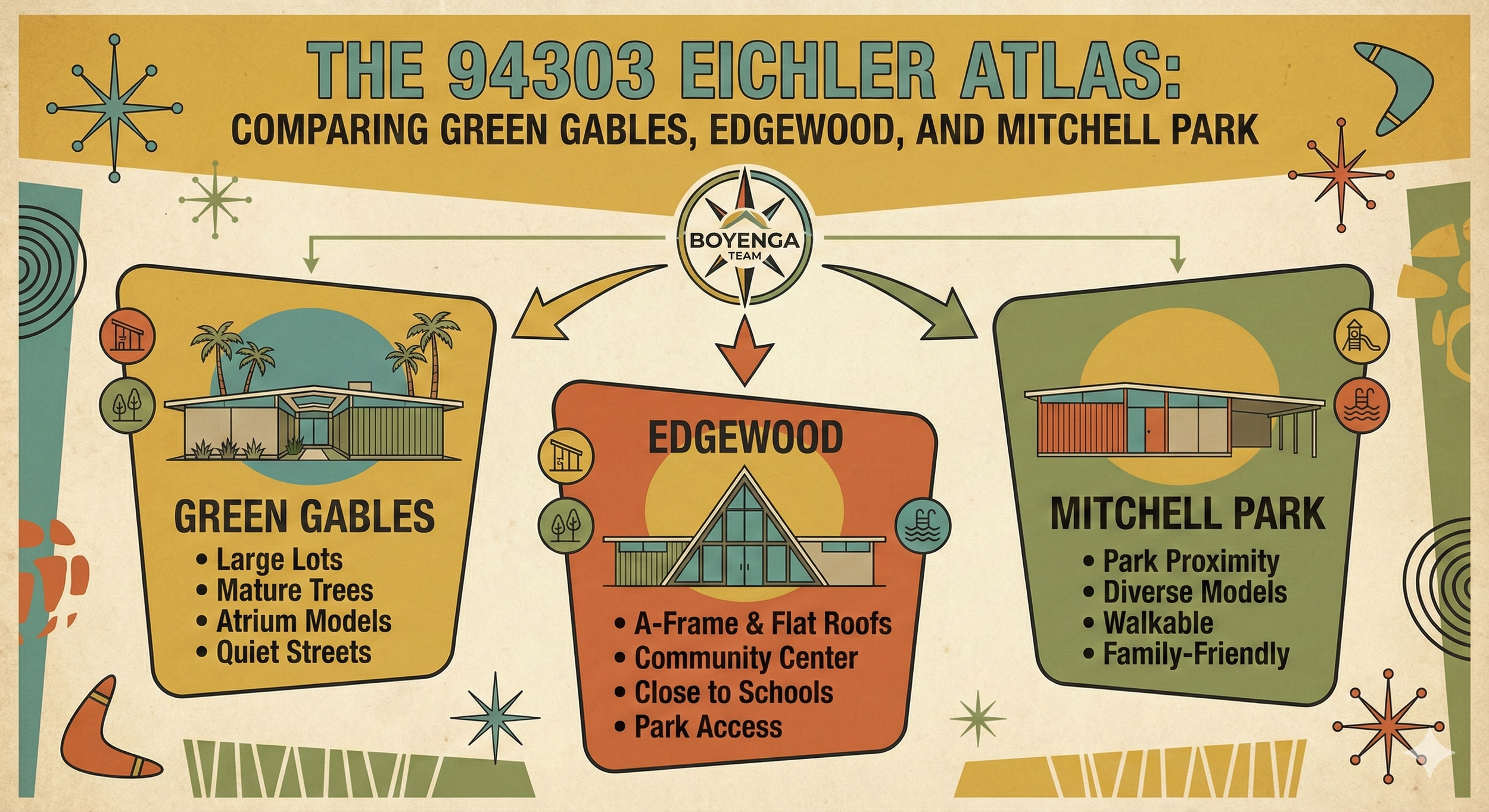
Nestled in Palo Alto’s 94303 area are three enclaves that represent the pinnacle of Joseph Eichler’s mid-century modern vision: Green Gables, Edgewood, and the Mitchell Park area (centered around historic Greenmeadow). This mega-guide offers an authoritative, HBR-style deep dive into what makes these neighborhoods unique and desirable. We’ll explore their post-war origins, demographic trends, top-ranked schools, parks and lifestyle, architectural highlights like atriums and butterfly roofs, and real estate market data, all through a lens of rigorous research and local insight. By the end, you’ll understand why these Eichler havens remain some of Palo Alto’s most sought-after communities – and how the Boyenga Team, Silicon Valley’s leading Eichler experts, leverages this knowledge for buyers and sellers.
Green Gables
Historical Overview
Origins (1950): Green Gables is one of Palo Alto’s earliest and most iconic Eichler subdivisions. In 1950, visionary developer Joseph Eichler broke ground here with 63 single-story Eichler homes along Channing Avenue, Greer Road, Ivy Lane, and Wildwood Lane. Partnering with architects Anshen & Allen, Eichler realized his dream of bringing modernist architecture to the post-war middle class eichlerhomesforsale.com. The result was a bold departure from traditional suburban style – flat or low-gabled rooflines, open floor plans, and walls of glass that invited nature indoors eichlerhomesforsale.com. In fact, Architectural Digest honored Green Gables as “Subdivision of the Year” in 1960 eichlerhomesforsale.com for its groundbreaking design.
Evolution and Preservation: Over subsequent decades, Green Gables evolved while retaining its mid-century soul. The tract – also known as Duveneck/St. Francis area – gradually incorporated a mosaic of home styles beyond Eichler originals eichlerhomesforsale.com. Interspersed among the post-and-beam Eichlers are a few surviving 1920s–40s cottages and ranchers, as well as tasteful contemporary rebuilds. Yet Eichler’s influence dominates. The neighborhood’s significance was officially recognized in 2005 when Green Gables was listed on the National Register of Historic Places eichlerhomesforsale.com – one of only two Palo Alto Eichler tracts with that honor (the other being Greenmeadow). This historic status, coupled with residents’ advocacy, led to protective zoning: Green Gables adopted a single-story overlay that prohibits towering additions, preserving the low-slung modernist character eichlerhomesforsale.com. In 2018, Palo Alto introduced Eichler Design Guidelines to further steer remodels in Green Gables and similar tracts, ensuring any expansions respect the mid-century aesthetic eichlerhomesforsale.com.
Notable Moments: A defining piece of Green Gables lore is the story of the Aronson Eichler home. Built in 1950 as a model home for the tract, it was owned by the same family for 68 years. When it finally hit the market in 2018, listed by Eric Boyenga, it attracted robust interest for its time-capsule authenticity – virtually none of the original Anshen & Allen design had been altered. Such living history underscores Green Gables’ legacy. The neighborhood also benefits from visionary planning decisions: early on, Eichler built Edgewood Plaza one block away – the only shopping center he ever built – to serve Green Gables residents with a modern retail hub eichlerhomesforsale.com. By the mid-1950s, Eichler expanded just eastward with the adjacent Edgewood tract, extending the community of modern homes (often collectively still called “Green Gables” by locals). Together, these tracts formed a nucleus of progressive design that influenced Palo Alto’s development.
Demographic and Socioeconomic Profile
Affluent and Highly Educated: Today Green Gables exemplifies Palo Alto’s blend of affluence and intellect. Approximately 705 people live in the immediate Green Gables neighborhood, with a median age in the mid-40s. The community is highly educated, as is Palo Alto at large – an estimated 80–85% of adult residents hold a bachelor’s or graduate degree boyengarealestateteam.com. Many are employed in the tech and professional sectors; over 95% of local workers are in white-collar jobs. Median household incomes are in the solidly six-figure range (often $180K–$250K+), reflecting dual-career professional families. In Green Gables specifically, the average individual income is about $124,000 per year, and median household income for the broader 94303 zip code stands around $148,000 boyengarealestateteam.com. This is actually the most “accessible” among Palo Alto zip codes, due in part to inclusion of some less affluent pockets in East Palo Alto boyengarealestateteam.com. Nonetheless, by national standards Green Gables is very affluent – a reality seen in its multi-million-dollar home values.
Diversity: The neighborhood’s population is a multicultural tapestry, aligning with Palo Alto’s role as a global tech hub. Ethnically, about 46% of Green Gables/94303 residents are White and roughly 36% Asian (with no single ethnic majority) boyengarealestateteam.com. Significant communities of Chinese and Indian professionals have settled here in recent decades, attracted by Stanford and Silicon Valley jobs. Smaller percentages of Hispanic/Latino (approx. 7–8%) and African-American residents round out the mix. Nearly 36% of Palo Alto’s population is foreign-born – primarily from Asia and Europe – reflecting the city’s international draw boyengarealestateteam.com. Green Gables’ diversity is evident in the languages heard at its parks and the cultural breadth of its community events. Despite these shifts, a strong neighborhood cohesion persists, with longtime residents (including original Eichler homeowners) living alongside newer arrivals.
Community Character: Green Gables retains a family-friendly, community-oriented vibe. Longtime resident and local realtor Nicholas French notes that many families find Green Gables an “entry-level” point into Palo Alto – relatively speaking – because lot sizes and homes are a bit more modest than in estates like Crescent Park. The result is an active neighborhood full of kids playing outdoors, low traffic on its residential streets, and a tradition of festive holiday gatherings. Indeed, Halloween and Christmas are big events – the Fulton Street “Christmas Tree Lane” is a city-wide draw each December, when the entire block is adorned with elaborate lights and displays eichlerhomesforsale.com. This tradition dates back to 1940 and continues to unite neighbors each winter. Green Gables residents also show strong civic engagement, often spearheading preservation efforts and participating in Palo Alto’s community life. Overall, the socioeconomics here combine high income and education with a down-to-earth, suburban community spirit, consistent with the inclusive ethos Joseph Eichler envisioned.
School Districts and Education Landscape
Top-Ranked Public Schools: Green Gables is part of the Palo Alto Unified School District (PAUSD), one of the highest-performing districts in California. Families are drawn to the neighborhood in large part for its excellent local schools. Children here attend Duveneck Elementary School, which Niche grades A+ and is considered a “destination school” by realtors. Parents praise Duveneck’s strong PTA, nurturing teachers, and community feel – it’s common to see families walking and biking to campus from all corners of Green Gables. For middle school, students move on to Frank S. Greene Jr. Middle School (formerly Jordan Middle School). Greene Middle, also highly rated, offers robust STEM programs and diverse electives, preparing students well for the rigors of high school eichlerhomesforsale.com. Green Gables lies in the Palo Alto High School (Paly) attendance area, and teens attend this famed institution near Stanford University. Paly, founded in 1898, is consistently ranked among California’s top public high schools, boasting Advanced Placement courses, award-winning journalism and arts programs, and championship athletics eichlerhomesforsale.com. Its modern media arts center and STEM facilities give students hands-on opportunities in graphic design, robotics, and more. Equally important, Paly’s college placement is stellar, with dedicated counseling guiding students to top universities.
School Performance and Reputation: All PAUSD schools serving Green Gables carry sterling reputations. Duveneck’s test scores are well above state averages; Greene Middle and Paly each hold California Distinguished School awards. The continuity of education – K-12 all within a few miles – fosters a tight-knit network for families. Neighbors often meet through school events, and older students volunteer at the elementary campus. The “neighborhood school” model is a huge draw for homebuyers: as one local put it, “People say, ‘I want Duveneck’” when house-hunting. School boundary stability also protects home values, since being within these coveted zones commands a premium. It’s no surprise that even those without children appreciate living in an area where the public schools are high caliber – it speaks to an engaged, high-achieving community.
Nearby Private Schools and Higher Education: In addition to public schools, Green Gables is near several esteemed private institutions. The International School of the Peninsula (ISTP) offers bilingual French and Chinese programs for K–8 and is just a short drive away, attracting globally minded families. Keys School, another well-regarded K-8, is also nearby. For all-girls education, Castilleja School (grades 6–12, Palo Alto’s historic girls’ school) is a few miles south. These private options provide alternatives, though most Green Gables families stick with the excellent public schools. Proximity to Stanford University (about 3 miles away) further enriches the educational landscape. Many Stanford faculty and staff live in North Palo Alto neighborhoods like Green Gables, and the intellectual influence of the university is strongly felt. From weekend youth programs at Stanford to frequent Stanford speakers in town, the community benefits from being in the orbit of a world-class university. In sum, Green Gables offers an education pipeline from preschool to Ph.D., right in its backyard – a major factor in its enduring desirability.
Neighborhood Attractions and Lifestyle
Parks and Recreation: Despite its tranquil residential feel, Green Gables enjoys easy access to parks and recreation. Just to the south is Rinconada Park, Palo Alto’s oldest and most beloved city park, spanning 19 acres. Rinconada offers something for everyone – playgrounds, picnic areas, tennis courts, a public swimming pool, and even the Palo Alto Junior Museum & Zoo (a delightful hands-on science museum and small zoo for children). Within its redwood groves lies the “Magic Forest” playground, a favorite spot for local kids. Many Green Gables families walk or bike to Rinconada on weekends, enjoying the park’s seasonal community events and summer outdoor concerts. Closer to home, Eleanor Pardee Park is a 10-acre green space right in the Green Gables area. Pardee Park features community gardens, open fields, and a toddler-friendly playground – an ideal spot for a casual weekend picnic or an evening dog walk under heritage oak trees. The neighborhood’s tree-lined streets themselves are very walkable, with sidewalks shaded by mature camphor and magnolia trees (Duveneck-St. Francis is actually nicknamed “Green Gables” by locals for its lush tree canopy).
For those who enjoy nature trails, the Baylands Nature Preserve is a short hop across Highway 101. Within minutes, residents can be strolling on boardwalks over tidal marshes, spotting migratory birds. The Baylands provide miles of flat trails for jogging and biking, extending to the Palo Alto Duck Pond and sailing station. This proximity to open space, rare in an urban area, is a cherished perk of Green Gables life.
Shopping and Dining: Green Gables has convenient, if low-key, retail options nearby. The historic Edgewood Plaza Shopping Center sits at the northeast edge of the neighborhood. Built by Eichler in 1956–57, Edgewood Plaza was designed in the same modernist spirit as the homes eichlerhomesforsale.com. After a comprehensive renovation, today it houses an upscale grocery (the Market at Edgewood), a cozy coffee shop, and essential services like a dry cleaner eichlerhomesforsale.com. The plaza retains its mid-century architectural elements, earning design awards for blending Eichler’s original structures with new amenities. Beyond Edgewood Plaza, residents are roughly equidistant (about 2 miles) from both Downtown Palo Alto (University Avenue) and the California Avenueshopping district. University Ave is Palo Alto’s dining and nightlife hub, offering everything from Michelin-starred restaurants to casual brunch cafés, plus bookstores, boutiques, and the Stanford Theatre. California Ave, on the other hand, has a more local vibe with its Sunday farmers’ market, coffeehouses, and international eateries. Green Gables’ strategic location means you can reach either downtown or midtown retail in under 10 minutes, yet come home to a peaceful enclave removed from the bustle.
Culture and Community Life: Living in Green Gables offers a balanced Silicon Valley lifestyle – suburban tranquility with urban conveniences close by eichlerhomesforsale.com. The neighborhood organizes block parties, holiday parades, and Eichler home tour events, fostering camaraderie among neighbors eichlerhomesforsale.com. The annual “Christmas Tree Lane” on Fulton Street, mentioned earlier, is a major community event that draws visitors from all over the city to stroll the twinkling lights and sip hot cocoa with residents eichlerhomesforsale.com. Throughout the year, Green Gables residents engage in Palo Alto’s rich cultural offerings. The Palo Alto Art Center and Children’s Library (both adjacent to Rinconada Park) are popular weekend stops. Stanford University’s world-class museums (Cantor Arts Center and Anderson Collection) and performing arts (Bing Concert Hall) are a short drive, providing endless cultural stimulation.
Connectivity: For commuters, Green Gables is highly convenient. Highway 101 access via Embarcadero Road is just minutes away, putting major tech employment centers within easy reach eichlerhomesforsale.com. Google’s headquartersin Mountain View, for example, is ~15 minutes by car; Meta/Facebook in Menlo Park is about 10 minutes north. Employers like HP, Tesla, and VMware have offices just a short commute from here eichlerhomesforsale.com. Despite the nearby freeways, the neighborhood itself remains quiet and insulated from traffic. Notably, many residents also bike to work or to downtown – Palo Alto’s bike score is “Very Bikeable” at 87, and there are bike lanes on Greer Road and Channing that connect to the broader city network. All told, Green Gables offers a lifestyle of ease: parks, schools, shops, and jobs all accessible, while enjoying the calm of a tree-lined suburban retreat.
Architectural Highlights and Housing Inventory
Mid-Century Modern Heritage: Architecturally, Green Gables is an open-air museum of mid-century design. The original Eichler homes, built 1950–51, showcase hallmark features that were revolutionary for their time: post-and-beam construction (eliminating interior load-bearing walls), floor-to-ceiling glass panels, open-plan layouts, and integration of indoor-outdoor living eichlerhomesforsale.com. Many early Green Gables Eichlers have flat or low-pitched roofs emphasizing horizontal lines – an Eichler experiment in achieving harmony with the flatlands by San Francisquito Creek eichlerhomesforsale.com. A few models even sport the distinctive butterfly roof (an inverted gable V-shape) which is a rarity and prized by architecture buffs. These homes, typically ~1,100–1,500 sq ft originally, were modest in size but felt larger due to their light-filled interiors and atriums or patios. In fact, Green Gables represents Eichler’s first use of the atrium concept in Palo Alto – albeit in a nascent form. The very first models had central courtyards and glass walls that hinted at the fully enclosed atriums Eichler would perfect later in the decade. This focus on transparency and light set Green Gables apart from traditional post-war tract homes and remains one of its most cherished qualities eichlerhomesforsale.com.
Housing Mix: Today, Green Gables’ housing inventory is composed primarily of single-family homes, with Eichler mid-century modern the predominant style. Alongside the ~63 original Eichlers, there are additional Eichler-designed homes from the mid-50s (often lumped into the Edgewood count) and a scattering of 1940s ranch-style houses in parts of the Duveneck/St. Francis area. Those ranch homes, with their brick facades and attached garages, provide an interesting contrast but are largely outnumbered by Eichlers and other modernist renovations. There are no condo or townhome developments within Green Gables proper – the neighborhood is zoned R-1 for single-family residences only (with special Eichler overlay provisions). Lot sizes typically range from 6,000 to 8,000 sq ft – relatively standard for Palo Alto, offering yards for gardening but not huge estates. The streets are gently curving or gridlike, with no cul-de-sacs in the original tract, which encourages a connective street grid. Aesthetic continuity is valued: many homes still sport their original mahogany paneling and globe lights, and when homes are remodeled, owners often strive to preserve mid-century character (encouraged by the design guidelines).
Notable Architectural Features: A walk through Green Gables reveals delightful architectural details. The Eichlers here were among the first to feature designs by Anshen & Allen, Eichler’s initial architect partners eichlerhomesforsale.com. Their influence is seen in the clean lines and lack of ornamentation – form follows function. Signature elements include:expansive glass walls facing private rear gardens, exposed post-and-beam ceilings, and Philippine mahogany interior wall paneling that adds warmth. Some homes have the classic Eichler atrium entry – a partially enclosed courtyard at the front entrance, which in later years Eichler fully embraced. These atriums and courtyards remain beloved, as they create a private outdoor sanctuary while bringing sunlight into the heart of the home eichlerhomesforsale.com. Many Green Gables houses still feature their original brick or cinderblock fireplaces, strategically placed between glass walls to divide living spaces without enclosing them. The combination of radiant floor heating (another Eichler staple) and concrete slab floors was ahead of its time in 1950 eichlerhomesforsale.com, and quite a few homes have preserved these systems (some upgraded to modern hydronic systems).
Beyond Eichler designs, a handful of newer custom-built homes have sprung up on teardown lots in the broader Green Gables/Duveneck area. These tend to be two-story contemporaries or Craftsman-style homes built in the 2000s, usually on lots where an Eichler or cottage was removed. However, thanks to the R-1 single-story overlay in the Eichler tract, the core Green Gables streets remain architecturally intact, with very few intrusive second-story structures eichlerhomesforsale.com. This gives the area a cohesive mid-century skyline – one can drive down Channing Avenue and still feel a 1950s ambiance. In summary, Green Gables offers homebuyers predominantly mid-century modern houses (3–4 bedrooms, ~1,500–2,000 sq ft), on comfortably sized lots, in an environment that has staunchly protected its architectural heritage.
Real Estate Market Analysis
Home Values and Price Trends: Green Gables sits in Palo Alto’s robust real estate market, where demand perennially outstrips supply. As of 2024–2025, median single-family home prices in Green Gables are around $3.7–$4 million, slightly above Palo Alto’s overall median of ~$3.5M. In April 2024, for example, the median sale price in the Duveneck/St. Francis (Green Gables) area was about $3.7 million – 7% higher than Palo Alto’s citywide median. Prices had risen ~6% year-over-year at that point, reflecting steady appreciation. By late 2025, the market has seen some normalization with higher interest rates, but Palo Alto home values remain near record highs. It’s virtually impossible to find any Eichler in Palo Alto under $2.5M today – even smaller original models (~1,200 sq ft) routinely fetch $2.6–$3M+. In Green Gables specifically, entry-level 2-bedroom cottages start around $2.4M, while larger or updated Eichler homes (4 bed/2 bath) range from about $2.6M up to $4M depending on condition. A completely remodeled, expanded Eichler or a new custom home can push above $5M. (Indeed, a modern 4BD in this area can reach $5.1M on the high end.)
It’s worth noting that market activity is limited by low inventory – Green Gables is a small neighborhood and turnover is low, as many owners hold their homes for decades. When a well-preserved Eichler does hit the market, it often sparks bidding wars among mid-century modern enthusiasts. Realtors report that homes with original Eichler features in good shape command premium prices, as buyers highly value the authentic MCM character eichlerhomesforsale.com. Conversely, homes that have lost Eichler elements to past remodels might not see the same fervor (though land value in Palo Alto keeps a strong floor under every property). Overall, Green Gables properties appreciate reliably year after year, underpinned by Palo Alto’s economic strength and the neighborhood’s historic cachet.
Market Velocity and Demand: The Green Gables market is characterized by high demand and fast sales. Even in a cooling Bay Area market, desirable listings here get snatched up quickly. Homes often sell in a matter of 1–2 weeks on the market, frequently with multiple offers. In nearby Greenmeadow, for instance (a similar Eichler market), the average days on market recently was just 8–12 days, with winning bids ~11% over list price on average. Green Gables sees comparable competitive dynamics – it’s common for a new listing to receive all-cash offers or pre-emptive (“bully”) offers from buyers eager to secure a foothold in North Palo Alto. Open houses are busy with both young tech professionals and downsizing empty-nesters, all drawn to the area’s quality of life and architecture. The limited inventory (sometimes only a handful of sales per year in Green Gables proper) creates a sense of urgency among buyers.
Gentrification and Value Outlook: Although Palo Alto as a whole is fully developed, one could say Green Gables has undergone a form of “gentrification” over the past 30 years – turning from a modest middle-class tract into a luxury-priced enclave as Silicon Valley wealth surged. Longtime residents have watched home values skyrocket from the low six figures in the 1970s–80s to multi-million-dollar levels today. Interestingly, relative to some other Palo Alto neighborhoods, Green Gables and Edgewood have been seen as slightly more affordable alternatives to ultra-premium Old Palo Alto or Crescent Park. This relative value has spurred demand and rapid appreciation. A recent analysis highlighted that as Palo Alto’s prime neighborhoods (94301 zip) became unattainable for even well-paid professionals, demand spilled over into adjacent areas like 94303, driving dramatic price increases boyengarealestateteam.com. In fact, 94303 (which includes Green Gables along with less expensive areas) saw a stunning 102% year-over-year increase in median home price at one point, indicating how intense the appreciation has been boyengarealestateteam.com. This suggests strong investment potential going forward: even as prices are high, the upward trajectory for Eichler neighborhoods remains positive, buoyed by their architectural rarity and the perpetual influx of tech wealth.
Comparison with Other ZIP Codes: In Palo Alto’s hierarchy of housing, Green Gables (94303) and Greenmeadow (94306) hold their own against traditionally pricier 94301. For instance, 94306 (South Palo Alto) has a median household income of ~$186K and median home values also north of $3M boyengarealestateteam.com. Green Gables’ 94303, encompassing parts of East Palo Alto, shows a lower median income (~$148K) boyengarealestateteam.com, but if isolating the Palo Alto portion, it’s comparable to 94306. The key difference is that 94303 offers a mix of ultra-high-end (Green Gables/Eichlers) and more entry-level areas (across the creek in EPA), hence city data alone doesn’t tell the full story. In terms of appreciation, both north and south Palo Alto Eichler tracts have seen robust growth. South PA’s Greenmeadow, for example, had a median sale price around $3.3M in late 2025 (down slightly from the peak, but still very high). Meanwhile, a renovated Eichler in Palo Alto’s Greendell tract recently sold for a record $5 million, underlining that top-tier Eichlers can rival prices in any Palo Alto neighborhood. In short, Green Gables has graduated into the echelon of Palo Alto luxury neighborhoods, with pricing and demand that compete with the best – yet it retains a unique niche appeal due to its Eichler heritage, something the classical mansion districts cannot offer.
Edgewood
Historical Overview
Origins and Development: The Edgewood Eichler tract is essentially a continuation of Eichler’s Green Gables project, representing the next phase of his Palo Alto vision. Built in 1955–1956, Edgewood comprises around 80 Eichler homessituated on streets like Wildwood Lane, Edgewood Drive, Channing Avenue (east end), and Sandalwood Court eichlerhomesforsale.com. After the success of the initial 63 Green Gables homes in 1950, Joseph Eichler saw demand for larger homes and expanded designs. Edgewood was his answer – often considered a more refined evolution of the Green Gables models eichlerhomesforsale.com. Eichler again collaborated with Anshen + Allen for Edgewood’s designs, ensuring continuity in modernist principles eichlerhomesforsale.com. However, the homes grew in size and amenities: whereas Green Gables Eichlers averaged ~1,100 sq ft with 3 beds/1 bath, the Edgewood Eichlers averaged ~1,700 sq ft with 4 bedrooms and 2 baths – a significant upmarket shift for the mid-1950s eichlerhomesforsale.com. These new models often included an atrium or interior courtyard, more expansive kitchens, and either a carport or enclosed garage (still one-car, as few families had multiple cars in that era).
Architectural Significance: Edgewood, like Green Gables, broke away from cookie-cutter suburbia and solidified Eichler’s reputation as an innovator. Notably, Edgewood Plaza Shopping Center was constructed adjacent to the tract around the same time (1956–57), reflecting Eichler’s comprehensive approach to community design. The Plaza, designed by Eichler’s architects (Jones & Emmons) in a mid-century style, provided local shopping and a community gathering spot for Edgewood and Green Gables residents. It’s one of the earliest examples of a planned mid-century modern neighborhood shopping center in California eichlerhomesforsale.com. Over the decades, Edgewood Plaza went through decline and revival – by 2015 it was renovated, preserving key elements of Eichler’s original structures and adding a handful of new homes on site, thus tying the area’s past and future together.
Transformations Over Time: Through the latter 20th century, Edgewood remained a relatively small, close-knit enclave. Being somewhat tucked east of Greer Road, it saw less teardown-rebuild activity than other Palo Alto areas – a fortunate fact for preservation. Many Edgewood homes stayed in the hands of original owners or like-minded buyers who appreciated their design. In recent years, the neighborhood successfully petitioned for an “Eichler single-story overlay”similar to Green Gables, preventing insensitive second-story additions eichlerhomesforsale.com. As a result, Edgewood’s skyline today is much as it was in 1956 – low-profile and harmonious. One change has been the upgrading of many homes for modern living: you’ll see Tesla chargers in carports, solar panels on roofs, and tasteful expansions at the rear of homes (within city guidelines). Throughout, Edgewood’s identity as a modernist haven has only strengthened. While not officially on the National Register like Green Gables, Edgewood is informally recognized by the city as a historically significant tract. In 2020, local preservationists even floated the idea of expanding Green Gables’ historic district boundaries to include Edgewood’s Eichlers, citing their contiguous development and shared heritage eichlerhomesforsale.com.
Notable Figures: Edgewood doesn’t boast famous former residents in the way some neighborhoods do, but it has plenty of proud longtime owners who’ve served as stewards of Eichler’s legacy. One such figure was Steven Aronson, whose story was covered earlier – while his house is technically in Green Gables, families like his helped shape the larger community ethos that includes Edgewood. Also notable is that Eric & Janelle Boyenga, top Eichler realtors, have been closely involved in Edgewood’s real estate and preservation efforts for years eichlerhomesforsale.com. Their advocacy (as residents or specialists) has raised awareness of Edgewood’s unique value. Culturally, Edgewood’s proximity to the arts is highlighted by Edgewood Plaza’s occasional art installations and the fact that it’s just a mile from the Main Library and Art Center. In sum, Edgewood’s history is one of subtle distinction: a neighborhood that started as an “adjacent addition” but matured into a jewel of mid-century architecture on its own merits.
Demographic and Socioeconomic Profile
Community Makeup: Given its small size (around 60–80 households), Edgewood’s demographic profile closely aligns with greater North Palo Alto. The neighborhood is family-oriented and affluent. Many households are dual-income professionals – often in tech, engineering, academia, or finance. With the larger 4-bedroom floor plans, Edgewood Eichlers tend to attract families with children (or those planning for children), as well as some older empty-nesters who downsized from larger homes elsewhere but still wanted space for grandkids and hobbies. Income levels are high; likely the median household income exceeds $180,000, in line with Palo Alto averages. Education levels are very high – most adults hold advanced degrees. It’s common to meet Edgewood residents who are Stanford graduates or who work at Stanford, Google, or local startups. The population is predominantly White and Asian, similar to Palo Alto’s ~47% White / 36% Asian split. Many Asian-American families (Chinese, Indian, Korean) have settled in recent years, drawn by the schools and area’s safety. There is notable international diversity as well – one might find a German software engineer family next door to a Canadian university professor and a Silicon Valley native family that’s been in Palo Alto for generations.
Economic Trends: Edgewood’s socioeconomic trajectory mirrors Palo Alto’s broader one: a middle-class 1950s tract transformed into an elite enclave by 21st-century tech wealth. Many of the original mid-century owners were middle managers, teachers, or military veterans (like the Aronsons) who could afford Eichlers when they were ~$10,000 new. Today, those same homes sell to software engineers, venture capitalists, and physicians who often have stock options or equity from tech companies. Despite the change in professions and bank accounts, Edgewood maintains a down-to-earth, neighborly feel. Residents describe the vibe as unpretentious – yes, people are well-off, but block parties and BBQs are common and there’s a shared pride in the architecture rather than any flaunting of wealth. The small size fosters a sense of community watchdog – neighbors band together on issues like traffic calming or zoning hearings, and they welcome new families warmly (often with a welcome packet or invitation to coffee).
Gentrification and Stability: It might be said that Edgewood has completed its “gentrification” cycle – virtually every home is now updated and priced in the multi-millions, leaving no room for further dramatic price shifts except general market appreciation. This economic stability contributes to a stable resident base. Most who buy into Edgewood stay for the long haul, meaning turnover is low and many households know each other over years. That stability translates to consistent socioeconomics: highly engaged parents in the PTA, active volunteers in community initiatives, and a neighborhood email list or WhatsApp group to share everything from contractor recommendations to coyote sightings. In essence, Edgewood’s demographic profile is upper-middle-class meets Silicon Valley elite, but bound by a collective appreciation for the mid-century lifestyle and a desire to preserve the friendly, inclusive spirit Eichler intended.
School Districts and Education Landscape
Public Schools: Edgewood is fortunate to be assigned to the same top-tier PAUSD schools as Green Gables, which significantly boosts its family appeal. Children here attend Duveneck Elementary, Greene Middle School, and Palo Alto High School (Paly) eichlerhomesforsale.com. This alignment means Edgewood kids often join Green Gables kids in the same classes, further knitting the communities together. Duveneck Elementary School, a short walk or bike ride away, is cherished for its excellent teachers and strong parent community. Edgewood parents frequently volunteer in classrooms and for events like the school’s May Fête and annual auction. Greene Middle (formerly Jordan) continues the tradition of excellence with a broad curriculum including music, arts, and coding electives. By the time students reach Paly, they enter a high school with an illustrious reputation for academics and extracurriculars (from championship sports to award-winning publications). Paly’s proximity to Stanford and partnerships (e.g. high schoolers taking advanced classes at Stanford) benefit all PAUSD students. For Edgewood teens, popping over to Town & Country Village (across from Paly) for lunch or after-school hangouts is a rite of passage, just as it is for others in North Palo Alto.
One aspect families appreciate is that all these schools are highly ranked – for example, Niche gives Duveneck and Greene A+ ratings, and Paly is often ranked among the top 10 public high schools in California. The continuity from K through 12 in excellent schools provides peace of mind for parents investing in an Edgewood home. School performance metrics (standardized test scores, college matriculation rates) are well above state averages, thanks to PAUSD’s resources and the community’s emphasis on education.
School Community and Homebuyer Impact: Homes in Edgewood routinely market “access to Palo Alto’s top-ranked schools” as a key selling point eichlerhomesforsale.com. Savvy buyers know that living in this neighborhood essentially guarantees entry to some of the best public education in the nation, without needing private school tuition. This factor alone adds significant intrinsic value to Edgewood properties – a sort of “school district premium.” Realtors report that some buyers, especially international transferees from tech companies, specifically target North Palo Alto (94303/94301) over South (94306) because they prefer Paly over Gunn High School, or simply desire the Duveneck/Greene track. (In truth, Gunn is equally excellent; it often comes down to personal preference or familiarity.) Regardless, being in PAUSD ensures that Edgewood’s appeal endures in any market conditions, as there’s always demand from families with school-age children.
Nearby Educational Amenities: Edgewood’s location also gives students and families extra advantages. The Children’s Library (the first standalone children’s library in the US) is just a mile away, offering reading programs and a charming storytime space under old-growth trees. Rinconada Library is equally close for research and study space. The presence of Stanford University just 3 miles west provides an ever-present educational inspiration – whether via the EPGY (Education Program for Gifted Youth) that some middle schoolers attend, or just the cultural enrichment of having Stanford lectures, museums, and sporting events accessible. Some Edgewood high schoolers get to conduct science research internships at Stanford labs or take advanced math courses at the university, leveraging opportunities unique to Palo Alto.
In summary, Edgewood’s educational landscape is second to none: public schools that are national models of excellence, plus a community culture that deeply values learning. It’s common to find kids here attending coding camp or music lessons after school, supported by highly educated parents. This focus on education perpetuates a virtuous cycle – it attracts like-minded families who continue to invest in and uphold the quality of the schools, which in turn sustains home values and community vitality.
Neighborhood Attractions and Lifestyle
Parks and Outdoor Life: While Edgewood itself is a small tract without its own park inside the subdivision, residents benefit from several nearby green spaces. Just southwest is Eleanor Pardee Park, easily reachable on foot or bike, offering open lawns, picnic tables, and community gardens. Many Edgewood families enjoy weekend playdates there or gardening in the community plots. A short distance further is Rinconada Park, with its larger array of amenities (pool, playground, etc., as detailed earlier). Edgewood’s position near the edge of town means it’s also very close to the Baylands – in fact, the entrance to the Baylands Nature Preserve at the end of Embarcadero Road is only a couple of minutes’ drive. This proximity is a boon for bird-watchers, joggers, and dog walkers. One can start an early morning with a serene hike among the tidal marsh trails and be back home in Edgewood for breakfast.
Within the neighborhood, tree-lined streets and sidewalks make evening strolls pleasant. Edgewood’s streets (e.g., Wildwood Ln, Edgewood Dr) are quiet and safe, so children often play basketball or ride bikes in front of their homeshomes.com. The neighborhood’s mature landscaping – from Japanese maples in atrium courtyards to the tall camphor trees on the perimeter – gives a tranquil, shaded feel. Homeowners take pride in mid-century appropriate landscaping, with many opting for drought-tolerant plants, decorative grasses, and even authentic period elements like breeze block screens and rock gardens in front yards.
Edgewood Plaza & Local Conveniences: The beating heart of Edgewood’s local life is Edgewood Plaza. As the only retail center in Palo Alto built by Eichler, it holds special significance eichlerhomesforsale.com. Today, after its renovation, the plaza features an award-winning grocery store (The Market at Edgewood, known for organic selections and gourmet products) eichlerhomesforsale.com. There’s also a couple of cafés and eateries – for instance, a coffee shop where neighbors often meet in the mornings, and a casual deli/bakery perfect for picking up sandwiches. The plaza also hosts a summer farmers’ market in its parking area occasionally, bringing in local produce stands. For Edgewood residents, having this walkable hub is a huge perk: they can get daily essentials without needing to drive into downtown. The mid-century modern design of the plaza, with its low-slung rooflines and distinctive dove-cote structure, also contributes to the area’s character, reminding everyone of Eichler’s holistic vision of community eichlerhomesforsale.com. Community bulletin boards at the plaza advertise neighborhood events (block parties, Eichler home tours, etc.), reinforcing a small-town camaraderie.
Community and Culture: Edgewood fosters a tight-knit community atmosphere. Annual traditions keep neighbors connected – for example, Edgewood holds yearly block parties and potluck BBQs each summer eichlerhomesforsale.com. During these events, new and long-time residents mingle, kids play street games, and sometimes classic 1950s music sets the mood (a nod to the neighborhood’s birth era). There are also Eichler home tour days where a few residents open up their lovingly restored homes for others to admire – these tours, often organized with preservation groups, celebrate the architecture and have even raised funds for local causes eichlerhomesforsale.com. Edgewood residents share a common cause in preservation efforts: many participated in lobbying for the single-story overlay and speak out at city meetings on issues affecting Eichler neighborhoods. This has created a sense of collective stewardship.
Lifestyle in Edgewood is also marked by convenience for commuters. The neighborhood is bordered by Embarcadero Road and Highway 101, making it extremely easy to hop on the freeway to reach major job centers eichlerhomesforsale.com. Commuters can be at Google, LinkedIn, or Microsoft offices in Mountain View in ~10 minutes, or over the Dumbarton Bridge to Newark/Fremont tech campuses in under 25 minutes. Additionally, downtown Palo Alto Caltrain station is a short drive or bike ride, offering a transit option to San Francisco. Despite this connectivity, Edgewood’s immediate surroundings are quiet, as Embarcadero’s noise is buffered by sound walls and landscaping.
Being in North Palo Alto, Edgewood is closer to many cultural attractions as well: the Palo Alto Art Center, Children’s Theatre, and Junior Museum (all near Rinconada Park) are very close. Stanford University campus – with its Cantor Arts Center, Bing Concert Hall, and sports venues – is maybe a 10-minute drive. Many Edgewood residents take advantage of Stanford’s public lectures or catch Stanford football games, integrating big-city culture into their suburban routine. In the evenings, it’s easy to head to downtown’s restaurants or catch an indie film at the Stanford Theatre. For families, nearby services like libraries, pediatricians, and enrichment classes (music, martial arts, etc. along Embarcadero or Middlefield) make life convenient. Overall, Edgewood offers a lifestyle of ease and engagement: peaceful residential living with an undercurrent of community activity, and all the amenities of Palo Alto and Silicon Valley at one’s fingertips.
Architectural Highlights and Housing Inventory
Design and Style: The Edgewood Eichler homes represent some of the most refined mid-century designs in Palo Alto’s Eichler repertoire. Architecturally, they embody classic Eichler DNA with notable upgrades. Each home was designed by Anshen + Allen, showcasing signature Eichler elements: post-and-beam construction, open atrium entrances, floor-to-ceiling glass, and integration with nature eichlerhomesforsale.com. However, compared to the earlier 1950 models, Edgewood’s 1955–56 Eichlers often have bolder roof profiles – including some low-gabled roofs with extended eaves and the occasional steep A-frame or peaked gable over the living area. A few butterfly roofexamples exist here too, which are quite rare overall, making them prized by enthusiasts. All homes are single-story and originally came in various configurations around ~1,600–1,800 sq ft. The layouts typically feature a central atrium or side courtyard that brings light into the home’s core eichlerhomesforsale.com. Large plate-glass windows and sliding doorsopen from living and dining areas onto back patios, enhancing the indoor-outdoor flow eichlerhomesforsale.com.
Interiors boasted open-plan kitchens adjacent to living areas – a novelty in the 1950s, meant to encourage family togetherness and casual entertaining (instead of formal separate dining rooms). Kitchens in Edgewood Eichlers were bigger than those in 1950 Green Gables models, acknowledging the trend toward more modern appliances and the kitchen as a social hub. Many homes were equipped with Philippine mahogany wall paneling, radiant heated floors, and globe pendant lighting, all hallmarks of Eichler’s mid-century aesthetic eichlerhomesforsale.com. Edgewood homes also introduced more storage and built-ins (like expanded closet space and built-in bookcases) since by mid-decade Eichler was responding to feedback from earlier homeowners who desired more practicality.
Housing Inventory: Edgewood’s housing stock is almost entirely composed of single-family Eichler homes – roughly 63 are often cited as the count, though some sources say around 80 including adjacent builds eichlerhomesforsale.com. There are no condos, townhomes, or apartment complexeswithin the immediate Edgewood tract. (Nearby along Edgewood Drive outside the tract, there is a newer small development of a few homes built as part of the Edgewood Plaza redevelopment around 2015, but these are distinct, two-story contemporary homes on tiny lots, and not part of the Eichler community proper.) Within Edgewood, lot sizes are generally in the 6,000–7,500 sq ft range, similar to Green Gables, giving each home a modest front yard and a private backyard. Thanks to the Eichler design, backyards are like extensions of the living space – often with covered patios (pergolas) and mature landscaping that complements the architecture.
There is limited variation beyond Eichler style: a couple of edge properties might have been originally non-Eichler or later replaced, but by and large if you drive through Edgewood, every house you see is an Eichler, maintaining a strong cohesive look. This uniformity (in style, not identical appearance) is precisely what residents aimed to protect by implementing the single-story overlay eichlerhomesforsale.com. It prevents, say, a Mediterranean two-story from popping up and sticking out like a sore thumb. The overlay, plus voluntary adherence to Eichler-friendly design, means that even remodels or expansions are done in a way that harmonizes with the neighborhood. Many Edgewood homeowners who expanded have done so by building into their backyards or atrium (enclosing atriums with glass roofs or adding small additions that are invisible from the street). Exterior materials remain mid-century in spirit: you’ll see vertical grooved siding, tongue-and-groove wood ceilings extending to eaves, and era-appropriate paint colors (earthy browns, grays, and the occasional pop of teal or orange on front doors).
Noteworthy Features and Builders: While Joseph Eichler was the developer, the craftsmanship of Edgewood homes was executed by a builder Eichler Homes contracted – oftentimes in Palo Alto, that was Brown & Kaufman or other builders working under Eichler’s supervision. The quality of construction was solid for the time, and many structural elements (beams, slabs) have held up well. Unique to Edgewood is its relationship with Edgewood Plaza: a few homes on Channing and Edgewood Drive actually back up to the plaza area, meaning those homeowners have ultra-convenient access to shops (though they also navigated the construction of the plaza remodel). Importantly, Edgewood Plaza’s design complements the homes – Eichler ensured that the shopping center’s low horizontal lines and extensive use of glass and breeze blocks would “fit seamlessly” into the residential context. This integrated planning is a hallmark of Edgewood’s design significance.
In the broader context of mid-century architecture, Edgewood Eichlers are considered a significant “mature phase” of Eichler’s work – bridging the early austere designs and the later more experimental ones. For example, some Edgewood models start to feature distinctive facade variations, like perforated concrete block screens by the entry or a front courtyard with a gated wall, which add visual interest. Yet they stop short of the late-50s extravagances (no two-story models or foam roofs yet here). The consistency of style and the relatively small number of homes make Edgewood feel almost like a private enclave. In real estate listings, agents frequently highlight “original Eichler design by Anshen & Allen” and the presence of “classic atrium and floor-to-ceiling glass” for Edgewood homes, knowing that these features are a major draw. All told, Edgewood’s architectural inventory is a time capsule of mid-’50s modernism, lovingly maintained and lightly updated to serve contemporary lifestyles.
Real Estate Market Analysis
Home Values: Edgewood shares the high-value real estate characteristics of North Palo Alto, with an extra boost due to its Eichler cachet. Home prices in Edgewood typically parallel those in Green Gables, given their proximity and similar home sizes. As of early 2025, most Edgewood Eichler homes sell in the $3 to $4 million range, depending on condition and lot position. Well-preserved or tastefully upgraded Eichlers are at the top end of that range (often $3.5M–$4M). For instance, an Edgewood Eichler with original mahogany walls restored, updated kitchen/baths, and a landscaped yard might fetch around $3.8M in the current market, whereas a more modestly updated home could be in the low $3Ms. Entry-level for Edgewood (which is rare, since few are in poor condition) would likely still be around $2.8M–$3M even for a smaller 3-bedroom model or one needing significant renovation.
Because Edgewood is a niche within a niche, formal median price stats for it specifically are hard to come by (often it’s lumped with Green Gables). But given that Green Gables median was around $3.7M in 2024, Edgewood’s median likely falls right around $3.5–$3.8M. It’s worth noting that Edgewood’s values have climbed steeply over the past decade – in 2010, many Edgewood Eichlers were selling for $1.2–$1.5M; by 2020 they were in the $2.5–$3M range; and now several have crossed the $4M threshold. This appreciation reflects both Palo Alto’s overall market and a growing premium for well-preserved Eichlers as mid-century modern style surged in popularity. As one market trend, homes with original Eichler features intact often achieve higher sale prices, because there’s a subset of buyers actively seeking that authenticity eichlerhomesforsale.com. Realtors have observed Eichler enthusiast buyers outbidding developers, showing how the preservation mindset has economic clout here.
Market Dynamics: The Edgewood market is extremely tight and competitive. Since only a few dozen homes exist, and turnover is low, there might be only 1 or 2 Edgewood listings in an entire year. When one does hit the market, it draws intense interest. Buyers include local Palo Altans looking to move up or downsize within town, as well as incoming tech executives relocating to Silicon Valley. Frequently, listings garner multiple offers (often 5-10 offers in hot markets). It’s common for sale prices to exceed asking – even in a more balanced 2025 market, buyers might bid 5–10% over list to secure an Edgewood Eichler. In stronger seller markets, homes have gone 15-20% over list. According to local agents, Edgewood remains one of Palo Alto’s most desirable Eichler communities, with limited availability and high demand for its well-preserved mid-century homes eichlerhomesforsale.com.
Another factor is that many Edgewood sales are somewhat discreet – occasionally homes change hands off-market or privately within networks of Eichler aficionados. The Boyenga Team and other Eichler-specialist agents maintain lists of interested buyers, and sometimes an email or two is enough to line up a buyer without full marketing. However, even off-market sales often fetch strong prices due to the backlog of demand. The market velocity is quick: a typical listing, if priced appropriately, may go pending in under 10 days. Homes that are turnkey (move-in ready with modern upgrades but period charm) tend to be snapped up immediately. Even fixers attract flippers or end-users willing to invest, given the neighborhood’s upside.
Appreciation Trends and Outlook: Edgewood’s price appreciation has outpaced the broader market at times, particularly as Eichler homes gained in collectible status. In recent years, the implementation of preservation measures (like the single-story overlay) has ironically boosted home values – buyers are willing to pay more knowing the neighborhood’s character will be protected, thereby protecting their investment eichlerhomesforsale.com. Additionally, many homeowners investing in sustainability upgrades (solar panels, energy-efficient windows, etc.) both reduce their own costs and add value that modern buyers appreciate eichlerhomesforsale.com. These green improvements align with Palo Alto’s eco-conscious ethos and Eichler’s original indoor-outdoor harmony, enhancing market appeal without detracting from character.
Looking ahead, the investment outlook for Edgewood appears very strong. Its combination of architectural significance, prime Palo Alto location, and access to top schools forms a trifecta that will likely keep demand high and supply sparse. Even if overall Bay Area real estate experiences cycles, Edgewood’s floor is very high – there will always be a baseline of buyers (tech wealth, etc.) ready to jump in when a rare opportunity arises. Moreover, as mid-century homes elsewhere get torn down or altered, intact Eichler enclaves like Edgewood become ever more unique, potentially making them akin to “historic districts” that command premium pricing (similar to how preserved Victorian districts in San Francisco have their own niche market). Therefore, owners can expect continued healthy appreciation and liquidity, with Edgewood homes remaining a blue-chip asset in Silicon Valley’s real estate landscape.
Mitchell Park Area (Greenmeadow)
Mitchell Park in South Palo Alto anchors another Eichler heartland – primarily the Greenmeadow tract and its surrounding mid-century neighborhoods (often collectively just referred to as “Greenmeadow” or the Mitchell Park Eichler neighborhoods). Greenmeadow is so significant that it’s listed on the National Register like Green Gables eichlerhomesforsale.com. For our purposes, we’ll focus on Greenmeadow and adjacent Eichler communities near Mitchell Park, including Fairmeadow (“The Circles”) and Charleston Meadows, to paint a full picture of this area.
Historical Overview
Origins of Greenmeadow (1954–1957): Greenmeadow is one of Eichler’s crowning achievements in community development. Built in the mid-1950s (around 1954), it was Eichler’s ambitious attempt to create an entire planned neighborhood from scratch – housing, community facilities, and all. The tract eventually included 270 Eichler homes – making it one of the largest Eichler developments in Palo Alto eichlerhomesforsale.com. Unlike the piecemeal earlier tracts, Greenmeadow was master-planned with curving wide streets, cul-de-sacs, and a central community park/pool. Eichler targeted a slightly more upscale market here, offering larger floor plans (many 4-bed/2-bath homes around 1,600–2,000 sq ft) and a cohesive neighborhood identity eichlerhomesforsale.com. The architects Jones & Emmons (Eichler’s later go-to firm) were heavily involved, bringing designs that included prominent atriums, clerestory windows, and varied roof profiles (flat, A-frame, etc.). Greenmeadow opened to great fanfare – it was featured in contemporary press as a model post-war suburb that balanced modern architecture with family-friendly planning.
Historic Significance: Greenmeadow’s importance was cemented when it was designated a Historic District and added to the National Register of Historic Places (in 2005, alongside Green Gables) eichlerhomesforsale.com. This recognized not only the architectural merit of the individual homes but the neighborhood’s pioneering community planning. Indeed, Greenmeadow was one of the first suburban developments in California to include a private community center with pool and park exclusively for residents eichlerhomesforsale.com. Eichler’s idea was revolutionary: fostering community interaction and recreation as part of daily life, rather than as an afterthought. This communal core remains the heart of Greenmeadow today. Over the decades, Greenmeadow’s homeowner association (HOA) became a forceful advocate for preserving the tract’s character – leading efforts like establishing Greenmeadow Park as a city park but with input from residents, and pushing for single-story overlay zoning to prevent overbuilding eichlerhomesforsale.com.
Key Transformations: While the layout of Greenmeadow has changed little since the 1950s, the surrounding area urbanized significantly. Adjacent to it, Eichler also built Fairmeadow in the late ‘50s – famous for its cul-de-sac “circle” street pattern that you can see from aerial views eichlerhomesforsale.com. Fairmeadow’s circles (two looping streets, Ferne Ave and Maureen Ave, forming a bullseye pattern) were an experiment in traffic calming and community cohesion. Those homes were similar vintage Eichlers and remain an integral part of the Mitchell Park Eichler zone. Further south, smaller Eichler tracts like Charleston Meadows and Greendell filled in by 1960. The construction of Mitchell Parkitself (a large public park and community center, named after J. Pearce Mitchell) in the late 1950s provided South Palo Alto with a civic anchor, complementing Eichler’s private Greenmeadow park. Over time, zoning changes included establishing school sites (Fairmeadow Elementary was built to serve the influx of kids) and later, in the 1980s, repurposing the old Cubberley High School site into Cubberley Community Center. Through all this, the Eichler neighborhoods remained largely residential and low-density, protected from the apartment and condo developments that sprang up along nearby East Charleston Road in later decades. By the 1970s, Palo Alto instituted more systematic R-1 zoning overlays to maintain the single-story character in Greenmeadow and Fairmeadow, responding to homeowner petitions. This foresight has kept the Mitchell Park Eichler area one of the most architecturally intact mid-century zones in Silicon Valley.
Notable Figures/Developments: Greenmeadow’s HOA stands out as a notable entity – it’s one of Palo Alto’s most active neighborhood associations. The HOA organizes events and was instrumental in the National Register nomination. The neighborhood center at 303 Parkside Drive (Greenmeadow Community Center) itself is a notable mid-century building, often cited as an example of Eichler’s community architecture. Prominent residents have included various tech luminaries who appreciated the low-key vibe (rumor has it a few early HP engineers and later Apple employees made Greenmeadow their home). Eichler’s own influence lingered; he famously had his team design two Eichler condominiums on Greenmeadow Way (built in 1962) as an experiment in higher-density Eichler living. These two-story Eichler townhomes – extremely rare – still exist, blending in gracefully and now themselves a mid-century collectible. All told, the Mitchell Park area’s story is one of visionary development followed by vigilant preservation, resulting in a neighborhood that feels like a 1950s time capsule thriving in modern Palo Alto.
Demographic and Socioeconomic Profile
Family-Friendly Demographics: The Mitchell Park Eichler neighborhoods (Greenmeadow/Fairmeadow/Charleston area) have long been known as family-centric communities. With their cul-de-sacs, parks, and top schools, these neighborhoods attract many households with children. The population of Greenmeadow proper is about 1,300 residents across ~568 households – an average household size of roughly 2.5. Demographically, nearly 18% of residents are under 15 years old, reflecting the kid-friendly nature. There’s also a healthy mix of middle-aged adults (many in the 25–44 and 45–64 ranges) and about 18% seniors 65+, some of whom are original owners aging in place. The area is a microcosm of Palo Alto’s diversity: racially, Greenmeadow is ~46% White and ~37% Asian, with the remainder being multiracial, Hispanic (~5%), and a small African-American presence. This diversity increased notably from the 1990s to now, as Silicon Valley’s tech boom drew more international professionals.
Affluence and Occupations: Socioeconomically, the Mitchell Park Eichler neighborhoods are solidly upper-middle class to wealthy. Greenmeadow’s median household income is about $186,000 (ACS 2019-2023), and city-data estimates in 2023 showed around $224,650, indicating a very affluent community by national standards. Neighbors are often highly educated; about 80.5% of residents in 94306 have a bachelor’s or higher boyengarealestateteam.com. Many work in professional fields: tech (software engineers, product managers), biotech, academia (Stanford faculty), law, and medicine. According to one source, about 95% of local workers are in white-collar jobs, and a high proportion are employed by private tech companies (63%) or are self-employed professionals (11%). The prevalence of dual-income families (e.g., two tech workers) contributes to the high household incomes. Even so, compared to North Palo Alto, there’s perhaps a touch more middle-class feel remaining – e.g., some long-time residents who bought in the 60s or 70s at far lower prices still live here on fixed retiree incomes, though their homes are now worth a fortune.
Community Ethos: The Mitchell Park Eichler community ethos is often described as inclusive, low-key, and civic-minded. There’s a blend of old-timers and newcomers, with the HOA and local events bridging the gap. Residents value the diversity and intellectual vibe – it’s not uncommon to have block parties where you hear a mix of languages and where conversations range from parenting tips to discussing the latest TED talk. The neighborhoods have undergone some degree of “tech-driven shifts” as younger tech executives replace older residents, but thanks to the stable environment (no major new development to uproot people), it’s been a gradual change. One could characterize it not as gentrification (since it was already quite affluent) but as a generational turnover. The new generation continues traditions like the Greenmeadow Fourth of July Parade and Labor Day BBQ, ensuring the community spirit endures.
Trends in Housing Turnover: In recent years, a trend has been young tech families moving from San Francisco or abroad into these Palo Alto Eichler neighborhoods for more space and schools. This sometimes raises tensions like concern over teardowns (hence the overlays preventing that) but overall, new families are eager to integrate. The HOA’s welcome committees help by providing new residents with information on Eichler maintenance, city services, etc. Economically, the barrier to entry is high (multi-million-dollar prices), which means the community is socioeconomically homogeneous in being wealthy, though culturally quite heterogeneous. Additionally, with more families from tech, you see things like a greater demand for after-school STEM programs, but also a strong interest in maintaining the mid-century charm that attracted them here in the first place. In essence, the neighborhoods around Mitchell Park remain affluent, highly educated, family-oriented, and internationally flavored, with a shared pride in their unique Eichler heritage and communal lifestyle.
School Districts and Education Landscape
Public Schools – PAUSD Excellence: The Mitchell Park Eichler neighborhoods are served by Palo Alto’s top public schools, underpinning their family appeal. Greenmeadow and Fairmeadow feed into the South Palo Alto cluster of PAUSD. Specifically, the local elementary school is Fairmeadow Elementary, conveniently located right by the “Circles” of Fairmeadow tract and a short walk for many Greenmeadow kids eichlerhomesforsale.com. Fairmeadow Elementary is highly regarded for its strong academics and emphasis on creativity and social-emotional learning eichlerhomesforsale.com. The school integrates STEM and arts from early grades, reflecting the values of the community (a number of tech parents volunteer for coding clubs or science fairs). After elementary, students attend Jane Lathrop Stanford (JLS) Middle School eichlerhomesforsale.com, which is approximately a mile north (adjacent to Mitchell Park). JLS Middle offers a diverse range of electives – from robotics to drama to foreign languages – and has a reputation for preparing well-rounded students. It emphasizes leadership and community service, which resonates in a neighborhood known for civic engagement eichlerhomesforsale.com.
For high school, this area’s students typically matriculate to Henry M. Gunn High School (commonly just “Gunn High”), which is Palo Alto’s other top high school besides Paly. (Note: There is a slight boundary nuance: Historically, Charleston area east of Alma went to Cubberley High until it closed in 1979, after which boundaries were redrawn. Today, most Greenmeadow/Fairmeadow addresses are zoned to Gunn High School, which is located a few miles west on Arastradero Road. The Greenmeadow blog erroneously mentioned Paly, but in practice Gunn serves this area.) Gunn High School is an academic powerhouse in its own right – ranked among the top STEM high schools in California, and noted for its robust AP program, championship athletics, and performing arts. Gunn, like Paly, receives an A+ from Niche and sends graduates to the Ivies, Stanford, UC Berkeley, etc. One key difference: Gunn is on the south side, so it’s a bit farther for students here (some bike 3-4 miles or carpool), but still within a 10-minute drive.
School Performance and Reputation: All these schools – Fairmeadow, JLS, Gunn – are distinguished schools with numerous awards. Fairmeadow is a California Distinguished School, JLS has won accolades for its inclusive programs, and Gunn perennially is recognized in national rankings. The community strongly supports education funding, through measures like the Palo Alto PiE (Partners in Education) foundation which supplements school budgets for arts and counseling. There’s also a school parcel tax that local voters consistently renew, underscoring the priority placed on education. Homebuyers frequently cite “PAUSD schools” as a top reason for moving to this area, and real estate agents highlight that these neighborhoods feed into “arguably the best public schools in the state.”
School Boundary Relevance: Being within certain school boundaries can noticeably impact home value in Palo Alto. In the Mitchell Park Eichler area, all homes are in PAUSD, but there used to be some boundary quirks – for instance, a small number of homes closer to San Antonio Road once were tied to different elementaries or middle schools. However, currently Greenmeadow and its environs have a unified feeder pattern: Fairmeadow → JLS → Gunn, which simplifies matters for families. Buyers do sometimes ask, “Is this house in the Gunn or Paly boundary?” and both high schools are excellent, but some prefer one or the other. Since this area is Gunn, it attracts families who maybe want a slightly less hectic downtown environment (as Paly is near downtown) and who value Gunn’s strengths in science/tech. It’s worth noting that Greenmeadow’s inclusion on the National Register has no effect on school boundaries, but it does reflect a synergy: both the schools and the historic homes are points of pride.
Private and Nearby Educational Institutions: Aside from stellar public schools, the Mitchell Park area has several private education options nearby. For younger kids, there are renowned preschools like Ventura Community Center preschool or Oshman Family JCC preschool on Charleston. A notable private K-8 in South Palo Alto is Keys School(Lower Campus) on Charleston, offering a progressive education (though Keys Lower is closer to Middlefield, technically serving north PA mostly). Stratford School has a campus not far (on Emerson St) with a rigorous academic program for K-8, which was mentioned as a private option for Edgewood as well. High schoolers seeking private education might look at Castilleja (girls) or Harker (though Harker is in San Jose, some commute), but given Gunn’s quality, most in this area stick to public.
Also worth mentioning is the proximity to Foothill College and De Anza College (community colleges in Los Altos Hills and Cupertino, respectively) – while not in Palo Alto, high schoolers sometimes take enrichment classes there, and adults appreciate continuing ed programs. Stanford University is about 5–6 miles away; while not as close as for North Palo Alto, it’s still a key part of the region’s educational landscape. Many Stanford faculty opt to live in South Palo Alto Eichler neighborhoods for the larger lot sizes and strong community, making for an academically rich residential profile (e.g., it’s not unusual to have a Stanford professor or two on your block).
In summary, the Mitchell Park Eichler neighborhoods enjoy one of the finest K-12 public education experiences available, which is intimately tied to their identity. The presence of local elementary and middle schools within walking/biking distance (Fairmeadow and JLS are both adjacent to the neighborhoods) fosters a safe, friendly dynamic – you’ll see the morning bike brigades of kids with helmets cruising through the Circles to school. Education truly is the cornerstone here, and it’s both a magnet for incoming families and a glue that holds the community together over generations.
Neighborhood Attractions and Lifestyle
Parks and Recreation: The Mitchell Park area is blessed with abundant parks and recreation facilities, making it a haven for active families. Mitchell Park itself is the star – a 21-acre city park that offers something for everyone. It boasts expansive lawns, multiple playgrounds (including the innovative Magical Bridge Playground designed to be accessible for children of all abilities boyengarealestateteam.com), tennis courts, a dog park, and picnic areas. The Mitchell Park Community Center and Library, completely rebuilt in 2014, is a state-of-the-art complex with public meeting rooms, a teen center, and one of Palo Alto’s two main libraries. This modern facility has quickly become a social hub; one can find everything from toddler story hours to seniors’ bridge clubs happening there. Residents of Greenmeadow and Fairmeadow are often seen strolling to Mitchell Park on weekends for community events (like the City’s May Fete fair or outdoor movie nights) or just to enjoy the open space.
Within Greenmeadow, there is also the private Greenmeadow Park & Pool (on Parkside Drive). This members-only facility (membership comes with home ownership in Greenmeadow) includes a swimming pool, children’s pool, and a clubhouse amid a green park eichlerhomesforsale.com. It’s literally the heart of the community – hosting summer barbecues, the 4th of July parade and picnic, holiday parties, and casual weekend hangouts. Kids learn to swim at the Greenmeadow pool and join the neighborhood swim team, fostering a tight community bond. The HOA organizes seasonal events: summer ice cream socials, back-to-school potlucks, etc., all at this park, which greatly enhances neighborhood camaraderie eichlerhomesforsale.com.
Other nearby parks include Charleston Meadows Park (a small green space west of Alma) and Seale Park (north in Midtown), but with Mitchell Park so comprehensive, most recreation needs are met there. For nature enthusiasts, the Baylands are a bit further (you’d likely drive ~10 minutes up San Antonio to reach Baylands trails or Byxbee Park). However, being in South Palo Alto also means proximity to the Stevens Creek Trail and bike paths leading into Mountain View, which is great for long bike rides.
Shopping and Dining: The Mitchell Park Eichler neighborhoods benefit from several convenient shopping areas. Charleston Center, a small strip mall at Middlefield and Charleston, offers local favorites like Piazza’s Fine Foods (a high-end grocery), a Walgreens, and a handful of eateries (e.g., Asian cuisine, a bakery). It’s a quick bike ride for many, making daily errands easy. Just across Alma Street is the Alma Village center with a grocer and coffee shop as well. A bit further south, the San Antonio Center straddling Palo Alto and Mountain View provides big-box retail (Safeway, Walmart, Target in Mountain View) and popular restaurants.
For dining out, residents have a wide range of options: from the trendy Midtown Palo Alto restaurants (like Chef Chu’s for Chinese, or Philz Coffee for a caffeine fix) about 5 minutes north, to the diverse choices at San Antonio Center (the Village at San Antonio has everything from Starbucks and Soma wine bar to Asian fusion). Additionally, being on the south side means it’s easy to hop over to Mountain View’s California Street or Castro Street dining scenes, or to Los Altos downtown – all within 10-15 minutes. So while this area is more suburban, one is not lacking in food and shopping.
A unique locale here is the Oshman Family JCC (Jewish Community Center) on San Antonio Road. Opened in 2009, it’s a large complex with a fitness center, cultural arts hall, cafe, and often hosts events like film festivals, lectures, and seasonal fairs. Many residents, regardless of faith, become members for the gym and pool, or attend its public events, adding to local lifestyle options.
Entertainment and Culture: While downtown Palo Alto (with its nightlife, Stanford Theatre, etc.) is across town (~15 minutes drive), South Palo Alto has its own quieter charms. The new Mitchell Park Library & Community Centerregularly holds workshops, speaker series, and teen game nights. The Cubberley Community Center (a repurposed school campus on Middlefield) is a hive of cultural activity – it houses dance studios, art studios (the Art League), music classes, and even a small theater. Community theater productions, art exhibitions, and classes from karate to piano happen at Cubberley, making it a fantastic resource that’s often walking distance for Fairmeadow residents.
Families in this area also enjoy convenient access to kid-friendly attractions like Winter Lodge (an outdoor ice rink in Midtown Palo Alto, open seasonally) and Pearson-Arastradero Preserve or Shoreline Park (just a short drive for weekend nature outings).
Proximity to Employers and Commute: The Mitchell Park area is centrally located relative to many Silicon Valley job centers. It’s adjacent to the Stanford Research Park (just a few miles west on Oregon Expwy/Page Mill), which houses companies like VMware, Tesla (Palo Alto offices), and Hewlett-Packard. Google’s main campus is ~5 miles east (via San Antonio to Shoreline), making for a reasonably short commute. Facebook (Meta) is ~20 minutes north in Menlo Park. And numerous startups and tech firms along the US-101 corridor (in Mountain View, Sunnyvale, etc.) are within a 15-20 minute reach. For commute, residents can take 101 via San Antonio or Oregon, or 280 via Page Mill; either way, multiple options exist, which is convenient depending on one’s destination. Public transit-wise, the area is served by VTA buses, and Caltrain’s San Antonio station is just at the edge of Palo Alto/Mountain View border, offering train service (though less frequent than Palo Alto’s main station).
Lifestyle Summary: The lifestyle around Mitchell Park is often described as idyllic suburban living with a modern, active twist. On any given evening, you might see parents pushing strollers or jogging on the tree-lined sidewalks, kids playing in cul-de-sacs, and neighbors chatting by the front yard Eichler breeze block fences. Weekends revolve around park time, sports leagues (Little League at Mitchell Park’s diamonds, AYSO soccer on the fields), and casual neighborhood get-togethers. The Eichler homes, with their glass walls, often reveal glimpses of life – a family dinner in an atrium, friends gathering around a backyard fire pit. It’s a community that values both privacy (the homes are sanctuaries behind their courtyard walls) and togetherness (with so many shared amenities and events). The presence of major tech employers just minutes away means many residents have demanding day jobs, but at home they find a peaceful retreat. Indeed, one of the great appeals is that you can be writing code at Google or negotiating a venture deal by day, and by evening be BBQing with neighbors while the kids bike around – a balance of fast-paced Silicon Valley and relaxed mid-century California lifestyle.
Architectural Highlights and Housing Inventory
Predominant Architectural Styles: The Mitchell Park Eichler neighborhoods are a treasure trove of Mid-Century Modern architecture, predominantly Eichler homes but with some variety. Greenmeadow itself features classic Eichler one-story homes with plenty of architectural distinction: low-pitched gable roofs, some flat-roof models, and the famed center atriums that Eichler introduced there eichlerhomesforsale.com. Eichler’s architects (Jones & Emmons, with some Anshen & Allen influence in early phases) gave Greenmeadow multiple floor plans to avoid cookie-cutter monotony – so you’ll see L-shaped layouts, T-shaped layouts with an atrium in the middle, and models where the garage/carport is cleverly integrated so as not to dominate the facade. One hallmark of Greenmeadow Eichlers is the generous atrium – these homes were among the first to fully embrace the atrium concept, where a large open-air courtyard is at the entrance, enclosed by the house’s U-shape, often transparent to the living spaces eichlerhomesforsale.com. These atriums, typically small gardens or patios, are beloved features that flood interiors with light. They exemplify Eichler’s ethos of bringing the outside in, and are a big selling point today.
Greenmeadow homes also showcase iconic elements: post-and-beam construction, walls of glass, Philippine mahogany panels, radiant heating, and pitched ceilings with exposed beams eichlerhomesforsale.com. Many have clerestory windows near the roofline to usher in additional light while maintaining privacy eichlerhomesforsale.com. Roof styles vary; some are nearly flat, others modest gables, and a few “A-frame” peaks that create dramatic interior volumes. Eichler also built a couple of two-story models in later Greenmeadow phases (Greenmeadow Unit No.3 in the early 60s), though those are very limited in number (and even those two-stories were Eichler’s own designs by Claude Oakland). The vast majority remain one-story, a conscious design to promote an egalitarian, community-focused feel (no one towering over another).
In Fairmeadow (The Circles), the Eichler homes are similarly mid-50s vintage, though a number of them were on slightly smaller lots and some had 3-bedroom layouts. The circular street design itself influenced some carport placements and lot shapes to be pie-wedges, but the architecture is consistent mid-century modern. Charleston Meadows (west of Alma) saw some later Eichler models (late 50s) with even more updated features like sliding shoji screens and integrated room dividers.
Aside from Eichlers, there are relatively few other styles within these immediate tracts. One exception: near the edges of Greenmeadow and Fairmeadow, a handful of ranch-style houses by other builders existed (some pre-dated Eichler’s development). Over time, some of those have been remodeled or even replaced by new construction. However, within the core Eichler streets, it’s overwhelmingly Eichler MCM. There are also a few Mackay homes (another mid-century builder, known for California Modern style too) just outside the Eichler tract, and a cluster of Stern & Price “Holiday” homes near Ferne Ave – these are contemporary mid-century designs often mistaken for Eichlers, with features like mansard roofs and atrium-like entries. While not Eichler, they contribute to a generally cohesive modernist aesthetic of the area.
Noteworthy Builders or Home Types: Besides Joseph Eichler, who is the dominant figure, a few other developers touched the area. For example, Mackay Homes developed some tracts in south Palo Alto (their designs also had open-beam ceilings, though not as much glass as Eichler). Stern & Price, as mentioned, built a small number of mid-century modern homes (their “Holiday Homes” line) in Palo Alto around 1955 – these are rare but do exist near Montrose Ave in Charleston Meadows. They feature slightly different styling (e.g., vertical wood siding with patterned breeze block accents) but are complementary. Gavin & Glennon were another builder who did a tract or two in the late 50s with ranchers, though those are mostly outside the Eichler clusters.
There’s also a mention of “Bahl homes” and “Gavello” in South Bay mid-century context, but those were more prevalent in cities like Sunnyvale and Cupertino (Bahl Patio Homes) and Santa Clara (Stern & Price). In Palo Alto’s Eichler zones, we don’t see Bahl’s unique atrium patio homes – those were south of here. However, referencing them in a comparative sense: the Palo Alto Eichlers are often contrasted with, say, Monta Loma Eichlers in Mountain View or Lucas Valley Eichlers in Marin – each Eichler tract has its distinctions, but Greenmeadow is particularly famed for its community center and intact character, which many other Eichler tracts envy.
Housing Inventory Breakdown: Within the Mitchell Park area Eichler neighborhoods:
Single-family detached homes: This is the bulk of inventory. Greenmeadow’s 270 homes, Fairmeadow’s ~150 Eichlers, plus Charleston Meadows and Greendell, sum up to several hundred Eichler SFHs in 94306. Lot sizes are typically around 7,000–8,000 sq ft in Greenmeadow, a bit smaller in Fairmeadow (some ~6,000 sq ft pie lots). House square footage ranges ~1,500 sq ft for 3BR models up to maybe 2,100 for the largest 4-5BR models (pre-expansion).
Condominiums/Townhomes: Unusual for Eichler neighborhoods, Greenmeadow actually has two Eichler-built townhouse/condo buildings on Greenmeadow Way. These are two-story structures comprising multiple units – essentially Eichler’s experiment to offer multi-family living with Eichler style. They are now part of the HOA as well. Aside from those, there aren’t condos inside the tracts, but just outside (e.g., along W. Meadow Dr or E. Charleston) some apartment and condo complexes were built in the 1960s-70s. Those are separate from the Eichler enclaves and not generally included in discussions of these neighborhoods, but for completeness: yes, a few condo developments exist along the periphery (like the Greenhouse condos on San Antonio Road).
Estates: There are no “estates” (large mansions on oversized lots) in these Eichler neighborhoods – that concept applies more to Old Palo Alto or Crescent Park. Here, even the biggest Eichler homes remain on modest lots in a tract development context.
The housing stock has largely remained single-story due to single-story overlay zoning approved in Greenmeadow, Charleston Meadows, Walnut Grove, and several other south PA tracts. This has prevented teardown replacements with two-story homes. On occasion, someone will do a major remodel or second-story addition, but in Greenmeadow’s case, it’s disallowed by overlay and HOA covenants. Thus, the integrity of mid-century design is high. When homes come on market, they often still have many original features (which realtors play up), though kitchens and baths are usually remodeled for modern convenience.
Architectural Preservation Efforts: The City’s Eichler Neighborhood Design Guidelines (2018) are heavily used here – homeowners refer to them when planning changes, and the city’s HRB (Historic Resources Board) considers them for any major alterations eichlerhomesforsale.com. The Greenmeadow HOA also reviews architectural changes to ensure they’re in keeping with the look (e.g., encouraging flat roof additions, discouraging second-story pop-ups) eichlerhomesforsale.com. As a result, driving through these neighborhoods today feels remarkably like stepping back in time: butterfly roofs, open atriums, and floor-to-ceiling glass abound, and even many original carport façades and patterned block fences remain. It’s an architectural ensemble seldom found intact elsewhere in Silicon Valley.
In essence, the Mitchell Park Eichler neighborhoods offer a rich inventory of mid-century modern single-family homes, predominantly Eichlers with a smattering of other MCM builders, with very little intrusion of newer styles. They stand as a cohesive testament to Joseph Eichler’s ideal of modern living – so much so that even over 60 years later, new generations move here specifically to live the Eichler lifestyle.
Real Estate Market Analysis
Home Prices and Trends: The real estate market in the Mitchell Park (Greenmeadow & environs) Eichler neighborhoods has seen tremendous growth over the past decade, much like the rest of Palo Alto. As of late 2025, typical single-family Eichler homes in this area sell for between $3 million and $4 million, depending on size, condition, and exact location. To illustrate, Greenmeadow’s historic status and desirability drive strong demand, often resulting in quick sales at premium prices eichlerhomesforsale.com. Recent data from Redfin in Oct 2025 showed Greenmeadow’s median sale price around $3.3M, which was actually a slight dip (~10% YOY) after the crazy peak of 2022. This softening reflects broader market adjustments (higher interest rates) rather than any loss of intrinsic appeal. Indeed, even in a down tick, homes are selling in a median of just 12 days on market, versus 26 days the year before – an indicator of persistent high demand and limited supply.
During the 2020-2022 boom, it wasn’t uncommon for updated larger Eichlers in Greenmeadow to fetch $3.5M–$4M, sometimes with multiple offers. The absolute top sale to date was an extensively expanded Eichler in nearby Greendell that hit $5M (as mentioned, a record for Palo Alto Eichler). In Greenmeadow, most record sales cluster in the high $3M’s. For example, a 4-bedroom Eichler on a large lot with tasteful modernization might close around $3.8M. Smaller 3-bedroom, 1,500 sq ft Eichlers in Fairmeadow might go for around $2.8M–$3M if original or needing work, up to $3.3M if remodeled. Median price per square foot in this area is high – in late 2025 about $1,850 per sq. ft., reflecting the land value and desirability.
Market Velocity: Homes here tend to sell extremely fast, often with multiple offers. Even in the cooling 2023-2024 market, Greenmeadow was noted as “most competitive” with homes selling in ~8 days on average, many 11% over list price. In hotter times, that overbid percentage was higher (15-20%). Part of the competitive nature is that inventory is chronically low – many owners hold long-term, and the tight-knit HOA/community means people often know someone who wants to buy in, even off-market. As a result, when a listing does appear, it triggers pent-up demand. The single-story overlay also means flippers and spec builders are less interested (since they can’t exploit adding square footage easily), so buyers are typically families or Eichler enthusiasts, which often leads to end-users in bidding wars rather than purely investors. These end-users often bid with emotion and willingness to pay a premium for the right house.
Appreciation and Investment Outlook: Over the past 5 years, this area saw annual appreciation rates often in the high single digits, even surpassing 10% in the frenzied 2021 market. It slightly corrected by 2023 (down perhaps ~5-10% from peak) but is expected to remain robust. Real estate experts assert that Greenmeadow’s historic designation and architectural prestige actually bolster property values – preservation has made the area more attractive, not less eichlerhomesforsale.com. Buyers know they’re not just buying a home, but a piece of mid-century history in a protected environment. This often translates into a “preservation premium.” For example, properties retaining original Eichler features like atriums, glass walls, etc., are particularly sought after and can command higher prices eichlerhomesforsale.com. Conversely, a heavily altered Eichler (say with a Tuscan remodel inside) might ironically sell for a bit less, as Eichler purists assign value to unmodified character.
Looking ahead, the investment outlook remains very positive. Palo Alto’s overall median price as of 2025 is around $3.8M (for all homes), and these Eichler tracts are basically at or slightly above the city median. Given their schools and charm, they will likely continue to appreciate at least on pace with the city, if not faster due to increasing rarity of such neighborhoods. South Palo Alto (94306) has historically been a tad lower in price than North (94301), but the gap has been narrowing – in part because young buyers want the Eichler style and yard space versus an old bungalow north. According to analysis, 94306 is a “large, affluent suburban ZIP code” with median HH income $186K and has seen strong demand from families, and its Eichler tracts provide classic suburban neighborhoods with top schools boyengarealestateteam.com. If North PA becomes too pricy (94301 median HH $235K, etc.), more will turn to South PA, pushing values up further boyengarealestateteam.com.
One interesting note: rentals in this area are also in high demand (for those who want PA schools but can’t buy). Eichler homes can rent for $6K-$8K/month depending on size/condition, offering decent yield given Palo Alto’s rental market. However, most owners here are end-users rather than investors.
Comparison with Neighboring Areas: Compared to nearby Mountain View or Los Altos, these Palo Alto Eichler neighborhoods hold their own or exceed in value. For instance, an Eichler in Mountain View’s Monta Loma might be $2M-$2.5M; in Palo Alto, it’s $3M+. Los Altos has some Eichlers (Los Arboles tract in north LA) which sell for $3M+, but Los Altos doesn’t have as many Eichler communities. In terms of appreciation, one could argue these Palo Alto Eichlers are a safe bet: they carry Palo Alto’s general market strength plus the micro desirability of Eichler cachet.
In conclusion, the real estate market in the Mitchell Park Eichler neighborhoods is characterized by high property values, rapid sales, and a resilient upward trajectory. Even as markets ebb and flow, the combination of location, schools, and mid-century allure makes these homes a blue-chip investment. The outlook is for continued strong demand – as one local agent quipped, “There will always be multiple families waiting in the wings to join Greenmeadow; it’s that kind of place.” And with the Boyenga Team and others emphasizing these homes’ unique story and features in marketing, the legacy (and value) of these Eichler neighborhoods is in good hands.
Case Studies and Success Stories
To illustrate the market dynamics and the Boyenga Team’s expertise, let’s look at a few real-world success stories in these Palo Alto Eichler neighborhoods:
The Historic Model Home Sale (Green Gables): In 2018, the Boyenga Team had the privilege of listing 1914 Channing Avenue, the Aronson Eichler model home in Green Gables – the first Eichler built in that tract, coming on the market for the first time since 1950. With its one-of-a-kind provenance and intact original features, this 3-bed, 2-bath Eichler was priced at $2,598,000. Eric Boyenga recognized that this home was more than just real estate; it was a story. The Boyenga Team launched a targeted marketing campaign highlighting the home’s history – its appearance in a 1950 House Beautiful feature, its single-family ownership for 68 years – and leveraged media coverage (the Eichler Network dubbed it “‘Historic’ Palo Alto Eichler”). The team staged the home minimally to let the architecture speak, hosted packed open houses (with Eichler enthusiasts and preservationists turning out in droves), and set an offer date. The result? Multiple offers poured in, and the home sold well above asking, after just one weekend of showings (specific sale price confidential, but significantly over $2.6M). This success story underscored how the Boyenga Team’s appreciation of Eichler’s legacy and savvy storytelling drove up buyer interest – in Eric Boyenga’s words, “not many houses with a story like this one,” and he ensured that story translated into value.
Breaking Price Records with Modern Marketing: In Edgewood, the Boyenga Team successfully represented a homeowner in selling an impeccably restored 4-bedroom Eichler. The strategy included implementing Compass’s Concierge program to fund strategic pre-sale renovations – refinishing the original mahogany paneling, polishing the concrete floors, and doing a landscape refresh to showcase a classic Eichler indoor-outdoor lifestyle. With design-forward staging (using mid-century modern furnishings to appeal to the target demographic) and high-end photography + 3D tours, the marketing portrayed the home as a modernist gem. The property was quietly advertised to the Boyenga Team’s network of Eichler buyers before hitting MLS, generating buzz. Once listed, it attracted 8 offers and ultimately sold for $3.85M, setting a new high for the Edgewood tract at the time. The winning bid was $300K over asking, achieved through a combination of multiple-offer strategy and leveraging an all-cash international buyer who fell in love with the home’s aesthetic. This case showed the value of Boyenga’s Compass Private Exclusive network – they had access to out-of-area and overseas buyers seeking mid-century homes, which broadened the demand beyond the usual local crowd.
Sunnyvale Eichler – $327K Over Asking: The Boyenga Team’s expertise isn’t confined to Palo Alto; they have replicated success across Silicon Valley’s Eichler markets. In Sunnyvale’s Fairbrae Eichler tract, they listed a thoughtfully “green remodeled” Eichler home. Using an aggressive online marketing campaign (detailed videos highlighting the home’s solar and energy-efficient features) and tapping into their list of mid-century aficionados, they drummed up intense interest. The result: the home sold for $327,000 over the asking price, a huge overbid in that market. It was a record for the Fairbrae neighborhood at the time. The Boyengas attribute this to positioning the home not just as a residence but as a lifestyle investment – they educated buyers on the long-term utility savings and health benefits of the home’s upgrades, essentially monetizing its green features in the sale price. This “Property Nerds” data-driven approach (true to their moniker) set their listing apart and maximized seller ROI.
West San Jose Eichler – Multiple Offers Success: In 2014, as documented in the media, the Boyenga Team successfully sold an Eichler in San Jose’s Rose Glen neighborhood (Goodwin Avenue). Listed at $629,000, it attracted heavy traffic due to Boyenga’s modern marketing and staging, and sold for $745,000 with multiple offers. This sale, garnering ~18% over list, demonstrated how even in emerging Eichler markets, Boyenga’s brand and reach pulled in motivated buyers. They cross-promoted this listing to their Palo Alto and Sunnyvale Eichler clientele – some of whom were priced out of those cities but jumped at a San Jose Eichler – effectively driving competition by treating the Eichler market as one ecosystem.
Off-Market Matchmaking: The Boyenga Team often engages in “off-MLS” matchmaking, leveraging their extensive client database. For instance, in Greenmeadow, they knew a young Google executive family who desperately wanted in the neighborhood. When an original owner was considering selling quietly, Boyenga facilitated an off-market sale at a premium price that satisfied the seller’s net expectations while giving the buyers their dream Eichler without competition. This was a win-win, and the seller saved time and effort. Boyenga’s reputation for having qualified Eichler buyers ready (sometimes even through HomeLight’s Trade-In program, which lets buyers purchase a new home before selling their old one, thus coming in with no sale contingency) helps their clients secure deals that otherwise wouldn’t happen.
Each of these case studies highlights strategies that the Boyenga Team employs: strategic pre-sale enhancements (Compass Concierge), data-driven and story-driven marketing, a vast network via Compass and HomeLight to find buyers, and deep knowledge of mid-century homes that allows them to articulate value to the market. Whether it’s achieving a record price, selling a historically significant home, or arranging a quiet transaction for a client, the common denominator is the Boyenga Team’s Next-Gen real estate techniques paired with niche expertise that deliver superior results.
Highlighted Strategies in Success Stories
Modern Staging and Renovation: By investing in period-correct staging and smart renovations (paid upfront by Compass Concierge, then reimbursed at closing), Boyenga listings often show at their full potential, commanding top dollar. For Eichlers, this might mean removing dated carpet to expose concrete floors or using Eichler-appropriate paint schemes – relatively small touches that hugely impact buyer perception. In the Greenmeadow sale above, such tweaks led to multiple offers well over ask, validating the strategy.
Exclusive Off-Market Channels: The Boyenga Team utilizes platforms like Compass Private Exclusives and partnerships with HomeLight to provide options for sellers to quietly market or for buyers to secure a home before selling theirs. This agility can create sales that otherwise wouldn’t materialize. For example, Homelight’s “Buy Before You Sell” program has been a game-changer for some clients – Boyenga can present offers from clients who’ve essentially got a cash-like backing from HomeLight, making their bids more attractive (and winning in competitive situations) eichlerhomesforsale.com.
Technology and Data Intelligence: Dubbed “Property Nerds”, Eric and Janelle leverage analytics to advise clients. They might show a seller data that Eichler homes with original atriums get X% higher ROI, supporting preserving a feature during remodel rather than eliminating it. For buyers, they crunch comps and even construction cost estimates (thanks to their background in design/construction) to help formulate winning yet sensible offers. This analytical approach builds trust and ensures clients feel confident, which is crucial in high-stakes luxury transactionsboyenga.com boyengarealestateteam.com.
Storytelling & PR: As seen with the historic Eichler sale, Boyenga is adept at garnering media coverage for unique listings. They’ve been featured in Eichler Network articles, local news, and real estate blogs, which amplifies exposure. Their in-house content (blogs on eichlerhomesforsale.com, etc.) also elevates the narrative around a property – turning a house into a piece of art with a story. This can attract niche buyers who are willing to pay a premium. It also positions Boyenga Team listings as rare opportunities, generating buzz.
Negotiation and Positioning: The Boyengas’ long experience (25+ years combined) means they’ve navigated multiple market cycles. They know how to position a listing for multiple offers or how to craft a non-contingent, compelling offer for their buyers to beat out competition. They often employ tactics like pre-inspections (for sellers to avoid surprises and for buyers to waive contingencies confidently) and strategic pricing (listing at a price that will spark bidding without undercutting value). Their success stories often involve scenarios of multiple bids or swift above-ask sales – a testament to negotiation acumen.
Overall, these case studies and strategies illustrate that the Boyenga Team consistently goes beyond the standard playbook, using creativity, exclusive tools, and deep market knowledge to achieve standout outcomes. Whether it’s a record-setting sale, a seamless off-market deal, or helping a buyer win their dream home against the odds, the Boyenga touch is evident.
The Boyenga Team Advantage
When it comes to navigating Palo Alto’s luxury real estate – especially architecturally significant Eichler homes – Eric and Janelle Boyenga and their Boyenga Team offer an unparalleled edge. Branded as “Next-Gen Agents” and known as the original “Property Nerds” of Silicon Valley real estate, the Boyengas blend innovation with deep local roots to deliver exceptional results for clients.
Mid-Century Market Masters: The Boyenga Team are recognized Eichler and mid-century specialists who don’t just sell homes – they are passionate advocates for the architectural heritage. With over two decades of experience (Top 100 Teams in the U.S., per Wall Street Journal rankings) eichlerhomesforsale.com, they have intimate knowledge of every Eichler neighborhood from Palo Alto to Willow Glen. This means they can articulate the true value of homes like those in Green Gables, Edgewood, and Greenmeadow to buyers who might be unfamiliar – effectively selling the lifestyle and history, not just the house. Sellers benefit from this expertise as the team can uniquely market the “Eichler advantage” – whether it’s explaining an atrium’s appeal or how an R-1 overlay protects long-term value – thus attracting motivated, high-paying buyers. The Boyengas have even been involved in crafting preservation guidelines, so they’re absolutely in tune with what makes these neighborhoods special eichlerhomesforsale.com.
Compass Resources and Exclusive Partnerships: As part of Compass, a technology-driven luxury brokerage, the Boyenga Team leverages cutting-edge tools. Through Compass Concierge, they provide upfront funds to sellers for improvements like staging, cosmetic updates, or landscaping – no interest or fees – elevating a home’s presentation and sale price. For example, in Eichler sales, they often use Concierge to refinish a tar-and-gravel roof or polish original aggregate floors, investments that reap multiples in return. The Boyengas also utilize Compass’s Private Exclusive platform to quietly market properties to an exclusive network, creating a sense of rarity and often fielding offers even before a public listing. This can especially benefit high-profile sellers or those testing pricing.
Their partnership with HomeLight (and other fintech) is another differentiator. They can offer programs like HomeLight Trade-In or Buy Before You Sell, enabling clients to act like cash buyers – a huge advantage in competitive Palo Alto markets eichlerhomesforsale.com. These innovative solutions showcase how Boyenga stays ahead of the curve to remove friction for their clients.
Innovative Marketing – The Property Nerds Approach: The Boyenga Team prides itself on a data-driven, design-forward marketing strategy boyengarealestateteam.com. Branded as “Property Nerds,” they dive deep into market analytics to guide pricing and timing. Clients receive detailed market reports (often far beyond a typical CMA) analyzing neighborhood sales, appreciation trends, even micro-data like the premium for a remodeled kitchen or an atrium in Palo Alto Eichlers. This intelligence informs strategic decisions that maximize value or save money in negotiation. At the same time, their marketing is anything but nerdy-looking: they invest in high-end photography, drone videography, 3D virtual tours, and stylish collateral that could grace an architecture magazine. For an Eichler home, for instance, they might produce a glossy booklet telling the home’s story, complete with archival images or quotes about Eichler homes, positioning the property as a limited-edition art piece. Their listings are frequently highlighted in press and on social media, thanks to a savvy online presence and engagement with communities of interest (they run an Eichler fan blog and social media channels that draw in exactly the right audience). All of this results in high exposure and a curated image for each property.
Next-Gen Negotiation and Service: Eric and Janelle’s combined background covers design, marketing, and construction, which comes in handy during inspections and negotiations. They can expertly advise on an Eichler’s slab foundation quirk or how to address a 60-year-old radiant heating system – easing buyer concerns and solving issues that might stall a deal with less experienced agents. Their negotiation style is bolstered by Compass’s real-time data dashboards and their own breadth of deal experience; they are skilled at reading multiple-offer situations and positioning their client (buyer or seller) to win. Importantly, service doesn’t end at closing – the Boyenga Team has a vast network of contractors, designers, and even Eichler-specific craftsmen which they share with clients. Need a specialist for mahogany wall refinishing or modernizing an Eichler kitchen? The Boyengas have vetted referrals on speed dial. This after-sale support is invaluable, especially to new homeowners undertaking projects, and it exemplifies the team’s commitment to being long-term real estate partners, not one-time agents.
Track Record in Luxury and Innovation: The Boyenga Team isn’t only about mid-century; they are top producers in Silicon Valley luxury real estate broadly, with hundreds of millions in sales. They’ve sold everything from Los Altos Hills estates to modern downtown San Jose condos. This breadth means their buyer pool is vast – sometimes the buyer for an Eichler might come from their network of luxury home seekers who initially weren’t focused on mid-century but get introduced to it via Boyenga’s marketing (for example, a tech executive renting in Atherton might fall in love with an Eichler in Palo Alto after seeing Boyenga’s promotion). Being at Compass also connects them to a national and international luxury referral network, helpful in an area where foreign buyers and relocating executives are often in the mix.
In the context of San Jose’s finer communities and Silicon Valley at large, the Boyengas are known as market leaders and innovators. Clients often mention that working with Boyenga feels like “real estate reimagined” – there’s the traditional personal touch and local savvy, but also the advantage of Silicon Valley technology and Compass partnerships fueling the process. It’s a concierge-level experience: from personalized home search apps to a dedicated team of staging and marketing professionals at their disposal.
Local Knowledge and Community Involvement: Finally, a crucial advantage is the Boyengas’ unmatched local knowledge. Both Eric and Janelle are longtime residents of Silicon Valley; they understand the micro-neighborhood distinctions, school boundaries, traffic patterns – all the intangibles that matter in Palo Alto and nearby cities. They often can tell you the history of a given house or the backstory of a neighborhood’s development (as evidenced by their own Eichler blogs and research). This authenticity builds trust with clients and other agents. They’re also involved in community initiatives – from sponsoring neighborhood events to supporting historic preservation efforts – further cementing their role as community experts, not just agents. When they market a Palo Alto Eichler, it’s coming from a place of genuine enthusiasm and authority, which resonates with buyers and sellers alike.
In summary, the Boyenga Team Advantage is a combination of deep expertise, innovative tools, and client-centric service. For sellers, it means your home is marketed as a luxury asset with global reach and micro-targeted precision, often achieving record prices (or being sold in record time). For buyers, it means getting access to opportunities and crafting winning strategies with agents who know how to outmaneuver the competition. Whether it’s a $5M Green Gables Eichler or a $500K starter condo, Eric and Janelle apply the same high standard of care and cutting-edge strategy. It’s no wonder they’re known as Silicon Valley’s trusted real estate innovators, delivering results that often exceed expectations and doing so with professionalism and a passion for the communities they serve.