Eichler Homes in Menlo Park 94025: Rarity, Architecture & Market Performance

Inventory and Rarity in Menlo Park’s Eichler Stock
Limited Supply: Menlo Park has a very small number of Eichler homes compared to neighboring cities. Only about 50 Eichler houses were built in Menlo Park – a tiny fraction of Joseph Eichler’s total output. These were constructed between roughly 1950 and 1970, spanning some of Eichler’s earliest experiments and a few later models. Over time, some have been lost to teardown or heavy remodel, so the remaining count today is on the order of a few dozen homes, making authentic Eichlers in the 94025 zip code a rare find.
Historic Context: Menlo Park’s Eichlers include some of the first Eichler tract homes ever built (circa 1950) and also some of the largest mid-1950s models Eichler produced. For example, Stanford Gardens – developed in 1950 – was Eichler’s fifth subdivision and introduced features like radiant floor heating to Bay Area housing. It was a tiny tract of ~12 homes on Evergreen Street and Lemon Street. Two years later, in 1952, Eichler built Oakdell Park, a cluster of 16 houses around Oakdell Drive, Olive Street, and two small courts. These West Menlo Park tracts were designed in collaboration with noted modernist architects (Anshen + Allen and Jones & Emmons) and were relatively upscale for their day – original prices ranged ~$25–29k in 1952. After the early 1950s, no large Eichler subdivisions were built in Menlo Park. However, a handful of individual Eichlers appeared in later years (for instance, a few 1960s homes on flag lots off Stanford Avenue, and scattered examples in the unincorporated Menlo Oaks area).
Micro-Neighborhoods: Menlo Park’s Eichlers are concentrated in two main enclaves:
“Fairmeadow” – Stanford Gardens & Oakdell Park (West Menlo Park): Tucked in a prestigious part of Menlo Park near Stanford, these adjacent tracts (often collectively nicknamed “Fairmeadow” by Eichler fans) form a small Eichler oasis. Notable streets include Evergreen St., Lemon St., Oakdell Dr., Magnolia Ct., Middle Ct., and Olive St. On these quiet cul-de-sacs, Eichler’s low-profile modern homes sit almost hidden among larger traditional neighbors.
Flood Park Triangle area (East Menlo Park): This area (around the Suburban Park, Flood Park, and Lorelei Manor neighborhoods) is sometimes cited in Eichler discussions because of its mid-century ranch homes. Important caveat: Flood Park Triangle was not an official Eichler development, but many 1950s houses there echo Eichler’s style (single-story, open-beam ceilings, large windows). A few homes are even marketed as “Eichler-esque” or feature Eichler-inspired elements, though other developers built them. Essentially, East Menlo Park offers a mid-century modern vibe, but the truly authentic Eichlers in Menlo Park are primarily found in the West Menlo enclaves described above.
Rarity and Preservation Status: The small number of Menlo Park Eichlers amplifies their exclusivity. Many are virtually invisible from main roads, hidden on private lanes or behind foliage. Indeed, even avid Eichler aficionados sometimes overlook Menlo Park’s examples due to their obscurity. This seclusion has been a double-edged sword: it preserves a quiet, “time-capsule” atmosphere, but it also means no historic district protections and little public awareness. Unfortunately, many Menlo Park Eichlers have been lost or altered over the years. Longtime residents report that starting in the 1980s and accelerating in the 2000s, original Eichler houses were increasingly torn down or massively remodeled to make way for larger homes. In the Stanford Gardens tract alone, roughly 20 of the original Eichlers have vanished since the late 20th century, replaced by 5,000–6,000 sq. ft. “neo-Craftsman” and Colonial-style houses. What remains today is truly a surviving remnant of mid-century modern heritage. Every intact Menlo Park Eichler is now a prized survivor of a once larger group, which is why local Eichler owners and fans are keenly aware of their rarity and often advocate informally for their preservation.

Architectural and Cultural Value
Signature Eichler Design Features: Despite their age, Menlo Park’s Eichler homes still embody the core principles of mid-century modern design. Hallmarks include open, free-flowing floor plans, exposed post-and-beam construction, and expansive floor-to-ceiling glass that blurs the line between indoors and outdoors. Many of these models feature an atrium or central courtyard (or at least a private front patio) that brings light into the center of the home. Low-pitched or single-sloped rooflines are typical – in Menlo Park’s case, several homes use the distinctive “shed” roof profile (a single angled roof plane) that gives a geometric modern façade. Interior finishes showcased Eichler’s love of natural materials: Philippine mahogany paneled walls, tongue-and-groove wood ceilings with exposed beams, and built-in cabinetry were common. Original Eichlers also came with globe pendant light fixtures and in-floor radiant heating (copper pipes embedded in the concrete slab) – an innovative comfort feature Eichler introduced in 1950. In essence, an authentic Eichler feels unpretentious yet modern, characterized by its “inside-outside” harmony (large glass walls facing onto yards or atriums) and its human-scaled, horizontal profile hugging the landscape.
Notable Architects and Designs: Joseph Eichler was a developer, not an architect, so he hired top talent to design his homes. The Menlo Park Eichlers reflect the work of several important architects in Eichler’s stable. Anshen + Allen – Eichler’s first architectural partners – and Jones & Emmons – who designed many Eichler homes in the 1950s – both had a hand in the 94025 projects. In fact, the Oakdell Park tract was a collaboration with Anshen & Allen and Jones & Emmons, yielding five distinct floor plans for the 16 homes. These models were slightly larger and more advanced than Eichler’s early-’50s houses elsewhere, often offering 3-4 bedrooms and features like integrated atrium patios. By contrast, Eichler’s Stanford Gardens tract (1950) was so early that its designs are attributed to a draftsman known only as “Castor,” who worked with Eichler on his first Palo Alto and Menlo Park ventures. Thus, Menlo Park’s Eichlers range from prototype designs of Eichler’s inaugural period to the more refined designs of the mid-’50s. This range includes some of Eichler’s smallest 2-bedroom starter homes and some of his largest one-story models of that era (homes in the 2,200–2,800 sq. ft. range that were “luxurious” for the 1950s). Such variety in a sample of only ~50 homes is remarkable – it’s a capsule of Eichler’s evolution as a builder. Culturally, it’s also worth noting that Eichler’s experimentation in Menlo Park (e.g., radiant heating, shed roofs, and integrating indoor-outdoor living with an upscale flair) set the stage for his later, larger developments. Stanford Gardens and Oakdell Park were essentially boutique subdivisions that allowed Eichler and his architects to refine their modernist approach before rolling it out to the masses in places like Palo Alto and Sunnyvale.
Cultural Significance: Eichler homes have come to symbolize California mid-century modern living, and the Menlo Park examples are no exception. Owners often describe living in an Eichler as a lifestyle as much as a home choice – the openness, the way the house “embraces” the outdoors, and the simple, clean aesthetics all contribute to a casual yet innovative California feel. Menlo Park’s Eichler enclaves have fostered a sense of community among residents. Neighbors have recounted hosting block parties and progressive dinners where multiple Eichler homeowners open their doors to share and appreciate the mid-century architecture. There is a pride in maintaining these homes as living history. In a city famous for tech industry wealth and modern development, the Eichler clusters represent a preserved piece of 1950s optimism and design – almost a quiet rebellion against McMansions. This cultural value is recognized by enthusiasts far beyond Menlo Park: Eichler homeowners across the Bay Area see themselves as stewards of a unique architectural legacy. Menlo Park’s Eichlers, few in number and somewhat under the radar, are sometimes called “hidden treasures”. They contribute to the city’s housing diversity and connect the high-tech present with a Space-Age past when modern design was new and exciting. In short, these houses are important not just as real estate, but as artifacts of a modernist movement in post-war California that emphasized egalitarian design, indoor-outdoor harmony, and quality modern architecture for everyday families.
Renovation Trends – Preservation vs. Modernization: Seven decades on, Menlo Park’s Eichlers have naturally required updates – and here, we see a split in philosophy between homeowners. On one side are the preservationists and purists who strive to keep original details intact; on the other side are those who extensively modernize (or even replace) the home to meet 21st-century expectations. This tension is so pronounced locally that “Menlomorphosis” has become a nickname for the wave of dramatic transformations many Menlo Park homes (including Eichlers) have undergone. Some notable trends and examples:
Sympathetic Renovations: Several Eichler owners have opted to upgrade their homes while preserving the quintessential Eichler character sensitively. These renovations often include practical improvements like foam roofing (for better insulation), new dual-pane window walls, updated heating systems, and contemporary kitchens and baths – yet they honor the original design. For instance, remodelers will keep the post-and-beam structure exposed, retain or restore mahogany paneling, and design additions in a low-profile way. Many Menlo Park Eichlers now boast high-end modern kitchens and spa-like bathrooms, but still feature the open atrium, glass walls, and post-and-beam ceilings that define the Eichler look. In real terms, an owner might enlarge the master suite or expand the living area, but use floor-to-ceiling glass sliders and flat-roof extensions that look like Eichler might have designed. These careful modernizations prove that it’s possible to have “the best of both worlds” – mid-century soul with modern comfort. Homes that follow this route tend to be celebrated in the Eichler community. In fact, several Menlo Park Eichlers have been featured on home tours after renovation, showcasing how a 1950s Eichler can be adapted beautifully for contemporary living.
Unsympathetic Remodels and Teardowns: Unfortunately, many other Eichlers have not been so lucky. With land prices in Menlo Park sky-high, there is constant pressure to maximize home size and value. As noted, dozens of Eichlers have been either completely demolished or aggressively remodeled into another style. Some new owners see a 1,500 sq ft Eichler as a teardown opportunity to build a 5,000+ sq ft luxury home. Others keep the structure but alter it beyond recognition – e.g., adding a second story and a traditional façade. Longtime residents recall some egregious examples: one modest Eichler was transformed into a faux-Tuscan villa with columns, a makeover that made Eichler enthusiasts cringe. In another case, an early Eichler in Stanford Gardens was literally knocked down in a matter of minutes by a backhoe in 2013 to clear the lot for new construction (neighbors were shocked to see an Eichler “erased” so abruptly). There was even an incident where a couple offered their Eichler for free on Craigslist to anyone willing to move it off the lot – there were no takers, and the house was ultimately destroyed. These kinds of incidents underscore how vulnerable Menlo Park’s Eichlers have been in an environment of intense redevelopment.
The city of Menlo Park has no design ordinances to protect Eichler homes, so preservation comes down to individual owners' passion. In contrast, Palo Alto (for example) adopted Eichler design guidelines and single-story overlay zones in several neighborhoods to discourage exactly these kinds of incompatible remodels. Menlo Park’s Eichler clusters lack such formal protections. The result has been a patchwork: on one street, you might find a “time capsule” Eichler with original globe lights and cork floors next door to a brand-new two-story mansion looming over it. One Eichler resident’s experience poignantly captures this dynamic: “There’s the danger of your neighbor tearing down the one next to you, and then there’s a wall of windows on the second story looking down at you,” a Menlo Oaks Eichler owner told CA-Modern magazine. Despite these challenges, the Eichler legacy persists in Menlo Park. Homeowners who cherish “living modern” have formed informal networks, sharing recommendations for Eichler-friendly contractors and advocating for preservation of what remains. Every sale of an Eichler in Menlo Park now raises the question: will the new owner lovingly restore it, or replace it? In recent years, there have been a few positive signs – several Eichlers that hit the market as originals were bought by preservation-minded buyers who then undertook respectful renovations (rather than scrapes). The ongoing hope among Eichler fans is that education and appreciation will keep these mid-century gems from disappearing. In any case, the cultural value of Menlo Park’s Eichlers – as icons of a design-forward era – is widely recognized, even as the battle between preservation versus modernization continues.

Market Dynamics of Eichler Homes in 94025
Sales Velocity (Days on Market): Eichler homes in Menlo Park tend to sell very quickly when they do come up for sale, reflecting both the overall hot market and the niche demand for mid-century modern gems. For context, the broader Menlo Park housing market is “very competitive,” with the typical home (all types) selling in around 12 days as of late 2025. Eichlers often match or even beat this velocity. Their scarcity means that when a well-priced Eichler hits the market, eager buyers (from MCM enthusiasts to developers) jump in swiftly. Anecdotal evidence suggests that Eichler-specialist realtors have noted that in the Silicon Valley market, “You can sell it in a day if you want” due to pent-up demand. Many Eichlers receive multiple offers and may go into contract in under 2 weeks, often after a single dedicated open-house weekend. Even during market lulls, Eichlers remain a sought-after “collectible” – serious buyers watch closely for them. It’s also worth noting that some Eichlers change hands off-market via private networks of agents and Eichler aficionados. Those sales don’t even register DOM (days on market) because they never hit public MLS – a testament to how coveted these homes are. In summary, an Eichler listing in Menlo Park typically sees brisk activity, comparable to (or faster than) other luxury homes in the area, despite appealing to a more niche segment. Buyers who blink can miss the opportunity, so agents often counsel their Eichler-selling clients to set an offer deadline shortly after listing, knowing the right buyers will act fast.
Pricing Trends (Last 5–10 Years): The past decade has seen dramatic appreciation in Eichler home values, both in Menlo Park and across the Bay Area. In the mid-2010s, a Menlo Park Eichler might have sold in the $1–2 million range, depending on size/condition; by the early 2020s, prices had soared into the multi-millions. Overall, Silicon Valley housing prices rose sharply, and Eichlers rode that wave – perhaps even outperforming in some cases due to their design cachet. Concrete examples tell the story:
In 2019, a “very small” Menlo Park Eichler (likely ~3-bed, 1,500 sq ft) sold for about $3.8 million – an astonishing price that grabbed attention, as it showed buyers were willing to pay a premium for Eichler style in Menlo Park.
By 2021, Eichler records were being shattered elsewhere (e.g., the first $3M+ sale in San Mateo Highlands), and Menlo Park Eichlers were routinely eclipsing $3–4M. For instance, an Eichler on Evergreen Street (fully renovated, ~2,200 sq ft) was listed at $3.85M and sold for $4.25M in May 2021 – more than $400k over the asking price.
In 2025, despite some market fluctuations, Eichler prices remain extremely strong. Many Menlo Park Eichlers fall in the $2.8M to $4M+ range, depending on size and condition. A pristine, mostly original Eichler in Oakdell Park (3-bed/2-bath, ~1,610 sq ft) was listed at $3.88M and attracted competitive bids, selling for about $4.20M in March 2025 (see Table below). On the higher end, an expanded Eichler (~2,700 sq ft with additions) on an oversized lot can reach the $5M+ tier – for example, an Eichler-inspired contemporary on Evergreen St sold for roughly $5.25M in late 2025.
Overall, 5- to 10-year trend for Eichlers has been upward – rapid appreciation from 2015 through 2022, a brief cooling in 2023, and a stabilization or modest uptick by 2025. Median prices in Menlo Park are slightly up year-over-year in 2025, and Eichlers, as luxury niche properties, tend to track the upper end of the market. It’s worth noting that Eichlers in neighboring Palo Alto (which have hundreds available) have hit even higher medians (often $3–4M for a ~1,600 sq ft Eichler), indicating that Menlo Park Eichlers are valued on par with the region’s most expensive Eichler markets. Even in Sunnyvale – traditionally more affordable – original Eichlers now commonly sell in the high $1M to $2M+ range (with remodeled ones in the $2.5–3M range), showing a region-wide demand. In Menlo Park’s case, the combination of Eichler design and the Menlo Park address (schools, location, prestige) has created a bit of a “perfect storm” for high prices. Buyers are effectively paying both for the architecture and the land/neighborhood.
Buyer Demographics and Motivations: Who is buying Menlo Park’s Eichlers, and why? In broad terms, two buyer profiles dominate: mid-century modern enthusiasts and affluent Silicon Valley professionals – often, there’s overlap between the two.
MCM Enthusiasts & Preservationists: These are buyers who specifically seek out Eichler homes (or other mid-century modern houses) because they love the design and ethos. They’re the ones who appreciate the mahogany walls, the floor-to-ceiling glass, and the history of the home. Such buyers in Menlo Park might be architects, designers, academics, or just MCM fans with the means to purchase in a high-end market. Their motivation is often to own an architectural icon, and they tend to prioritize preservation. Many will restore original features, or if they remodel, they do so in an Eichler-sensitive way. They’re also the folks likely to engage in the Eichler community – hosting home tours or participating in Eichler Network forums. This group is thrilled by the “time capsule” feel of an untouched Eichler and often prefers Menlo Park’s hidden Eichlers specifically because they are so rare. As one Eichler real estate expert observed, Menlo Park Eichler neighborhoods offer a “coveted combination of prestigious location and top-rated school zones…ideal for those who want Eichler style without sacrificing space or privacy”eichlerhomesforsale.com. This perfectly encapsulates the appeal for an enthusiast who also values Menlo Park’s amenities.
Tech Executives & Modern Upscale Buyers: Menlo Park, being in the heart of Silicon Valley (and home to Meta/Facebook HQ, venture capital firms, etc.), attracts many tech industry buyers. Among these, a subset of well-paid professionals (engineers, executives, investors) is design-conscious and drawn to unique properties. A decent number of Eichler buyers fall into this category – they have the budget for a $3–4M home and could choose a new build, but the Eichler offers a distinctive style that sets it apart. These buyers might not be hardcore Eichler purists, but they appreciate the “cool factor” of owning a mid-century modern home. Often, they will modernize the home (they want the high-end kitchen, smart home systems, etc.), yet they still retain some original elements because they do value the aesthetic. Menlo Park Eichlers have lured tech buyers who could also afford Palo Alto – the difference is that Menlo Park’s Eichler neighborhoods are smaller and more private, which some find appealing. Additionally, Menlo’s Eichler tracts feed into excellent public schools (e.g. Oak Knoll Elementary, Hillview Middle, Menlo-Atherton High) eichlerhomesforsale.com, which is a huge motivation for young tech families. So, you might see a Google manager or a Stanford doctor buying an Eichler in Oakdell Park as a family home that’s both stylish and practical for schooling and commute.
Developers/Flippers: A third category (albeit one the Eichler community frets about) is speculative buyers who are less interested in the Eichler per se and more interested in the lot/location. These are the ones who may intend to tear down or significantly rebuild. In Menlo Park, given the prices, this is usually smaller-scale luxury builders or individuals, not big developers. Their motivation is profit or “build to suit” – for example, someone might buy an Eichler for $3M knowing they can build a 5,000 sq ft new house and have it be worth $6–8M. While this is a reality in the market, it’s not the norm for every Eichler sale. The mid-century allure and high price point of Eichlers often ensure they go to end-users who treasure them. Still, the threat of teardown means even enthusiasts sometimes have to outbid builders to “rescue” an Eichler. This dynamic was seen during the peak market years when virtually any Menlo Park listing (Eichler or not) could attract a builder bid.
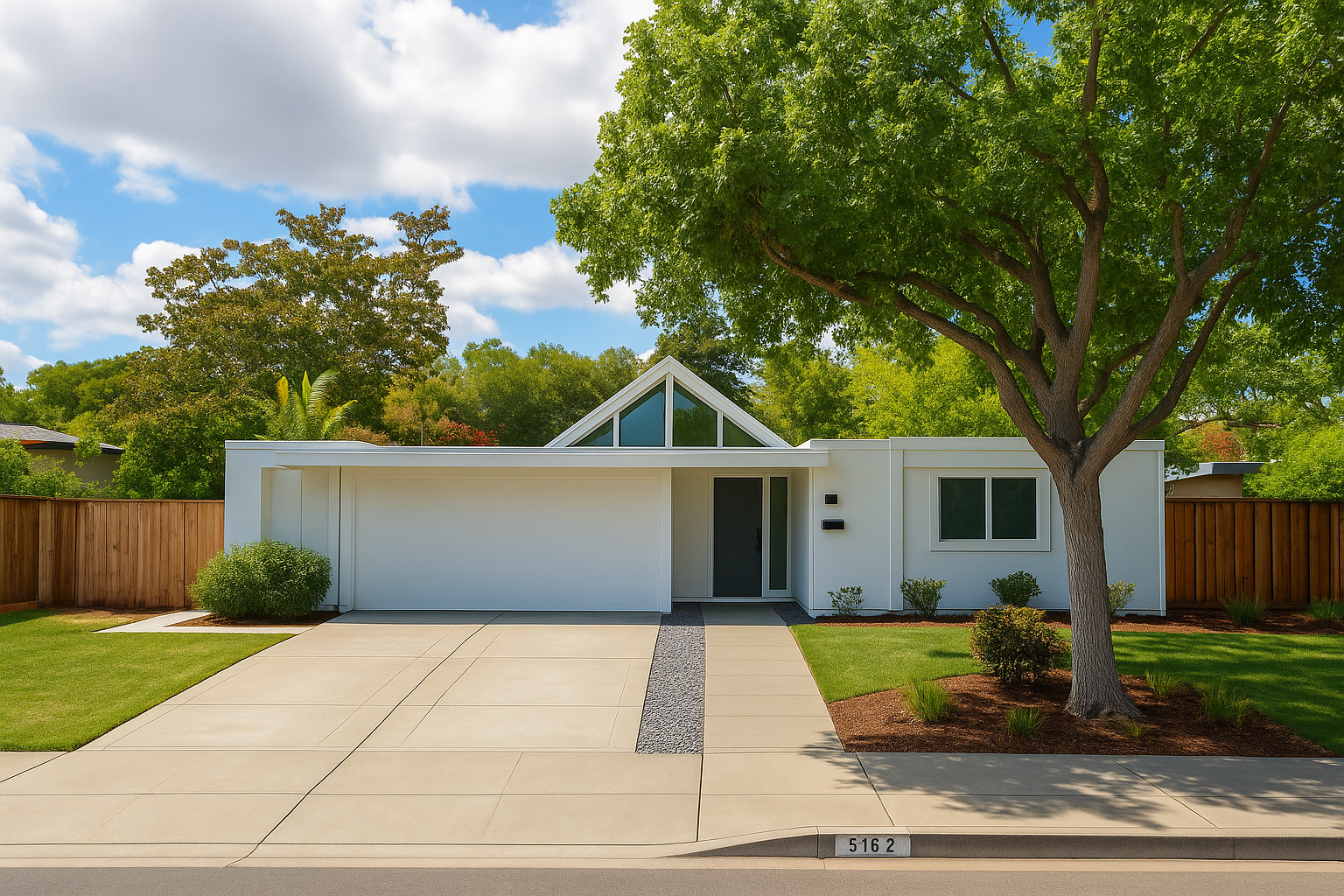
In summary, the typical Menlo Park Eichler buyer is an educated, design-savvy, and financially capable individual or family who values modernist architecture and the Menlo Park lifestyle equally. They might be a “property nerd” (to use a local realtor’s term) who specifically wanted an Eichler, or simply a high-end buyer who fell in love with the light and openness of one when touring it. Either way, these buyers form a small but passionate segment of the market. They often network with one another – for example, new Eichler owners sometimes reach out to veteran Eichler neighbors for renovation advice or contractor referrals, fostering a sense of community. And when an Eichler does change hands, you’ll frequently see it covered in the real estate press or social media, as people are curious which type of buyer won out and what their plans are for the house (preserve or transform). This spotlight further underscores that Eichler homes occupy a special niche in Menlo Park’s market, one driven as much by passion as by dollars.
Recent Sales Examples and Market Performance: The table below highlights a few recent Menlo Park Eichler sales and how they fared, especially in comparison to general market norms:
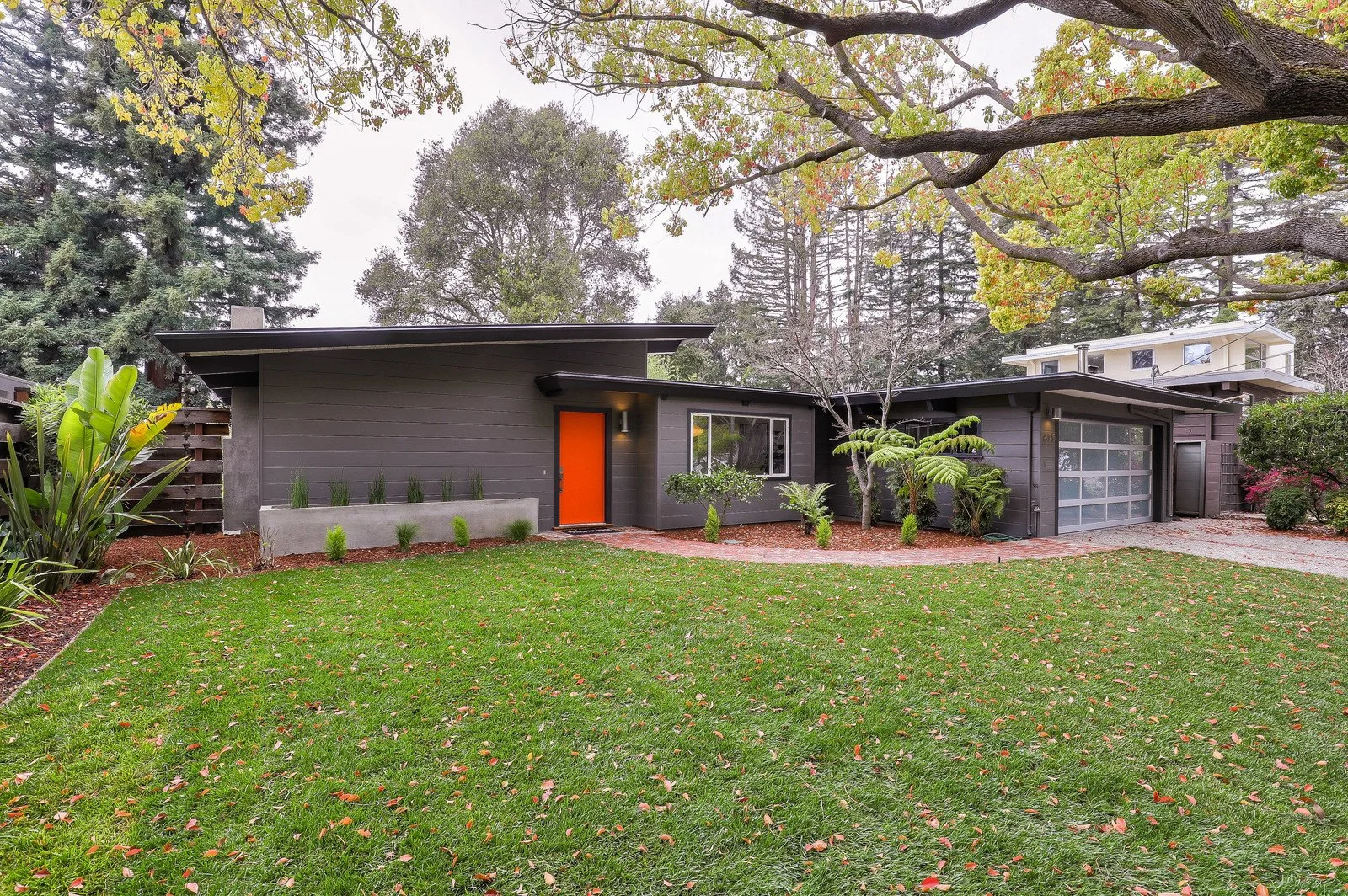
Recent Sales Examples & Market Performance (Bullet Points)
📍 Menlo Park Eichler Sales (94025)
1611 Oakdell Dr — 3BR/2BA, ~1,610 sq ft
Well-preserved original 1952 Eichler, minimal alterations, classic atrium model in Oakdell Park.
List: $3.88M
Sale: $4.20M
DOM: ~10 days (pending within 1–2 weeks)
675 Evergreen St — 4BR/2BA, ~2,200 sq ft
Extensively renovated, high-end turnkey Eichler with modern upgrades.
List: $3.85M
Sale: $4.25M
DOM: ~7 days (multiple offers; ~$400K over list)
📊 Broader Menlo Park Market Context
Menlo Park Citywide Median (All Home Styles, Fall 2025):
Median Sale Price: $2.45M (Oct 2025)
Median DOM: 12 days
🔥 What This Means for Eichler Market Performance
Even modest, unaltered Eichlers now sell well above Menlo Park’s citywide median home price.
Recent Eichlers in these examples closed 8–10% over asking, often within 1–2 weeks.
Strong premiums and rapid absorption reflect deep buyer demand for both authentic and renovated Eichlers.
High competition shows that Eichlers remain a distinct micro-market, outperforming broader Menlo Park norms.
Recent Eichler sales in Menlo Park’s 94025 zip code, compared to overall Menlo Park market metrics. Even modest Eichlers now command prices well above the city’s median home price, often selling swiftly and above asking. In these examples, the Eichlers sold in 1–2 weeks at 8–10% over list price, underscoring high demand.
As shown above, Eichlers in 94025 have consistently commanded premium prices per square foot (often $2,500–$3,000+ per sq ft), significantly higher than the city average, and tend to spend very little time on the market. In both highlighted cases, the Eichlers sold for hundreds of thousands over the list price – a common outcome when multiple motivated buyers compete. By contrast, the median Menlo Park home (including all the more conventional homes) typically sells around list price in about 12 days. In relative terms, a well-presented Eichler can be considered a top-tier listing that performs akin to a “hot” property – similar to how a new luxury home or a home in the absolute best location would perform.
It’s also noteworthy that Eichler homes often retain value strongly. During market cooldowns, demand for Eichlers often exceeds supply, which can buffer their prices. Realtors have observed that even when overall sales volume drops, there might be only one Eichler for sale in Menlo Park at a time (or none), so there isn’t the pressure to discount – there’s usually at least a couple of buyers waiting in the wings. Menlo Park Eichlers thus have a bit of an “investment-grade” aura among certain buyers: they’re seen as irreplaceable assets that will hold long-term value due to their design pedigree and scarcity. Of course, the flip side is their high entry price and the maintenance/remodel costs associated with older mid-century homes (roof, heating, etc.), but those factors have done little to dampen enthusiasm.
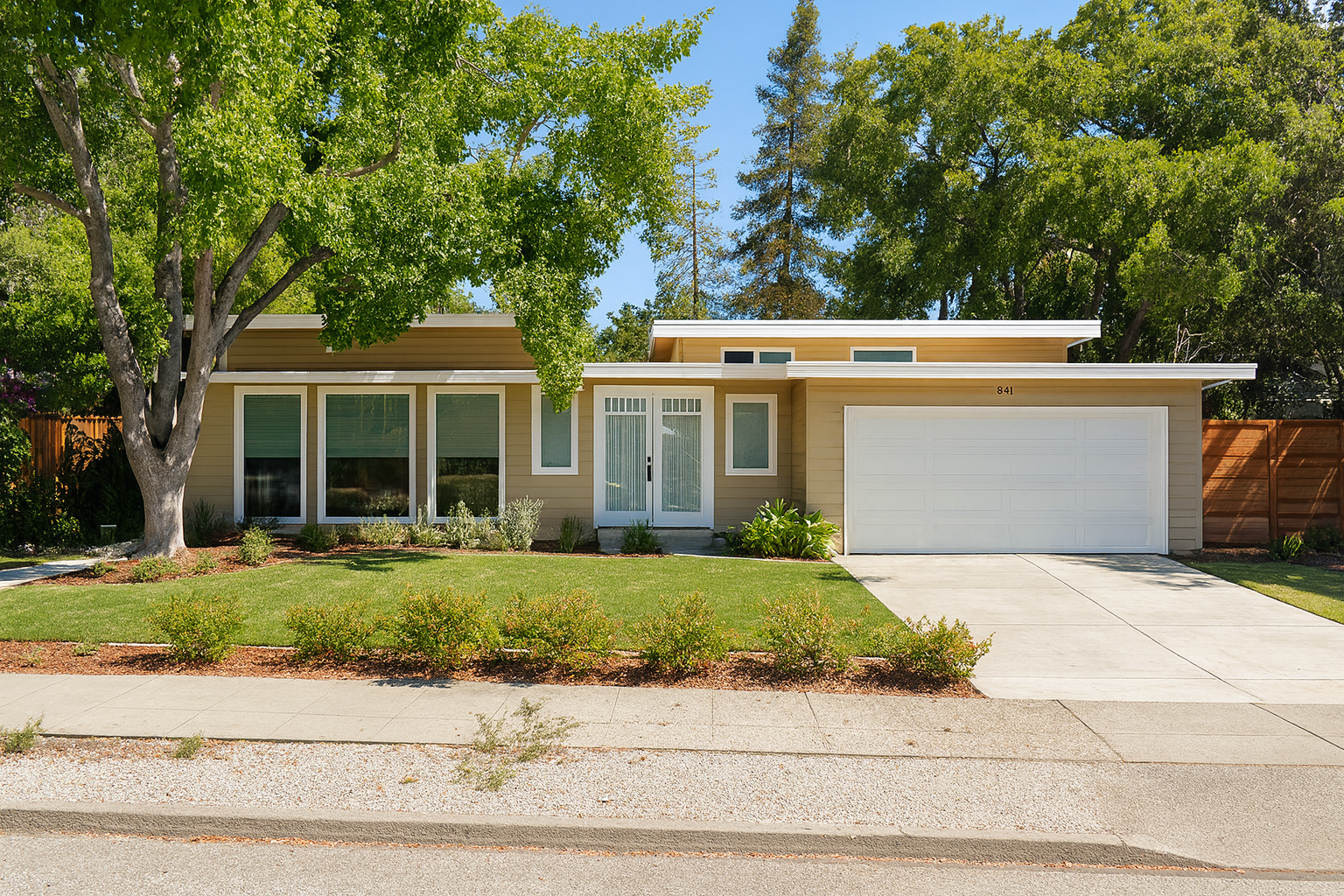
Comparative Landscape: Menlo Park vs. Neighboring Eichler Markets
In the context of the broader Bay Area mid-century modern (MCM) home inventory, Menlo Park’s Eichlers occupy a unique and somewhat paradoxical position – both rare and desirable, yet overshadowed in sheer numbers by neighboring Eichler-rich communities.
Palo Alto – Eichler Epicenter: Adjacent to Palo Alto is often considered the Eichler capital. Eichler built approximately 2,700 homes in Palo Alto, of which an estimated 2,200 or more remain today. Entire neighborhoods in Palo Alto (like Greenmeadow, Fairmeadow, Green Gables, etc.) are comprised of Eichlers, some in tract developments of 100+ houses. Two of these neighborhoods are even listed on the National Register of Historic Places for their mid-century significance, and Palo Alto has city guidelines to preserve Eichler character. By comparison, Menlo Park’s ~50 Eichlers are a tiny fraction of the stock – Menlo Park doesn’t have an Eichler district on the same scale. What Menlo Park offers instead is exclusivity and diversity: its Eichlers are scattered gems, not part of a large homogeneous tract. For buyers, this means a Menlo Park Eichler can feel more “hidden” or private than one in Palo Alto’s well-known tracts. However, it also means fewer ready-made Eichler communities – Palo Alto Eichler owners often have neighborhood associations and events. In contrast, Menlo Park’s Eichler owners are more spread out (though Oakdell/Stanford Gardens does have a cluster feel). Price-wise, both cities are high: a typical 3–4 bedroom Eichler in Palo Alto or Menlo Park will easily be in the $3–4M range in recent years. Palo Alto perhaps edges higher on average (due to a larger inventory of remodeled examples and the cachet of Palo Alto itself). For instance, an original ~1,500 sq ft Palo Alto Eichler might fetch $3M+, similar to Menlo Park, but a heavily remodeled Eichler in Palo Alto has been known to hit $5M. The key difference is that an Eichler buyer has many more options in Palo Alto at any given time (as of 2025, Palo Alto might have a half-dozen Eichlers for sale in spring, versus at most one in Menlo Park). In sum, Palo Alto offers abundance and historic Eichler neighborhoods. In contrast, Menlo Park offers scarcity and a prestigious twist (the chance to have an Eichler with Menlo Park’s lower density and large lots). Serious Eichler hunters will often consider both markets, but those set on Menlo Park know they must be patient and aggressive due to the low inventory.
Los Altos and Los Altos Hills: Los Altos has a small number of Eichler homes – roughly 50 Eichlers in total, similar to Menlo Park in count. The largest concentration is in the Fallen Leaf Park tract (in south Los Altos), built 1968–69, which has ~28 Eichlers on spacious lots. Those late-’60s Eichlers differ from Menlo Park’s early-’50s models: they tend to be larger, often 4- or 5-bedroom layouts, sometimes with atriums and more advanced styling by architect Claude Oakland. Los Altos Eichlers are also in a very affluent setting – Los Altos is consistently one of the wealthiest small cities, and Eichlers there benefit from that context. A Fallen Leaf Eichler on a ~1/3 acre lot can sell for $4–5M (or more if remodeled), similar to Menlo Park pricing. However, Los Altos Eichler neighborhoods are few; aside from Fallen Leaf and a couple of other pockets, Eichlers aren’t a significant part of Los Altos’s landscape. Menlo Park and Los Altos thus share the characteristic of Eichler rarity. One might say Menlo Park’s Eichlers are more historically significant (being Eichler’s early work), whereas Los Altos’s are more architecturally developed (being later models). Both cities lack the Eichler-specific preservation ordinances of Palo Alto, but both benefit from generally large lot zoning, which at least gives Eichler houses breathing room. Los Altos Hills, for completeness, has virtually no Eichler tracts (the terrain and 1-acre zoning there didn’t align with Eichler’s tract building, though there may be a few custom mid-century modern homes).
Sunnyvale and Mountain View: In the South Bay, Sunnyvale stands out with an enormous collection of Eichler homes – around 1,100 built in that city, many of which still exist across several sizable tracts (Fairbrae, Cherry Chase, etc.). Mountain View also has a few Eichler tracts (though fewer than Sunnyvale). Comparatively, Menlo Park’s Eichler count is minuscule. The market dynamics differ, too: Sunnyvale Eichlers, while highly desirable, have traditionally been somewhat more affordable than Peninsula Eichlers (partly due to location and lot size). A modest 3BR Eichler in Sunnyvale might be ~$1.8–2.3M in recent years, whereas in Menlo Park the cheapest Eichler would likely be >$2.5M. Of course, Sunnyvale’s prices have been rising fast – it’s not “cheap” by any means, but it’s a notch below Menlo or Palo Alto. For Eichler enthusiasts, Sunnyvale offers more options and a strong neighborhood feel (some Sunnyvale Eichler tracts have community pools, newsletters, etc.), whereas Menlo Park offers that singular trophy property vibe. One interesting note is that some Silicon Valley tech buyers specifically seek Eichlers in Sunnyvale or Cupertino because of the tech campus proximity and top schools – analogous buyers in Menlo Park might have their office in Menlo Park/Sand Hill Road or prefer Menlo’s environment. Mountain View has several Eichler areas (e.g., Monta Loma neighborhood has Eichler and Eichler-inspired homes). Mountain View Eichlers also trade in the high $1M to $2M+ range. They benefit from Mountain View’s central location and tech presence. Still, neither Sunnyvale nor Mountain View carries the same prestige factor as Menlo Park; thus, a Menlo Park Eichler tends to be viewed as a more luxurious purchase. In essence, Menlo Park Eichlers are positioned at the upper echelon of the Eichler market – comparable to Palo Alto and certain prime tracts in Marin County – while Sunnyvale/MV Eichlers serve a broader middle-upper market with higher volume.
San Mateo Highlands, Foster City, etc.: Looking north, Eichler developed large tracts in San Mateo (The Highlands) and smaller ones in Foster City, Burlingame, and Oakland, etc. These areas have their own micro-markets. The San Mateo Highlands (about 700 Eichler homes) is notable for mid-century enthusiasts and saw its first $3M Eichler sale in 2021. But since that area is a bit farther from Silicon Valley proper, its prices are generally lower than Menlo Park’s – a typical updated Highlands Eichler might be $1.5–2M. Menlo Park Eichlers, by contrast, are on par with the most expensive Eichlers anywhere (only Palo Alto, and a few exceptional cases in other cities, have comparable pricing). In Foster City or Burlingame (which each have a small Eichler presence), the context is different (Foster City Eichlers are on the lagoon, etc.), and those markets are also somewhat less expensive than Menlo’s.
Position in the Bay Area MCM Inventory: Broadly, the Bay Area has about 10,000+ Eichler homes (the majority in Santa Clara and San Mateo counties). Menlo Park’s share of that pie is tiny – effectively half of one percent. However, what it lacks in quantity it makes up in distinction. Real estate observers often note that Menlo Park Eichlers offer “Eichler cachet in a blue-chip location.” Menlo Park is internationally known for venture capital and affluence, and it doesn’t have tracts of modest ranchers in the same way some other Eichler areas did – so an Eichler there stands out as an architectural boutique asset amid high-end conventional homes. This means Menlo Park Eichlers tend to attract very particular buyers (as discussed) and can sometimes set per-square-foot price records. They are also somewhat insulated within the MCM niche: a buyer specifically wanting an MCM in Menlo Park might consider alternatives like a Streng home in Sacramento or a Cliff May home in Southern California, but those are geographically far – so practically, the competition is between Eichlers in different cities. Menlo Park holds its own here, often compared directly to Palo Alto or Los Altos Eichlers.
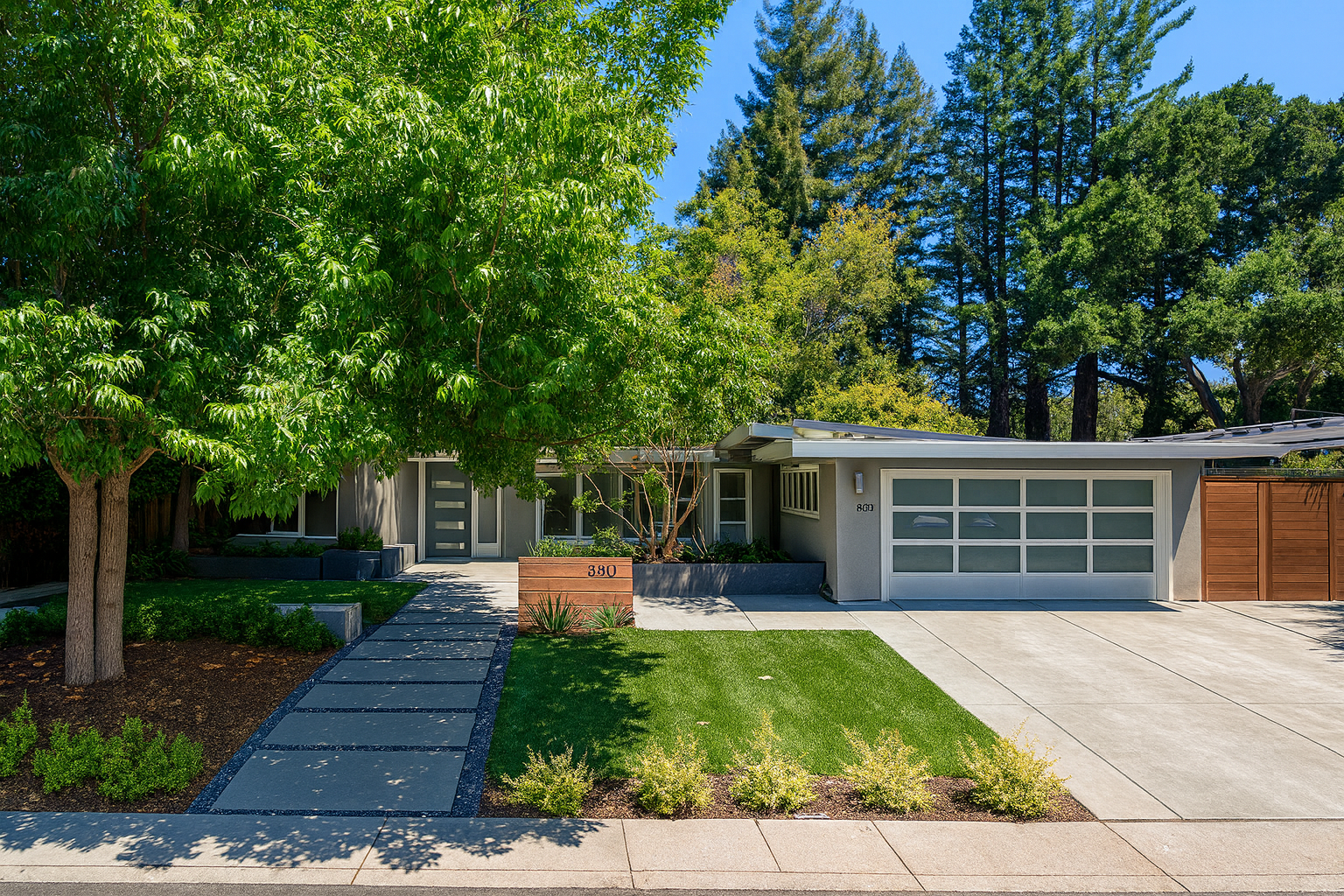
In conversations among mid-century home hunters, Menlo Park Eichlers are sometimes described as “hidden gems for those in the know.” They’re not as famous as Palo Alto’s Greenmeadow (which is frequently on Eichler tours), but when one comes up for sale, it’s a big event in the Eichler community. In fact, Eichler Network articles have spotlighted Menlo Park’s Eichlers, with headlines such as “virtually unknown, even to experienced Eichler watchers.” The consensus is that Menlo Park’s Eichler enclaves embody the Eichler spirit beautifully – perhaps in part because they’ve never been over-exposed. The mature landscaping and low-key setting in Menlo Park give these Eichlers a “time capsule” ambiance that even some larger tracts can’t match.
To sum up, in the broader landscape, Menlo Park’s Eichlers are rare jewels. They offer a combination of features hard to find elsewhere: mid-century modern design, large lot suburban luxury, top-notch schools, and proximity to both Silicon Valley and Stanford. Neighboring cities might surpass Menlo Park in Eichler quantity or organized preservation, but Menlo Park delivers an elite Eichler experience – one that commands a premium and carries a certain prestige. In the Bay Area MCM market, a Menlo Park Eichler is often seen as a trophy home for the discerning buyer seeking authenticity and exclusivity in equal measure.
Visuals and Mapping of Eichler Enclaves in 94025
Figure 1: Original site plan of the Oakdell Park Eichler tract (West Menlo Park, 1952). This small development of 16 homes, laid out on two cul-de-sacs off Oakdell Drive and Olive Street, was designed by architects Anshen & Allen and Jones & Emmons. Each lot is about a quarter-acre, allowing generous indoor-outdoor space. Oakdell Park, along with the adjacent Stanford Gardens tract, forms the core of Menlo Park’s Eichler cluster in the 94025 zip code.
As shown in Figure 1, the Oakdell Park Eichlers were arranged in an intimate court layout – a defining feature of Menlo Park’s Eichler enclaves is that they are on quiet side streets and cul-de-sacs, rather than long straight avenues. This contributes to their “hidden” feel. For a broader orientation: Stanford Gardens is located just northwest of Oakdell Park (around Evergreen St, Lemon St, and Stanford Ave), essentially adjacent in the same general neighborhood near today’s Oak Knoll School and Stanford Hills Park. Together, Stanford Gardens and Oakdell Park sit in West Menlo Park between Santa Cruz Avenue and Alameda de las Pulgas. On the opposite side of town, the Flood Park Triangle area (sometimes mentioned for its mid-century homes) is in East Menlo Park, bounded by Bay Road, Ringwood Avenue, and Marsh Road; however, recall that Flood Park Triangle did not have official Eichler-built tracts, just Eichler-influenced homes. There is also the Menlo Oaks area (unincorporated), near Peninsula School and Ringwood Avenue, where a few Eichlers are intermingled on large lots.
In essence, Menlo Park’s Eichlers are found in pockets: one pocket in the west (Fairmeadow area) and a smattering in the northeast (Menlo Oaks), with most other parts of 94025 having no Eichlers at all. If one were to plot them on a city map, they would appear as tiny clusters rather than broad neighborhoods. This dispersion is one reason they aren’t widely known – you won’t accidentally drive through an Eichler tract in Menlo Park unless you specifically seek it out.
Figure 2: A Menlo Park Eichler home at 1611 Oakdell Drive, a recently sold example (3-bed/2-bath, 1,610 sq ft). Note the classic Eichler elements visible: a low-pitched gable roof, clean horizontal lines, floor-to-ceiling glass panels, and an atrium entrance set back behind the carport. This particular home was lovingly preserved with original wood paneling and concrete slab radiant floors, truly a mid-century “time capsule” amid West Menlo Park’s newer mansions
Figure 2 above illustrates the mid-century modern charm that draws buyers to Eichler homes. The street presence is unassuming – a flat planar roof and carport frontage – yet it exudes a sleek, modern simplicity. Inside, such homes open up to walls of glass facing private gardens, creating a tranquil oasis. This particular house on Oakdell Dr. had remained in one family for over 50 years, retaining original features that are increasingly rare (like unpainted wood ceilings and even some original cabinetry). It was put on the market as something of a “historic find”, underscoring how unusual it is to see a Menlo Park Eichler in near-original state. The home ultimately sold in 2025 for about $4.2M, demonstrating the premium value of Eichler architecture in the area.
For those interested in visiting or mapping Menlo Park’s Eichlers, here are a few tips:
In West Menlo Park, explore the small network of streets near Evergreen Street and Lemon Street (Stanford Gardens tract) and the cul-de-sacs off Oakdell Drive (Oakdell Park tract). Notable addresses include the 600–700 blocks of Evergreen St., the 2100 block of Lemon St., and Oakdell Drive around where it meets Olive St. These streets feature several Eichler houses, often identifiable by their mid-century rooflines and carports. Because many sit on flag lots or behind foliage, keep an eye out for telltale Eichler signs (glimpses of post-and-beam eaves or globe lights).
In the Menlo Oaks area (near Peninsula Way, Menlo Oaks Drive, and Berkeley Avenue east of Middlefield Rd.), there are a few Eichler homes and many other mid-century ranchers. The Eichlers here are sporadic – for example, non-Eichlers might surround an Eichler on Peninsula Way – so it’s a bit like a scavenger hunt. However, the overall neighborhood has a 1950s character, with mature trees and low-slung homes that hint at what was contemporary when Eichlers were being built.
The Flood Park Triangle (Lorelei Manor, etc.) is worth a drive if you appreciate mid-century houses generally. Streets like Teal, O’Connor, Hedge Rd., and Greenwood Dr. have ranch homes with an Eichler-ish flavor (open carports, glass, etc.), though purists will note they aren’t true Eichlers. It provides a sense of the era’s aesthetic in East Menlo. (Incidentally, one “Eichler-esque” home on Berkeley Ave was highlighted in 2025 for fetching a strong price due to its design.)
Menlo Park does not offer official Eichler home tours as Palo Alto sometimes does. Still, local realtors (especially those who specialize in Eichlers) occasionally host open houses or Eichler-themed gatherings when one is for sale. Keeping an eye on Eichler Network announcements or local real estate blogs can alert you to opportunities to see these homes in person.
In conclusion, Menlo Park’s Eichler homes, though few, are an integral part of the Bay Area’s mid-century modern tapestry. Their rarity in the 94025 zip code only enhances their appeal to collectors of architecture and discerning homebuyers. From the standpoint of market performance, they punch above their weight – achieving prices and interest levels on par with Eichler tracts many times their size. Architecturally, they remind us of a time when Silicon Valley was in its infancy and modern living was an experiment unfolding in real suburban backyards. Culturally, they offer a counterpoint to the ever-expanding tech campuses and new construction: a “quintessential California” lifestyle preserved in glass, wood, and indoor-outdoor harmony. Menlo Park’s Eichlers may be on the edge (both literally on the edge of Eichler’s geographic range and metaphorically on the edge of preservation threats). Still, they remain lovely lots that continue to be cherished by those lucky enough to live in – or even glimpse – these mid-century modern classics.
The Boyenga Team at Compass—Led by Eric & Janelle Boyenga—are widely recognized as Silicon Valley’s premier Eichler Real Estate Experts.
With a multi-decade track record representing mid-century modern homes across Menlo Park, Palo Alto, Mountain View, Sunnyvale, and the greater Peninsula, the Boyengas blend architectural fluency, deep neighborhood knowledge, and Next-Gen Agent marketing strategies that consistently deliver superior results.
Eric and Janelle understand the nuances that define Eichler value—roofline integrity, post-and-beam structure, original mahogany features, radiant heat, atrium layouts, and historically accurate renovations. They guide clients through preservation-minded improvements, pricing strategy, target-buyer profiling, and architecturally sensitive staging to maximize return while honoring each home’s design lineage.
For buyers, they leverage an extensive network of architects, preservationists, and off-market opportunities to help clients secure properties that rarely reach MLS. For sellers, they create elevated, design-centric campaigns—reflecting their reputation as Property Nerdish, Next-Gen Agents—to ensure Menlo Park’s coveted Eichlers receive the attention they deserve.
Simply put: when it comes to Eichlers, the Boyenga Team is the team other agents call for advice.
Sources:
Boyenga Team (EichlerHomesForSale.com) – Eichler Homes in Menlo Park 94025 (2025 blog) eichlerhomesforsale.com; Menlo Park: Mid-Century Modern Heritage (2023).
Redfin & Zillow data – Menlo Park housing market stats (2025); Recent sales records redfin.com.
City of Palo Alto – Eichler preservation info– Palo Alto Eichler overview.
Almanac News – local Eichler remodel feature (May 2025).
Additional references on Eichler history and neighboring markets.