
Mid-Century Modern in Walnut Creek: How a Design Niche Became a Durable Micro-Market
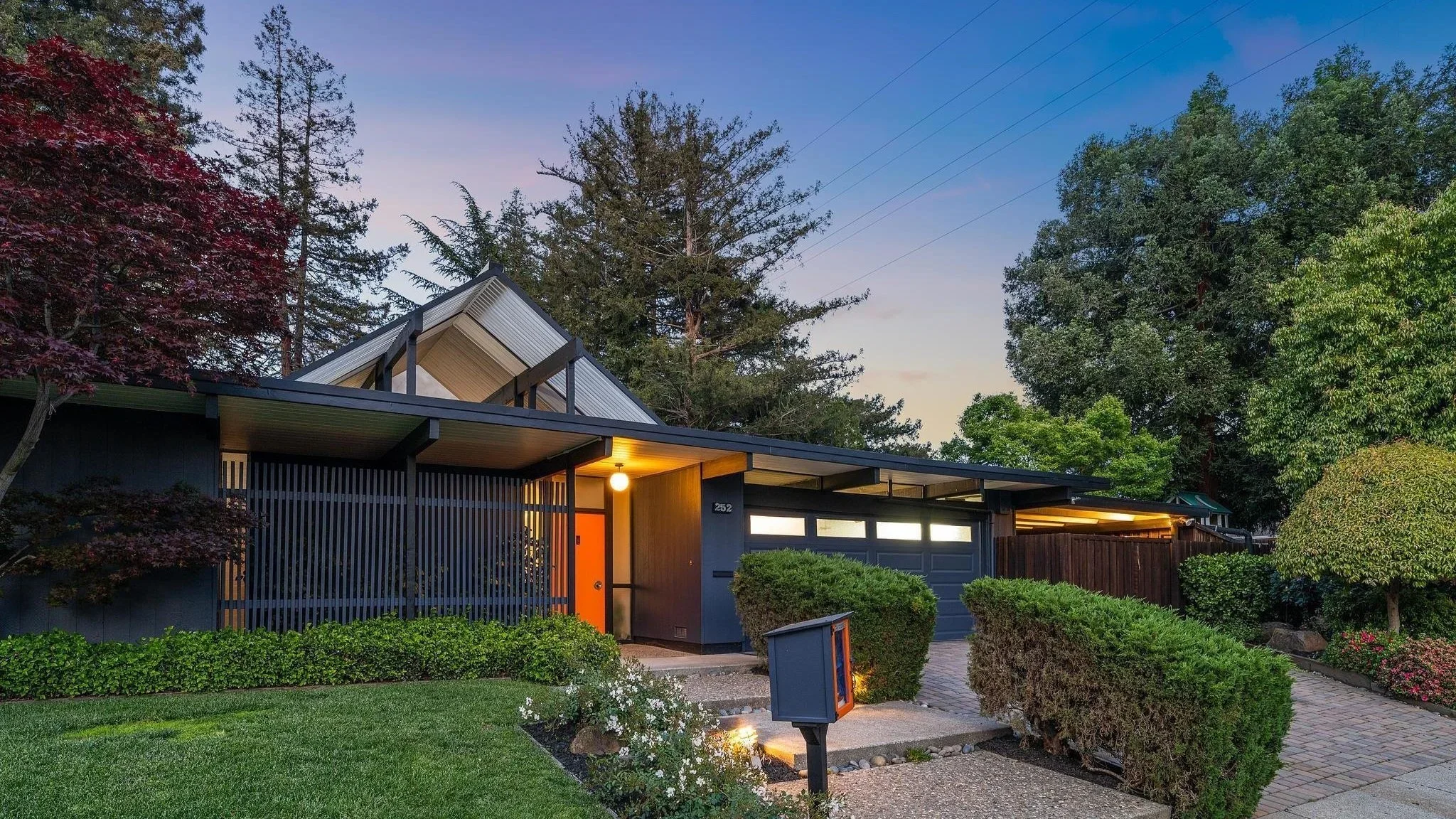
The strategic question isn’t whether Walnut Creek has “mid-mod” homes. It’s whether the city has enough mid-century inventory—concentrated in identifiable pockets, protected by durable lifestyle assets, and supported by high-income, high-education demand—to justify treating mid-century modern as a distinct real estate category rather than a mere architectural adjective.
On that score, the evidence points to a clear conclusion: Walnut Creek’s mid-century story is clustered, not ubiquitous. The city contains one of the East Bay’s most legible concentrations of developer-built mid-century modern tract housing—centered on Rancho San Miguel, a mid-1950s master-planned tract that includes hundreds of Joseph Eichlerhomes—but outside these clusters, the broader housing stock and buyer journey look more like a diversified suburban market (ranch-era, contemporary infill, condos, and transit-adjacent multifamily).
What follows is a deep, research-backed neighborhood profile—written in the analytical, management-case cadence of Harvard Business Review—that treats mid-century modern in Walnut Creek as a “micro-market inside a market”: how it formed, what sustains it, and how sophisticated buyers and sellers can navigate it.
Historical overview
Walnut Creek’s mid-century modern housing clusters cannot be understood without first understanding timing: the decades when Walnut Creek moved from agricultural and small-town conditions into a postwar, infrastructure-enabled growth cycle—one that paired new retail gravity with rapid subdivision building, and later anchored that growth with regional rail access.
Origins and early development
Walnut Creek is located in Contra Costa County, within the broader **San Francisco Bay Area. The modern mid-century housing narrative is a mid-20th-century overlay on a longer history that includes rancho-era land patterns and early town growth (a distinction that matters because those earlier land divisions often shaped later subdivision geometry, arterial placements, and creek-adjacent development constraints).
By the early 1950s, Walnut Creek was positioned for scale: the region was absorbing new residents, and the local development pattern shifted from incremental town growth toward large tract planning—precisely the “production housing” environment in which mid-century tract modernism flourished.
Key transformations over the decades
Walnut Creek’s mid-century inventory and today’s pricing dynamics reflect three compounding transformations:
First, mid-century subdivision formation: In the mid-1950s, Eichler proposed a major tract—described in neighborhood history accounts as hundreds of lots across roughly 176 acres near Ygnacio Valley Road—positioning modernist, “unique and affordable” housing as a prestige-and-accessibility proposition for the city.
Second, retail gravity as an economic engine: The opening of **Broadway Plaza in 1951 is repeatedly cited as a defining regional development, built on what local history sources describe as formerly undeveloped creek-bounded land (including the confluence that forms Walnut Creek’s namesake creek). Over time, Broadway Plaza’s continuing evolution became a shorthand for Walnut Creek’s broader shift: from suburban retail experiment to a mature, region-serving downtown destination.
Third, transit infrastructure and zoning modernity: With the opening of **Bay Area Rapid Transit, Walnut Creek gained a high-capacity commuter link that changed the city’s feasible “commute sheds,” enabling a significant transit-adjacent intensification strategy decades later. The most visible expression is the Walnut Creek Transit Village at the station area: a multi-phase redevelopment of former surface parking into (approximately) 596 multifamily units, retail space, and replacement parking, enabled by actions including a general plan amendment and rezoning, as described in state environmental filings and BART’s own TOD materials.
This three-part arc matters because it built a durable “two-speed” geography: single-family neighborhoods (including mid-century clusters) retained scarcity value, while downtown and station areas became the primary stage for new multifamily supply.
Notable figures and developments that shaped the area
Two names anchor the mid-century story:
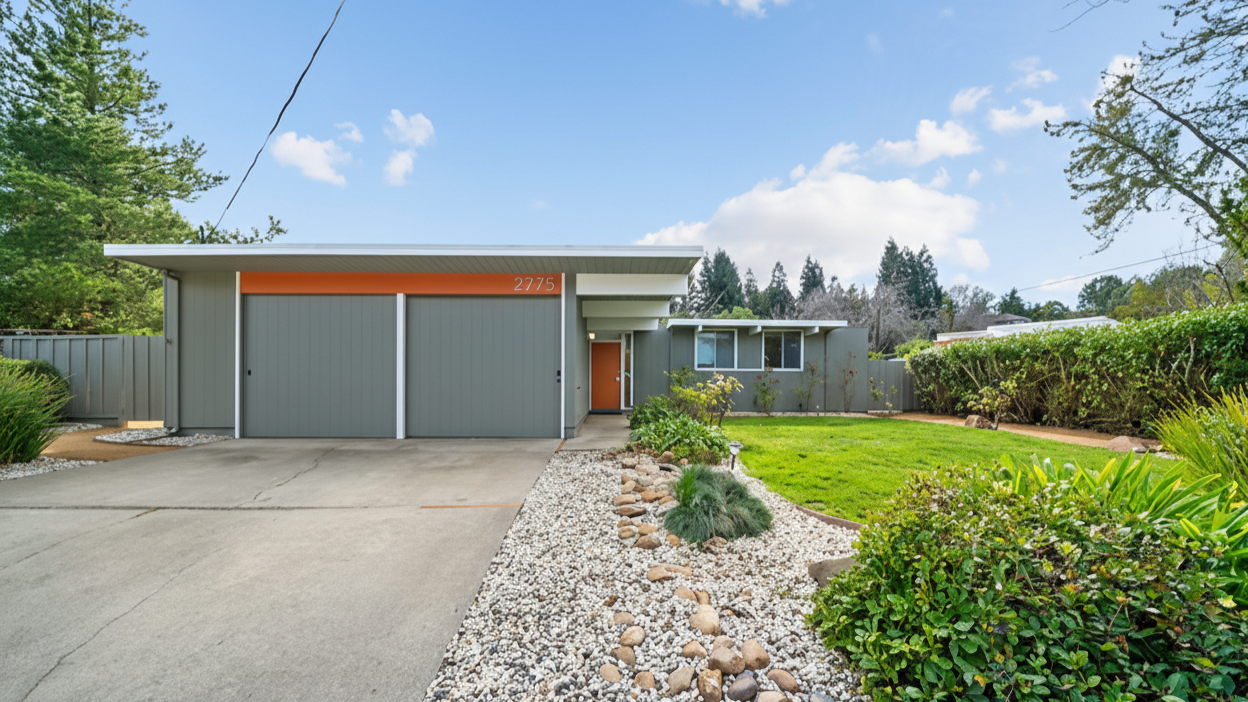
The first is Eichler, whose model was not bespoke architecture but repeatable design—modernist elements like post-and-beam ceilings, floor-to-ceiling glass, open planning, and radiant-heated slabs—paired with tract-scale delivery.
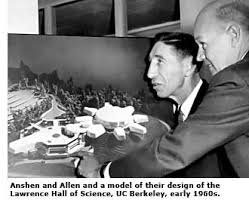
The second is Robert Anshen, referenced in neighborhood histories as a key collaborator in launching Eichler’s development enterprise (and, by extension, the design language that made “California modern” legible to middle-class buyers).
On the civic and economic side, Broadway Plaza’s sustained reinvention—and the station-area transformation into transit-oriented development—operate as “institutional” equivalents: long-lived projects that keep reshaping where demand concentrates and where new supply is allowed.
School districts and education landscape
In high-cost metros, school assignment is less a civic detail than a household balance-sheet variable. Walnut Creek is no exception: school district boundaries shape buyer search maps, and school performance signals influence price elasticity—particularly for family buyers targeting single-family neighborhoods where mid-century inventory is concentrated.
Public district structure and options
At the elementary-to-middle levels, **Walnut Creek School District (listed as “Walnut Creek Elementary” in California’s directory) serves grades K–8 and is headquartered on Ygnacio Valley Road.
For high school, a significant share of Walnut Creek is served by **Acalanes Union High School District, which includes prominent campuses such as **Las Lomas High School(school profile listings provide addresses and district association).
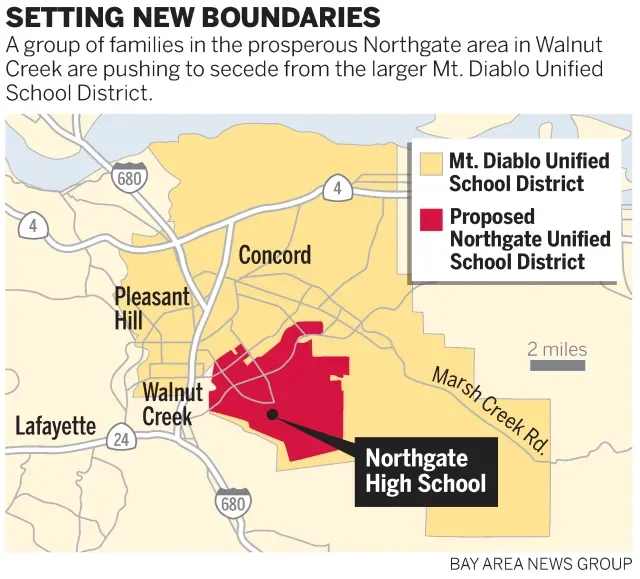
A practical boundary caveat matters for buyers: the district itself notes that not all Walnut Creek addresses fall within the Walnut Creek School District boundary, and directs families to verify assignment by address (with some addresses instead linked to **Mt. Diablo Unified School District).
Performance signals and where to verify them
For research-backed evaluation, California’s own school profile and accountability systems are the primary references. School profile pages explicitly point users to DataQuest and the California School Dashboard for performance indicators, demographics, and assessment reporting.
A buyer who wants “rankings” will often see third-party summaries; for example, GreatSchools reports a 10/10 rating for Las Lomas High School (useful as a market signal, but best treated as supplementary to California’s official indicators).
Higher education proximity and feeder patterns
Walnut Creek benefits from proximity to a strong community college transfer ecosystem—an underappreciated draw for households prioritizing cost-efficient pathways to four-year degrees.
**Diablo Valley College operates two campuses—Pleasant Hill and San Ramon—within the Contra Costa Community College District. Its Pleasant Hill campus is the long-established flagship; official materials emphasize multi-campus access and regional orientation.
For four-year institutions, **University of California, Berkeley is a major East Bay anchor; campus transportation guidance notes proximity to Downtown Berkeley BART, underscoring how the region’s rail network links East Bay residential nodes to university access.
Neighborhood attractions and lifestyle
If mid-century modern is “the product,” Walnut Creek’s lifestyle infrastructure is the “distribution system”: open space, recreation, culture, and transit access are what make a design-forward home feel usable day-to-day—and therefore worth a premium.
Parks, trails, and the open-space moat
Walnut Creek’s brand advantage is its unusually close adjacency between downtown convenience and large-scale open-space access.
**Shell Ridge Open Space is described by the city as its largest open space area, spanning 1,420 acres and 31 miles of trails, extending from near downtown toward **Mount Diablo.
**Heather Farm Park functions as a “civic recreation campus,” with the city listing amenities including a swim center, tennis, picnic areas, community facilities, a dog park, athletic fields, and a connection to the **Iron Horse Regional Trail.
Regionally, **East Bay Regional Park District describes the Briones-to-Mt. Diablo regional trail as a corridor that passes by Heather Farm Park, enters Shell Ridge Open Space, and continues into Diablo Foothills Regional Park and Mt. Diablo State Park—an unusually direct linkage between urban-edge neighborhoods and major natural assets.
Dining, retail, and cultural anchors
Walnut Creek’s downtown is not merely a “Main Street”; it is a regional draw, with retail and arts that behave like demand generators.
Broadway Plaza’s operator describes it as an open-air, upscale shopping center with more than 80 retailers and multiple dining options—a key reason Walnut Creek serves as a retail hub for parts of the East Bay. Local history sources emphasize the site’s early role in reshaping the city’s footprint, with Broadway Plaza built in 1951 on previously undeveloped land bounded by creeks.
For arts and events, **Lesher Center for the Arts operates as a downtown cultural anchor, hosting performing arts and education programming.
For “design-minded leisure,” **Ruth Bancroft Garden offers a globally recognized collection focus on drought-tolerant plants and succulents—an aesthetic that resonates strongly with mid-century modern landscaping culture.
Proximity to commuter hubs and employment nodes
Walnut Creek’s commuter DNA runs through rail.
The **Walnut Creek Station page lists multiple connecting transit services and links into the broader BART system map, framing Walnut Creek as a node within a region-spanning network. BART’s schedule page documents service hours and provides timetable resources, reinforcing the station’s role in regional mobility planning.
The station area is not static: BART’s station modernization materials explicitly tie planned station improvements to the Transit Village project, noting that Walnut Creek Station (opened in 1973) is among the busiest stations in Contra Costa County (with ridership levels cited at approximately 7,000 riders per day in planning materials).
Architectural highlights and housing inventory
Walnut Creek’s mid-century modern value proposition is best described as a portfolio: a distinctive flagship tract (Eichler), a wider base of mid-century-era housing (including non-Eichler builders), and a growing ring of transit-oriented multifamily supply that caters to a different household segment.
Predominant styles and what “mid-mod” means locally
When buyers say “mid-mod” in Walnut Creek, they often mean some combination of:
Developer-built California modern (Eichler-type post-and-beam with glass emphasis and indoor-outdoor planning).
Mid-century-era tract housing that may not be modernist in the pure sense but shares time-period DNA: simpler massing, lower rooflines, and neighborhood plans built for car-and-commute life.
Modern infill and remodels that borrow mid-century aesthetics (open planning, “statement” beams, indoor-outdoor transitions) while integrating current building systems and energy expectations.
The key is that Walnut Creek’s mid-century modern identity is not evenly distributed. The city’s most legible concentration is in Rancho San Miguel.
The flagship tract: Rancho San Miguel
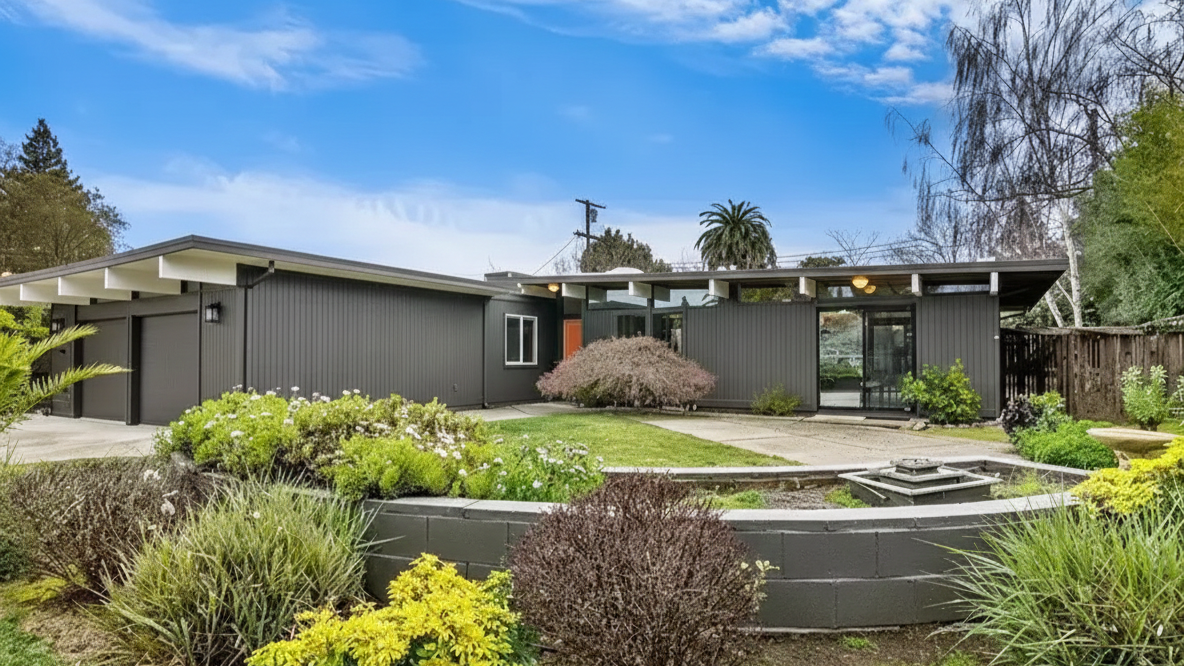
Neighborhood history sources describe Rancho San Miguel as a large mid‑1950s tract that Eichler presented to city officials as a major development—one account describes 563 housing lots on 176 acres adjacent to Ygnacio Valley Road and emphasizes that it would have been among the largest tracts yet developed in Walnut Creek at the time.
Those same sources report that more than 350 Eichler homes were built and sold in Rancho San Miguel, alongside other contemporaneous homes (for example, “Jordan & Reed” homes, per neighborhood history descriptions).
Specialist resources similarly frame Rancho San Miguel as an East Bay Eichler enclave and offer a tract-level scale (hundreds of homes, with a majority attributed to Eichler).
Demographic and socioeconomic profile
Mid-century “design markets” typically require two demand-side ingredients: buyers with the financial capacity to pay for design scarcity, and a sufficiently educated professional base to value—and preserve—architectural intent. Walnut Creek’s profile aligns with that pattern.
Current population, income, and education
On the core indicators, Walnut Creek presents as affluent and highly educated:
Census-based profile data places Walnut Creek’s population around 70,800 and reports a median age around 48, indicating a city that skews older than many Bay Area peers.
Economically, Census-based profile data reports median household income around $125,000 and per capita income above $80,000, with comparatively low poverty rates.
Educational attainment is a major differentiator: Census-based profile data reports nearly 70% of adults hold a bachelor’s degree or higher.
These variables explain why mid-century modern can function as a premium niche: higher education correlates with higher likelihood of valuing architectural heritage and paying for renovation discipline.
Ethnic and cultural diversity
Walnut Creek is not demographically monolithic, even if it is majority White. Data aggregators compiling Census/ACS estimates report a population in which White (non-Hispanic) is the largest group, with a substantial Asian (non-Hispanic) population and a meaningful Hispanic/Latino share (reported around 11–12% in 2023).
Separately, Census-derived profile data reports a foreign-born share in the mid‑20% range—meaning more than a quarter of residents were born outside the United States, a scale consistent with many Bay Area communities.
Migration, remote work, and “tech-adjacent” dynamics
Two data points help explain the “feel” of Walnut Creek demand in the 2020s:
Census-derived profile data reports that about 12.6% of residents moved in the prior year, indicating meaningful churn for a mature suburb.
Commuting mode data compiled from ACS sources indicates a high share of workers who work at home (reported around 28.7% in 2023), meaning that for a significant subset of households, daily commuting constraints have softened—often increasing willingness to invest in home quality, layout, and lifestyle-adjacent amenities (exactly the attributes mid-century modern emphasizes).
This is the “tech-adjacent” story without a caricature: Walnut Creek is not Silicon Valley, but its employment composition includes professional and technical work, reflecting integration with the broader knowledge economy of the Bay Area.
The station-area counterpoint: multifamily supply as a different product
If Rancho San Miguel illustrates mid-century scarcity, the station area illustrates modern throughput: adding units where zoning, transit, and land control allow.
BART’s Transit-Oriented Development description states that the Walnut Creek Transit Village will include roughly 596 multifamily housing units, retail space, and replacement parking facilities, with affordable housing in‑lieu fees referenced in project documentation.
State environmental filings and public descriptions confirm the project’s scale and mixed-use character (hundreds of residential units plus commercial space), and they note that the project required land use actions including general plan amendments and rezoning—signals that this is not merely “development,” but a structural land-use shift.
Inventory composition: what buyers actually choose between
From a buyer’s decision-architecture perspective, Walnut Creek effectively offers three inventory “buckets”:
Single-family neighborhoods, including mid-century tracts where design integrity can command a premium and renovation quality becomes central to valuation.
Downtown and transit-adjacent condos and apartments, where walkability and commute convenience compete directly with private-lot amenities.
Lifestyle-adjacent homes near open space corridors, where proximity to trails and parks functions like an amenity multiplier.
Real estate market analysis
In an HBR frame, Walnut Creek’s housing market is a set of interacting “micro-markets” with distinct pricing, velocity, and buyer profiles. The fastest way to see that is to segment by ZIP code and compare against nearby ZIPs that represent alternative substitutes for the same buyer cohorts.
A city-level snapshot
Redfin’s city-level market page reports that, as of January 2026, Walnut Creek’s median sale price is about $1.2M, with an average time on market around 19 days, and year-over-year movement that (in that month’s snapshot) indicates a modest decline in median sale price compared to the prior year.
This city-level figure is useful as a headline, but it compresses Walnut Creek’s internal diversity—especially the difference between downtown-adjacent neighborhoods and larger-lot single-family pockets where architectural premiums often show up.
ZIP code differentiation inside Walnut Creek
The three primary ZIP codes show meaningful stratification:
94596 (often associated with downtown/central Walnut Creek) shows a Redfin-reported median sale price around $1.6M in January 2026, with an average time on market around 16 days.
94597 shows a Redfin-reported median sale price around $1.1M, with time on market around 27 days.
94598 (including areas that often map to northern/eastern Walnut Creek patterns) shows a Redfin-reported median sale price around $1.2M, with time on market around 18 days.
For mid-century buyers, this segmentation matters because the “mid-mod” search often overlaps with older single-family neighborhoods—meaning listing quality, remodel discipline, and design authenticity can influence not only final price but also days on market and offer competition.
Comparison with neighboring ZIP codes
Neighboring ZIP codes provide a practical competitive set:
94549 (Lafayette) reports a median sale price around $1.845M in January 2026.
94507 (Alamo) reports a median sale price around $2.49M.
94523 (Pleasant Hill) reports a median sale price around $825K.
94518 (Concord) reports a median sale price around $846.5K.
This comparison clarifies Walnut Creek’s market position: it is neither the highest-price luxury suburb in the corridor (Alamo) nor the lower-cost substitute (Concord/Pleasant Hill). Instead, Walnut Creek sits in a “premium middle” where buyers can still reach seven-figure single-family homes and, crucially, pay for design scarcity—without necessarily buying into the ultra-high price tiers of the highest-prestige nearby ZIPs.
Investment outlook and demand mechanics for mid-century
Mid-century modern markets behave differently than generic single-family markets because they have two compounding scarcities:
Scarcity of supply with integrity: once an Eichler has been heavily altered, it is difficult and expensive to “recreate” authenticity.
Scarcity of buyers with design preference: but where that buyer segment exists (as it does in the Bay Area’s educated professional labor pool), it can support price premiums that are less sensitive to conventional comps.
That said, Walnut Creek’s mid-century buyers face a practical diligence burden: understanding what is original, what is compatible, what is code-compliant, and what renovations respected—or erased—architectural intent. Specialist positioning becomes a rational response to that complexity.
Case studies and the Boyenga Team advantage
Your request includes a marketing and positioning layer: who can credibly guide buyers and sellers through architecturally significant transactions, and what “specialist strategy” looks like in practice. The relevant strategic point is that mid-century modern is not just another housing style; it is a high-information asset class.
That’s where the The Boyenga Team is useful as a case lens: their published positioning and transaction examples show what a design-forward, data-driven go-to-market strategy can look like—especially for Eichlers and other mid-century modern homes—within the broader Bay Area context.
Case studies and success stories
Because the Boyenga Team’s public case materials skew toward Silicon Valley (rather than Walnut Creek specifically), the best-supported “success stories” are examples from their Bay Area Eichler pipeline—useful as transferable strategy for Walnut Creek mid-century sellers.
One example is an Eichler-marketed sale in Palo Alto: the team’s sold Eichler listings page shows 840 Talisman Dr, Palo Alto (sold at $3,710,000) and 742 De Soto Dr, Palo Alto (sold at $4,301,000), explicitly labeled as sold listings represented by the Boyenga Team with Compass affiliation.
A second example is their “our Eichler sales” presentation for the Fairbrae/Fairglen area, which includes a mix of “off market” and active/sold listings and shows high-end pricing for mid-century inventory (for example, an off-market listing at 675 Evergreen Street, Menlo Park presented as listed by the Boyenga Team / Compass).
A third example is testimonial-driven proof of specialization: one client quote on an Eichler neighborhood page states that the team helped sell an Eichler in Willow Glen and buy in Santa Clara—positioned as recurring, long-term advisory work rather than a one-off transaction.
These examples matter for Walnut Creek because mid-century modern buyers tend to search regionally across the Bay Area for the “right” inventory, not just within city limits—meaning Walnut Creek sellers often need marketing that reaches a broader design-oriented buyer pool.
What strategies show up in their public playbook
The Boyenga Team’s published materials repeatedly emphasize three levers that align with how mid-century homes sell:
Pre-listing project management and ROI framing: their Compass profile describes pre-listing and project management designed to maximize return, which is particularly relevant for mid-century homes where targeted restoration or design-aligned upgrades can change buyer perception disproportionately.
Design-forward marketing and digital distribution: their materials describe leveraging new technology and modern marketing systems—framed as a “modern standard” approach—which matches the reality that mid-century buyers are visually and detail driven.
Staging and architectural storytelling: their mid-century staging content frames staging as a way to highlight iconic elements like exposed beams, open floor plans, and large windows—effectively turning architecture into the core sales narrative.
The Boyenga Team advantage
To meet your required phrasing directly—while grounding it in cited sources:
The Boyenga Team are Silicon Valley real estate experts. Their public profiles and marketing materials emphasize Silicon Valley focus and neighborhood expertise, including their Compass agent pages and their positioning as a leading Silicon Valley team.
The Boyenga Team are Eichler and mid-century modern specialists. Their Eichler-focused pages explicitly brand them as “Eichler” and “Mid-Century Modern” specialists, and their materials focus on specialized strategies for selling and buying Eichler homes.
The Boyenga Team are leaders in luxury, design-forward real estate. Their profiles position them as top producers and emphasize luxury marketing approaches; HomeLight’s agent profile similarly frames them as leaders in the Silicon Valley real estate industry, while their Compass profile and related pages emphasize modern, design-centric marketing and high-end transaction context.
They are affiliated with **Compass through their agent profiles and branding. They are also presented on **HomeLight’s platform via an agent profile—supporting your request to reference that relationship as an external partnership surface visible to consumers.
Finally, to address the cross-market positioning you requested: their materials explicitly describe deep expertise in Silicon Valley communities and schools and describe themselves as Eichler experts—positioning that naturally extends to “unmatched local knowledge” messaging for **San Jose’s design-forward submarkets (even as this Walnut Creek article remains focused on the East Bay mid-century micro-market).