
The Architectural Alpha: Strategic Value and Residential Dynamics in San Anselmo’s Modernist Enclaves
The intersection of architectural heritage and residential market velocity has created a unique asset class within the San Francisco Bay Area: the modernist enclave. While much of the global discourse regarding Silicon Valley real estate focuses on the high-density tech hubs of the Peninsula, a profound structural shift has redirected executive demand toward the "micro-climates" of Marin County. San Anselmo, particularly the Sleepy Hollow area, represents the zenith of this trend. By synthesizing post-war optimism with contemporary remote-work flexibility, San Anselmo has emerged as a case study in how design-forward real estate can insulate value against broader macroeconomic volatility. This report analyzes the historical, demographic, and architectural factors that define San Anselmo, positioning it as a primary destination for sophisticated capital and discerning residents.
Historical Foundations: From Rancho Days to Modernist Reorganization
The developmental trajectory of San Anselmo is a narrative of strategic land utilization and civic resilience. The area’s history is rooted in the transition from Mexican land grants to the pastoral estates of the 19th century. The territory was originally part of the Punta de Quintin Corte Madera, la Laguna y Canada de San Anselmo grant, awarded in 1840 to sea captain Juan Bautista Rogers Cooper by the Mexican governor Juan B. Alvarado. Following a series of land transfers to Benjamin Buckelew and subsequently to James Ross in 1857, the region began its transition into a formal township.
The dissolution of the Ross estate after the patriarch’s death led to the fragmentation of large parcels into the prestigious neighborhoods known today. William Barber, a prominent San Francisco attorney, consolidated over 134 acres between 1875 and 1876, creating what is now the Barber Tract. This area became a cultural and architectural anchor, attracting refugees from the 1906 San Francisco earthquake and fire. These new residents, often from the city’s upper-middle class, converted summer cottages into permanent homes, initiating a wave of construction that featured designs by luminaries such as Bernard Maybeck, Julia Morgan, and Ernest Coxhead.
The Evolution of the Civic Core
San Anselmo’s identity has been shaped as much by its environmental challenges as its planning successes. The San Anselmo Public Library, an original Carnegie library established in 1915, serves as a symbol of this resilience. The building has withstood major floods in 1940, 1982, and 2005, with the 1982 event destroying over 4,000 volumes. These recurring events necessitated a series of seismic retrofitting and remodeling efforts, most notably in 1997 and 2015, which have preserved the town’s historical aesthetic while modernizing its infrastructure.
Urban planning in the mid-20th century was defined by a calculated move to preserve the town's intimate scale. As the population of Marin County exploded between 1950 and 1970—adding over 123,000 new residents—San Anselmo faced pressure to integrate into a regional freeway system. Local leaders resisted a proposed freeway through the Ross Valley, instead initiating a ten-year street renovation project focused on the "Hub" intersection. Completed in 1970, this redesign restructuring Sir Francis Drake Boulevard and Center Boulevard prevented the town from becoming a thoroughfare, thereby safeguarding the quiet character that attracts today’s luxury homebuyers.
The Mid-Century Pivot and Claude Oakland
The introduction of mid-century modernism to San Anselmo was not merely an architectural trend but a strategic business reorganization by Joseph Eichler. After selling Eichler Homes, Inc. in 1965, Eichler formed J.L. Eichler Associates and partnered with architect Claude Oakland. This "late-career" phase of Eichler’s work focused on smaller, more exclusive developments rather than the massive tracts seen in the 1950s.
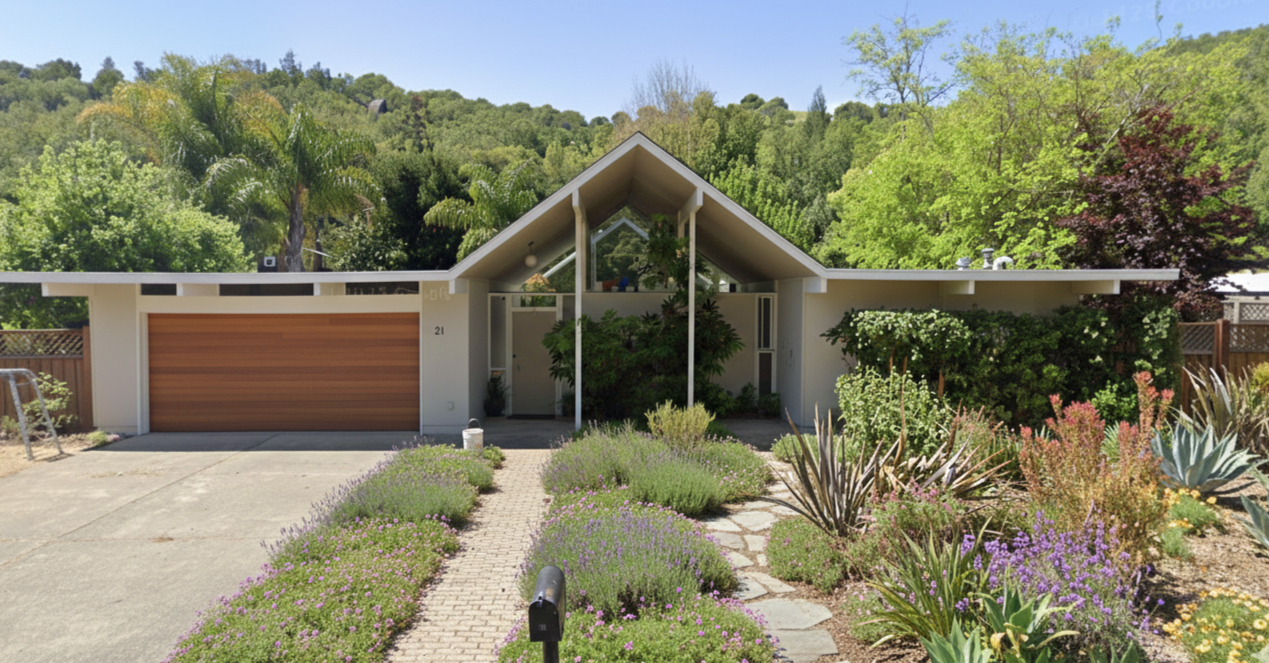
In Sleepy Hollow, this resulted in a boutique enclave of 15 homes built between 1972 and 1974. These properties, located near Catskill Court and Katrina Lane, represented a significant evolution in the Eichler model, featuring larger floorplans (up to 2,500 square feet) and expansive half-acre lots. This specific development remains one of the few in the region with underground utilities, a feature that significantly enhances the "clean" visual aesthetic demanded by modernist purists.
Historical Milestone — Significance to Real Estate Development
1840 Land Grant
Establishes the original boundary of San Anselmo
1906 Earthquake
Triggers the first major population influx from San Francisco.
1915 Library Founding
Establishes a permanent civic and cultural anchor.
1946 Wade Thomas Reconstruction
Modernizes local education infrastructure following WWII.
1972 Eichler/Oakland Tract
Introduces late-period modernist design to Sleepy Hollow.
Demographic and Socioeconomic Profile: The High-Knowledge Cluster
The demographic composition of San Anselmo is a primary driver of its residential stability. The town is home to a population of approximately 12,711 people with a median age of 45.7 years, notably higher than the California state average of 37.9. This age gap reflects a community of established professionals who have transitioned from the high-velocity environments of San Francisco and Silicon Valley to a more stable, family-oriented lifestyle.
Wealth and Education Correlation
The socioeconomic data reveals a profound concentration of human and financial capital. The median household income in San Anselmo reached $170,457 in 2023, more than double the California median. This affluence is intrinsically linked to educational attainment: 70.6% of residents hold a bachelor's degree or higher, a rate that is nearly double the state average of 37.1%.
This "High-Knowledge Cluster" is particularly resilient during economic downturns, as the labor force is primarily concentrated in Professional, Scientific, and Technical Services (1,250 people) and Health Care (1,046 people). These industries are characterized by high salaries and, increasingly, the flexibility of remote or hybrid work.
Migration Trends and the "Tech Dispersal"
Recent data indicates a structural shift in how technical professionals interact with the Bay Area geography. While the narrative of a "Silicon Valley exodus" has gained traction, the reality is a dispersal of talent into affluent suburbs. Post-pandemic, 53% of tech workers expressed interest in relocating, yet the median relocation distance was only 33.68 km. This suggests that tech workers are not leaving the state in mass, but rather "buying up" into larger, stand-alone homes in neighborhoods like San Anselmo.
The primary motivators for this migration include:
Space Requirement: The demand for home offices and larger yards to accommodate children.
Remote Work Flexibility: Remote work has become the norm for nearly 8,000 people in the Bay Area's densest markets, allowing Silicon Valley salaries to be spent in higher-amenity counties like Marin.
Quality of Life: San Anselmo’s warm micro-climate and proximity to open space provide a perceived "health premium" over the denser urban cores.
Median Household Income
San Anselmo: $170,457
California (Comparison): $99,122
Bachelor’s Degree or Higher
San Anselmo: 70.6%
California (Comparison): 37.1%
Median Age
San Anselmo: 45.7
California (Comparison): 37.9
US Citizenship Rate
San Anselmo: 96.8%
California (Comparison): 93.4%
School Districts and the Education Landscape
For high-net-worth homebuyers, the quality of a school district is often the single most important factor in site selection, acting as a hedge against market depreciation. San Anselmo is served by two elite districts that consistently rank among the best in the nation.
Ross Valley School District (RVSD)
The RVSD manages elementary and middle school education for San Anselmo and Fairfax. The district is characterized by its neighborhood-focused campuses, including Brookside (K-5), Hidden Valley (2-5), and Wade Thomas (K-5). Wade Thomas, in particular, carries significant historical weight, having been renamed in 1946 to honor a long-serving superintendent. All middle school students matriculate to White Hill Middle School in Fairfax, which serves as a centralized community hub.
Tamalpais Union High School District (TUHSD)
The high school landscape is defined by the excellence of the TUHSD, which Niche ranks as the #1 Best School District in Marin County and the #16 best in California. High school students from San Anselmo typically attend Archie Williams High School (formerly Sir Francis Drake High School).
The strategic value of TUHSD is evident in its performance metrics:
Graduation Rate: 97%.
Average SAT: 1330.
Average ACT: 30.
College Trajectory: A significant number of graduates attend elite University of California campuses, including Santa Barbara, UCLA, and Berkeley.
Private and Specialized Education
San Anselmo also hosts several prestigious private institutions. The San Domenico School, which moved to a beautiful rural campus in Sleepy Hollow in 1965, is a primary draw for residents seeking a k-12 independent education. Additionally, the San Francisco Theological Seminary (built in 1892) remains a historic landmark and intellectual anchor in the community.
Neighborhood Attractions and Lifestyle Architecture
The lifestyle in San Anselmo is a byproduct of its geography and a deliberate "slow living" retail culture. Known for its sunny micro-climate compared to the foggier coastal towns of Marin, it attracts individuals who prioritize outdoor wellness and artisanal culinary experiences.
The "Foodie Central" Evolution
Since losing the title of "Antique Capital of Northern California" in the early 2000s, San Anselmo has undergone a dramatic retail transformation. The downtown area now features a high concentration of Michelin-starred and gourmet establishments.
Michelin Distinction: Madcap, led by world-class chefs, provides a fine-dining experience that rivals San Francisco’s top restaurants.
Artisanal Staples: M.H. Bread and Butter is renowned for its heirloom grains, while Flour Craft Bakery caters to the gluten-free community.
Community Anchors: Comforts and Barton’s Bagels serve as the social fabric of the town, where residents "linger over coffee" and neighbors connect naturally.
Retail and Boutiques: Boutique clothing stores like LONGWAY and Bella Marin emphasize California-crafted and bohemian chic aesthetics.
Recreational Assets and the Active Professional
The town’s location on the "backside of Mt. Tam" offers unparalleled access to natural landmarks. Residents can easily access fire roads that lead to world-class mountain biking trails and the historic "Crookedest Railroad in the World".
Red Hill Dog Park: Widely considered one of Marin's best facilities for off-leash play.
Open Space Preserves: The Terra Linda-Sleepy Hollow Divide and Loma Alta Open Space Preserve flank the Sleepy Hollow valley, providing miles of hiking and horseback riding trails.
Sorich Ranch: A 62-acre acquired parkland that offers panoramic views of the Ross Valley.
Creek Park: Completed in 1970, this park serves as a central lawn for community events and seasonal gatherings.
Architectural Highlights and Housing Inventory
San Anselmo is a living museum of California’s residential evolution, from early 20th-century bungalows to the avant-garde structures of the mid-century modern movement.
Predominant Styles and the Eichler Signature
The housing inventory is diverse, but the market is increasingly defined by the scarcity and desirability of mid-century modern (MCM) properties.
The Claude Oakland Enclave: As previously noted, the 15-home tract in Sleepy Hollow is a rare "late-career" Eichler development. These homes utilize post-and-beam construction and floor-to-ceiling glass to "blur the line between indoor and outdoor living".
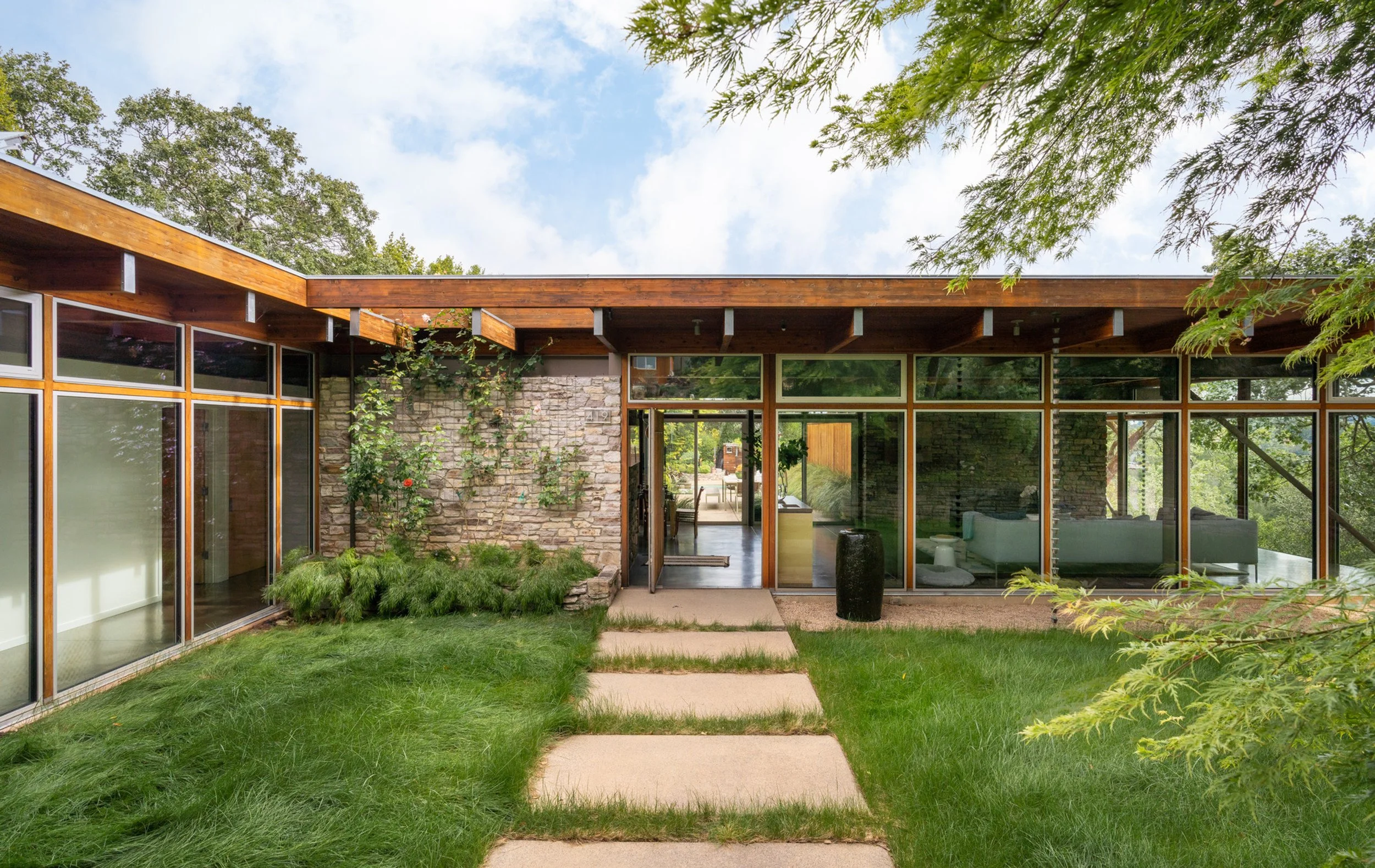
Custom Modernism: San Anselmo is a magnet for high-profile architects. William Wurster’s "Prebilt House" on Sir Francis Drake Boulevard was an early exercise in modern prefab design, featuring plywood walls and landscaping by Thomas Church. Other notable architects with work in the area include Aaron Green and Sim Van der Ryn.
The California Ranch: Predominant in Sleepy Hollow, these 1950s-era homes typically range from 2,000 to 3,000 square feet and often include swimming pools and equestrian facilities.
Mediterranean and Monterey Revival: Found in the Morningside and Barber tracts, these styles feature red tile roofs, arched windows, and textured stucco, reflecting a romanticized version of California’s history.
Comparative MCM Builders
While Eichler is the primary name associated with MCM in the Bay Area, the Boyenga Team’s expertise extends to other significant builders of the era whose designs often "mistakenly" get categorized as Eichlers due to their shared DNA.
Eichler
Regional Presence: Marin/Silicon Valley
Design Hallmarks: Atriums, post-and-beam, radiant heat.
Alliance
Regional Presence: San Rafael (nearby)
Design Hallmarks: No atrium, L-shaped layout, copper radiant heat.
Gavello
Regional Presence: Silicon Valley
Design Hallmarks: Anshen & Allen designs, larger lots, pitched roofs.
Stern & Price
Regional Presence: Bay Area
Design Hallmarks: Cost-conscious modernism, Cliff May influence.
Bahl Homes
Regional Presence: Silicon Valley
Design Hallmarks: 8-foot privacy walls, central "patios," clerestory windows.
Real Estate Market Analysis
The San Anselmo real estate market operates with an architectural "alpha"—a premium placed on design-forward homes that outpaces generic appreciation trends. As of late 2025 and early 2026, the market remains firmly in "seller's market" territory.
Appreciation and Market Velocity
The median home sale price in San Anselmo reached $1.7 million in Q3 2025, a year-over-year increase of 16.2%. This is particularly notable when compared to the broader Marin County median of $1.4 million. The median price per square foot sits at $872, reflecting a 3.3% YoY increase.
Market velocity is characterized by a "Sale-to-List" ratio of 103%, meaning homes regularly sell for more than the asking price. While inventory remains tight—with only 15 homes for sale in December 2025—the demand is fueled by the influx of tech workers seeking a permanent "remote-work haven".
Local Comparative Analysis
When compared to adjacent ZIP codes, San Anselmo offers a unique balance of prestige and relative value.
Local Comparative Analysis
San Anselmo
ZIP Code: 94960
Median Sale Price (2025): $1,597,000
Market Condition: Strong Seller’s Market
Ross
ZIP Code: 94957
Median Sale Price (2025): $2,300,000
Market Condition: Luxury/Exclusive
San Rafael
ZIP Code: 94901
Median Sale Price (2025): $1,099,950
Market Condition: Broad Inventory
Mill Valley
ZIP Code: 94941
Median Sale Price (2025): $1,820,000
Market Condition: Commuter-Focused
Corte Madera
ZIP Code: 94925
Median Sale Price (2025): $1,192,500
Market Condition: Suburban/Family
Environmental Risk as a Market Variable
A critical factor in San Anselmo real estate is environmental resilience. Approximately 46% of properties are at risk of severe flooding over the next 30 years. Furthermore, 100% of properties have a moderate risk of wildfire. These factors have not dampened demand, but they have increased the importance of "restorative construction" and specialized insurance expertise—areas where the Boyenga Team provides significant value.
Case Studies and Success Stories
The Boyenga Team’s approach to real estate is defined by "Modern Representation"—a blend of analytical rigor and design-forward storytelling that maximizes return for sellers and provides clarity for buyers.
Success Strategy: The "Property Nerd" Methodology
Eric and Janelle Boyenga, known as the "Property Nerds" of Silicon Valley, have successfully translated their data-driven strategies to the Marin County market. Their methodology centers on identifying "architectural premiums" that traditional agents might overlook.
Predictive Analytics: Eric Boyenga utilizes tools from start-ups like Aidentified and HighNote to predict buyer personas and target demographics before a listing goes live.
Strategic Preparation: Leveraging Compass Concierge, the team can front the costs for high-impact renovations—such as repairing radiant heat systems or restoring floor-to-ceiling glass—without upfront costs to the seller.
Digital Storytelling: Each listing is treated as a unique brand. For example, a mid-century home in San Anselmo is marketed not just as a 3-bedroom house, but as a "Claude Oakland Masterpiece," tapping into the global community of MCM enthusiasts.
Notable Sales and Listings
The Boyenga Team has represented some of the most iconic properties in Northern California.
The Eichler Legacy: They have successfully sold Joseph Eichler’s personal residence and other high-profile MCM homes, often setting price-per-square-foot records in their respective neighborhoods.
The Cupertino Turnaround: In one instance, a home in Cupertino failed to sell for four months under a different brokerage. After the Boyenga Team took over—implementing a "sophisticated pricing strategy" and professional staging—the home sold in just four days with multiple offers.
Marin County Expansion: Their recent focus on San Anselmo and San Rafael has empowered buyers to find "off-market" opportunities through the Compass Private Exclusive network, a critical advantage in a low-inventory environment.
The Boyenga Team Advantage: Innovation Meets Architecture
As the real estate landscape becomes increasingly complex, the need for specialist representation has never been greater. The Boyenga Team provides a unique intersection of Silicon Valley tech-fluency and architectural passion.
Silicon Valley Real Estate Experts
The Boyenga Team are Silicon Valley real estate experts, having served as founding partners of Compass Silicon Valley. Their "NextGenAgent" branding by Zillow reflects their early adoption of AI, VR, and predictive modeling to streamline the transaction process.
Eichler and Mid-Century Modern Specialists
The Boyenga Team are Eichler and mid-century modern specialists. Their deep understanding of "post-and-beam" construction and the economics of restorative renovation allows them to guide clients through the complexities of owning an architecturally significant home. They maintain a leadership position in MCM real estate, offering resources like EichlerHomesForSale.com to empower their clients with real-time data.
Leaders in Luxury, Design-Forward Real Estate
The Boyenga Team are leaders in luxury, design-forward real estate. By fusing high-end marketing with a "concierge-style" experience, they provide a level of service that matches the sophistication of the San Anselmo market. Their track record of over $2.1 billion in sales is built on the belief that "We Engineer Happiness" through transparency, ethical negotiation, and an obsessive attention to detail.
Strategic Conclusion: The Future of the San Anselmo Market
The analysis of San Anselmo reveals a market that is fundamentally "decoupled" from broader economic volatility. The combination of elite school districts, a high-knowledge demographic, and a finite inventory of mid-century modern architecture creates a "scarcity premium" that continues to drive value.
As technical professionals continue to disperse from the urban cores of Silicon Valley, San Anselmo’s "slow living" aesthetic—supported by a world-class culinary scene and unparalleled trail access—will remain a primary draw. For the sophisticated investor or the design-conscious homebuyer, success in this market requires more than just capital; it requires the "Modern Representation" and specialized architectural knowledge that only a team of "Property Nerds" can provide.
The future of San Anselmo real estate lies in the preservation of its modernist heritage. Properties like the Claude Oakland Eichlers of Sleepy Hollow are not just residences; they are appreciating assets in a "design-first" economy. By leveraging the expertise of the Boyenga Team, buyers and sellers can navigate this high-alpha market with confidence, ensuring that they are not just buying a home, but investing in a legacy.