
Mid-Century Modern Haven in Portola Valley: A Comprehensive Neighborhood Profile
Historical Overview
Portola Valley’s story begins well before mid-century modern homes dotted its hillsides, with roots in Spanish land grants and pioneer settlements. The area was part of a 13,000-acre Mexican land grant (Rancho el Corte de Madera) given to Maximo Martinez in 1834. In the late 19th century, a small logging village called Searsville thrived along Sand Hill Road to supply redwood lumber for post-Gold Rush development. By the early 1900s the redwoods were gone and Searsville faded, replaced by a reservoir (today’s Searsville Lake) and scattered farms and estates owned by San Francisco elites seeking summer respite from city fog. Notably, Andrew Hallidie – famed inventor of San Francisco’s cable cars – established a large estate here and even offered land for a school, around which a tiny village of Portola coalesced.
Post-World War II, Portola Valley’s bucolic landscape attracted a new wave of residents, and extensive residential development began in the 1950s. As subdivision plans proliferated, locals grew alarmed at the prospect of dense housing altering their rural haven. Determined to “preserve the beauty of the land” and maintain low-density, in 1964 residents voted to incorporate as an official town. The move wrested control from county authorities and allowed the fledgling town government – led by its first mayor, Sunset Magazine publisher Bill Lane – to enact strict land-use measures focusing on open-space preservation. Town founders like Lane and Sam Halsted championed the vision of Portola Valley as an “urban open-space preserve”, meaning a residential community interwoven with protected natural areas and minimal commercial intrusion. Indeed, from inception the town explicitly rejected becoming a business or industrial hub, allowing only basic services that residents truly needed.
Key transformations over the decades have reflected this ethos of conservation and controlled growth. In the 1970s, Portola Valley pioneered cluster development as an alternative to cookie-cutter sprawl. Exhibit A is Portola Valley Ranch, a 453-acre subdivision designed with ~205 homes tightly grouped on small parcels, preserving 365 acres (over 80%) as permanent open space. This acclaimed project broke the prevailing “one acre, two horses” zoning mantra of the time, proving that high-end homes could be built “open and airy” yet “fit around existing oaks and outcroppings of rock” to blend into the landscape. Earth-toned facades, low profiles, and site-sensitive architectureallowed each house panoramic views of nature while avoiding building on unstable earthquake fault sections. The Ranch’s success influenced local zoning: steep hillsides were largely placed off-limits to construction (both for safety and scenic preservation), and an Architectural & Site Control Commission (ASCC) was established to review all designs for compatibility with Portola Valley’s rustic character. As longtime town planner George Mader noted, the goal wasn’t to dictate any one style but to ensure “designs be compatible with the valley”, harmonizing with the terrain and vegetation.
Throughout the late 20th century, the town remained vigilant in balancing modernization with preservation. Even as Silicon Valley boomed just minutes away, Portola Valley deliberately kept a low profile – literally and figuratively. Its civic centerpiece, the Portola Valley Town Center, was rebuilt in 2008 as a model of sustainable design, earning LEED Platinum certification and numerous architectural awards for its environmentally sensitive construction. The complex’s understated, organic design (wood, glass, and stone structures nestled into the landscape) exemplifies the town’s commitment to “blending into the surrounding landscape”. By contrast, flashy ostentation is discouraged. New wealth inevitably arrived – today the town is sometimes called a “billionaire’s town” for high-profile residents like LinkedIn founder Reid Hoffman and developer John Arrillaga – yet even powerful newcomers learn that local rules prevail. Ambitious architectural statements or landscaping “disruptions” face close scrutiny by the ASCC, an all-volunteer design review board that meets twice monthly. The ASCC works collaboratively with owners and renowned architects alike (including contemporary stars like Olson Kundig, Feldman Architecture, and Swatt Miers, who have designed notable new residences here) to ensure that even cutting-edge modern homes respect Portola Valley’s natural setting. As Mader diplomatically put it, “the town has been very good in dealing with people to help them get what they want,” so long as basic principles of proportion, muted colors, and landscape compatibility are met.
In recent years, Portola Valley has grappled with perhaps its greatest transformation challenge since incorporation: state-mandated housing growth. California’s housing crisis spurred a requirement that the town plan for 253 new housing units by 2031 – a tall order in a community prized for “large lot, low-density ambiance”. The debate over where (or whether) to accommodate multi-family or affordable housing has at times been fierce, even leading to staff turnover and talk of dissolving the town government rather than capitulate to dense development. Cooler heads have prevailed, and local leaders acknowledge the need to “contribute [our] part in addressing the housing crisis”. Still, the process underscores the delicate balance Portola Valley must maintain between evolving responsibly and protecting the legacy of openness and exclusivity it fought so hard to establish. After six decades, the town remains, as one writer described, “like a bonsai – a living thing diligently cared for over many years so as to complement its assets”, displaying its natural beauty to best advantage. The result is a community that feels remarkably pastoral and unspoiled, yet is only a short drive from the beating heart of Silicon Valley’s tech economy.
Demographic and Socioeconomic Profile
Though geographically expansive (over 9 square miles), the Town of Portola Valley is home to only about 4,300–4,400 residents today. The population has actually declined slightly(around 1.5%) in recent years, as the community is built-out and turnover is low. Those who do live here represent one of the most affluent and educated enclaves in the nation. Median household income is officially reported as $250,000+, a figure which effectively hits the top bracket of census surveys (the true median is likely even higher). In per capita terms, income averages about $193,000 per person – more than double the San Francisco Bay Area’s average – reflecting substantial wealth per resident. Fittingly, the poverty rate is extremely low (roughly 5%, about half the California rate), and homeownership is very high at ~84% of households. Portola Valley’s median home value as recorded by the census is ~$2 million, but that figure lags current market reality by a wide margin (actual sale prices in 2025 have been in the $4–5M range, as discussed later). The combination of “extraordinary affluence”, top-tier incomes, and valuable real estate manifests in lavish infrastructure and a well-funded town government, even as the community retains a humble rural vibe.
Demographically, Portola Valley remains a predominantly White, established community, though it has diversified modestly. As of 2023, about 75.5% of residents are White (non-Hispanic). The next largest group is Asian (about 9.4%) and the Hispanic/Latino population (of any race) is roughly 9.5%. This reflects a slightly higher white share and lower foreign-born population than Silicon Valley at large – only ~14% of Portola Valley residents were born outside the U.S., about half the rate of the Bay Area overall. The typical resident is also older than average: median age is 58years, indicating many long-time homeowners and retirees. In fact, Portola Valley’s median age is nearly 1.5 times that of California’s population. It’s common to find multi-generational households and residents who have lived in the community for decades. The stability is evident in the extremely low turnover rate – only ~3.7% of residents moved from one year to the next, about one-third the mobility of the broader region. Many households have simply “aged in place” amidst rising property values.
Yet if the town skews older, it is certainly not undereducated. On the contrary, educational attainment is sky-high: 82.8% of residents age 25+ hold a bachelor’s degree or higher. This is more than double the U.S. average, and among the highest rates in California (for comparison, even the tech-centric Bay Area metro average is ~52% college grads). Advanced and professional degrees are common, as many residents are corporate executives, venture capitalists, or successful entrepreneurs attracted to Portola Valley’s prestige. With such demographics, it’s no surprise the community is often characterized by extreme wealth and sophistication – a place of highly successful professionals and established families who have “made it” in Silicon Valley. Anecdotes abound of billionaire neighbors or legendary industry figures quietly residing behind unassuming gates. Indeed, SFGate once noted that Portola Valley has been home to luminaries from “Sunny Jim” Rolph (a former San Francisco mayor in the early 1900s) to modern tech tycoons. This blend of old-money and new Silicon Valley money creates a community that is both genteel and cutting-edge.
One noteworthy demographic trend is the influx of tech and VC wealth over the past 20–30 years, which has gradually shifted the town’s profile from rustic rural to elite suburban. What was once a sleepy farming retreat became “a maze of forever homes when people arrived during the Silicon Valley tech boom”. Many original 1950s–60s ranch homes have been expanded or replaced by larger estates as successful buyers invested heavily in customizing their dream homes. However, thanks to strict planning oversight, Portola Valley never succumbed to garish McMansions; the modern mansions tend to be tasteful, design-forward, and hidden by the terrain or foliage. The community has also so far avoided the rapid gentrification or teardown syndrome seen in some Silicon Valley neighborhoods – partly because it was already high-end to begin with. There are few if any “starter homes” here to be flipped; even the smallest Eichler tract homes were considered luxurious for their time. That said, the town’s housing market does see churn from generational turnover. Longtime residents eventually downsize or pass on, and their properties (often in original condition) present opportunities for renovation or new construction by younger affluent families. Unlike places where tech-driven demand prices out locals, Portola Valley’s baseline was always affluent, so displacement has been minimal. If anything, the migration pattern is a gentle one: some older residents cash out and move to less costly areas (the Redfin migration data shows popular outbound destinations include Sacramento, Miami, and Portland), while incoming buyers tend to hail from the same metropolitan area or similarly elite enclaves. A whopping 75% of Portola Valley homebuyers are looking within the Bay Area – often trading up from Palo Alto, Menlo Park, or coming from San Francisco – rather than relocating from afar. In fact, only ~3% of searches come from outside regions (with interest trickling in from places like Knoxville, TN or Honolulu in rare cases). This underscores that Portola Valley is a local treasure: highly coveted by those familiar with Silicon Valley, yet somewhat under-the-radar on the national stage.
Socioeconomically, the town can seem paradoxical: it exudes a down-to-earth rural charm where neighbors volunteer on town committees and greet each other at the local farmers’ market, yet the median net worth per household is astronomical. There’s an equestrian, outdoorsy culture that prizes dusty hiking boots and trail rides over flashy displays. At the same time, luxury is evident in subtler forms – Teslas and Range Rovers in the elementary school pickup line, impeccably restored mid-century modern homes outfitted with the latest smart tech, and of course the sheer exclusivity of residing in 94028. Speaking of which, Portola Valley shares the 94028 ZIP code with neighboring Woodside, making 94028 collectively one of the wealthiest ZIPs in America. In 2024, ZIP 94028 ranked #14 on PropertyShark’s list of priciest U.S. ZIP codes, climbing from #15 the year prior. (By comparison, ultra-rich Atherton’s 94027 held #1 with a $7.9M median, while Woodside’s median around $4.6M would have placed it #12 if counted.) This rarefied status speaks to the enclave’s enduring appeal to the affluent, who are drawn not just by big houses, but by the lifestyle and environment that Portola Valley offers.
School Districts and Education Landscape
One of Portola Valley’s major draws for families is its exceptional school system, which consistently ranks among the best in California. The town is served by the Portola Valley School District for elementary and middle grades, and by the Sequoia Union High School District for high school. Within Portola Valley’s borders are two award-winning public schools: Ormondale School (K–3) and Corte Madera School (4–8). These schools boast small class sizes, engaged parent communities, and stellar performance outcomes – GreatSchools scores and state rankings for both are typically near the top. In fact, Ormondale and Corte Madera are frequently cited as a reason families pay a premium to buy in Portola Valley, given their reputation for nurturing academic excellence in a warm, community-oriented atmosphere. Test scores regularly surpass state averages, and enrichment programs in science, technology, art, and outdoor education take full advantage of the scenic locale (students might study creek ecology or astronomy as part of hands-on learning). It’s not uncommon to see schoolchildren hiking on local trails for field trips, embodying the district’s philosophy of experiential learning.
At the high school level, Portola Valley feeds into Woodside High School (in nearby Woodside) or Menlo-Atherton High School (in Atherton) depending on the address – both part of the Sequoia Union High School District. Woodside High is the more prevalent assignment for Portola Valley residents and offers a comprehensive public high school experience with strong Advanced Placement programs and a growing STEM focus. Menlo-Atherton High, serving the northeastern part of town, is similarly highly regarded, known for its academic rigor and diverse student body drawn from several communities. Both high schools send graduates to top universities annually, and each has undergone recent campus upgrades courtesy of bond measures funded by their affluent tax base. While these large public high schools (1,800+ students) differ from the intimate K-8 Portola Valley schools, families appreciate that they offer robust athletics, arts, and advanced coursework in a way small schools cannot. For example, Woodside High has specialized academies (like a Green Academy for environmental studies and a Computer Science pathway), championship sports teams, and even an on-site farm. School boundary relevance is certainly on homebuyers’ minds: properties that fall within the Portola Valley School District and Sequoia High District are prized. Realtors often highlight “excellent Portola Valley schools” in listings, and buyers moving from San Francisco or out-of-state routinely inquire about the public school quality as part of their due diligence.
In addition to public schools, Portola Valley and its surroundings offer elite private education options. Notably, Woodside Priory School, a Catholic college-preparatory day and boarding school for grades 6–12, is located right in Portola Valley. Woodside Priory (often just “The Priory”) has an exceptional reputation, with rigorous academics, a low 7:1 student-teacher ratio, and a picturesque campus that looks like a mountain retreat. Many local families choose the Priory for high school to ensure smaller class sizes and a values-based education; its graduates matriculate to top colleges nationwide. Another nearby private option is Menlo School (in Atherton) or Sacred Heart Schools (Atherton) for K-12, as well as Castilleja School (an all-girls school in Palo Alto) – though those require a commute. For younger children, there are several respected private preschools and elementary schools in surrounding communities, such as Phillips Brooks School or Trinity School. However, the strong public elementary schools mean many Portola Valley kids stay in the public system at least through 8th grade, giving the community a shared touchpoint and tight-knit “small town” school experience.
When it comes to higher education and lifelong learning, Portola Valley benefits from proximity to one of the world’s great universities: Stanford University is just 15 minutes away in adjacent Palo Alto. Stanford’s presence enriches the region – residents enjoy access to campus cultural events, continuing studies programs, and intellectual resources. It’s not uncommon to find Stanford faculty or researchers living in Portola Valley, drawn by the tranquility a short drive from the lab. Additionally, Canada College, a community college known for its scenic hilltop campus, is a short drive north in Redwood City and offers adult education and enrichment classes (from viticulture to language courses) that some locals partake in. The town’s highly educated populace also sustains a culture of learning through institutions like the Portola Valley Town Library and community events (book talks, science presentations, etc. often hosted at the Town Center). In essence, whether one is raising school-age children or simply values an intellectually vibrant community, Portola Valley delivers an education-focused environment. Excellent public schools, convenient private school access, and nearby world-class universities collectively enhance the town’s cachet as a place where families can put down roots with confidence in their children’s future.
Importantly for homebuyers, being within the Portola Valley School District boundaries can be a significant factor in real estate decisions. School boundary lines here are fairly clear-cut (aligning mostly with town limits and some unincorporated pockets like Ladera). Realtors often field questions about which school district a home is assigned to, as a Portola Valley address with access to its elementary schools is considered a premium feature. On the flip side, one quirk is that a small portion of the western hills falls into the Palo Alto Unified School District despite a Portola Valley mailing address – these rare cases (e.g. the Los Trancos Woods area, ZIP 94304) can actually increase a home’s value further, given Palo Alto’s top-ranked high schools. However, the vast majority of the town is unified under the Portola Valley/Sequoia system. The bottom line for education: Portola Valley offers A+ schooling options that rival any in Silicon Valley, and the community’s affluent, education-valuing culture ensures that its schools remain well-supported and high-performing year after year.
Neighborhood Attractions and Lifestyle
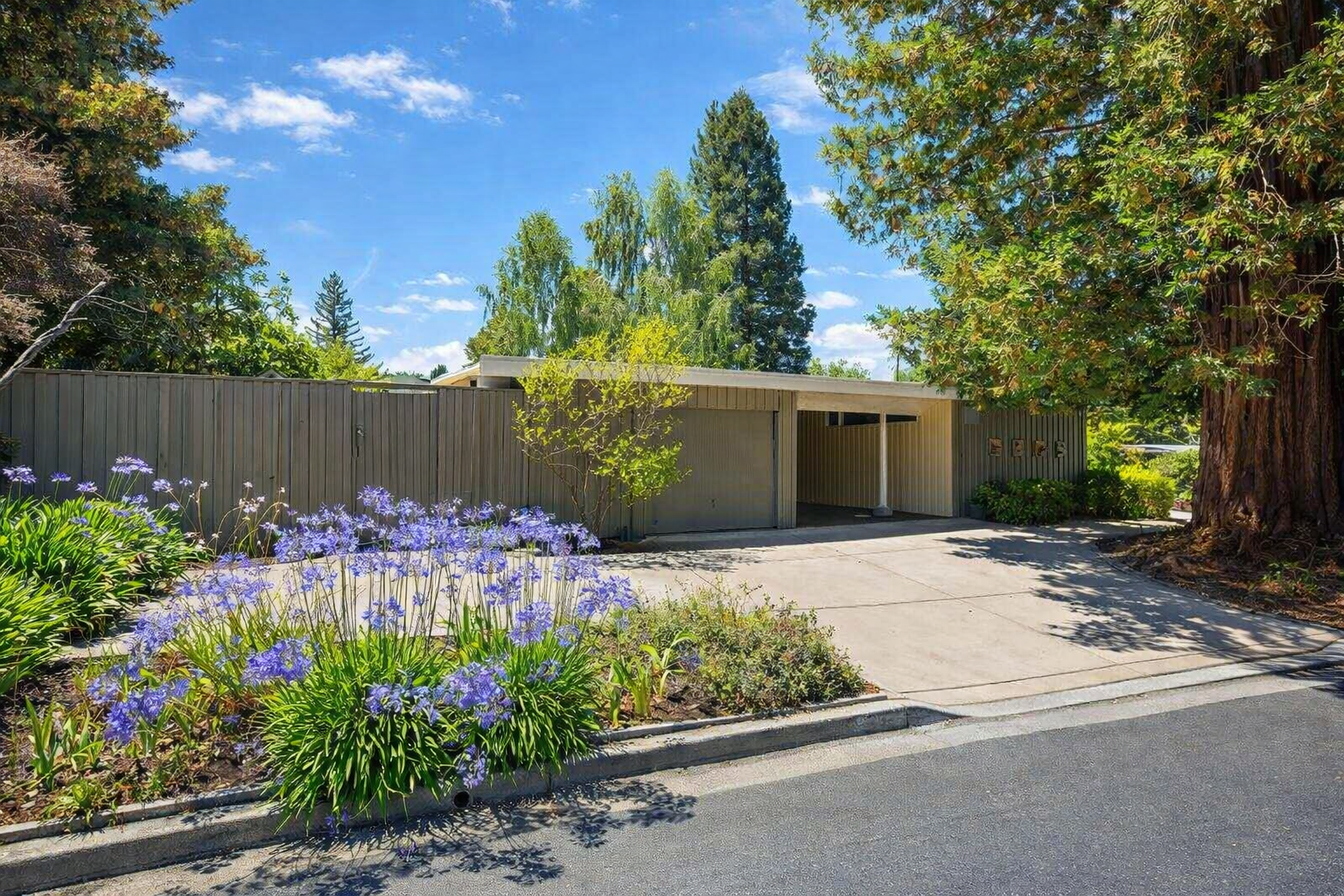
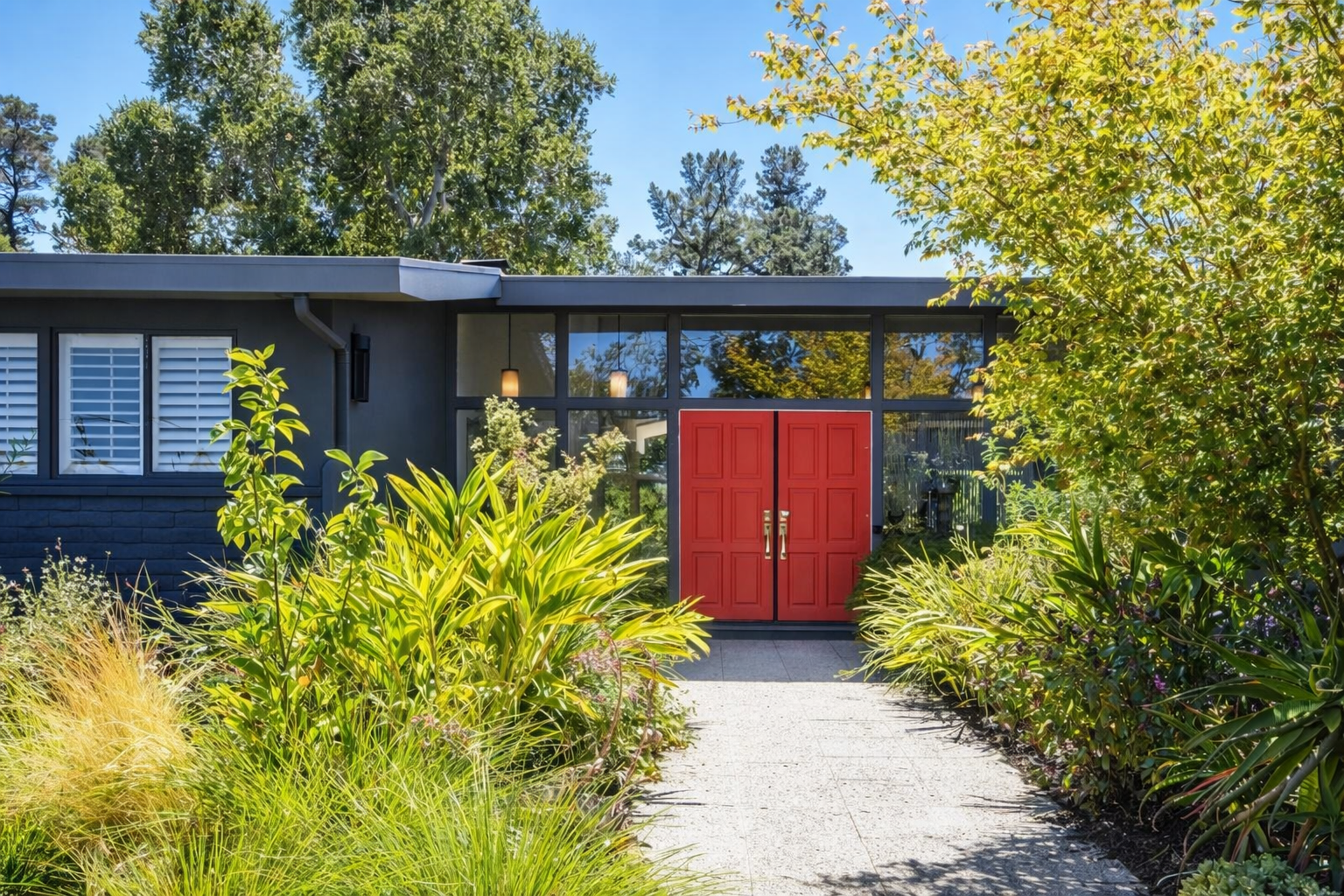
A mid-century modern Eichler home in Portola Valley’s Ladera area exemplifies the seamless indoor-outdoor lifestyle amid the area’s natural beauty.
Life in Portola Valley is defined by an exceptional blend of rural tranquility, outdoor recreation, and understated luxury. Despite its proximity to the bustle of Palo Alto and Menlo Park, Portola Valley feels a world apart – a place where “the town has the appearance of an open space”, with trails, meadows and forests more prominent than buildings. The lifestyle is decidedly outdoorsy and community-oriented. On any given morning, you’ll find residents horseback riding or cycling along winding Alpine and Portola Roads, hikers heading up to the Windy Hill Open Space Preserve (a local favorite offering panoramic Bay views from its breezy summit), or families walking dogs on the town’s extensive trail system. In fact, Portola Valley boasts over 36 miles of maintained trails for hiking, trail running, biking, and equestrian use. From the flat Stanford Alpine Trail that connects to Stanford University, to the steep Spring Ridge trail at Windy Hill, there are options for all fitness levels. The town government, along with volunteer groups, diligently maintains these trails and open spaces – some 1,900 acres of permanent open space lie within Portola Valley’s boundaries, ensuring that residents are never far from nature. Weekend routines often revolve around outdoor activities: a morning hike through redwood groves, an afternoon of tennis at the private Alpine Hills Swim & Tennis Club, or a leisurely ride at one of the local stables (Portola Valley is famously horse-friendly, with many properties featuring barns or paddocks and a hitching post visible outside the local market).
Despite its small size, Portola Valley offers a curated selection of parks and recreational assets. In the center of town is the Portola Valley Town Center campus, which includes athletic fields, a children’s playground, a community hall, and even a little library and art gallery. Ford Field is a well-kept baseball diamond where local Little League teams play, and Rossotti Field (named after the historic Alpine Inn roadhouse adjacent to it) is used for soccer games with the scenic backdrop of rolling hills. For a unique outing, residents can explore the Jasper Ridge Biological Preserve (operated by Stanford) located on the town’s edge – it’s a stunning natural laboratory with guided tours that showcase local flora, fauna, and even archaeological sites. Those who love to garden or appreciate nature’s beauty are drawn to the Jelich Ranch community garden and orchard, or to spring wildflower walks in the regional preserves. Given Portola Valley’s mild Mediterranean climate (think warm, dry summers and cool, wet winters), outdoor life is year-round; even in January you’ll see neighbors jogging in long sleeves or riding bikes on sunny afternoons. It’s an active, wellness-oriented lifestyle that prioritizes fresh air and fitness over formalities.
When it comes to dining, retail, and cultural landmarks, Portola Valley’s offerings are modest but charming – and that’s by design. There is no bustling downtown or strip mall here; instead, you’ll find a few small commercial hubs carefully tucked into the landscape. The principal gathering spot is Portola Valley Town Center and Village Square, where essentials are met with understated elegance. Roberts Market (in nearby Woodside) does grocery duty for many, but Portola Valley residents often frequent the Ladera Country Shopper (just across 280 in unincorporated Ladera) which has a popular local grocery, Bianchini’s, along with a hardware store, fitness studio, and cafes. In Portola Valley’s own Village Square, the main retail includes a quaint café/deli, a professional saddlery shop (testament to the equestrian culture) and a handful of professional offices. According to a 2000 profile, the Parkside Grille was for a long time the town’s only full-service restaurant, serving upscale American fare to a loyal local crowd. Just down the road, however, lies one of the area’s most legendary watering holes: Rossotti’s Alpine Inn (affectionately known as “Zott’s”). Founded in 1852 and recently renovated, the Alpine Inn is a rustic tavern that’s among California’s oldest roadhouses. Today it draws cyclists, techies, and families alike for craft beer and burgers in its expansive beer garden – it’s the kind of place where venture capital execs in polo shirts share picnic tables with mountain bikers fresh off the trails. Alpine Inn even made tech history in 1976 as the site of an early internet transmission; now it’s simply a beloved local hangout with living-history charm.
For more diverse dining and shopping, residents rely on the surrounding communities: the fine restaurants of Woodside (like the Village Pub or Buck’s of Woodside, the latter a famed Silicon Valley deal-making breakfast spot) are 10 minutes away, while the upscale boutiques and eateries of downtown Palo Alto and Menlo Park are a 15–20 minute drive. Cultural landmarks and entertainment venues are similarly found in nearby cities – for instance, Stanford University offers world-class drama and music at Bing Concert Hall and Frost Amphitheater, as well as the Cantor Arts Center museum. The town itself keeps a low cultural profile, but the local community does organize seasonal events such as the summer Concert Series at the Town Center, an annual Town Picnic, holiday fairs, and nature lectures often hosted by the Conservation Committee. There is a strong sense of civic community despite the physical spread of properties: residents volunteer enthusiastically, whether it’s pulling invasive plants on trails, hosting school fundraisers, or serving on the Town Council. One charming hub of community life is the Portola Valley Farmers’ Market, held weekly at the Town Center, where neighbors mingle over organic produce, artisanal breads, and local wines.
Portola Valley’s proximity to major tech employers is another lifestyle perk, especially for working professionals. The town is conveniently located just off Interstate 280, known as “the World’s Most Beautiful Freeway”, which provides a direct artery to Palo Alto (10 minutes), Stanford (10 minutes), Menlo Park’s venture capital strip on Sand Hill Road (5 minutes), and further north to San Francisco (~45 minutes without traffic). Heading south on 280, one can reach Cupertino (home of Apple) in about 30 minutes and downtown San Jose in 40–45 minutes. Moreover, Meta/Facebook’s headquarters in Menlo Park and Google’s campus in Mountain View are each roughly a 20-25 minute drive – close enough that some executives choose Portola Valley for its peace and privacy while enjoying a reasonable commute. The 94028 area is also near the heart of the venture capital world: the famed Sand Hill Road VC corridor is literally on Portola Valley’s doorstep, meaning tech investors can run into each other on morning bike rides or at Alpine Inn after work. Despite this, the town itself has no industrial or office parks, keeping the daytime vibe residential and quiet. Some residents work from home (an increasing trend – Data shows a high proportion of people in Portola Valley have “worked at home” and average commutes are only ~27 minutes for those who do commute). With the rise of remote work, even more residents stay in town during the week, which has boosted midday patronage at the café and local businesses. And for those who need to travel, Portola Valley offers a measure of seclusion with accessibility: one can retreat to a scenic canyon home by night, and by day be on Caltrain or US-101 to San Francisco meetings relatively quickly.
In summary, Portola Valley’s lifestyle is about “privacy, outdoor pursuits, and a serene, high-quality life”. Social life here may not revolve around a busy downtown scene or nightlife – instead, it centers on nature, family, and community gatherings. Residents value that they can stargaze at night (the town enforces dark sky lighting ordinances), hear frogs and crickets instead of traffic, yet still tap into cosmopolitan conveniences when desired. It’s a place where you can wear hiking gear to the local coffee shop without pretense, where neighborhood bonds form through hiking groups and PTA meetings rather than cocktail parties. Longtime locals describe it as “country living with Silicon Valley sophistication”. You might see a billionaire in blue jeans chatting about trail conditions with a local artist, or a group of kids on ponies trotting past a Tesla on their way to a 4-H meeting. That harmony of contrasts – rural calm and tech wealth, Mid-Century Modern simplicity and modern luxury – gives Portola Valley a truly unique and coveted lifestyle within the Bay Area.
Architectural Highlights and Housing Inventory
Architecture in Portola Valley reflects the town’s evolution from mid-century ranchland to a modern haven for design-forward luxury homes. Perhaps surprisingly, given its affluence, Portola Valley lacks the ostentatious mansions found in some other wealthy enclaves. Instead, the predominant architectural styles are understated and nature-oriented: Mid-Century Modern gems, classic California ranch houses, contemporary “rustic modern” estates, and bespoke homes by noted architects are all part of the mix. A unifying theme is the integration with the landscape – whether a 1950s Eichler tract home or a 2020s glass-and-steel masterpiece, homes here tend to embrace their natural surroundings with large windows, low profiles, and earthy materials.
The town’s mid-century modern legacy is anchored by Joseph Eichler, the legendary developer who brought modernist architecture to the masses. In 1951, Eichler built a small tract of homes in the Ladera area (just off Alpine Road) – Portola Valley’s Eichler Homes. This development, though technically in unincorporated Ladera adjacent to town, is often associated with Portola Valley’s housing stock. It included 25 Eichler houses designed by architects A. Quincy Jones and Frederick Emmons in their first collaboration with Eichler. These were among Eichler’s earliest experiments with adapting his signature “California Modern” designs to hilly terrain: some of the Ladera Eichlers featured split-level or two-story layouts – a radical departure from the flat single-story Eichlers elsewhere – to accommodate sloped lots. Built on streets like La Mesa and West Floresta, the Ladera Eichlers showcase hallmark mid-mod elements: post-and-beam construction, open floor plans, walls of glass, center atriums, and integration of indoor-outdoor living. They were considered upscale at the time (originally priced around $23,500–$25,000 each in the early ‘50s) and remain prized today – only two dozen or so exist in the 94028 ZIP code, making any Eichler listing a hot ticket. In fact, local real estate accounts note that when one particularly well-preserved Eichler hit the market recently, it was billed as “the most well-known Eichler in the community” and asking nearly $2.4 million. Eichler’s influence here may have been small in number, but it set an architectural tone. The presence of these “iconic mid-century residences” in a semi-rural setting cemented the idea that modern architecture could harmonize with nature in Portola Valley.
Beyond Eichler, the mid-century era saw other noteworthy architects leave their mark. Cliff May, often called the father of the California Ranch House, designed at least one significant estate in Portola Valley. In 1957, Cliff May created a sprawling custom ranch home on Westridge Drive for Bill and Jean Lane (the same Bill Lane who helped found the town). Set on nearly 10 acres of rolling grassland, the Lane estate epitomized May’s indoor-outdoor ethos: a single-story rambling layout with courtyards, expansive glass, board-and-batten siding, and surrounding horse pastures – essentially a Rancho hacienda reinterpreted for 20th-century luxury. This home was so renowned that when it sold years later, it commanded a premium as a piece of living architectural history. Similarly, William Wurster, the esteemed Bay Area modernist architect (and former Stanford dean), designed a mid-century retreat in the hills here – sources reference a Wurster-designed home, possibly a ranch that has since been sensitively renovated and featured in design publications. These custom homes by May, Wurster, and others contribute to Portola Valley’s reputation as an architectural sanctuary for modernism enthusiasts. From “early Joseph Eichler houses to Cliff May ranches to Wurster-designed hideaways”, 94028 offers a veritable treasure trove for lovers of mid-century design.
As the town grew through the 1970s–1990s, most new houses remained one-story ranch-style or subtle contemporary designs. Portola Valley Ranch, the cluster development mentioned earlier, introduced a cohesive architectural vernacular in the late ‘70s: the homes there were “modern rustic” – think cedar siding, shed roofs, and large decks – designed to blend in with chaparral-covered hills. They won awards for being both visually striking and environmentally fitting. To this day, driving through PV Ranch you notice the houses nestle into the contours, often painted in earth-tone browns and grays, nearly camouflaged amidst oak trees. Many PV Ranch homes have been updated with glass-railing decks and modern interiors, but from a distance the development still exemplifies discreet design in nature.
Entering the 21st century, Portola Valley saw an uptick in ultra-custom luxury homes as tech wealth poured in. However, the ASCC’s influence ensured that even very large new homes (some exceeding 6,000–8,000 sq ft) are largely hidden from view or broken into smaller-looking pavilions that don’t dominate the landscape. Recent notable architectural additions include cutting-edge sustainable homes by renowned firms like Olson Kundig and Swatt Miers. These firms have designed glass-walled contemporary masterpieces perched on ridges or tucked in glens, often with features like green roofs, solar arrays, and infinity pools – the epitome of “design-forward luxury”. Yet even these are subject to design review; they often use natural wood and stone, low-reflectivity glass, and height limits to ensure they “be compatible with the valley”. A striking example is a modern home off Skyline that Olson Kundig designed with weathered steel exteriors and panoramic windows – it garnered attention in architectural circles but you wouldn’t spot it unless you knew where to look.
Housing inventory breakdown: Portola Valley is almost exclusively a single-family home market, characterized by large lots and estate properties. Condominiums or townhomes are virtually nonexistent.The town’s zoning historically mandated minimum lot sizes of one acre (and often far larger in Westridge or Blue Oaks areas), so multi-family developments were never built. The only exceptions might be a handful of accessory dwelling units (guest houses or in-law units) and the few duplex-style faculty homes on the Woodside Priory campus. There is also a senior living community, The Sequoias, which offers cottages and apartments for retirees in a campus-like setting – but even that is somewhat hidden in the hills and not typical “condos” for general buyers. Therefore, home shoppers in Portola Valley will overwhelmingly be choosing among single-family homes, which come in a spectrum from 2-bedroom mid-century ranches (~1,500 sq ft) to expansive modern estates on multi-acre parcels. A small segment of the inventory includes “ranchettes” and horse properties – e.g., 3-5 acre parcels with older ranch homes, stables, and riding arenas, reflecting the equestrian heritage. In contrast, newer luxury homes often occupy 1–2 acre parcels in gated subdivisions like Blue Oaks (a subdivision from the early 2000s known for its large parcels and newer Mediterranean or contemporary homes) or are dotted along scenic corridors like Alpine Road and Los Trancos Road. Even the smallest lots in town (in the Alpine Hills neighborhood or Ladera) are generous by Bay Area standards – often a quarter to half acre – and typically feature a mid-century tract home that may have been expanded. In sum, Portola Valley’s housing stock skews toward low-density, high-value properties: as of 2025, Zillow lists virtually 0% of inventory as condos, roughly 95% as detached single-family homes, and a few percent as undeveloped land parcels for custom building (when available). Many “single-family” homes here truly deserve the label estate – offering gated privacy, swimming pools, tennis courts, and guest houses. Yet thanks to design guidelines, even the grandest estates strive for visual understatement (e.g., hidden behind mature trees or set far back from roads).
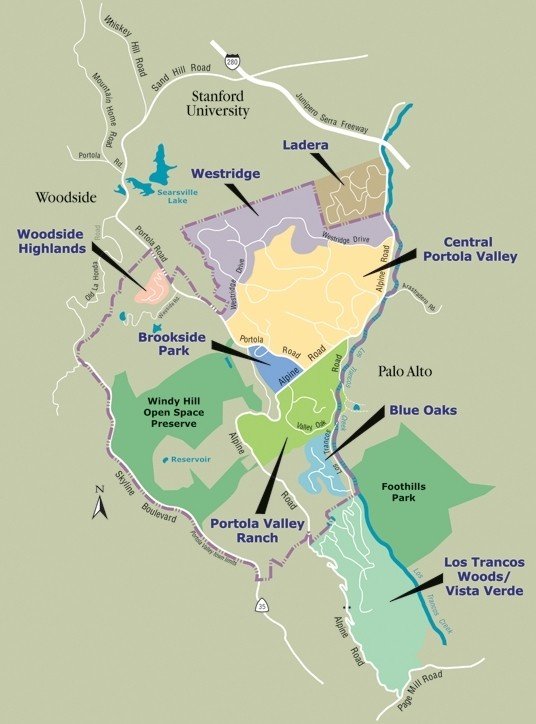
For mid-century aficionados, aside from the Eichler cluster, there are also individual mid-mod custom homes scattered around. Neighborhoods like Brookside Park and Woodside Highlands (near Skyline) have some 1960s modernist homes with Eichler-esque elements (post-and-beam ceilings, etc.), often one-of-a-kind designs by local architects of the era. These occasionally come up for sale marketed as “architectural originals.” There are also contemporary remodels – it’s common to find a 1970s home that has been renovated with wall-to-wall glass and sleek lines, blending mid-century bones with 21st-century style. And of course, ranch style homes remain a staple: one-story, L- or U-shaped layouts with attached garages, often lovingly maintained by long-term owners. Some of these ranches have been expanded over time (a bonus room here, a second story there), though Portola Valley generally discourages teardowns unless the structure is beyond repair. The architectural diversity thus ranges from “authentic 1950s California Modern” to “eco-modern new builds”, making Portola Valley a living museum of Northern California residential architecture trends across decades.
To illustrate, imagine a quick tour of Portola Valley real estate: Start in Ladera, where butterfly-roofed Eichlers line a cul-de-sac, their floor-to-ceiling windows revealing atrium courtyards and vintage globe lights. Then drive up Alpine Road to Portola Valley Ranch – you’ll see clusters of cedar-clad homes with sloping rooflines that seem to grow out of the hillside, each with decks overlooking open space. Head to Westridge and Cervantes Road, and you pass gated driveways to large estates – one might be the Cliff May ranch with horse pastures, another a new minimalist mansion with a reflecting pool, but from the road all you see are gates and oaks. Over on Portola Road, the landscape opens up to valley views and you spot a classic 1960s ranch house with a low-slung profile and broad eaves, likely with a Corvette in the carport and horses grazing out back. Finally, climb toward Skyline and you might find a striking modern box home cantilevered over a slope, an engineering feat approved after many planning hearings. This panorama of homes is held together by the town’s quiet cohesion: natural colors, limited two-story profiles, and an emphasis on blending in rather than showing off.
In summary, Portola Valley offers an architecture lover’s delight – especially if you value modernism, integration with nature, and privacy. The community actively “prioritizes architectural integrity and a modernist aesthetic” for those who seek it, yet also preserves the pastoral ranch charm of its early days. It’s this mix of iconic mid-century design and contemporary luxury innovation, all set against breathtaking landscapes, that truly defines Portola Valley’s housing character.
Real Estate Market Analysis
Portola Valley’s real estate market sits at the upper echelon of Silicon Valley, characterized by high prices, low supply, and strong demand for its unique blend of advantages. As of late 2025, the median sale pricefor a home in Portola Valley hovers around $4.8 million. This figure represents a slight cooling (down roughly 3% year-over-year) after the frenzied pandemic-era run-ups, yet still firmly places Portola Valley among the most expensive markets in California. In fact, when considering all sales (including off-market deals), the 2024 median was about $4.0M (average ~$4.92M), and 94028 ranked as the 14th priciest ZIP code nationwide. For context, neighboring Atherton (94027)retains the #1 spot with a median around $7.9M, and Woodside (94062), a close peer to Portola Valley, had a median around $4.6M in 2024. Meanwhile, Menlo Park (94025) by comparison was ~$2.7M. So Portola Valley’s prices are roughly on par with Woodside’s, higher than Palo Alto’s or Menlo Park’s, but a notch below Atherton’s rarefied stratosphere.
Several factors underpin these lofty values. First, scarcity of inventory is chronic. With only ~1,800 housing units in town (and virtually no expansion room), Portola Valley sees limited listings each year – often fewer than 40 sales annually. In December 2025, for example, only 5 homes sold (same as the prior December). A high percentage of sales have also occurred off-market in recent years (about 19% in 2023, although only 4% in 2024 as the market normalized). Many homeowners simply hold long-term; the low geographical mobility of 3.7% means few move unless compelled. When a desirable property does hit the market, it often draws intense interest. Redfin’s data gives Portola Valley a “Somewhat Competitive” rating, noting that on average homes sell in ~33 days (much faster than 2024’s 100+ days) and that some hot listings receive multiple offers and go for above asking. Indeed, the Redfin Compete Score was 51/100, indicating moderate competition – not as overheated as Palo Alto, but certainly not languid either. Homes that are priced right and turnkey (especially those mid-century modern gems or newly renovated estates) can sell quickly, occasionally at premiums of 5-10% over list if they tick all the boxes.
The market velocity saw an uptick in 2024–2025 after a slower 2023. The median days on market fell significantly; one analysis showed average DOM dropping from 107 days to just 39 days year-over-year. Low inventory plus renewed buyer confidence (helped by a booming tech stock market in late 2024) meant well-priced homes didn’t linger. For example, a property on Hawk View that listed in fall 2025 took about 33 days to go pending, compared to similar homes sitting 3+ months the year prior. That said, Portola Valley is a small sample market, so a couple of high-end listings can skew averages. Price reductions do happen if sellers overreach, as buyers at this price tier are discerning and often willing to wait for the right house.
Appreciation trends: Over the long term, Portola Valley real estate has appreciated robustly, in line with Silicon Valley’s general trajectory but with even sharper gains in certain periods due to its exclusivity. According to a local market report, Portola Valley’s average price in 2024 was up 15% from 2023 (helped by some big-ticket sales), and the median was up 5%. This bucked some broader Bay Area cooling trends, possibly because the ultra-high-end segment remained resilient. Zooming out, over the past decade the town’s home values roughly doubled, buoyed by the Bay Area tech boom and wealthy buyers seeking refuge from urban density. Even the pandemic did not dent values for long – after a brief pause in mid-2020, demand surged for properties with space and privacy, which is Portola Valley’s hallmark. The only constraint on even faster appreciation is the ultra-luxury nature of the homes: when you’re already at $4-5M median, the buyer pool is limited, so prices tend to rise steadily but not exponentially. Still, Portola Valley benefitted from the mid-2020s trend of affluent remote workers upgrading to estate properties; its combination of nature and broadband (many areas now have fiber internet) made it a top choice for those who could suddenly work from anywhere.
Demand patterns show that Portola Valley is particularly attractive to two buyer segments: move-up local families and architecture enthusiasts/collectors. Many buyers are coming from Palo Alto, Menlo Park or Los Altos – they’ve perhaps outgrown a $3M 3-bedroom and are ready to spend $5-8M for land and tranquility. They often have kids approaching middle school and value the Portola Valley School District. The other segment are buyers specifically hunting for unique homes (like an Eichler or a Cliff May design); these folks might be downsizing from Atherton or coming from San Francisco, motivated by design and setting more than school concerns. Both segments have one thing in common: ample financial resources, often cash-heavy from tech IPOs or stock gains. International buyers are less common here than in Palo Alto/Los Altos Hills – Portola Valley doesn’t market itself overseas as a global destination, it’s more of a word-of-mouth gem among Silicon Valley circles.
The supply side remains tight. New construction is infrequent – aside from custom builds replacing older homes, there’s little new inventory. The town’s housing element may eventually introduce some smaller multi-unit projects (for example, a senior housing cottage cluster or a few duplexes on donated land), but those are in planning and not yet impacting the market. Thus, buyers mostly compete for resales of existing homes. As of early 2026, active listings in Portola Valley were often in the single digits (sometimes zero Eichlers on the market at any given time, for instance). Many transactions happen off-market via agent networks (private offerings through Compass or others), which means insiders often get first crack. Realtors like the Boyenga Team maintain lists of interested buyers ready to pounce if an owner whispers that they might sell quietly. This furtive market dynamic keeps public inventory low.
Investment outlook: Portola Valley real estate is widely seen as a blue-chip long-term investment – perhaps not the highest short-term flipper yield, but a stable store of value that appreciates handsomely over time. The combination of limited land, strict zoning (which prevents over-building), and perpetual desirability (who wouldn’t want safe, beautiful open-space living 5 minutes from Sand Hill Road?) insulates the market. Even if broader Bay Area prices wobble with tech cycles, the ultra-rich areas tend to hold value better. The main risk factor on the horizon is related to environmental and regulatory issues: wildfire insurance and seismic concerns. The town’s high fire zone status and the well-publicized challenges of California insurance have made insurers skittish; some homeowners faced policy non-renewals or premium hikes due to wildfire risk. However, recent moves like state interventions and insurers resuming coverage with higher caps are alleviating this somewhat. Earthquake risk (the San Andreas Fault runs through town) is a known factor but largely mitigated by strict building codes and the fact that many homes are on solid ground (the fault zones themselves often left as open space). These factors haven’t notably depressed values, but are watched by the market.
When comparing Portola Valley to neighboring ZIP codes on metrics beyond price, a few points stand out: Portola Valley tends to have longer days on market and fewer sales than places like Palo Alto or Menlo Park, simply due to its niche nature. It’s not a fast churn market; each sale is unique. Market velocity in Palo Alto, for instance, can be faster with dozens of buyers for each listing, whereas Portola Valley might see a handful of very qualified buyers per listing. However, Portola Valley often has higher average transaction size (Menlo Park’s average in 2024 was ~$3.2M vs PV’s $4.9M). In terms of value growth, Atherton and Portola Valley both saw slight median dips around 2023 followed by stabilization, which was better than some markets that fell more with rising interest rates. The consensus among local agents is that “the floor on Portola Valley prices is very high” – the wealth concentration means fewer distressed sales, and many owners could weather economic downturns without needing to sell low.
As a microcosm, the Eichler sub-market in Portola Valley is instructive: Eichler homes in Ladera, despite being among the smallest and oldest houses in town, often fetch valuations north of $3–4M today (if updated). Their price per square foot can exceed $1,100, substantially higher than larger estate homes, because they are so scarce and architecturally desirable. This points to a phenomenon in Portola Valley: architectural significance commands a premium. A generic 1980s house might sell for land value (~$X per acre), whereas a mid-century modern classic or a cutting-edge green home might spark bidding wars above what traditional comps suggest.
Market indicators (2025): Median price ~$4.8M; average price ~$5M+; median price per square foot ~$1,120 (down from $1,860 the year before, possibly due to larger homes selling); average DOM ~33 days; sale-to-list price ratio around 100% on average (with exceptional sales going 5-10% over, as noted). Supply is often under 2 months of inventory, indicating a seller’s market. The luxury segment (top 10% of sales) in Portola Valley commonly sees transactions in the $7M–$12M range for prime estates or large acreage properties – these can take longer to find the right buyer, but there are enough Silicon Valley millionaires around to absorb them eventually.
Looking ahead, if Silicon Valley’s economy stays strong (and early 2026 signs with AI and biotech investment indicate it is), Portola Valley’s real estate is poised to remain robust. Local expert Hugh Cornish forecasts “prices to increase, inventory to stay low, and demand to be strong” in 2025, citing the Bay Area’s innovation economy and lack of new supply. In essence, Portola Valley will likely continue its trajectory as a safe haven for capital and lifestyle – a place where each home sale is a bespoke event and where values reflect not just square footage, but the privilege of entry into a one-of-a-kind community.
Case Studies and Success Stories
To illustrate Portola Valley’s real estate nuances, let’s explore a few notable sales and success stories – specifically ones involving mid-century modern homes and how savvy representation made a difference. The Boyenga Team, with their expertise in Eichler and design-forward properties, has been at the forefront of some of these special transactions.
Case Study 1: Off-Market Eichler, Sold in 48 Hours – An excellent example of leveraging networks is a recent Palo Alto Eichler sale by the Boyenga Team (just up the road from Portola Valley). Rather than list publicly, they quietly marketed the property as a Compass “Private Exclusive” to their curated list of Eichler enthusiasts. Within 48 hours, a qualified buyer was found through Compass’s internal agent network – no public listing, no fuss. The sale closed above asking price, delighting the sellers who avoided the hassle of open houses. This scenario highlights how off-market strategies can yield outstanding results for unique mid-mod homes. In Portola Valley, where many sellers cherish privacy, such off-market deals are common. The Boyenga Team’s ability to tap into a 340,000-agent global network (via Compass + Anywhere partnership) means they can match niche buyers and sellers swiftly, making seemingly “invisible” transactions successful. For the Eichler seller, the Boyengas’ reputation as the Eichler experts gave confidence that even without MLS exposure, the home would be shown to the right people – and it was, selling quietly at a premium.
Case Study 2: Mid-Century Ranch Revival – 47% Over Asking – Not all sellers start with a turnkey home. One Portola Valley couple owned a charming 1960s ranch that had seen minimal updates in decades. Enter the Boyenga Team and Compass Concierge. With the Compass Concierge program, the sellers were fronted funds for strategic updates: fresh interior paint in retro-cool palettes, refinishing the hardwood floors, modern staging with mid-century flair, and front yard landscaping to boost curb appeal. These improvements were completed in weeks, at no upfront cost to the sellers. The home was then listed at a price the sellers thought ambitious – but after Boyenga’s marketing (including “Coming Soon” pre-marketing to build buzz) and the dazzling debut, the property received multiple offers. It ultimately sold in 12 days for 47% over the asking price. The sellers, who originally worried how they’d finance fix-ups on a limited budget, were ecstatic; Compass Concierge and Boyenga’s project management had “removed the stress and delivered a stunning result”, as they put it. This case underscores the value of proper preparation and staging – especially for mid-century homes where maintaining the period charm while appealing to modern buyers is key. By highlighting original features (open-beam ceilings, etc.) and refreshing the rest, the Boyenga Team turned a potential fixer-upper into a mid-mod showcase that captured buyers’ hearts and wallets.
Case Study 3: Record-Breaking Sale in Portola Valley Ranch – In the Portola Valley Ranch community, homes occasionally trade off-market among insiders. The Boyenga Team was aware of a particular modernized PV Ranch house with jaw-dropping views that the owner might consider selling. They introduced a buyer client before any sign went up. Utilizing Compass Coming Soon, they floated the listing privately to gauge interest while finalizing preparations. During that sneak-peek period, interest surged. The Boyengas advised the seller to list slightly below a round number to spur competition. The tactic worked: once officially on MLS, the home saw a bidding war and went $600,000 over the seller’s initial target price in just 22 days. Key strategies here were the Coming Soon exposure (creating urgency and scarcity) and targeted marketing to agents with mid-century buyer clients. The sale set a record price per square foot for PV Ranch. Both seller and buyer were thrilled – the seller for obvious reasons, and the buyer because such homes rarely hit market. It shows how the Boyenga Team’s pricing acumen and Compass tools maximized value even in a niche segment.
Case Study 4: Architecturally Significant Estate Placement – Portola Valley is full of architectural treasures, but connecting them with the right buyers is an art. The Boyenga Team had long cultivated a relationship with owners of a Cliff May-designed Westridge estate – the Lanes’ former ranch. When the owners decided to downsize, Eric and Janelle Boyenga crafted a bespoke marketing plan highlighting the home’s provenance (Sunset Magazine publisher, Cliff May pedigree) to luxury channels. They engaged Compass’s luxury division and Sotheby’s affiliates to reach design aficionados nationally and even abroad. The property was showcased in architectural media as well. The effort culminated in a sale to a buyer who valued the estate’s history and was willing to pay top dollar to preserve it. While details are confidential, it’s known the sale was one of the highest in Portola Valley that year. The success lies in storytelling marketing – Boyenga Team didn’t just sell a house, they sold a narrative of California modernism and legacy. By doing so, they attracted a non-local buyer who might otherwise have overlooked Portola Valley for more famous zip codes.
Each of these vignettes emphasizes different strategies: off-market networking, staging/Concierge, Coming Soon pre-marketing, targeted luxury outreach – but all share a common thread: the Boyenga Team’s innovative approach and deep knowledge yielding superior outcomes. They’ve demonstrated that even in a low-volume market like Portola Valley, the right tactics can lead to above-market results. Off-market sales ensure privacy and often speed (as in the Eichler case). Proper preparation and pricing can dramatically amplify sale price (as seen with the ranch revival and Coming Soon cases). And understanding a home’s unique value (the Cliff May estate) allows for finding that perfect-match buyer who pays a premium for one-of-a-kind properties.
Another Boyenga hallmark is their use of technology and data-driven tools in these deals. They leverage Compass’s analytics to advise on timing (e.g., listing in spring when mid-century buyer interest peaks online) and to identify where potential buyers are coming from. For instance, if analytics show many Bay Area mid-century home website hits originate in New York, they’ll incorporate that into outreach. In one instance, Compass’s AI even flagged an East Coast client of a partner agent who loved mid-century style – a lead that turned into a buyer for a Boyenga listing. This kind of matchmaking at scale is a new frontier, and Boyenga Team is adept at exploiting it.
Overall, the success stories in Portola Valley illustrate that while the product (luxury homes) is outstanding to begin with, the process matters immensely. Skilled agents can unlock hidden value – be it by revealing an Eichler to a secret buyer pool or by investing in a home’s potential through renovations. And in a high-stakes market where every sale and purchase is a major life event, having representatives who know how to navigate the intricacies (permits, design review constraints, historical significance, etc.) is invaluable. The Boyenga Team’s case studies show they don’t just transact homes; they curate outcomes where both sellers and buyers win. Sellers achieve record prices and smooth deals, and buyers land their dream mid-mod home in this competitive environment.
The Boyenga Team Advantage
The Boyenga Team are Silicon Valley real estate experts. This is not a mere slogan but a fact borne out by their track record and industry recognition. Led by Eric and Janelle Boyenga, the team has been active in Bay Area real estate since 1996 and collectively has sold over $2.1 billion in real estate (2,123+ properties) to date. They have deep roots in Silicon Valley’s most prestigious neighborhoods, from Palo Alto and Los Altos to Saratoga – and of course Portola Valley and its mid-century enclaves. What truly sets the Boyengas apart is their fusion of next-generation tech-driven strategy with old-fashioned local knowledge. Zillow once dubbed them “next generation agents” for pioneering the use of digital marketing and analytics in real estate. At the same time, they’re known as “Property Nerds”, an affectionate nickname highlighting their data-driven approach to understanding market trends, pricing, and home features. This unique blend means clients get the best of both worlds – a cutting-edge marketing platform and the seasoned instincts of agents who’ve seen every market cycle.
The Boyenga Team are Eichler and mid-century modern specialists. In particular, they have cultivated an unrivaled niche in the mid-mod and architectural homes segment. Eric and Janelle have an almost encyclopedic knowledge of Eichler homes, Joseph Eichler’s architects (Anshen+Allen, Jones & Emmons, etc.), and other modernist builders like Stern & Price, Gavello, and Mackay. They’ve represented countless buyers and sellers of Eichlers across Silicon Valley – from the tract neighborhoods of Sunnyvale and Mountain View to the custom Eichlers of Ladera and Atherton. In Portola Valley, they are widely regarded as the go-to experts for Eichler and modernist properties. This specialization matters because selling a mid-century modern home is not like selling a tract Colonial. The Boyengas understand how to market the intangible qualities – the post-and-beam ceilings, the indoor-outdoor flow, the architectural pedigree – to the right audience. They also can spot what makes a particular mid-mod home valuable and guide sellers on preserving or restoring key features (for instance, they might advise keeping original Philippine mahogany walls unpainted, knowing Eichler buyers covet that authenticity). Their passion runs so deep that they operate a dedicated website EichlerHomesForSale.com and publish blogs and guides on mid-century architecture. Clients who engage Boyenga for an architectural home are effectively tapping into a vast network of design aficionados and a repository of knowledge about comparable sales, renovation resources, and marketing angles. In short, no one knows Eichlers and mid-century modern like the Boyenga Team.
The Boyenga Team are leaders in luxury, design-forward real estate. Beyond mid-century niche, Eric and Janelle are top performers in the Silicon Valley luxury market at large. As evidence, they are Compass’s #1 real estate team in Silicon Valley by sales volume, and have been consistent top-producers ranked in the Wall Street Journal’s RealTrends list. Luxury real estate in this area often means architecturally significant homes, whether it’s a $10M new contemporary or a historic estate. The Boyenga Team has a reputation for handling these with white-glove service and innovative marketing. Their listings frequently feature high-end aerial drone videography, 3D virtual tours, custom property websites, and PR campaigns that get coverage in outlets like Modern Home or Luxury Properties magazines. They also leverage Compass’s Luxury Division and partnerships (Compass is allied with Luxury Portfolio International and similar networks) to syndicate listings to international affluent buyers. The team’s ethos of being “design-forward” is evident – they often consult on light staging or cosmetic tweaks that can modernize a space and appeal to today’s luxury consumers. Janelle Boyenga, in fact, is an Accredited Staging Professional and has a keen eye for design; she ensures every Boyenga listing is showcased in its best light, often using a minimalist, contemporary staging style that resonates with Silicon Valley’s tech elite tastes.
Affiliation with Compass has further amplified the Boyenga advantage. As part of Compass – now augmented by Anywhere Real Estate’s network – they wield industry-leading tools. For sellers, Compass Concierge (which fronts money for pre-sale improvements) has been a game-changer, as illustrated in the case studies. The Boyenga Team has become adept at deploying Concierge to maximize sale prices (their blog details success stories like a $600k ROI after using Concierge and Coming Soon together). They also fully utilize Compass Coming Soon and Private Exclusives, which is crucial in a place like Portola Valley where off-market transactions are common. Their ability to quietly market a home to an exclusive network often results in discreet sales at strong prices for clients who value privacy. Meanwhile, buyers working with Boyenga benefit from access to these off-market opportunities – the team frequently knows of quiet listings or owners open to selling (thanks to their vast local connections and data mining of likely sellers). In essence, Boyenga clients see homes that others might not even know are available.
Another edge is their embrace of data analytics and AI tools in real estate. Compass’s platform provides proprietary insights (e.g., identifying where interested buyers are coming from, what features are most clicked in listings) and the Boyengas use this intel to advise sellers on everything from optimal timing to which home improvements yield ROI. For example, if data shows Portola Valley luxury listings get more traction after a certain stock vesting period in tech, they might align a listing’s debut with that timeline. They truly epitomize the notion of “Next-Gen Agents” blending tech and traditional service.
Furthermore, the Boyenga Team’s exclusive partnerships enhance their service. One notable partnership is with HomeLight, a tech platform that matches sellers with top agents. Boyenga Team has been identified as a top-tier partner agent, meaning HomeLight often refers high-end clients to them, recognizing their success rate. They’ve also partnered with design firms and contractors for the Compass Concierge work, effectively creating a one-stop solution for preparing a home. Their extensive vendor network – from Eichler-specialist contractors to landscape architects – becomes a benefit passed to their clients.
Finally, local knowledge of San Jose’s finer communities and beyond: While Portola Valley/Peninsula is a core area, the Boyenga Team actually spans Silicon Valley end-to-end, including San Jose’s luxury markets like Silver Creek, Willow Glen, and Los Gatos. They are known to have “unmatched local knowledge” not just in the wealthy Peninsula towns but also the upscale enclaves of Santa Clara Valley. This broad purview means they understand how Portola Valley compares to Los Altos Hills or Saratoga for a buyer, and they can advise clients weighing different areas. If a client is selling in Portola Valley and moving to, say, downtown San Jose (or vice versa), the Boyengas can seamlessly handle both sides with specialists on their team for each locale. Their team structure – 25+ team members including buyer specialists, listing coordinators, marketing experts – ensures a high level of service and attention to detail at every step.
In sum, choosing the Boyenga Team means choosing a proven track record, specialized expertise, and cutting-edge approach. They are Silicon Valley real estate experts in every sense: knowledgeable about the market minutiae, networked with key players, and innovative in execution. They are Eichler and mid-century specialists who speak the language of design and can excite the exact right audience for an architectural home. And they are leaders in luxury real estate, continually staying ahead of the curve with technology (AI-driven pricing tools, global agent networks) and marketing prowess. For Portola Valley clients – whether selling a treasured mid-mod home or buying into this exclusive community – the Boyenga Team offers an unbeatable combination of local insight and global reach, analytical rigor and aesthetic appreciation. It’s no wonder they’re often called the “Original Silicon Valley Real Estate Team”, having innovated in the industry for nearly three decades while always keeping their clients’ interests at heart.
Contact Us and Begin Your Mid Mod Journey Today!
Boyenga Team + Compass Eric & Janelle Boyenga 📞 Call / Text : 408-373-1660 📧 Email : MidMods@Boyenga.com 🌐 www.BoyengaTeam.com / www.EichlerHomesForSale.com DRE #01254724 / #01254725